Rumors about the Templars’ secret initiation ceremony created distrust.

Curated/Reviewed by Matthew A. McIntosh
Public Historian
Brewminate
Introduction
The Poor Fellow-Soldiers of Christ and of the Temple of Solomon, mainly known as the Knights Templar, was a military order of the Catholic faith, and one of the wealthiest and most popular military orders in Western Christianity. They were founded c. 1119, headquartered on the Temple Mount in Jerusalem, and existed for nearly two centuries during the Middle Ages.
Officially endorsed by the Roman Catholic Church by such decrees as the papal bull Omne datum optimum of Pope Innocent II, the Templars became a favoured charity throughout Christendom and grew rapidly in membership and power. The Templar knights, in their distinctive white mantles with a red cross, were among the most skilled fighting units of the Crusades. They were prominent in Christian finance; non-combatant members of the order, who made up as much as 90% of their members,[2][3] managed a large economic infrastructure throughout Christendom.[4] They developed innovative financial techniques that were an early form of banking,[5][6] building a network of nearly 1,000 commanderies and fortifications across Europe and the Holy Land, and arguably forming one of the world’s earliest multinational corporations.[7]
The Templars were closely tied to the Crusades. As they became unable to secure their holdings in the Holy Land, support for the order faded.[8] Rumours about the Templars’ secret initiation ceremony created distrust, and King Philip IV of France, while being deeply in debt to the order, used this distrust to take advantage of the situation. In 1307, he pressured Pope Clement V to have many of the order’s members in France arrested, tortured into giving false confessions, and then burned at the stake.[9] Under further pressure, Pope Clement V disbanded the order in 1312.[10] The abrupt disappearance of a major part of the medieval European infrastructure gave rise to speculation and legends, which have kept the “Templar” name alive into the present day.
Names
The Poor Fellow-Soldiers of Christ and of the Temple of Solomon (Latin: Pauperes commilitones Christi Templique Salomonici) are also known as the Order of Solomon’s Temple, and mainly the Knights Templar, or simply the Templars.
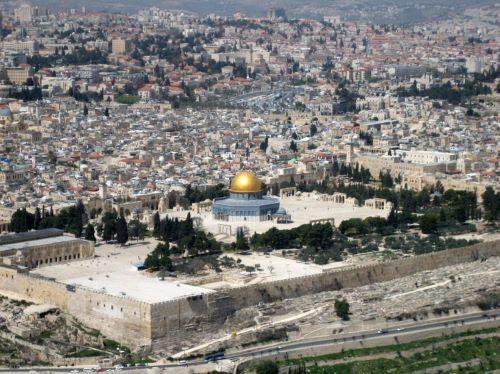
The Temple Mount where they had their headquarters had a mystique because it was above what was believed to be the ruins of the Temple of Solomon.[11] The Crusaders therefore referred to the Al-Aqsa Mosque as Solomon’s Temple, and from this location, the new order took the name of Poor Knights of Christ and the Temple of Solomon, or “Templar” knights.
History
Rise
After the Franks in the First Crusade captured Jerusalem from the Fatimid Caliphate in 1099, many Christians made pilgrimages to various sacred sites in the Holy Land. Although the city of Jerusalem was relatively secure under Christian control, the rest of Outremer was not. Bandits and marauding highwaymen preyed upon these Christian pilgrims, who were routinely slaughtered, sometimes by the hundreds, as they attempted to make the journey from the coastline at Jaffa through to the interior of the Holy Land.[12]
In 1119, the French knightHugues de Payens approached King Baldwin II of Jerusalem and Warmund, Patriarch of Jerusalem, and proposed creating a Catholic monasticreligious order for the protection of these pilgrims. King Baldwin and Patriarch Warmund agreed to the request, probably at the Council of Nablus in January 1120, and the king granted the Templars a headquarters in a wing of the royal palace on the Temple Mount in the captured Al-Aqsa Mosque.[13]
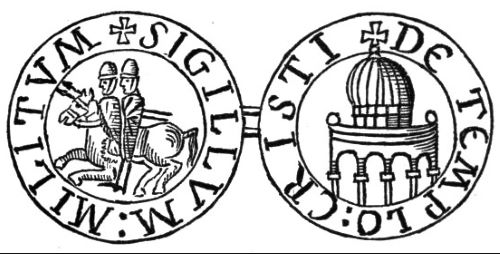
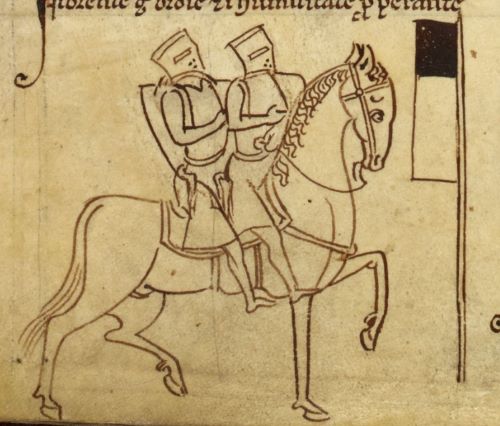
The order, with about nine knights including Godfrey de Saint-Omer and André de Montbard, had few financial resources and relied on donations to survive. Their emblem was of two knights riding on a single horse, emphasizing the order’s poverty.[14]
The impoverished status of the Templars did not last long. They had a powerful advocate in Saint Bernard of Clairvaux, a leading Church figure, the French abbot primarily responsible for the founding of the Cistercian Order of monks and a nephew of André de Montbard, one of the founding knights. Bernard put his weight behind them and wrote persuasively on their behalf in the letter “In Praise of the New Knighthood”,[15][16] and in 1129, at the Council of Troyes, he led a group of leading churchmen to officially approve and endorse the order on behalf of the church. With this formal blessing, the Templars became a favoured charity throughout Christendom, receiving money, land, businesses, and noble-born sons from families who were eager to help with the fight in the Holy Land. At the Council of Pisa in 1135, Pope Innocent II initiated the first papal monetary donation to the Order.[17] Another major benefit came in 1139, when Innocent II’s papal bull Omne Datum Optimum exempted the order from obedience to local laws. This ruling meant that the Templars could pass freely through all borders, were not required to pay any taxes and were exempt from all authority except that of the pope.[18]
With its clear mission and ample resources, the order grew rapidly. Templars were often the advance shock troops in key battles of the Crusades, as the heavily armoured knights on their warhorses would set out to charge at the enemy, ahead of the main army bodies, in an attempt to break opposition lines. One of their most famous victories was in 1177 during the Battle of Montgisard, where some 500 Templar knights helped several thousand infantry to defeat Saladin’s army of more than 26,000 soldiers.
“A Templar Knight is truly a fearless knight, and secure on every side, for his soul is protected by the armour of faith, just as his body is protected by the armour of steel. He is thus doubly armed, and need fear neither demons nor men.”
Bernard of Clairvaux, c. 1135, De Laude Novae Militae – In Praise of the New Knighthood[20]
Although the primary mission of the order was militaristic, relatively few members were combatants. The majority acted in support positions to assist the knights and manage the financial infrastructure. The Templar Order, though its members were sworn to individual poverty, was given control of wealth beyond direct donations. A nobleman who was interested in participating in the Crusades might place all his assets under Templar management while he was away. Accumulating wealth in this manner throughout Christendom and the Outremer, the order in 1150 began generating letters of credit for pilgrims journeying to the Holy Land: pilgrims deposited their valuables with a local Templar preceptory before embarking, received a document indicating the value of their deposit, then used that document upon arrival in the Holy Land to retrieve their funds in an amount of treasure of equal value. This innovative arrangement was an early form of banking and may have been the first formal system to support the use of cheques; it improved the safety of pilgrims by making them less attractive targets for thieves, and also contributed to the Templar finances.[21]
Based on this mix of donations and business dealing, the Templars established financial networks across the whole of Christendom. They acquired large tracts of land, both in Europe and the Middle East; they bought and managed farms and vineyards; they built massive stone cathedrals and castles; they were involved in manufacturing, import and export; they had their own fleet of ships; and at one point they even owned the entire island of Cyprus. The Order of the Knights Templar arguably qualifies as the world’s first multinational corporation.[22][23]
From the mid-12th century on, the Templars were forced (jointly with the Knights Hospitaller) to actively involve themselves in anti-Muslim military activities in the Iberian Peninsula. Prior to this time, human resources were exclusively dedicated towards the extraction of resources to send to the Latin East.[24] In the kingdoms of Castile and León, they obtained some major strongholds (such as Calatrava la Vieja or Coria), but the fragility of their positions along the border was exposed upon Almohad offensive.[25] In Aragon, the Templars seized the possessions of the Order of Mountjoy in the late 12th century, becoming an important vanguard force in the border, while in Portugal they were charged with operating some castles along the Tagus line.[26] One of these was Tomar, which was unsuccessfully sieged by the Almohad Caliphate in 1190.
Due to the economic drain caused by sending a third of their revenues to the East, Templar and Hospitaller activities in the Iberian Peninsula were nonetheless at a disadvantage with respect to the Hispanic military orders, which were able to entirely devote their resources to the region.[27]
Decline

In the mid-12th century, the tide began to turn in the Crusades. The Islamic world had become more united under effective leaders such as Saladin, and the reborn Sunni regime in Egypt. Dissension arose among Christian factions in and concerning the Holy Land. The Knights Templar were occasionally at odds with the two other Christian military orders, the Knights Hospitaller and the Teutonic Knights, and decades of internecine feuds weakened Christian positions, both politically and militarily. After the Templars were involved in several unsuccessful campaigns, including the pivotal Battle of Hattin, Jerusalem was recaptured by Muslim forces under Saladin in 1187. The Holy Roman Emperor Frederick II reclaimed the city for Christians in the Sixth Crusade of 1229, without Templar aid, but only held it for a little more than a decade. In 1244, the Ayyubid dynasty together with Khwarezmi mercenaries recaptured Jerusalem, and the city did not return to Western control until 1917 when, during World War I, the British captured it from the Ottoman Empire.[28]
The Templars were forced to relocate their headquarters to other cities in the north, such as the seaport of Acre, which they held for the next century. It was lost in 1291, followed by their last mainland strongholds, Tortosa (Tartus in present-day Syria) and Atlit (in present-day Israel). Their headquarters then moved to Limassol on the island of Cyprus,[29] and they also attempted to maintain a garrison on tiny Arwad Island, just off the coast from Tortosa. In 1300, there was some attempt to engage in coordinated military efforts with the Mongols[30] via a new invasion force at Arwad. In 1302 or 1303, however, the Templars lost the island to the Egyptian Mamluk Sultanate in the siege of Arwad. With the island gone, the Crusaders lost their last foothold in the Holy Land.[31]
With the order’s military mission now less important, support for the organization began to dwindle. The situation was complex, however, since during the two hundred years of their existence, the Templars had become a part of daily life throughout Christendom.[32] The organisation’s Templar Houses, hundreds of which were dotted throughout Europe and the Near East, gave them a widespread presence at the local level.[3] The Templars still managed many businesses, and many Europeans had daily contact with the Templar network, such as by working at a Templar farm or vineyard, or using the order as a bank in which to store personal valuables. The order was still not subject to local government, making it everywhere a “state within a state” – its standing army, although it no longer had a well-defined mission, could pass freely through all borders. This situation heightened tensions with some European nobility, especially as the Templars were indicating an interest in founding their own monastic state, just as the Teutonic Knights had done in Prussia and the Baltic and the Knights Hospitaller were doing in Rhodes.[33]
Arrest, Charges, and Dissolution

In 1305, the new Pope Clement V, based in Avignon, France, sent letters to both the Templar Grand Master Jacques de Molay and the Hospitaller Grand Master Fulk de Villaret to discuss the possibility of merging the two orders. Neither was amenable to the idea, but Pope Clement persisted, and in 1306 he invited both Grand Masters to France to discuss the matter. De Molay arrived first in early 1307, but de Villaret was delayed for several months. While waiting, De Molay and Clement discussed criminal charges that had been made two years earlier by an ousted Templar and were being discussed by King Philip IV of France and his ministers. It was generally agreed that the charges were false, but Clement sent King Philip a written request for assistance in the investigation. According to some historians, Philip, who was already deeply in debt to the Templars from his war against England, decided to seize upon the rumours for his own purposes. He began pressuring the church to take action against the order, as a way of freeing himself from his debts.[34]
At dawn on Friday, 13 October 1307 – a date, that helped influence the superstition, but not necessarily the origin, of the popular stories about Friday the 13th[36][37] – King Philip IV ordered de Molay and scores of other French Templars to be simultaneously arrested. The arrest warrant started with the words: “Dieu n’est pas content, nous avons des ennemis de la foi dans le Royaume” (“God is not pleased. We have enemies of the faith in the kingdom”).[38]
Claims were made that during Templar admissions ceremonies, recruits were forced to spit on the Cross, deny Christ, and engage in indecent kissing; brethren were also accused of worshipping idols, and the order was said to have encouraged homosexual practices.[39] Many of these allegations contain tropes that bear similarities to accusations made against other persecuted groups such as Jews, heretics, and accused witches.[40] These allegations, though, were highly politicised without any real evidence.[41] Still, the Templars were charged with numerous other offences such as financial corruption, fraud, and secrecy.[42] Many of the accused confessed to these charges under torture (even though the Templars denied being tortured in their written confessions), and their confessions, even though obtained under duress, caused a scandal in Paris. The prisoners were coerced to confess that they had spat on the Cross. One said: “Moi, Raymond de La Fère, 21 ans, reconnais que [j’ai] craché trois fois sur la Croix, mais de bouche et pas de cœur” (“I, Raymond de La Fère, 21 years old, admit that I have spat three times on the Cross, but only from my mouth and not from my heart”). The Templars were accused of idolatry and were charged with worshipping either a figure known as Baphomet or a mummified severed head they recovered, amongst other artefacts, at their original headquarters on the Temple Mount. Some have theorized that this head might have been believed to be that of John the Baptist, among other things.[43]
Relenting to King Phillip’s demands, Pope Clement then issued the papal bull Pastoralis praeeminentiae on 22 November 1307, which instructed all Christian monarchs in Europe to arrest all Templars and seize their assets.[44] Clement called for papal hearings to determine the Templars’ guilt or innocence, and once freed of the Inquisitors’ torture, many Templars recanted their confessions. Some had sufficient legal experience to defend themselves in the trials, but in 1310, having appointed the archbishop of Sens, Philippe de Marigny, to lead the investigation, Philip blocked this attempt, using the previously forced confessions to have dozens of Templars burned at the stake in Paris.[45][46][47]
With Philip threatening military action unless the pope complied with his wishes, Clement finally agreed to disband the order, citing the public scandal that had been generated by the confessions. At the Council of Vienne in 1312, he issued a series of papal bulls, including Vox in excelso, which officially dissolved the order, and Ad providam, which turned over most Templar assets to the Hospitallers.[48]
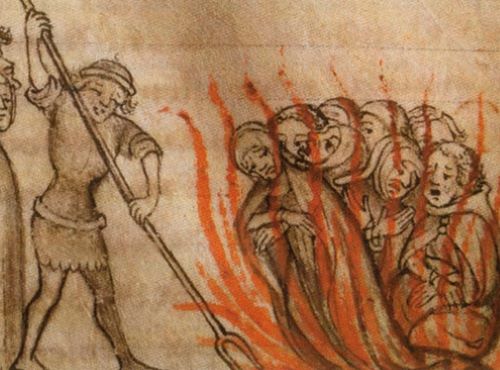
As for the leaders of the order, the elderly Grand Master Jacques de Molay, who had confessed under torture, retracted his confession. Geoffroi de Charney, Preceptor of Normandy, also retracted his confession and insisted on his innocence. Both men, under pressure from the king, were declared guilty of being relapsed heretics and sentenced to burn alive at the stake in Paris on 18 March 1314. De Molay reportedly remained defiant to the end, asking to be tied in such a way that he could face the Notre Dame Cathedral and hold his hands together in prayer.[49] According to legend, he called out from the flames that both Pope Clement and King Philip would soon meet him before God. His actual words were recorded on the parchment as follows: “Dieu sait qui a tort et a péché. Il va bientôt arriver malheur à ceux qui nous ont condamnés à mort” (“God knows who is wrong and has sinned. Soon a calamity will occur to those who have condemned us to death”).[38] Clement died only a month later, and Philip died while hunting within the same year.[50][51][52]
The remaining Templars around Europe were either arrested and tried under the Papal investigation (with virtually none convicted), absorbed into other Catholic military orders, or pensioned off and allowed to live out their days peacefully. By papal decree, the property of the Templars was transferred to the Knights Hospitaller except in the Kingdoms of Castile, Aragon, and Portugal. Portugal was the first country in Europe where they had settled, occurring only two or three years after the order’s foundation in Jerusalem and even having a presence during Portugal’s conception.[53]
The Portuguese king, Denis I, refused to pursue and persecute the former knights, as had occurred in some other states under the influence of Philip & the crown. Under his protection, Templar organizations simply changed their name, from “Knights Templar” to the reconstituted Order of Christ and also a parallel Supreme Order of Christ of the Holy See; both are considered successors to the Knights Templar.[54][55][56]
Chinon Parchment
In September 2001, a document known as the Chinon Parchment dated 17–20 August 1308 was discovered in the Vatican Archives by Barbara Frale, apparently after having been filed in the wrong place in 1628. It is a record of the trial of the Templars and shows that Clement absolved the Templars of all heresies in 1308 before formally disbanding the order in 1312, as did another Chinon Parchment dated 20 August 1308 addressed to Philip IV of France, also mentioning that all Templars that had confessed to heresy were “restored to the Sacraments and to the unity of the Church”. This other Chinon Parchment has been well known to historians,[57][58][59] having been published by Étienne Baluze in 1693[60] and by Pierre Dupuy in 1751.[61]
The current position of the Roman Catholic Church is that the medieval persecution of the Knights Templar was unjust, that nothing was inherently wrong with the order or its rule, and that Pope Clement was pressed into his actions by the magnitude of the public scandal and by the dominating influence of King Philip IV, who was Clement’s relative.[62]
Organization
Overview
The Templars were organized as a monastic order similar to Bernard’s Cistercian Order, which was considered the first effective international organization in Europe.[63] The organizational structure had a strong chain of authority. Each country with a major Templar presence (France, Poitou, Anjou, Jerusalem, England, Spain, Portugal, Italy, Tripoli, Antioch, Hungary, and Croatia)[64] had a Master of the Order for the Templars in that region.
All of them were subject to the Grand Master, appointed for life, who oversaw both the order’s military efforts in the East and their financial holdings in the West. The Grand Master exercised his authority via the visitors-general of the order, who were knights specially appointed by the Grand Master and convent of Jerusalem to visit the different provinces, correct malpractices, introduce new regulations, and resolve important disputes. The visitors-general had the power to remove knights from office and to suspend the Master of the province concerned.[65]
No precise numbers exist, but it is estimated that at the order’s peak, there were between 15,000 and 20,000 Templars, of whom about a tenth were actual knights.[2][3]
Three Main Ranks
There was a threefold division of the ranks of the Templars: the noble knights, the non-noble sergeants, and the chaplains. The Templars did not perform knighting ceremonies, so any knight wishing to become a Knight Templar had to be a knight already.[66] They were the most visible branch of the order, and wore the famous white mantles to symbolize their purity and chastity.[67] They were equipped as heavy cavalry, with three or four horses and one or two squires. Squires were generally not members of the order but were instead outsiders who were hired for a set period of time. Beneath the knights in the order and drawn from non-noble families were the sergeants.[68] They brought vital skills and trades from blacksmiths and builders, including administration of many of the order’s European properties. In the Crusader States, they fought alongside the knights as light cavalry with a single horse.[69] Several of the order’s most senior positions were reserved for sergeants, including the post of Commander of the Vault of Acre, who was the de facto Admiral of the Templar fleet. The sergeants wore black or brown. From 1139, chaplains constituted a third Templar class. They were ordained priests who cared for the Templars’ spiritual needs.[70] All three classes of brothers wore the order’s red cross.[71]
Grand Masters

Starting with founder Hugues de Payens, the order’s highest office was that of Grand Master, a position which was held for life, though considering the martial nature of the order, this could mean a very short tenure. All but two of the Grand Masters died in office, and several died during military campaigns. For example, during the Siege of Ascalon in 1153, Grand Master Bernard de Tremelay led a group of 40 Templars through a breach in the city walls. When the rest of the Crusader army did not follow, the Templars, including their Grand Master, were surrounded and beheaded.[72] Grand Master Gérard de Ridefort was beheaded by Saladin in 1189 at the Siege of Acre.
The Grand Master oversaw all of the operations of the order, including both the military operations in the Holy Land and Eastern Europe and the Templars’ financial and business dealings in Western Europe. Some Grand Masters also served as battlefield commanders, though this was not always wise: several blunders in de Ridefort’s combat leadership contributed to the devastating defeat at the Battle of Hattin. The last Grand Master was Jacques de Molay, burned at the stake in Paris in 1314 by order of King Philip IV.[47]
Conduct, Costume, and Beards

Bernard de Clairvaux and founder Hugues de Payens devised a specific code of conduct for the Templar Order, known to modern historians as the Latin Rule. Its 72 clauses laid down the details of the knights’ way of life, including the types of garments they were to wear and how many horses they could have. Knights were to take their meals in silence, eat meat no more than three times per week, and not have physical contact of any kind with women, even members of their own family. A Master of the Order was assigned “4 horses, and one chaplain-brother and one clerk with three horses, and one sergeant brother with two horses, and one gentleman valet to carry his shield and lance, with one horse”.[74] As the order grew, more guidelines were added, and the original list of 72 clauses was expanded to several hundred in its final form.[75][76]
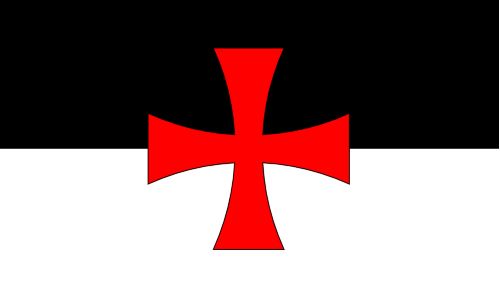
The knights wore a white surcoat with a red cross, and a white mantle also with a red cross; the sergeants wore a black tunic with a red cross on the front and a black or brown mantle.[77][78] The white mantle was assigned to the Templars at the Council of Troyes in 1129, and the cross was most probably added to their robes at the launch of the Second Crusade in 1147, when Pope Eugenius III, King Louis VII of France, and many other notables attended a meeting of the French Templars at their headquarters near Paris.[79][80][81] Under the Rule, the knights were to wear the white mantle at all times: they were even forbidden to eat or drink unless wearing it.[82]
The red cross that the Templars wore on their robes was a symbol of martyrdom, and to die in combat was considered a great honour that assured a place in heaven.[83] There was a cardinal rule that the warriors of the order should never surrender unless the Templar flag had fallen, and even then they were first to try to regroup with another of the Christian orders, such as that of the Hospitallers. Only after all flags had fallen were they allowed to leave the battlefield.[84] This uncompromising principle, along with their reputation for courage, excellent training, and heavy armament, made the Templars one of the most feared combat forces in medieval times.
Although not prescribed by the Templar Rule, it later became customary for members of the order to wear long and prominent beards. In about 1240, Alberic of Trois-Fontaines described the Templars as an “order of bearded brethren”; while during the interrogations by the papal commissioners in Paris in 1310–1311, out of nearly 230 knights and brothers questioned, 76 are described as wearing a beard, in some cases specified as being “in the style of the Templars”, and 133 are said to have shaved off their beards, either in renunciation of the order or because they had hoped to escape detection.[85][86]
Initiation,[87] known as Reception (receptio) into the order, was a profound commitment and involved a solemn ceremony. Outsiders were discouraged from attending the ceremony, which aroused the suspicions of medieval inquisitors during the later trials. New members had to willingly sign over all of their wealth and goods to the order and take vows of poverty, chastity, piety, and obedience.[88] Most brothers joined for life, although some were allowed to join for a set period. Sometimes a married man was allowed to join if he had his wife’s permission,[78] but he was not allowed to wear the white mantle.[89]
Legacy
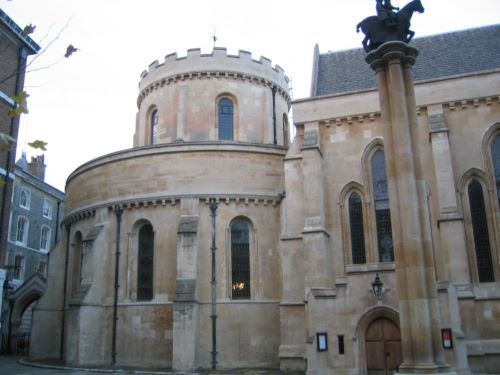
With their military mission and extensive financial resources, the Knights Templar funded a large number of building projects around Europe and the Holy Land. Many of these structures are still standing. Many sites also maintain the name “Temple” because of centuries-old association with the Templars.[90] For example, some of the Templars’ lands in London were later rented to lawyers, which led to the names of the Temple Bar gateway and the Temple Underground station. Two of the four Inns of Court which may call members to act as barristers are the Inner Temple and Middle Temple – the entire area known as Temple, London.[91]
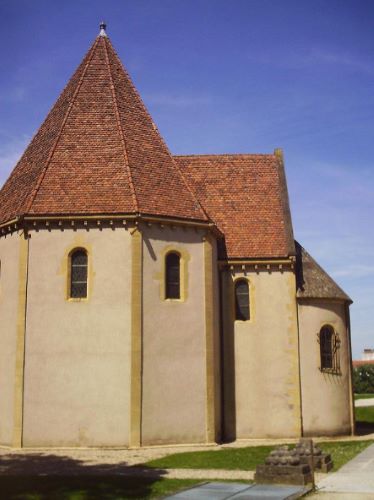
Distinctive architectural elements of Templar buildings include the use of the image of “two knights on a single horse”, representing the Knights’ poverty, and round buildings designed to resemble the Church of the Holy Sepulchre in Jerusalem.[92]
See endnotes and bibliography at source.
Originally published by Wikipedia, 09.28.2001, under a Creative Commons Attribution-ShareAlike 3.0 Unported license.
About the Author