What did sexual education look like for women in the Regency era?

By Dr. Alexandra Vasti
Writer and Educator
Perhaps the greatest side plot in Season 3 of Netflix’s Bridgerton involves the sexual education of the Featherington sisters. Overbearing mama Lady Portia Featherington (Polly Walker) is desperate for her married daughters to reproduce in order to secure an inheritance; in one of the show’s most hilarious and incisive scenes, Lady Featherington corners her daughters at a ball and demands an update on their progress toward an heir. Daughter Philippa (Harriet Cains) declares her marital congress frequent and regular, while Prudence (Bessie Carter) glumly reports that she does not enjoy carnal conversation with her husband.
Lady Featherington is undeterred and launches into a motherly tutorial on the sexual act, complete with evocative hand gestures. “A lady’s pleasure is more subtle than a man’s,” she begins. “You see, when he inserts himself—”
An astonished Philippa interrupts her mother’s explanation. “Inserts himself?” she demands. “Inserts himself where?”
To Lady Featherington’s deep dismay, Philippa reveals that her marital intimacies thus far have comprised kissing followed by her husband’s removal to change his breeches.
It’s a brilliantly played scene, from Philippa’s general aura of pleasant befuddlement to Lady Featherington’s long-suffering reply (“Why must I be punished over and over?”). But it also underscores one of the central conflicts of the Bridgerton series: the sexual education of women, the perils of sex and sexuality, and the interplay between sex and power for its 19th-century female characters. This dynamic has underscored works of fiction since the earliest English novels (e.g. Samuel Richardson’s 1740 Pamela) and continues to play a major role in historical romance novels of the 20th and 21st centuries.
What did sexual education look like for women in the Regency era? Would Philippa’s experience have been common or even plausible?
Questions like these inspired my first historical romance, Ne’er Duke Well, which debuted on the USA Today best-seller list in July 2024. The Regency-era protagonist of Ne’er Duke Well, Selina Ravenscroft, runs a circulating library with a secret catalog of books for ladies, including racy memoirs, erotic poetry, early feminist tracts, and works explicitly designed for sexual education.
I’m a longtime reader of historical romance, but I’m also a professor and literary historian. I put my experience as a researcher to use in first imagining and then stocking Selina’s radical library. In truth, it’s hard to say whether Philippa’s experience would have been likely in the early 19th century — sexual education for young upper-class women would most frequently have been elided from the historical record because it took place verbally, behind closed doors.
Yet we can infer from a variety of contemporary texts that Philippa’s total lack of knowledge in Bridgerton Season 3 probably wasn’t common. Popular Regency novels like Jane Austen’s Sense and Sensibility and Pride and Prejudice clearly assume a certain level of sexual knowledge amongst their readers. Both Elizas in Sense and Sensibility are seduced and live “a life of sin,” a term which the reader is expected to understand, particularly since Colonel Brandon is suspected of having fathered the younger Eliza. When Pride and Prejudice’s Lydia Bennett shacks up with George Wickham without any obvious plan to marry, her unwed sister Elizabeth is unsurprised: “How Lydia could ever have attached him [for marriage] had appeared incomprehensible. But … for such an attachment as this, she might have sufficient charm.” In other words, Lydia is perfectly appealing as an object of sexual desire, if not a plausible marital prospect. (Honestly, a devastating roast from her own family!) Jane Austen’s own letters suggest a clear awareness of sexual intimacy and its contours outside of the bonds of marriage. In a letter to her sister Cassandra, she remarks that she is relieved that she does “not have a congratulatory letter to write” to a cousin after her “misconduct” prior to her marriage — that is, the cousin is lucky she didn’t conceive!
Books explicitly designed for sexual education also existed in the period. One well-known work was the grandiosely titled Aristotle’s Masterpiece, first published in 1648 but regularly revised and reprinted throughout the 18th, 19th, and early 20th centuries. (No connection to the ancient Greek philosopher is supported by the historical record.) The manual includes descriptions and diagrams of sexual anatomy, including an explanation of the clitoris as crucial to female pleasure. Tableau de l’Amour Conjugal by Nicolas Venette was purportedly written by a medical doctor and, like Aristotle’s Masterpiece, was a central sexual education text for hundreds of years after its 17th-century publication. In 1826, frequently jailed British reformer and radical publisher Richard Carlile put out the first well-known sexual education tract specifically designed for women: Every Woman’s Book, or What Is Love? Every Woman’s Book includes extensive descriptions of contraceptive options, including how to access and employ them. These books were often sold alongside medical textbooks, but we know from newspapers and diaries that they were frequently read by laypeople as well. Though Aristotle’s Masterpiece and its later editions were often published anonymously, print runs were high and the book sold extremely well — even when the medical information therein was considerably out of date.
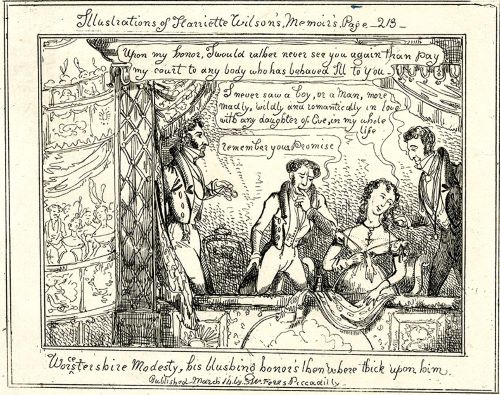
And of course, the historical record also gives us numerous books from the period written for titillation. Eighteenth-century erotic novels, often translated from the French, were enormously popular and provide a fascinating window into the sexuality of the period. Lesbian sexual encounters were common in fiction, even for otherwise heterosexual characters, such as the eponymous Fanny Hill, written by John Cleland in 1748. Works like the Harris’s Lists of Covent Garden Ladies, published annually in the second half of the 18th century, blur the lines between guidebook and erotica. These lists purport to describe all the sex workers in London, often in effusive and charming terms, along with their prices and favorite activities. One “inviting nymph” in 1788 is “of the middle stature, fine auburn hair, dark eyes, and very inviting countenance … In bed she is all the heart can wish, or eye admire, every limb is symmetry, every action under cover truly amorous.” The list helpfully informs us that this nymph’s fee “is two pounds two.” Sex worker memoirs were not uncommon; one particularly well-known work in this genre is The Memoirs of Harriette Wilson, Written by Herself (1825). Wilson’s lovers included numerous members of high society, including the Duke of Wellington, and her autobiography displays her ambition, intellect, and powerful style. “I will be the mere instrument of pleasure to no man,” she writes.
I knew when I first began the research for Ne’er Duke Well that I wanted it to be grounded in historical fact. All the books that I reference in Selina’s library are real 18th- and 19th-century texts. Yet one of the challenges of incorporating this historical reality into the novel involves confronting the contexts and biases of 21st-century readers. Philippa’s hilarious “Inserts himself where?” line of dialogue suggests a particular understanding of the historical past as prim, proper, and thoroughly desexualized; this ahistorical attitude can lead readers to push back against novels that portray a more complete version of Regency-era sexuality. Indeed, the suggestion of a lesbian storyline in a future Bridgerton season was decried as “historically inaccurate” by some show fans — evidently unaware of not only the proliferation of lesbian erotica in the period but also real-life Regency lesbians such as Anne Lister, who married Ann Walker in an unofficial church ceremony in York in 1834.
I’ve recently sent in my third historical romance novel to the publisher — a sapphic romance about a pair of Gothic novelists set to publish in fall 2025 — and I’ve found that my author’s notes at the end grow longer with each subsequent book. While a secret erotic circulating library for ladies did not exist in 1815 (as far as I know!), the notion that all women in the period lacked sexual knowledge and sexual agency is not supported by the historical record. It’s also suggestive of the many ways that women’s sexuality is suppressed and erased — a problem that is equally alive today in 2024 as it was in the 19th century.
When writing Ne’er Duke Well in 2021 and 2022, I found myself confronting the rise of bans on books that discuss gender identity and sexuality. Today, sexual education in public schools grows increasingly under threat in places like Florida, where new guidance has included ordering schools to remove contraceptive demonstrations from all grade levels. Twenty-first-century culture wars demonstrate that the restriction of sexual education under the guide of “protection” is not limited to the historical past. Yet the research that I did for Ne’er Duke Well also shows us that real people have fought and continue to fight for widespread access to safe and accurate information about sex and bodies. The historical record offers up a long history of writers and printers who promoted, encouraged, and reproduced sexual education texts — sometimes secretly, sometimes at great personal cost. Selina’s library is the fictional story of one such radical act. The historical record shows us the reality of many more.
Originally published by History News Network, 10.15.2024, under the terms of a Creative Commons Attribution 3.0 Unported license.
About the Author