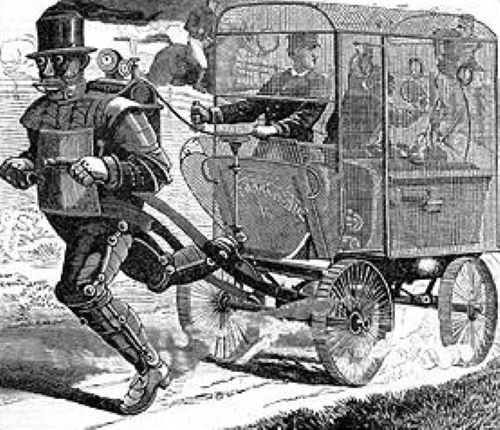
Both Dickens and Conan Doyle were able to create characters that allowed them to speculate on future photography.
Introduction
Like the internet, the inception of the photographic camera in the Victorian era offered new potential for technologically enhanced methods of criminal surveillance. Such potential finds its way into the literary world through the detective fiction genre (which also coincides with the development of the camera during the late 1800s).
The detectives in works like Inspector Bucket in Bleak House and Sherlock Holmes in “A Scandal in Bohemia” are often described as machine-like with superhuman abilities of deduction. In trying to understand how cameras fit into the world of policework, Charles Dickens and Sir Arthur Conan Doyle create cyborg-like characters, with both characters inadvertently depicting the faults of modern internet surveillance systems.
Sherlock Holmes
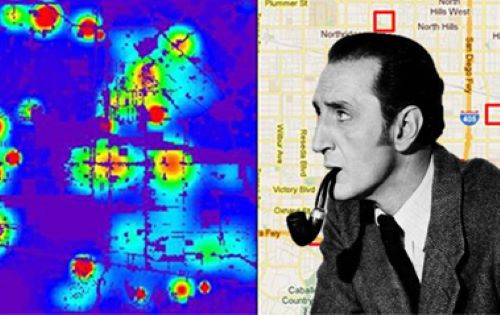
In “A Scandal in Bohemia” Sherlock Holmes takes on camera-like qualities. Based on an initial description by Watson, Holmes is like a machine, calculating and emotionally lacking. But this lack of humanity is perceived to be beneficial because it gives him the ability to be “the most perfect reasoning and observing machine that the world has seen” (3). Apparently, emotions could cloud his judgement and cast doubt on his results, so it’s better to be more camera than person in the business of mystery solving. Were he to have emotions, it would be like “Grit in a sensitive instrument, or a crack in one of his own high-power lenses” (3). Indeed, Holmes is continually compared to a tool or “instrument”. Distancing himself from his humanity ensures that his lens (his camera-like observational skills) remains unbiased.
Unfortunately for Holmes, his lens is already clouded. Despite all his “perfect reasoning” and excellent observational skills, Irene Adler manages to dupe him. Before Holmes met Adler, he “used to make merry over the cleverness of women, but I have not heard him do it of late” (15). Holmes often made assumptions about women and used those assumptions in his analyses. Considering the time frame, this is unsurprising. However, it is these gendered predictions about women’s intelligence that damages his results.
Moreover, his failure to get the photograph from Adler does not mean that he fails at maintaining his camera-like persona, rather he lives up to its flaws. Cameras do not always portray the truth. The images they produce can not only be staged and altered, but they can also be used to demonstrate patterns where they do not exist. For example, in the image below, mugshots of inmates are compiled to determine whether hereditary physical traits can indicate a tendency to commit crime (Sekula, 50).
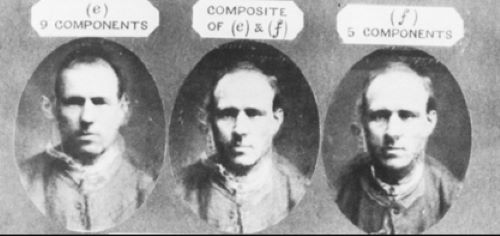
This line of tracking never stopped; it has only gotten worse with improved image AI tracking technology. “At every stage of the process – from policing, sentencing, and imprisonment to parole – automated risk assessments are employed to determine people’s likelihood of committing a crime” (Benjamin, 85-86). Just as prediction AI cannot accurately predict whether someone will commit a crime based solely on their looks, their class, or the place they live, Holmes acting as a camera cannot predict Adler’s movements based on assumptions about her gender.
Inspector Bucket
Like Holmes, Mr. Bucket is provided with a camera-like description; but he is more like an all-knowing spy camera than a photographic one. He is “attentive” and “sharpeyed” and seems to possess “an unlimited number of eyes” (459, 470). Most importantly, he looks at Mr. Snagsby “as if he were going to take his portrait” (459) Mr. Bucket’s gaze is akin to that of a focused camera. These characteristics are similar to Holmes, except Mr. Bucket has a haunting air about him. When Mr. Bucket steps out of the shadow in Mr. Tulkinghorn’s office, he startles Mr. Snagsby because he has a “ghostly manner of appearing” (459). Mr. Snagsby notes that the door did not creak open, nor were there any audible footsteps on the floor in the time that he entered. This is all to say that Mr. Bucket resembles a surveillance camera, purposefully hidden to catch moments of indiscretions.
But Mr. Bucket is not always in the shadows; he represents a more sinister type of surveillance technology, the kind that pretends to be your friend. In the case of Mr. Snagsby, Mr. Bucket appeals to his ego to find Jo, telling him that he is “a man of the world, you know, and a man of business, and a man of sense. That’s what YOU are” (460). These friendships only serve as a manipulation tactic to achieve a particular end for his employers’ benefit, not for justice. The investigation only became about seeking justice after his employer, Mr. Tulkinghorn, was murdered. Before then, Mr. Bucket’s function in the story was to contain Lady Dedlock’s secret so that Mr. Tulkinghorn could use it as Blackmail.
Mr. Buckets’ mysterious behavior and surveillance camera-like attributes reflect the same characteristics as current internet companies that sell their user data to third parties. Indeed, if Google were a person, it would probably seem a lot like Mr. Bucket. Until 2018, Google’s company motto was, “Don’t be Evil” (Montti). Like Mr. Bucket, the search engine portrays itself as genuine and authentic. However, the shadowy reality behind Google is that everything a user does on the search engine (including email) is surveilled and sold to advertisers, the police, and the government (Benjamin, 178). Like Mr. Bucket, Google renders itself an observational tool to whoever helps it gain a profit while also maintaining a charismatic façade to continue user data flow.
Tech and the Future
Both Dickens and Conan Doyle were able to create characters that allowed them to hypothetically speculate on the way photographic cameras would affect policing in the future. Conclusion? While the expectations are that integrating camera and person as one should create the perfect crime-solving cyborg, the creations fall short in both instances. This is because technology is never entirely removed from humanity. Technology is fundamentally a human creation, so it will continue to make mistakes and enforce systems of inequality already present in society. Nothing will change until the shortcomings of tech (personified by Holmes and Mr. Bucket over a hundred years ago!) are addressed.
Works Cited
- Benjamin, Ruha. Race after Technology: Abolitionist Tools for the New Jim Code. Polity Press, 2019.
- Dickens, Charles. Bleak House. Planet e-Book, 2020. https://www.planetebook.com/bleak-house/
- Doyle, Arthur Conan. “A Scandal in Bohemia.” Strand Magazine, July, 1891. E-version by Stanford Continuing Studies, 2016.
- Montti, Roger. Google’s “Don’t Be Evil” No Longer Prefaces Code of Conduct. 27 Oct. 2018, http://www.searchenginejournal.com/google-dont-be-evil/254019/.
- Sekula, Allan. “The Body and the Archive.” October, vol. 39, 1986, pp. 3–64. JSTOR, http://www.jstor.org/stable/778312.
Originally published by Victorian Visual Culture, Mount Holyoke College, 11.30.2020, to the public domain.
About the Author