By Carly Pippin
Communications Specialist
The Getty Foundation
Aziza Chaouni first visited the thermal baths of Sidi Harazem, Morocco, as a child with her grandmother. “I was initially a bit fearful of the imposing structures, yet I quickly became enthralled with the constructed waterfalls, floating stairs, and mysterious pyramid-covered rooftops. There is little doubt my appreciation for modern architecture is indebted to those defining encounters.” Several decades later, she has dedicated her career as a structural engineer and architect to conserving the site and involving the community every step of the way.
The site has a complicated legacy. When construction began in 1958 on the bath complex near Fez, Morocco, villagers whose ancestors had lived on the same land for generations were forcibly moved several miles away to accommodate the new tourist destination. “It’s a story of modernism we don’t tell often because the psychological trauma remains,” said Chaouni. However, the baths have also provided much-needed economic activity and jobs. To add even another layer, architect Jean-François Zevaco’s brutalist concrete structures have deteriorated over time, forcing closures.

With grant support through the Getty Foundation’s Keeping It Modern architectural conservation initiative, Chaouni has been working since 2017 to preserve the modernist oasis. “It was a choice from the beginning to let the villagers know that I wasn’t there to take things from them, but rather have a reciprocal relationship,” said Chaouni. “I wanted to connect with the community on a human level.”
To do this, Chaouni invited villagers to tea, interviewed people who’ve lived near the baths for decades, and developed collaborative design workshops—all so she could remind the townspeople that they are as much a part of Sidi Harazem’s past as they are its future. She even used board games, card games, and pictograms to involve the approximately 50% of villagers who never learned to read or write. “Talking to people helped us understand what parts of the complex to rehabilitate and when, and how we could integrate new activities into the site. It was a democratic exchange.”
Before Chaouni started her work, many of the town’s younger residents had never seen the shuttered portions of the bath complex. She guided them through Zevaco’s sculpted landscape, highlighting the details that once represented the most advanced architecture of its time. “It’s rewarding to see the local youth now speak very proudly about the concrete Vierendeel trusses, for them to know that the lines and patterns on the concrete are actually a result of Zevaco’s carefully designed formwork,” she said. “Even if I die tomorrow, at least I have passed down some of this knowledge.”
Architect, Activist, Citizen

On a dry August night in 2020, a fire ripped through the Sidi Harazem’s “informal market,” destroying dozens of outdoor stalls and storefronts that, for decades, had employed many locals. No one was hurt, yet every vendor stall burned to the ground, individuals who couldn’t access banks lost their money, and families saw their livelihoods vanish.
In response, Chaouni sprang into action. Phase 1 of her conservation plan had included the design of a new market to house the informal stall owners and peddlers. COVID-19 had delayed this part of the project, but Chaouni launched a fundraising campaign and petitioned the mayor to build temporary stalls that would reinvigorate the market. By July 2021, 68 new temporary stalls were ready to open.
“In a sense, I’ve become more of an activist,” she said. “Because of the Keeping It Modern stakeholder workshops we led, city leaders learned how important the market is to the community. Now, trust has been established.”
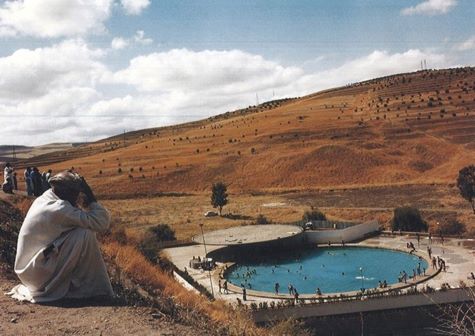
Chaouni has continued to fight to keep Sidi Harazem relevant during the pandemic. When tourism across the country drastically declined, she convinced the government and site managers to bring young Moroccan artists to Sidi Harazem for free residencies, supported by local volunteers and with financial contributions from Mr. Jennane, the Amina and Brahim Slaoui Foundation, and MAFODER. Eighteen sculptors, painters, videographers, and musicians descended onto the thermal baths, using its stark modernist forms and flowing waters to inspire their work. “I cried when Moroccan classical pianist Dina Bensaïd performed her original piece based off of Zevaco’s surroundings,” said Chaouni. “It brought life back to the place.”
The local community embraced Chaouni as a result of her efforts. “They want me to become their politician,” she joked, “but I’m just an architect who acts before all as a citizen.”

As a direct result of Chaouni’s advocacy, when Sidi Harazem reopens it will support the local economy through a covered farmer’s market, museum, and cooking school. Most importantly, the site’s owners, the Moroccan State Pension Fund CDG and the Region of Fez, have decided to fund the eventual rehabilitation of the entire thermal complex.
“When I started this project, I thought I was embarking on the technical conservation of the site,” said Chaouni. “But I soon realized that there were far more human aspects which had to happen first. Awakening people’s awareness towards architectural heritage must always come before a building’s rehabilitation, and when that happens, the rest follows.”
Originally published by The Iris, 07.27.2021, under a Creative Commons Attribution 4.0 International license.
About the Author