
The first law differentiating the rights within nobility was enacted by the national assembly, the diet of Wladislaus II, in 1498.


By Ádám Novák (left) and Balázs Antal Bacsa (right) / 10.22.2018
PhD Students of Political History
University of Debrecen
Abstract
One might perceive the Middle Ages as an era of certain rights and privileges.Social stratification or the conformation of a group’s identity were all established around privileges in the Kingdom of Hungary. In the medieval period, as opposed to a modern state, the most important constructors of a group’s identity were privileges. When members of a social group bear identical prerogatives, that group can be recognized as an order or estate. The ecclesiastic order existed side-by-side with the noble estate. In possession of political power were strictly those who were at the top of the strongly hierarchical system. However, in the Kingdom of Hungary, the significance of the ecclesiastical order was dwarfed by the importance of landed nobility. Some five percent of the population was of nobles, who also held political power. Until the end of the 15th century,the members of this stratum were equal in law. Only distinctions in financial situation can be noticed during the 14th and 15th centuries. The first law differentiating the rights within nobility was enacted by the national assembly, the diet of Wladislaus II (1490–1516), in 1498. Only from then on can we speak of gentry and aristocracy. This almost two-century-long process can be observed by examining a representational tool, the usage of red wax in seals. Upon studying medieval Hungarian history, we must use all sources available due to their rapid destruction, hence examining seal usage to explain aristocratic representation. In this paper, we briefly summarize the social structure of medieval Hungary and its traditions in seal usage, and present several unique seals. Our goal is to highlight some connections that historiography would benefit from, to provide new data, and to arouse the interest of a broad spectrum of audiences in Hungarian social history.
Introduction
Medieval societies were structured differently across Europe, and each had undergone a process of development that differed from the others. In Western Europe, vassalage was established, which placed the members of nobility below one another in a hierarchical order. This form of fiefdom did not develop in Hungary or in Central Europe. According to the law, all those who were privileged owed service solely to the king, and the landholding nobles possessed equal rights until the end of the 15th century.The 1222 Golden Bull, issued by Andrew II (1205–1235) (Zsoldos 2011), and its later empowerment in 1351 by Louis the Great (1342–1382) declares that nobles dispose of “one and the same liberty”(Schiller 1900, p. 19; See also (Engel 2001)). Only distinctions in financial situation can be noticed within the estate during the 14th and 15th centuries. Therefore, in modern literature, noble society is categorized primarily by land holdings. Historiography does not classify the landowner society as gentry, middling nobility, and peerage, but small, middle, and great landholders. The first law differentiating between noble rights was passed by the diet of Wladislaus II in 1498 (Engel 1968, p. 340).This roughly one and a half to two centuries can be illustrated by the usage of red wax in sealing.
It was the aforementioned Golden Bull of Andrew II that laid down the bases of Hungarian society of the late Middle Ages. Its Article XI granted several fundamental rights to the royal servientes (members of the libertas, who owed military service to the king), such as tax exemption,royal judgement, and freedom to inherit land tenures. In return, the king obliged them for the defense of the country. Only royal officials and high dignitaries with nationwide authority differed from the emerging coherent nobility. Furthermore, they only had different rights during the terms of their offices. The value of the pledge of a baro in high royal office was worth ten times more than the oath of a nobleman. In the 15th century, land size and offices were the bases of power, not ancestry(Engel 1977).
The Baronial Estate
High dignitaries with nationwide authority formed the royal council, namely the barones, together with the prelates. These can be divided into three groups. Possessors of executive power: the voivode of Transylvania, bans holding certain banatus districts (e.g., Slavonia), and most importantly the comites—or ispánok [Singular: ispán, comes, sheriff of a county],—for instance, the ispán/comes ofTemes/Temesch/Timis, Pozsony/Pressburg/Bratislava, and Máramaros/Marmarosch/Maramures, counties. Secondly, judicial officials, such as the Lord Palatine and the Judge Royal; and thirdly,another layer was composed of court officials, such as the Master of the Horse, Steward,and Cup-bearers (Engel 2001). The members of the council were the wealthiest landholders of the country, or at least they became wealthy due to their offices. Possession of one to three castles would count as a significant fortune. This could then be complemented with lands given from the royal lands as honor from the early 14th century, in the age of the Angevin dynasty (Engel 1982). Barons received castles in one or more counties as a form of payment for the duration of their office. Thus, all income from these lands was due to go to the holder during office. The king could, however, reclaim these at any time. In addition to their own properties, the honor lands granted military power to those in office.A so-called polysigillic diploma issued in 1358 can be seen below, validated by the most influential people of the royal council. These polysigillic diplomas can help us to define the composition of the council (see Figure 1). Significant financial differences could not have been formed amongst noblemen;the honor land was de facto property of the king, who possessed more than two thirds of the castles at the time.
For dignitaries in the 14th century, the title “magister” was given. However, it was not only the officials with nationwide authority who could bear this title, but lesser ones too, such as castellans. Nonetheless, this title was not inheritable, and neither was the honor. Seal usage in the 14th century was not widespread. Seals were only used by officials, and that is why it is hard to detect differentiation within nobility (Kumorovitz 1993). Barons stood out solely because of their wealth and military power. In the first part of the 14th century, the determinative baronial family of the north-eastern part of the country was the Druget family. Philip Druget came to the Hungarian Kingdom from Italy with Charles I of Anjou (1301–1342). He was a loyal follower of the king; thus, he became Palatine—the highest-ranking officer—and received most territories of the late oligarch, Amadeus Aba.He gained donations of perpetual land tenure, primarily in Northeastern Hungary—the counties of Szepes/Zipis/Spiš and Zemplén/Semplin/Zemplín. However, as royal honor, he fulfilled the role of the ispán in seven counties. He was the wealthiest nobleman at the time. He successfully devolved his power to his son William, who eventually also became Palatine until 1342 (Zsoldos 2017).
Two thirds of the royal castles fell into private hands following the death of Louis the Great in 1382. This, for the most part, is the result of the donation of the first fifteen years of Sigismund of Luxemburg’s (1387–1437) rule. We can see how the land structure changed in the North Eastern part of the country between 1382 and 1439. Old and new baronial families received castles as perpetual tenure.The wealthiest ones (Garai, Ilsvai, Bebek, Kanizsai, Perényi) possessed between five and fifteen castles. The Bebeks gained significant influence in the region. Then, they were followed by three branches of the Perényi, and later the Rozgonyi family (Engel 1995). This resulted in a sharp increase in financial differences. One single great landholder could have authority over several thousand villein families.In the Sigismund era, barons received the “magnificus” title, while their sons were titled “egregius”. Barons were able to hold their title perpetually, but their sons could not inherit it. Thus, a process had begun, which drove a wedge between noblemen (Fügedi 1970).

In 1408, Sigismund of Luxemburg, together with his second queen Borbála of Cilli, founded the Order of the Dragon. Beyond its ecclesiastic afflatus and detailed “sacrosanct goals”, the order, which set its target of protecting Christianity, served as a supporter of Sigismund’s power and meant to eliminate internal dissension (Mályusz 1984). Traditionally, being part of the order was of great prestige. Forty-two secular lords can be found amongst the founders of the order—the trustworthy supporters of Sigismund, who were to upkeep the internal peace and protect the country from external attacks. The symbol of the order, which depicts a dragon with its tail coiled around its neck,appears in several baronial coats of arms (Baranyai 1925), especially seen in the case of two crucial baronial families, the Bátori and Cilli (Bárány 2013).
The king extended this “monarchical club” in 1431. Several foreign noblemen and even kings became members.
The Perpetual Ispánság [Comitatus, Sheriffdom]

Let us now survey the origin of the title perpetual ispánság. The leaders of the counties, ispánok, comites, received their assignments from the king until withdrawal or up to their deaths.Consequently, the first perpetual ispánság were granted to institutions, not persons. Such institutions would be a bishopric or an archbishopric. The comes of Esztergom/Gran county was the Archbishop of Esztergom from 1270. (see Figure 2). Likewise, from the 15th century, the comes of Bihar/Bihor/Bihor countywas the bishop of Várad/Wardien/Oradea and the comes of Gy˝or/Raab county was the bishop of Gy˝or (Norbert 2011). Perpetual ispánságok [plural of ispánság] were connected to secular institutions as well. It was the task of the ban of Macsó/Maˇcva to organize the protection of the southern borderline along the Lower Danube. For this purpose, the ban of Macsó fulfilled the role of the comes in the Bács/Batsch/Baˇc, Bodrog, Baranya/Branau, Szerém/Syrmien/Srem, and Valkó/Wukowar/Vukovar counties from the 14th century. With this customary law, the expenses of the office were covered (Hajnik 1888).
Red Wax and the Development of Orders
The Usage of Red Wax
At first, the color of the wax used for seals to authorize diplomas was natural, that is, brown (Kumorovitz 1993). Red wax first appeared in the 13th century in royal seal usage (Takács 2012, p.150). This, along with minting, salt trade, and mining, was a royal monopoly (Szentpétery 1938).Prelates had the right to use red wax from the 14th century onwards. It was then that signet rings started to spread, which were now pressed into red wax. Charles I, Louis the Great, and Queen Mary of Hungary (1382–1395) consistently pressed their signet rings into red wax (Kumorovitz 1993). A seal made with the signet ring of King Louis is given below (see Figure 3).

The chivalric symbol of Louis, the ostrich holding a horseshoe in its beak, is in the field of th eseal. This emblem was the symbol of power and strength since, according to the legend of the era,ostriches even ate iron. In the field of the secret seal of Queen Mary, the coat of arms of the Angevinsis apparent: That is the fleur-de-lys, and the Árpád stripes (Kumorovitz 1937). Following the Anjouera, the seal of the national council became the symbol of governmental authority in the country for the time being, having no crowned monarch. The wax of that was always red. Historical researchers know of three such periods. The first was in 1386, after the assassination of Charles II (1385–1386),although the country had a crowned ruler, namely Queen Mary. Another was in 1401, during a rebellion against King Sigismund, and the third one was between 1446–1452, under the regency of John Hunyadi (Szentpétery 1902) (see Figure 4).

Red wax seals of foreign rulers from around the country appear on the diplomas kept in Hungarian archives; for example, the seal of the Serbian despot Đurađ Branković is one of these.
The red wax usage of the Serbian despot is not an isolated example in Central Europe. The fact that Polish rulers used red wax from the 14th century is well known. Furthermore, the Moldavian and Wallachian Voivode also pressed his seal in red wax in order to differentiate himself from other boyars. (Moldavian see: Archiwum Główne Akt Dawnych Zbior Doc. Perg. Nr. 5615.; Wallachian: Nr. 5329.)
The Earliest Secular Nobles to Use Red Wax
The first secular person to use red wax in the Hungarian Kingdom was Hermann, the count of Cillei/Cilli/Celjski. He was only licensed to use it due to his title as imperial count (Norbert 2011).Later, following his example, families with special rights started to use red wax in the Croatian Banate. The Korbáviai/counts of Krbava, the Frangepán/Frankopan, and the Zrínyi/Zrinski families were perpetual comites. The Kórógyi family was the first family of Hungarian origins to use the count title.During the Council of Constance, Philip Kórógyi concluded an inheritance contract with a distant relative, the count of Castell. From this point, they were allowed to use each other’s titles, and Philip frequently referred to himself as the count of Castell. Then, Sigismund granted him the right to use red wax (Neumann 2014).

Thus, by the mid-15th century, several noble families used red wax. The question arises whether this entailed only prestige, or some form of authority as well. To give an answer, we must examine a multisigillic diploma from 1440. The dignitaries gathered in Buda sent emissaries to Kraków, to the court of Władysław III of Poland. The officials present placed their seals on the charter, in descending hierarchical order, from left to right, as was customary at the time. Firstly, we can see the red wax seals of prelates. Ulrich of Cilli starts the line of the secular sealers, and the greatest secular official present, the Ban of Macsó/Maˇcva, only places his seal after them. Thus, Ulrich of Cilli outranked the high dignitaries of the kingdom as an imperial count. We can only see the seals of the Kórógyi andKorbáviai at the end of the line, as they were not in office. Red wax primarily served representational goals, and together with the perpetual comes title, it meant a certain rank. Still, authority did not come automatically with it (Novák 2018) (see Figure 5).
Changes during the Development of the Estate
However, the number of perpetual comes and count titles increased continually from the 1440s. Matkó/Matthias of Tallóc/Tallóci/Talovac and his family became the count of Cetina in 1442 (Mályusz 1980). Following the death of Władislaus I (1440–1444, Władysław III of Poland), John Hunyadi was elected to rule the country as a governor; he used red wax for his seals.After Ladislaus the Posthumous (1440–1457) returned to the country in 1453, Hunyadi was given the title Count of Beszterce/Bistritz/Bistrit,a; thus, he did not suffer any loss in prestige after his governorship ended (MNL OL DL 2009, 24 762.). An increasing number of landowners rose in rank to the level of barons. They were perpetual comites/ispánok or counts and were privileged to use red wax(see Figure 6).

This continual increase in the numbers of red wax users was particularly accelerated under the rule of Matthias Corvinus (1458–1490). This right was now granted to the free royal cities, having the privilege of being under the authority of the Lord Chief Treasurer only. Buda was the first city to receive the right to use red wax (Kubinyi 1961). Košice, Bardejov, Prešov, Bratislava, Trnava, Sopron, and Pest were also given this right, after Buda. The Szapolyai and the Bazini and Szentgyörgyi families, both being of supporters of Matthias, also rose to baronial rank. Their female relatives were licensed to use red wax as well. The widow of John Hunyadi, mother of the ruler, who was also a sister of governor Michael Szilágyi, was authorized to use red wax (see Figure 7).
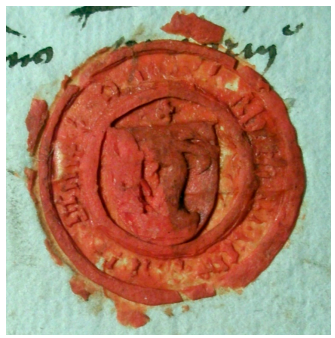
By 1490, a greater number of lords partook in the royal council than those who did not have such a title (Mályusz 1940). The representational value of using red wax had grown, almost as if it was anexpectation towards the members of the royal council. Above, we can see a diploma from the CityArchive of Košice, dated after the death of King Matthias. The patent was validated by the seals of Queen Beatrice of Aragon and the most significant officials. In addition to the prelates, John Corvinus, Stephen Bátori of Ecsed, Peter, and Matthias Geréb of Vingárd all used red wax. Only Paul Kinizsi continued to use green wax (see Figure 8).

The last stage of the forming of the aristocracy was Article XXII of 1498 (Dőry et al. 2010, pp. 102–103). The diet made a list of those families that were now obliged to raise troops and enlisted 37 lords.With this, they received the “magnate” title. From then onwards, lords were legally differentiated from common nobles. Until the Battle of Mohács (the end of the Middle Ages in Hungary, 1526), a greater and greater number of lords received the perpetual ispán title, which was now transmissible. Furthermore, they were also licensed to use red wax.
The last stage of the forming of the aristocracy was Article XXII of 1498 (Dőry et al. 2010, pp. 102–103). The diet made a list of those families that were now obliged to raise troops and enlisted 37 lords.With this, they received the “magnate” title. From then onwards, lords were legally differentiatedfrom common nobles. Until the Battle of Mohács (the end of the Middle Ages in Hungary, 1526), agreater and greater number of lords received the perpetual ispán title, which was now transmissible.Furthermore, they were also licensed to use red wax.
Conclusions
Let us now summarize what red wax symbolizes. In the first half of the 15th century, counts did not yet have greater authority than the rest of the nobles; however, the title raised the prestige of itsowner. The right to use red wax came with the title, and it was an important representational tool in a time of illiteracy. Thus, an even greater number of landholders endeavored to acquire it throughout the century. A gap opened and broadened between nobles and, at the turn of the century, nobility became legally differentiated. The application of red wax is the measure of this process, which can be spotted by examining seal usage. Stephen Werbőcz encapsulated the results of this process in his Tripartitum at the beginning of the 16th century. From then onwards, this jurisdictional code stood asa sample during the forthcoming centuries, up until the revolution in 1848. In our paper, we presented and supplemented a well-known process of social development by examining the usage of red wax. Clearly, Hungarian aristocracy strived to represent its power, the tool of which became the usage of red wax during the 15th century. We saw, through the example of Philip Kórógyi, that members of the Hungarian royal entourage came into contact with European nobility and realized the importance and tools of representation during their Western journeys, which were in connection with the Council of Constance, for the proliferation of armorial granting by the king, which can be linked to the synod (Nyulásziné 1981). Alongside the coats of arms, the usage of various titles became important as well. However, since these were not so refined and widespread in the Hungarian Kingdom as they were in Western Europe, those who were allowed tried to compensate by using red wax and the title perpetual comes. Thus, in addition to wealth generation, the usage of red wax became an important tool in representing authority.
References
- Novák, Ádám. 2018. Az 1440. januári királyválasztó országgy ˝ulés oklevelének meger˝osít˝oi. [Seals of thepoly-sigillic diploma from the diet of January 1440]. In Micae mediaevales VII.: Fiatal történészek dolgozataia középkori Magyarországról és Európáról. Edited by András Ribi Csaba Farkas and Kristóf György Veres.Budapest: ELTE BTK Történelemtudományi Doktori Iskola, pp. 121–38.
- Kubinyi, András. 1961. Buda város pecséthasználatának kialakulása. [The development of the seal usage Buda].Tanulmányok Budapest Múltjából 14: 109–46.
- Zsoldos, Attila. 2011. II. András Aranybullája. [The Golden Bull of Andrew II]. Történelmi Szemle 53: 1–38.
- Bárány, Attila. 2013. A fejedelmi lovagrendek hatása a magyar bárói társadalomban. [The effect of monarchicalchivalric orders on the Hungarian baronial society]. In A magyar arisztokrácia társadalmi sokszín ˝usége,változó értékek és életviszonyok. Edited by Klára Papp and Levente Püski. Debrecen: DE Történelmi Intézet,pp. 11–43.
- Zsoldos, Attila. 2017. A Druget-tartomány története 1315–1342. [The History of the Druget-Domain 1315–1342].Budapest: MTA BTK Történettudományi Intézet, (Magyar történeti emlékek. Értekezések).
- Baranyai, Béla. 1925. Zsigmond király un. Sárkány-rendje. [King Sigismund’s so-called Order of the Dragon].Századok 59–60: 561–591, 681–719.
- Kumorovitz, Lajos Bernát. 1937. A magyar királyi egyszer ˝u és titkospecsét használatának alakulása aközépkorban [The development of the usage of royal and secret royal seal of Hungarian kings in the MiddleAges]. In A Gróf Klebelsberg Kuno Magyar Történetkutató Intézet évkönyve VII. Edited by Gyula Miskolczy.Budapest-Pécs: Dunántúl Pécsi Egyetemi Könyvkiadó, pp. 96–112.
- Kumorovitz, Lajos Bernát. 1993. A magyar pecséthasználat története a középkorban. [Der Gebrauch von Siegeln inUngarn im Mittelalter]. Budapest: Magyar Nemzeti Múzeum.
- Schiller, Bódog. 1900. Az örökös f˝orendiség eredete Magyarországon. [The Origins of Perpetual Peerage in Hungary].
- Budapest: Kilián.D˝ory, Ferenc, Péter Banyó, Martyn Rady, and János M. Bak. 2010. The Laws of the Medieval Kingdom ofHungary. Decreta Regni Medievalis Hungariae IV. 1490–1526. Budapest: Department of Medieval Studies,Central European University.
- Mályusz, Elemér. 1940. A magyar társadalom a Hunyadiak korában. A h ˝ubériség és rendiség problémája.[Hungarian society in the Hunyadi-period. The problems of vassalage and the system of the estates andorders]. In Emlékkönyv Mátyás király születésének ötszázéves fordulójára. Edited by Imre Lukinich. Budapest:Franklin-Társulat, pp. 311–433.
- Mályusz, Elemér. 1980. A négy Tallóci-fivér. [The four Tallóci brothers]. Történelmi Szemle 23: 531–76.
- Mályusz, Elemér. 1984. Zsigmond király uralma Magyarországon. [The Reign of King Sigismund in Hungary].
- Budapest:Gondolat Kiadó.Fügedi, Erik. 1970. A 15. századi magyar arisztokrácia mobilitása. [The Mobility of the Hungarian Aristocracy in the 15thCentury]. Budapest: Magyar Országos Levéltár.
- Nyulásziné Straub, Éva. 1981. A Magyar Országos Levéltárban ˝orzött eredeti címereslevelek jegyzéke. [List of OriginalCoat of Arms-Charters Preserved in the Hungarian National Archives]. Budapest: Magyar Országos Levéltár.
- Hajnik, Imre. 1888. Az örökös f˝oispánság a magyar alkotmánytörténetben. [Perpetual chief sheriffdom inHungarian constitutional history]. In Értekezések a történelmi tudományok köréb˝ol. XIII/10. Budapest: MTA.
- Szentpétery, Imre. 1902. Hédervári Imre 1447-iki felment˝o levele. [Imre Héderváry’s letter of exemption from 1447]. Turul 20: 153–65.
- Szentpétery, Imre, Jr. 1938. A vörös viaszpecsét bizonyító ereje a középkorban. [The Certifying Power of redwax seals in the Middle Ages]. In Emlékkönyv Szentpétery Imre születése hatvanadik évfordulójának ünnepére.Edited by Tivadar Baráth, Gy˝oz˝o Ember and Miklós Kring. Budapest-Pécs: Dunántúl Pécsi EgyetemiKönyvkiadó, pp. 440–53.
- Takács, Imre. 2012. Az Árpád-házi királyok pecsétjei. [Royal Seals of the Árpád Dynasty]. Budapest: Magyar OrszágosLevéltár, (Corpus sigillorum hungariae mediaevalis 1.).
- Memoria Hungariae. 2015. Database of the MTA–DE “Hungary in the Medieval Europe” Lendület ResearchGroup. Available online: http://lendulet.memhung.unideb.hu:8080/momentum-web/Momentum_web.html (accessed on 19 October 2018).
- MNL OL DL. 2009. Magyar Nemzeti Levéltár Országos Levéltára Diplomatikai Levéltár. Available online:https://archives.hungaricana.hu/hu/charters/ (accessed on 19 October 2018).
- Norbert, C. Tóth. 2011. Az örökös ispánságok Zsigmond király korában. [Perpetual sheriffdoms in the Age ofKing Sigismund]. Történelmi Szemle 53: 467–77.
- Engel, Pál. 1968. A magyar világi nagybirtok megoszlása a XV. században 1–2. [The distribution of Hungarianaristocratic landed properties in the 15th century]. Az Egyetemi Könyvtár Évkönyvei 4: 337–57.
- Engel, Pál. 1977. Királyi hatalom és arisztokrácia viszonya a Zsigmond-korban (1387–1437). [The Relationship betweenRoyal Power and Aristocracy in the Reign of Sigismund]. Budapest: Akadémiai Kiadó.
- Engel, Pál. 1982. Honor, vár, ispánság (Tanulmányok az Anjou-kor kormányzati rendszerér˝ol). [Honor, castle,sheriffdom (Treatises on the governmental system of the Anjou-period]. Századok 116: 880–921.
- Engel, Pál. 1995. A magyarországi birtokszerkezet átalakulása a Zsigmond-korban (Öt északkeleti megye példája).[The transformation of the Hungarian landed possession system in the Sigismund-era (The example of fiveNortheastern counties)]. In Kelet és Nyugat között. Történeti tanulmányok Kristó Gyula tiszteletére. Edited byLászló Koszta. Szeged: Szegedi Középkorász M ˝uhely, pp. 141–59.
- Engel, Pál. 2001. The Realm of St. Stephen. In A History of Medieval Hungary 895–1526. Edited by Andrew C. Ayton.London and New York: I. B. Tauris.
- L˝ovei, Pál, and Imre Takács. 2014. Egy 1358. évi dubrovniki sokpecsétes oklevél pecsétjei. [The seals of apoly-sigillic diploma issued in Dubrovnik in 1358]. In Arcana tabularii. Tanulmányok Solmyosi László tiszteletéreI–II. Edited by Attila Bárány, Gábor Dreska and Kornél Szovák. Budapest–Deberecen: DE Történelmi Intézet,pp. 131–46.
- Neumann, Tibor. 2014. Találkozó Konstanzban (A Kórógyiak grófi címe). [Meeting in Konstanz (the title of theKórógyi Counts)]. Turul 87: 104–8.
Originally published by MDPI Genealogy under the terms of a Creative Commons Attribution 4.0 International license.
About the Author