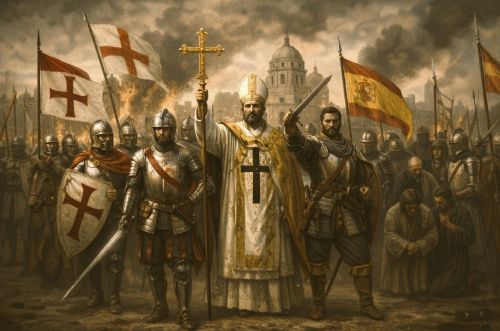
In sixteenth- and seventeenth-century Spain, the army enforced Catholic orthodoxy, revealing how confessional unity became inseparable from imperial power.

By Matthew A. McIntosh
Public Historian
Brewminate
Introduction: Confession and Crown after 1492
The year 1492 marked more than the fall of Granada and the symbolic completion of the Reconquista. It represented the beginning of a profound reorientation in the relationship between monarchy, religion, and power in Spain. With Muslim rule extinguished in Iberia, the Catholic Monarchs, Queen Isabella I of Castile and King Ferdinand II of Aragon, faced not an external frontier but an internal question: how should a newly consolidated realm define unity? Increasingly, unity came to be articulated not simply in territorial or dynastic terms but in religious ones. Catholicism was elevated from favored religion to foundational principle of political order.
The expulsion of Jews in 1492 and the mounting pressures placed upon Muslims to convert signaled a shift from coexistence to consolidation. Conversion did not resolve suspicion. Instead, it generated new categories of anxiety: conversos and Moriscos whose sincerity could be questioned and whose loyalties could be doubted. Religious identity became intertwined with political reliability. The state’s commitment to orthodoxy was not merely theological. It was strategic. In a Europe increasingly fractured by religious conflict, Spanish rulers framed confessional uniformity as safeguard against internal fracture and foreign infiltration.
This confessional consolidation unfolded within the broader development of early modern statecraft. The monarchy strengthened administrative mechanisms, expanded fiscal extraction, and increasingly coordinated governance across its composite realms. Royal councils professionalized decision-making, and bureaucratic offices multiplied in both Castile and Aragon. Parallel to these administrative developments was the refinement of a standing military capacity, most visibly embodied in the tercios that would become synonymous with Spanish martial reputation. The army remained formally subordinate to the crown and was not conceived as a religious fraternity. Yet the ideological environment in which it operated shifted decisively. As Catholic orthodoxy became inseparable from dynastic legitimacy, deviations from that orthodoxy assumed political significance. Military mobilization was no longer confined to frontier defense or foreign war. It became a means of disciplining internal unrest defined as religious threat. The presence of armed force behind royal decrees lent coercive weight to confessional policy. In moments of uprising or resistance, the army served as the instrument through which the crown’s theological commitments were translated into territorial control.
In sixteenth- and early seventeenth-century Spain, the army functioned not merely as defender of territory but as guardian of religious order. Military campaigns against Morisco uprisings, the policing of Protestant enclaves, and ultimately the expulsion of suspect populations reveal how religious identity operated as a test of political loyalty. In this framework, religious pluralism appeared not as manageable diversity but as latent instability. The Spanish case provides a powerful early modern example of how armed power can be mobilized to discipline belief within a centralized state, incorporating confessional orthodoxy into the very definition of national security.
From Reconquista to Confessional Consolidation
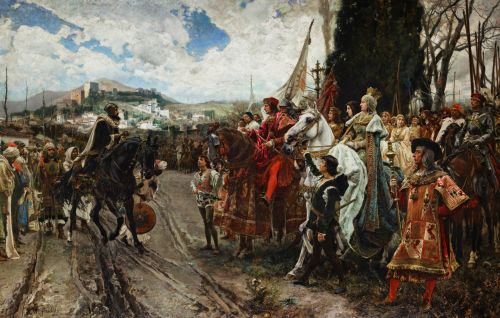
The completion of the Reconquista in 1492 did not inaugurate an era of relaxed pluralism but rather intensified efforts to define the religious character of the Spanish monarchy. The fall of Granada ended nearly eight centuries of Muslim political presence in Iberia, yet it also removed the unifying clarity of a frontier war against an external Islamic power. The crusading logic that had animated Iberian warfare for generations no longer had an obvious territorial outlet within the peninsula. With territorial conquest achieved, attention turned inward. The Catholic Monarchs faced the challenge of integrating diverse populations into a composite monarchy that spanned Castile, Aragon, and newly acquired territories across the Atlantic and Mediterranean. Religious difference, once managed through negotiated coexistence under Muslim and Christian regimes alike, increasingly appeared incompatible with the emerging vision of political unity. The language of triumph and purification that accompanied the fall of Granada fed expectations that the peninsula should now reflect the religious identity of its victorious rulers.
The Alhambra Decree of 1492, ordering the expulsion of practicing Jews who refused conversion, marked a watershed in this process. It reflected not only theological conviction but also a growing suspicion that religious minorities posed political risks. The presence of conversos, many of whom had converted in earlier waves of pressure or violence, generated anxiety about sincerity and hidden allegiance. The Spanish Inquisition, established in 1478 with papal authorization, operated as an institutional mechanism to investigate and discipline suspected heresy among baptized Christians. Although technically ecclesiastical, the Inquisition functioned within a framework closely aligned with royal authority. It embodied the fusion of religious scrutiny and political consolidation that characterized the period.
Muslims in the newly conquered Kingdom of Granada initially received guarantees of religious tolerance under the terms of capitulation. Those assurances proved fragile. By the early sixteenth century, pressures for conversion intensified, and by 1502 in Castile and later in Aragon, Muslims were compelled to accept baptism or face expulsion. The resulting Morisco population occupied a precarious position within Spanish society. Officially Christian, they remained culturally and linguistically distinct in many regions, especially in Valencia and Granada. Their ambiguous status fed narratives of disloyalty and potential collaboration with Ottoman or North African powers. Religious identity became entangled with geopolitical fear.
The broader European context reinforced this trajectory. The Protestant Reformation beginning in 1517 fractured Latin Christendom and heightened Spanish anxieties about doctrinal deviation. While Protestant communities within Spain remained relatively small, the specter of heresy carried disproportionate weight in royal and ecclesiastical discourse. Monarchs such as Charles I and Philip II portrayed themselves as defenders of Catholic orthodoxy not only abroad but within their own dominions. Spain’s entanglement in European conflicts, from the Italian Wars to struggles in the Low Countries, intensified the sense that religious fragmentation elsewhere could destabilize political order everywhere. The Council of Trent and the Catholic Reformation deepened confessional lines across Europe, encouraging rulers to pursue clarity and uniformity of belief within their territories. In Spain, this impulse aligned with an existing pattern of religious consolidation and reinforced the conviction that ambiguity of faith was a liability in an age of ideological war.
The Spanish crown increasingly conceptualized religious homogeneity as foundation of political stability. Confessional difference was interpreted not simply as spiritual error but as latent rebellion. The memory of the Granada frontier, the presence of Moriscos in strategically sensitive regions, and the expansion of Ottoman naval power in the Mediterranean all fed a narrative in which internal minorities could become conduits for external enemies. Royal discourse cast Catholic cohesion as shield against fragmentation. The boundary between religious dissent and political treason narrowed.
The movement from Reconquista to confessional consolidation reflects more than a sequence of isolated decrees. It reveals a transformation in political logic. Where medieval Iberia had tolerated forms of coexistence under structured hierarchy, early modern Spain increasingly pursued homogeneity. Institutional mechanisms such as the Inquisition and policies of forced conversion laid the groundwork for moments when military intervention would enforce what administrative and ecclesiastical measures could not secure. The consolidation of Catholic orthodoxy became central to the monarchy’s understanding of sovereignty, preparing the stage for the army’s later role as instrument of internal religious discipline.
The Military and the Alpujarras Revolt (1568–1571)
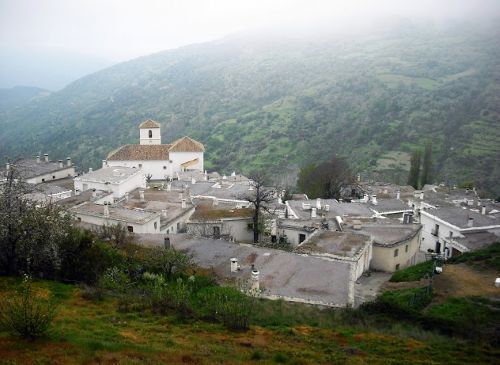
The uprising in the Alpujarras between 1568 and 1571 marked the most dramatic confrontation between the Spanish monarchy and its Morisco population. Tensions had simmered for decades following forced conversions, restrictions on language, dress, and customary practices, and sustained suspicion regarding the sincerity of Morisco Christianity. Royal edicts in the 1560s intensified enforcement of these measures, prohibiting the use of Arabic, banning traditional garments, and targeting communal customs that preserved distinct identity. In the mountainous region of Granada, where Morisco communities remained numerous, geographically concentrated, and socially interconnected, resentment coalesced into organized rebellion. The revolt was not a spontaneous eruption but the culmination of mounting pressure within a population that experienced confessional conformity as cultural erasure. Its outbreak revealed the limits of administrative coercion and the readiness of the crown to deploy armed force to secure religious uniformity when legal mandates and inquisitorial scrutiny proved insufficient.
Initial efforts to contain the uprising relied on local forces, but the scale and persistence of resistance quickly necessitated broader mobilization. Philip II authorized significant military intervention, eventually placing command in the hands of Don John of Austria. The campaign combined siege warfare, punitive raids, and systematic devastation of rebel strongholds. The rugged terrain of the Alpujarras complicated operations, yet the crown committed substantial resources to suppress what it framed not merely as regional disorder but as threat to religious and political unity. The army functioned as decisive instrument in translating royal confessional policy into coercive action.
The language surrounding the revolt underscores the conflation of religious deviation with political disloyalty. Morisco resistance was interpreted through the lens of suspected collusion with Ottoman or North African powers, heightening fears that internal dissent could align with external enemies at a moment when Spain was deeply engaged in Mediterranean rivalry. Reports circulated of potential Ottoman intervention, whether exaggerated or grounded in limited contacts, reinforcing the perception that the rebellion endangered not only regional stability but imperial security. Military repression carried symbolic as well as tactical meaning. It signaled that deviation from Catholic orthodoxy would not be tolerated as cultural diversity but would be treated as rebellion against the state. By casting insurgency as both heresy and sedition, royal authorities justified extraordinary measures and normalized the use of armed force to discipline belief. The campaign did not aim solely to defeat armed insurgents. It aimed to dismantle the social infrastructure that sustained distinct communal identity and to demonstrate that confessional ambiguity would be met with uncompromising authority.
The aftermath of suppression reveals the depth of this logic. Rather than restoring the Morisco population to their previous settlements, the crown implemented forced dispersal on a massive scale. Thousands were relocated from Granada to other regions of Castile in an effort to fragment communal cohesion, weaken local networks, and dilute the possibility of renewed collective action. Families were uprooted, property confiscated, and communities redistributed under close supervision. This policy required logistical coordination, military oversight, and sustained administrative vigilance, further entangling armed presence with confessional governance. Dispersal was not merely punitive. It was preventative, designed to reshape demographic realities in ways that would render future resistance more difficult. Armed force had secured victory on the battlefield. Demographic engineering sought to secure long-term compliance.
The Alpujarras Revolt illustrates how the Spanish army operated as guardian of orthodoxy within a confessional state. Military intervention was not incidental to religious policy. It was integral to its enforcement when persuasion and ecclesiastical discipline failed. By treating Morisco resistance as both heresy and treason, the monarchy collapsed the distinction between belief and loyalty. The suppression of the revolt reinforced a pattern in which armed power stood behind confessional consolidation, shaping the trajectory that would culminate decades later in the expulsion of the Moriscos from Spain altogether.
Protestant Threat and Internal Policing of Belief

Although Protestantism never gained a mass foothold in Spain comparable to its expansion in parts of Germany, the Low Countries, or England, its perceived presence exerted disproportionate influence on Spanish confessional policy. The emergence of Lutheran and later Calvinist doctrines in the early sixteenth century coincided with Spain’s ascent as a major European power. As Charles I and later Philip II confronted Protestant princes and rebellious provinces abroad, religious dissent assumed geopolitical dimensions. The possibility that heterodox ideas might penetrate Iberia carried implications that extended beyond theology. It threatened the ideological coherence upon which Habsburg authority increasingly rested.
Small circles influenced by Protestant thought did emerge in urban centers such as Seville and Valladolid in the mid-sixteenth century. These communities were composed largely of educated elites, clerics, and individuals with exposure to northern European intellectual currents, rather than broad popular movements. Their existence demonstrated that Spain was not insulated from the theological ferment reshaping the continent. The response was swift and highly public. Investigations culminated in spectacular autos de fe in 1559 and 1560, where alleged Lutherans were tried and punished before large audiences. These proceedings served not only as judicial events but as ritualized affirmations of orthodoxy. The number of adherents may have been limited, yet the crown and Inquisition treated them as harbingers of potential fragmentation. The symbolic significance of their prosecution lay in deterrence. Public condemnation reinforced the message that deviation, however minor or intellectual in character, would be interpreted as rupture within the body politic.
Military authority intersected with this environment in more indirect but significant ways. Spain’s engagement in wars against Protestant powers, particularly in the Low Countries and against England, reinforced the association between Catholic identity and political loyalty. Soldiers who fought under the banner of the Catholic Monarch were not merely defending territory. They were presented as defenders of the true faith against heretical challenge. This external framing reverberated internally. A state that waged war in the name of Catholic orthodoxy abroad could not tolerate visible dissent at home without undermining its own legitimacy.
The Spanish army’s role in internal policing did not typically mirror the dramatic suppression seen in the Alpujarras. Protestant communities within Spain were too limited to provoke large-scale armed revolt. Yet the presence of troops in strategic urban centers, the enforcement of royal decrees, and the maintenance of order during moments of inquisitorial prosecution reveal how coercive capacity underwrote confessional discipline. Garrisons stationed in key ports and cities symbolized the crown’s readiness to defend orthodoxy if unrest were to escalate. Military commanders cooperated with civil and ecclesiastical authorities in ensuring that decrees were implemented and disturbances contained. Even when swords were not drawn, the visible availability of force shaped the atmosphere in which dissent was assessed and punished. The boundary between ecclesiastical correction and political enforcement remained porous, with the army positioned as ultimate guarantor should persuasion and judicial measures falter.
Confessional uniformity operated as a loyalty test embedded within the logic of national security. Spain’s rulers confronted not only internal minorities but also the example of neighboring realms fractured by religious civil war. The French Wars of Religion and the Dutch Revolt offered cautionary models of what confessional division could produce. Spanish policy sought to preclude similar fragmentation by ensuring that belief and allegiance aligned. Suspicion of Protestant infiltration became intertwined with vigilance against sedition, espionage, and foreign subversion.
The Protestant threat within Spain may have been numerically small, but its conceptual impact was profound. It reinforced a pattern in which deviation from Catholic orthodoxy was interpreted through the lens of political danger rather than private conscience. Royal correspondence and administrative directives reveal persistent anxiety that heterodox belief could signal divided allegiance in an era of confessional geopolitics. Military power did not always operate as the visible instrument of repression in these cases, yet its structural presence shaped the environment in which confessional conformity was demanded. The army embodied the state’s capacity to enforce unity if internal tensions escalated into disorder. In this sense, even limited Protestant dissent contributed to the broader consolidation of a confessional regime in which belief and loyalty were treated as inseparable pillars of stability.
Army, Empire, and Catholic Identity

By the later sixteenth century, the Spanish monarchy presided over a vast and geographically dispersed empire that stretched from the Americas to the Low Countries and across the Mediterranean. The army, particularly the renowned tercios, became emblematic of Spanish power. Yet these forces did not operate within a purely secular ideological frame. Campaigns in Italy, the Netherlands, and against the Ottoman Empire were repeatedly articulated as defenses of Catholic Christendom. Military service was infused with religious symbolism, reinforcing the perception that Spain’s imperial expansion and confessional commitment were mutually sustaining projects.
The tercios cultivated a reputation for discipline, cohesion, and endurance that was closely tied to loyalty to crown and faith. Their organizational structure, blending pikemen, arquebusiers, and supporting units into flexible formations, contributed to battlefield success, but morale and identity were equally significant. Soldiers were not bound by monastic vows, yet Catholic ritual and symbolism permeated their environment. Chaplains accompanied units, Mass was celebrated before major engagements, and confessions were heard in anticipation of combat. Sacred banners and invocations of divine favor framed preparation and victory alike. Participation in campaigns against Protestant rebels in the Low Countries or Muslim forces in the Mediterranean reinforced the perception that Spain bore a providential responsibility to defend orthodoxy. This rhetoric strengthened cohesion by presenting war as morally intelligible and spiritually consequential. Strategic calculation and logistical planning remained central to operations, but the language through which campaigns were interpreted consistently linked military success to Catholic fidelity.
Empire further intensified the alignment of military authority and Catholic identity. In the Americas, conquest and colonization unfolded under royal patronage intertwined with missionary enterprise. Although ecclesiastical orders such as the Franciscans and Dominicans played leading roles in evangelization, the presence of armed force underwrote imperial authority and facilitated the extension of Christian institutions. The Spanish soldier operated within a framework in which loyalty to the crown entailed defense of a Catholic imperial order. Religious conformity was presented as stabilizing force within colonial governance as well as metropolitan policy.
The Dutch Revolt offers a particularly revealing example of this alignment. As rebellion in the Low Countries escalated in the later sixteenth century, Spanish forces were deployed to suppress what was framed not only as political insubordination but as Protestant heresy threatening the unity of Christendom. The Duke of Alba’s campaigns were accompanied by rhetoric that cast resistance as both rebellion against legitimate sovereign authority and defiance of Catholic truth. Military repression, including harsh disciplinary measures and public punishment of insurgents, was justified as necessary to restore order and defend the faith. The conflict’s longevity deepened the identification between Spanish arms and Catholic cause, even as it strained imperial finances and exposed limits of coercive power. The war in the Netherlands became emblematic of Spain’s broader struggle against Protestant expansion in Europe, reinforcing domestically the idea that the monarchy’s military efforts were inseparable from its confessional commitments. In this context, the army did not merely fight political enemies. It was perceived as engaged in a sustained defense of a religious civilization.
Through these imperial engagements, Catholic identity became inseparable from Spanish military prestige. Service in the army signified participation in a broader confessional struggle that extended beyond Iberia. Even as internal enforcement of orthodoxy continued within Spain, external campaigns reinforced the message that faith and loyalty were intertwined pillars of national identity. The army functioned not only as instrument of policy but as symbol of a monarchy that defined itself as champion of Catholic unity. In this synthesis of empire and confession, military power both projected and protected the religious framework upon which the Spanish state grounded its legitimacy.
Expulsion of the Moriscos (1609–1614): Final Act of Confessional Security
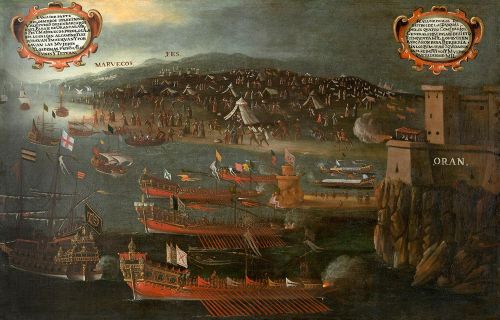
The decision to expel the Moriscos between 1609 and 1614 represented the culmination of decades of suspicion, repression, and coercive integration. Under King Philip III and the influence of his chief minister, the Duke of Lerma, the monarchy resolved that forced conversion and dispersal had failed to secure reliable conformity. Moriscos were officially baptized Christians, yet doubts about the sincerity of their faith persisted, particularly in regions such as Valencia where they formed significant portions of the rural population. Royal councils increasingly framed their continued presence as latent danger to the stability of the realm. Expulsion was presented not as religious persecution but as precautionary measure necessary to eliminate an internal vulnerability.
The operation required extensive logistical planning and direct coordination with military forces. Troops were deployed to supervise embarkation, prevent resistance, and ensure compliance in communities where removal disrupted economic and social life. Ports along the Mediterranean became sites of organized deportation, with armed oversight maintaining order during forced departure. The scale of the expulsion, affecting hundreds of thousands over several years, underscores that this was not symbolic gesture but systematic policy executed through the apparatus of the state. Military presence guaranteed that the decree would not remain aspirational rhetoric. It translated confessional decision into territorial reality.
The language of security dominated justification for the expulsion. Memories of the Alpujarras Revolt remained vivid, and fears of Ottoman incursions or collusion with North African corsairs continued to circulate in official discourse. The Moriscos were portrayed as unreliable subjects whose cultural distinctiveness rendered them susceptible to foreign influence and whose communal cohesion raised concerns about divided allegiance. Royal memoranda and advisory opinions framed the issue not in terms of individual guilt but collective vulnerability. Even in the absence of active rebellion, the persistence of a population perceived as internally different was construed as strategic liability. In this reasoning, religious difference and political threat became indistinguishable. The crown did not claim that all Moriscos were actively rebellious. It asserted that their collective existence constituted unacceptable risk in an age of confessional rivalry, Mediterranean warfare, and imperial competition. Uniformity appeared safer than ambiguity, and the eradication of perceived insecurity was prioritized over the complexities of coexistence.
The consequences were profound. Regions such as Valencia suffered demographic and economic disruption, as Moriscos had played central roles in agriculture and local economies. Yet the monarchy accepted these costs in pursuit of confessional clarity. The expulsion demonstrated that the Spanish state prioritized religious homogeneity over material stability when the two appeared in tension. Military enforcement of the decree confirmed the army’s function as instrument of internal consolidation as well as imperial projection. In removing the Moriscos, the crown enacted the final stage of a long trajectory in which Catholic orthodoxy became inseparable from political belonging, and armed force stood ready to secure that definition.
Conclusion: Armed Orthodoxy and the Confessional State
The trajectory of early modern Spain reveals how a centralized monarchy can mobilize armed force to secure religious conformity within its own borders. From the aftermath of 1492 through the expulsion of the Moriscos in the early seventeenth century, Catholic orthodoxy became intertwined with political legitimacy. Religious identity operated not as a private matter of conscience but as measure of civic trustworthiness. Where administrative edicts, inquisitorial scrutiny, and cultural pressure failed to produce conformity, military intervention supplied coercive reinforcement. The army functioned as guarantor of a political theology that equated unity of belief with stability of rule.
Unlike the militarized monasticism of the Teutonic Order, Spain’s model did not fuse religious and military authority institutionally at the level of vows or internal rule. The Spanish army remained a royal instrument rather than a religious fraternity. Yet its deployment reflected a confessional logic that permeated statecraft. Campaigns against Morisco rebellion, the suppression of Protestant enclaves, and the enforcement of expulsion decrees demonstrate how armed force translated religious preference into territorial reality. Faith served as loyalty test, and deviation from orthodoxy could be interpreted as incipient rebellion.
This alignment between Catholic identity and military authority also shaped Spain’s imperial posture in enduring ways. Engagements in the Mediterranean against Ottoman forces and in the Low Countries against Protestant rebels reinforced the narrative that Spain defended not only dynastic interests but the integrity of Christendom itself. Military victories were interpreted as signs of divine favor, while setbacks intensified anxieties about fidelity and resolve. External conflict and internal consolidation fed one another in a reciprocal dynamic. The perception of encirclement by Protestant and Ottoman powers sharpened suspicion toward religious minorities within the peninsula, especially those already marked by recent conversion or cultural distinctiveness. In this context, the army did more than project power abroad. It symbolized the crown’s determination to preserve Catholic unity at home. Military authority operated within a broader cultural and ideological framework that framed uniformity as shield against fragmentation and pluralism as pathway to instability. Armed orthodoxy became woven into the definition of national security and imperial identity alike.
The Spanish case demonstrates that confessional states can rely upon the army not merely for defense of borders but for discipline of belief. In early modern Spain, the preservation of Catholic unity was treated as existential necessity. Armed force ensured that royal decisions were enacted when persuasion faltered. The result was a political order in which religious conformity and civic belonging were inseparable. Spain’s experience stands as a powerful example of how military authority can serve as guardian of orthodoxy within a state that fears pluralism, revealing both the cohesion such alignment can produce and the tensions it inevitably generates.
Bibliography
- Amelang, James S. The Flight of Icarus: Artisan Autobiography in Early Modern Europe. Stanford: Stanford University Press, 1998.
- Dadson, Trevor J. Tolerance and Coexistence in Early Modern Spain: Old Christians and Moriscos in the Campo de Calatrava. Woodbridge: Boydell Press, 2014.
- Elliott, J. H. Empires of the Atlantic World: Britain and Spain in America, 1492–1830. New Haven: Yale University Press, 2006.
- —-. Imperial Spain, 1469–1716. London: Penguin, 2002.
- Harvey, L. P. Muslims in Spain, 1500–1614. Chicago: University of Chicago Press, 2005.
- Kamen, Henry. Spain, 1469–1714: A Society of Conflict. 3rd ed. London: Pearson, 2005.
- —-. The Spanish Inquisition: A Historical Revision. New Haven: Yale University Press, 1965.
- Meyerson, Mark D. The Muslims of Valencia in the Age of Fernando and Isabel. Berkeley: University of California Press, 1991.
- Parker, Geoffrey. The Army of Flanders and the Spanish Road, 1567–1659. Cambridge: Cambridge University Press, 1972.
- —-. The Grand Strategy of Philip II. New Haven: Yale University Press, 1998.
- —-. Philip II. Chicago: Open Court, 1978.
- Roche, Jonathan. “Elizabethan Catholic Intelligencers, Spain and the Armada of 1597.” History: The Journal of the Historical Association 108:381 (2023), 244-261.
- Sherer, Idan. “The Tratado de las campañas of Martin García Cerezeda: Military Life Writing and Self-Advancement in the Memoirs of a Sixteenth-Century Spanish Veteran.” Journal of Medieval Iberian Studies 17:1 (2025), 117-138.
Originally published by Brewminate, 02.27.2026, under the terms of a Creative Commons Attribution-NonCommercial-NoDerivatives 4.0 International license.
About the Author