A period of immigration from mainland Europe.

By Sonja Anderson
Daily Correspondent/Contributor
Smithsonian Magazine
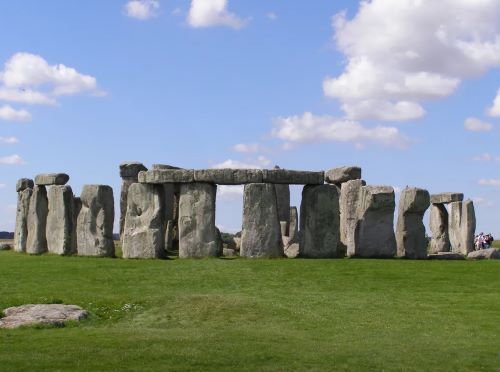
Around 5,000 years ago, prehistoric people in what is now southern England began constructing the circular formation of massive standing and stacked boulders now known as Stonehenge. The monument is composed of rocks transported from far and wide—impressive feats of shipping for its Neolithic builders.
Recent research suggests that Stonehenge’s 43 bluestones came from about 140 miles away in western Wales, while its larger sarsen stones originated 15 miles north of the site. The structure’s central, 13,200-pound Altar Stone, meanwhile, likely traveled not from Wales, but rather remote Scotland, more than 400 miles away.
Based on these findings, archaeologists have proposed a new theory about Stonehenge’s purpose. According to a forthcoming study in the journal Archaeology International, the circle might have been erected to unify Britain’s ancient inhabitants.
“The fact that all of [Stonehenge’s] stones originated from distant regions, making it unique among over 900 stone circles in Britain, suggests that the stone circle may have had a political as well as a religious purpose—as a monument of unification for the peoples of Britain, celebrating their eternal links with their ancestors and the cosmos,” says lead author Mike Parker Pearson, an archaeologist at University College London, in a statement.
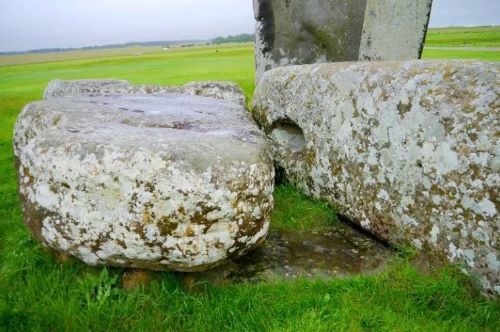
Stonehenge was built in phases. A 2015 analysis by Parker Pearson indicated that the bluestones were placed first, around 2900 B.C.E., followed by the sarsen stones around 2500 B.C.E. Stonehenge later went through a rebuilding phase, during which prehistoric people erected a large outer circle of sarsen stones and an inner horseshoe of trilithons (pairs of vertical stones capped by horizontal lintels). It was during this phase—sometime between roughly 2500 and 2020 B.C.E.—that the Altar Stone was placed within the monument’s central horseshoe.
Today, the Altar Stone lies flat and is partially hidden by a fallen rock. As Parker Pearson tells the Guardian’s Esther Addley, people have long assumed that it, too, once stood up straight but later fell down. But researchers know of multiple circular monuments in northeastern Scotland that were purposely laid flat. They posit that Stonehenge’s builders excavated the Altar Stone from a distant Scottish circle.
“Given what we now know about where it’s from, it seems all the more likely that it was deliberately set as a recumbent stone,” Parker Pearson says. It’s “highly likely” that the Altar Stone was once part of an older Scottish monument, he adds. “These stones are not just plucked out of anywhere.”
Stonehenge’s location, on the expansive plateau of Salisbury Plain, must have been important to both the immediate inhabitants of the region and people across Britain, Parker Pearson tells CNN’s Ashley Strickland. The plain was important enough that ancient peoples “brought massive monoliths across sometimes hundreds of miles to this one location.”
The stones’ distant origins have led Parker Pearson and his colleagues to believe that Stonehenge’s second phase of construction was meant to bring Britain together. The era was marked by the arrival of new immigrants from Europe—mainly the modern-day Netherlands and Germany. Stonehenge’s builders may have added to the Salisbury monument “to unite Indigenous Britons,” the statement says.
“There’s obviously some kind of interaction—you might call it ‘first contact’ [with immigrants],” Parker Pearson tells the Guardian. “That is the moment that Stonehenge is built, and I wonder if it is that moment of contact that serves, in whatever way, as the catalyst for this really impressive second stage of Stonehenge. It’s an attempt to assert unity, quite possibly integrating the newcomers—or not.”
Moving such large, heavy stones would have been an “extraordinary feat” in Neolithic Britain, the statement notes. Though the wheel was invented in Mesopotamia around the fifth millennium B.C.E., the technology hadn’t yet reached the British Isles. So, moving Stonehenge’s pieces would have “required the efforts of hundreds if not thousands of people,” making each act a show of unity in and of itself.
As for the Altar Stone’s exact origins, researchers have slightly narrowed the possibilities: This fall, they concluded that the stone is not from the Scottish archipelago of Orkney.
“It’s really gratifying that our geological investigations can contribute to the archaeological research and the unfolding story as our knowledge has been improving so dramatically in just the last few years,” says study co-author Richard Bevins, an archaeologist at Aberystwyth University in Wales, in the statement.
Since researchers began excavating and studying Stonehenge in the 17th century, the structure’s purpose has remained a mystery. Earlier scholars suggested the monument was a temple, a calendar or an observatory. Stonehenge is famously aligned with the sun and the moon, and modern crowds gather at the site on the solstices to celebrate the longest and shortest days of the year. The new research about the monument’s stones has widened its possible cultural significance.
“I think we’ve just not been looking at Stonehenge in the right way,” Parker Pearson tells the Guardian. As he says in the statement, “The similarities in architecture and material culture between the Stonehenge area and northern Scotland now make more sense. … These distant places had more in common than we might have once thought.”
Originally published by Smithsonian Magazine, 12.24.2024, reprinted with permission under a Creative Commons license for educational, non-commercial purposes.
About the Author