Her style, like everything Joan did, was a masterpiece.

By Dr. Emma Maggie Solberg
Associate Professor of English
Bowdoin College
There’s something you should know about Joan of Arc’s haircut. You might have an image in your mind’s eye of a Prince Valiant pageboy, or a cute pixie à la Jean Seberg. You have been misled. Reader, Joan wore a bowl cut. Haters have attempted to erase the memory of this bowl cut from our collective memory, but I am here to bring it back.
Joan fashioned this cut, and the complete look that went with it, with great intention. And this style, like everything Joan did, was a masterpiece.
Joan ran away from home in 1428 during the Hundred Years’ War (1337–1453) to become a warrior-saint and save France from the allied forces of the English and the Burgundians. On the way to meet the future king, Charles VII of France, and demand an army, Joan chose a hairstyle that the historical record describes as cut “in the round,” “above the ears,” “like a young man’s.” (We know all this because the Inquisition kept meticulous records of its many interrogations of Joan; Daniel Hobbins has published an accessible translation of the trial with Harvard University Press, which is the text I will be quoting throughout this essay.)
Joan donned a new outfit, too: a tight-fitting ensemble of doublet and hose with a short, knee-length robe; a close-cut hood; high-laced boots; long spurs; and a sword, dagger, lance, scabbard of red velvet and gold cloth; and all the accessories befitting a man-at-arms. Joan wore armor made of the shiniest polished steel and carried a self-designed battle-banner, white and fringed with silk, picturing sacred symbols of Joan’s invention — an image of the world flanked by angels, a field sown with fleurs-de-lis, and the names of Jesus and Mary. When Joan was asked by the inquisitors “which she preferred, the banner or the sword,” Joan chose silk over steel, as recorded in the transcripts of the trial: “she was much fonder, indeed 40 times fonder, of the banner than the sword.” Joan commanded fashion’s power to exert influence. This banner, the record shows, set a trend. It was copied by all the soldiers in Joan’s army, who believed in its miraculous power to bring victory. And it worked, at least for a while: Joan wore this look during the liberation of the besieged city of Orléans and the coronation of Charles VII.
Joan said that the haircut had been divinely ordained, and claimed to have heard the voices of angels. These angels told Joan to get a bowl cut, put on a doublet and hose, and save France. After being captured by the Burgundian and English forces in 1430 and put on trial for heresy by an ecclesiastical court, the Inquisition declared the hair, clothes, and armor a violation of scripture, the prohibitions of the Church, and the teachings of saints and doctors in theology and canon law. The Inquisition put it clearly: “She is apostate for cutting off her hair.” From the Inquisition’s perspective, only Satan could have inspired a peasant girl to dare wear the haircut of a prince. When the Inquisition demanded to know who was to blame for the makeover, Joan inisisted that “she has not taken clothing, nor has she done anything else, but by command of God and the angels.”
After months of imprisonment and interrogation, Joan finally broke and confessed to the Inquisition’s many accusations. Perhaps Joan could have lived this way — with a shaved skull in a dress of penance — for some time, maybe even until France won the war. But that’s not what happened. Joan “relapsed,” as the Inquisition had it, by putting men’s clothes back on. “Like a dog returning to its vomit,” the death sentence reads, “you fell into the same errors and crimes.” The reason behind this final and fatal relapse is not definitively known, and different readers have suggested different explanations to fill this gap in the record — lies, conspiracy, coercion, sexual violence, and, as persuasively argued in the recent and brilliant work of Kit Heyam, M.W. Bychowski, and Clovis Maillet, gender dysphoria. But, whatever the reason, Joan, only 19 years old, was burned at the stake.
For centuries after, Joan was remembered as a hero by some (Christine de Pisan and the city of Orléans) and as a villain by others (Shakespeare and Voltaire). By the time the Catholic Church canonized Joan as a saint in 1920, the Maid of Orléans had become a universally beloved symbol of war and peace, democracy and fascism, religion and secularism — anything and everything. Since then, Joan’s name and image have advertised the suffragist movement and the far-right politics of Marine le Pen, a line of canned beans and a rubberized winter boot. Through it all, however, the thing we have forgotten about Joan is the bowl.
Let’s focus in on that hair: cut “in the round,” “above the ears,” “like a young man’s.” Specifically, we’re talking about a high-fashion medieval combination of an undercut and a bowl. In 1929, the French historian Adrien Harmand contributed to his era’s raging mania for this newly canonized saint by publishing a meticulously researched study of Joan’s style, in which he included drawings of the outfits described in medieval records (complete with sewing patterns, in case you want to make your own robe of penance or medieval leggings), and detailed historical research on Joan’s haircut.
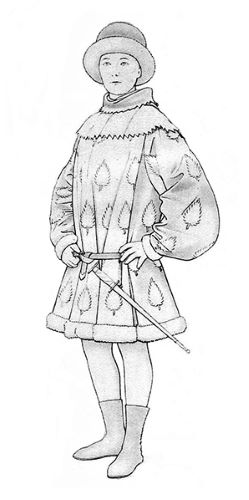
In his chapter on hair, Harmand demonstrates that Joan’s round cut above the ears was the early 15th-century French style sported by kings, princes, and dukes. The currency of this look becomes clear when looking at the contemporary calendrical illuminated manuscript of the Très Riches Heures du Duc de Berry, in which apparently every single attendee at a fancy New Year’s party — minus the tonsured men of the Church and the servants with their buzz-cuts —seems to be sporting a poofy little hair-hat. The bowl cuts match the gorgeous textiles; the radiant colors made from lapis, malachite, and cinnabar; and the huge and fantastic hats.
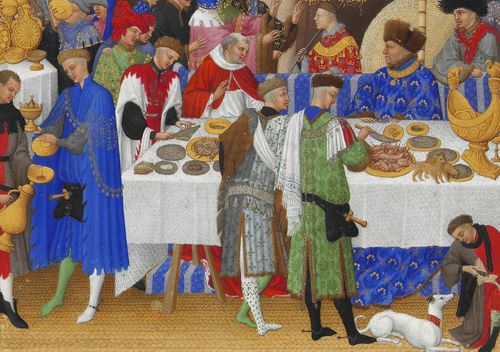
In the early 15th century, this cut served power. Joan was making a statement: I am a princely warrior-saint sent by God to save France, and I look incredible.
It must also be acknowledged that this specific cut has been out of fashion since 1455, after which point, Harmand notes, it became rare except among old men who “remained faithful to this fashion of their youth.”
To this day, the bowl cut remains, to put it diplomatically, controversial. The bowl cut in general, and specificially in its early-15th-century iteration, freaks people out, especially when shown on the head of Joan of Arc. Harmand collects quotations from other historians who knew the awful truth about Joan’s hair, and bewailed and insulted “the hideous skull cap,” as one put it. These writers applauded the artists throughout history who colluded in the pretense that this haircut never happened — not to Joan. As the French philosopher Marcel Hébert put it, no artist has dared.
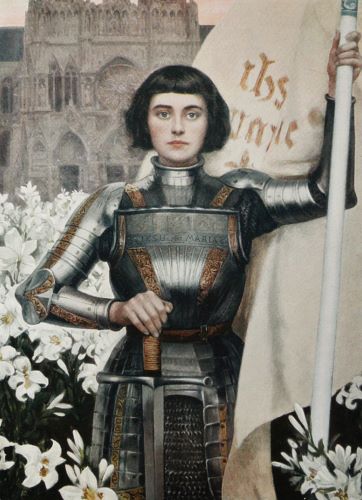
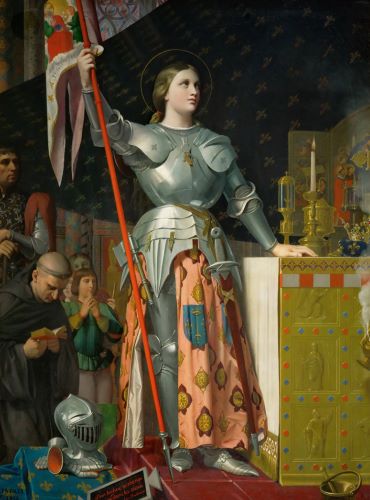
Although Joan only wore long hair until running away from home, the visual arts have tended to represent flowing locks throughout Joan’s entire life-story, from childhood to death by fire. Many of the most famous images choose to go with medieval-maiden hair. There are the very first portraits from the 15th century, all with long wavy tresses. Jean-Auguste-Dominique Ingres’ famous 1854 portrait, in which Joan wears a ponytail, is at the Louvre. The Pre-Raphaelite muses Jane Morris and Lizzie Siddal bestowed upon Joan their own thick manes in Dante Gabriel Rossetti’s 19th century paintings. In the beloved 1879 painting by Jules Bastien-Lepage, on view at the Metropolitan Museum of Art, Joan gazes into the beyond with heavy braids coiled at the nape. This revision of history has not yet gone out of style. To this day, Joan wears ponytails and big blow-outs in video and table-top games, as well as the sexy Halloween costumes for sale on Amazon, and in a 2018 episode of Drunk History, in which Joan is played by Vanessa Hudgens.
And yet while posterity may have repressed the exact image of the bowl cut, we have never completely forgotten that Joan insisted on wearing short hair. After all, the Inquisition made sure that the record of this crime would be remembered forever. At the turn of the 20th century, when the tide began to turn against Victorian braids and as Joan ascended toward canonization, those who wanted to take scissors to their hair looked to this new/old saint for inspiration.
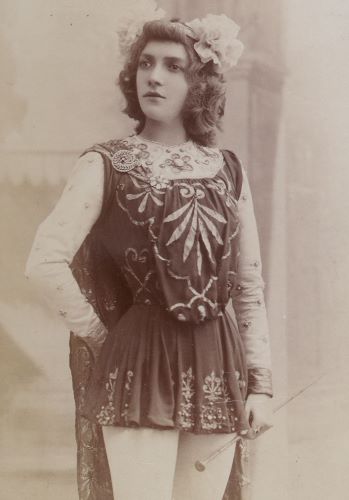
Antoine (born Antoni Cierplikowski), one of the most celebrated hairstylists of Paris in the early 20th century, tells the origin story of the bob in his wonderfully readable memoirs, Antoine by Antoine, published in English in 1947, and J’ai coiffé le monde entier! (I’ve Coiffed the Entire World!), published in French in 1953. The great French actress Ève Lavallière, he recounts, found herself in the difficult position of being cast as a teenager in a stage comedy. As the premiere approached, Ève called Antoine for help — she needed a new look for opening night. By chance, the little daughter of the concierge with the shortish pageboy cut often worn by children at the time came into the dressing room to hand-deliver a letter to Ève, who offered her a bon bon. Antoine was struck by the charming sight of their two faces reflected side by side in the mirror. He cut Ève’s hair in what we call a bob, but which he called the cut à la Jeanne d’Arc. “L’Ève androngyne était née,” Antoine recounts — Androgynous Ève was born. This cut made Ève’s age and gender indeterminate — it snipped the line between child and adult, man and woman. The day after the premiere, Antoine recounts, the salon was filled with clients begging for the Jeanne d’Arc.
A charming 1925 piece by Robert Dieudonné in the Paris newspaper L’Oeuvre reports on a Sunday sermon given by a local curate about how “men should have short hair and women long hair.” He happened to choose the Feast Day of Joan of Arc for his PSA, which led to some mixed messages. “The most brazen” of the young ladies in the congregation pointed “with an insolent finger” to the statue of Saint Joan, perhaps sculpted in the style of the one by François Rude in the city’s Luxembourg Gardens, in which Joan wears a cute crop. This was a fair point, and the curate could not possibly malign a saint. So, he pivoted, and turned to the evils of lipstick and eyeshadow. But the same brazen parishioner pointed at a statue of the Madonna wearing a blood-red lip and azure eyelids. At that point, the curate just gave up, defeated in his crusade against modern fashion by the impenetrable defense of Joan of Arc and the Virgin Mary.
By then, there were many fictional heroines who had chopped their hair short, including Louisa May Alcott’s Jo March in 1868, Colette’s Claudine in 1901, and Lucy Maud Montgomery’s Anne of Green Gables in 1908. In all three cases, the bob is framed as accidental, not intentional. Jo needs to raise money fast for her wounded father’s convalescence, Claudine irreparably mats her hair while recovering from a life-threatening illness, and Anne encounters a dodgy hair-dye in her quest for raven-black tresses and tries to get rid of the resulting off-green in a hurry.
Colette imitated her heroine by cutting her own hair short in 1902 (a move often represented as a publicity stunt orchestrated by her husband), which would seem to make her the first celebrity to take on the look. But there are also claims for the actress Carythis, who allegedly in 1913 cut off her braid and nailed it to the door of a man “whom she had failed to arouse” (as the historian Mary Lou Roberts reports), and Coco Chanel, who, according to legend, in 1916 or 1917 accidentally burned her hair off while getting ready for the opera and decided to just go with it, thereby causing a sensation.
These origin-myths abound — and, in each case, they narrate the fantasy of an enchanting, titillating, binary-violating haircut that happens to a Nice Girl completely by chance, not of her own volition. In this preference for reaction rather than action, these stories recall the old explanations given by historians that interpret Joan’s haircut as a necessary defense of virginity rather than a God-given inspiration.
In any case, the bob soon conquered the world, and its many variations adorned the heads of sex symbols like Josephine Baker, Louise Brooks, and Betty Boop.
Harmand concludes that the bowl cut definitively explains how Joan could have been beautiful (which he assumes Joan had to have been) but also virginal, because no suitor would have come anywhere near this Joan’s hirsute monstrosity. He writes approvingly that Joan “abdicated all feminine coquetry” with this chastity-preserving haircut. Here, Harmand tries his best to put a positive spin on his bad news: it turns out that Joan’s hair looked nothing like the sexy bobs of his own day and age. Antoine’s cut à la Jeanne d’Arc was, he asserts, anachronistic, something new posing as something old. Here was an explanation that preserved Joan’s beauty and virginity: Joan had the ugly haircut of a true saint.
Our memory of Joan’s hair changes with the times. In the ’90s, when the bowl cut was in, Milla Jovovich’s Joan in Luc Besson’s 1999 film The Messenger: The Story of Joan of Arc chopped off her hair with a sword in a fit of rage, arriving at a shaggy sort-of-bowl reminiscent of Hilary Swank’s trans martyr Brandon Teena in Boys Don’t Cry, which came out the same year. In Boys Don’t Cry, Hilary/Brandon’s bowl cut is much closer to the 15th-century skullcap-bob, while Milla’s compromises on the severity of the straight line that divides the sharp contrast between close-shaved skin and round bowl, preferring instead softening curves, layers, fades, and highlights. In The Messenger, Milla stands surrounded by male extras wearing bowl cuts straight out of a 15th-century illuminated manuscript, but her hair lands somewhere between the Middle Ages and the Rachel.
In the 21st century, the bob has come back to Joan. First, it was the angular Louise Brooks look — this is how Katy Perry wore her hair in the 2017 video for “Hey, Hey, Hey,” (in which Katy/Joan avenges the beheaded Katy/Marie Antoinette), and Zendaya wore hers at the “Heavenly Bodies: Fashion and the Catholic Imagination” Met Gala in 2018 (at which there were at least four Joans, all in shiny silver and with bangs). In more recent years, nonbinary Joans have worn the bob without the sharp angles. In the music video for Madonna’s 2019 “Dark Ballet,” Mykki Blanco wears an artfully tousled bob that serves both sacred martyrdom and high glamour. In the production of I, Joan that recently played at Shakespeare’s Globe in London, Isobel Thom, like Milla before them, hacked off their hair with a sword, resulting in an uneven chop. An appropriate look for the pandemic, which necessitated so many homemade haircuts, but very different from Joan’s 15th-century, super-precise skullcap.
There has still never been a performer who has played Joan of Arc wearing the precise bowl cut described by the medieval record. At the 2024 Summer Olympics, the composite figure of Jeanne d’Arc and Sequana, the goddess of the Seine, wore a hood that completely eliminated the need to decide what Joan’s hair would have looked like then, or should look like now. We’re still not ready, probably because the bowl cut hasn’t lost any of its remarkable capacity to upset those who feel the need to see Joan as a nice girl and pretty lady.
But there may be another subtler, and sillier, impediment. Some of us may be guilty of a deep-seated anti-bowl cut prejudice. That prejudice derives, at least in part, I think, from the low-level trauma of getting a non-consenual bowl cut back in middle school. Whether personally experienced, witnessed as a spectator, or merely received as a tale of horror by way of oral tradition, this humiliation is not soon forgotten. It seems to permanently scar the mind. Hence the preeminence of getting a bowl cut (“No, Mom! Noooooo!”) in the first act of the pilot episode of PEN15, Hulu’s reliquary of half-repressed adolescent memories.
But Joan’s bowl cut is not our bowl cut. Our bowl cut is all about thrift. “Waste of hair-cut money,” says the mother of Maya, the PEN15 character getting the dreaded look. The Pyrex bowl is right there in her kitchen and provides an easy method of scissoring a straight line. A seventh grader is in the unhappy liminal position of feeling too old to be groomed by mommy, but also too young to make an appointment, get to and from the salon, and pay for services rendered. The mother, motivated by pragmatism, chooses infantilization. She’s doing the best she can, but the result is, well, instant social death. (Maya immediately becomes UGIS, the Ugliest Girl in School.)
Joan’s short hair signified the end of childhood and the freedom won by running away from home to start a newly self-determined life. The gesture of imitating Joan by cutting off long hair has been and remains liberatory rather than regressive. Joan’s haircut is unthrifty and impractical. According to Ryo Murakawa, the stylist who did Timothet Chalamet’s medieval bowl cut for Netflix’s The King (2019: the year of the “hot bowl-cut summer”), this look requires 15-minute upkeep sessions twice a week.
Baz Luhrmann, it turns out, is making a Joan movie. We have another chance to make things right. Let’s not let our big feelings about the bowl cut motivate our collusion in the erasure of Joan’s aesthetic choices. Let’s breathe, reflect, and rise above it. Let’s do it for Joan.
Originally published by History News Network, 10.01.2024, republished with permission for educational, non-commercial purposes.
About the Author