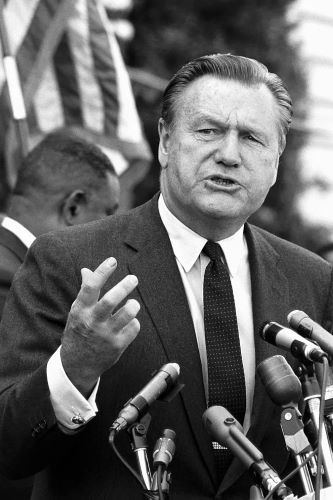
1964 helped set the party on the path to becoming openly fascist.

By Dr. Marsha E. Barrett
Assistant Professor of Political Science
University of Illinois Urbana-Champaign
As Republicans arrived in Milwaukee to nominate Donald Trump, the convention comes on the 60th anniversary of an important warning from New York Governor Nelson Rockefeller at the party’s 1964 gathering in San Francisco: “There is no place in this Republican Party for those who would infiltrate its ranks, distort its aims, and convert it into a cloak of apparent respectability for a dangerous extremism.”
Republican convention goers in 1964 — including many new activists on the right who had earned coveted delegate spots by working around the party’s moderate leadership and winning support at the grassroots — were there to nominate the conservative Arizona Senator Barry Goldwater. They responded to Rockefeller’s remark by booing, jeering, and hurling invective at the high-profile moderate Republican governor.
Meanwhile, moderates worried — with good cause, as it turned out — that it was not electorally prudent to nominate a conservative like Goldwater. Conservatism had been outside of the mainstream of presidential politics since Herbert Hoover’s failed presidency and they correctly foresaw an electoral disaster with Goldwater at the top of the ticket. But Rockefeller’s warning demonstrated more than mere electoral concerns. In the early 1960s, he had become alarmed by the gravitation of extreme groups like the Ku Klux Klan and the John Birch Society — who rejected efforts to make the U.S. a multiracial society — toward the GOP.
Rockefeller’s speech has been mythologized in an era where conventions have become little more than infomercials. It’s known as a dramatic display of party disunity, and as moderates’ prescient, but unheeded, warning to their party. That narrative, however, obscures a more complicated history of moderate and mainstream conservative silence and complicity in Republican Party politics that continues to shape the GOP to this day.
About the Author