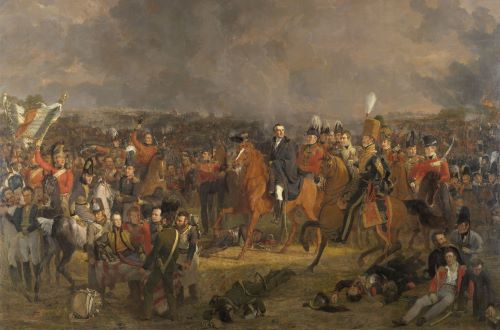
The history of the Battle of Waterloo, as well as the biographies of the two powerful adversaries who met on that battlefield, were engulfed in controversy in the years following the conflict.

By Dr. Frederick Burwick
Late Professor of English
University of California Los Angeles
Introduction
Although Europe had celebrated the end of the Napoleonic Wars with the defeat of the French armies and the abdication of the emperor on 11 April 1814, Napoleon escaped and again rallied his troops against the British and Prussian armies. His defeat at Waterloo on 18 June 1815 was the final battle with heavy losses on all sides. The extensive response in the British press was unprecedented. In addition to several military reports of the battle, many civilian eye-witness narratives also appeared. Memoirs, histories, and biographies added to the prose accounts. With contributions from Lord Byron, Sir Walter Scott, Robert Southey, William Wordsworth, and many minor authors, the poetry included both celebrations of the victory and lamentations over the loss of lives. Theatres, too, brought forth numerous spectacles and melodrama. Londoners were also treated to several exhibitions and panorama displaying scenes from the battle (Favret 8-12).
Following the defeat of his armies in March 1814, Napoleon abdicated and was banished to Elba on 11 April. Ten months later, on 26 February 1815, he escaped the island, returned to France, and quickly reassembled an army of 300,000, which he led into Belgium, gaining victory over the Prussians at the Battle of Ligny on 15 June. Simultaneously, he confronted the British at the Battle of Quatre Bras. Napoleon’s strategy was to keep the British and Prussian forces from combining, but instead he found his forces caught between their pincers at Waterloo on 18 June 1815. By the war’s end, the French losses totalled 33,000 casualties, while British and Prussian casualties were estimated at 22,000. Four days later, Napoleon was forced to abdicate a second time. He was banished to the island of Saint Helena, whence escape was impossible. The British press responded with hundreds of publications on the Battle of Waterloo.
Whether celebrating the victory or lamenting the loss of many lives, the response was politically charged and factionally divided. Napoleon’s early reputation as a liberator from monarchical oppression had been undermined by his ambitions as emperor, his tyrannical policies, and his endeavour to achieve pan-European domination. He nevertheless still garnered respect for his former opposition to absolutism. The factional division was evident in the efforts to justify Napoleon’s actions, often in terms of praiseworthy motives that had been corrupted by power. The conservative-liberal divide could also be seen in the extent to which Wellington’s faults were delineated, or Gebhard Leberecht von Blücher was blamed for his overzealous pursuit of the vanquished French soldiers, or the monarchical states were charged with having provoked and sustained the Napoleonic Wars. Rather than prosperity, the defeat of Napoleon brought economic recession. Low wages aggravated the condition of the labouring class. Because of his conservative convictions, the Duke of Wellington’s victory reaped diminishing praise, even as the clamour for reform was growing more insistent. The anti-Wellington fervour was at its peak during his years as Prime Minister (1828-1830).
Prose
In the immediate aftermath of Waterloo, Wellington was certainly the conquering hero in the earliest military accounts (Ramsey 3). Lieutenant-General W. A. Scott’s Battle of Waterloo, published in August 1815, had four aims: 1) to laud the leadership of Wellington; 2) to explain in detail the military operations; 3) to describe the heroism of individual officers and their troops; 4) to expose the excesses and brutality of Napoleon. The worst vice of Napoleon’s character as a soldier was his cowardice. He revealed no bravery in his last battle, but instead abandoned the field, leaving his armies to fend for themselves: “Having quitted the field of battle at Waterloo amongst the very first, Buonaparte (famous for flight) soon escaped his pursuers, and after skulking for some time, like a poltroon, in a French port, he surrendered himself a prisoner to the British nation” (W. A. Scott 223).
Not just in terms of the vast number of pages, but also in terms of the avid readership, newspaper accounts were the most extensive of the prose reports of Waterloo. The second most extensive were the sermons. One historian estimated that Waterloo sermons published in 1815 totaled approximately 100,000, more than any other genre apart from newspaper reportage (Black 256). Many of these were collection sermons. In his sermon, Another mite for Waterloo (20 August 1815), Henry Cotes referred to Christ’s praise for the impoverished widow’s mite as being far more generous than the larger sums donated by the wealthy (Mark 12:41-4, Luke 21:1-4). Recollecting the well known sermon of John Donne, “No man is an island,” Cotes emphasized community support in the parish with his biblical text: “And whether one member suffer, all the members suffer with it; or one member be honored, all the members rejoice with it” (1 Corinthians 12:26). The Hampshire Chronicle (Monday, 28 August 1815) reported on the Sunday sermon preached at Bremhill, Wilts, by William Lisle Bowles, whose Fourteen Sonnets (1789) won the high praise of Samuel Taylor Coleridge. Bowles’s sermon, too, urged a collection for the benefit of the widows and orphans of the brave men of the parish who fell at Waterloo.
Lieutenant G. W. Picton, in his The Battle of Waterloo: or, A General History (1816), traced the Hundred Days following Napoleon’s escape from Elba, and summarized the engagement at Quatre Bras of the Fifth Division under Lieutenant General Sir Thomas Picton against the French infantry and cavalry under Marshal Ney. In spite of a wound to the chest, Picton led his Division on the morning of 18 June against a French attack on the Wavre Road, where he was killed by a shot to his head.
The most extensive compilation of military dispatches of the campaign was John Booth’s The Battle of Waterloo: Containing the Accounts Published by Authority, British and Foreign, and Other Relevant Documents. Declared to be the work of “a near observer,” this collection included an on-site panorama of the field of battle that was indeed the work of an eye-witness. Booth’s collection of relevant materials went through seven editions in the first year, each one larger than the last. By its second year, in 1817, the edition had grown to two volumes replete with maps and portraits.
Although presented as a soldier’s letters sent from the front, Major W. E. Frye’s After Waterloo: Reminiscences of European Travel 1815–1819 was apparently a travel journal subsequently revised in a semi-epistolary form. The travels commenced in
Brussels in Frye’s 31st year and continued until he was 35. He died at age 69 in 1853, and his epistolary journal, edited by Salomon Reinach, was published in 1908. Although he drew from actual military accounts, his battlefield narrative is fictional, and the ensuing travel narrative, except for the epistolary pretence, is probably no more fictional than the accounts by numerous other tourists to the site of Napoleon’s defeat. Major Frye did not fight at Waterloo, but there is an authenticity in the eye-witness details of his description of the wounded still being treated on the fatal slope at Waterloo: “The sight was too horrible to behold … the multitude of carcasses, the heaps of wounded men with mangled limbs unable to move, and perishing from not having their wounds dressed or from hunger, as the allies were, of course, obliged to take their surgeons and waggons with them … [B]oth allied and the French, remain in an equally deplorable state” (Frye 28).
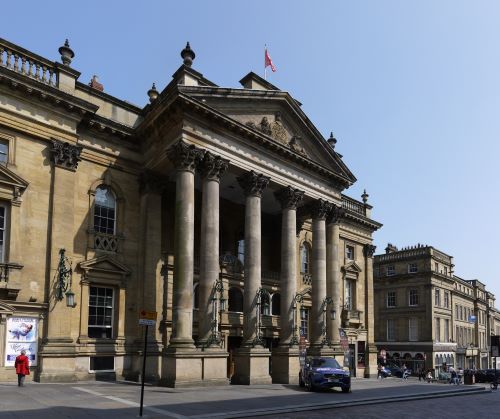
After John Waldie, part owner of the Newcastle Theatre Royal, arrived in Waterloo with his two sisters in June 1815, he soon found himself an “accidental tourist” at the scene of battle. As a theatre aficionado, Waldie had undertaken the tour to become acquainted with the European performances. His sister Jane arranged to meet with her fiancé, Captain (afterwards Rear Admiral) George Edward Watts. His sister Charlotte Ann, subsequently married to Stephen Eaton of Stamford, intended to keep a travel diary which she could then turn into a novel. Charlotte’s Narrative of a Residence in Belgium, during the Campaign of 1815 (1817),1 illustrated by Jane, went through numerous printings, and was twice revived later in the century (The Days of Battle [1853] and Waterloo Days [1892]). Her Rome in the Nineteenth Century (1820) was also well received and frequently reprinted. Jane Waldie, whose paintings were exhibited at the Royal Academy and the British Gallery, had her panoramic sketch, The Battlefield of Waterloo, printed with a prose description, Waterloo, by a near Observer (1817),2 which enjoyed ten editions within a few months. Jane’s Sketches Descriptive of Italy in 1816-1817 (1820) failed to achieve the success of Charlotte’s work, and it prompted from Lord Byron a denunciatory tirade before he discovered, “(horresco referens) that it is written by a WOMAN!!!” Whereupon he condescendingly apologized, “I can only say that I am sorry that a Lady should say anything of the kind” (Byron, L&J 7: 183).
While Major Frye’s After Waterloo provides a transition in genre from the military accounts to the reports of curious tourists, John Waldie’s diary, as the source for both Jane and Charlotte, is the first civilian eye-witness to record the events in Brussels and the battlefields. Waldie kept notes of his discussions with both citizens and soldiers during the confusion. He relates the fear and anxiety in response to the news of Brunswick’s death and the report that the Prussian army had been defeated. He writes, too, of the wagonloads of the wounded and dead. His stark account of these events is twice transcribed from the original journal entries: one, a neatly copied and stylistically corrected version in the eleven-volume “Journal of Travels” prepared for his library; the other, a literary rendition rhetorically amplified with appropriate quotations, inserted dialogue, and dramatic exclamations. Among dozens of passages inserted in the transcription, the following MS fragment comments on the mass cremation and burial of the fallen soldiers:
close to the Chateau are 2 immense heaps of rocks under which are numbers of dead bodies—chiefly of the regiments of the Guards who bore the brunt of the attack on this position—There was such a quantities [sic] of dead bodies there were thrown into 2 great holes, & were then burnt—so now two black hillocks of human dust mark this spot of destruction—and the stench was even now, terrible. (Waldie 169/27, 303)
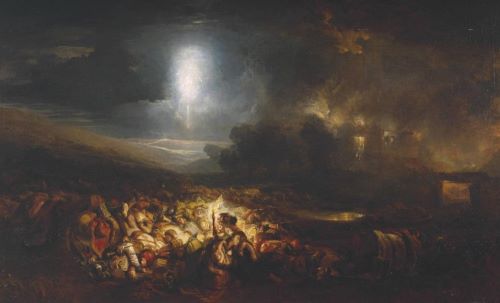
Following her brother’s diary, Charlotte, too, included in her Narrative a walk across the blood-sodden field strewn with the rotting dead. These topoi were repeated in several of the later accounts. John Scott, editor of The Champion and then of the London Magazine, repeated the details of the gruesome scene as a grim finale of the ruin and poverty he encountered on his tour, Paris Revisited, in 1815, by Way of Brussels: Including a Walk over the Field of Battle at Waterloo (1816). James Simpson provided similarly morbid descriptions, which he augmented with one of the first accounts of a military field hospital in his A Visit to Flanders, in July, 1815, being chiefly an account of the field of Waterloo, with a short sketch of Antwerp and Brussels at that time occupied by the wounded of both armies (1816). More successfully than Major Frye’s After Waterloo, Robert Hills created in his Sketches in Flanders and Holland; with some account of a tour through parts of those countries, shortly after the battle of Waterloo (1816) a fictive interlocutor by presenting his travel diary in epistolary form. Tourists visiting the battleground typically made the trip part of a more extensive journey. For them, Charles Campbell prepared The Traveller’s Complete Guide Through Belgium & Holland (1817), which provided useful information on museums and galleries, noteworthy architecture, and historical events. The brief section on Waterloo (Campbell 62-69) was sufficiently rich in detail that Turner consulted it in preparing his notes and sketches for his grand painting, The Field of Waterloo, exhibited 1818.
Among the most poignant tales of the wounded and slain at Waterloo is the personal narrative of Lady Magdalene De Lancey, A Week at Waterloo in 1815. Aged twenty-two, fifteen years younger than her husband, Magdalene married Colonel Sir William De Lancey on 4 April 1815 and then accompanied her husband to Brussels to meet with Wellington, who had just commissioned De Lancey to be deputy quartermaster-general of the Allied Army. Shortly before the outbreak of battle, Magdalene was urged to move from Brussels to
Antwerp, sixty kilometers away, to keep her at a safe distant from hostilities should the French Army break through the Allied fortifications. On 18 June 1815, just over three months after their marriage, Lady De Lancey was informed that her husband had been struck in battle. Wellington himself described the event:
De Lancey was with me, and speaking to me when he was struck. We were on a point of land that overlooked the plain. I had just been warned off by some soldiers (but as I saw well from it, and two divisions were engaging below, I said “Never mind”), when a ball came bounding along en ricochet, as it is called, and, striking him on the back, sent him many yards over the head of his horse. He fell on his face, and bounded upwards and fell again. All the staff dismounted and ran to him, and when I came up he said, “Pray tell them to leave me and let me die in peace.” I had him conveyed to the rear, and two days after, on my return from Brussels, I saw him in a barn, and he spoke with such strength that I said (for I had reported him killed), “Why! De Lancey, you will have the advantage of Sir Condy in ‘Castle Rackrent’——you will know what your friends said of you after you were dead.” “I hope I shall,” he replied. Poor fellow! We knew each other ever since we were boys. But I had no time to be sorry. I went on with the army, and never saw him again. (Chichester 305; Rogers 288)
Having suffered eight broken ribs, De Lancey was slowly dying from internal bleeding. He was conveyed to a cottage in the village of Waterloo, where Lady De Lancey found him after being misinformed that her husband was dead. Throughout the following six days, she was at his bedside tenderly nursing him in spite of the pale chill that indicated his decline. He resisted death until 26 June 1815, when Magdalene gave him a farewell kiss. Only after her husband’s death did she set down the details of their final days together. She left a manuscript account which remained unpublished for almost a century until it was capably edited by Major Bernard Rowland Ward in 1906. Charles Dalton revived awareness of their fate in his Waterloo Roll Call (1904). He quoted lines from the anonymous “Ballad of Waterloo” (1816):
Fair lady’s love, and splendid fame,
De Lancey did enthral.
His loyal heart alike they claim,
They sigh to see him fall. (Dalton 33)
He then recounted Wellington’s version of the event, and went on to describe Magdalene’s desperate ride through fields of carnage from Antwerp to Waterloo: “she rode in a carriage through packed crowds of wounded, past fields filled with the dead from the battle that made their horses ‘scream at the smell of corruption’” (33).
Several of the Waterloo narratives were richly illustrated with maps of the sites of battle, marking in detail the movement of the British, German, and French troops. These prose works are similar to the military narratives, but are apparently intended for the gentleman-officer who wants to recreate imaginatively the exploits of battle from the comfort of his armchair. One of the most elaborate of these was The Campaign of Waterloo, illustrated with engravings of Les Quatre Bras, La Belle Alliance, Hougoumont, La Haye Sainte (1816), compiled by Thomas Hartwell Horne. The anonymous The Battle of Waterloo; or, A faithful and interesting history of the unparalleled events connected therewith; from the period of Bonaparte’s escape from Elba, to his arrival at St. Helena (1816) was also lavishly illustrated with maps and portraits, and complemented the battle narrative with biographies of the principle officers.
Biographies of Napoleon tended to honour his genius in military strategy. The effect sometimes bordered on hero-worship, as in Eneas Mackenzie’s An account of the most striking and wonderful events in the life of Napoleon Bonaparte (1816). Sir Walter Scott’s The Life of Napoleon Buonaparte (1827) presented a more balanced account of Napoleon’s life and achievements. More than a military genius, Napoleon possessed the skills of civic administration. He left to France, Scott declared, a practical system of education, improved modes of communications, and the Napoleonic Code, forbidding privileges based on birth, securing freedom of religion, and specifying that government jobs should go to the most qualified. Opposing the conservative depiction of a ruthless tyrant and warmonger, Scott presented Napoleon as a mild and temperate leader. His self-destruction was driven by a tragic hubris.
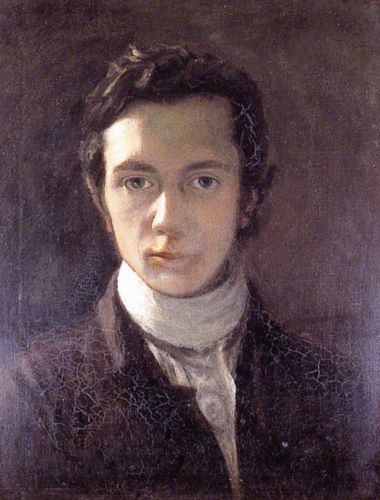
William Hazlitt was not the only Romantic author to recognize the heroic in the Satan of Paradise Lost, nor was he alone in comparing the fallen Satan to Napoleon at Waterloo. In The Life of Napoleon Bonaparte (1828-1830), Hazlitt echoes the prevailing fervour of the Reform Movement in reaffirming the value of the rebellious spirit and individual rights. Milton’s Satan served as apt analogy for Napoleon’s career (13: ix-x; 17: 220-21). Trusting the shared zeal of his officers, Napoleon had not anticipated the failure of Marshal Grouchy to join the charge. Grouchy remained with his troops in Gembloux because the weather was bad. What was this “Strange and most pernicious infatuation?” Hesitating to accuse Grouchy of “deliberate treachery,” Hazlitt suggested in a footnote that “the vanity of the French was so excited and tortured at this period. . . that they fairly lost their senses and their self-possession altogether” (15: 264). With the arrival of the Prussian army under Blücher, the French faced “an overwhelming superiority of numbers, which it had been the object of all the French general’s endeavours to disunite, and in which he so far and would still have succeeded, had it not been for the unaccountable absence of Grouchy both from Waterloo and from Wavres” (15: 269). Hazlitt’s blow-by-blow account of the battle makes little mention of Wellington, who is elided rather than faulted. Hazlitt may be right in supposing a possible French victory if Grouchy and his 33,000 French troops had arrived at Waterloo on 18 June. Too late on the following day, Marshal Grouchy arrived at Wavre and defeated General Thielemann. Wellington’s official dispatch of victory, “The Waterloo Dispatch,” was published in the London Gazette on 22 June.
Writing years later at the period of reform agitation, others openly denigrated Wellington in anonymously printed broadsides and lampoons. Principle Characters in the New Piece entitled ‘The Man Wot Drives the Sovereign’ (1828) was a satirical broadside, with an illustration of Arthur, or ‘Nosey’, or ‘Achilles, the man wot drives the sovereign’ and his unsavoury cronies, i.e. Wellington as Prime Minister (1828-1830) and his Cabinet. Indicative of the persistent hostility directed toward Wellington in the early 1830s is the tract entitled Political Life, Fortunes and Character of the Military dictator, Duke of Wellington (l834). Wellington is accused of unrestrained lust in his personal affairs, rigidity and harshness during war, greed and of contempt toward the working-class at the war’s end.
Wellington has no role at all in Thomas De Quincey’s “The English Mail-Coach” (1849). Recollecting the impact of Waterloo thirty-four years earlier, De Quincey invokes that catastrophic event as a historical marker of dubious progress—of transportation and communication but also of “artillery and the forces of destruction” (Suspiria 15: 130). Writing at the end of a decade of rapid railway expansion, De Quincey ignores the speed of current transportation and recollects instead the mail-coaches and their revelation of “the glory of motion.” (16: 409). Among other dispatches, the mail-coaches “distributed over the face of the land, like the opening of apocalyptic vials, the heart-shaking news of Trafalgar, of Salamanca, of Vittoria, of Waterloo. These were the harvests that, in the grandeur of their reaping, redeemed the tears and blood in which they had been sown” (16: 409). As a passenger of the mail-coach, his flirtation with Fanny of the Bath Road was severely restricted by the brief time needed for changing horses, “a process which ten years later did not occupy above eighty seconds; but then, viz., about Waterloo, it occupied five times eighty” (16: 418). Love and death are the persistent motifs throughout The English Mail-Coach. De Quincey’s own nightmares are but echoes of the deterioration and destruction across the land: “when I look back upon those days, it seems to me that all things change or perish. Even thunder and lightning, it pains me to say, are not the thunder and lightning which I seem to remember about the time of Waterloo. Roses, I fear, are degenerating, and, without a Red revolution, must come to the dust” (16: 420). The mail-coach itself wreaks havoc when it thunders through small market towns, and the news of victory which it may deliver contains as well the names of lovers, husbands, sons, and fathers slain in the skirmish. The years leading up to Waterloo “furnished a long succession of victories” and kept alive “the sense of a deep-seated vulnerability in France” (16: 423).
Poetry
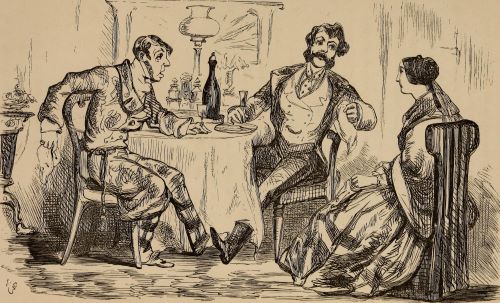
Just as newspaper reports and sermons reached the widest audience, street ballads and comic songs on “Old Bony” had a popular distribution. Some of these have been preserved in collections of theater songs, such as “Mammoth and Buonaparte” in Mirth and Metre (Dibdin 168-70). Others survive as sheet music, broadsides, and pamphlets, and have been studied in terms of their influence on the more serious poetry of the Napoleonic wars, British politics, and national character (Cox Jensen 104-33). The songs provide a significant historical record of the popular reactions to Napoleon’s bold return to France and his brief reign and overthrow. The University of Warwick hosted a conference, “Popular Reaction to Napoleon’s 100 Days: Print, Satire, Song and Theatre” (1 July 2014). The British Museum revived “Song and Satire” in a performance of “an evening’s balladry for Bonaparte and the British” (6 March 2015).
Several of the prose authors discussed, such as Charlotte Waldie Eaton, Major Frye, Robert Hills, and John Scott, presented their narratives as travelogues. Lord Byron was already in the travelogue mode when he returned to Childe Harold’s Pilgrimage. In Cantos 1 and 2 (1812), he recounts travels through Portugal and Spain with Napoleon’s Peninsular War haunting his steps. In Stanzas 17 to 46 of Canto 3 (1816), Byron takes Harold and the reader to Brussels and out to the battlefield. Before a step can be taken, he halts the action and commands attention to the place: “Stop!—for thy tread is on an Empire’s dust! / An Earthquake’s spoil is sepulchred below!” (3.17). He further reveals the significance of the place: “And Harold stands upon this place of skulls, / The grave of France, the deadly Waterloo” (3.18).
Byron next transports his readers to the Grand Ball hosted by Charlotte, Duchess of Richmond, whose husband, Charles Lennox, 4th Duke of Richmond, commanded a reserve force in Brussels. Charlotte Eaton was among the first to comment on the gaiety of the ball interrupted by the onslaught of war. It is mentioned, too, by Sir Walter Scott in Paul’s Letters to his Kinsfolk (1816). Years later, William Makepeace Thackeray in Vanity Fair (1847-8) has Becky Sharp attend the ball and flirt with all ranks of the military. Unlike Eaton, Byron recognized irony of the vanitas in the glamour of the ball being disrupted by the horror of battle. But Byron’s scene is no still-life, rather it moves dramatically from the “sound of revelry by night” (3.21), to hearing the threat as “a deep sound strikes like a rising knell! (3.21), to the recognition that the attack is underway “nearer, clearer, deadlier than before! / Arm! Arm! it is—it is—the cannon’s opening roar!” (3.22).
From the disruption of the ball on the night of 15 June 1815, Byron turns to the Battle of Quatre Bras and has the Duke of Brunswick lead the way, eager to avenge his father: “His heart more truly knew that peal too well / Which stretch’d his father on a bloody bier, And roused the vengeance blood alone could quell” (3.23). The elder Duke of Brunswick had been killed by the French at the Battle of Auerstadt (October 1896). His son met the same fate: “He rush’d into the field, and, foremost fighting, fell” (3.23). Describing the assembling of the Scottish Brigade, Byron shifts from the iambic pace to the anapaestic gallop he used in “The Destruction of the Sennacherib”: “And wild and high the Cameron’s gathering rose” (3.26). The inevitable clash is massive slaughter: “Rider and horse,—friend, foe,—in one red burial blent!” (3.28). The mourning of the fallen soldiers (3.29-35) is followed by his appraisal of Napoleon (3.36-42). Byron does not damn with faint praise, rather he praises with recognition of a curse of pride and ambition:
There sunk the greatest, nor the worst of men,
Whose spirit antithetically mixt
One moment of the mightiest, and again
On little objects with like firmness fixt,
Extreme in all things! hadst thou been betwixt,
Thy throne had still been thine, or never been;
For daring made thy rise as fall: thou seek’st
Even now to re-assume the imperial mien,
And shake again the world, the Thunderer of the scene! (3.36)
The same curse and contagion, Byron adds (3.43-5), has enthralled many throughout history.
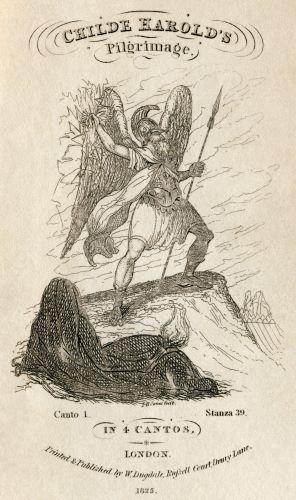
While others celebrated Wellington as the victorious hero, Byron made no mention of him in Childe Harold’s Pilgrimage, and denounced his fame-hungry hypocrisy in other poems, especially in Cantos 8 and 9 of Don Juan. In Canto 8, Byron placed Juan in the Russian army under Alexander Suvorov during the storming of Ismael, the Ottoman fortress. The Russian claim of glorious victory in their extensive slaughter prompted Byron’s comparison to Wellington at Waterloo. He raised the question whether Wellington, as claimed in his dispatch, was the first in victory:
Among the first,—I will not say the first,
For such precedence upon such occasions
Will oftentimes make deadly quarrels burst
Out between friends as well as allied nations:
The Briton must be bold who really durst
Put to such trial John Bull’s partial patience,
As say that Wellington at Waterloo
Was beaten—though the Prussians say so too;—And that if Blücher, Bulow, Gneisenau,
And God knows who besides in ‘au’ and ‘ow,’
Had not come up in time to cast an awe
Into the hearts of those who fought till now
As tigers combat with an empty craw,
The Duke of Wellington had ceased to show
His orders, also to receive his pensions,
Which are the heaviest that our history mentions. (DJ 8.38-9)
In addition to noting that the battle might have been lost without the aggressive assault by Blücher, Byron also suggests that the extraordinarily generous pension allotted the Irish Duke might justly be shared with his starving landsmen: “Read your own hearts and Ireland’s present story, / Then feed her famine fat with Wellesley’s glory” (DJ 8.125).
Immediately following the Battle of Waterloo, Byron had expressed to Thomas Moore a more favourable opinion of Wellington, less favourable of Blücher (L&J 4: 302; 5 July 1815). In subsequent years Byron registered hypocrisy and deceit in Wellington’s actions. Canto 9 of Don Juan commences with fifteen stanzas of scorn addressed against Wellington, scorn so vehement that Byron worried that they might be censored. “If they have fallen into Murray’s hands,” he wrote to Moore, his publisher “might suppress them, as those lines rate that hero at his real value” (L&J 9: 182-3; 12 July 1822). Leslie Marchand, in his note to this letter, explains that the anti-Wellington stanzas were written for Canto 3 on 10 July 1819. They were never sent to John Murray, who had published the earlier cantos, but to John Hunt who published them with Canto 9. With an opening apostrophe, “Oh, Wellington! (or ‘Villainton’),” Byron goes on “to rate that hero at his real value,” which “as man tends fast to zero.” Borrowing Macbeth’s praise to Banquo’s murderer, Byron praises Wellington as “the best of cut-throats” (Macbeth III.iv.17). It is not Wellington’s role as warrior that Byron condemns, but rather his oblivious disregard for the suffering of his own people even while he gathers abundant wealth: “You did great things: but not being great in mind, / Have left undone the greatest—and mankind” (DJ 9.1-10).
Josiah Conder, poet and critic, was equally cautious in appraising the claims of Wellington’s great victory. For twenty-three years (1814–37), Conder served as editor of The Eclectic Review. Because of his active engagement in the abolitionist movement and the Jewish emancipation, he also served another twenty-three years (1832-55) as editor of The Patriot, a newspaper that supported major reform endeavours. In his correspondence with Robert Southey, he became increasingly aware of the extent to which the contemporary Romantic poets were engaged in political causes. In the aftermath of Waterloo, hundreds of poems were submitted to The Eclectic Review—far more than could be reviewed. Conder found it expedient to appraise four of these poems, offering one commentary devoted to Robert Southey’s The Poet’s Pilgrimage to Waterloo (1816) and William Wordsworth’s Thanksgiving Ode, January 18, 1816, and a second commentary, considerably shorter, on Henry Davidson’s Waterloo, a Poem (1816) and John Haskins’ The Battle of Waterloo a Poem, in two cantos (1816). Devoting eighteen pages to his first review and only two to the second, Conder is by no means subtle in distinguishing the superior quality of the first two from the literary ineptitude of the latter two. But he has a larger indictment against all such poems: “It ought to occasion no surprise that modern poets have rarely succeeded in the attempt to please or to interest, when subjects of present political concern have been their theme” (Conder, ER 1, 93).
Conder’s insight applies as much to his own poetry as it does to the numerous Waterloo poems sent to The Eclectic Review. The political stance substitutes polemical rhetoric for the authentic expression of poetic feeling. Conder spends the first two pages of his review in denouncing obtrusive partisanship and feigned emotions. But the rant against the lack of integrity is relevant to the praise that he then bestows on Southey:
No living author, we believe, is more competent to appreciate, or has shewn himself-more able to surmount these disadvantages in treating of contemporary events, than the Poet Laureate. Upon him it properly devolves to redeem, if possible, the character of poems written on national occasions. No man appears so habitually to regard every subject that presents itself to his mind, with the eye and the heart of a poet,—the imaginative eye that discriminates and appropriates in all things the fair and the good, and the heart warmly alive to the best interests of human kind,—as Mr. Southey. No writer impresses us more strongly with the conviction that the opinions he avows, are his genuine sentiments, and the warmth he discovers is unaffected earnestness; and this conviction, even where we do not think and feel in unison with him, strengthens in a considerable degree the impression of what he writes. (3)
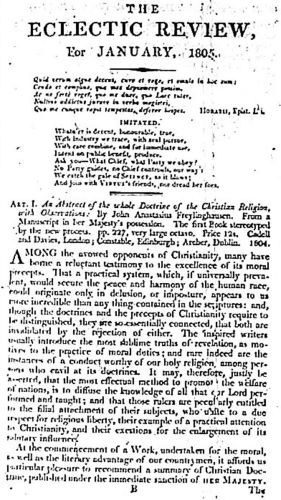
Conder has no such praise for Wordsworth. Although he explicitly denies “bringing our two greatest living poets into direct comparison with each other” (4), he nevertheless addresses “the characteristic difference between the two authors.” Southey is the master of the “easy and flowing stanza, which well suits the familiar epistolary style of the narrative” (10). Wordsworth, by contrast, “always metaphysical, loses himself perpetually in the depths of abstraction on the simplest subject; and frequently employing words as the arbitrary signs of recondite and mystical meanings, exhibits a singular inequality of style, varying from Miltonic majesty of thought and diction, to apparent poverty and meanness” (4).
Offering an example of the “peculiarities” of Wordsworth’s thought, Conder cites from Paradise Lost the lines that adopt the language of prayer and seem to echo Satan’s raping Sin and siring Death:
For these, and for our errors,
And sins that point their terrors,
We bow our heads before thee, and we laud
And magnify thy name. Almighty God!
But thy most dreaded instrument
In working out a pure intent
Is Man—arrayed for mutual slaughter,—
Yea, carnage is thy daughter. (2.273–80)
“Carnage is thy daughter” became a line often quoted, often mocked (Gravil 6). “What strange and revolting phraseology, to use the mildest term, is this!” Conder exclaimed, “How utterly at variance with the language of truly Christian devotion.” Byron quoted the line in the Waterloo passage in Don Juan:
‘Carnage (so Wordsworth tells you) is God’s daughter;’
If he speak truth, she is Christ’s sister, and
Just behaved as in the Holy Land. (7.9)
Shelley, in his parody of Wordsworth in Peter Bell the Third, refers to The Thanksgiving Ode as “one of the odes to the Devil”:
May Carnage and Slaughter,
Thy niece and thy daughter,
May Rapine and Famine,
Thy gorge ever cramming,
Glut Thee with living and dead! (6.636-40)
In 1843, Wordsworth capitulated, altering the offending phrase “Carnage is thy daughter” to the more pedestrian “Man is thy most awful instrument” (2.280).
As example of Waterloo poems of considerably less merit than those of Southey and Wordsworth, Conder reviewed Henry Davidson’s Waterloo, a Poem, With Notes (1816) and John Haskins’ The Battle of Waterloo a poem, in two cantos (1816). He opens this much shorter review by recollecting his caution regarding “subjects of present political concern” (Conder, ER 93). Had Davidson heeded that caution, he would not have resorted to “the solemn whiffs and puffs by means of which … the Coffee-house politician prolonged attention to his important tale” (93). As a result, his “metrical narrative is diffuse and incoherent, ‘full of sound and fury’” (93-4). A skilled poet might introduce a few eye-rhymes or off-rhymes without undermining the reader’s confidence in the author’s command as a poet. Until he acquires adequate command, Davidson cannot “be indulged in such careless rhyming” (93). His title announces “a Poem, With Notes.” These Notes, Davidson explains, obviate any charges of plagiarism by offering similar passages and parallel sentiments as expressed by well known poets. These Notes, Conder observes, provide “the only interesting part of Mr. Davidson’s poem” (93).
In Haskins’ The Battle of Waterloo a poem, in two cantos, Conder finds passages to ridicule and none to praise. He refers, for example, to the unintended slip from pathos into bathos in Haskins’s couplet on La Haye Sainte:
A broken fence precedes the British line
Weak for protection, ’tis O “Holy” thine. (94)
Named after the crown of thorns placed on the head of Christ at the crucifixion, La Haye Sainte was a walled farmhouse crucial in providing a temporary defence to British and German troops under attack by a much larger French contingent. If his army had immediately captured La Haye Sainte, Napoleon may well have broken through the allied centre and defeated the Duke of Wellington’s army. Instead, the French were forced to retreat because of the timely arrival of Blücher’s army. Haskins may have intended to reanimate the sense of divine glory in Christ’s suffering “the crown of thorns.” But he failed utterly to secure that union of reference in the image of the “broken fence. . . / Weak for protection” (94).
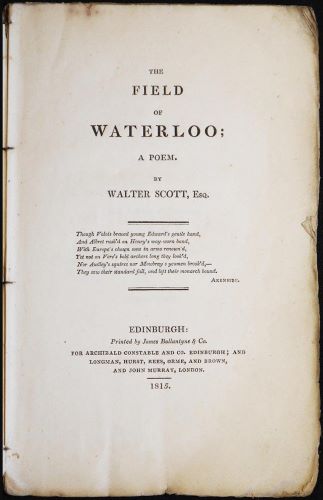
Sir Walter Scott published both a prose account of the battle in Paul’s Letters to his Kinsfolk (1816) and a poetic version in The Field of Waterloo (1815). The latter prompted the anonymous jesting quatrain:
On Waterloo’s ensanguined plain
Full many a gallant man was slain,
But none, by bullet or by shot,
Fell half so flat as Walter Scott. (Qtd. in Johnson 508-9)
Scott had written more rousing verses of battle in Marmion (1813) and of attack and siege in Rokeby (1808). For The Field of Waterloo, more than strident narrative was required. Scott endeavoured to combine moments of elegiac grief with those of jubilant triumph and those of nationalist pride, yet each interfered with the others, so that the result was indeed often flat. Scott’s poem was in two parts: twenty-three irregular stanzas of tetrameter couplets followed by six Spenserian stanzas. A critic in the Monthly Review preferred the latter:
After the poem of Waterloo, properly so called, is concluded, we have another ‘Conclusion,’ or ‘Excrescence,’ of a very poetical nature, in the stanza of Spenser. This, we think is the best specimen of Mr. Scott’s writing in so much nobler a style than there is room to display in the octosyllabic measure. (Rev. of. Scott, MR 258)
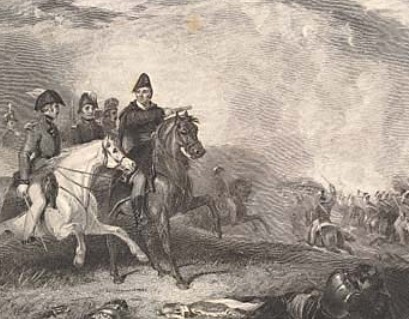
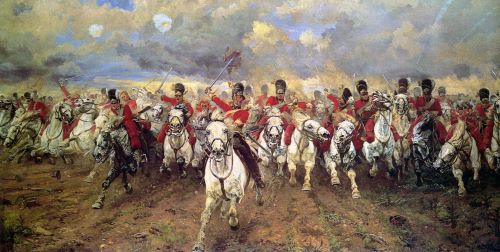
As did other accounts of the battle, Scott’s gave emphasis to the climactic action, which for Scott gave occasion to praise the charge of the 92nd (Gordon) Highlanders and the Royal Scots Greys. In stanza 21, Scott’s “roll of blood” includes the names of the Scottish heroes: John Cameron, “offspring of Lochiel,” served as Colonel of the Gordon Highlanders and was killed at Quatre Bras, and Lieutenant-Colonel Sir Alexander Gordon was killed at Waterloo. Scott’s tribute is forthright, but lacks the lines to reveal the bravery of battle. The officers are named, but only named, and the troops remain nameless. In stanza 22, Scott acknowledges the inadequacy: “Forgive, brave Dead, the imperfect lay! / Who may your names, your numbers, say?”
A critic of the European Magazine acknowledges that “the poem possesses many beauties,” but he nevertheless finds that “a monotonous dulness pervades parts which require all the brilliance of the rest to dissipate.” Because of his mastery of vigorous poetry of conflict and strife, his readers were disappointed to find that Scott relied too much on subjective response: “Here is no narration, no necessary chain of events to be described”; each heroic moment is quickly darkened by sadness, so that the presiding effect is unremitting “monotony and dullness” (Rev. of Scott, EM 141).
To announce his intention to celebrate the courage and valour of the Gordon Highlanders and the Royal Scots Greys, David Home Buchan advertised his own authorship as that of “a Native of Edinburgh” on the title page of his The Battle of Waterloo: a poem (1815), which was very much a Scots version.
Another Scottish celebration of the Scots was James Hogg’s The Field of Battle, a poetic endeavour apparently prompted by John Wilson’s letter to Hogg (September 1815) expressing his disappointment in Sir Walter Scott’s poem of that title:
Scott’s Field of Waterloo I have seen. What a poem!—such bald and nerveless language, mean imagery, commonplace sentiments, and clumsy versification! It is beneath criticism. Unless the latter part of the battle be very fine indeed, this poem will injure him. (Qtd. in Gordon 130)
In response to Wilson’s criticism, Hogg promptly commenced his own poem of the same title, “The Field of Waterloo.” It remained unpublished until it was included in his Poetical Works (1822; 2: 281-323). Hogg’s earlier attempts to publish the long poem had failed. William Blackwood wrote to John Murray (20 December 1815) to relate his rejection of the poem:
I have a curious epistle from The Ettrick Shepherd today enclosing me two sheets of “The Field of Waterloo a Poem by James Hogg.” I’ll cross it “though it blast me. Hamlet.” He says he wishes it printed forthwith and that you will lend it a helping hand. From the glance I have given it appears bitter bad, but as he says I may send the proofs to Mr Scott, I mean to consult him this afternoon about it. (Hogg, Letters 1: 257)
Two days later (22 December 1815), Blackwood wrote again to Murray to relate Scott’s embarrassment at being involved in the decision, although he concurred that nothing could be done to rescue “poor Hogg’s lamentable production” (257). Enlisting John Wilson to convey to Hogg the negative consensus, Blackwood declares that he is rid of the problem: “I have got it knock’d on the head” (257).
It was in many ways simpler for Edmund Lenthal Swift to write an Irish version and declare a Irish victory, for Wellington was an Irishman. In Waterloo, a Poem (1815), Swift makes that point repeatedly. Another Irish version was Charles Robert Maturin’s Lines on the Battle of Waterloo (1816). An Irish Protestant clergyman (ordained in the Church of Ireland), Maturin was an author of Gothic plays and novels. His best-known works are the novel Melmoth the Wanderer and the play Bertam, denounced by Samuel Taylor Coleridge in the Biographia Literaria. The battlefield provided Maturin adequate stimulus for the gore of gothic description:
A sullen, undistinguished hum
(Like the faint beat of distant drum)
Murmurs yon human hill beneath,
And tells of sufferings worse than death—
Where the loose Earth, all lightly laid,
Scarce hides the dying and the dead—
Where the red turf yet heaves with life,
And of the agonizing strife
All that yon oozing blood-drops show,
Forbids to ask—what lies below? (29-38)
And Wellington himself was praised as the superlative “Irish hero”:Tribute to Wellington as an Irish hero:
Son of the isle—where souls of fire
The natives’ glowing breasts inspire—
What land, what language may not raise
Its tribute to thy deathless Praise? (117-20)
Throughout the ensuing decade, odes, elegies, patriotic hymns, and nationalist celebrations of the hard-won victory continued to appear in the journals. Again and again, the fierce encounters were retold as well as many of the anecdotes of bravery. Several poets, however, introduced new perspectives and found new ways to tell the familiar tales. In Paris in 1815: A Poem, George Croly finds Paris itself animated by whole armies returning from battle. “Its public places were crowded with all the armies of Europe. Every man of whom we had been conceiving portraits through the cloud and tumult of the war, was to be met face to face in the streets” (Croly vii). In The Heroes of Waterloo: an ode (1815), as his title indicates, William Sidney Walker creates a series of animated biographical sketches of the prominent officers of the battle.
Elizabeth Cobbold’s Ode on the Victory of Waterloo (1815) exhibits ingenuity in its personification and allegorical animation. Each of the poem’s twenty-one tetrameter stanzas introduces an allegorical figure; none, however, sustains a role beyond a single stanza. Even when an actual person is called forth, the action of that person is instigated by an allegorical figure or a series of figures. Napoleon, for example, is roused by “Treason” in stanza 5, aided by Infamy, and abandoned by coward Falsehood in stanza 7. Upon the death of the Duke of Brunswick at Quatre Bras, “Brunswick’s Star” in stanza 3 inspires hope among the drooping Lillies of his regiment. In stanza 8, Wellington’s leadership is conveyed by his “inspiring glance,” which then “Beam’d on the Brunswick’s noble band” and “led the charge.” Referring to Napoleon’s abdication and exile, Cobbold begins her poem describing the apparent peace during the eleven-month interim: “How lately, in delusive State, / Bright Peace enthron’d in sunbeams sate (1). The concluding stanza heralds the return of abiding Peace for “Britain, Empress of the Sea / And Guardian Genius of the Western World” (23).
William Thomas Fitzgerald’s “Wellington’s Triumph, or, The Battle of Waterloo” (Bennett 592-4) was a companion piece to his earlier poem, “Wellington’s Triumph! and Portugal Relieved” published in the European Magazine (59: 373). Not unfairly, the critic of the Augustan Review declared that Fitzgerald’s “muse would never want praise, could her patriotism be viewed apart from her poetry” (“Waterloo Poems” 1: 793-4). Rather than mere patriotism, Fitzgerald’s poetry owes its vigour to its soldierly balladeering:
Here Captain Kelly of the Guards
A Colonel fought and slew,
Commander of the Cuirassiers;
He clove his head in two.
Not the brutal swing of the sabre, but the judicious military strategy heads the qualities for which he praises Wellington: “His eagle eye discerns from far / That moment which decides the war” (58-9). Neither better nor worse than the vast outpouring of poetical sentiments on the triumph of Wellington, Harriet Cope’s Waterloo: A Poem in Two Parts By The Author of Triumphs of Religion (1822) came later than most, late enough to be coloured by the hopes of the reform movement (Bainbridge 155).
Later still, Paulin Huggett Pearce’s Tragedy of the Battle of Waterloo, in five acts (1869) was intended as a memorial. Although entitled a “Tragedy” and divided into “Acts,” Pearce’s work is a narrative poem in irregular iambic pentameter couplets, with more thunder than pathos, more metaphorical than physical action.
Then General Picton, like a lion bold
Disturbed by hunters, hurries from his hold
With noisy rear, and grinds his teeth, enraged,
Longing to tear his prey and be engaged. (24)
On occasions when he might have relied on metaphor he resorts to gory detail:
But in the charge, the warlike Picton fell,
While cannon bellowed oft and terrible;
He led the soldiers on to glory’s call,
Entranced in hope, when sang a musket ball,
His temple struck, the skin the other side
Retained the shot, in glories arms he died. (24)
Perhaps the typesetter was to blame for substituting “glories arms” for “glory’s arms,” but Pearce himself was responsible for the many awkward off rhymes, such as “Picton fell” and “terrible.” Pearce had dealt previously with Waterloo. Fifteen years earlier, he had written The Duke of Wellington’s Grand Funeral Ode (1854). Before that he had composed Napoleon Bonaparte’s Last Campaign (1846).
In his Tragedy of the Battle of Waterloo, Pearce lists a few of the artefacts stripped from the captured Napoleon:
Napoleon’s carriage fell an easy prize,
His hat, his jewels, of surpassing size;
His sword, seal-ring, and far-eyed telescope,
With which he viewed the battle full of hope. (34)
For many years on display in London, these memorabilia would be familiar to Pearce’s readers. Napoleon’s carriage, captured by Major von Keller on 18 June 1815, was acquired by William Bullock and exhibited at his
Egyptian Hall in 1816. In 1842, the carriage was acquired by Madame Tussaud and exhibited at her Bazaar on Baker Street where she set up the “Chamber of Horrors” depicting scenes from the French Revolution. Her collection of Napoleonic relics, including the carriage, remained on exhibition for some eighty years until all was destroyed in the fire of 18 March 1925 (Altick 239-43, 249, 333-8).
Drama
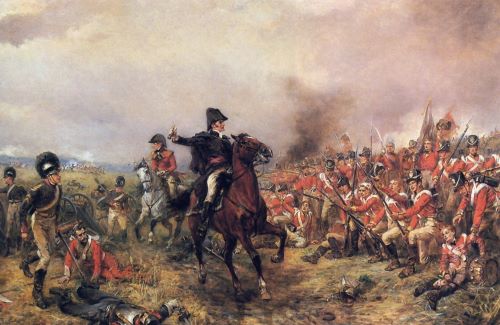
Even as returning hero of Waterloo, the Duke of Wellington was not impervious to scandal. He had grown estranged from his wife, Kitty Pakenham (Bolen), and had taken up with several mistresses, including Lady Frances Shelley, courtesan Harriet Wilson Princess Dorothea Lieven, the Russian Ambassador’s wife, and Harriet Arbuthnot (Patridge 199-202; Swinton 226). Two of his mistresses had previously been Napoleon’s mistresses: one was Josephina Grassini, an opera singer, the other Josephine Weimer, an actress (Holmes 96-8). In 1824, Wellington was one of many lovers to whom Harriette Wilson proposed a discreet deletion from her Memoirs in exchange for a financial consideration. Wellington declined the offer with an abrupt reply: “Publish and be damned” (O’Connell 161-81).
Unlike Wellington, Lord Byron in April of 1814 dismissed Harriette Wilson’s overtures (L&J 4: 88), and he suspected that Wellington, although legally exonerated, was in fact guilty of adultery with Lady Frances Webster. Her husband, James Wedderburn Webster, Lieutenant in the 9th Dragoons and aide de camp to Lord Uxbridge, observed the dalliance but sought to end the gossip that accompanied Wellington on his triumphant return. Webster first charged Wellington with criminal conversation (allegations such as this became known as crim. con.) for adultery with his wife, a charge which meant that Webster himself must produce the evidence against Wellington and Lady Frances. Reappraising the situation, he brought a charge of libel against Charles Baldwin for publishing salacious gossip implicating the presumed adultery. Baldwin had a witness, whom he cited in the newspaper:
A report is very prevalent in the first Parisian circles, that a distinguished Commander has surrendered himself captive to the beautiful wife of a military officer of high rank, in a manner to make a very serious investigation of this event indispensable; but it is to be hoped that this will turn out to be nothing more than a tale of malevolence.
The amour which is the foundation of the crim. con. case alluded to in a former paragraph, did not take place at Paris, but at Brussels, a day or two previous to the battle of Waterloo. The husband has laid his damages at £50,000, which it is said the fortunate lover offered to pay, but the affair was too notorious for composition, or the party injured had too much sensibility to be content with wearing gilded horns. The Parisian husbands are astonished at this conduct, which they ridicule as a strange English prejudice, and each of them wishes that he had the good fortune to have netted his Venus with such another Mars. An orderly Sergeant did the duty generally performed by a prying chambermaid upon such occasions will be the principal witness on the trial. (Baldwin 24-5)
Because Baldwin’s witness would not affirm to the court his confidential testimony, Webster obtained a judgment of £2,000 damages for the libel (Webster, Court of Common Pleas, Westminster, 16 February 1816).
After the defeat of Napoleon, Lady Frances, competing with Lady Caroline Lamb for Wellington’s attentions, followed the victorious Field Marshal from Brussels to Paris (Douglass 155, 173-4). There is unmistakable irony in Byron’s reference, on the occasion of the libel trial, to her “unimpeachable virtue & uniform correctness of conduct &c. &c.” (L&J 5: 28). Leslie Marchand notes that Byron had conducted “an abortive affair with Lady Frances Webster in 1813” (5: 28). At that time, Charles Stanhope, Viscount Petersham, “had also flirted with Lady Frances and must have been obliged to pay damages” on “crim. con.” charges (10: 48). In his diary of 5 January 1819, Thomas Moore recorded that Lady Frances talked to him about Byron “as if nothing had happened” (5: 28). He adds, however, that Byron himself “certainly gave me to think otherwise, and her letters (which I saw) showed, at least, that she was (or fancied herself) much in love with him.” In Moore’s judgement, “her great ambition is to attract people of celebrity—if so, she must have been gratified—as the first Poet [Byron] & first Captain [Wellington] of the age have been among her lovers.” (5: 28).
In the context of this scandal, John Larpent, Examiner of Plays, chose to refuse a license for the performance of The Duke’s Coat; or, The Night after Waterloo. A Dramatick Anecdote. Intended to open at the Lyceum on 6 September 1815, rehearsals were stopped on 29 August, when Samuel James Arnold, Theatre Manager, was notified that a license could not be granted (Conolly 106-7). Wellington figures only indirectly in the play, which concerns, rather, the reception of an aide de camp who means to mend the Field Marshal’s coat. Because of mistaken identity, he inadvertently attracts the attention of two young ladies while staying at La Belle Alliance farm. That oblique implication of sexual possibilities was enough to arouse Larpent’s sense of duty, who blocked the production of what the playwright called “a mere trifle” (Cox 166). The Dramatick Anecdote was borrowed from a French farce in which an innkeeper mistakes an aide de camp for the Field Marshall (166). In the published version, there is little that might be deemed a coded reference to the present trial and Wellington’s sexual escapades.
Another borrowed anecdote provided the substance of John Walker’s Napoleon; or, The Emperor and the Soldier (Sadler’s Wells, 15 September 1828), which depicts the magnanimity of Napoleon. While praising Napoleon did not necessarily mean maligning Wellington, the play was performed at the very time that Wellington, as Prime Minister (1828–1830), was vigorously opposing the Reform Bill. No doubt used often, the anecdote of a ruler’s generosity had previously provided the plot for a melodrama by Frederick More Maddox, Frederick the Great; or, The King and the Deserter (Coberg, 15 September 1824). The Waterloo Bridge, originally called the Strand Bridge, was renamed by the Prince of Wales and the Duke of Wellington on 18 June 1817 to celebrate the second anniversary of the Battle of Waterloo. On that very evening of the opening ceremony was re-enacted as Waterloo Bridge; or, The Anniversary (Royal Circus, 18 June 1817) in a spectacle prepared by Charles Dibdin, the Younger. On Monday of the following week Dibdin brought forth Forget me not! or, The Flower of Waterloo (Sadler’s Wells, 23 June 1817), a sentimental melodrama of a grieving young woman who believes her lover perished in battle.
After his death at St. Helena on 5 May 1821, a series of vignettes from Napoleon’s career was performed at the Royal Coburg in Waterloo Road, Napoleon Bonaparte, General, Consul and Emperor (Coburg, 23 July 1821). For the tenth anniversary of Napoleon’s death, a more ample dramatization, Napoleon Buonaparte, Captain of Artillery, General and First Consul, Emperor and Exile (Covent Garden, 16 May 1831) was prepared in the grand operatic style by Michael Rophino Lacy. While The Last Days of Napoleon Buonaparte at St. Helena (Royal Amphitheatre, 28 April 1828) and Napoleon’s Glory; or, Wonders in St Helena (Adelphi, 8 December 1840) might be considered among the plays honoring the memory of the fallen emperor, there were also plays of tribute to the British officers who treated their prisoner with dignity (Thornton 38-54).
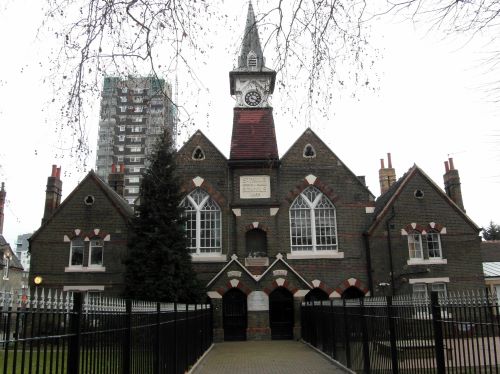
With unabated exuberance, the Waterloo-mania persisted throughout the ensuing two years, and it could still be reanimated many years later. Among the first theatrical representations was The Battle of Waterloo (15 November 1815), a staged spectacle of conflict with musical fanfare performed in the old Royalty in Wellclose Square. Richard Altick cites the performance of The Battle of Waterloo (Royal Amphitheatre, 19 April 1824). Scripted by John H. Amherst nine years after the event, the equestrian spectacle, featuring “cavalry advances, bugle calls, and cannon fire, ran for 144 consecutive performances and then went into repertory to become the second most frequently performed show in the house’s history” (Altick 176). Within a week of its opening in London, Amherst’s spectacle was imitated at Davis’s Royal Amphitheatre (25 April 1825), at that time the largest theatre in Hull.3
The popularity of the performances triggered a new wave of Waterloo exhibitions and panorama. At Vauxhall Gardens in 1827, space was cleared for an open-air equestrian performance of The Battle of Waterloo under the management Thomas Taplin Cooke. For the finale, Cooke himself would mount his charger, “and, at full speed, ride up a nearly perpendicular Rock, to the Temple of Fame, at the summit of the Fire-Work Tower, and there deposit the British and French Colours, as an Emblem of Amity, in the Temple of Concord, a Feat unequalled in the Annals of Horsemanship” (Altick 320). Similar to the synopses of Napoleon’s career performed at the Coburg in 1821 and Covent Garden in 1831, the Royal Amphitheatre developed an equestrian representation of The Wars of Wellington (31 March 1834 and 18 May 1840). Patriotic celebrations of the Waterloo victory were intermittent but never long absent from the stage. Even at mid-century, John H. Wilkins could make the tears flow with his sentimental melodrama, The Eve of Waterloo (City of London 1849).
Exhibitions
In his Tragedy of the Battle of Waterloo (1869), Pearce noted Napoleon’s carriage and other possessions on display in London, first at Bullock’s Egyptian Hall and later at Madame Tussaud’s Bazaar. Napoleonic artefacts attracted public curiosity and crowds queued to see items gathered from the battlefield (Altick 239-40). Palmer, in the catalogue he prepared for his Waterloo Museum, announced the display of a portrait of Napoleon, a large painting of Waterloo, four eagles awarded to heroic units of Napoleon’s army, and a large array of weapons and armour (Palmer 1-24). Dozens of painted panoramas opened for viewing (Altick 136-40, 194-5, 201, 222). Although the “Grand National and Historical Diorama, Illustrating the Wellington Campaigns. . . Concluding with the Battle of Waterloo” (April 1852) might have seemed a belated tribute, the scenes prepared by theatre artists William Telbin and John Burnett could not have been more timely. The aged Duke, now 83, had retired to Walmer Castle. Following seizures and a stroke, he died on 14 September 1852. (On the death of Wellington, see Sean Grass, “On the Death of the Duke of Wellington, 14 September 1852.″) Telbin and Burnett renamed their exhibition “The Life of Wellington” and added new scenes to depict his final years, gaining an entrepreneurial advantage over the sudden resurgence of Waterloo galleries, exhibitions, and stage spectacles (Altick 479-80; see also: A Catalogue of the Waterloo Museum).
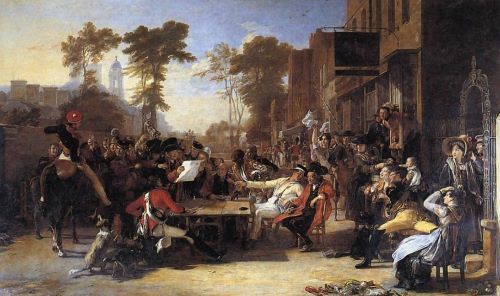
Just as authors sought for new and different modes of literary representation, the visual artists too were challenged to avoid repeating the stock images of battle. One of the most successful paintings was Turner’s The Field of Waterloo (Fig. 1), exhibited at the Royal Academy in 1818. Visiting Waterloo in 1817, Turner made numerous sketches aided by Charles Campbell’s Guide to Belgium and Holland (1817). Rather than a hectic scene of conflict, Turner chose to depict a night scene of loss and suffering on a battle field that was strewn with tens of thousands of the wounded and dead. The primary action is provided by a blast of lightning that partially illuminates the heaps of scattered bodies. Turner has depicted in the foreground torch-bearing women searching for their fallen loved ones (Shaw 23, 67-91). Another painting greatly admired by the public was one commissioned by Wellington himself and representing a scene far from the battlefield. This was Sir David Wilkie’s Chelsea Pensioners Receiving the London Gazette Extraordinary of Thursday, June 22, 1815, Announcing the Battle of Waterloo (Fig. 2). Depicting not the battle, but the reception of the battle among a group intimately acquainted with the horrors of military slaughter, Wilkie used his skills as genre painter to capture the array of emotional response. The pensioners are actual portraits of characters identified in Wilkie’s preparatory notes and sketches. When exhibited at the Royal Academy in 1822, the painting attracted unprecedented crowds (Cunningham 2: 77).
The Battle of Waterloo was re-enacted with tin soldiers on table-tops throughout Britain. The toy soldiers were a favourite among collectors, and many were meticulous in recreating their table-top warfare. On display in the museum of the Winston Churchill War Rooms in London is a hand-painted collection of 43 cavalry and 54 infantry totalling 1,500 pieces. Churchill got his first set of toy soldiers when he was seven years old. The set continued to grow through his teenage years, and he gained expertise in re-enacting the war games of Waterloo. Relevant to the contentious debate concerning the respective field movements of Wellington and Blücher, an interesting discovery was made in 1830 when Lieutenant William Siborne, an enthusiastic young artist and cartographer, was commissioned to make a gigantic model for the new Royal United Services Museum (Barker, 6). He travelled to Belgium and devoted months to the surveying and charting the battlefield:
taking an accurate survey of the ground, and in ascertaining, with the greatest mathematical precision, the position and extent of every object and enclosure, and the level of the surface and its undulations. Every village, every house and farm-yard, every knot of trees, every field is given with the closest accuracy, from a six months’ personal observation, aided by the most authentic information. The Model is constructed upon a scale of nine feet to a mile. It is 21 feet 4 inches in length, by 19 feet 8 inches in breadth, and comprises an area of 400 square feet. It affords a complete representation of the ground on which the battle was fought. As nearly as possible it shows the deposition of the hostile armies at 7.45 p.m., the turning point of the battle. (Leetham 141-2)
The precise position of the French, German, and British armies was represented with 80,000 hand-painted metal soldiers. In spite of request to show the troops at the outset of the battle, Siborne chose to depict the crisis on the evening of 18 June 1815. Lord Fitzroy Somerset, Wellington’s military secretary, objected to Siborne’s rendition: “the position you have given to the Prussian troops is not the correct one as regards the moment you wish to represent, and. . . those who see the work will deduce from it that the result of the Battle was not so much owing to British Valour, and the great Generalship of the Chief of the English Army, as to the flank Movements of the Prussians” (Leetham 142). In his dispatch, Wellington declared that his attack secured the victory, but the detailed accuracy of Siborne’s model made it clear that Prussian support had been indispensable.
In the exhibition catalogue of the Royal United Service Museum (Leetham 141-3), Siborne’s model of the Field and Battle of Waterloo is described with high praise for its precise rendering of scale and disposition. No mention is made of the dispute over the relative positions of Wellington and Blücher during the battle. When the German military strategist, Carl von Clausewitz, raised the issue in On Wellington: a Critique of Waterloo [Strategische Uebersicht des Feldzug von 1815; Strategic Overview of the Campaign of 1815] (1827), Wellington was obliged to respond, belatedly acknowledging Blücher’s crucial role in his “Memorandum on the Battle of Waterloo” (1842).
The history of the Battle of Waterloo, as well as the biographies of the two powerful adversaries who met on that battlefield, were engulfed in controversy in the years following the conflict. Far more than other conflicts of that era, the literary and popular reception reflected and even directed the course of that controversy—in the eye-witness narratives, in the poetry, plays, spectacles, gallery exhibitions, panorama, street shows, and even in the display of tin soldiers.
Appendix
Endnotes
- See Eaton, Charlotte Waldie.
- See Watts, Jane Waldie.
- Note that this theater is a different theater than the similarly named Davis’s Amphitheatre in London.
Bibliography – Primary Sources
- Anon. The battle of Waterloo; or, A faithful and interesting history of the unparalleled events connected therewith; from the period of Bonaparte’s escape from Elba, to his arrival at St. Helena. Containing a circumstantial narrative of the decisive victory obtained over the French by the allied armies on the plains of Waterloo, June 18, 1815, under the command of those illustrious generals, the Duke of Wellington and Prince Blücher. Collected from official documents … Illustrated with plans of the battle, portraits, etc. beautifully engraved. Ed. J. Gleave. 2nd ed. Manchester, 1816. Print.
- —. A Catalogue of the Waterloo Museum, 97, Pall Mall. Established in the year 1815. London: Printed by J. Lowe, 1815. Print.
- —. Political Life, Fortunes and Character of the Military dictator, Duke of Wellington. Glasgow, l834. Print.
- —. Principle Characters in the New Piece entitled ‘The Man Wot Drives the Sovereign’. London, 1828. Print.
- Baldwin, Charles. The St. James’s Chronicle and London Evening Post 1-3 Aug. 1815: 24-5. Print.
- Barker, Henry Aston. Description of the field of battle, and disposition of the troops engaged in the action, fought on the 18th of June, 1815, near Waterloo; illustrative of the representation of that great event, in the Panorama, Leicester-Square. London, 1816. Print.
- Booth, John. The Battle of Waterloo: Containing the Accounts Published by Authority, British and Foreign, and Other Relevant Documents, with Circumstantial Details, Previous and After the Battle, from a Variety of Authentic and Original Sources. 2nd ed. London: printed for J. Booth and T. Ergeton; Military Library, Whitehall, 1815. Print.
- Bowles, William Lisle. “Battle of Waterloo Sermon.” Battle of Waterloo Sermon and Collection. Web. 20 Apr. 2016. <http://www.wiltshire-opc.org.uk/Items/Bremhill/Bremhill%20-%20Battle%20of%20Waterloo%20Sermon%20and%20Collection%201815.pdf.>
- Byron, George Gordon, Baron. Byron’s Letters and Journals. Ed. Leslie A. Marchand. 12 vols. Cambridge MA: Harvard UP, 1974-1982. Print.
- Campbell, Charles. The Traveller’s Complete Guide Through Belgium & Holland: Containing Full Directions for Gentlemen, Lovers of the Fine Arts, and Travellers in General; with a Sketch of a Tour in Germany. London: Sherwood, Neeley, and Jones, 1817. Print.
- Cotes, Henry. Another mite for Waterloo, a sermon preached in the parish church of Bedlington, 20 August 1815. Newcastle: E. Charnley; London: Baldwin, Cradock, and Joy, 1815. Print.
- De Lancey, Lady Magdalene. A Week at Waterloo in 1815: Lady De Lancey’s narrative: being an account of how she nursed her husband, Colonel Sir William Howe De Lancey, quartermaster-general of the army, mortally wounded in the great battle. Ed. Major Bernard Rowland Ward. London: John Murray, 1906. Print.
- De Quincey, Thomas. “The English Mail-Coach: The Glory of Motion and the Vision of Sudden Death.” 1849. The Works of Thomas De Quincey. Ed. Grevel Lindop, et. al. 21 vols. London: Pickering and Chatto, 2000-03. 16: 408-49. Print.
- Eaton, Charlotte Waldie and Jane Waldie Watts. Narrative of a Residence in Belgium during the Campaign of 1815; and of a visit to the field of Waterloo. London: J. Murray, 1817. Print.
- Frye, William Edward, Major. After Waterloo: Reminiscences of European Travel 1815–1819. Ed. Salomon Reinach. London: Heinemann, 1908. Print.
- Hazlitt, William. The Life of Napoleon Bonaparte. 1828. The Complete Works of William Hazlitt. Vols. 13-15 Ed. P. P. Howe. London: J. M. Dent & Sons, 1931. (Bainbridge, 193-197) Print.
- Hills, Robert. Sketches in Flanders and Holland; with some account of a tour through parts of those countries, shortly after the battle of Waterloo; in a series of letters to a friend. London: Printed by J. Haines and J. Turner, 1816. Print.
- Horne, Thomas Hartwell. The campaign of Waterloo, illustrated with engravings of Les Quatre Bras, La Belle Alliance, Hougoumont, La Haye Sainte, and other principal scenes of action; including a correct military plan … To which is prefixed a history of the campaign, comp. from official documents and other authentic sources. London: Printed by T. Bensley, for R. Bowyer, 1816. Print.
- Mackenzie, Eneas. An account of the most striking and wonderful events in the life of Napoleon Bonaparte, from his sailing from Elba to his landing at St. Helena: comprising a circumstantial description of the memorable Battle of Waterloo, and of the singular island to which the ex-emperor has been banished. Embellished with a view of St. Helena. Newcastle upon Tyne: Printed by Mackenzie and Dent, 1816. Print.
- Picton, G. W. Lieutenant. The Battle of Waterloo: or, A General history of the events connected with that important era; from the period of Bonaparte’s escape from Elba, to his arrival at St. Helena. London: R. Edwards, 1816. Print.
- Rogers, Samuel, Recollections of the Table-Talk of Samuel Rogers. London, E. Moxon, 1856. Print.
- Scott, John. Paris Revisited, in 1815, by Way of Brussels: Including a Walk over the Field of Battle at Waterloo. London: Longman, Hurst, Rees, Orme, and Brown, 1816. Print.
- Scott, W. A., Lieutenant-General. Battle of Waterloo; or, Correct narrative of the late sanguinary conflict on the plains of Waterloo: exhibiting a minute detail of all the military operations of the heroes who signalized themselves on that memorable occasion, opposed to Napoleon Buonaparte, in person: with an authentic memoir of that most extraordinary person; from the beginning, to the end, of his political career. Embellished with a correct coloured engraving of La Belle alliance. London: E. Cox and Son, 1815. Print.
- Scott, Sir Walter. The Life of Napoleon Buonaparte, Emperor of the French. With a Preliminary View of the French Revolution. 9 vols. Edinburgh: Printed by Ballantyne and Co. for Longman, Rees, Orme, Brown, & Green, London; Cadell & Co., Edinburgh 1827. Print.
- —. Paul’s Letters to His Kinsfolk. Edinburgh: Printed by James Ballantyne and Co. for Archibald Constable and Company, Edinburgh; Longman, Hurst, Rees, Orme, and Brown, and John Murray, London. 1816. Print.
- Siborne, William. History of the War in France and Belgium, in 1815. Containing minute details of the battles of Quatre-Bras, Ligny, Wavre, and Waterloo, with 11 plates, 12 maps. 2 vols. London: T. and W. Boone, New Bond Street, 1844. Print.
- Simpson, James. A visit to Flanders, in July, 1815, being chiefly an account of the field of Waterloo, with a short sketch of Antwerp and Brussels at that time occupied by the wounded of both armies. Edinburgh: W. Blackwood, 1816. Print.
- Swinton, Georgiana. A Sketch of the Life of Georgiana, Lady de Ros: With Some Reminiscences of her friends, including the Duke of Wellington. London: John Murry, 1893. Print.
- Thackeray, William Makepeace. Vanity Fair. [Originally published in Punch 1847-48.] London: Bradbury & Evans, 1848. Print.
- Waldie, John. The Journal of John Waldie Theatre Commentaries, 1799-1830. Ed. Frederick Burwick. Los Angeles: UCLA Special Collections, 2008. Web. 13 Nov. 2015. <https://escholarship.org/uc/uclalib_dsc_waldie>.
- Watts, Jane Waldie. Waterloo, by a near Observer. London: John Murray, 1817. Print.
- Webster, J. W. W. Proceedings on the trial of a special action on the case, by James Webster Wedderburn Webster, Esq. and Lady Frances Caroline Webster Wedderburn Webster, his wife, against Charles Baldwin, for a libel; in the Court of Common Pleas, at Westminister, on Friday, the 16th of February 1816. London: Printed for James Ridgway and E. Kerby, 1816. Print.
- Wellington, Arthur Wellesley, Duke. “Memorandum on the Battle of Waterloo, Written by the Duke of Wellington after reading the statements of General Clausewitz.” 1842. Ed./Trans. Christopher Bassford, Daniel Moran, and Gregory W. Pedlow. Clausewitz.com, 2010. Print
- —. “The Waterloo Dispatch.” The London Gazette 22 June 1815: 1213-16. 13. Nov. 2015. <https://www.thegazette.co.uk/London/issue/17028/page/1213>.
- Anon. A Ballad of Waterloo. London: Sherwood and Co, 1816. Print.
- Buchan, David Home. The Battle of Waterloo: a poem. By a Native of Edinburgh. 1815. 2nd ed. London: T. & G. Underwood, 1816. Print.
- Byron, George Gordon, Baron. Childe Harold’s Pilgrimage Canto the Third. London: Printed for John Murray, 1816. Print.
- —. Don Juan. The Complete Poetical Works. 7 vols. Ed. Jerome J. McGann. Oxford: Clarendon Press; New York: Oxford UP, 1980-1993. Print.
- Cobbold, Elizabeth. Ode on the Victory of Waterloo. Ipswich: Raw, 1815. Print.
- Conder, Josiah. Review: Henry Davidson and John Haskins. Eclectic Review July 1816: 93-4. Print.
- —. Rev. of Robert Southey and William Wordsworth. Eclectic Review July 1816: 1-18. Print.
- —. Rev. of Sir Walter Scott. Eclectic Review Dec. 1815: 570-8. Print.
- Cope, Harriet. Waterloo: A Poem in Two Parts. London: J. Hatchard & Son, 1822. Print.
- Croly, George. Paris in 1815. A Poem. 2 vols. London: John Murray, 1818. Print.
- Davidson, Henry. Waterloo, a Poem. With notes. Edinburgh: Printed for William Blackwood; and John Murray, Albemarle-Street, London: 1816. Print.
- Dibdin, Charles, the younger. Mirth and Metre: consisting of poems, serious, humorous, and satirical Songs, Sonnets, Ballads, & Bagatelles. London: Vernor, Hood, and Sharpe, 1807. Print.
- Fitzgerald, William Thomas. “Wellington’s Triumph! and Portugal Relieved.” The European Magazine, and London Review Jan.-June, 1811: 373. Print.
- —. “Wellington’s Triumph, or, The Battle of Waterloo.” London: J. Hatchard, 1815. Print.
- Haskins, John. The Battle of Waterloo: a poem, in two cantos. London: James Black, and Son, 1816. Print.
- Hogg, James. The Collected Letters of James Hogg. 3 vols. Ed. Gillian Hughes. Edinburgh: Edinburgh UP, 2004. Print.
- —. “The Field of Waterloo.” Poetical Works. 4 vols. Edinburgh: Printed for Arch. Constable & Co.; London: Hurst, Robinson & Co., 1822. 2: 281-323. Print.
- Maturin, Charles Robert. Lines on the Battle of Waterloo. Dublin: Printed for R. Milliken, Grafton-Street, 1816. Web. 13 Nov. 2015. <https://books.google.com/books?id=fOc_AQAAMAAJ&printsec=frontcover#v=onepage&q&f=false>.
- Pearce, Paulin Huggett. The Duke of Wellington’s Grand Funeral Ode. London: W. Brickhill, 1854. Print.
- —. Napoleon Bonaparte’s Last Campaign: Comprising his wonderful escape from the Island of Elba; his route, and triumphant entry into Paris. London: G. Berger, 1845. Print.
- —. Tragedy of the Battle of Waterloo, in five acts. London: W. Horsell, 13 Paternoster Row, 1869. Print.
- Rev. of Sir Walter Scott. European Magazine. Feb. 1816: 141-2. Print.
- Rev. of Sir Walter Scott. Monthly Review. Nov. 1815: 251-60. Print.
- Scott, Sir Walter. The Field of Waterloo, a poem. Edinburgh: Printed by J. Ballantyne for A. Constable, 1815. Print.
- Shelley, Percy Bysshe. Peter Bell the Third, a facsimile of the press-copy. New York: Garland, 1986. Print.
- Southey, Robert. The Poet’s Pilgrimage to Waterloo. London: Printed for Longman, Hurst, Rees, Orme, and Brown, Paternoster Row, 1816. Print.
- Swift, Edmund Lenthal. Waterloo, a Poem. London: Printed for J. J. Stockdale, 1815. Print.
- Walker, William Sidney. The Heroes of Waterloo: an Ode. London: Whittingham and Arliss, 1815. Print.
- “Waterloo Poems.” Rev. of Sir Walter Scott, Edmund Swift, John Agg, William Sidney Walker, George Walker, William Thomas Fitzgerald, Elizabeth Cobbald. The Augustan Review. Nov. 1815: 785-94. Print.
- Wordsworth, William. Thanksgiving Ode, January 18, 1816. With other Short Pieces, chiefly referring to recent Public Events. London: Printed for Longman, Hurst, Rees, Orme, and Brown, Paternoster Row, 1816. Print.
- Amherst, J. H. The Battle of Waterloo. (Royal Amphitheatre, 19 April 1824). Performance. [See the Colman Collection, British Library.]
- Anon. The Battle of Waterloo. (Royalty, 15 November 1815). Performance. [See the Larpent Collection, Huntington Library.]
- —. The Battle of Waterloo. (Hull, Davis’s Royal Amphitheatre, 25 April 1825). Performance. [See the Colman Collection, British Library.]
- —. The Duke’s Coat; or, The Night after Waterloo. A Dramatick Anecdote. London: Printed for J. Miller by B. M’Millan, 1815. Print.
- —. The Last Days of Napoleon Buonaparte at St. Helena. (Royal Amphitheatre, 28 April 1828). Performance. [See the Colman Collection, British Library.]
- —. Napoleon Bonaparte, General, Consul and Emperor. (Coburg, 23 July 1821). Performance. [See the Larpent Collection, Huntington Library.]
- —. Napoleon; or, The Victim of Ambition. (Surrey, 21 May 1831). Performance. [See the Colman Collection, British Library.]
- —. Napoleon’s Glory; or, Wonders in St Helena. (Adelphi, 8 December 1840). Performance.
- —. The Wars of Wellington. (Royal Amphitheatre, 31 March 1834). Performance. [See the Colman Collection, British Library.]
- Cooke, Thomas Taplin. The Battle of Waterloo. (Vauxhall Gardens, 1827). Performance. [See the Colman Collection, British Library.]
- Dibdin, Charles, the younger. Forget me not! or, The Flower of Waterloo. (Sadler’s Wells, 23 June 1817). Performance. [See the Larpent Collection, Huntington Library.]
- —. Waterloo Bridge; or, The Anniversary. (Royal Circus, 18 June 1817). Performance. [See the Larpent Collection, Huntington Library.]
- Lacy, Michael Rophino. Napoleon Buonaparte, Captain of Artillery, General and First Consul, Emperor and Exile (Covent Garden 16 May 1831). Performance. [See the Colman Collection, British Library.]
- Maddox, John Medex. Frederick the Great : a melo-drama in two acts. London: Samuel French, 1824. Print.
- Walker, John. D. Napoleon; or, The Emperor and the Soldier. (Sadler’s Wells, 15 September 1828). Performance. [See the Colman Collection, British Library.]
- Wilkins, John H. The Eve of Waterloo. (City of London, 1849). Performance.
- Barker, Henry Aston, Description of the field of battle, and disposition of the troops engaged in the action, fought on the 18th of June, 1815, near Waterloo; illustrative of the representation of that great event, in the Panorama, Leicester-Square. London, 1816. Print.
- Barker, Henry Aston. A Description of the Defeat of the French Army, under the command of Napoleon Bonaparte, by the Allied Armies, Commanded by Field Marshal his Grace, The Duke of Wellington, and Field Marshal Prince Blucher, in front of Waterloo, On the 15th of June, 1815; now Exhibiting in Barker’s Panorama, Strand, near Surrey-Street. London, 1816. Print.
- Leetham, Arthur, Sir, comp. Official Catalogue of the Royal United Service Museum, Whitehall, S.W. London: Printed for the Council of the Royal United Service Institution by J. J. Keliher, 1914. Print.
- Palmer. A catalogue of the Waterloo museum, 97, Pall Mall. Established in the year 1815. London, Printed by J. Lowe, 1815. Print.
Bibliography – Secondary Sources
- Black, Jeremy. The Battle of Waterloo. New York: Random House, 2010. Print.
- Chandler, David G. Campaigns of Napoleon. New York: Scribner, 1973. Print.
- —. Rev. of 1815: The Waterloo Campaign: The German Victory, by Peter Hofschröer. MHQ: The Quarterly Journal of Military History Reviews 8 Dec. 2001. Web. 13 Nov. <http://www.historynet.com/book-review-1815-the-waterloo-campaign-the-german-victory-by-peter-hofschrer-mhq.htm>.
- Chichester, Henry Manners “De Lancey, William Howe.” Dictionary of National Biography. Vol. 14, 1885-1900. 14: 304-305. Web. 29 Apr. 2016. <https://en.wikisource.org/wiki/De_Lancey,_William_Howe_(DNB00)>.
- Glover, Michael. The Napoleonic Wars: An Illustrated History, 1792–1815. New York: Hippocrene Books, 1973. Print.
- Hofschröer, Peter. 1815: The Waterloo Campaign: The German Victory. London: Greenhill Books 1999. Print.
- —. 1815: The Waterloo Campaign: Wellington, His German Allies and the Battles of Ligny and Quatre Bras. London: Greenhill Books, 1998. Print.
- —. Waterloo 1815: Quatre Bras and Ligny. London: Leo Cooper, 2005. Print.
- —. Wellington’s Smallest Victory: The Duke, the Model Maker, and the Secret of Waterloo. London: Faber & Faber, 2004. Print.
- Holmes, Richard. Wellington: The Iron Duke. London: Harper Collins, 2002. Print.
- Howarth, David. Waterloo a Near Run Thing. 1968. London: Phoenix/Windrush Press, 1997. Print.
- Pindar, Ian. Rev. of Peter Hofschröer, Wellington’s Smallest Victory: The Duke, the Model Maker, and the Secret of Waterloo. The Guardian 16 April 2004. Web. 13 Nov. 2015. <http://www.theguardian.com/books/2004/apr/17/featuresreviews.guardianreview23>
- Snow, Peter. To War with Wellington, From the Peninsula to Waterloo. London: John Murray, 2010. Print.
- Thornton, Michael John. Napoleon after Waterloo: England and the St. Helena Decision. Stanford: Stanford UP, 1968. Print.
- Weller, J. Wellington at Waterloo. London: Greenhill Books, 1992. Print.
- Altick, Richard D. The Shows of London. Cambridge, MA: Belknap Press, 1978. Print.
- Bainbridge, Simon. Napoleon and English Romanticism. Cambridge: Cambridge UP, 1995. Print.
- Bennett, Betty, ed. British War Poetry in the Age of Romanticism, 1793-1815. New York: Garland Pub., 1976. Print.
- Bolen, Cheryl. “The Duke of Wellington’s Disastrous Marriage.” The Regency Reader January 2011. 29 Apr. 2016. <http://www.cherylbolen.com/Wellington%20Marriage.htm.>
- Conolly, Leonard W. The Censorship of English Drama 1737-1824. San Marino: Huntington Library, 1976. Print.
- Cox, Jeffrey. Romanticism in the Shadow of War: Literary Culture in the Napoleonic War Years. Cambridge: Cambridge UP, 2014. Print.
- Cox Jensen, Oskar. Napoleon and British Song 1797-1822. Houndmills: Palgrave Macmillan, 2015. Print.
- Cunningham, Allan. The Life of Sir David Wilkie with his journals, tours and critical remarks on works of Art. 3 vols. London: John Murray 1843. Print.
- Dalton, Charles. The Waterloo roll call. With biographical notes and anecdotes. London: Eyre and Spottiswoode, 1904. Print.
- Douglass, Paul. Lady Caroline Lamb. A Biography. Houndmills, Basingstoke, Hampshire: Palgrave-Macmillan, 2004. Print.
- Favret, Mary. War at a Distance War: Romanticism and the making of Modern Wartime. Princeton: Princeton UP, 2010. Print.
- Gordon, Mary Wilson. Christopher North, a Memoir of John Wilson, late professor of moral philosophy in the University of Edinburgh. 1862. New York: H.W. Hagemann, 1894. Print.
- Gravil, Richard. Wordsworth’s Thanksgiving Ode in Context. Penrith, Cumbria: Humanities-Ebooks, 2015. Print.
- Johnson, Edgar. Sir Walter Scott: The Great Unknown. 2 vols. New York: Macmillan, 1970. Print.
- O’Connell, Lisa. “Authorship and Libertine Celebrity: Harriette Wilson’s Regency Memoirs.” Libertine Enlightenment: Sex, Liberty and Licence in the Eighteenth Century. Ed. Peter Cryle and Lisa O’Connell. Houndmills: Palgrave Macmillan, 2004. 161-81. Print.
- Patridge, Michael S. The Duke of Wellington, 1769-1852: A Bibliography. London: Meckler, 1990. Print.
- Popular Reaction to Napoleon’s 100 Days: Print, Satire, Song and Theatre. Department of History, University of Warwick. 1 July 2014. Conference. <http://www2.warwick.ac.uk/fac/arts/history/calendar/?calendarItem=094d43d543fc8c7401440782c4ba7173>
- Ramsey, Neil, The Military Memoir and Romantic Literary Culture, 1780-1835. Farnham: Ashgate, 2011. Print.
- Shaw, Philip. Waterloo and the Romantic Imagination. Houndmills: Palgrave Macmillan, 2002. Print.
- “Song and satire: an evening’s balladry for Bonaparte and the British.” British Museum. 6 Mar. 2015. Performance. <http://www.britishmuseum.org/whats_on/events_calendar/event_detail.aspx?eventId=2016&title=Song%20and%20satire:%20an%20evening%92s%20balladry%20for%20Bonaparte%20and%20the%20British&eventType=Performance>
Originally published by BRANCH Collective (June 2016) under the terms of a Creative Commons Attribution 3.0 Unported license.
About the Author