Early Christians have long been blamed for mutilating the Parthenon metopes, but the evidence identifies neither the attackers nor their motives and may not even establish the century.

By Dr. Benjamin Anderson
Assistant Professor of Art History
Cornell University
The dating and interpretation of archaeologically attested acts of vandalism is a hazardous business. Consider the Arch of Constantine. The archaeologist remarks that the emperor’s head has been systematically removed from each of the Constantinian reliefs, while all other figures remain intact. He deduces an attack on the memory of Constantine, and proceeds to ask when this might have occurred. Since Constantine was associated with Christianity, he settles on the reign of the traditionalist emperor Julian, and the milieu of the city’s “pagan aristocracy.”[1]Let us call this an “argument from epochal suitability”—the selective defacement of the reliefs accords with our expectations of a specific era.
Such an argument might seem sound, until another scholar invokes an oration, delivered in 1535, that attributes the assault on the reliefs to Lorenzo di Pierfrancesco de’Medici, commonly known as “Lorenzino.” As a member of a republican branch of the famous Tuscan family, Lorenzino was hostile both to the hereditary rule of Florence (in 1537 he assassinated the first Medici duke, Alessandro) and to the Medici Pope Clement VII, whom he sued for payment of a debt. In 1534 Clement settled the claim only in part, his stinginess perhaps the proximate cause of Lorenzino’s act of defacement. The removal of the heads was less an attack on the memory of Constantine than on his role in constructions of papal authority. For the hostile orator, it expressed Lorenzino’s hatred of state and religion, while for the twentieth-century art historian it was an exemplary act of anti-hierarchical iconoclasm.[2]
The lesson of the Arch of Constantine may be generalized. For every act of defacement, the creation of the object sets a terminus post quem, the first documentation of the damage a terminus ante quem. In rare cases the defaced object may emerge from a stratigraphic context that provides an earlier terminus ante quem.[3] Similarly, documentation of the object in a yet unadulterated state may set a later terminus post quem.[4] But usually the interval between creation and documentation is—as it were—empty. We can try to fill the lacuna with the eras of world history, with transitions between empires and religions. However, such arguments from epochal suitability obscure the generational rhythms of local history, wherein motives range from the psychological through the familial to the civic and national, but obey our epochal expectations only by accident, if at all.

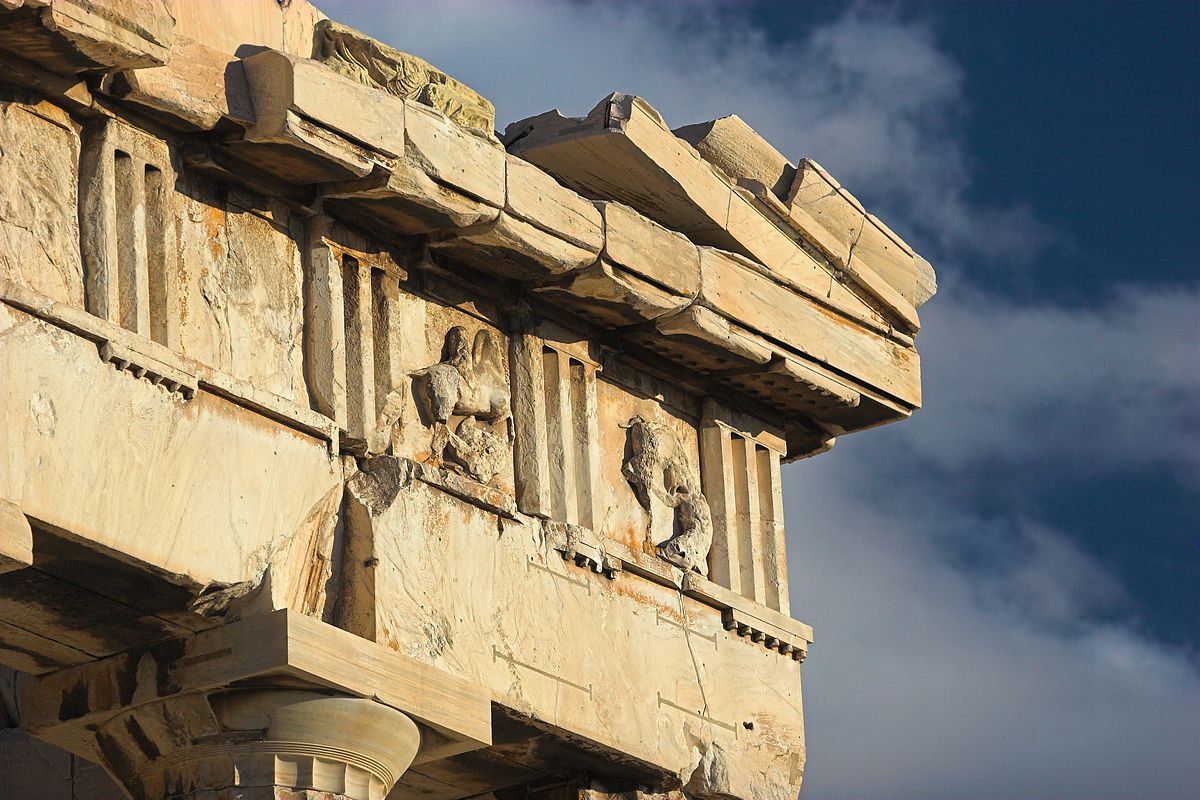
Analogous considerations apply to the sculptures of the Parthenon. Unusually for a classical Doric temple, all four sides of the Athenian peristyle were crowned by metopes sculpted in figural relief. The south metopes were still well preserved in 1674, when they were drawn by an artist in the employ of the French ambassador to Constantinople,[5] although some were destroyed in the explosion of 1687 while others were damaged and dismounted by Lord Elgin’s agents in the early nineteenth century.[6] Different in kind is the defacement visible on the east, west, and north metopes, whose figures have been systematically chiseled away. Only the figures on the westernmost of the north metopes—“North 32” according to standard numbering—are partially preserved ( fig. 1). The damage to the west metopes is documented in two seventeenth-century drawings, that to the north and east in drawings executed by William Pars in 1765/6.[7]
If we follow the guidelines proposed above, then the terminus post quem for the defacement of the Parthenon metopes is ca. 432 B.C., and a rough terminus ante quem may be set in the seventeenth or eighteenth century A.D.[8] However, scholars have sought to fill the two-millennium interval with a more confident story. For example:
When the Parthenon was transformed into a Christian church in the sixth century, most of the metopes sustained devastating damage by recently converted Christians who were eager to remove any vestige of pagan gods and goddesses from the former temple. Until then, all ninety-two reliefs had been intact. This intentional defacement was the worst single event to affect the metopes as a whole.[9]
This strong version of the story contains an implicit argument from epochal suitability: just as Julian and the “pagan aristocrats” might have born a grudge against Constantine, so too might “recently converted Christians” have acted to “remove any vestige of pagan gods and goddesses.”
Other scholars agree that the defacement was carried out by Christians, but are more cautious about the date and motivation:
the metope sculptures of the east, north, and west sides were defaced … but there is no way to known when and why this happened. One metope was left intact on the west end of the north side, possibly because it seemed to depict the Annunciation (the angel and Maria), a likely instance of interpretatio Christiana … For all we know, it was the Latin lords of Athens, in the period 1205–1456, who defaced and destroyed the metopes (it is unlikely to have been the Turks, because of the “Annunciation” metope).[10]
Or more succinctly: “We know Christians did it because they left untouched one [metope] which probably reminded them of the Annunciation.”[11]
All three passages quoted above cite the same source: a note published by the classical archaeologist Gerhart Rodenwaldt in 1933. Rodenwaldt’s paper advances three primary claims. First, the metopes were defaced when the Parthenon was converted into a church. Second, alone among the north metopes, the westernmost (North 32) was spared: “not a single blow of the chisel touched it.” Third, Christians left this metope intact because they interpreted it as a depiction of the Annunciation.[12]

This account has enjoyed wide acceptance. As we have seen, the supposed reinterpretation of North 32 has convinced even those scholars skeptical of the argument from epochal suitability to attribute the defacement of the metopes to Christians. In 2012, the metope itself, which had been removed from the building and conserved, was put on display in the Acropolis Museum ( fig. 2). The accompanying text identified the object as “The Metope of the Annunciation,” and relayed a modified version of Rodenwaldt’s argument: “Archaeological research has attributed the preservation of this metope to the fact that the scene was thought to portray the Annunciation of the Virgin Mary.”[13]
Nevertheless, not one of Rodenwaldt’s claims stands up to scrutiny. The first, that the metopes were defaced when the Parthenon was converted into a church, relies on the authority of Camillo Praschniker, who had argued as follows: the defacement of the metopes required the construction of scaffolding. The Ottoman conversion of the building to a mosque entailed few alterations to its fabric, but earlier when the Parthenon was converted to a church, “the cella was covered with vaulting, and various other changes were made that could not have been carried out without scaffolding.” This must have been the occasion on which the metopes were attacked.[14]
More recent study of the architectural remains has clarified the history of the Parthenon in late antiquity. After a fire whose causes and date are unknown, a series of repairs were undertaken, including the restoration of the eastern entrance, which was later blocked by the apse of the church, and the installation of a new pedestal for a statue in the cella. Both measures suggest that the cult of Athena was still active. Furthermore, the building’s wooden roof, which had been destroyed in the fire, was replaced by a new roof which did not extend to the peristyle, but covered only the cella. This arrangement was retained when the temple was converted to Christian use (which occurred by the seventh century at the latest). The sanctuary of the church occupied the roofed interior of the cella, while the space between cella and peristyle (the “pteroma”) was left open to the sky, forming “a sort of ambulatory.”[15] In short, the construction of the new roof and the conversion to a church were not simultaneous, and neither required the erection of scaffolding on the exterior of the peristyle.
Rodenwaldt’s second claim, that only metope North 32 was spared defacement, must also be abandoned. Although the figures on this relief were not completely removed, it too has suffered extensive damage. As John Pollini has discussed in detail, the heads of both figures were intentionally knocked off, and their arms and feet were attacked (see figs. 1 and 2).[16]
Despite this important observation, Pollini both maintains the traditional attribution of the defacement of the remaining metopes to late antique Christians (“probably carried out by Christian laborers involved in the conversion of the temple to a church,” 213), and repeats the theory of a Christian reinterpretation of North 32. Thus adherence to one argument from epochal suitability requires generation of a second: “the most likely time for the intentional mutilation of [North 32] would have been during the period of Christian iconoclasm in the 8th and 9th centuries” (216). However, unless it were possible to physically distinguish between two separate campaigns of defacement, the simpler hypothesis of a single attack should be preferred. Either the defacement of the north metopes was carried out from left to right (east to west) and abandoned before completion, leaving North 32 only partially defaced; or North 32 was difficult to reach and received a few targeted blows from a distance.

Finally, Rodenwaldt’s claim that Christians interpreted North 32 as a depiction of the Annunciation is not supported by any medieval or early modern source.[17] It relies entirely on his formal comparison of the metope with an ivory panel from the cathedra of Maximian in Ravenna ( fig. 3). The juxtaposition is ingenious, but without the contextual support of Rodenwaldt’s first two claims, it is nothing more than pattern matching.
To summarize, there is no evidence that the Parthenon metopes were defaced when the building was converted to a church. The more cautious attribution of the defacement to Christians working at some unspecified time should also be abandoned. Rodenwaldt’s theory of a “Metope of the Annunciation” relies on two faulty archaeological premises and a clever comparison. It cannot provide a basis for further arguments about the history of the building, much less for generalizations about early Christian responses to “pagan” sculpture.[18]
For the Parthenon, in contrast to the Arch of Constantine, we lack any contemporary record of the defacement of the reliefs. However, the seventeenth-century traveler Evliya Çelebi recorded an account of his visit to Athens which is interspersed with stories of a medieval sack of the Parthenon’s treasures:[19]
In the year (—), during the reign of the Umayyads, Sultan Mansur came from the Maghreb with 1,000 ships and conquered the islands of Crete and Sicily, and also conquered this walled town of Athens. He took away the … carbuncle lamps and the chains of jewels and thousands of precious idols and candlesticks and jewel-encrusted crosses.
A few pages later, Evliya provides an additional detail: “But when that terrible Sultan of the West, King Mansur, conquered this province, he gouged out the jewel-eyes of all the statues [sc. of the Parthenon] and ‘blinded’ them.”20 Like many of the stories recorded by Evliya, this account probably preserves a local tradition.[21] It would therefore constitute a rare Athenian account of the defacement of the sculptures of the Parthenon.[22]
The story seems to conflate two elements that are, taken in isolation, verifiable. First, there was a Fatimid caliph al-Mansur, who ruled in the Maghreb from 946 to 953, during the reign of the Andalusian Umayyads, and who oversaw the reestablishment of Fatimid rule in Sicily and launched raids against Calabria.[23] He did not rule in Crete, but (second) this island was from ca. 824 to 961 home to a petty emirate that undertook regular naval raids in the Aegean.[24] Apart from Evliya’s account, there is no written or archaeological evidence for an Arab sack of Athens, although Cretan troops will have come within sight of the city when they took Aegina.[25]
Yet in one sense Evliya’s account is of greater historical value than the story of newly converted Christians removing the old gods. Any theory of monotheistically motivated defacement of the Parthenon must contend with the multitude of sculptures (the south metopes, the frieze, and west pediment) that remained intact throughout Byzantine, Frankish, and Ottoman rule.[26]The rulers of Athens, Christian and Muslim, had centuries to dispose of them properly had they wished to do so. For al-Mansur’s reported assault, however, one could propose a practical motivation. The primeval rock of the Athenian Acropolis presents a spectacular natural defense, and its abundance of figural sculpture will have enhanced the appearance of impregnability for those who understood the supernatural ability of such objects to repel attack.[27] A force intending only to raid, not to occupy, might seek to weaken the city’s defenses by reducing its store of talismans before sailing home.
Thus, even if Evliya’s account relays a later invention, it is an invention that betrays an implicit awareness of the contours of
plausibility in local history, contours wholly distinct from those presumed by arguments from epochal suitability. The defacement of the Parthenon metopes, whether it occurred in the fifth century B.C., the seventeenth century A.D., or at any other time in between, was more likely an unpredictable irruption provoked by local exigencies, than a dutiful response to the call of world history.[28]
Notes
- J. Arce, “Damnatio memoriae sur l’arc de Constantin à Rome,” in S. Benoist (ed.), Mémoire et histoire: les procédures de condamnation dans l’Antiquité romaine (Metz 2007) 131–136.
- T. Molza, Delle poesie volgari e latine di Francesco Maria Molza, corrette, illustrate, ed accresciute II (Bergamo 1750) 203– 218; H. Bredekamp, “Lorenzinos de’Medici Angriff auf den Konstantinsbogen als ‘Schlacht von Cannae’,” in S. Michalski (ed.), L’Art et les révolutions. Section 4: Les iconoclasmes (Strasbourg 1992) 95–115; H. Bredekamp, Repräsentation und Bildmagie der Renaissance als Formproblem (Munich 1995) 42–46. None of these sources were known to Arce.
- For example, the defaced reliefs excavated at Saraçhane in Istanbul, and today housed in the Istanbul Archaeological Museum: R. M. Harrison, Excavations at Saraçhane in Istanbul I (Princeton 1986) 156–157.
- For example, a cast made in 1787 from a section of the east frieze of the Parthenon shows heads and bodies intact that were subsequently removed, perhaps to satisfy tourists’ desire for souvenirs of Athens: J. Pollini, “Christian Desecration and Mutilation of the Parthenon,” AthMitt 122 (2007) 207–228, here at 222–224.
- In the so-called “Album de Nointel.” For reproductions, see T. Bowie and D. Thimme, The Carrey Drawings of the Parthenon Sculptures (Bloomington 1971). On the attribution of the drawings see Jean-Pierre De Rycke, “Arnould de Vuez, auteur des dessins du Parthénon attribués à Carrey,” BCH 131 (2007) 721–753.
- Die Explosion des Parthenon (Berlin 1990); William St. Clair, Lord Elgin and the Marbles (Oxford 1998), esp. 92–93 and 102–103.
- For the seventeenth-century drawings see Bowie and Thimme, Carrey Drawings 89; and compare the drawing of the west pediment in the “Album de Nointel” (Bowie and Thimme 40–41). For the Pars drawings of the north metopes see F. Brommer, Die Metopen des Parthenon (Mainz 1967) 39–43 (this publication also includes thorough inventories of the preserved depictions of all four sides.) For the Pars drawings of the east metopes see F. Brommer, Die Skulpturen der Parthenon-Giebel (Mainz 1963), Taf. 3–4.
- Brommer, Die Metopen 157, proposes a terminus ante quem of 1674: “denn Carrey [to whom the drawings of the “Album de Nointel” were then attributed] hat doch offenbar damals von allen Metopen nur die der Südseite gezeichnet, weil die Metopen der anderen Seiten damals schon zerstört waren.”
- K. A. Schwab, “Celebrations of Victory: The Metopes of the Parthenon,” in J. Neils (ed.), The Parthenon: From Antiquity to the Present (Cambridge 2005) 159–197, here at 165.
- A. Kaldellis, The Christian Parthenon: Classicism and Pilgrimage in Byzantine Athens (Cambridge 2009) 41–42.
- G. Fowden, “The Parthenon between Antiquity, Barbarism, and Europe,” JRA 23 (2010) 802–810, here at 804.
- G. Rodenwaldt, “Interpretatio Christiana,” AA 48 (1933) 401–405; at 402, “kein Meißelschlag hat sie berührt.” For discussion of this essay in its intellectual-historical context see D. Kinney, “Interpretatio Christiana,” in P. B. Harvey, Jr., and C. Conybeare (eds.), Maxima debetur magistro reverentia: Essays on Rome and the Roman Tradition in Honor of Russell T. Scott (Como 2009) 117–125.
- Visit of 18 May 2014. The label text is available at http://www.theacropolismuseum.gr/sites/default/files/the_metope_of_the_ annunciation_en.pdf.
- C. Praschniker, Parthenonstudien (Augsburg 1928) 49: “Damals, als man das Dach entfernte und die Cella mit einem Gewölbe eindeckte und auch sonst große Veränderungen vornahm, die nicht ohne Einrüstung durchzuführen waren, muß man auch gewaltsam Hand an die Metopen gelegt haben.”
- M. Korres, “The Parthenon from Antiquity to the 19th Century,” in P. Tournikiotis (ed.), The Parthenon and its Impact in Modern Times (Athens 1994) 136–161, esp. 140–147; R. Ousterhout, “ ‘Bestride the Very Peak of Heaven’: The Parthenon After Antiquity,” in The Parthenon: From Antiquity to the Present 293–329, the quotation at 304.
- Pollini, AthMitt 122 (2007) 215.
- Even if such a source did exist, it would not necessarily speak to the motivation behind the defacement; North 32 could have been preserved by accident, only to be reinterpreted later. Compare e.g. the case of the ancient funerary stele dug up in Athens by “Ἐρνέστης τις Ῥωμαῖος φαρμακοποιός” in 1817. The locals identified it as a “holy image,” purchased it from the pharmacist, and set it up in the narthex of the Church of the Megali Panagia. See Γ. Δεσπίνης, “Ένα επιτύμβιο ανάγλυφο από τη Μακεδονία στην Αθήνα,” Εγνατία 3 (1991–1992) 57–70, here at 62–66.
- For a useful account that invokes the Parthenon metopes only in passing, and in the subjunctive, see T. M. Kristensen, Making and Breaking the Gods: Christian Responses to Pagan Sculpture in Late Antiquity (Aarhus 2013).
- R. Dankoff and S. Kim, An Ottoman Traveller: Selections from the Book of Travels of Evliya Çelebi (London 2010) 282. Turkish text in S. A. Kahraman, Y. Dağlı, and R. Dankoff, Evliya Çelebi Seyahatnamesi VIII (Istanbul 2003) 115.
- Dankoff and Kim, An Ottoman Traveller 286. Turkish: Kahraman et al., Evliya Çelebi Seyahatnamesi VIII 117. For the physical traces of targeted attacks on the faces of the Parthenon reliefs see Pollini, AthMitt 122 (2007) 218–219.
- See R. Dankoff, An Ottoman Mentality: The World of Evliya Çelebi (Leiden 2006), esp. 185–214. Evliya’s account of the Acropolis is presently being studied by Elizabeth Fowden.
- Compare the vague account relayed in Georges Guillet de Saint- Georges, Athènes ancienne et nouvelle (Paris 1675) 194: “Tout cela [sc. the sculptures on the exterior of the temple] a couru grand risque d’estre ruiné par le scrupule de la Religion Mahometane, qui ne souffre aucune figure de choses animées. Il y en a mesme quelques-unes qui sont mutilées. Mais enfin les plus honnestes gens d’entr’eux ont expliqué leur Loy plus favorablement, & arresté la suitte de ces débris…” Thereupon follows the story of the anonymous janissary’s assault on an image of the Virgin, also told by Spon and Wheler. On the long-running controversy regarding Guillet’s book see D. Constantine, “The Question of Authenticity in Some Early Accounts of Greece,” in G. W. Clarke (ed.), Rediscovering Hellenism: The Hellenic Inheritance and the English Imagination (Cambridge 1989) 1–22.
- H. Halm, The Empire of the Mahdi: The Rise of the Fatimids (Leiden 1996) 330–335.
- V. Christides, “The Raids of the Moslems of Crete in the Aegean Sea: Piracy and Conquest,” Byzantion 51 (1981) 76–111.
- On the Arab sack of Athens as a phantom of twentieth-century historiography see G. van Steen, “Sin and the City: A Mid-Fifteenth-Century Lament for the Fall of Athens to the ‘Persians’,” in D. Tziovas (ed.), Reimagining the Past: Antiquity and Modern Greek Culture (Oxford 2014) 229–251, here at 231–232; and Kaldellis, Christian Parthenon 94–95, with references to earlier literature. Evliya’s account was known to the historian who argued most vociferously that such a sack had occurred, albeit in an imprecise translation that hampered his understanding of the passage: Δ. Καμπού-ρογλου, Ἡ Άλωσις των Αθηνών υπό των Σαρακηνών (Athens 1935) 135–136. (Compare e.g. “ὁ Σουλτάνος Μανσοὺρ ἐπέδραμεν ἐκ τῆς χώρας τῶν Ἀρά-βων” with Dankoff and Kim’s “Sultan Mansur came from the Maghreb” for Evliya’s “Mağrib-zemînden Sultân Mansûr.”) Aegina: Christides, Byzantion 51 (1981) 87–89, 96–97, and 99–100.
- Pollini, AthMitt 122 (2007) 217–222, documents intentional damage to two blocks of the frieze (East Frieze V and North Frieze X), both of which were removed from the building in the course of renovations, and thus rendered susceptible to casual acts of vandalism.
- In general on such talismans see C. A. Faraone, Talismans and Trojan Horses: Guardian Statues in Ancient Greek Myth and Ritual (Oxford 1992); G. Calasso, “Les remparts et la loi, les talismans et les saints: la protection de la ville dans les sources musulmanes médiévales,” BEO 44 (1992) 83–104; J. Gonnella, “Columns and Hieroglyphs: Magic ‘Spolia’ in Medieval Islamic Architecture of Northern Syria,” Muqarnas 27 (2010) 103–120.
- I thank Annetta Alexandridis for her comments on an early draft of this paper; and the editorial board of GRBS and the external reviewer for suggesting helpful revisions.
Originally published by Greek, Roman, and Byzantine Studies 57 (2017), 248-260, under a Creative Commons Attribution 3.0 Unported license.
About the Author