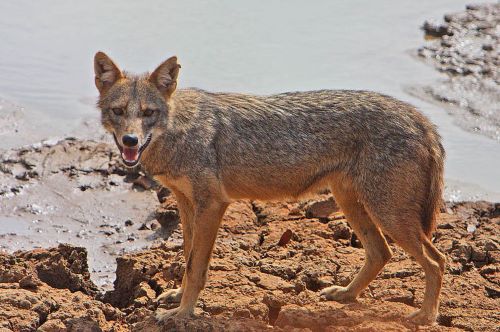
The jackal bears a particular status as a much-maligned beast.

By Dr. Reiko Ohnuma
Professor of Religious Studies
Dartmouth University
Abstract
Buddhist literature in Pāli presents a world that is rich in animal imagery, with some animals carrying largely positive associations and other animals seen in a consistently negative light. Among the many species that populate the Pāli imaginaire, the jackal bears a particular status as a much-maligned beast. Jackals are depicted in Pāli literature as lowly, inferior, greedy, and cunning creatures. The jackal, as a natural scavenger, exists on the periphery of both human and animal society and is commonly associated with carrion, human corpses, impurity, and death. In this paper, I am interested in the use of the jackal as an image for both heresy and heterodoxy—that is, the jackal’s consistent association with heretical Buddhist figures, such as Devadatta, and with heterodox teachers, such as the leaders of competing samaṇa movements. Why was the jackal such an appropriate animal to stand for those who hold the wrong views? And how does association with such an animal sometimes result in a particularly nefarious sort of dehumanization that goes against the teachings of Buddhism?
Introduction
Theravāda Buddhist literature preserved in Pāli (both canonical and commentarial, and dating from perhaps the 3rd c. BCE to the 5th c. CE) presents a world that is rich in animal imagery, with some animals carrying largely positive associations and other animals seen in a consistently negative light.1 Thus, the lion is the “king of beasts” and sovereign of the jungle, and its roar is a common image for the Buddha’s preaching of the Dhamma. The monkey is capricious and full of mischief, and its leaping from branch to branch is associated with the flighty nature of the human mind. The deer is the paradigmatic “wild” animal and the quintessential object of the hunt. The elephant is associated with royalty and fertility, while its taming under the goad of the mahout serves as an image for the spiritual discipline of a good monk. Buddhism in South Asia was physically rooted within a natural landscape alive with the reality of nonhuman animals and Buddhist monks, in particular, often built their monasteries on the outskirts of human settlements, as well as spending considerable time wandering or meditating in the wilderness. As a result, Buddhist texts display a high degree of knowledge of the characteristics, behaviors, and habitats of many different animal species, and make use of this knowledge to employ animal imagery for symbolic or metaphorical ends.
Among the many species that populate the Pāli imaginaire, the jackal bears a particular status as a much-maligned beast.2 As a natural scavenger, the jackal exists on the periphery of both animal and human society and is commonly associated with carrion, human corpses, impurity, and death. Descriptions of asubha-bhāvanā (“meditation on the foul”)—the practice of contemplating decomposing human corpses in order to realize the truth of impermanence—consistently refer to such corpses as being devoured and torn apart by jackals (along with other lowly animals, such as crows, vultures, and dogs).3 In a canonical discourse from the Saṃyutta Nikāya, the six senses are compared to six animals tied together with a rope, each animal straining to get to its own preferred domain, with the jackal wholly fixated on reaching the charnel-ground (Bodhi 2000, vol. ii, pp. 1255–57). “The jackal wishes to go to a charnel-ground full of corpses so it can eat human flesh, stretch out on its back, and lie down,” (Woodward 1929–1937, vol. iii, p. 69) notes the commentary, thus drawing a link between the jackal’s scavenging and its supposed laziness. Too weak and powerless to hunt for its own prey, the jackal is often depicted as living off the leavings of other, more powerful predators (particularly lions). It is constantly greedy for food, yet unwilling to work for it, and its palate is undiscerning: In the Milindapañha, in fact, the only practice of a jackal that a good monk should emulate is the fact that it “eats as much as it needs to, without feeling any disgust” and “does not stop to see whether the food is awful or delicious” (Trenckner 1880, p. 395).

The jackal’s association with scavenging, corpses, and death seems to lend it a permanent mark of impurity. According to the Udapānadūsaka Jātaka (No. 271), “this is the law for jackals: wherever they drink, they defecate” (Fausboll 1875–1897, vol. ii, p. 355). In explaining why any jackal can be referred to as an “old jackal,” the commentary to the Saṃyutta Nikāya notes that “just as even a golden-colored body is called a ‘putrid body’—and piss, from the moment it falls, is called ‘putrid piss’—in the same way, even a jackal born that very day is referred to as an ‘old jackal’” (Woodward 1929–1937, vol. ii, p. 208). The association of the jackal with filth, impurity, and the decrepitude of old age is perhaps further reinforced by its frequent affliction with various skin diseases. The jackal afflicted with mange, for example, is used as an image of mental discomfort in several discourses from the Saṃyutta Nikāya (Bodhi 2000, vol. i, pp. 685, 712), one of which notes that such a jackal “cannot get comfortable in a cave, at the foot of a tree, or in the open air. Wherever he goes, wherever he stands, wherever he sits, and wherever he lies down, he falls into distress and misery” (Feer 1884–1904, vol. ii, p. 230). As a result of mange and other afflictions, the commentary tells us, “all of the jackal’s fur falls out, and its entire body becomes hairless and breaks out into sores” (Woodward 1929–1937, vol. ii, p. 208).
These negative associations surrounding the jackal also extend to the characteristic sound that it makes—the jackal’s piercing howl, described in the Aṅguttara Nikāya commentary as “an unpleasant sound” made by “a broken voice” (Walleser and Kopp 1924–1957, vol. ii, p. 304). In fact, as van Damme (1991, p. 252) has noted, several Sanskrit nouns used to refer to the jackal (including śṛgāla, kroṣṭṛ, and gomāyu) suggest that it is identified, first and foremost, as “a screamer, a yeller.” The jackal’s howl is pathetic and ugly, and frequently contrasted with the magnificent roar of the lion. Altogether, these features conspire to give the jackal a low and ignoble status within animal society: In the Sigāla Jātaka (No. 152), it is “lowly and vile like an outcaste”;4 in the Daddara Jātaka (No. 172), it is the “lowest of all beasts”;5 and in the Anta Jātaka (No. 295), it is again the “lowest of all beasts,” grouped together with the crow as the “lowest of all birds” and the castor-oil tree as the “lowest of all trees” (Fausboll 1875–1897, vol. ii, p. 440). Physical impurity and low social status find their reflection in the jackal’s moral character, as well, for jackals are depicted in Pāli literature as lazy, greedy, and cunning creatures, always looking out for themselves and seeking to deceive and slander others to bring about their own ends.6 “Jackals behave badly”—the Manoja Jātaka (No. 397) states—“they are wicked by nature and urge others to do wrong” (Fausboll 1875–1897, vol. iii, p. 322).
The imagery surrounding jackals in Pāli Buddhist sources is consistent, moreover, with the imagery found elsewhere in South Asian tradition, for example, in Vedic and classical Hindu texts. As noted by Taylor (2007, pp. 56–57), the jackal’s association with death, inauspiciousness, and the eating of corpses goes all the way back to the Vedic Atharva Veda, and lends a sinister interpretation to the jackal’s howl, which generally augurs doom and misfortune. In the Mahābhārata (2.55.2–3) epic, for example, the evil Duryodhana, who is destined to bring about the ruin of his family, “cries discordantly like a jackal” upon his birth, and his father Dhṛtarāṣṭra is later criticized for not having recognized “the jackal in the form of Duryodhana living in your house” (Taylor 2007, p. 57). A jackal similarly howls at the game of dice that will result in disaster for the Pandava heroes. No doubt, this is why the ancient law-giver Manu advises, in the Mānava Dharma Śāstra (4.115), that “a brāhmaṇa shall not recite [the Veda] … while a jackal howls” (Taylor 2007, p. 57). Regarding the jackal’s low social status, Taylor further points to several associations between jackals and very low-caste people such as caṇḍālas, who are also sometimes described as carrion-eaters residing in the charnel-ground or otherwise banished to the outskirts of human settlements. Finally, in terms of its moral character, too, the greedy, cunning, and deceptive nature displayed by the jackal throughout the Pāli Jātakas (previous life stories of the Buddha) finds a close parallel in the Pañcatantra and other Hindu tale collections.7
To what extent do these negative depictions match up with the phenomenological reality of the Indian jackal? Is it true, for example, that the jackal is just a scavenger who lives off the hard work of others? Canis aureus indicus, the subspecies of the Golden Jackal found throughout the South Asian subcontinent, has been described as an “opportunistic omnivore” (Alam et al. 2015) or “opportunistic forager” (Negi 2014, p. 346) whose diet varies widely according to food availability. It is indeed an avid scavenger, but also a skillful hunter of small mammals, birds, reptiles, and fish, with a diet that further consists of perhaps 40% plants and fruits. In short, the jackal is “much less dependent on carrion than is commonly supposed”8—yet its scavenging perhaps makes the greatest impression upon human beings, since it is not uncommon for groups of jackals to rush in and descend upon the kills of larger predators, such as leopards, lions, or tigers,9 or for jackals close to human settlements to frequent both abattoirs and cremation grounds. Regarding its characteristic cry, the Golden Jackal does indeed produce “a high-pitched, wavering howl” (Macdonald 2007)—but rather than auguring doom and misfortune, the primary function of the howl is to locate the jackal’s family members and announce the family’s territory to other jackal groups in order to avoid accidental confrontation (Negi 2014, p. 351). The jackal’s association with impurity and disease perhaps has some basis in fact: “Skin diseases like mange and parasites like ticks and fleas are common in jackals in areas where they occur at high densities” (ibid., p. 353), and rabies epidemics are frequent. Finally, while it makes little sense, of course, to speak of the “moral character” of a particular animal species, we can at least note that the jackal has just as many features that might lead human beings to give them a positive moral depiction as those that have been perceived negatively: Jackals have excellent “family values,” for example. They are monogamous and mate for life, and both males and females take care of their young, while young adults often remain with their parents for a time to help protect a subsequent litter of cubs.10
In short, the Buddhist depiction of the jackal is a curious mixture of fact, fiction, and exaggeration. The phenomenological reality of the animals monastic authors encountered in the wild obviously shaped and constrained—yet it did not fix or determine—the symbolic representations of animals they employed in Buddhist texts. This constant interplay between animal representations and actual animals makes the animal a particularly interesting symbolic resource. In fact, out of all of the nonhuman realms of rebirth that are posited in Buddhist cosmology—such as gods, demi-gods, hungry ghosts, and hell-beings—animals are the only nonhuman realm of rebirth that is actually visible and present to us in the real world. The reality of animals and the aliveness of animals push back against the human imagination and finally resist our complete control. The animal alone, among all symbols, gazes back at us.
The Heretical, Heterodox Howl

Due to its negative connotations, the jackal seems to have become a convenient image used by Buddhist authors to condemn certain human characters and human behaviors by associating them with the jackal,11 either metaphorically or through the mechanism of a previous rebirth. This is often the way in which animals function in narrative literature: Because of their highly stereotypical characters, animals constitute a convenient shorthand for highlighting certain aspects of a human being’s personality, thereby circumventing our ordinary perception of human beings as highly complex individuals. In our own cultural context, for example, as soon as two human characters are compared to the tortoise and the hare, we immediately understand that the essential point of the story will be that the former is “slow” while the latter is “fast”—but those who are “slow” may prevail. In this way, the message of the story is clearly signaled, uncluttered by the complicated messiness of actual human beings (Lessing 1996; Daston and Mitman 2005).
Thus, in both the Biḷāra Jātaka (No. 128) and the Aggika Jātaka (No. 129), the “deceitful” (kuhaka) character of a particular monk is highlighted through his previous rebirth as a deceitful jackal, who pretends to be an ascetic in order to gain the trust of a troop of rats, only to kill and eat them.12 In the Saṃyutta Nikāya, the anxiety and worry of a monk whose mind is obsessed with gain, honor, and fame are compared to the constant discomfort experienced by a jackal afflicted by mange (Bodhi 2000, vol. i, p. 685). In the Sandhibheda Jātaka (No. 349), the destructive slander engaged in by the notorious “Group of Six” monks (chabaggiya) is compared to a jackal who slanders other animals in order to bring about its own benefit.13 And, in the Dabbhapuppha Jātaka (No. 400), the perennial “greed” (mahātaṇhā) of the monk Upananda is highlighted by his previous rebirth as a greedy jackal who tricks two otters out of a fish.14 In this way, some of the standard elements of the jackal’s depiction—its deceitfulness, greed, cunning, and discomfort caused by mange—are invoked in order to highlight the particular aspects of the human characters each story wishes to emphasize. Moreover, the contrast between different characters can be expressed in an economical fashion through the contrast between different species of animals. Thus, in the Cattumaṭṭha Jātaka (No. 187), the stupidity of a monk who has renounced in old age (the stock image of the mahallaka-bhikkhu) is contrasted with the wisdom of Sāriputta and Moggallāna (the Buddha’s two chief disciples) through their previous rebirths as a jackal and two geese, respectively. In this tale, the two geese perch in a certain tree every day to talk about spiritual matters, but leave in disgust when a jackal wishes to join them. Even before hearing the story, however, we can recognize the basic contrast being drawn, since the goose in Buddhist literature (in stark contrast to the jackal) has royal connotations and is generally depicted in a positive light.
Though many different animals can be used in this way—that is, to signal either positive or negative qualities—what I am particularly interested in here is the jackal’s consistent association with both heresy and heterodoxy. While a variety of animals can be employed to suggest that a person is deceitful, stupid, selfish, lazy, or greedy, it is the jackal alone who is generally invoked to condemn someone for having the wrong view. I use the term heresy here to signify the adherence to blasphemous or unacceptable views by one who identifies with the Buddhist tradition itself—the prime example being the Buddha’s cousin and schismatic monk Devadatta. In contrast, I use the term heterodoxy to stand for non-Buddhist teachers whose teachings were in direct competition with the Dhamma propounded by the Buddha—for example, Jains and other renunciant teachers, variously referred to in Pāli as titthiyas, samaṇas, or paribbājakas. Why is the jackal so often associated with heretics and heterodox teachers?
It is the jackal’s propensity to howl, I contend, that makes it a particularly suitable image for those who voice the wrong views: Just as the jackal uses its “broken voice” to produce an “unpleasant” howl, so do heretics and heterodox teachers use their voices to propagate harmful teachings. The demonization of such figures through association with the jackal’s ugly howl becomes even more effective when we consider the common opposition drawn between the jackal and the lion—and the many associations between the lion and the Buddha, which all pertain to the Buddha’s preaching: He sits upon a “lion-throne” (sīhāsana) and preaches the Dhamma with a “lion’s roar” (sīhanāda). “Lion,” as the Aṅguttara Nikāya notes, “is a designation for the Tathāgata, Arhat, fully enlightened Buddha, and the Dhamma taught by the Tathāgata to the assembly—that is his Lion’s Roar” (Morris 1885–1910, vol. iii, p. 122). Thus, the teaching of the Buddha is like the magnificent roar of the lion, while the teachings of heretics and heterodox teachers are like the pathetic howl of the jackal; in this way, the superiority of the Buddha’s teaching over all others is affirmed. To this opposition between the lion’s roar and the jackal’s howl, we can also add a further opposition between the lion as predator and the jackal as scavenger, the first being self-sufficient and hunting its own prey and the latter merely surviving off the scraps left by others. In fact, both of these oppositions come together in a common scenario found frequently in Buddhist texts: The lazy jackal slinks around after the lion, gets fat on the lion’s leftovers, and eventually comes to think that it is the lion’s equal. But as soon as it tries to roar like a lion, everyone knows it is just a jackal—because of its pathetic jackal’s howl. By means of this common trope, not only is the truth of the Buddha’s teaching contrasted with the falsity of the teachings of others but, in addition, the total self-sufficiency of the Buddha (as predator) is contrasted with the dependence and helplessness of others (as scavengers).

Let us look at a few examples of the functioning of this trope in connection with heterodox (non-Buddhist) figures. In the Pāṭika Sutta of the Dīgha Nikāya (No. 24) (Walshe 1995, pp. 371–83), the naked ascetic (acela) Pāṭikaputta challenges the Buddha to a contest of supernatural miracles, boastfully claiming that he will perform twice as many miracles as the Buddha. However, when the time for the contest arrives, Pāṭikaputta finds that he cannot even rise from his seat. The Buddha and Pāṭikaputta are then compared to a lion and a jackal: The jackal sees the lion emerge from its lair, look around in all directions, and roar three times—and thinks to itself: “What’s the difference between me and the lion, king of beasts?” (Rhys Davids and Stede 1890–1911, vol. iii, p. 24). Thus, the jackal, too, emerges from its lair, looks around in all directions, and tries to roar three times—but can only howl like a jackal. “In just the same way, Brother Pāṭikaputta, you live amidst the good deeds of the Well-Gone Ones, eating the leftovers of the Well-Gone Ones, and you think that you can compare to Tathāgatas, Arhats, fully enlightened Buddhas! But how can miserable Pāṭikaputtas compare to Tathāgatas, Arhats, fully enlightened Buddhas?” (ibid.). The full import of the lion/jackal metaphor is then expressed in verse:
Considering itself to be a lion,
(ibid., vol. iii, pp. 25–26)
the jackal thinks, “I’m king of the beasts!”
Even so, it howls like a jackal.
And how can the wretched [howl of] the jackal compare to a lion’s roar?
… Following after another and seeking its scraps,
the jackal is so unaware of itself that it thinks itself a tiger.
Even so, it howls like a jackal.
And how can the wretched [howl of] the jackal compare to a lion’s roar?
… Eating frogs and mice from the threshing-room floors,
and corpses thrown into the charnel-ground,
growing fat in the great and empty wilds,
the jackal thinks, “I’m king of the beasts!”
Even so, it howls like a jackal.
And how can the wretched [howl of] the jackal compare to a lion’s roar?
Heterodox teachers are, thus, depicted as those who live off the scraps of the Buddha’s fine reputation. They may look like the Buddha and try to act like the Buddha—but their false teachings finally reveal their true nature.
In a discourse from the Aṅguttara Nikāya (Bodhi 2012, pp. 277–79), it is a wanderer (paribbājaka) named Sarabha who announces to an assembly of people in Rājagaha that having learned the Buddha’s Dhamma and Vinaya, he rejected it and chose to leave it. Nevertheless, when confronted by the Buddha himself, Sarabha is reduced to total silence. The other wanderers then rebuke Sarabha by comparing him to the cowardly jackal: “Friend Sarabha, suppose an old jackal in a vast forest were to say, ‘I will roar a lion’s roar,’ but only howl and yelp like a jackal. In just the same way, Friend Sarabha, when the ascetic Gotama is elsewhere, you say you will roar a lion’s roar, but you only howl and yelp like a jackal” (Morris 1885–1910, vol. i, p. 187). Here, the commentary also explains to us the jackal’s faulty line of reasoning: The jackal looks at the lion and thinks, “That’s an animal and so am I. That has four limbs and so do I. So I, too, will roar a lion’s roar!” (Walleser and Kopp 1924–1957, vol. ii, p. 304)—but of course, it can only howl and yelp like a jackal. The superficial similarity between the two animals—the fact that both of them are four-footed mammals—belies the crucial difference between their voices. In just the same way, of course, the early Buddhist community likely existed within a context in which the distinctiveness of its own teaching was obscured by the many similarities in physical appearance and behavior between itself and various other groups of titthiyas, samaṇas, and paribbājakas.
We find the same concern with distinguishing between similar external trappings and crucial differences in teaching in a discourse from the Saṃyutta Nikāya (Bodhi 2000, vol. i, pp. 161–63). Here, a series of deities who, in their former lives, were the disciples of the heterodox teachers Pūraṇa Kassapa, Makkhali Gosāla, Nigaṇṭha Nātaputta, and Pakudhaka Kātiyāna each recite verses in praise of their former teachers—whereupon another deity rebukes them by means of the lion/jackal trope:
Even while behaving the same, the wretched jackal
(Feer 1884–1904, vol. i, p. 66)
will never be anything like a lion.
[So too,] the naked teacher who leads an assembly
but speaks falsely and behaves wickedly
is nothing like those who are good
Or, as the commentary paraphrases, “heterodox teachers are like black jackals—how can you turn them into lions?” (Woodward 1929–1937, vol. i, p. 127). Thus, looking like a teacher, being surrounded by disciples, and attaining a certain degree of success—none of these external trappings guarantees the truth of one’s teaching, which is only revealed when the teacher opens his mouth.15 We can see in all of these passages a sense of anxiety that due to certain similarities in appearance, Buddhist “lions” might be indistinguishable from heterodox “jackals.” Hopefully, of course, the distinction will become clear as a result of hearing their respective teachings—yet we can also sense a worry that remains unstated in the use of this trope: Is the difference between the lion’s roar and the jackal’s howl really enough to ensure the success of the Buddha’s Order? In a pluralistic religious environment in which many different groups are competing for householders’ alms, could the Buddhist community rely on the distinctiveness of the Dhamma alone to secure their survival and flourishing?

There is one jātaka, in fact, that directly connects the distinctions between different animal species to the issue of different religious groups competing for householders’ alms. In the Neru Jātaka (No. 379) (Cowell 1895–1913, vol. iii, pp. 159–60), the Buddha tells the story of a golden mountain whose special feature is that all animals on the mountain look exactly the same, due to the mountain’s golden reflection. One day, two geese arrive at this mountain—and here, we should keep in mind that geese are positively depicted in Buddhist literature and often associated with Buddhism itself—yet they soon fly away in utter disgust. Why? Because the mountain makes all animals look exactly the same. And who wants to stay on a mountain where geese, the “best of birds,” look identical to ravens and crows, and where jackals, the “vilest of beasts,” look exactly like tigers and lions?16 In other words, who wants to stay on a mountain where the crucial differences between animal species go unrecognized? Here, we should take note of why the Buddha tells this story: He tells it to instruct his monks that they should leave a particular area once it becomes clear that the householders of that area patronize the teachers of other sects. These householders are thus likened to those who are fooled by the mountain’s golden reflection into believing that all animals are golden, thereby failing to distinguish properly between Buddhist “geese” and “lions” and heterodox “crows” and “jackals.” Once again, we can see in this story the Buddhist community’s anxiety that the distinctiveness of the Dhamma alone might not be enough to compete effectively for householders’ alms against other religious groups.
Claire Maes, drawing on the work of Jonathan Z. Smith, has described the various non-Buddhist ascetic groups that surrounded the early Buddhist community as Buddhism’s “proximate other”—an “other” that is particularly threatening precisely because it is so proximate to the self.17 In comparison to the “remote” other or the “absolute” other, she notes, “The dialectical force of the proximate other lies in the fact that when a community is defining its proximate other it is simultaneously defining itself” (Maes 2016, p. 544). She further observes that among the various labels one might use to designate one’s proximate others, those that function metonymically are most revealing of the dialectical process through which a community engages in “othering” in order to simultaneously define itself. Her example of a metonymical designation is the term acela (“without cloth”), generally translated as “naked ascetic” and used in connection with various non-Buddhist groups who made a practice of wandering naked. When Buddhist authors refer to other groups as acela, or “naked ascetics,” they are simultaneously constructing a Buddhist identity around their commitment to wearing a monastic robe—that is, they are marking themselves in terms of cela, not acela. In other words, they observe a group that might in many ways be quite similar to their own, and then highlight a single criterion of difference—the presence or absence of clothing—which then becomes symbolic of the difference between the two groups, and serves to define themselves just as much as it defines their “others.” In this way, a Buddhist identity, rather than being essentialized, is constructed relationally and through processes of othering.
Though the jackal’s howl is not a term of designation, it is, I think, an image or trope that likewise functions in a metonymical manner. In fact, part of the usefulness of animal imagery, as we have already seen, lies precisely in the highly stereotypical manner in which different species of animals are depicted, which aids in the metonymical project. Thus, associating heterodox teachings with the pathetic howl of the jackal simultaneously constructs the Buddha’s teaching as the magnificent roar of the lion, and assures the Buddhist community that they are lions rather than jackals. Both may be four-footed mammals—but once they open their mouths, it is hoped, one will see the difference between them.
Devadatta as Jackal

I turn now from the jackal’s association with heterodoxy to the jackal’s association with heresy, or the holding of wrong and unacceptable views by one who identifies with the Buddhist tradition itself. The primary example of heresy is the infamous figure of Devadatta, who is not only the Buddha’s own cousin, but also a Buddhist monk of long standing; nevertheless, Devadatta is famous for attempting to wrest leadership of the Sangha away from the Buddha, trying to assassinate the Buddha on three different occasions, and propagating harmful teachings that threatened to lead to a schism in the unified Sangha.18 If heterodox, non-Buddhist teachers constitute the early Buddhist community’s “proximate other” (an other that is threatening because of its proximity to the self), then the heretic Devadatta is an “even-more-proximate other”—an “other” who aggressively claims that he is, in fact, the self. We should not be surprised, then, to find the lion/jackal trope used in connection with Devadatta.
We might begin by noting that even apart from any reference to the lion, Devadatta is frequently associated with the jackal and tarred with the jackal’s negative qualities. Thus, in the Sigāla Jātaka (No. 113) (Cowell 1895–1913, vol. i, pp. 255–56), Devadatta’s false teachings and heretical views (laddhi) (Fausboll 1875–1897, vol. i, p. 424) are explained through his previous rebirth as a cunning jackal who successfully tricks a brahmin and defecates all over his coat. In the Sabbadāṭha Jātaka (No. 241) (Cowell 1895–1913, vol. ii, pp. 168–70), the fact that Devadatta won many followers but could not hold onto them for long is explained through his previous rebirth as a jackal, “stiff in pride and greedy for followers” (Fausboll 1875–1897, vol. ii, p. 244), who becomes the king of all beasts but quickly loses his station. In both the Jambukhādaka Jātaka (No. 294) and the Anta Jātaka (No. 295) (Cowell 1895–1913, vol. ii, pp. 299–301), the tendency of Devadatta and his closest ally Kokālika to flatter and praise one another is explained through their previous rebirths as a jackal and a crow (another lowly beast) who constantly flatter one another. In this way, the jackal’s characteristic qualities of cunning, greed, and deceptive speech are invoked in order to condemn these same qualities in Devadatta. In some cases, moreover, Devadatta is maligned as being even worse than a jackal. In a discourse from the Saṃyutta Nikāya (Bodhi 2000, vol. i, p. 712), the Buddha says that a certain monk—identified by the commentary as Devadatta19—is so evil that he would be lucky to attain rebirth as a jackal afflicted with mange. Likewise, in the immediately following discourse (Bodhi 2000, vol. i, p. 712), the Buddha says that this same monk has even less gratitude and gratefulness than an “old jackal.”20 Devadatta thus out-jackals even the jackal itself.
It is in combination with the lion, however, that the image of the jackal works most effectively to demonize Devadatta. Since Devadatta’s specific misdeeds involve an attempt to usurp the position of the Buddha as leader of the Sangha—just as the jackal is commonly described as attempting to usurp the position of the lion as king of all beasts—the lion/jackal scenario is particularly apt in his case. Thus, the Virocana Jātaka (No. 143) (Cowell 1895–1913, vol. i, pp. 305–7) tells of the previous rebirths of the Buddha and Devadatta as a lion and a jackal, respectively. At the beginning of the story, the jackal throws itself at the magnificent lion’s feet and begs to be the lion’s servant in exchange for meat from the lion’s prey—just as Devadatta, initially, submitted himself to the Buddha’s authority. After living contentedly in this arrangement for a while, however, the jackal “grows in pride,”21 eventually coming to think that it is just as good as the lion. Once again, the jackal looks at the lion and thinks, “I, too, have four legs. Why should I live, being nourished by others every day? From now on, I, too, will kill elephants and so forth and eat their flesh” (Fausboll 1875–1897, vol. i, p. 492). Naturally, however, the jackal is not a very good hunter and soon ends up having its skull crushed by an elephant. Thus does the uppity jackal come to ruin—just as Devadatta, “showing himself in the guise of the Well-Gone One and thinking that he could engage in the sport of a Buddha,”22 also comes to ruin. Here, in lieu of the contrast between the lion’s roar and the jackal’s howl, it is instead the contrast between the lion as a self-sufficient predator and the jackal as a helplessly dependent scavenger that serves to mark the difference between the Buddha and Devadatta. What Devadatta fails to realize is the difference between a Buddha, who discovers the Dhamma on his own, and a disciple, who has to hear the Dhamma from the Buddha—or in other words, the difference between a predator and a scavenger. Once again, the stark contrast between the lion and the jackal can help us distinguish the true Buddha from the false Buddha Devadatta, an “other” who is otherwise disturbingly proximate to the Buddha, for he too is a Buddhist monk and even the Buddha’s own cousin.
We find exactly the same scenario in the Jambuka Jātaka (No. 335) (Cowell 1895–1913, vol. iii, pp. 74–76), which uses the same characters (Devadatta as jackal, the Buddha as lion) and tells much the same story: Once again, the jackal grows haughty, attempts to usurp the lion’s place, and meets an unfortunate end, whereupon the lion recites a verse:
One who invests oneself with the pride of a lion,
(Fausboll 1875–1897, vol. iii, p. 114)
even though it’s a jackal and not a lion,
upon attacking an elephant,
soon lies on the ground lamenting
The same lion/jackal imagery is also used in order to warn other Buddhist monks not to consort with schismatics like Devadatta: Thus, in the Manoja Jātaka (No. 397) (Cowell 1895–1913, vol. iii, pp. 199–200), the behavior of a “monk who keeps bad company”23 is explained through his previous rebirth as a lion-cub who falls for the cunning speech of a jackal and soon comes to regret it—even though the lion-cub’s own father had tried to warn it against consorting with jackals, who “behave badly and are wicked by nature.”24 As we might expect, the jackal was a previous rebirth of Devadatta, while the lion-cub’s father was a previous birth of the Buddha.

We can return to the theme of the lion’s roar and the jackal’s howl—and their specific connection with preaching—by looking at two jātakas involving Kokālika, one of the partisan followers of Devadatta and a monk renown for constantly talking too much.25 In the Daddara Jātaka’s “story of the present” (No. 172) (Cowell 1895–1913, vol. ii, pp. 45–46), some learned monks at Jetavana are described as sounding “like young lions roaring”26 whenever they recite the Dhamma. The monk Kokālika, “not knowing how worthless he was,”27 believes that he can recite the Dhamma just as well as them, and pesters them until they agree to allow him to recite. When the time comes, Kokālika dresses himself in elaborate robes and ascends the preaching seat, but soon breaks out in a sweat and is only able to recite a single verse before becoming flustered and running away out of shame. The other monks then observe that “formerly, it was difficult to see how worthless Kokālika was, but now, he himself has made it clear by speaking” (Fausboll 1875–1897, vol. ii, p. 66)—whereupon the Buddha explains that he also did this in the past. He then relates a “story of the past” in which a lion-king and its many followers all roar, but fall silent with disgust when they hear a jackal try to imitate them by howling. The lion-king’s son then asks his father: “Who is this who reveals himself by means of his own voice?” And the lion-king responds: “It’s the jackal, son, the vilest of all beasts, who utters that sound; despising its kind, the lions sit in silence” (ibid., vol. ii, p. 67). The jackal, of course, was a previous birth of Kokālika, while the lion-king and its followers were the previous rebirths of the Buddha and his monks.
Here again, we find the idea that jackals may look something like lions, but as soon as they open their mouths, the differences will become clear—just as a monk like Kokālika may take on all of the external trappings of a learned monk who can preach, but the preaching itself will betray him. Once again, we find the same anxiety expressed that a monk’s worthless nature might be “difficult to see” at first—and the same reassurance that what they say will make it clear. Of course, this is not a story about heresy per se, since it is Kokālika’s ability to recite the Dhamma correctly that is at stake; nevertheless, Kokālika’s close association with Devadatta perhaps justifies our placing this story in the same category of the “even-more-proximate-other.” Just as the existence of other ascetic groups who looked and acted somewhat like the Buddhists themselves required the early Buddhist community to define itself in opposition to its “proximate others,” so also, those monks who saw themselves as good, virtuous, and well-disciplined perhaps had to be on constant guard to identify their “even-more-proximate-others”—who must have been something like an enemy within, virtually indistinguishable from oneself. Invoking the clear and stark contrast between the lion’s roar and the jackal’s howl was perhaps reassuring in such a context.
In the Sīhakoṭṭhuka Jātaka (No. 188) (Cowell 1895–1913, vol. ii, p. 75), which again pertains to the episode of Kokālika’s faulty reciting, the same need to recognize one’s very-proximate-others in order to define and distinguish oneself in opposition to them is expressed with even more anxiety through the image of an animal that is half-lion and half-jackal. Here, a male lion mates with a female jackal to produce a cub that is half and half. This is how the cub is described: “Its paws, its claws, its mane, and its body—in all these attributes, it was like its father. But in voice, it was like its mother” (Fausboll 1875–1897, vol. ii, p. 108). In other words, it looks exactly like a lion, but its true nature resides in its howl, which is that of a jackal. The half-breed cub was, of course, a previous rebirth of Kokālika, whose true nature was only revealed when he tried in vain to preach the Dhamma. Thus, whereas in previous stories, we have seen the idea that a jackal might be confused with a lion because both of them are four-footed mammals, here we have the more worrying case of a jackal who looks exactly like a lion—with only its howl betraying its true identity. This is parallel, of course, to the fact that Buddhist monks residing together in a monastery must have looked and behaved much the same—particularly because they were all following the same Vinaya (monastic code)—which presumably made the identification and avoidance of the “bad apples” among them all the more complicated. “Listen carefully to what your fellow monks are saying”—the story seems to suggest—“so you can identify the ‘other’ who lurks within your midst”.
The early Buddhist community existed within a pluralistic and competitive religious environment—an environment in which it continuously had to negotiate its own identity in relation to various “proximate others,” such as the non-Buddhist titthiyas, samaṇas, and paribbājakas with whom it shared the Indian landscape, and in relation to “even-more-proximate others,” such as the heretical monks within its own monasteries. The same process may even have extended down to the level of the individual, such that a “good” monk had to define himself in opposition to other monks—seen as “bad”—who nevertheless may have looked and behaved very much like himself. Within such a context, involving multiple levels of othering, the stark dividing lines that characterize the depictions of different species of animals perhaps constituted one important symbolic resource for negotiating a Buddhist identity. By confidently branding his various “others” as weak and scavenging jackals, the virtuous Buddhist monk further solidified his own identity as a strong and powerful lion. There is, of course, a certain irony involved in the use of such imagery, for Buddhist monks—as bhikkhus, or “beggars,” wholly reliant on others for their subsistence—are themselves the ultimate scavengers. In fact, from this perspective, it is, perhaps, the laity who constitute the true “lions” by providing food for others.
Demonization of Others and the Language of “Birth” or “Kind”

In his discussion of the use of animal characters in the Hindu Pañcatantra and other Sanskrit tale collections, Patrick Olivelle asserts that one of the major functions fulfilled by animal tales in India is to naturalize caste distinctions and caste hierarchies: “Animals, divided as they are into distinct species, provide a wonderful canvas to paint the picture of a society divided into distinct groups” (Olivelle 2013, p. 8). Using animals to represent castes effectively suggests that “such social classes are not contingent social formations but essentially different species” (ibid.)—species, moreover, whose characters are inborn and immutable, such that “it is impossible to turn a meat-eating animal into a grass-eating one … [or] to change the disposition of a jackal … [or] that a snake and a mongoose should become friends.”28
Building upon Olivelle’s insight, McComas Taylor’s monograph-length study of the Pañcatantra (2007) demonstrates that within the world it describes, different species of animals constitute mutually exclusive “kinds” (jāti). Each “kind” is characterized by its own “essential nature” or “natural disposition” (svabhāva), a particular social status (whether high or low), and natural relations of enmity and amity with other “kinds.” Transgressive actions that violate these strictures (such as a jackal’s assumption of kingship, or the friendship between a “meat-eater” and a “grass-eater”) are consistently shown to be unwise, untenable, and unsustainable—since “one’s own nature is hard to transcend” (as the Pañcatantra itself puts it) (Olivelle 1997, p. 131). All of these assumptions, Taylor argues, are likewise meant to be applied to the human categories of class and caste—varṇa and jāti—which are likewise immutable, hierarchically arranged, and determined solely by birth. In this way, the Pañcatantra participates in an authoritative “discourse of division” that is fundamental to Hindu thought, and engages in a thoroughgoing project of “naturalization,” whereby the socially constructed phenomena of caste are projected onto the natural species of the animal kingdom and thus made to seem wholly “natural”.
Though we occasionally find the same use of animals in the Pāli Jātakas, as well,29 overall, the Buddhist tradition, with its very different interpretations of caste,30 seems relatively uninterested in using animal species to naturalize caste distinctions. In fact, one important scripture on caste—the Vāseṭṭha Sutta, found in both the Sutta Nipāta (Norman 1984–1992, vol. i, pp. 103–10) and the Majjhima Nikāya31—explicitly argues against the view that animal species can be analogized to human castes. In refuting a brahmin’s view that the superiority of the brahmin caste is a matter of birth, the Buddha says: “I will explain to you truthfully and in due order … how living beings are classified by ‘kind’ (or ‘species’ or ‘caste’ or ‘birth,’ jāti)—for [different] ‘kinds’ are mutually distinct from one another” (Andersen and Smith [1913] 1990, p. 117). He then runs through a list of plants, insects, quadrupeds, snakes, fish, and birds, stating that each individual species has its own “characteristic mark” (liṅga). However, he continues: “Whereas in those kinds, the characteristic mark that constitutes each kind is distinct, among human beings, there is no characteristic mark constituting each kind as distinct” (ibid., p. 118). Human beings are similar, for example, in terms of their eyes, noses, mouths, and other body parts; all human beings are biologically the same. “Among human bodies, no distinctions can be found. Distinctions among human beings are created through designation [alone]” (ibid., p. 119). Thus, the project of naturalization is thoroughly repudiated: different human castes are not akin to biologically distinct animal species; instead, caste designations are merely social conventions.32 Likewise, certain human beings are not constitutionally inferior to others; instead, each person’s true status depends upon his or her behavior and virtue alone—all common Buddhist tropes in speaking about caste.
Yet in spite of the Buddhist tradition’s disinterest in using animal species to naturalize the institutions of caste, the use of animals to demonize certain people still remains vulnerable to falling into the particular type of dehumanization brought about by employing the naturalizing language of “kind,” “species,” “birth,” or “caste”—in other words, the language of jāti. In some stories, in other words, the jackal is used to suggest that heretics, heterodox teachers, and other negatively perceived figures should be condemned not merely because of the actions they engage in or the teachings they propagate, but also because they are constitutionally inferior by birth—which seems a most un-Buddhist position. In these instances, it is no longer the case that all human beings are essentially the same, to be judged on their behavior and virtue alone. Instead, the targets of criticism have been profoundly “othered” and dehumanized—turned into a foreign species and incapable of ever rising above their lowly station.
One example of this can be seen in the Catumaṭṭha Jātaka (No. 187) (Cowell 1895–1913, vol. ii, pp. 73–74) discussed earlier. Here, the wisdom of the Buddha’s two chief disciples, Sāriputta and Moggallāna, is contrasted with the stupidity of an “old monk” (mahallaka-bhikkhu) by relating a past-life story in which two geese perch in a certain tree every day to talk about spiritual matters, but leave in disgust when a jackal tries to join them. A nearby tree-spirit then recites a verse in which he sarcastically refers to the jackal as a “Fourfold Pure One.” What does this title mean? The word-commentary explains:
This means one who is pure (suddha) and clean (maṭṭha) with respect to four things: body, birth (jāti), voice, and qualities. He is really speaking about one who is impure (asuddha) and censuring him by using [sarcastic] words of praise. The [true] meaning here is, “What are you doing here, jackal who is inferior in these four things?”
(Fausboll 1875–1897, vol. ii, p. 107)

The implications of such a passage are rather disturbing. Here, it is no longer merely the case that an old monk can be compared to a jackal because of his dimwittedness; now we have an assertion that the old monk is impure—in his body and in his birth—such that he is unworthy of keeping company with those who are pure and clean. A deficiency in intelligence is, thus, transformed into a congenital state of impurity. This is the dark underside of animal imagery: The ease of ascribing a constitutional impurity to the jackal carries over and affects the demonization of the old monk. In this way, the old monk is profoundly “othered” and dehumanized.
The language of “birth” equally affects the treatment of Devadatta in the Jambuka Jātaka (No. 335) (Cowell 1895–1913, vol. iii, pp. 74–76), also discussed earlier. Here, when the lion (a previous rebirth of the Buddha) warns the jackal (a previous rebirth of Devadatta) that it is not capable of hunting its own prey, it is the language of birth into the right family that is employed: “Listen, Jackal, please don’t do this! You were not born from the womb of those who kill elephants and eat their flesh … You weren’t born into a family of those who go after elephants!” (Fausboll 1875–1897, vol. iii, p. 113). Again, the animal trope here slips into another register: “Being a jackal” or “being a lion” is no longer just a matter of one’s moral behavior. Instead, it is constitutional and determined by birth and lineage—which has the effect, of course, of suggesting that figures like Devadatta are wholly irredeemable. The sins committed by Devadatta are no longer moral choices he has made, but seem to flow forth from his very nature (svabhāva). Devadatta is thus profoundly dehumanized.
In much the same way, in the Daddara Jātaka (No. 172) (Cowell 1895–1913, vol. ii, pp. 45–46), some lions begin to roar, but when a jackal suddenly howls, all of the lions fall silent with disgust because they “despise its kind”33; that is, they despise its jāti—its “birth,” “caste,” or “species”—rather than merely despising its howl. (In other words, they hate the sinner, not the sin.) This previous-life story serves to explain why all of the good monks of Jetavana were critical of Kokālika’s faulty reciting, which is thus depicted as an innate and congenital defect. This raises the obvious question: How could Kokālika, Devadatta, or any other demonized figure ever redeem himself? How could a jackal ever become a lion? In their rush to repudiate those whom they saw as “other,” early Buddhist authors sometimes moved significantly beyond simply judging a person’s behavior to impose upon the person a congenital, inalterable fault—thereby violating their own fundamental belief in the possibilities of human self-transformation.34
Let me conclude, then, by offering one final jātaka, one that suggests that the Buddhist tradition itself was perhaps aware of such a danger. In the Satapatta Jātaka (No. 279) (Cowell 1895–1913, vol. ii, pp. 264–66), the Buddha tells the following story: A man is carrying a large amount of money (part of the inheritance from his father) and is about to enter a forest where a ruthless gang of thugs plans to rob him and beat him up. A kindly jackal cries out to the man, trying to stop him from entering the forest, but the man drives the jackal away. Why? Because jackals are “bad luck” (kāḷakaṇṇī) (Fausboll 1875–1897, vol. ii, p. 388). Meanwhile, a malicious crane cries out to draw the thugs’ attention toward the man, and the man cries out in greeting to the crane. Why? Because cranes are “good luck” (maṅgala) (ibid.). So the man is caught by the gang of thugs and robbed of all his wealth. And the leader of the gang then reveals to him the truth: The jackal was actually his own mother—reborn as a jackal—trying to look out for his welfare. And the crane was actually one of his enemies—reborn as a crane—trying to cause him misfortune. “Through your own foolishness,” he says to the man, “you thought of your mother, who wished for your welfare, as one who did not wish for your welfare, and you thought of the crane, who did not wish for your welfare, as one who wished for your welfare.” “This man is a fool,” he concludes (ibid., vol. ii, p. 389).
So, what lesson should we take from this story? To my mind, several lessons seem possible. One is that we should not traffic in animal stereotypes, for in a world governed by karma and rebirth, not all jackals (or cranes) are the same. Every animal is an individual with at least some degree of moral agency, and sorting them into naturalized “classes” or “kinds” may lead one astray. A second lesson is that when we demonize other human beings by associating them with animals, we should keep in mind the fluid dividing line between the human and animal realms: animals and humans are both fellow travelers subject to suffering, karma, and rebirth. And a third, and final, lesson—perhaps the most Buddhist one of them all—is that no being is ever bound by an inherent or inalterable nature. For in a world of cause and effect, dependent arising, and ceaseless becoming, there is always a possibility of growth, cultivation, and change. Nobody is ever irredeemable.
Conclusion
Defining a Buddhist identity required the early Buddhist community to engage in continual processes of othering, with a variety of ever-more-proximate others—moving from heterodox teachers, to heretics, to more run-of-the-mill faulty monks residing within their own monasteries. The more proximate these “others” were to the “self,” the more convenient it perhaps became to rely on the natural distinctions between animal species to clarify the identities of both oneself and others. Thus, figures who perhaps looked and behaved much the same could nevertheless be sharply distinguished through association with lions and jackals. But the process of othering can easily slip into the more troubling processes of demonization and dehumanization, in a way that violates fundamental Buddhist ideas about the nature of humanity—a danger that is intensified by the use of animal imagery. These dangers are perhaps especially relevant when it comes to an animal like the jackal—lowly and impure scavenger, perpetual outcaste, harbinger of death, and wanderer of charnel-grounds.
Appendix
Endnotes
| 1 | On animal imagery in South Asian Buddhist literature, see (Ohnuma 2017; Deleanu 2000; Schmithausen and Maithrimurti 2009; Waldau 2002). |
| 2 | On jackal imagery in South Asian Buddhist literature, see (Deleanu 2000, pp. 112–16; Ohnuma 2017, pp. 171–77; van Damme 1991) (in Dutch, but with an English summary on 251–65). |
| 3 | See, for example, the Mahāsatipaṭṭhāna Sutta (Dīgha Nikāya No. 22) (Walshe 1995, pp. 335–50): “And again, monks, it is as if a monk were to see a corpse thrown into a charnel-ground and being eaten by crows, hawks, vultures, herons, dogs, tigers, panthers, jackals, or other types of living beings. He would focus on his own body and think: ‘This body, too, is of the same nature; it will become the same; it is destined for the same” (Rhys Davids and Stede 1890–1911, vol. ii, p. 295). |
| 4 | hīno paṭikuṭṭho caṇḍālasadiso (Fausboll 1875–1897, vol. ii, p. 6). |
| 5 | adhamo migajātānaṃ (Fausboll 1875–1897, vol. ii, p. 67). |
| 6 | This is the basic character of the jackal in both the Pañcatantra and the Pāli Jātakas, according to van Damme, who further states (van Damme 1991, p. 253): “Going through this material it became clear that in the Jātakas a negative judgement is more often, more distinctly and more explicitly pronounced than in the Pañcatantra.” |
| 7 | Olivelle (1997, p. xxiv) sums up the jackal’s character in the Pañcatantra as “the epitome of greed and cunning, somewhat akin to the fox in the European imagination…The contempt for the jackal is implicit whenever it is mentioned.” See also van Damme (1991), which is a study of the jackal’s depiction in the Pañcatantra, with frequent comparison to the Pāli Jātakas. |
| 8 | (Negi 2014, p. 347). The percentage of the Golden Jackal’s diet that results from scavenging is variously reported, depending on the study and the region. According to the Encyclopedia of Mammals, “in many areas scavenged material makes up only 6–10 percent of the diet” (Macdonald 2007). Nevertheless, one study using scat analysis (and undertaken at the Gir National Park and Sanctuary in Gujarat, India) found that large mammals (obtained through scavenging) made up roughly 43% of the jackal’s diet (Alam et al. 2015). |
| 9 | “The golden jackal is often seen scavenging. They are ever alert to scavenging opportunities provided by kills of larger predators … When they spot a large predator making a kill, the jackals rush in to eat any remaining meat. Groups of 5–18 jackals have been seen frequently [feeding on] large ungulating carcasses” (Negi 2014, p. 346). |
| 10 | For an affectionate portrait of jackal family life (though in Africa rather than South Asia), see (van Lawick-Goodall and van Lawick-Goodall 1970, pp. 139–93). |
| 11 | Precisely because of its negative connotations, I should note, the jackal is also capable of bearing certain positive and salvific connotations within the antinomian world of Tantra (both Hindu and Buddhist). Regretfully, I cannot deal with this interesting topic here, as it lies far outside the scope of the present paper. |
| 12 | (Cowell 1895–1913, vol. i, pp. 281–84). Interestingly enough, the canonical verse included in the Biḷāra Jātaka (as the title of the jātaka also suggests) identifies the animal in question as a cat (biḷāra) rather than a jackal, even though the prose repeatedly refers to a jackal. The identification of the sham ascetic as a cat (another negatively-depicted animal) would place this story in agreement with a story found in the Mahābhārata (and charmingly depicted at Mamallapuram). |
| 13 | (Cowell 1895–1913, vol. iii, pp. 99–101). In contrast, in the Vaṇṇāroha Jātaka (No. 361), the wisdom of Sāriputta and Moggallāna is explained through their previous rebirths as two animals (lion and tiger) who were too smart to fall for the jackal’s slander (Cowell 1895–1913, vol. iii, pp. 126–27). |
| 14 | (Cowell 1895–1913, vol. iii, pp. 332–36). The same story (again in connection with Upananda) appears in the Dhammapada Aṭṭhakathā, as the commentary to Dhammapada, verse 158 (Burlingame 1921, vol. ii, pp. 353–54). |
| 15 | In fact, an alternative reading for “even while behaving the same” (sahācaritena) in the above verse is “even while howling along” (sahāravena). See (Bodhi 2000, vol. i, p. 398, n. 196). |
| 16 | patataṃ varā; migādhamā (Fausboll 1875–1897, vol. iii, p. 247). |
| 17 | (Maes 2016). The work she draws on is (Smith [1985] 2004; Smith [1992] 2004). |
| 18 | For a convenient collection of Pāli passages relating to Devadatta (translated into English), see (Ñāṇamoli 1992, pp. 257–70). For a summary of these traditions, see (Malalasekera 1937–1938, vol. i, pp. 106–11) (s.v. Devadatta). |
| 19 | “This is said with reference to Devadatta. For he will not obtain even such little peace of mind [as the jackal afflicted with mange] in his future rebirth” (Woodward 1929–1937, vol. ii, p. 231). |
| 20 | The commentary here tells a story about a grateful jackal who saves a man’s life after the man has saved its life (Woodward 1929–1937, vol. ii, p. 232)—one of the few positive stories about jackals to be found in Pāli literature. Other stories in which the jackal is depicted positively are two jātakas (No. 142 and No. 148) in which the bodhisatta himself is reborn as a jackal (Cowell 1895–1913, vol. i, pp. 304–5; vol. i, pp. 314–16); another jātaka (No. 157), in which the bodhisatta and Ānanda are reborn as a lion and jackal, respectively, who live together harmoniously (ibid., vol. ii, pp. 17–21); and a story from the Dhammapada Aṭṭhakathā, in which the god Sakka is reborn as a wise jackal who teaches a non-virtuous woman a lesson (Burlingame 1921, vol. iii, pp. 232–34). Positive depictions of the jackal, thus, seem to be limited to the past-life stories of positively-depicted human characters. |
| 21 | mānaṃ vaḍḍhesi (Fausboll 1875–1897, vol. i, p. 492). |
| 22 | buddhalīlaṃ karissāmīti sugatālayaṃ dassento (Fausboll 1875–1897, vol. i, p. 491). |
| 23 | vipakkhasevakaṃ bhikkhuṃ (Fausboll 1875–1897, vol. iii, p. 321). |
| 24 | dussīlā pāpadhammā (Fausboll 1875–1897, vol. iii, p. 322). |
| 25 | On Kokālika, see (Malalasekera 1937–1938, vol. i, pp. 673–74) (s.v. Kokālika [Kokāliya]). Kokālika’s tendency to talk too much is charmingly illustrated in the Kacchapa Jātaka (No. 215), in which he is reborn as a tortoise. Two geese, attempting to save the tortoise’s life, tell it to bite on a stick so they can grab the two ends of the stick and fly away to safety. Alas, when some children taunt the tortoise, it foolishly opens its mouth to respond to them angrily, falls on the ground, and dies (Cowell 1895–1913, vol. ii, pp. 123–24). |
| 26 | nadamānā taruṇasīhā viya (Fausboll 1875–1897, vol. ii, p. 65). |
| 27 | attano tucchabhāvaṃ ajānitvāva (Fausboll 1875–1897, vol. ii, p. 66). |
| 28 | (Olivelle 1997, p. xxxvi, 2002). |
| 29 | One good example is the Sigāla Jātaka (No. 152) (Cowell 1895–1913, vol. ii, pp. 4–7), in which a low-caste barber youth falls in love with a high-born Licchavi maiden. His father admonishes him: “You are of low birth, the son of a barber, while the Licchavi maiden is the daughter of a Khattiya, endowed with high birth—she isn’t suitable for you” (Fausboll 1875–1897, vol. ii, p. 5). Nevertheless, the barber youth continues to pine away for the girl until he loses his life. The Buddha then explains to his father that the same thing happened in a previous life, as well, when the son was born as a jackal who fell in love with a lioness. Once again, the jackal makes the mistake of thinking that because “I am a four-footed creature and so are you” (ibid., vol. ii, p. 6), the lionness can become its wife. The lionness, however, understands that “among four-footed creatures, this jackal is lowly and vile like an outcaste, while I am honored for being of superior royal birth; what he says to me is improper and sinful” (ibid.). Eventually, this leads to the lionness’ brother killing the jackal for its impudence. The story thus suggests that a barber marrying an aristocratic Licchavi maiden is just as untenable as a jackal marrying a lion. |
| 30 | Among the many sources devoted to Buddhism’s interpretation of caste, see, for example, (Barua 1959; Samuels 2007; Krishan 1986; de Jong 1988). |
| 31 | (Ñāṇamoli and Bodhi 1995, pp. 798–807). Much the same argument is also found in the Śārdūlakarṇāvadāna of the Divyāvadāna. |
| 32 | Likewise, in the Vaccha Sutta of the Aṅguttara Nikāya (Bodhi 2012, vol. i, pp. 254–56), human beings of different castes are likened to different colors of cattle. They may have distinctions of color, but they are all collectively compared to a single animal species. This view is not unanimously maintained, however: In the Kaṇṇakatthala Sutta of the Majjhima Nikāya (Ñāṇamoli and Bodhi 1995, pp. 734–40), human beings of different castes are indeed likened to different species of animals (such as elephants, horses, and oxen); nevertheless, the point is still made that regardless of animal species, some animals will be easy to tame and some will be hard to tame, for “there is a difference in exertion among them” (Trenckner 1888–1925, vol. ii, p. 129). This points to another characteristic feature of the Buddhist view of caste: that it is irrelevant when it comes to matters of Dhamma. |
| 33 | jātim assa jigucchantā (Fausboll 1875–1897, vol. ii, p. 67). |
| 34 | There is, of course, one Buddhist idea that does deem certain beings to be wholly irredeemable, though it is limited to a small number of Mahāyāna sutras. This is the notion of the icchantika, which “refers to a class, or ‘lineage’ (Sanskrit, gotra) of beings who are beyond all redemption and lose forever the capacity to achieve nirvāṇa (Sanskrit, aparinirvāṇagotraka)” (Buswell 2004, p. 351). This idea was controversial even within the Mahāyāna, however, as it appears to violate many other basic Buddhist principles. See (Buswell 1992). |
References
- Alam, M. Shamshad, Jamal A. Khan, Chege H. Njoroge, Sandeep Kumar, and R. L. Meena. 2015. Food Preferences of the Golden Jackal Canis aureus in the Gir National Park and Sanctuary, Gujarat, India. Journal of Threatened Taxa 7: 2.
- Andersen, Dines, and Helmer Smith, eds. 1990. Sutta-Nipāta, new ed. Oxford: Pali Text Society. First published 1913.
- Barua, P. 1959. The Doctrine of Caste in Early Buddhism. Journal of the Asiatic Society of Pakistan 4: 134–56.
- Bhikkhu Bodhi, trans. 2000, The Connected Discourses of the Buddha: A New Translation of the Saṃyutta Nikāya. 2 vols. Somerville: Wisdom Publications.
- Bhikkhu Bodhi, trans. 2012, The Numerical Discourses of the Buddha: A Translation of the Aṅguttara Nikāya. Somerville: Wisdom Publications.
- Eugene Watson Burlingame, trans. 1921, Buddhist Legends, Translated from the Original Pali Text of the Dhammapada Commentary. 3 vols. Harvard Oriental Series, Vols. 28, 29, and 30; Cambridge: Harvard University Press.
- Buswell, Robert E., Jr. 1992. The Path to Perdition: The Wholesome Roots and Their Eradication. In Paths to Liberation: The Mārga and Its Transformations in Buddhist Thought. Edited by Robert E. Buswell Jr. and Robert M. Gimello. Honolulu: University of Hawaii Press, pp. 107–34.
- Buswell, Robert E., Jr. 2004. Encyclopedia of Buddhism. New York: Macmillan Reference (USA), vol. 1.
- Cowell, Edward B., ed. 1895–1913. The Jātaka or Stories of the Buddha’s Former Births. 7 vols. Cambridge: Cambridge University Press.
- Daston, Lorraine, and Gregg Mitman. 2005. Introduction: The How and Why of Thinking with Animals. In Thinking with Animals: New Perspectives on Anthropomorphism. Edited by Lorraine Daston and Gregg Mitman. New York: Columbia University Press, pp. 1–14.
- de Jong, Jan Willem. 1988. Buddhism and the Equality of the Four Castes. Acta Iranica. Deuxième Series. Hommages et Opera 12: 423–31.
- Deleanu, Florin. 2000. Buddhist “ethology” in the Pāli Canon: Between Symbol and Observation. Eastern Buddhist, New Series 32: 79–127.
- Fausboll, Viggo, ed. 1875–1897. The Jātaka Together with Its Commentary, Being Tales of the Anterior Births of Gotama Buddha. 7 vols. London: Trübner.
- Feer, Léon, ed. 1884–1904. The Saṃyutta-Nikāya of the Sutta-Piṭaka. 6 vols. London: Pali Text Society.
- Krishan, Yuvraj. 1986. Buddhism and the Caste System. Journal of the International Association of Buddhist Studies 9: 71–84.
- Lessing, Gotthold Ephraim. 1996. Von dem Gebrauche der Thiere in der Fabel [On the Use of Animals in Fables, 1759]. In Literaturtheoretische und ästhetische Schriften. Translated by Justin E. H. Smith. Stuttgart: Philipp Reclam, pp. 43–47. Available online: http://www.jehsmith.com/1/2011/04/g-e-lessing-on-the-use-of-animals-in-fables-1759.html (accessed on 12 June 2017).
- Macdonald, David W., ed. 2007. The Encyclopedia of Mammals, 3rd ed. Online Version. Oxford: Oxford University Press.
- Maes, Claire. 2016. Flirtation with the Other: An Examination of the Processes of Othering in the Pali Vinaya. Bulletin of the School of Oriental and African Studies 79: 535–57.
- Malalasekera, Gunapala Piyasena. 1937–1938. Dictionary of Pāli Proper Names. 2 vols. London: J. Murray.
- Morris, Richard, ed. 1885–1910. The Aṅguttara-nikāya. 5 vols. and Index. London: Pali Text Society.
- Bhikkhu Ñāṇamoli, trans. 1992, The Life of the Buddha, According to the Pali Canon. Kandy: Buddhist Publication Society.
- Bhikkhu Ñāṇamoli, and Bhikkhu Bodhi, transs. 1995, The Middle Length Discourses of the Buddha: A New Translation of the Majjhima Nikāya. Somerville: Wisdom Publications.
- Negi, Tripti. 2014. Review on Current Worldwide Status, Distribution, Ecology and Dietary Habits of Golden Jackal, Canis Aureus. Octa Journal of Environmental Research 2: 338–59.
- K. R. Norman, trans. 1984–1992, The Rhinoceros Horn and Other Early Buddhist Poems (Sutta-nipāta). 2 vols. Oxford: Pali Text Society.
- Ohnuma, Reiko. 2017. Unfortunate Destiny: Animals in the Indian Buddhist Imagination. New York: Oxford University Press.
- Patrick Olivelle, trans. 1997, The Pañcatantra: The Book of India’s Folk Wisdom. Oxford World’s Classics. Oxford: Oxford University Press.
- Olivelle, Patrick. 2002. Meat-Eaters and Grass-Eaters: Exploration of Human Nature in Kathā and Dharma Literature. In Holy War: Violence and the Bhagavad Gita. Edited by Steven J. Rosen. Hampton: Deepak Heritage Books, pp. 99–116.
- Olivelle, Patrick. 2013. Talking Animals: Explorations in an Indian Literary Genre. In Charming Beauties and Frightful Beasts: Non-Human Animals in South Asian Myth, Ritual and Folklore. Edited by Fabrizio M. Ferrari and Thomas Dähnhardt. Sheffield: Equinox, pp. 1–14.
- Rhys Davids, Thomas William, and William Stede, eds. 1890–1911. The Dīgha Nikāya. 3 vols. London: Pali Text Society.
- Samuels, Jeffrey. 2007. Buddhism and Caste in India and Sri Lanka. Religion Compass 1: 120–30.
- Schmithausen, Lambert, and Mudagamuwe Maithrimurti. 2009. Attitudes Towards Animals in Indian Buddhism. In Penser, dire, et représenter l’animal dans le monde indien. Edited by Nalini Balbir and Georges-Jean Pinault. Paris: Librairie Honoré Champion, pp. 47–121.
- Smith, Jonathan Z. 2004. What a Difference a Difference Makes. In Relating Religion: Essays in the Study of Religion. Chicago: University of Chicago Press, pp. 251–302. First published 1985.
- Smith, Jonathan Z. 2004. Differential Equations: On Constructing the Other. In Relating Religion: Essays in the Study of Religion. Smith. Chicago: University of Chicago Press, pp. 230–50. First published 1992.
- Taylor, McComas. 2007. The Fall of the Indigo Jackal: The Discourse of Division and Pūrṇabhadra’s Pañcatantra. Albany: State University of New York Press.
- Trenckner, Vilhelm, ed. 1880. The Milindapañho, Being Dialogues Between King Milinda and the Buddhist Sage Nāgasena. London: Williams and Norgate.
- Trenckner, Vilhelm, ed. 1888–1925. The Majjhima Nikāya. 4 vols. London: Pali Text Society.
- van Damme, Greta. 1991. De Jakhals in de Oudindische Pañcatantra. Brussel: AWLSK.
- van Lawick-Goodall, Hugo, and Jane van Lawick-Goodall. 1970. Innocent Killers. New York: Ballantine Books.
- Waldau, Paul. 2002. The Specter of Speciesism: Buddhist and Christian Views of Animals. Edited by Carole Myscofski. American Academy of Religion Academy Series. New York: Oxford University Press.
- Walleser, Max, and Herman Kopp, eds. 1924–1957. Manorathapūraṇī. 5 vols. London: Pali Text Society.
- Maurice Walshe, trans. 1995, The Long Discourses of the Buddha: A Translation of the Dīgha Nikāya. Somerville: Wisdom Publications.
- Woodward, F. L., ed. 1929–1937. Sāratthappakāsinī. 3 vols. London: Pali Text Society.
Originally published by Religions 10:3 (2019, 221), under the terms of a Creative Commons Attribution 4.0 International license.
About the Author