Even as researchers find loneliness is epidemic, people young and old are relearning how to hang out.
By Julia Hotz
As I wait for my first guest, I wonder what sort of characters would sign up for this.
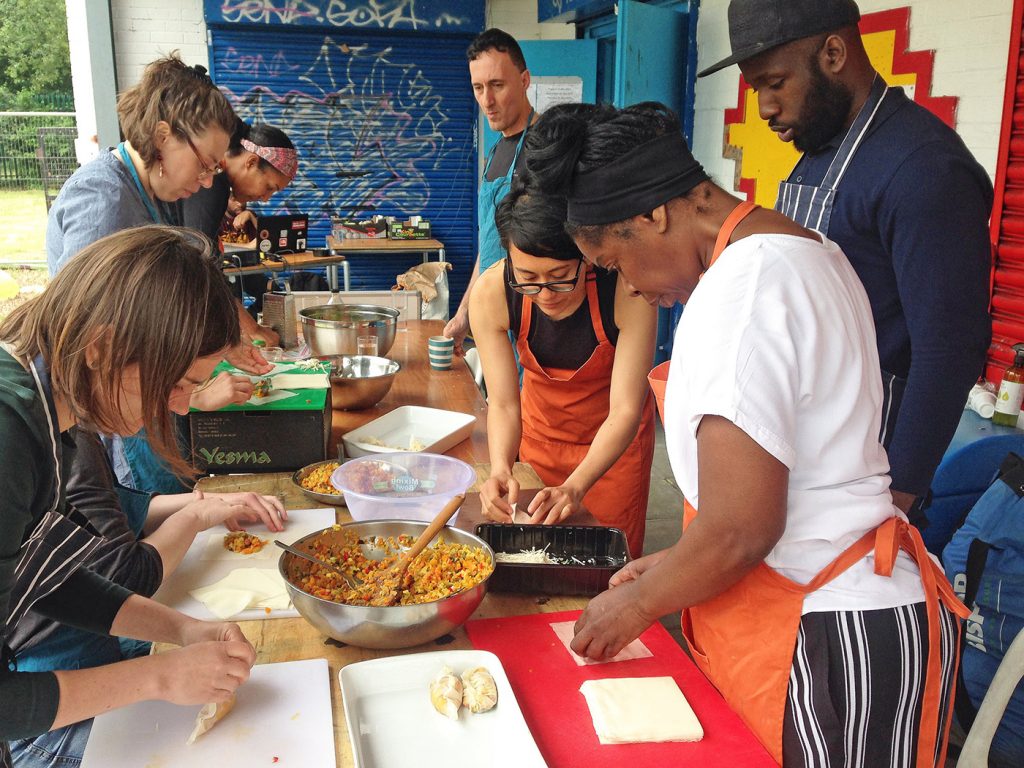
“This” is LokPal—a local cooking workshop, premised on strangers “sharing a meal and sharing a bond.”
Then Abby arrives, wearing cherry-red lipstick as bright as her smile. As I hand over her name tag and prepare to ask the usual barrage of small-talk questions, Abby makes the first move, deftly breaking the ice with tales of her kindergarten classroom.
Next is Tania, a marketing specialist with the down-to-earth manner characteristic of England’s “North.” She’s followed by Sana, an Indian woman with unending enthusiasm and a penchant for vegetarian cooking. Stanley arrives, and then Doris, two salt-and-pepper-haired strangers radiating a gentleness that makes you feel you’ve known them for years. Last is Alex, whose serious face stands in stark contrast to his neon-yellow jacket and quirky sense of humor.
These six are joined by 40 others who’ve signed up for LokPal’s four-week series of cooking classes in which residents of Cambridge, England, can connect with their “local food, local area, and local neighbors.”
Yet what unites more than half of this Breakfast Club-esque crew of varied personalities goes beyond a longing for localism. Rather, it is a longing for meaningful social connection—an affliction the research literature calls loneliness.
“We all know why we’re here,” Alex tells the table, forking a wad of watercress into his mouth. “It’s not just to cook local food. It’s to make friends. And we don’t know how or where to do that anymore.”
Armed with a passion for farmers markets (and a practical need for a master’s degree research topic), I created LokPal to study the social dynamics of local communities in the era of e-commerce and friend networks over social media. Using questionnaires, participant observation, and focus group interviews, I’d hoped to gain some insight on the value of in-person interaction.
But what exceeded my wildest expectations—and completely shifted the thesis’ focus—was uncovering just how many Cambridge locals felt lonely. When signing up for the LokPal sessions, more than 50 percent of participants reported sometimes or often relating to all three signposts of loneliness: feeling “isolated,” “left out,” and “lacking in companionship.”
These 20 Cambridge residents are only a microsample of the 9 million Britons who chronically feel lonely, which studies have linked to weak immune systems, an increased risk of cancer, and shorter life spans. Perhaps that’s why Britain, with its overpressured and underfunded national health system, has taken preventive action by creating a government minister of loneliness.
Attempts to address this ailment are not totally new to the U.K. A quick Google search reveals the nation’s considerable number of loneliness-combating charities. Yet among the biggest organizations, there’s a common misconception. AgeUK offers befriending services, but only to senior citizens. Silverline offers a 24-hour helpline specifically for older people in want of conversation. And even the inclusive-sounding Campaign to End Loneliness primarily targets the elderly population.
What national statistics reveal, and what LokPal’s demography helped illustrate, is that loneliness is no longer the preserve of the elderly and isolated. To the contrary, increasing evidence suggests that loneliness occurs in equal or greater proportions among the young and the employed. One recent study by Britain’s Office for National Statistics suggested that 16- to 24-year-olds are three times more likely to be lonely than those 65 and older.
“I had thousands of people around me at work, but I always felt very isolated,” Sana confesses. “You know, there were lots of colleagues, lots of dinners. But it was all very formal, and I’m not in touch with anybody now.”
Neuroscientist John Cacioppo offered an illuminating analogy: Just as hunger can happen where food is abundant, loneliness can happen where people are plentiful. Dr. Vivek Murthy, a former U.S surgeon general, recently echoed that point when he called loneliness an “epidemic,” as deadly as smoking a pack of cigarettes a day.
Of course, dramatic analogies and talk of epidemics provoke the skeptics. Some doubt that loneliness is higher now than it’s ever been, blaming the apparent outbreak on a low bar of survey criteria or manipulative government public relations moves.
There may be some truth behind those claims. But it’s hard to deny that the friend-making climate has changed since 1966, when the Beatles first asked “All the lonely people, where do they all belong?” As highlighted in the book Bowling Alone, the mid-20th century demarked peak rates of community participation through sports, civic groups, religious institutions, shops, and social workplaces.
But over the past 50 years, the culture of individualism has slowly contributed to the social decline of community. Instead, in recent years, Britain has topped the charts for eating alone, shopping online, declaring “no religion,” and working in isolation. And perhaps as a result of this individualization of public life, Brits overwhelmingly view their neighbors as strangers.
Back in a cozy classroom of the University of Cambridge’s sociology department—LokPal’s makeshift kitchen—many participants speak, spontaneously, about the increasingly isolated nature of British life.
“My son is a student in London and lives in a shared house with four people. They actually share the kitchen, bathroom, everything … but they don’t speak to each other,” Doris reveals with astonishment. “I can’t believe it, they just pass each other. They live completely independently.”
Tania agrees, her voice tinged with nostalgia for her Yorkshire hometown, where, she says, neighbors are friends and strangers don’t think twice before pouring out their life stories.
“In Cambridge, I’ve never spoken to any of my neighbors, and I hate that,” she notes. “But it’s an area where everyone’s quite transient—people moving in and out—so you don’t really see the point of making friends with them. You think, ‘Well, they’re going to be moving out soon, so what’s the point?’”
That’s why Tania turned to the internet.
“So you’ve got social pages like ‘New in Cambridge—Want to Make Friends.’ From there, you could message someone and say, ‘Hey there, let’s meet for a coffee!’ And the following day you’ll have met the girl and made friends.”
Most other LokPal-ers say their online socializing is limited to keeping up with old friends, not making new ones. Indeed, the results are mixed when assessing the internet as a means to increase social well-being—with one experiment describing internet usage as both the cause and effect of loneliness.
That’s why the Beatles’ question resonates today more than ever: Where—if not the internet—can a lonely person go to find the in-person companionship and belonging they lack?
LokPal attendees deem a few factors crucial. Nearly all suggest that social spaces should bind those with “common interests and needs” and offer a regular commitment.
“I never felt like I was a part of community when living in Stratford,” confesses Laila, a LokPal-er who recently migrated to England from the Middle East. “Then later when I had a child here, I grew a community with other moms because we all have something we share. By going to the breastfeeding group every week, I made strong relationships through that common connection.”
But this sort of organic group socializing doesn’t come as easily for men in the group, who mention that they find small talk difficult.
“I know my sister can just ‘meet up’ with friends, but that could never happen with me,” Alex explains. “There has to be something we’re doing. Just sitting around and talking doesn’t appeal to me.”
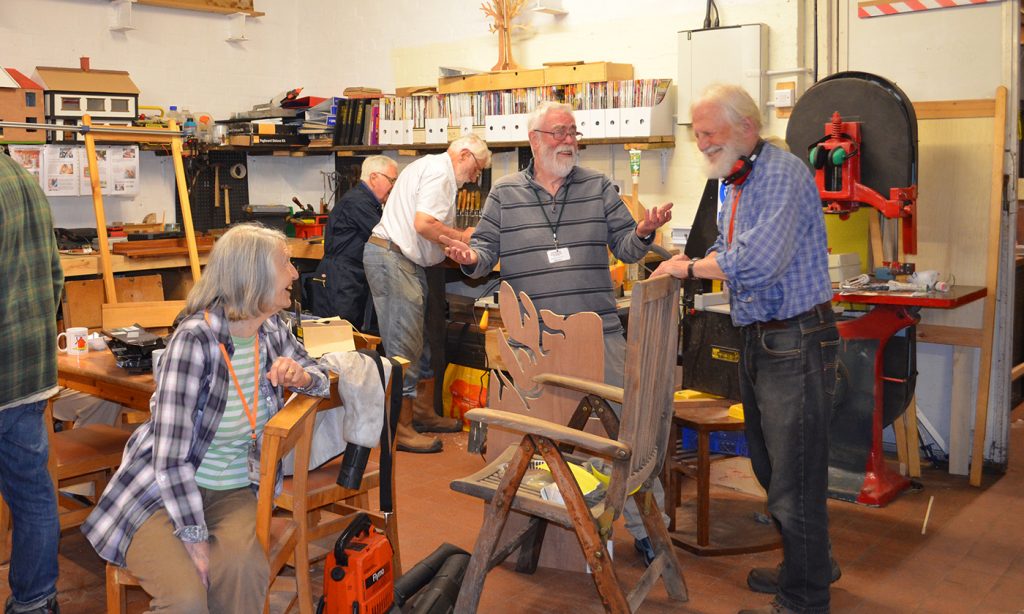
That exact philosophy helped found Men’s Sheds—community hubs that foster social bonds through collective activities. Originally founded in Australia, the now-international nonprofit suggests that men best communicate not face to face, but rather shoulder to shoulder.
To enable this, Men’s Sheds offer a variety of hands-on projects, including woodworking, metalworking, repairing and restoring electronics, and even building cars. But, as explained by Laura Winkley, membership and support officer of UK Men’s Sheds Association, “the essence of a [Men’s] Shed is not a building, but the connections and relationships between its members.”
Winkley says that many men come to a Men’s Shed with pre-existing mental health issues but leave with a renewed sense of self. “We’ve met widowers who have struggled with depression and isolation, but have found a new sense of belonging and purpose through attending their local shed. Another Shedder I met with spoke of an addiction he had struggled with for many years. But having the [Men’s] Shed to go to several times a week gave him a new purpose and drive to gain control of it.”
Yet she adds that evidence of the success of Men’s Sheds goes beyond anecdotes. UK Men’s Sheds Association “was originally founded in 2013, when there were just 30. … Fast-forward to today and there are over 400 Men’s Sheds open, and an additional 100 in planning.”
While Winkley notes that the association is in touch with the U.K.’s minister of loneliness, she adds that most Men’s Sheds are entirely self-sustained through a bottom-up approach, relying on support from grants and donors. In this regard, there are challenges in finding physical space and keeping them affordable, if not free, for all members. On the subject of including women, there are exceptions, but most Men’s Sheds exist purely for “the mental health benefits they bring to men.”
These shortcomings of affordability and exclusivity are less prevalent in People’s Kitchen, a London-based nonprofit where locals can regularly come to cook and consume community feasts. Securing funds from private foundations, individual donations, and the local government of the London borough of Hackney, People’s Kitchen has received international praise for its sustainable, scalable, and anecdotally successful model.
As promising as these initiatives are, many of the LokPal participants I interview believe the government—both local and national—should be doing more to support and spread grassroots initiatives, such as People’s Kitchen and Men’s Sheds, and offer a more diverse range of activities.
“Just as there’s an Office of Tourism for people visiting Cambridge, there should be an Office of Loneliness, where people can come if they want more social connections,” explains one LokPal-er, Jolie, over a plate of potato salad. “Because even though there’s stuff to do for tourists, there’s something missing for local people.”
Others add that loneliness requires more than bandage fixes from the minister. It requires both a long-term investment in community spaces and a cultural investment to destigmatize the affliction.
“The big thing is not making people embarrassed to look for friendship,” says Carina, another LokPal attendee. “If [the minister] helps us to go beyond that, I think we could just say, ‘We all meet at this square,’ like how it is at the GP where you walk in.”
Of course, LokPal participants aren’t representative of all lonely folks, as Ayia, a recent college grad, explains: “For some people, coming into a place like this cooking workshop where they’ve never met anyone before would be like a nightmare. But they’re still lonely. So I think another barrier that prevents people from talking to other people is anxiety, especially social anxiety.”
Indeed, even talkative Tania admits coming to LokPal was a “really big step” and that her social anxiety almost prevented her from coming at all. But it’s for people like Tania that gestures of social inclusion mean the most.
“Two weeks ago, I moved to a residential area, and I’ve already been invited to their local bread club, where this lady makes bread for the local neighbors every Friday,” she recalls. “It’s really lovely—she’s telling me everyone’s names, their kids’ names, and I’ve only been there two weeks, but she already invited me back to her house next week. I’ve not felt a part of a community like this for years, but where I am now people are really happy to see me.”
Originally published by Yes! Magazine, 02.25.2019, under a Creative Commons Attribution-NonCommercial-NoDerivatives 4.0 International license.
About the Author