Blackjack is the most played casino table game in the world, yet most people who sit down at a table know nothing of the four centuries of gambling, fraud, mathematics, and institutional power that shaped every rule in front of them. If you want to find the best online blackjack with provably fair odds today, the game you are playing carries the accumulated weight of royal courts, gold rush saloons, Las Vegas mob money, and a mathematics professor who broke the house using a computer he wore on his body. Here is how it actually got here.
The Oldest Reference: Cervantes and the Card Cheats of Seville
The earliest documented reference to a game resembling blackjack does not come from a casino. It comes from a short story by Miguel de Cervantes, the author of Don Quixote, written between 1601 and 1602. In Rinconete y Cortadillo, two card cheats in Seville are described as experts at a game called veintiuna, the Spanish word for twenty-one. The object, as Cervantes described it, was to reach 21 points without going over, and the ace counted as either 1 or 11. The game was played with the Spanish baraja deck, which excluded eights, nines, and tens.
This is the earliest confirmed written record of the game that became blackjack. According to the documented history of blackjack, the story places the origins in Castile at the beginning of the 17th century or possibly earlier, since Cervantes described the cheats as already proficient rather than as novelties. The game had already been refined enough to cheat at. Blackjack’s documented history begins not with noble leisure but with fraud. As the birth and development of gambling on this site explores, this pattern of games emerging from illicit rather than official contexts is characteristic of most card game histories across Europe.
Vingt-et-Un: The French Royal Courts
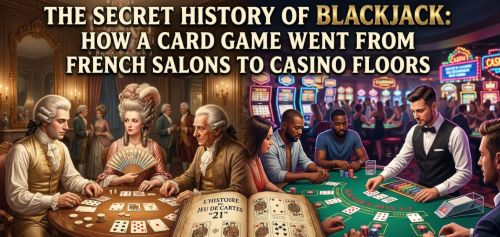
By the 18th century, a version of twenty-one called Vingt-et-Un, meaning twenty-one in French, was circulating through the parlors and courts of France. The game became a favourite among the French nobility. Figures including Madame du Barry and Napoleon Bonaparte are documented players. The French version introduced structural changes from the Spanish original, allowing both players and dealers to double their bets, and drew influence from an earlier game called Chemin de Fer, which later evolved separately into baccarat.

The game was played at the French Royal Court during the reign of King Louis XV. Its mechanics were elegant for the period: simple enough to learn in minutes, complex enough to sustain genuine skill decisions, and fast enough to generate a rapid sequence of outcomes. These qualities made Vingt-et-Un ideal for the social gaming environment of European aristocracy and equally ideal, it would later become clear, for professional gambling operations.
The first formal rules appeared in Britain in 1800 under the name vingt-un, published in Hoyle’s Games, the authoritative reference for card games of the era. As covered in the germinate article on medieval gambling and pub life, playing cards had been introduced to Europe from Asia and the Arab world in the mid-15th century, and by the 17th century the card game ecosystem from which Vingt-et-Un emerged was already several generations deep. By the time the formal rules of twenty-one appeared in Hoyle’s, the game had already crossed the Atlantic.
America: New Orleans and the Gambling Halls
French colonists brought Vingt-et-Un to North America in the late 18th and early 19th centuries. The game established itself in New Orleans, where legal gambling halls operated by the 1820s. The American version retained the core objective but diverged in specific rules. Early American play still allowed only the dealer to double down, giving the house a structural advantage the European versions had not enforced as rigidly.
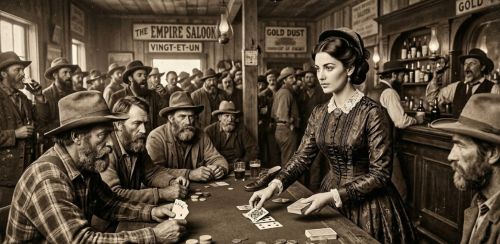
One documented figure from this period is Eleanor Dumont, a French immigrant who traveled across America as a skilled dealer and eventually opened a gambling establishment in Nevada City, California, which she named Vingt-et-Un. Dumont was widely considered a remarkable card dealer and attracted players specifically to compete against her, making her one of the earliest known professional dealers in American history.
The Gold Rush and the Name
The game arrived in Nevada in the late 19th century still called twenty-one. The name blackjack is specifically American, and its origin was documented by French card historian Thierry Depaulis, who traced it to the Klondike Gold Rush of 1896 to 1899. Prospectors gave the name blackjack to the game of American vingt-un, with the bonus hand being the ace of spades and a black jack. Depaulis also noted that blackjack referred to the mineral zincblende, commonly associated with gold and silver deposits, and suggested the mineral name was transferred by prospectors to the top bonus hand.
The ten-to-one bonus payout for holding the ace of spades and a black jack was a promotional device used by gambling houses to draw players to twenty-one tables. The bonus was eventually discontinued. The name was not. When gambling was legalised in Nevada in 1931 and the modern casino industry began to take formal institutional shape, the game entered its commercial era carrying the name blackjack.
Basic Strategy and the Four Horsemen
The first serious mathematical analysis of blackjack came in 1957, when four US Army researchers — Roger Baldwin, Wilbert Cantey, Herbert Maisel, and James McDermott, later nicknamed the Four Horsemen of Aberdeen — published a paper titled Optimum Strategy in Blackjack in the Journal of the American Statistical Association. Using mechanical desk calculators, they worked through the probability distributions of every possible hand combination and produced the first documented basic strategy: a set of rules specifying the mathematically correct play for every player hand against every dealer upcard. Their work largely went unnoticed outside specialist circles. That changed five years later.
Edward Thorp and Beat the Dealer
In 1962, Edward O. Thorp, a mathematics professor at New Mexico State University who had previously worked at MIT, published Beat the Dealer. The book used computer analysis on the IBM 704 to prove mathematically that the house advantage in blackjack could be overcome through card counting. It sold over 700,000 copies, reached the New York Times bestseller list, and permanently altered the relationship between casinos and the game they had been running for decades.
Thorp’s system tracked the ratio of high-value cards to low-value cards remaining in the deck. When the deck was rich in tens and aces, the player held a statistical advantage and the correct response was to raise bets. Thorp tested his theory in Reno, Lake Tahoe, and Las Vegas using $10,000 in capital provided by professional gambler Manny Kimmel, wearing disguises including fake beards and wraparound glasses to avoid being identified and ejected. According to MIT Libraries, the publication of Beat the Dealer in 1962 caused a sensation among players and heightened concern among gaming regulators, leading casino owners to convene in early 1964 specifically to discuss countermeasures including multiple-deck blackjack and the elimination of many betting options.
Casinos responded by introducing multiple decks, shuffling earlier in the shoe, and implementing surveillance measures that remain standard practice today. Their changes reduced but did not eliminate the card counter’s edge. The publication of Beat the Dealer also inadvertently boosted casino revenues. A flood of players arrived in Las Vegas convinced they could beat the house. Most could not, and casinos profited from the influx of confident, underprepared players far more than they lost to the skilled few.
The MIT Blackjack Team
From the 1980s through the early 2000s, an organised group of students and former students from MIT operated a card counting team that played casinos across the United States for approximately two decades, legally beating the house by millions of dollars. The team used team play techniques with spotters tracking the count and signalling big players to join tables when the deck was favourable. Casinos hired private investigators to identify and ban team members. The operation was eventually documented in Ben Mezrich’s 2003 book Bringing Down the House, later adapted into the film 21.
The House Always Adjusts
Every time players found a structural edge in blackjack, casinos engineered a countermeasure. Single decks became six-deck shoes. Early shuffling reduced the depth of penetration available for counting. Continuous shuffle machines eliminated counting entirely on affected tables. Facial recognition technology and shared ban lists made team play progressively harder. Payout structures shifted from the traditional 3 to 2 on a natural blackjack to 6 to 5 at many tables, increasing the house edge by approximately 1.4 percentage points. This pattern of institutional adjustment closely mirrors the pattern of monetary fraud and institutional response documented throughout medieval financial history, where every technique individuals developed to exploit a system was eventually closed by the authorities who governed it. In blackjack, the casino is both the house and the rule-maker.
From Casino Floors to the Blockchain
The digital era produced the first online blackjack platforms in the mid-1990s, replicating the physical game in software. For the first time, players could access the game without a casino floor, a dealer, or a physical deck. The underlying problem remained the same one that had existed since Cervantes described card cheats in Seville in 1601: players had no independent means of verifying that the game was fair. Online casinos ran closed backend systems with proprietary random number generators. Players trusted the platform.
The introduction of blockchain-based casinos changed that architecture for the first time in the game’s history. According to the Blackjack Hall of Fame, Edward Thorp’s original contribution was proving that mathematical verification of fairness was possible in a game the casino had always controlled. Blockchain platforms extend that principle to the infrastructure itself. On platforms built on public blockchain infrastructure, every outcome in a blackjack hand is recorded on-chain in a publicly audited smart contract that neither the casino nor the player can alter after the fact. The transaction hash for every round is publicly verifiable. The house edge is encoded in code rather than enforced by a pit boss. PVP blackjack variants running on a rake-only model eliminate the house edge from the game entirely.
The game that Miguel de Cervantes described in a Seville back street in 1601 has passed through French royal courts, American frontier saloons, Las Vegas casino floors, academic research papers, and organised betting teams. At each stage, the structural tension between the house’s interest in preserving its edge and the player’s interest in finding a fair game has driven the game’s evolution. That tension has not been resolved. It has moved to a new medium.
About the Author