Miller’s most lasting influence came from his assertions about one particular text.

By Dr. Abram Van Engen
Dean’s Fellow for Educational Innovations and Initiatives
Chair and Professor of English
Professor of Religion and Politics
Washington University in St. Louis
Perry Miller, a midcentury Harvard scholar of history and literature, was a giant of academe. From 1931 to 1963, as the scholar Michael Clark has summarized, Miller “presided over most literary and historical research into the early forms of American culture.” He helped establish the study of what he called “American Civilization,” contributing to the rise of a new discipline, American Studies.
Devoting himself to what he called “the meaning of America,” he tried to unravel its mystery and understand “America’s unending struggle to make herself intelligible.” After he died, the theologian Reinhold Niebuhr said that “Miller’s historical labors were . . . of such a high order that they not only gave delight to those who appreciated the brilliance of his imaginative and searching intellect, but also contributed to the self-understanding of the whole American Nation.”
That self-understanding, for Perry Miller, started with the Puritans. In graduate school, as Miller once recalled, “it seemed obvious that I had to commence with the Puritan migration.” The short prologue of his most widely read book, Errand into the Wilderness (1956), uses the words “begin,” “beginning,” “began,” “commence,” and “origin” fourteen times in three short pages, and almost all of those words applied directly to the Puritans. And because he began America with the Puritans—because he did so in such an original way and with such overwhelming force—he left in his wake a long train of scholars who took up the study of early New England with fresh interest, all of them re-envisioning Puritanism for the twentieth century.
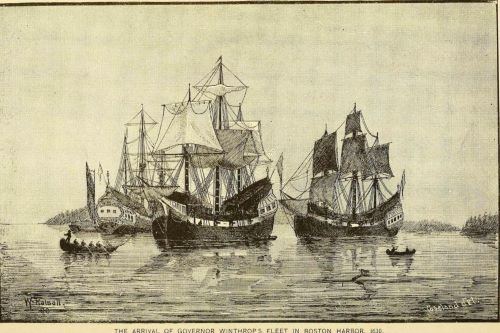
Miller’s most lasting influence, however, came not from his overall study of the Puritans but from his assertions about one particular text. In deciding that “the uniqueness of the American experience” was fundamentally Puritan, Miller turned to the precise origin of America—the founding of Boston in 1630 with the arrival of John Winthrop on the Arbella. Or, to be more precise, he turned to the moment marked as an origin in a mostly forgotten text. After all, other Puritans founded Salem in 1628; the Mayflower Separatists established Plymouth in 1620; the Dutch arrived in Manhattan in 1609; the Spanish set up St. Augustine in 1565; and Native Americans had been here all along. Then, too, there was that other English colony farther south, Virginia, founded in 1607, which Miller dismissed for lacking the “coherence with which I could coherently begin.”
In other words, Miller did not seek an origin of America so much as an expression of origins: “the first articulate body of expression upon which I could get a leverage.” For Miller, the Puritans “spoke as fully as they knew how, and none more magnificently or cogently than John Winthrop in the midst of the passage itself, when he delivered a lay sermon aboard the flagship Arbella and called it ‘A Modell of Christian Charity.’”

That 1630 sermon by John Winthrop is now famous mainly for its proclamation that “we shall be as a city upon a hill.” Beginning in the 1970s, Ronald Reagan placed that line, from that sermon, at the center of his political career. Tracing the story of America from John Winthrop forward, Reagan built a powerful articulation of American exceptionalism—the idea, as he explained, “that there was some divine plan that placed this great continent between two oceans to be sought out by those who were possessed of an abiding love of freedom and a special kind of courage.” In 2012, American exceptionalism—as summarized by the phrase “city on a hill”—became an official plank in the platform of the Republican party.
Before Miller began his career, no politician had turned to “A Model of Christian Charity” as the origin of America or sought national office by quoting, citing, or invoking it. Hardly anyone knew this sermon existed, and no one described the nation as a “city on a hill.” It wasn’t just Reagan who picked it up, either. After Miller, Winthrop’s text has been quoted by almost every president to hold office: John F. Kennedy, Lyndon Johnson, Richard Nixon, Jimmy Carter, Ronald Reagan, George H. W. Bush, Bill Clinton, and Barack Obama.

In the many years that history textbooks hit the market before Miller’s career, none made the coming of Winthrop’s ship a special beginning to American history, and none called the United States a “city on a hill.” After Miller died, Winthrop’s sermon began spreading across textbooks at every level of schooling, so that by 2010 a new U.S. history textbook appeared taking City upon a Hill as its title.
Miller’s claims reshaped literature as well. Through the mid-twentieth century, American literary history had no place in it for “A Model of Christian Charity.” After Miller died, Winthrop’s sermon gradually became the key text defining and explaining the development of American literature from its origins to the present day. By 1979, this text opened and anchored The Norton Anthology of American Literature, the most dominant anthology on the market. Countless students still read it today.
Why? What did Winthrop’s sermon do for Perry Miller? And through Miller, what did it do for twentieth-century Americans that they so avidly adopted and promoted it?
Born in 1905 to New England transplants in the Austin neighborhood of Chicago, Perry Gilbert Eddy Miller entered the world just a few blocks away from Ernest Hemingway, who was raised at roughly the same time in Oak Park, Illinois. Like Hemingway, Miller grew up an atheist (sometimes an agnostic) with an existential quest for meaning and an ardent thirst for travel and adventure. After high school, he enrolled at the University of Chicago but quickly dropped out, roaming to Colorado, New York, Mexico, the Mediterranean, and Africa. It was in Africa, while unloading barrels of American oil, that he claims to have had an epiphany. Thinking of the famous historian Edward Gibbon, who wrote The History of the Decline and Fall of the Roman Empire, Miller explained that he, like Gibbon, found his purpose far from home: “It was given to me, equally disconsolate on the edge of a jungle of central Africa, to have thrust upon me the mission of expounding what I took to be the innermost propulsion of the United States.” To that cause he would dedicate his mind, his career, his classroom, his pen, and his public speaking. He spent the rest of his life trying to find out and convince fellow Americans what America really means.
Miller re-enrolled at the University of Chicago, earning his bachelor’s and then his doctorate in 1931. Immediately he began teaching at Harvard, and over the next three decades he built a powerful story of America that began in the intellectual culture of seventeenth-century Puritanism and declined into the modern behemoth of twentieth-century United States materialism. He sought to bring America back to its senses, back to its roots, back to an intellectual and literary culture richer than all the goods that oil could buy. And when he stumbled on a little-known sermon from 1630, Miller determined that the best way to tell his story was by touting the significance of this one particular text.
“A Model of Christian Charity” began Miller’s story of the nation with purpose. “A society that is both clear and articulate about its intentions is something of a rarity in modern history,” Miller lectured. “Most of the nations of Europe and Asia grew up by chance and by accident either of geography or politics.” In other countries, so much had changed over so much time, he explained, “that even the most patriotic citizens would not dare say to what conscious purpose the nation was originally devoted.” Europe had legends and myths, a murky past misted over by a cloud of unknowing. But America had a recorded past—a written and articulate beginning. All one needed to do was gather up the texts. All one had to do was check the sources. All one really had to do, Miller insisted, was read a single sermon by Winthrop.
This need for a purpose—this story of a nation founded in purpose and defined by it ever since—resonated with a wide range of thinkers and writers following the close of World War II and the opening of the Cold War. In the late 1950s, for example, Henry Luce, the powerful editor of Life magazine, asked respected intellectual and political leaders to articulate and explain the purpose of the country. “More than anything else,” he claimed, “the people of America are asking for a clear sense of National Purpose.” Respondents included politicians, poets, journalists, evangelists, and government officials—everyone from Billy Graham to Adlai Stevenson.

Most in this august group were haunted by a nation that seemed to have lost its way. As John Jessup, a prominent journalist, wrote, “Is there not a connection between the rise of nations and great purpose, between the loss of purpose and their decline?” The problem, it seemed, was complacency. Wealth had made Americans weak. “Part of our problem,” John W. Gardner declared, “is how to stay awake on a full stomach.” Nothing was being asked of the American people. Having achieved material success and world power, the United States seemed content to let citizens go about spending and consuming, little caring about a higher cause.
A whole culture of academics and public intellectuals took up these concerns. David Brinkley, Betty Friedan, Richard Hofstadter, C. Wright Mills, David Reisman, William Appleman Williams, and so many others in their own ways condemned American consumerism and anti-intellectualism in works that were broadly digested and debated by the American masses. Miller, who portrayed himself as a “lone wolf,” was by no means alone in his concerns. He, like others, believed that America’s influence might be terribly short-lived. “History is littered with the corpses of civilization that reached the limit of expansion, dug in behind walls and moats, and there yielded to decay,” he proclaimed. According to him, the materialistic culture of America would soon exhaust itself. It didn’t require particular genius “to ask yourself, at least from time to time, whether this American way of life is not rushing at a steadily accelerating pace toward a massive megalopolis which finally, of sheer dead weight, shall grind to an agonizing stop, and then crumble into ruin by the force of inertia.” As one of his students summarized, “He could imagine the end of America, if not of American affluence.” Yet for Miller, as for others, mere affluence constituted its own form of demise.
To get back to that underlying sense of purpose, Americans had to return to the ideas—though not the doctrines—of the Puritans. In making such a claim, Miller argued that “A Model of Christian Charity” mattered both in what it marked and in what it said. For Miller, this sermon meant that America’s story held world-historical importance. According to him, Winthrop self-consciously established his society as a model for all to see, a monument intended to guide the rest of the nations to God. In one of his most famous metaphors, Miller explained that the Puritans engaged in a “flank attack” on Christendom. “New England was the culmination of the Reformation,” he argued. It was “the climax of world history.” That was what Winthrop’s sermon signaled, Miller claimed. Winthrop “preached to the emigrants during the voyage that the eyes of the world would be upon them, that they would be as a city set upon a hill for all to observe.” If this sermon were the origin of America, then America, from the first, had a role to play in putting the world right. That aspect of Winthrop’s sermon would reappear frequently in the political speeches of President Reagan and many others in the years to come.
But the content of Winthrop’s sermon—what Miller thought Winthrop was actually saying or proposing as a model—differed radically from what Reagan and others would make of it. According to Miller, this sermon called Puritans to model radical communal solidarity. It had nothing to do with the American Dream, nothing to do with bettering one’s life, nothing at all to do with making money or getting ahead. In fact, Miller claimed, Winthrop specifically rejected all such ideas. Going it alone, pulling ahead of others, getting rich or even trying to—these were the very dangers that Winthrop sought to guard against. Society’s success depended instead on mutual affection, being “knit together in this work as one man.” According to Miller, the Puritans exhibited “a mighty conviction of solidarity,” a “living cohesion” and “concept of a fellowship united in a common dedication.” Unlike today, Miller insisted, New England theorists thought of society “not as an aggregation of individuals, but as an organism functioning for a definite purpose, with all parts subordinate to the whole, all members contributing a definite share, every person occupying a particular status.”
According to Miller, the commitment to a higher cause and the dedication to God had made the Puritan community unusually successful, and the success of their venture—the wealth it generated—had eventually undermined the venture itself. When Puritans started making money, their purposes collapsed. “A hundred years after the landings, they were forced to look upon themselves with amazement, hardly capable of understanding how they had come to be what they were,” he wrote. They had lost sight of their cause and plan, their purpose and devotion. For Miller, the point of this failure was clear: The demise of the Puritans did not arise from external opposition; rather, it came about from within. It was caused by the Puritans’ own success.
That was the story Miller saw playing out again in the 1950s: The success of the United States, its sudden wealth and power, would soon prove the nation’s undoing. According to Miller, this paradigm had been repeated in a host of societies scattered through the leaves of history. The downfall of the Roman Empire, which Miller explicitly compared to America, also came about through dissolutions wrought by its own success. For Miller, history was fundamentally ironic. Victory and achievement produce disappointment and disaster; progress results from causes other than one’s own intentions; and no advance is finally secure since all growth contains within it the seeds of a new and possibly more catastrophic decline. As the historian Henry May once summarized, “His works on Puritanism all illustrate the slogan that nothing fails like success.” Wherever Miller turned, he saw the same laws of history replayed, and, in his mind’s eye, the beginning of demise could be read in the modern riches of America’s rise.
The way Miller made such claims set him apart from other scholars. He was “impatient with balderdash and decorum,” one student recalled, “abrupt and snorting—perhaps not unlike one of Melville’s magnificent whales.” When Miller died, his obituary in the Harvard Crimson compared him to Melville’s mad Captain Ahab: “Those brawling sentences, the brooding manner, the great, obscene chuckles whose delight it was impossible not to share, all were touched with something superhuman, something demonic. He lived intensely, self-destructively even.” His “manners were often bad,” another student recalled; “his casual conversation was calculated to shock.”
Opening his courses with an attempt “to scare the overwhelming crowds away,” Miller first recounted his “immense accomplishments” and then laid before students an equally immense, almost impossible reading list. Such shows of force would seem to distance him from students, yet “you could not be in his presence without feeling that he cared about you and your ideas,” one student reminisced. “Miller was not unkind,” another added; “he was simply relentless.” In one graduate seminar, “he forbade us to praise our fellow students’ papers. ‘Let us be brutal,’ he said, ‘for we love one another.’” According to at least one account, these lessons applied equally to himself. A student remembered hearing a violent argument in Miller’s office while he waited outside the door. When the shouting died down, he knocked and entered, only to discover that Miller was alone. The argument had been with himself.

In the 1950s, Miller’s arguments and ambitions entered a new phase. Midway through the decade he began work on a magnum opus called The Life of the Mind in America—an attempt to capture every facet of “the American mind” from the Revolution to the Civil War, the whole of it organized into nine coherent books: religion, law, science, education, political economy and association, philosophy, theology, nature, and the self. This compilation would serve as a capstone to all his efforts, the culmination to over three decades of dedicated study. All he had achieved, Miller once claimed, was just a preface to the real project—this project, the last.
When Miller began The Life of the Mind in America, he sought financial support from whatever foundations he could find. Not many existed during his day, and few came forward to help. One supplied him with enough money to hire a graduate student named Alan Heimert, who would soon replace him as the Powell M. Cabot Professor of American Literature at Harvard. Still, Miller was not granted much assistance. He reported his frustrations to a good friend named Samuel R. Rosenthal, an eminent Chicago lawyer, and Rosenthal responded by funding Miller himself. In 1956, Samuel Rosenthal gave $30,000 to Harvard—enough to pay half of Miller’s salary, plus benefits, for three years running, giving him one semester each year to write. Miller promised he would devote himself wholly to the “grand design” and “not do one particle of the hack work” he had from time to time let himself “get caught in.” Three years, it seemed, would be plenty of time.
Three years later, Miller wrote to Rosenthal to explain his lack of progress. He pleaded the intractability of the material and the ambition of the project itself: “I get overwhelmed from time to time at the arrogance implicit in my proposal,” he admitted. Receiving the letter, Rosenthal simply offered more money. Miller refused. He claimed in 1960 that he had plenty of material, plenty of notes. All he had to do was write it up. The book would be finished soon. Still, Rosenthal insisted that his invented “D and R Fund” would give more if only Miller asked. Instead, Miller pushed his friend off, promising Rosenthal that the book was almost done. Considering what was left when he died in 1963—he completed only two parts out of the nine—there is no way that Miller could have honestly believed he was ever close to finishing.
Perry Miller’s career came to a catastrophic close. Kicked out of his house by his wife, he lived alone in a Harvard dorm room and eventually drank himself to death. Having all his life admired the Puritans in their search for purpose, their desire for a pattern that could make sense of the whole, Miller seems finally to have been overwhelmed by his own quest for meaning. He had begun with John Winthrop and “A Model of Christian Charity”—an articulate expression of origins, a coherence with which he could coherently begin—but as he moved forward, as the story broadened, as the arc of the American narrative bent and shifted in multiple directions, he failed to find the paradigm that would fit it all together. Reading through his papers, one gets the sense that by the end of his life, Miller saw himself as having failed.
In a significant way he did fail, and that failure came about not despite his efforts but because of them. Miller’s dedication to the Puritans and to “A Model of Christian Charity” finally could not address or explain the concerns that dominated American society in the mid-twentieth century. At the opening of Miller’s career, W. E. B. Du Bois published Black Reconstruction in America (1935), a searing account of the way historical studies had systematically excluded and denigrated the struggles and contributions of African Americans. The next year, 1936, Langston Hughes wrote “Let America Be America Again”—a plea that the promises of America extend themselves to African Americans at last. In 1941, the same year that Henry Luce published “The American Century” in Life magazine, Richard Wright documented the diverse lives and hopes of 12 Million Black Voices in the Great Depression. A decade later, the civil rights movement erupted. And through all these years, millions and millions of African Americans migrated from the South to the North, from agricultural fields to urban centers—including the Austin neighborhood of Chicago, where Miller grew up. “The problem of the Twentieth Century is the problem of the color-line,” Du Bois prophesied in 1903. Yet the problem of the color line appears nowhere in all the mighty works of Perry Miller. No single book, and no single scholar, can address every single issue, of course. But Miller explicitly set himself the task of explaining the “meaning of America,” and that meaning never touched on one of the most vital issues engulfing the nation. If he felt that he had failed—if he felt that his story of America was increasingly hard to hold together and decreasingly important to the American people—he was right.

In one way, however, Miller succeeded far beyond his grandest hopes. He brought John Winthrop’s sermon “A Model of Christian Charity” before the public and turned it into the key text of American origins. Miller pronounced it the first articulate statement of community, a sermon expounding the idea that America would be dedicated to the life of the mind. He read in Winthrop’s text a monumental testimony against the basic premises of the American Dream. The irony of history—one that Miller might well have appreciated—is that in promoting Winthrop’s sermon, he caused it to become the key statement of all that he most feared and lamented. In the years to come, Winthrop’s “city upon a hill” sermon would become “the shining city on a hill” of President Reagan: a celebration of individual freedom, material prosperity, and American power—above all, a call for Americans to renew their optimism and believe in themselves again. Nothing breeds failure like success. And no one was more successful than Perry Miller in making Winthrop’s sermon the cornerstone of American culture.
From City on a Hill: A History of American Exceptionalism by Abram C. Van Engen. Published by Yale University Press in February 2020.
Originally published to the public domain by Humanities, the Magazine of the NEH 41:1 (Winter 2020).
About the Author