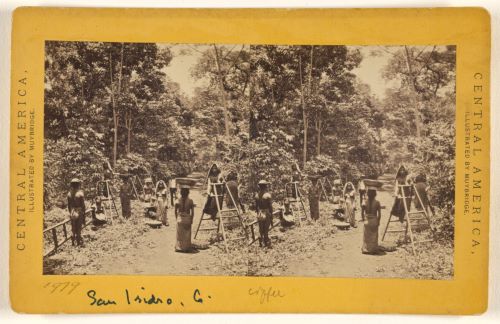
Eadweard Muybridge traveled to Panama and Guatemala in 1875, where he engaged in some questionable practices.

By Dr. Kirsten Lew
Associate Digital Media Producer
Getty Research Institute
Introduction
He was working as a photographer for the Pacific Mail Steamship Company, taking pictures of the region’s natural resources in the hope of luring American companies there. Along the way, he also took pictures of women. “He asked them to pose topless, even while picking coffee. The photos are artificially staged in a way that aestheticizes poverty and presents the people as backward, primitive, and left behind in modernity,” says Tatiana Reinoza, an art historian and Getty Scholar.
Reinoza is interested in Muybridge’s journey because of how it contrasts with her main area of research: modern photographers from the Central American diaspora who travel back to the region. They present a different image, she says, than either Muybridge or the contemporary American media, which usually focuses on migrant caravans of people escaping desperate situations. Instead, these artists use photography to represent their family’s complex experiences within Central America. “It helps to tell a different story of this place that isn’t framed as victimization.”
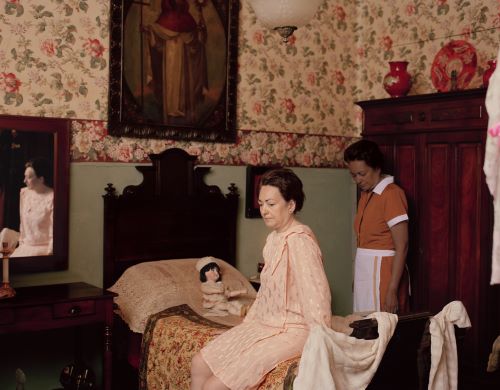
Take the artist Rachelle Mozman Solano. Her series Casa de Mujeres (House of Women) depicts what at first glance appear to be regular domestic interiors featuring a well-dressed light-skinned woman and a darker-complexioned maid. But on closer look, the viewer realizes that both figures are portrayed by the same person: Solano’s mother. She grew up in the Panama Canal Zone, where American control brought Jim Crow politics. “The photographs tell this other side to the story of Panama as it was left in the aftermath of US intervention,” explains Reinoza.
There and back again. The effect of human movement on art is the basis of the 2022–23 theme for the Getty Scholars Program—Art and Migration. Each year, a cohort is selected to conduct research at the Getty Library. While the scholars’ areas of interest can span the whole of history, this year their questions all revolve around issues of mobility.
The Things They Carried
Sometimes it starts with the movement of things rather than people—like the coco-de-mer nutshell, a type of double coconut native to the Seychelles and a subject of research for Getty Scholar Peyvand Firouzeh. “For most of the early modern era, coco-de-mer seeds were shrouded in legend. The fruits were thought to have fallen upward from a mythical forest at the bottom of the Indian Ocean,” she says.
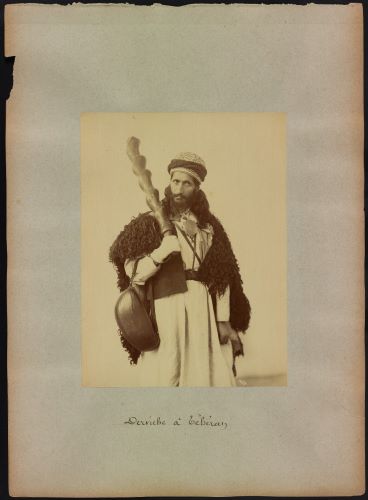
A combination of sea currents and trade networks brought the nutshells across Europe and Asia, including to Iran, where they were adopted by Sufi ascetics as begging bowls. “With their boat-shaped form, they symbolized Sufis’ allegorical sea journeys on their path of self-purification and divine knowledge,” Firouzeh writes. In a 19th-century photograph from Getty’s special collections, a Persian man identified as a dervish displays a simple coco-de-mer bowl hanging from a strap around his arm while posing in a studio in Tehran. As Firouzeh explains, “Surviving vessels made of coco-de-mer and photographs like this ultimately help us unravel stories about the movement not only of natural materials but also humans, whether through voluntary migrations, trade networks, or histories of Indian Ocean slavery and European colonization.”
Trade is a common way for art objects to circulate, but it can have a nefarious side. Another Getty Scholar, Ana Lucia Araujo, studies exchanges between European and African slave traders in the 18th and 19th centuries. She tracks the circulation of prestigious objects, like one French article given as a gift to an African agent as part of the trade in enslaved humans.
Europeans brought South American silver to the coast of Africa. For instance, silver was used by Fon artisans to fashion an elephant sculpture associated with King Guezo of Dahomey (present-day Republic of Benin), who ruled from 1818 to 1858. But less than a century later, the elephant was looted by French colonial forces and taken to Europe. It eventually ended up in the hands of American collectors.
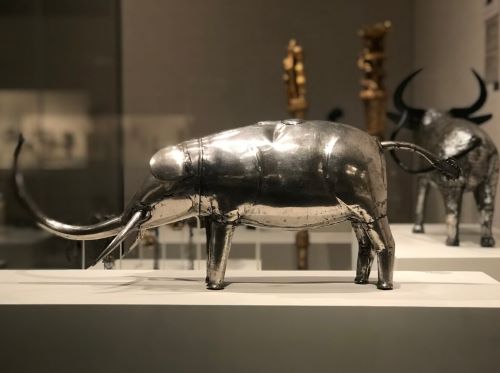
As Araujo puts it: “In my case study, French conquerors looted the same object slave traders previously gave as a gift to African agents. They kept looted African heritage in private and public collections for many decades, and only now are acknowledging it.”
Araujo isn’t the only scholar interested in looting. Megan O’Neil studies Mesoamerican artifacts that, in the mid-20th century, became all the rage among Los Angeles’s rich and famous, who used them to decorate their Hollywood mansions. “Many pieces were smuggled from countries such as Mexico, but others were moved by political elites, including heads of state from those countries,” she says. “With such movements, the things’ origins generally were forgotten or erased, whether to stymie competition or avoid prosecution.”
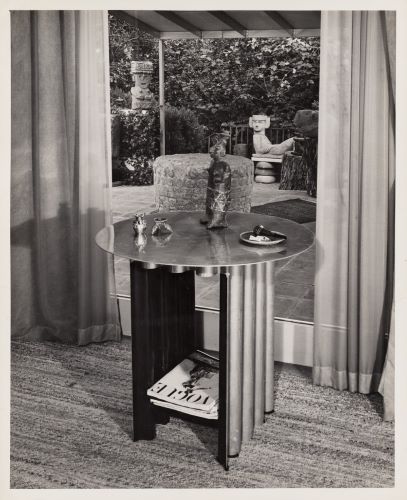
Although the original contexts of these objects are gone, not all is lost. “There is still important research to do about them, particularly to consider how the 20th-century transformations changed understandings of those pieces,” O’Neil says.
This notion of transformation is central to the concept of art and migration. The significance of a piece changes as it moves across cultures. What is decorative in one place might be sacred in another. What is unfamiliar and strange in one locale might be mundane and nostalgic somewhere else. For this year’s Getty Scholars, meaning doesn’t arise from the thing itself so much as the journey it took to get there. And that journey is worth studying.
Originally published by The Iris, 04.06.2023, under a Creative Commons Attribution 4.0 International license.
About the Author