
By Dr. John Manzo
Associate Professor of Sociology
University of Calgary
Abstract
Contemporary social life is often depicted, in and out of the social sciences, as an ever-worsening subterfuge of alienation, ennui, and the systematic destruction of traditional, human-scaled, publicly-accessible, “organic” sociality that people once enjoyed. In this paper I do not contend that these trends in our social and commercial landscape are not happening. I will instead contend that conventional face-to-face sociability thrives even in the face of the loss of many traditional public meeting places. My focus in this piece is on social interaction in independent cafes that are known, and that self-identify, as what coffee connoisseurs term “third-wave” coffeehouses. Deploying the analytic perspective of ethnomethodology, which prioritizes and problematizes the observed and reported lived experiences of research subjects, I argue not only that “authentic” sociality flourishes in these spaces but I also consider the role of shop employees—baristas—in them and uncover their perceptions concerning social interaction between themselves and customers. As such I not only question prevailing understandings about the “death” of traditional sociability but also add to past research on the coffeehouse as social form by problematizing, for the first time, the work world of the baristas and their interactions with customers.
Introduction
There are many places—in books, social scientific research articles, weblogs, and artistic products such as films and stage plays—to uncover perceptions that bemoan and disparage contemporary social life as an ever-worsening subterfuge of alienation, ennui, and the systematic destruction of traditional, Gemeinschaft-based, human-scaled, publicly-accessible “organic” sociality that people once enjoyed. This criticism contends that traditional sites for social interaction, such as village squares, high streets, public parks, traditional downtowns, and cafés, are disappearing, and that people are increasingly remanded to spaces that are privately owned and commodified; these are milieus such as shopping malls, “power centres,” chain restaurants, and theme parks. Worse, runs this critique, social interaction increasingly occurs in “virtual” space, a trend that further impels people away from traditional sociability and, ultimately, away from one another entirely. “Community,” according to this postmodern analysis, is dead; “Disneyization,” suburban sprawl and the Internet are among the culprits.
This paper does not contend that these trends in our social and commercial landscape are not happening. It will instead contend that conventional face-to-face sociability thrives even in the face of the loss of many of the traditional public meeting places. The focus of this piece is on social interaction in independent cafes that are known, and that self-identify, as what coffee connoisseurs term “third-wave” coffeehouses.
Context: Space, “Third Places,” and Coffee
Contemporary Space and “Public” Culture in North America

Shopping malls are the most notable postmodern pseudo-public spaces, and authors such as Gottdiener (2000, 2001) argue that malls entail the commodification of “public” space and, whereas traditional public spaces exist to support every sort of social behaviour, malls exist only to promote consumption, a fact that Abaza (2001) charges has further marginalized the poor, who might have been, and felt, welcome in settings that were not as frankly organized around commerce or that did not entail expensive entrance fees as do theme parks. Malls are thus depicted as negating those “natural” or “organic” social contexts that once constituted the sites of urban sociality; malls are “non-places” (Auge, 1992) are bereft of any meaning outside of that promoted by the retail occupants (Bauman, 2001; Knorr-Cetina, 2001; Woodward, Emmison, & Smith, 2000). Analysts see malls and other planned, privately-regulated spaces, such as theme parks, a venue deconstructed and lamented for its contribution to “Disneyization” (Bryman, 2004) in a myriad of pseudo-public spaces, as specifically detrimental for forms of social interaction that were facilitated in downtown business districts, town squares, high streets, municipal parks, and other such places. Moreover, even when persons engage in social interaction in the form of conversation on those high streets, all too often those conversations are circumscribed and regulated by the demands of retail environments such as the ubiquitous Starbucks which curtail the ability of those conversations to proceed organically (Gaudio, 2003).
In the purported demise of traditional public spaces, it is argued that “virtual” spaces have emerged as their replacements, and the number of social scientific investigations into online sociality has grown in response to this evolution in social interaction. As long ago as the mid-1980s, Meyrowitz (1985) lamented how then-emerging electronic technologies (such as a nascent “internet” based on text-based bulletin board systems) were contributing to a loss of sense of “place” among users, and Beniger (1987) derided any social form based on electronic communications technology as “pseudo-community.” Recently and famously, Putnam (2000) has used a purported increase in non-league bowling—“bowling alone,” in other words—as an allegory for not only the increasing trend for entertainment to be a solitary activity (due especially to the growth of the Internet and readily accessible cable/satellite television), but for the observable demise of civic culture and “social capital” that defines contemporary American society. Malls, hyper-planned space, the Internet, and the huge range of private entertainment options now available to people in their homes have made the world an antisocial place, according to these criticisms.
Third Places
Of course, malls, Starbucks, and the Internet have only been extant in relatively recent human history, and what preceded them were different sorts of gathering places. Oldenburg (1991, 2000) coined the term “third places” to refer to social spaces that are neither domestic nor work-related. The term encompasses many settings, including bars, barber shops and beauty salons, restaurants, bowling alleys, arcades, and of course cafes. Oldenburg characterizes third places as functionally vital for communities, as sites for genuinely “public” and civic life, but also laments their disappearance due to suburbanization and the increasingly private nature of home life in the late 20th century (Oldenburg, 1997).
Research has attended, ironically, to whether online fora (especially massively multiplayer online role-playing games, or “MMOs”) can be categorized as third places (cf. Steinkuehler and Williams, 2006). While this redefinition of “third place” might be supportable give the qualities of third place as elucidated by Oldenburg (1991), it begs the question as to whether we, as a society, really have arrived at this point. Malls are indeed profoundly recurrent and unavoidable aspects of social existence nearly everywhere around the world, and are adept “shape shifters” that can be modified to suit disparate cultural and geographical contexts (Underhill, 2004), and the growth of Internet-based sociality is a unquestionably a defining quality of modern sociality. But in the face of all this, “third places” still exist; they are, in some examples, thriving. One such setting is the independent coffee house, the “third wave” variant, defined above, which is the focus of this research.
Sociological Research on Coffeehouses

The traditional independently-owned urban café is “third place” par excellence, and there is no dearth of research on coffeehouses. Among these are works addressing the history of the coffeehouse in Europe (Arjomand, 2004; Cowan, 2005; Haine, 1996; Komecoglu, 2005); all of which see the pre-20th century coffeehouse as an important location for the development of a form of public sociability and even “civil society” tout court, a point famously made by Habermas (1962, p. 37) even to the extent that the English coffeehouses of the 18th century were sites in which the social statuses of visitors was rendered irrelevant.
Studies focussing specifically on modern coffeehouses are rarer, but include Laurier et al.’s (2001) ethnography of a “neighbourhood café,” and Milligan’s (1998) analysis of the emotional attachment that employees at a university coffeehouse had to the coffeehouse’s physical setting. Milligan (1998) is notable for being the only researcher among those uncovered for this literature review to consider the behaviours and viewpoints of coffeehouse employees and not customers or to treat “the coffeehouse” generically as “institution” and empirical focus. However, even in the case of Milligan’s study, coffee per se has always been epiphenomenal, and merely the comestible extant in the real focus of research, which has been public (customers’) behaviour and sociability. What is thus missing among these investigations is attention to coffee connoisseurship, which is the topic of an investigation by Manzo (2010) albeit with respect to home coffee hobbyists and not as it concerns café-based social experiences, and more important is the lack of attention to the owners and operators. A search for English-language academic research that even deployed the term “barista” turned up only one title, Manning’s (2008) paper on an employee at Starbucks but which focuses on imagined interactions. Cafés are indubitably important as customers’ meeting and “hang-out” spaces, but aside from acknowledging a gross difference between “chain” and “independent” coffeehouses (cf. Lyons, 2005), these are taken without reflection as un-studied contexts for describing and analysing customers’ experiences (as with Hampton and Gupta’s [2008] investigation of the role that wi-fi access in cafes plays in promoting a reduction in social interaction in public spaces) or issues germane to the coffee industry.
This investigation adds to existing research by addressing, and prioritising, the behaviours of shop employees and owners: the baristas, whose demonstrations of expertise with respect to coffees, drinks preparation, familiarity with equipment, and the argot surrounding all of these things are vitally important features of what is known as the “third wave” as a subculture. Before this current project, no sociological insight, never mind formal research process, has been brought to this phenomenon as an emerging venue for sociability in the 21st century.
The “Third Wave”
The “third-wave” coffee phenomenon comprises an independent coffeehouse, roaster, and home-hobbyist subculture. It is a subculture focusing on artisanship and expertise, sensual experience, face-to-face communication, and “community” in one of its most traditional senses, but is also technologically driven (especially with the attention and prestige accorded certain sorts of equipment) and makes extensive use of the Internet as a venue for discussion, social planning, product reviews, and so forth. There are other emerging and growing examples of this neo-traditionalism: crafting, knitting, folk dance clubs, wine tastings, book clubs, and many others. What’s distinctive about coffee among these and what makes the third wave especially appropriate for research is, first, that businesses are important elements, not only as suppliers to practitioners, but as the institutional, “brick and mortar” centres of the subculture and the homes of its most venerated experts, and thus provide a convenient and accessible site for investigation; and second, the coffee subculture puts great stock in one’s status as expert, artisan and connoisseur (unlike, say, folk dancing circles or book clubs, which do not demand expertise), at the level of the grower, the roaster, the barista, the home hobbyist, and even the customer, and thus the third wave comprises an energetic cadre of members amenable to telling their stories. The third-wave coffee “movement” merits special consideration among modern social forms as a depiction of what our future might look like.

“Third wave” is an expression invented to contrast contemporary artisanal coffee roasters and coffeehouses from forms and venues of coffee consumption that came before them. The third wave attends to coffee bean varietals as wine connoisseurs do to different grape terroirs; third-wave shops invest seemingly outrageous amounts of money into equipment, opting, for example, for $20,000 La Marzocco or Synesso espresso machines as against the $5000 for a used Astoria model that would have sufficed for a mom-and-pop espresso bar in the 1990s; and third-wave “baristas” take their skills in espresso extraction and drink preparation to such a level that there now exist “barista championships” all around the world to award extraordinary competence for things such as “latte art,” the creation of designs on drinks with foamed milk. There is, of course, more to this subculture than beans, machines, and milk, and it will be the focus of this report as an example of a postmodern subculture and a new version of old-fashioned sociability.
One way to grasp participants’ understanding of “third wave” is to be contrast it with “first” and “second” waves. In a food review column of LA Weekly, journalist Jonathon Gold (2008) does this elegantly:
The first wave of American coffee culture was probably the 19th-century surge that put Folgers on every table, and the second was the proliferation, starting in the 1960s at Peet’s and moving smartly through the Starbucks grande decaf latte, of espresso drinks and regionally labeled coffee. We are now in the third wave of coffee connoisseurship, where beans are sourced from farms instead of countries, roasting is about bringing out rather than incinerating the unique characteristics of each bean, and the flavor is clean and hard and pure.
The new face of coffee is neither Juan Valdez nor a gum-snapping waitress named Madge, or even Starbucks’ Howard Schultz, but a postmodern barista like [Eton] Tsuno, spiked hair and a gauzy shirt, stirring a siphon of Sumatran peaberry with the pouty insouciance of Jimmy Page executing a guitar solo, while awestruck customers study every flick of his long fingers.
This rendering of the history of coffee and the purported innovations constituting what members call “the third wave” might be revisionist, imprecise, North-American-focused, and generally unsatisfactory as a review of actual historical precedents to modern independent artisanal coffeehouses, but as a way of understanding members’ understandings of “third wave,” it is important to recognize these categorizations. The “first wave” refers to how coffee was prepared and consumed in, say, the 1950s until, say, the early 1990s, when coffee was a “caffeine delivery system” prepared in percolators or massive “office coffee” urns. The “second wave” refers to that period, starting in the early 1990s, when coffeehouse chains (Starbucks, Gloria Jean’s, The Coffee Bean and Tea Leaf, Second Cup, etc.) were born and became common features in urban storefronts and suburban malls. The “second wave” purveyors, this history claims, laid the groundwork for the “third wave,” which comprises independent and small-chain coffeehouses that are themselves part of a supply chain including a collection of field-to-cup actors: fair- and direct-trade growers, to small-batch “boutique” roasters, to the shops themselves, to well-trained baristas, to connoisseurs who cherish the label of “coffee geeks.” Again, this definition of the “third wave” is missing a great deal empirically, including the glaringly obvious fact that coffee and coffeehouses existed for many centuries in many countries before the American 1950s, but the point here is to understand the sense of reference of “third wave.” This paper is an investigation of one important aspect of the “third wave” phenomenon and it concerns social interaction that is observable in its cafes.
The Ethnomethodological Perspective
Overview

My analytic perspective of this project is an ethnomethodological one. The analytic goal in this piece is not to interpret discourse or social interaction that inform and infuse the third-wave coffee experience in light of some innovative analytic concern but rather to attempt to uncover the participants’ own interpretations of their experiences. These foci on the talk and demonstrations of knowledge of research subjects as topics in their own right are hallmarks of ethnomethodology (Garfinkel, 1967; Heritage, 1984). Ethnomethodology focuses on the means through which the “sense” that social life appears to have—its order, understandability, predictability, accountability, and so forth—are accomplished in the concrete activities and efforts of the persons living it. The focus of ethnomethodological inquiry is, first and foremost, what persons do in settings under study, and this paper brings precisely this grounded concern into focus. For example, with respect to persons employed at coffeehouses, part of the way in which their tasks are made understandable and meaningful includes the ways in which they collaboratively and individually construct a vision of themselves. They do this, of course, through their lived work practices generally, and also through their talk about their work. My goal in this paper is to uncover the workers’ understandings of their work, instead of imposing an interpretive judgment that may obscure lessons surrounding it as comprising its own order and its own set of definitions.
The goal in undertaking ethnomethodology is always to begin by asking what actors in a site are doing: what they are saying, what they are writing, what behaviours are visible alone and in concert with other members, how these things are organized, and how these findings contribute to their understandings of what they are involved in. Thus, when ethnomethodologists engage something like a coffee “subculture,” their goal is to uncover the grounded organization of that phenomenon and to uncover the members’ definitions, discourse, meanings, and so forth that make this “subculture” visible and understandable as such from their own perspectives as well as to the perceptions of outsiders.
I came to this project in two ways. The first was as a sociologist whose orientation as an ethnomethodologist and as a researcher whose work has always focussed, using various methodologies, on lived experience and what might be called “everyday life” with a priority on uncovering participants’ own creation, organization, and understandings around their social and interactional experiences. One recent project concerned the work worlds of security officers at shopping malls. In reviewing research on malls and other hyper-planned spaces, I found a univocal pessimism around not only the proliferation of these ersatz, privatised, pseudo-public spaces but also recurrent claims to the effect that authentic public spaces and the traditional sociability they encompassed were dying. I knew that this was not true, not completely, and that ordinary people were still eking out not only “authentic” social experiences in settings like mall food courts (Manzo, 2005), but also that there was a burgeoning and hopeful growth in places like independent coffeehouses in which that supposedly lost sociability was extant and thriving. Second, coffee is my avocation. I am an inveterate “coffee geek,” a trained barista judge, coffee blogger, and home espresso hobbyist tapped into my own local coffeehouse network, and my familiarity with this demimonde was also what motivated me to undertake this project and to give voice to the stories that this article comprises.
Data and Method

In line with the ethnomethodological imperative to “consider, analyze and describe the methods used in the production and recognition” of what is “observably the case in some talk, activity or setting” (Francis & Hester 2004, pp. 25-26), this project deploys interviews with personnel at “third wave” coffeehouses and the roasters that service them as well as ethnographic observation and photographic record-keeping at coffeehouses as sources of data. Interviews were conducted with 13 persons, each of whom answered open-ended questions concerning what were labelled “job” and “social” matters. The former category comprised questions about the interviewee’s work history and current work practices; the latter concerned relationships with fellow employees and with customers. The focus of this article is on the responses and the discursive sequelae that followed them from one question on the interview schedule: “Tell me about your interaction with customers ON THE JOB. Is there anything important or notable that has to do with your relationships with customers? Is it different from interaction with customers at other jobs, especially ones involving coffee?” This question was extremely productive in every interview and resulted in animated narratives concerning the social world of the third-wave coffeehouse, and so its responses became a resource for this article.
The strategy for sampling research participants for this project was a nonprobability approach akin to what Beighey and Unnithan (2006, p. 137) term “ideographic sampling” in which persons and cultural materials are selected because they are “representative or expressive of the topic under investigation.” Sites for observation were gleaned by inductively inspecting settings that exemplified and self-identified as “third wave” environments. Specifically, observation and photography were undertaken at six different coffeehouses; four in Calgary, Canada; one in Toronto, Canada; and one in Berlin, Germany, all between February 2009 and June 2010. Gatekeepers—the managers and/or owners of the coffeehouses—were given the opportunity to permit or deny both the displays of photographs in public fora (including research manuscripts) and to permit or deny identification of the shops considered here. In every case, the gatekeeper expressed a desire to be non-anonymous, and consequently the identifying information below is in compliance with guidelines for informed consent and related issues surrounding the ethical protections of human subjects, which I procured from my university’s Conjoint Faculty Ethics Review Board (CFREB) prior to the commencement of these interviews.
For this study, it was primarily the settings and the behaviours of persons observed in cafes that constitute “data,” and I only allude to interviews with café to illustrate certain point in this paper. I have sought to allow the data, in the form of visual information and observed behaviours, to “present themselves” in their own lively and grounded terms, and as such the theoretical perspective deployed in this piece is, again, that of ethnomethodology (Garfinkel, 1967; Heritage, 1984), which is a sociological perspective that engages the actual, as against the idealized, activities of persons to uncover how social order and sociality are accomplished in real time with real actors. My goal is therefore not to report only what designers “intended,” theoretically or formally, with café architecture or with machine design, but to inspect how real persons behave interact with and in thrall of these settings and the objects within them. I have additionally undertaken the ethnomethodological and phenomenological practice of “bracketing” (Husserl, 1911), or suspending an interest in aspects of the social context under study that would typically be issues for social scientific observers, and have instead focussed on actual behaviours that actors produce regardless of those actors’ social structural positions. What this means is that this paper will not focus on the place of traditional sociological concepts such race, gender, age, and so forth, except when and if these become apparent as relevant for and topicalised by actors themselves. For this piece, those social structural concerns were not relevant.
Interview-based data are uncommon in ethnomethodological inquiries and my reliance on them here may be a point of controversy. Ethnomethodology has traditionally attended to “naturally occurring” sites of social interaction, but there is a large and growing number of investigations that deploy conversation analytic techniques to study interaction entailed in interviews, both of the the formatted survey variety (cf. Dijkstra & Ongena, 2006; Maynard, Freese, & Schafer, 2010; Uhrig & Sala, 2011) and open-ended qualitative interviews (Laihonen, 2008; McKendy, 2006; Ogden & Cornwell, 2010; Stokoe, 2010). In all of these investigations the interview encounter is the topic of analysis and not a resource for inferences based on those encounters. This study is somewhat different in that I do deploy interviews as “resources” to make claims about the interviewees’ lifeworlds and about the café setting and so forth. However, my approach is also informed by several provisos that every ethnomethodological and conversation analytic work follows methodologically. One of these is to make the voice of the research subject available via verbatim transcription, which I endeavoured to do in this article. A second proviso is to moreover treat those real, observed behaviours of the participants—in these cases, the talk that they produced in the conduct of these interviews—as the analytic focus and not to defer to any “larger,” non-empirically-available theoretical covering concepts as “findings” here. Finally, conversation analysis recognises and prioritises the unavoidably interactional nature of interview-based talk. In the excerpts that follow, the turns of talk of both the interviewer and the interviewee are present. This is vitally important and should be provided in all interview-based study, but rarely is: the conversation-analytic “attitude” in this article provides a new way to analyze interviews, to determine the extent to which findings represent the outcomes of interactional co-construction by both persons speaking. This rigorous demand that the interview be understood as a kind of conversation and not only as monologic narrative is part of the contribution that an ethnomethodological perspective brings to data such as these.
Findings
Overview

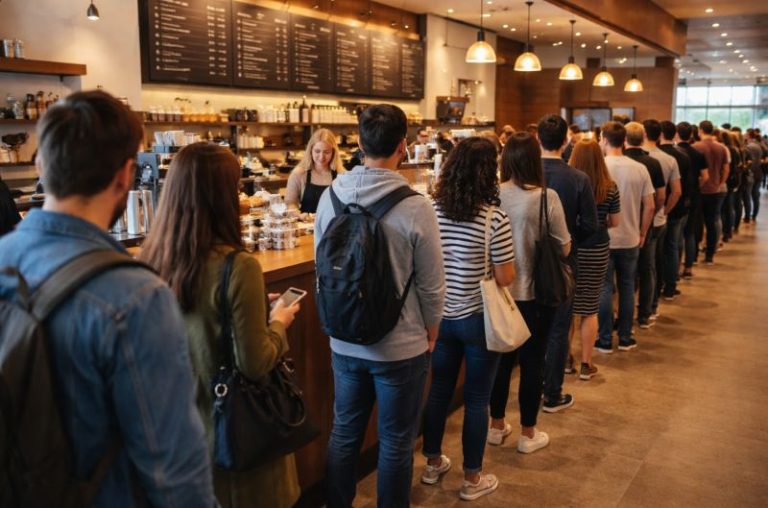
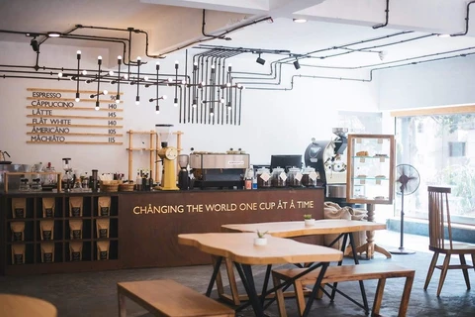
Despite claims to the contrary that seem to abound in the “coffeegeek” demimonde, one important general discovery gleaned from this project is that not all “third wave” coffeehouses and social experiences they comprise are the same. The coffeehouses studied for this research vary not only in anticipated ways with respect to built form—some seat 60, others seat 10, among myriad other qualities—but are also different with respect to business plans and business practices. Some militate exquisitely designed employee training programs whereas others adopt a more casual “on the job training” approach. Some are open past midnight, while others close at 4pm. Some are shockingly busy, with queues that never end and produce more than 1000 beverages a workday; others make as few as 200. There are absolutely similarities that undergird these establishments and which lend to their categorization and self-identification as “third wave,” but it would be overstating matters and would have been naïve to have assumed in the first place that every coffeehouse would evince the same social environment. As it happens, almost all of the employees interviewed have had experience at more than one coffeehouse and they do, in many cases, speak to this diversity and so instead of being a complication for this report, it instead constitutes an important finding.
Causal observation in the coffeehouses that I visited in this project suggests that a great deal—an endless amount, in fact—of “organic” sociality abounds in every one of them. To be sure, one Leitmotif of every modern coffeehouse of every description (chain, mom and pop, third wave) is the wide availability of wi-fi and precisely the observably antisocial, laptop-focused experience that it facilitates and which has been subject to analysis by Hampton and Gupta (2008). However, there was not a single instance in any of the dozens of hours spent in third wave shops that at least one conventional conversation was not encountered. What is intriguing however and part of what motivated this report is that these “conversations” are often and unavoidably between not only customers and between not only employees but also between employees—those at the cash register as well as those “on bar,” or those acting as baristas—and customers. Thus, not only do third wave (and other) coffeehouses allow for social interaction, but they also comprise a great deal of interaction between customers and employees, a form of social interaction recurrent in these cafes and one which has never been brought to analytic attention.
Interviews with baristas show the existence of important, authentic and even “traditional” sorts of sociality between shop employees and customers. In fact this is one of the signal features of the third wave coffeehouses owing to their built form as much as their “philosophy,” but a history of research on coffeehouses that has always focussed only on the interaction among customers has obscured and ignored this relationship. It is vital to the form of the coffeehouse and is part of how these venues facilitate durable sociality. Interviews with baristas included a question worded on the interview schedule (usually subject to paraphrasing though always retaining the sense of the original question) as follows: “Tell me about your interaction with customers ON THE JOB. Is there anything important or notable that has to do with your relationships with customers? Is it different from interaction with customers at other jobs, especially ones involving coffee?” This question often was transformed into a discussion of “good” versus “bad” customers and “good” versus “bad” experiences with them on the job since this rewording seemed to be better understood by interviewees and productive of more narration on their part. With that in mind, the following four themes help clarify the nature of employees’ interactions with customers and the role that this interaction plays in constituting the third-wave coffeehouse as a social form.
Theme 1: Conversational Interactions with Customers are Recurrent on the Job and are seen as Positive Features of the Job

To suggest that something akin to “conversation” constitutes part of any job that entails contact with members of the general public would seem to be obvious. Yet as noted earlier, the notion that the social interaction that takes place in coffeehouses is not only that between customers has been consistently ignored in research on the coffeehouse social realm. As venues that comprise sociality, it is interesting to note that, in interviews with baristas at third-wave cafes, they consider a “good customer” to be one who talks to them in a way that is respectful of the employee and her craft.
In the first interview excerpt, Mary notes that one of the best aspects of her job is the positive reaction from customers concerning the quality of the drinks she prepares and says that she wants customers to enjoy same coffee-related epiphany she reported that she had while visiting the cafes of Sydney, Australia.
Mary: I like the reactions of customers? If it’s- like it- if it’s- it tastes sometimes I get it’s really rare but “this is the best! Tasting coffee” or something like that it’s – that makes me feel good.
Interviewer: yeah I’m sure it would be.
Mary: And it just reminds me if how I? felt in Sydney? And I- like that’s my goal? I want some- something, how to say, something- it’s almost like making that person’s life change. And that would be really like great if I could do that to somebody.
Elyse offers a similar report of pleasant interactions with the “average” customer and like Mary intertwines this notion of “nice” customers and customers who have, or who develop, an appreciation for the sort of coffee that the third wave café provides. In the following excerpt, Elyse mentions how a customer might evolve from conventional dark roast to the lighter-roasted varietals that are brewed with a by-the-cup device known as a Clover machine.
Interviewer: So- but the average customer isn’t horrible.
Elyse: No the average customer is really quite nice and we’ve had a lot of cool customers come in. I’ve developed some really cool relationships with customers who come in and they started off just thinking that they wanted a brewed- like a dark roast black coffee and have started to drink the Clover and they come back each week to drink the Clover and have found out it’s so much better. Those people are pretty open to learning something- something new about coffee.
Further discussing the role of the Clover and uncovering the place that the brewing equipment can play in organizing and permitting the sorts of interactions that make for what baristas perceive as good customers, Ben suggest that this machine provides an opportunity, with every beverage, to engage customers because of the relative slow nature of brewing that it provides.
Ben: It – it depends like some of it is reading customers; some of it is also the demands of the Market. I think in a café setting it definitely is like more familiar. If somebody is sitting in a chair and I’m bussing their table – I did this at Bumpy’s I did this at Second Cup, you have an opportunity to talk to them. At the till, when there’s twenty people lined up, you have less of a luxury. I think it’s something that should change once we have Marda Loop. The situation – I think the area where I try to talk to customers the most and where I see the most conversation happening is on Clover? Because that’s-
Interviewer: Yeah I’ve noticed that too- that’s one reason why I enjoy sitting there, it’s so much calmer.
Ben: Yeah! Cause Clover-
Interviewer: But I don’t prefer it I’m really an espresso drinker.
Ben: Yeah.
Interviewer: But I like getting clovers because I can actually interact with the person who’s making my coffee. More than – more than with – you guys are extremely gracious with geeks like me who wanna talk about stuff? But the Clover’s custom built for that. You don’t have to pay as much attention to it while you’re brewing it.
Ben: And it’s – you can only move so fast. Like on till? You can move blazingly fast, on bar you can move blazingly fast. On Clover? Once you hit that button? You have about a minute. Like where- and if, if you’re NOT engaging the customer at that point? Like, something’s wrong. Like, you’re just standing there? Something’s definitely wrong.
Finally, Ashleigh summarizes the notion of the “good” customer as one who engages the staff member politely and, importantly, reflects with the employee about the coffee (or in this instance the “espresso”).
Interviewer: What makes somebody a GOOD customer?
Ashleigh: Just a- a well-mannered regular. You know? Someone who comes in, asks how you are and lets you know how the espresso was cause if it’s bad I want to hear it. Um and if it’s good I want to hear that even more. Yeah just I think- when when people are pleasant and make polite conversation that isn’t creepy you appreciate it.
All of the interviewees discussed experiences with both “good” and “bad” customers as a feature of the interview. What is notable is not merely that they addressed these matters, since they were introduced by the interviewer. What is notable is that the positive interactions with customers, which could be foreseen as entailing any number of things, all are related by interviewees as comprising something like “respect” for not only the employee but also admiration for the product and process of coffee making.
Related to this conceptualization of the “good” customer and the importance of social interaction between employees and customers generally is the specific content of that interaction, and the second theme uncovered in interviews relevant to that is the role that “educating” customers plays in those encounters.
Theme 2: Conversations with Customers are seen as a Resource for “Education” Around Coffee and the Third-Wave “Mission”

The first excerpt exemplifying this theme follows from my inquiring after Ben notes that, despite some customers’ clamoring for it, his café does not stock vanilla syrup. He uses this fact as a springboard to discuss how responding to customers’ requests for it is not only one of the opportunities for pleasant conversation referenced above but is also an opportunity for what might be called education.
Interviewer: You guys don’t have vanilla?
Ben: No, Uh, the philosophy behind it is, like we can make a really good vanilla latte if you take like Tahitian vanilla and do it but by not having it? Customers have to look at our menu. They have to think about what they’re ordering and it also gives us a chance to talk about the drinks we have. So we have other drinks, and at the same time that we’re trying to find a fit for them if there’s an opportunity to talk about coffee we’ll definitely use it. Obviously a customer doesn’t want to be preached to, and I think that’s an important thing to realize is that sometimes you just find the fit for that customer and you let them go their own way.
Justin, who works at the same café as does Ben, buttresses this notion of education further with the example of explaining his café’s coffee bean roast profile when customers request a dark roast. He concludes this narrative by saying that in most cases his efforts at education are successful (“…they say, ‘You know what, I’ll try it’”).
Justin: There are… yes. But, very- it’s more subtle than that I think there’s a lot of people who come and say “I want the darkest coffee that you have” and we have to explain that they’re not gonna get that dark, caramel roasty flavour profile with our coffees because all our coffees are roasted to a, you know, medium to light range and they’re roasted to bring out the flavour of the bean and not the roast. We don’t want people to taste the roast- charcoal. We don’t want people to taste charcoal we want the, the origin to come through. We want a Costa Rican to taste like a Costa Rican.
Interviewer: But how often does it happen that someone says I want something dark?
Justin: Um, oh every day.
Interviewer: Every day?
Justin: For sure.
Interviewer: Do they accept your account? When you say this to them, do they accept it?
Justin: Ninety percent do. They say, “You know what, I’ll try it.”
Of course, the fact that encounters with customers provide opportunities for education does not mean that these efforts will always be welcome or successful. Meghan’s attempts to apprise customers of what she sees as the superior vessel for coffee (“for here” porcelain versus “to go” paper) usually, she says, “never [go] well.”
Interviewer: What about when somebody asks for something that you… don’t think will taste good? Like an issue that I’ve discovered is important is the extra hot issue.
Meghan: Yeah. I don’t think- I don’t like making things extra hot. Um but if people ask for it, they don’t know any better. And that’s that’s something that’s hard to get over. People order espresso to go? Um to me and that’s- just don’t! Just don’t. Um at least get an Americano to go. But generally somebody who orders that doesn’t care if you tell ‘em it’s gonna taste worse.
Interviewer: Have you- do you ever mention that to people, that maybe they should try?
Meghan: Yeah. Often. Usually whenever any time someone orders one? I’ll say “are you sure you want that to go? It’s-“ but usually they say yes they are. Occasionally I’ve poured it in a for-here cup and they try to correct me and I say they can probably finish it before they get to the door. But that’s never gone over well.
Given Meghan’s implication that not all encounters with customers are positive, it is fitting now to consider what constitutes, from baristas’ perspectives, negative encounters.
Theme 3: “Bad” Customers are Those who Treat Staff with “Disrespect,” which is Evinced in Those Customers’ Adoption of “Unilateral” Conversational Strategies and Refusal to Permit Agency on the Part of the Employees.

As the sole interviewer for this project and as a person very much on the “inside” of the third-wave coffee phenomenon, I expected to be recurrently regaled with stories of the challenges of dealing with unknowledgeable customers whose coffee-related experience was limited to chains like Starbucks and Tim Hortons and expected furthermore for those customers, cursed with ignorance around quality coffee, to be the main source of complaints from interviewees. I was wrong; in fact the Starbucks drinkers and their ilk were the ones who provide baristas with the opportunities for education described above, opportunities that lend meaning to their jobs and that constitute many of the extended interactions between barista and customer that infiltrate this social setting. The “bad” customer could in fact be a coffee aficionado, and what made them “bad” was their perceivably “disrespectful” treatment of staff, treatment that comprised the customers’ refusal to engage with the barista in a manner that allowed the employee agency in the interaction. Carl reflects on this sort of interaction:
Interviewer: Can you tell me about one of those instances of a negative experience with a customer?
Carl: Sure- this was just last weekend when a guy comes in, I’m on the till and greet him the way I do every customer and he orders a cappuccino extra hot to go. No “I’m fine, how are you,” nothing. Doesn’t even look me in the eye. Anyway I let him know that we prefer not to make drinks extra hot and maybe we can make it our normal way and he can bring it back if he doesn’t like it. So I’m trying to do a little subtle education. He says “fuck it, I’ll go to Starbucks.” Walks out. Just treats me like crap. I can deal with customers who aren’t coffee experts and want their frappuccinos or whatever and those folks will usually at least listen when you explain what we’re about. But this guy ruined my day. I’m getting sort of pissed off just talking about it. You don’t treat people that way.
Carl elucidates how he does not have as much of a challenge with clientele “who aren’t coffee experts,” a notion that Ben mirrors and expands on insofar as he “feels for” such persons, but cannot stand for “rudeness”:
Interviewer: Hmm. How was he rude?
Ben: Um, I can’t, he’s just abusive to people, like if you’re fumbling with the till, like if somebody takes a while to get change he’ll like yell at you, if he walks to the other side and his drink’s not there right away he’ll yell, like, so like I can feel for the people who are ignorant of coffee cause I’ve been there. I think that’s a neat stage in coffee right now because no one’s grown up with fantastic coffee. So I’m- even if someone comes up to the till and orders something that’s really strange or they want a scooped cappuccino with tons of foam? I like I feel for that person. But if someone’s gonna be abusive to people on till for no reason, it’s definitely-
Interviewer: So it’s not about the coffee, it’s about their personality that that you don’t like about some customers.
Ben: yeah.
The final theme concerns the fact that none of this discussion is intended to imply that the third-wave phenomenon, at least with respect to the customer-employee relationship, is consistent across shops or within shops at different parts of the day.
Theme 4: Coffeehouses vary with respect to the social experience they can provide due to differences in busy-ness, built form, and other matters.
Elyse, who has worked at three shops that all, with respect to their focus on artisanally roasted coffee beans, high-end machines and well-trained staff, seamlessly qualify as “third-wave” shops, discusses how the possibilities for interaction with customers varied among them.
Interviewer: What about other coffeehouses you’ve worked at? Has your experience with customers been any different than at Bumpy’s or Java Jamboree?
Elyse: Uhhhh definitely like somewhere like Java Jamboree- I mean just because it wasn’t as high volume? It was more kind of like that typical like you know sit and chat with the customer while you’re waiting like when there’s nobody else in the café and you’re just sitting with the customer like for hours. And kind of that more easy-going attitude, there wasn’t as much of the education aspect um there was no education aspect I would say we would do whatever the customer wanted. And then at Bumpy’s it was like again very different um I don’t know just the actual physical layout of the store I think has a huge part in that in just at Bumpy’s it was very much like you’re on a higher level and behind a big machine…
Interviewer: Yeah. I’ve always- always been perplexed by that. I know that’s what they inherited but it’s always struck me as being off-putting like as a customer?
Elyse: Yeah. And I think it’s kind of- it’s hard to really have a quality interaction with someone? When you’re kind of like “oh I’m up higher I’m behind this big machine.” It’s a little bit different of an interaction there as well.
Discussion

The goal of this article has been to provide insights into a venue that encompasses notable “traditional” interpersonal sociability at a time in which such venues are purportedly disappearing. “Third places” exist all around us and one need only visit a coffee house to find a paradigmatic example of them. This discovery of authentic third places, then, is the easy part and it is shocking how often claims to the contrary (as with Oldenburg’s [1997] claims about third places “vanishing” despite evidence of their durability all around us) are shot through, and accepted uncritically, in academic versions of postmodern social space. There are too many other examples of authentic sociability to ever subject to the sort of analytic inquiry deployed here. To reiterate: This is the easy part.
The harder part is to undertake what I have attempted here, which is to answer a richer and more interesting question. That question is not, then, that surrounding whether face-to-face, organic, public sociability still exists—it does—but rather one that has always undergirded ethnomethodological inquiry: What are these people doing? It is further striking to note that, as important as coffeehouses and other sociable spaces for consumption have been in creating our modern sense of what every day social interaction and public social life look like, there has been no attention in the history of this phenomenon to the richly detailed and recurrent phenomenon of social interaction between the persons who work at the coffeehouses and the customers who visit them. This is a massive oversight in past research and this modest effort at interviewing baristas in “third wave” shops to ascertain, among other aspects of their work experience, whether and how they communicate with customers has been one attempt to redress this oversight. As it happens, not only are these interactions observably recurrent but they are also among the most important features of the baristas’ work world and are part of what constitutes that coffeehouse as a social environment that provides us with a hopeful vision of what the postmodern social world can look like: organic, pleasurable, meaningful, and involving both customers and the persons who serve them.
The objective in this research has been, most broadly, to challenge a largely taken-for-granted idea that informs sociological, anthropological, and cultural-studies-based critiques and investigations of contemporary sociality, namely, that the traditional public realm and traditional forms of sociality have been supplanted by venues, social settings, and social forms that are commodified, contrived, privately-regulated, privately-owned, and anathema to real, lived, organic sociality. I contend that this pessimistic view of postmodernity, while substantially accurate with regard to the new range of possible settings and types of sociability available to us, has been blind to both the adaptability of participants in these new social forms to resist and redefine settings as “organic,” and has also not considered the durability of “traditional” forms of sociality that exist all around us. My goal is not to dismiss critiques of commodification, “internet addiction,” privatization of public space, and the like. My intention is rather to consider, given these much-maligned trends, how people adapt to them, reshape them, and even react against them. I intend to specifically consider a subculture that focuses on lived, sensual experience and “old-fashioned” connoisseurship and that comprises similarly “old fashioned” sociality, with innovative aspects as well.
Of course, it is always seductive to attempt to generalize the findings of a qualitative (or quantitative) investigation deploying a tiny, non-probability sample of sites of observation beyond the research design’s ability to permit such generalization. It has always been the goal of ethnomethodology, from its earliest investigations involving “breaching experiments” and to its more contemporary reliance on conversation-analytic treatment of lived discourse in both casual and institutional settings, to focus on specific encounters and instances of interaction with an eye to address those encounters not as ideographic per se but as instantiations of some larger phenomena by uncovering regularities of conduct, patterns of social interaction, that inhere in all of those lived examples. To apply this version of “generalizability” to my findings in this article, it is notable that every interviewee oriented to “good” and “bad” customer encounters in the same way. This does not itself suggest that EVERY barista will display the same valence regarding the sorts of customers they like (or despise); it does suggest, however, that further research might suggest that the orientations to customers treated here as features of the third-wave café phenomenon are, in fact, durable and enduring. The recommendations for future research are, I think, obvious: More observations, and in particular more detailed analysis of actual encounters between customers and employees. Employees’ reflections are no substitute for the detailed study of lived interaction, but they help to elucidate matters about the third wave as a social experience.
References
- Abaza, M. (2001). Shopping malls, consumer culture and the reshaping of public space in Egypt. Theory, Culture, and Society, 18(5), 97-122.
- Altheide, D. L. (1987). Ethnographic content analysis. Qualitative Sociology, 10(1), 65-77.
- Arjomand, S. (2004). Coffeehouses, guilds and oriental despotism government and civil society in late 17th to early 18th century Istanbul and Isfahan, and as seen from Paris and London. European Journal of Sociology, 45(1), 23-42.
- Beniger, J. (1987). Personalization of mass media and the growth of pseudo-community. Communication Research, 14(3), 352-371.
- Bryman, A. (2004). The Disneyization of society. London, UK: Sage.
- Cowan, B. (2005). The social life of coffee: The emergence of the British coffeehouse. New Haven, CT: Yale University Press.
- Francis, D., & Hester, S. (2004). An invitation to ethnomethodology: Language, society, and interaction. London, UK: Sage Publications.
- Garfinkel, H. (1967). Studies in ethnomethodology. Englewood Cliffs, NJ: Prentice-Hall.
- Gaudio, R. (2003). Coffeetalk: Starbucks and the commercialization of conversation. Language in Society, 32(5), 659-691.
- Gold, J. (2008). La Mill: The latest buzz.” LA Weekly. Retrieved from http://www.laweekly.com/2008-03-13/eat-drink/the-latest-buzz
- Gottdiener, M. (2000). The consumption of space and the spaces of consumption. In M. Gottdiener (Ed.), New forms of consumption: Consumers, culture, and commodification (pp. 265-285). Lanham, MD: Rowman & Littlefield.
- Gottdiener, M. (2001). The theming of America: American dreams, media fantasies, and themed environments. Boulder, CO: Westview Press.
- Habermas, J. (1989/1962). The structural transformation of the public sphere: An inquiry into a category of Bourgeois society, tr. Thomas Burger. London, UK: Polity.
- Haine, W. (1996). The world of the Paris café: Sociability among the French working class, 1789-1914. London, UK: John Hopkins University Press.
- Hampton, K., & N. Gupta. (2008). Community and social interaction in the wireless city: Wi-fi use in public and semi-public spaces. New Media and Society, 10(6), 831-850.
- Heritage, J. (1984). Garfinkel and ethnomethodology. Cambridge, UK: Polity.
- Husserl, E. (1911). Philosophie als strenge wissenschaft. Logos, 1(2), 289-341.
- Komecoglu, U. (2005). The publicness and sociabilities of the Ottoman coffeehouse. Javnost/The Public, 12(2), 5-22.
- Laurier, E., Whyte, A., & Buckner, K. (2001). An ethnography of a neighbourhood café: Informality, table arrangements and background noise. Journal of Mundane Behavior, 2(2), 195-232.
- Lyons, J. (2005). Think Seattle, act globally: Specialty coffee, commodity biographies and the promotion of place. Cultural Studies, 19(4), 14-34.
- Manning, P. (2008). Barista rants about stupid customers at Starbucks: What imaginary conversations can teach us about real ones. Language & Communication, 28(2), 101-126.
- Manzo, J. (2005). Social control and the management of personal space in shopping malls. Space and Culture, 8(1), 83-97.
- Manzo, J. (2010). Coffee, connoisseurship, and an ethnomethodologically-informed sociology of taste. Human Studies, 33(2-3), 141-155.
- Milligan, M. (1998). Interactional past and potential: The social construction of place attachment. Symbolic Interaction, 21(1), 1-33.
- Oldenburg, R. (1991). The great good place. New York, NY: Paragon House.
- Oldenburg, R. (1997). Our vanishing “third places.” Planning Commissioners’ Journal, 25(1), 6- 10.
- Oldenburg, R. (2000). Celebrating the third place: Inspiring stories about the “great good paces” at the heart of our communities. New York, NY: Marlowe & Company.
- Underhill, P. (2004). Call of the mall: The geography of shopping. New York, NY: Simon and Schuster.
Originally published by The Qualitative Report 20:6 (2015, 746-761), republished by NSUWorks under the terms of a Creative Commons Attribution-NonCommercial-ShareAlike 4.0 International license.
About the Author