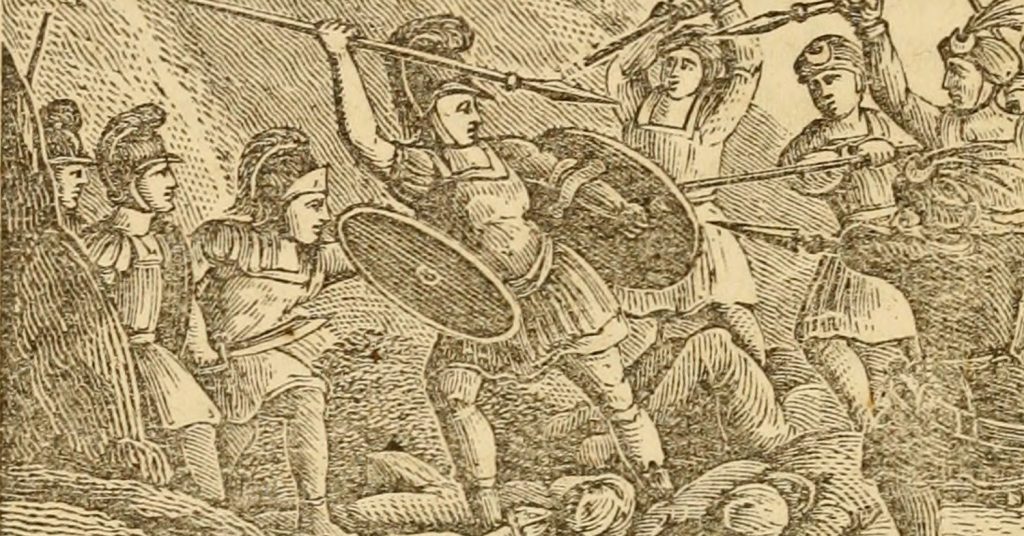
Thucydides placed Brasidas’s Homeric ending in a singularly admirable light.

By Nathan A. Jennings
NATO Planner, Afghanistan
In his seminal work, The Peloponnesian War, the ancient historian Thucydides employs numerous characters from the storied conflict as devices to reveal competing aspects of human nature. Among the varied personalities exposed by the tensions of war, the Spartan commander Brasidas emerges as a definitive figure who illustrates the strengths and weaknesses of not only his city-state’s “national character,” but also that of their great enemy, Athens.[1] As an energetic field leader who fought to secure Peloponnesian interests through unconventional and asymmetric strategies during the Archidamian phase of the war, the unorthodox general arrives to personify the best aspects of Lacedaemon martial education and reverent piety. Simultaneously, in a remarkable fusion of competing Hellenic qualities, the ambitious soldier enhances Spartan conservatism with an uncharacteristic enhancement of Athenian-style audacity and charisma.[2]
The resulting literary portrayal of Brasidas, as he dynamically shapes the early course of the conflict by combining Sparta’s “wise moderation” and Athens’s “spectacle of daring,” as defined by each city’s chief executives at the onset of the great conflict, allows nuanced commentary on the timeless extremes of human nature that animated what Thucydides called the “greatest movement known in history.”[3] As he chronicles this struggle for mastery of Hellas, the author deploys the Spartan officer not only to juxtapose his distinctive brand of martial excellence against both friend and foe, but also to reveal larger reflections of the internal nationalistic currents that compelled Sparta and Athens to embrace hegemonic rule. For the Lacedaemons in particular, Brasidas’s ostensibly sincere efforts to achieve “liberation for the Hellenes” from Athenian domination, as proclaimed by the general himself, would serve his polis well and propel Sparta through its darkest days of the war.[4]

Any understanding of the warrior Brasidas, as perhaps the most Athenian of all the Spartans described in Thucydides’s history, begins with a more expansive appreciation of the tectonic confrontation of national characteristics that drove the conduct of the war. Reflecting an exceptionally nuanced commentary at the nexus of imperial struggle and human nature, personalities like Brasidas, in addition to an array of statesmen, generals, and envoys from opposing sides, emerge as instructive characters in a larger drama. Thus with Sparta portrayed to endorse the ideal of Hellenic moderation, and Athens representing the extremes of aggrandizing Hellenic dynamism, the historian adeptly utilizes the unconventional Spartan to bring the opposing energies of the dominant city-states into sharp relief.
The first characteristic which Thucydides emphasizes, the theme of admirable Spartan moderation, establishes the baseline contrast that separates Lacedaemons and Athenians. Throughout the work, the author consistently implies Sparta to be the just actor in his story narrative, creating a sometimes hypocritical foil for the specter of Athenian imperialism. This description of traditionalism begins with praise of cultural aspects, where Thucydides associates the Spartans’ “modest style of dressing,” and method of “contending naked” in games, with “modern ideas” that innovated Hellenic sophistication. He likewise lauds the Spartan elites’ attempt to “assimilate their way of life to that of the common people,” as if to separate them from the ostentatious Athenians and even more opulent Persians. [5]
The historian later expands this individual modesty into national character, citing the Lacedaemons as the only great power who “knew how to be wise in prosperity,” and that “the more security” it gained “the greater it grew.”[6] Beginning in book one, Thucydides utilizes speeches of the Spartan King, Archidamus, and his allies the Corinthians, to first establish Sparta’s conservative nature. In 432 B.C., as the Corinthians attempt to galvanize Sparta into declaring war against Athens for siding with their Corcyreaean enemies, they accordingly accuse the Lacedaemons of being inclined to “attempt less than is justified by your power,” and that they suffer from “a total want of invention.”[7] As if to cement this moderation, Thucydides then allows the king to agree, but in a more positive light. When cautioning against hasty hostilities, Archidamus claims that Spartans “alone do not become insolent in success,” and lauds his society for giving away “less than others in misfortune.” He also explains that “it is our sense of order that makes us so.”[8]
In a marked contrast with this focus on moderation, Thucydides reveals the scope of Athenian dynamism with equal documentation. With intent to delineate the “wide difference between the two characters” of Hellas’s two greatest powers, he constructs an array of speeches to define Athens’s enterprising and aggrandizing nature.[9] The Corinthians, as before, offer perhaps the most critical commentary on this subject. In an attempt to shame Sparta into war, they warn of “the establishment in Hellas of a tyrant state,” and declare that the Athenians, with their innate inclination towards imperial domination, “take no rest and allow none to anyone else.”[10] As for the threat of Athenian audacity, the Peloponnesians describe them as “addicted to innovation,” and argue that their “designs are characterized by swiftness alike in conception and execution.”[11] The envoy finally stresses that the people of Athens are “adventurous beyond their power” and “daring beyond their judgment,” as an explicit criticism of Sparta’s traditional posture of reserved deliberation.[12]

From an opposing perspective, other actors in the work seek to justify Athenian dynamism as a form of deserved excellence. Like Archidamus before him, the great statesman Pericles offers a more admirable interpretation of his respective home city’s innate nature. In his famed Funeral Oration, the architect of Athens’s war strategy proclaims that his people had “forced every sea and land to be the highway of our daring,” and boasts that “in our enterprises we present the singular spectacle of daring and deliberation.”[13] He then asserts that Athens is “the school of Hellas,” while lauding the individual Athenian as “equal to so many emergencies” and “graced by so happy a versatility.”[14] In terms of sophisticated culture, Pericles defends his city’s ability to “provide plenty of means for the mind to refresh itself from business” and how its citizens “cultivate refinement without extravagance.”[15] Later in the chronicle, the Athenian demagogue and warmonger Cleon, who relentlessly lobbies for war until his death in 422, underscores the fickle political nature of Athens’s citizen assembly, complaining that it is led by “cleverness and intellectual rivalry.”[16]
These competing national characters, traditional moderation and progressive dynamism, proceed to manifest in a contrast of virtues associated with hegemonic rule. From the very commencement of the war, each of the great cities led and expanded their alliances under precarious, and often contradictory, justifications, bringing acute issues of liberty between master and subject state to the fore. With this tension defining the work, Thucydides subtly evokes Sparta as the “liberators of Hellas,” despite the self-serving and pragmatic nature of its foreign policy, and even asserts that the Lacedaemons had brought “freedom from tyrants” in the previous age.[17] Conversely, he records that the majority of Hellenic opinion moved against Athens by subjects “who wished to escape from her empire,” or those who “were apprehensive of being absorbed by it.”[18] The careers of Brasidas and his Athenian rivals, as captains who fought to extend programs of liberation or domination, again prove illustrative in this comparison of imperial rule.
With such a rich landscape of contrasting traditionalism and progressivism established by Thucydides as the underlying narrative of his work, Brasidas arrives to bring further definition to the scene. Revealed as a man who ostensibly risks all for both his city’s benefit and the cause of liberty, a portrait emerges of a general who personifies the most admirable Lacedaemon qualities while compensating for traditional societal weaknesses. According to Thucydides’s own assessment, the energetic commander demonstrates “moderation in all his conduct,” and shows “himself so good a man at all points” that potential allies find him convincing, making him an idealized projection of Archidamus’s vision of the “warlike and wise” Spartan warrior.[19]
As a leading field commander throughout the first decade of the war, beginning with his initial courageous service at Methone in 431, and ending with his Homeric death at Amphipolis in 422, Brasidas exemplifies audacity and charisma to improve the ideal of Lacedaemon moderation. Revealed as a man of heroic stature by Thucydides, his wartime exploits included impetuously preserving the allied city of Methone through a hazardous infantry charge in the opening year of the conflict, valorously repelling Athenian assault troops in futile coastal actions at Pylos and Spakteria in 425, and selflessly defending the allied city of Amphipolis just before the onset of the Peace of Nicias. Throughout each of these campaigns Brasidas is notable for his rapid marches, sudden attacks, and unique ability to train, inspire, and lead seemingly inferior allied troops on behalf of the Peloponnesian League.

Further appreciation of Brasidas, as a reflection of Spartan values, begins first and foremost with his martial prowess. While Sparta’s intense warrior culture may at first glance appear extreme, especially in comparison with less militarized and more cosmopolitan polis like Athens, it actually represents the very heart of Lacedaemon moderation. Explained by Thucydides through the words of Archidamus in the introductory Archeology, the king proclaims that Spartans are not innately unique from other men, but rather that “superiority lies with him who his reared in the severest school.” He also emphasizes that Lacedaemons are “warlike because self-control contains honor as a chief constraint.”[20] In this sense, the Spartan values of discipline and resoluteness are revealed as moderate “practices,” in contrast with Athens’s propensity to alternately become, as criticized by the Thucydides, “insolently elated” or “victims to a panic” according to the fortunes of war.[21]
This theme of Spartan military prowess is exemplified when Brasidas proceeds to impart his stern education, gained through a lifetime of institutionalized training and deprivation, to the non-Lacedaemon auxiliaries he recruits and commands. Speaking to his cohort of helots, mercenaries, and barbarian allies in 423 before commencing a battle in the Chalcidice region along the northeastern coast of Hellas, the general explains that their “bravery” stems not from allies, “native courage,” nor numbers, but instead from sheer “superiority in the field.” He stresses the “regular order” which their undisciplined opponents lack, and criticizes the enemies’ formidability of “outward appearance” and proclivity for “loud yelling.” In comparison, while revealing the author’s appreciation of the attributes that made Sparta invincible in battle, he encourages his men with a distinctly Lacedaemon imperative: “stand your ground therefore when they advance, and wait your opportunity to retire in good order.”[22]
This inclination for transforming lesser soldiers into infantry of Spartan quality, by way of superior training, reveals itself again as Brasidas prepares his ad hoc coalition for what would be his final battle. As the Peloponnesian alliance prepares to repel an impending assault against Amphipolis by an Athenian expeditionary force under the populist Cleon in 422, the Spartan commander first assures his men that they will “see me already upon them, as is likely, dealing terror among them.” He then exhorts the nervous troops to “show yourself a brave man, as a Spartiate should,” and compels them to remember that “zeal, honor, and obedience mark the good soldier.”[23] Fortunately for Brasidas, after sustaining a mortal wound, Thucydides notes that “he lived long enough to hear of the victory of his troops,” allowing him a confirmation of the triumph of Spartan education, even when given to non-Lacedaemons, over the fear and chaos of war.[24]
While Brasidas’s repeated instances of personal valor and combat leadership personify the traditional Spartan strengths of discipline and perseverance, he likewise addresses the persistent critique, as portrayed by Thucydides in speech after speech, of Lacedaemon “slowness and procrastination.”[25] As demonstrated in the rapidity and decisiveness of his campaigns across the periphery of Hellas, the exceptional general embraces a very Athenian flavor of audacity, bringing dynamism to his peoples’ proclivity for deliberation. Thus the historian is drawn to praise Brasidas in terms not ascribed to any other Spartan in the book, writing that the Peloponnesian allies were “eager to have a man so energetic as he,” and that “his service abroad proved of the utmost use to his country.”[26]

This combination of Spartan education and Athenian daring invites several illustrative comparisons. On the Lacedaemon side, Brasidas’s series of improvised campaigns across northwestern Hellas, and his audacious action at Pylos where he encouraged his fleet to “shiver their vessels and force a landing,” stand in marked contrast with the more conservative operations of the main Spartan army.[27] Time and time again, the Spartan kings Archidamus and Agis lead their army to “ravage the plain” of Attica without ever dissuading Athens from Pericles’s directive to “not go out to battle, but to come into the city and guard it, and get ready their fleet.”[28] If not for the plague that devastated Athens, and the self-damaging ambitions of statesmen like Cleon and Alcibiades, it is probable that the conventional strategy of the Spartan kings would have failed to yield ultimate victory over their fortified and maritime-focused enemy.
In a vivid contrast of both scope and effect, Brasidas’s economized campaigns in the Thracian region threaten to impede Athens crucial grain supply and remove tributary states from the empire, all without risking the integrity of the irreplaceable Spartan corps of peers that comprised the main force of its peerless heavy infantry. Through a combination of audacity, treachery, and astute diplomacy, the general manages to bring several key Athenian subject cities into revolt, while capturing others through force. At the culmination of the general’s career in 422, where he charges to victory and death at the city of Amphipolis, he succeeds in shattering a disastrous Athenian expedition under Cleon. In this manner, Brasidas, as Thucydides’s most dynamic Spartan, is perhaps more comparable to the author’s portrayal of the energetic Athenian general Demosthenes, or even to the ambitious visionary Alcibiades, than to his peer commanders at home.
In addition to combining discipline and audacity on the battlefield, Brasidas also embodies the convergence of two other competing national attributes: Spartan piety and Athenian charisma. Taking first the attribute of piety, the general is shown to revere the deities, and even more importantly, portrays an apparently sincere modesty of character. In 424, as he is storming the Athenian controlled fortress of Lecythus in the Chaldician region, Brasidas proclaims that he will give “thirty silver minae” to the “man first on the wall.” Upon seizing the heights, he conveniently realizes that his victory could not have been accomplished by “human agency,” and instead donates the money to temple of Athena. Brasidas then destroys the town and declares the “whole of it” to be “consecrated ground.” It is also notable that when he captures the fort the Spartan “put to the sword all he found in it,” demonstrating his capacity for brutality and mercilessness.[29]
While this reverence to Athena may have been entirely calculated to produce the appearance of Lacedaemon piety, Thucydides nevertheless juxtaposes Brasidas’s action against other leaders who devolve into sacrilege. Foremost amongst these stands the political chameleon Alcibiades, who the author attests that in his “private life” his habits “gave offense to everyone.”[30] In terms of sheer impiety, the aristocrat is indicted by the Athenian assembly while leading the Sicilian Expedition in 415 for “sacrilege in the matter of the Mysteries and of the Hermae,” where he is alleged to have profaned divine ceremonies and statues.[31] The resulting dismissal of Alcibiades from command of the “most costly and splendid Hellenic force that had ever been sent out,” and his subsequent exile from Athens, stands in marked contrast with Brasidas, who’s public act of piety coincided with a glorious victory at the height of his military fortunes.[32]

Despite this apparent lesson in the merits of piety by Thucydides, Brasidas’s appeal extended far beyond sacred reverence and into the sphere of public character and reputation. When describing the admirable impression that the Spartan broadcasted as he campaigned to expand the Peloponnesian confederacy in northeastern Hellas, Thucydides writes that he was already “known by experience to some, by hearsay to others,” and was what “mainly created an esteem for the Spartans among the allies of Athens.” In a rare instance of unequivocally lionizing a personality, the author then states that Brasidas engendered such admiration of his personal presentation “as to leave behind him the conviction that the rest were like him.”[33]
This singular portrayal of Brasidas, as a pragmatic paragon of piety and modesty, finds further contrast with another Lacedaemon of great renown: the general Pausanias. Though Thucydides writes that he was once “held in high honor by the Hellenes as the hero of Plataea,” in which he commanded the Hellenic alliance that defeated the Persian invasion of 479, the author carefully relates how Pausanias fell from power in his introductory chapter. When given post-war command over a Pan-Hellenic confederacy at the strategic Hellespont, which geographically placed the Spartan general far beyond the restraining influence of Lacedaemon culture, the veteran commander “became prouder than ever,” developed a “violent temper,” and intended to enact ambitions “on a grander scale.”[34]
More importantly, these character flaws served as “the principal reason why the confederacy went over to the Athenians,” thus setting Sparta’s great rival on its initial course for empire and hegemony over the Aegean basin.[35] In contrast, Brasidas is shown to be impervious to foreign corruption, and through his “valor and conduct,” wields a beneficial influence on his city on prospective allies. As the embodiment of Spartan ideals, Thucydides deduces that his “just and moderate conduct towards the cities generally succeeded in persuading many to revolt.” As a result of his personal diplomacy, Brasidas manages to entice, or intimidate, the strategic cities of Acanthus, Amphipolis, and Toroni to abandon the Athenian Empire in favor of Sparta, in addition to several other lesser towns.
While Brasidas’s deployment of personal moderation under the gaze of potential allies arguably equaled the value of entire regiments and brigades, the dynamic general further enhanced Lacedaemon character with another distinctly Athenian quality: demagogic charisma. Just before he delivers an uncharacteristically moving speech to the Acanthians, a people who he successfully enticed to join the Peloponnesian League, Thucydides describes the general as “not being a bad speaker for a Spartan.”[36] This comment reveals that the author appreciated the laconic nature of Spartan oratory, and again places “the seductive arguments of Brasidas” in direct comparison with the early, and ultimately persuasively unsuccessful, speeches of Archidamus.[37]

Brasidas’s charismatic oratory is thus emphasized in several speeches where he skillfully motivates allied Hellenes to achieve his city’s intended objectives. As before, this capacity for public persuasion deploys the general in direct contrast with Alcibiades. At first glance, within the context of persuasive oratory, both men are seen to be extremely capable at bringing audiences over to their agenda. For the Athenian demagogue, this ability is demonstrated in his shaping of the Argos alliance in 419, his singular influence in propelling the Sicilian Expedition four years later, and his seminal speech at Sparta following exile from Athens. For Brasidas, evidence of his skill emerges in his speech to a potential ally called Acanthus, to his soldiers on the eve of battle in the Chalcidice region in 423, and at Amphipolis the next year.
The Spartan general’s first and longest speech in the history, delivered to the “popular party” of Acanthus, emerges as an example of particularly compelling oratory. As he makes the case for Spartan leadership, the general weaves the theme of Hellenic liberation into a compelling argument against Athenian domination. The following quote, in which Thucydides reveals the Spartan’s ability to pursued, concludes the speech: “Endeavor, therefore, to decide wisely, and strive to begin the work of liberation for the Hellenes, and gain for yourselves endless renown, while escape private loss, and cover your commonwealth with glory.”[38]
Despite the similar oratory capabilities of Brasidas and Alcibiades, the effects of their demagoguery reveal divergent trends. For the Spartan commander, his speeches bring rapid and direct benefit to his home city. He ostensibly had been dispatched to “free Hellas” from the yoke of Athenian imperialism, at least as far as such liberation served Spartan interests, and the general accordingly instigates a series of tactical victories that create a strategic crisis for Athens.[39] As for Alcibiades, his well-intentioned alliance of 419 led to the decisive Battle of Mantinea and unintentionally resulted in a victorious and resurgent Sparta. In the case of his schemes for the conquest of Sicily, the unprecedented investment in ships and men by his city ended with “a destruction so complete not being thought credible.”[40]
Given this difference of outcomes, Thucydides reveals that charismatic oratory on behalf of Sparta’s program of pragmatic liberation, from the person of a modest speaker who retains Spartan values, yields more benefit than similarly skillful presentations by Athens’s most dynamic statesman, who sought to imperialistically “reduce Sicily and Carthage” in order to “gain in wealth and reputation by means of his successes.”[41] As a study in the virtues of hegemony, it reflects a telling contrast of character and material results, centering on the purity of intent by each man and his city. While men like Alcibiades brought their state to ruin through infectious ambition, the liberator Brasidas, as an officer who combined the best aspects of Hellenic character, accrues benefits to himself and his cause.

In the final analysis, Brasidas and his admirable, if brutal, military career emerge as an insightful commentary on the nature of human conflict. When describing the societal instability engendered by the contest between Sparta and Athens, Thucydides famously writes that “war takes away the easy supply of daily wants and so proves a rough master that brings most men’s characters to a level with their fortunes.”[42] It is possible then, as the historian employs Brasidas to reflect or contrast the full spectrum of Hellenic values, that the Spartan’s career exemplifies this truism. As a traditional Spartiate, his “severe” education allows him to negotiate “many and terrible” sufferings as “the whole Hellenic world was convulsed.”[43] As a Lacedaemon field commander who embraces the enterprise and charisma of Athenian dynamism, within the limits of Spartan “self control,” he demonstrates how personal excellence can coexist with modest behavior.[44]
In this regard, it appears that Thucydides has established a versatile literary foil that is simultaneously both disciplined and daring, both pious and charismatic. As Brasidas is contrasted against the opposing national characters described by Archidamus and Pericles, and subtly compared to the dynamic virtues of grasping leaders like Alcibiades, the author reveals extremes of the “nature of mankind” as represented by Hellas’s competing powers.[45] On one side reserved Sparta is found to hold an admirable moderation, lacking only a greater scope of Brasidas’s innovation. On the other, Athens is shown to be afflicted by the extremities its own dynamism, needing only the restraining influence of a figure like the Lacedaemon hero.
In the subsequent collision of innate natures, Spartan moderation and Athenian excess, Thucydides finds his greatest tension within the narratives of imperial hegemony, as Brasidas’s military success is both aligned and contrasted with Sparta’s self-serving intent to bring freedom from imperial Athens. While the dynamic officer clearly emerges as the polar opposite to Athenian imperial aggrandizement, his relationship to his own city is more nuanced. Even as Brasidas is campaigning to liberate potential allies from domination by Athens, Thucydides writes that his city planned to “offer in exchange” the liberated places for a negotiated peace and prisoner repatriation, revealing that Sparta actually valued its own strategic interests over principles of freedom and justice.[46] In this context, Brasidas is shown to be the paragon of sincere liberation, standing above the pragmatism of nation-state interests. Since the author never indicates that the general intended to betray the ideals by which he justified his campaigns, he is portrayed with a purity of intent absent from his more pragmatic and duplicitous home government.
This personal, and singular, commitment to Hellenic freedom culminates with Brasidas’s heroic demise. In a final endorsement of the unorthodox officer as the ideal leader in time of strife, Thucydides writes that the Amphipolitans, for whom he gave his life to free from Athenian tyranny while swaying them to the side of the Peloponnesian League, “attended in arms and buried Brasidas at the public expense in the city.” Then, in an act of praise not allowed to any other Hellene in the history, the victorious allies deify the Spartan by deciding to “ever afterwards sacrifice to him as a hero.” They also give Brasidas “the honor of games and annual offerings,” bringing a measure of immortality to his legacy.[47]
The resulting and most definitive portrayal of the character Brasidas, as the man who had “been sent out to free Hellas,” establishes the final juxtaposition for the lionized Spartiate.[48] Throughout Thucydides’s long history, general after general meet tragic deaths that symbolize either their own hubris or the excesses of their city. For the Athenians, the intrepid Demosthenes and the virtuous Nicias find ignominious ends during Athens’s hour of greatest folly in Sicily.[49] The “most violent man in Athens,” Cleon, likewise dies in the same battle as Brasidas, but his purposeless demise lacks his enemy’s virtuous significance.[50] And finally, though not included in the narrative, Alcibiades, the personification of Athenian “license,” is later assassinated in Persia as a spurned expatriate, paralleling the ultimate fate of his city’s unbridled “aggrandizement.”[51]
The symbolic deaths of these men, in addition to the meteoric fall of the Spartan Pausanias, places Brasidas’s Homeric ending in a singularly admirable light. While each of them at times match the Spartan in personal valor, dedication to piety, modesty of presentation, or in sheer charismatic appeal, none of them comprehensively measure against Thucydides’s balanced portrayal of the “preserver” of Amphipolis.[52] They and the extremities of their natures serve as reflections of their respective societies’ character flaws to be contrasted against the commander who brought Spartan education to helots and mercenaries; their imperialistic intentions pale against the general who proclaimed that he came “not to hurt but to free the Hellenes.”[53] Thus in the instructive career of Brasidas, the most Athenian of all Spartans, the best Lacedaemon qualities of moderation are enhanced with the most useful aspects of Athenian dynamism. In the reflection that ultimately emerges, perhaps we find the Hellenic personification of Thucydides’s ideal citizen-soldier.
Appendix
Notes
- Robert Strassler, The Landmark Thucydides: A Comprehensive Guide to the Peloponnesian War (New York: Free Press, 1996), 40; hereafter sited in section format as 1.70.1.
- 1.84.2.
- 1.84.2; 2.40.3; 1.1.1.
- 4.87.6.
- 1.6.4.
- 8.24.4.
- 1.70.3; 1.70.2.
- 1.84.2; 1.84.3.
- 8.96.5;
- 1.70.9; 1.122.3
- 1.70.2.
- 1.70.3.
- 2.41.4; 2.40.3
- 2.41.1.
- 2.38.1; 2.40.1.
- 3.37.5.
- 2.8.4; 1.18.1.
- 2.8.5.
- 4.108.2; 4.81.3; 1.84.3.
- 1.84.4; 1.84. 3.
- 2.65.9.
- 4.126. 2; 4.126.5; 4.126.6.
- 5.9.7; 5.9.9.
- 5.10.11.
- 1.84.1.
- 4.81.1.
- 4.11.4.
- 2.13.2.
- 4.116.2; 4.116.1.
- 6.15.4.
- 6.53.1.
- 6.31.2.
- 4.81.2; 4.81.3.
- 1.30.1.
- 1.30.2.
- 4.84.2.
- 4.88.1.
- 4.87.6.
- 4.85.1.
- 8.1.1.
- 6.15.2.
- 3.82.2.
- Ibid.
- 1.84.3.
- 3.82.2.
- 4.81.2.
- 5.11.1.
- 4.108.2.
- 4.108.3
- 3.36.6.
- 6.15.4; 1.86.5.
- 5.11.1.
- 4.86.1.
Bibliography
- Grene, David. Editor. The Peloponnesian War Thucydides: The Complete Hobbes Translation. Chicago: The University of Chicago Press, 1989.
- Harding, H. F. The Speeches of Thucydides. Lawrence: Colorado Press, 1973.
- Hutchinson, Godfrey. Attrition: Aspects of Command in the Peloponnesian War. Stroud: Spellmount, 2006.
- Kagan, Donald. The Peloponnesian War. New York: Penguin Group, 2003.
- Orwin, Clifford. The Humanity of Thucydides. Princeton, 1994.
- Romilly, Jacqueline. Thucydides and Athenian Empire. Translated by Philip Thody. New York: Arno Press, 1979.
- Strassler, Robert B. The Landmark Thucydides: A Comprehensive Guide to the Peloponnesian War. New York: Free Press, 1996.
Originally published by Small Wars Journal under the terms of a Creative Commons Attribution-NonCommercial-ShareAlike 3.0 Unported license.
About the Author