Making America poorer, weaker, and less secure.

By Dave Rank
Nonresident Senior Fellow
The Center for American Progress

By Alan Yu
Senior Vice President, National Security and International Policy
The Center for American Progress
Introduction
President-elect Donald Trump has made clear, through his policy proposals on the campaign trail and by those he has chosen to lead his national security team, what his plans for China policy under his second administration will look like. It is equally clear that his policy approaches threaten to wreck the U.S. economy, hurt American workers, damage trust with like-minded countries around the world, and increase wasteful military spending, even as they make the United States less secure.
Making America Poorer, Weaker, and Less Secure
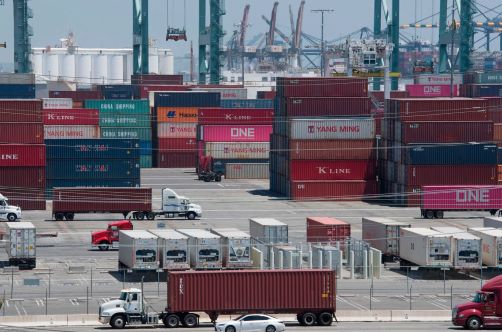
On trade, Trump pledged to levy a 60 percent tariff on all goods from China and a 10 percent tariff on all other imported goods, regardless of whether those products are—or even could be—made by Americans. There is a place for judicious use of tariffs as a part of a president’s trade toolbox, but it is important to think through the likely impacts of a 60 percent tariff on Chinese-made goods.
Consider the impact on manufacturing and manufacturing jobs here in the United States. Many of the United States’ roughly 600,000 small manufacturers and their 5 million workers use imported components for which there is currently no U.S.-made alternative. Many of those businesses rarely have the kind of supply chain operation needed to find new sources outside China. Instead, their only options would be to pay the 60 percent tax on those items they need to import or to go out of business. Larger manufacturers that can afford to scour the globe for new sources of inputs may find that their “new” suppliers are the same Chinese firms they have worked with for years but that now operate from a different country to avoid tariffs.
The past four years have demonstrated a better formula for the United States to create a thriving manufacturing base—a strategic combination of real federal investment, backstopped by targeted tariffs. It would be a shame if the incoming Trump administration let its singular focus on unilateral tariffs distract from the need to continue making such investments, thereby slowing the creation of viable domestic alternatives to Chinese suppliers.
Moreover, massive and indiscriminate U.S. tariffs on goods made in China would also have the perverse effect of driving further Chinese investment into Southeast Asia, Latin America, and elsewhere, giving China even greater influence—often at the United States’ expense—in places of significant strategic importance. This will make no difference in helping American manufacturers, or their workers, access the supply chains they need to produce in the United States. It will also not increase employment, improve worker welfare, or raise wages in the United States. Instead, it is likely to place even more pressure on U.S. manufacturers, which could face new import competition from Chinese firms operating in locations with low or nonexistent enforcement of environmental or labor standards. For U.S. manufacturers to compete fairly, the full social cost of production abroad must be included in the overall price of an imported good. Trump’s anti-China trade agenda not only doesn’t accomplish this; it actually makes it worse.
On technology, the incoming administration’s approach is reckless and, even more, unprincipled. Although Trump talks a good game about increasing high-tech manufacturing, his record during his first term was abysmal: The economy shed hundreds of thousands of manufacturing jobs in a trend that began before the pandemic. Rather than build on Biden administration programs that have spurred tens of billions of dollars in private investment in semiconductors, cars, clean energy, and other advanced manufacturing in the United States, Trump has pledged to undo these efforts that have helped U.S. industry and workers compete globally against Chinese industry. These investments will reduce U.S. dependence on China, improve the competitiveness of American companies, and boost living standards of U.S. workers, but despite their effectiveness, Trump opposes them. Reckless.
On the unprincipled front, when policymakers warn that advances in certain of China’s high-technology capabilities pose national security risks, will Trump policies focus on America first? There is reasonable concern—just ask his nominee for secretary of state, Marco Rubio. In his first term, Trump lifted U.S. penalties on Chinese telecom maker ZTE for its efforts to evade sanctions on Iran. This occurred mere days after the Chinese government and Chinese banks invested $1 billion in a Trump Organization-affiliated theme park. At the time, Sen. Rubio (R-FL) slammed Trump, declaring that China had “avoided tariffs & got a #ZTE deal without giving up anything meaningful in return. …This is #NotWinning.”
But it may be on Taiwan policy where Trump and his handpicked China hawk team are least coherent. When it involves Taiwan, incoherence in policy and rhetoric raises the risk for military miscalculation that could result in putting American and Chinese soldiers into war. For his part, Trump has made clear what he thinks about the United States coming to the island’s aid: “[The Taiwanese people] don’t pay us money for the protection, you know? The mob makes you pay money, right?” Hearing this, which he certainly has, Chinese President Xi Jinping could be forgiven if he questioned Trump’s commitment to Taiwan. Contrast this with the chest-thumping of Rubio and incoming national security adviser Michael Waltz, the latter of whom has declared the United States to be in a Cold War with the Chinese Communist Party. With Rubio and Waltz in charge of day-to-day policy, keep an eye out for talk about “strategic clarity” and an increase in symbolic stunts that would give Beijing an excuse to increase military pressure on the island while doing nothing to improve Taiwan’s ability to defend itself. This incoherence undermines Taiwan’s security and the confidence of allies and partners, raising the risk of conflict for the United States.
And experience suggests that the Trump administration’s response to a rising China security risk will be to spend more on defense, seemingly with limited regard to how that money makes America and its allies more secure. Already, between the departments of Defense and Veterans Affairs, the United States spends more than $1 trillion each year on its military. (And, notably, this figure does not include the $108,000 per minute the United States will spend for the next three decades to upgrade its nuclear forces.) It is instructive that, even as Elon Musk and Vivek Ramaswamy talk about cutting trillions in Social Security, Medicare, and Medicaid, they have been silent about efficient defense spending. If they do not insist that the Department of Defense finally pass an audit, as CAP calls for, it will be clear that the call for “government efficiency” is just the latest of the Trump administration’s policy efforts to eliminate the American social safety net.
A Serious Response to a Serious Challenge
It’s important to remain clear-eyed and realistic about the challenges that China’s policies, actions, and investments pose to U.S. national and economic security. But poor policy approaches, upside-down investment strategies, and chest-thumping rhetoric actually weaken the United States and can increase security risks.
Instead, the United States should seek an approach to China based on principled pragmatism—one that prioritizes the interests of American families and workers; one that understands the enormous advantages Americans derive from the United States’ unmatched education and innovation ecosystems, global network of partnerships and alliances, and democratic values; and one that emphasizes thoughtful, long-term progressive planning over clickbait populism. The United States needs a smarter way to confront the challenges posed by China’s policies and actions, minimize misunderstanding, and identify areas where it is in the American interest to engage the Chinese government—for example, to stem the influx of fentanyl, combat the climate crisis, or address a future global economic emergency.
Conclusion
As CAP outlined in April, the United States should pursue a progressive, principled, and pragmatic approach to the challenges it faces with China. Specifically, there’s a smart way for the United States to confront those challenges, by pursuing a principles-based policy that aligns with the interests of people and the values of our system. By adopting such an approach, the United States is best positioned to put in place policies that address legitimate concerns about the actions of the Chinese state and protect and advance the interests of ordinary Americans—by improving their opportunities, wages, and working conditions and by reducing the risk of conflict and military involvement abroad.
Originally published by The Center for American Progress, 12.19.2024, republished with permission educational, for non-commercial purposes.
About the Author