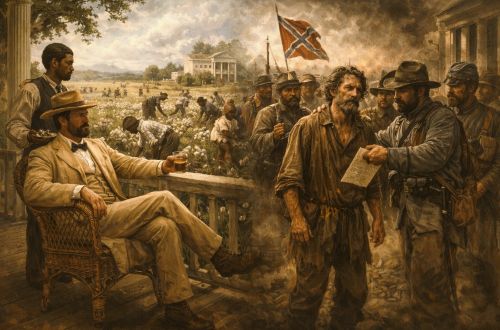
Confederate conscription exposed deep class divisions, as the “Twenty Negro Law” exempted slaveholders, fueling resentment among soldiers who saw the war as unequal sacrifice.

By Matthew A. McIntosh
Public Historian
Brewminate
Introduction: War, Slavery, and Social Inequality in the Confederacy
The American Civil War forced the Confederate States of America into a paradox that quickly exposed the social structure on which the rebellion rested. The new nation proclaimed political independence and mobilized its population for total war, yet it did so while preserving one of the most rigid systems of economic hierarchy in the nineteenth-century Atlantic world. Enslavement defined the Confederate economy, but it also structured power, privilege, and political influence among white Southerners themselves. Large slaveholders occupied the highest rung of this hierarchy, controlling vast agricultural enterprises and exercising influence in local and national politics. As the war intensified and the demands of military mobilization grew, the Confederate government faced the challenge of sustaining its armies without disrupting the social order that had produced secession in the first place.
The Confederacy initially relied on voluntary enlistment, drawing heavily on the enthusiasm that followed secession in 1861. Early battlefield successes and powerful appeals to honor, regional loyalty, and the defense of slavery helped fill the ranks of the new armies. Yet the initial surge of volunteers proved insufficient for a prolonged conflict against the industrial and demographic power of the United States. By the spring of 1862 Confederate leaders confronted a severe manpower crisis as enlistments declined and casualty lists lengthened. In response, the Confederate Congress enacted the first national conscription law in American history, compelling white men of military age to enter the army. This dramatic expansion of state authority reflected both the seriousness of the military situation and the Confederacy’s determination to sustain its war effort at almost any cost.
Compulsory service, however, collided with the South’s entrenched system of privilege and property rights. The Confederate government quickly began carving out exemptions for certain occupations deemed essential to the home front, including industrial workers, railroad employees, physicians, teachers, and agricultural overseers whose labor was considered vital to sustaining wartime production. Among the most controversial provisions appeared in the Second Conscription Act of October 1862, which exempted one white man on plantations with twenty or more enslaved people. Known popularly as the “Twenty Negro Law,” the policy was justified by Confederate officials as a necessary measure to maintain control over enslaved labor and prevent insurrection while large numbers of white men served at the front. Confederate authorities feared that large plantations left without white supervision could become centers of disorder or rebellion, especially as Union armies moved deeper into the South and enslaved people increasingly seized opportunities to escape or resist. By allowing one overseer or owner to remain behind, lawmakers argued that agricultural production could be preserved, protecting both the Confederate economy and the institution of slavery. Yet the exemption also appeared to protect the interests of the wealthiest slaveholders, whose economic power depended on maintaining large, enslaved workforces and whose political influence shaped the wartime policies of the Confederate state.
The social consequences of this policy were profound. Poorer white farmers and non-slaveholding soldiers increasingly perceived the law as confirmation that the Confederate war effort served elite interests. In letters, newspapers, and political debates, critics charged that wealthy slaveholders avoided military service while ordinary men bore the burdens of combat. The phrase “a rich man’s war and a poor man’s fight” circulated widely in Confederate ranks, capturing the resentment that grew among soldiers and civilians alike. The controversy surrounding the “Twenty Negro Law” illuminates a deeper tension within Confederate society: the attempt to wage a modern mass war while preserving a social order built on inequality and slaveholding privilege. Understanding this tension reveals how class divisions, alongside military defeat and economic collapse, eroded the fragile unity of the Confederate cause.
Confederate Mobilization and the Origins of Conscription

At the outbreak of the Civil War in 1861, Confederate leaders relied almost entirely on voluntary enlistment to fill their armies. The secession crisis had produced a powerful wave of regional enthusiasm that encouraged thousands of men to join newly organized state regiments. Appeals to honor, patriotism, and the defense of Southern independence proved highly effective in the early months of the conflict. Many volunteers believed the war would be brief and decisive, a struggle in which a display of martial courage might secure independence before the North could fully mobilize its superior industrial resources. This early confidence produced large numbers of enlistments, allowing Confederate forces to assemble substantial armies during the first year of the war.
The reliance on volunteerism, however, reflected both ideological conviction and political caution. Southern political culture traditionally emphasized states’ rights and local autonomy, making centralized military authority deeply controversial. Many Confederate politicians feared that a powerful national government might threaten the very liberties secession had supposedly protected. Memories of antebellum conflicts over federal authority, particularly disputes involving tariffs and slavery, had reinforced Southern suspicion toward centralized power. As a result, early mobilization relied heavily on state governments to organize, equip, and supply regiments, while the Confederate central government attempted to coordinate military strategy at a distance. Governors often retained considerable influence over their state troops, and local communities played a central role in recruitment and organization. This decentralized system initially allowed Confederate leaders to mobilize forces quickly while avoiding accusations of overreach. Yet the same structure also produced uneven equipment standards and frequent disputes between state and national authorities over control of manpower.
By early 1862 the limitations of voluntary enlistment had become increasingly apparent. The war proved far longer and more destructive than Confederate leaders had anticipated, and casualty lists from major battles quickly began to erode the ranks of existing regiments. The initial surge of patriotic enthusiasm faded as communities confronted the realities of wartime hardship. Agricultural disruption, economic strain, and the prolonged absence of male laborers discouraged further enlistment. Confederate officials recognized that reliance on volunteerism alone would not sustain the large armies required to defend the Confederacy’s vast territory against Union forces.
In response to this growing crisis, the Confederate Congress enacted the Conscription Act of April 16, 1862, establishing the first national draft in American history. The law required white men between the ages of eighteen and thirty-five to serve in the Confederate army for three years. Unlike earlier mobilization efforts, which had depended largely on state authority and voluntary service, the new policy asserted direct national control over military manpower. Confederate leaders justified the measure as a temporary necessity dictated by the demands of total war, arguing that the survival of the new nation required coordinated mobilization on a scale that voluntary enlistment could no longer sustain. Nevertheless, the legislation represented a dramatic expansion of central government power within a political system originally founded on resistance to federal authority. The act also extended the enlistment terms of soldiers who had initially volunteered for shorter periods, effectively binding them to continued service without renewed consent. While military officials welcomed the measure as essential for maintaining the army’s strength, many civilians and state leaders viewed it with suspicion, worrying that the Confederate government was assuming powers far greater than those it had criticized in the United States.
The implementation of conscription produced significant political controversy within the Confederacy. Critics argued that the law violated the principles of local autonomy and individual liberty that had motivated secession from the United States. Some state officials challenged the legality of the measure, while others worried that the Confederate government was becoming dangerously centralized. Many military leaders supported the policy as essential for maintaining effective armies in the field. The debate revealed a fundamental contradiction within Confederate political ideology: the need for strong centralized coordination in wartime clashed with a deeply rooted suspicion of national authority.
Despite these objections, conscription became a central component of Confederate military policy. The legislation allowed authorities to replenish depleted regiments and maintain the size of field armies during a period of intense fighting. Yet the system also introduced new tensions within Southern society, particularly as lawmakers added exemptions for certain occupations and economic interests. These exemptions, designed to preserve agricultural production and critical industries, often benefited individuals with substantial influence. As the Confederate government continued to expand and modify its conscription laws throughout the war, the balance between military necessity and social privilege became increasingly contentious.
The Second Conscription Act and the “Twenty Negro Law”
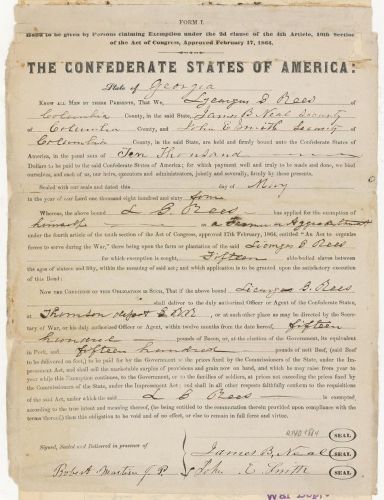
As the Civil War intensified during 1862, Confederate leaders sought to refine and expand their system of compulsory military service. The initial Conscription Act had addressed the immediate manpower crisis, but continued battlefield losses and the growing scale of the conflict demanded further legislative action. In October 1862 the Confederate Congress passed the Second Conscription Act, which expanded the age range of eligible men and clarified numerous administrative provisions related to military service. The law attempted to stabilize the Confederacy’s manpower supply while balancing the competing demands of military necessity, economic production, and internal security. Yet it was one particular provision within the legislation that generated the greatest controversy across the South.
Embedded within the act was a clause that allowed for the exemption of one white man on any plantation holding twenty or more enslaved people. This provision quickly became known as the “Twenty Negro Law,” a phrase that spread through newspapers, political debates, and soldier correspondence. Confederate lawmakers defended the exemption as a practical measure designed to maintain supervision over large enslaved populations. With thousands of white men serving in the army, plantation regions faced the prospect of leaving enslaved laborers without oversight at a time when Union forces were advancing deeper into Southern territory. Officials feared that such conditions could encourage escape, resistance, or even organized rebellion among enslaved people, particularly as news of emancipation policies and Union military successes circulated widely.
The law also reflected the central role that slavery played within the Confederate war economy. Large plantations produced much of the cotton, foodstuffs, and other agricultural commodities that sustained both the Southern economy and the Confederate army. Lawmakers argued that allowing one white overseer or owner to remain on plantations with large enslaved populations would help ensure the continued operation of these agricultural enterprises. Maintaining plantation productivity was framed as a matter of national survival rather than personal privilege. Confederate officials repeatedly emphasized that plantations with large enslaved populations required continuous supervision, both to enforce labor discipline and to manage the complex agricultural systems that sustained export production and local food supplies. In regions where enslaved people greatly outnumbered white residents, authorities feared that the removal of white oversight might create opportunities for resistance or mass escape, particularly as Union armies advanced and offered refuge to those fleeing bondage. Southern newspapers and political leaders frequently warned that the war could create conditions for widespread unrest among enslaved populations if plantations were left without supervision. By preserving the presence of a white overseer or owner, Confederate lawmakers hoped to maintain the stability of plantation society while also safeguarding the agricultural productivity that supported the Confederate economy and its armies in the field.
Despite these official justifications, the exemption quickly became one of the most divisive policies enacted by the Confederate government. Many poorer white Southerners viewed the provision as clear evidence that the Confederate state prioritized the interests of wealthy slaveholders. Soldiers and civilians alike complained that men from large plantations were allowed to remain safely at home while small farmers and non-slaveholding laborers filled the ranks of the army. The policy became a powerful symbol of social inequality within the Confederacy, reinforcing the perception that the war demanded sacrifice primarily from those who held the least economic power. The “Twenty Negro Law” not only addressed the practical concerns of plantation management but also exposed the deep class tensions that ran through Southern society during the war.
Plantation Power and the Politics of Slaveholding Elites

The political structure of the Confederacy was deeply shaped by the interests of slaveholding elites. Large plantation owners dominated the social and economic life of much of the South, controlling vast agricultural estates worked by enslaved labor. Their wealth translated into political influence long before the outbreak of the Civil War. In many Southern states, slaveholders occupied a disproportionate share of legislative seats, judicial positions, and local offices. This concentration of political authority ensured that the legal and institutional framework of the Confederacy reflected the priorities of those whose fortunes depended most directly on slavery.
Although slaveholders represented a minority of the white Southern population, they exerted extraordinary power within Southern political culture. Plantation owners often served as community leaders, financiers, and patrons within rural regions where economic opportunity was closely tied to access to land and enslaved labor. Their dominance extended into the leadership of the Confederate government itself. Many of the men who shaped wartime policy, including senior political officials and influential members of Congress, were themselves members of the slaveholding class. The result was a political system in which the protection of slavery remained central to legislative decision making, even as the demands of war required increasingly intrusive forms of government authority.
The wartime state that emerged within the Confederacy reflected a complicated relationship between military necessity and elite influence. Confederate leaders recognized that the survival of the new nation depended on mobilizing manpower, coordinating industry, and sustaining agricultural production. Yet these policies unfolded within a society where property rights, particularly the ownership of enslaved people, were treated as fundamental and inviolable. Legislators frequently attempted to balance military requirements with the protection of slaveholders’ economic interests. Measures that threatened plantation stability or interfered with slaveholding wealth often encountered resistance from powerful political constituencies.
By allowing large plantations to retain one white overseer or owner, Confederate lawmakers ensured that the most extensive slaveholding operations would continue functioning despite the large-scale mobilization of white men into the army. While the policy could be defended as a means of maintaining agricultural productivity and preventing unrest among enslaved populations, it also clearly favored those who owned large numbers of enslaved laborers. Smaller farmers who possessed few or no enslaved people received no comparable exemption. In practice, the law reinforced an existing hierarchy in which economic scale translated into political privilege. Plantation owners who possessed extensive enslaved workforces were positioned to protect both their economic interests and their personal security during wartime. Critics quickly pointed out that the measure appeared to shield the wealthiest members of Southern society from the risks faced by ordinary soldiers. The law became more than a policy. It served as a visible expression of how economic power shaped wartime legislation within the Confederacy.
The legislation also demonstrated how the Confederate state attempted to preserve the social order that had given rise to secession. Plantation agriculture remained the backbone of the Southern economy, and Confederate officials feared that disruptions to plantation management might weaken the war effort. Large slaveholders enjoyed a degree of protection within wartime policy making that reflected their perceived economic importance. Yet this protection came at a political cost. Policies that favored plantation elites increasingly alienated poorer white Southerners who were asked to bear the burden of military service without comparable economic security.
As the war continued, these tensions between elite privilege and mass mobilization became increasingly difficult to reconcile. Confederate leaders needed the labor system of plantation agriculture to sustain the economy and support the armies in the field, but they also required the loyalty and participation of ordinary white citizens. When policies such as the “Twenty Negro Law” appeared to shield wealthy slaveholders from sacrifice, they risked undermining the fragile sense of shared purpose that the Confederacy depended upon. Soldiers serving in Confederate ranks often expressed frustration in letters and diaries, complaining that plantation owners enjoyed legal protections while poorer men faced the constant dangers of military service. In communities across the South, debates over exemptions and privilege fueled political dissent and deepened suspicions about the motives of Confederate leadership. These tensions did not necessarily destroy Confederate nationalism, but they exposed how deeply class divisions shaped Southern society. The controversy surrounding elite privilege illustrates one of the central contradictions of the Confederate project: a government fighting a modern war that depended upon the cooperation of ordinary citizens while simultaneously preserving a rigid social hierarchy rooted in slavery and wealth.
Class Tensions among Non-Slaveholding Whites
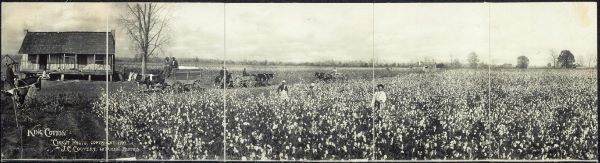
The Confederate war effort unfolded within a Southern society marked by economic diversity. Although slavery dominated the region’s political and cultural identity, most white Southerners did not own enslaved people. Small farmers, laborers, and rural artisans formed the majority of the white population across much of the Confederacy. These individuals often lived in modest agricultural communities where subsistence farming and limited market exchange defined everyday life. While many supported secession and initially joined Confederate armies out of loyalty to their states or communities, their economic interests did not necessarily align with those of the large plantation owners who dominated Southern political leadership.
As the war continued, the burdens placed upon these non-slaveholding whites became increasingly severe. Military service removed large numbers of men from their farms and households for extended periods, placing enormous pressure on families left behind. Women, children, and elderly relatives were forced to maintain farms under increasingly difficult conditions as inflation, shortages, and the disruption of trade networks spread throughout the Confederate economy. With transportation networks strained and commercial markets collapsing in many regions, rural households struggled to obtain basic necessities such as tools, salt, and manufactured goods. In many regions the loss of male labor combined with rising prices to produce acute hardship that threatened the survival of small farming families. Soldiers in the field became acutely aware of the economic struggles their families faced at home, and letters frequently expressed anxiety about declining harvests, mounting debts, and the inability of families to sustain themselves during prolonged wartime absence. Reports of hardship circulated widely within Confederate camps, reinforcing the sense that ordinary households were bearing enormous sacrifices while the war dragged on with no clear end in sight.
Policies that appeared to favor wealthy slaveholders generated deep resentment among poorer whites. The “Twenty Negro Law” became one of the most visible examples of this perceived inequality. Soldiers who owned no enslaved people saw plantation owners remain at home while they themselves faced the dangers of combat. Critics argued that the exemption created a system in which economic privilege translated directly into protection from military service. The law seemed to confirm suspicions that Confederate political leadership was more concerned with protecting slaveholding wealth than with distributing the sacrifices of war equally among the white population.
This resentment spread through both civilian communities and the Confederate army itself. Newspapers in several Southern states criticized the exemption, and local political debates reflected growing anger over the perceived favoritism shown to wealthy planters. Political meetings and public discussions in rural communities frequently raised questions about whether the burdens of war were being shared fairly among the white population. Among soldiers, the phrase “a rich man’s war and a poor man’s fight” began circulating widely as a shorthand expression of these grievances. The slogan captured the belief that poorer men were being asked to risk their lives to defend a social system that primarily benefited those with the greatest economic power. Letters from Confederate soldiers sometimes described resentment toward wealthy slaveholders who remained at home, reinforcing the perception that military service was disproportionately borne by those with the least economic influence. While not all soldiers embraced this interpretation of the war, the phrase nevertheless reflected a broader undercurrent of dissatisfaction that challenged the image of a unified Confederate society.
These class tensions did not eliminate support for the Confederate cause, but they revealed significant fractures within the Southern home front. Many non-slaveholding whites continued to fight out of loyalty to their communities, fear of Union invasion, or dedication to Southern independence. Yet their wartime experience increasingly exposed the unequal distribution of sacrifice within Confederate society. Policies such as the “Twenty Negro Law” served as powerful reminders that the Confederacy was not simply fighting an external enemy but also grappling with internal social divisions rooted in the economic hierarchy of slavery.
“A Rich Man’s War and a Poor Man’s Fight”
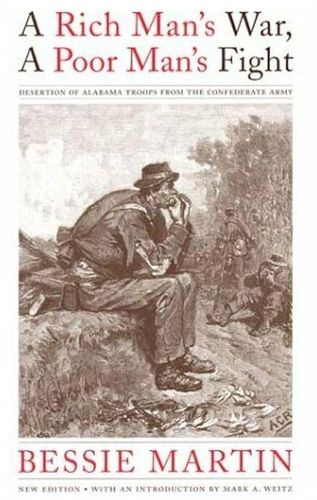
As the Civil War progressed, the phrase “a rich man’s war and a poor man’s fight” emerged as a widely circulated expression of frustration within the Confederate ranks. The slogan appeared in soldiers’ letters, political debates, and newspaper commentary across the South. Although not every Confederate soldier shared this sentiment, the phrase captured a growing perception that wartime sacrifices were distributed unevenly among white Southerners. Those with limited property and little political influence often found themselves serving in the army for extended periods, while wealthier men appeared more capable of securing exemptions or remaining on their plantations.
The expression reflected broader concerns about economic inequality within Southern society. Large slaveholders had long dominated regional politics and controlled much of the South’s wealth through plantation agriculture. When policies such as the “Twenty Negro Law” exempted overseers or plantation owners from military service, critics interpreted the measure as evidence that Confederate legislation protected the interests of this elite class. Soldiers without enslaved laborers at home frequently viewed the exemption as proof that political power allowed wealthy slaveholders to avoid the dangers of battlefield service while maintaining their economic position. For men drawn from small farms or working households, the contrast between their own military obligations and the perceived security enjoyed by wealthy planters appeared stark. Letters and camp discussions sometimes reflected anger that those with the greatest economic stake in slavery seemed least exposed to the personal dangers of defending it. The law came to symbolize not merely a technical exemption within conscription policy but a broader pattern in which wealth and political influence appeared to translate into protection from the hardships of war.
The slogan served as a form of wartime social commentary that exposed tensions within Confederate nationalism. Southern leaders often portrayed the conflict as a unified struggle to defend regional independence and the institution of slavery. Yet the phrase suggested that many ordinary soldiers interpreted the war through the lens of class experience rather than ideological unity. Complaints about unfair exemptions and unequal sacrifice circulated within military camps, revealing how the pressures of prolonged war sharpened existing social divisions.
The phrase did not necessarily signal a complete rejection of the Confederate cause. Many soldiers who voiced such complaints continued to fight in the army and remained committed to defending their communities. Expressions of resentment often coexisted with strong attachments to home, state, and comrades in arms. Soldiers frequently distinguished between their frustration with government policy and their loyalty to fellow soldiers or their determination to defend Southern territory from Union armies. The language of grievance operated alongside the language of duty and honor. Complaints about the privileges enjoyed by wealthy slaveholders did not automatically translate into widespread desertion or open rebellion within the ranks. Instead, they revealed the complicated emotional landscape of Confederate soldiers who endured the hardships of war while simultaneously questioning the fairness of the social system they were asked to defend.
The endurance of the phrase “a rich man’s war and a poor man’s fight” highlights the importance of class dynamics within the Confederate experience of war. It demonstrates how legislation, economic hardship, and prolonged military service combined to reshape the political language of Confederate soldiers and civilians. Although the Confederacy attempted to present itself as a united society defending a shared cause, the widespread circulation of this phrase revealed the persistent tensions between elite privilege and the sacrifices demanded of ordinary Southerners during the conflict.
Military Morale, Desertion, and Internal Dissent
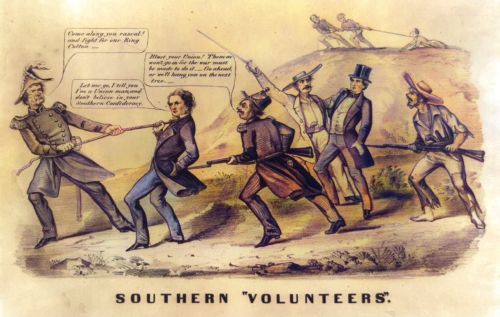
As the Civil War dragged into its later years, the cumulative pressures of prolonged conflict began to erode morale within the Confederate army. Soldiers faced constant exposure to hardship, including inadequate supplies, long campaigns, and the emotional strain of separation from their families. Food shortages, worn clothing, and irregular pay became increasingly common as the Confederate economy struggled to sustain the war effort. These material difficulties alone placed severe stress on soldiers’ willingness to continue fighting. Yet dissatisfaction also grew from social and political tensions within the Confederacy, particularly when soldiers believed that the burdens of military service were not shared equally across Southern society.
The perception that wealthy slaveholders enjoyed legal protections from military service contributed to these frustrations. Policies such as the “Twenty Negro Law,” along with other occupational exemptions, reinforced the belief that political influence and economic status could shield individuals from the dangers faced by ordinary soldiers. Many enlisted men came from modest agricultural backgrounds and had little experience with the wealth and political authority exercised by large plantation owners. When they observed that some of these elites remained at home while poorer men filled the ranks of the army, resentment could easily take root. Although the Confederate government justified such exemptions as necessary for maintaining agricultural production and social order, soldiers often interpreted them as evidence of an unfair system that privileged the wealthy.
Letters written from Confederate camps frequently reveal the complicated emotional responses soldiers experienced as the war continued. Some expressed anger toward politicians or plantation owners whom they believed were avoiding sacrifice, while others worried primarily about the welfare of their families struggling at home. News of inflation, crop failures, and shortages in local communities circulated widely through correspondence and visiting relatives. These reports deepened the sense of anxiety among soldiers who feared that their prolonged absence left families vulnerable to economic collapse. In many cases soldiers described the emotional conflict between their duty to remain with their regiments and their desire to return home to assist struggling relatives. The strain of hearing about hardship from afar could intensify frustration with government policy, especially when soldiers believed that wealthier households were less exposed to such difficulties. “Letters and diaries show how the social realities of the Confederate home front shaped morale within the army.
These frustrations contributed to rising levels of desertion as the war progressed. Desertion was influenced by many factors, including battlefield exhaustion, declining resources, and fear for the safety of families living near contested regions. Yet historians have also noted that resentment toward conscription policies and perceived inequalities within Confederate society could intensify these pressures. In certain areas of the South, especially regions with fewer slaveholders, communities became increasingly hostile toward Confederate authorities. Local resistance sometimes took the form of draft evasion, organized opposition to conscription officers, or the sheltering of deserters who returned home.
Internal dissent also appeared in the political sphere. State officials occasionally clashed with the Confederate government over the enforcement of conscription laws, reflecting ongoing tensions between local authority and national military policy. Critics argued that Confederate legislation had expanded the powers of the central government beyond what many Southerners had originally supported during secession. Debates over conscription enforcement often involved questions about the balance between military necessity and civil liberty, with some politicians warning that excessive centralization threatened the principles for which the Confederacy claimed to fight. In certain regions, these disagreements became particularly intense as local communities resisted what they viewed as intrusive wartime authority. Such disputes revealed how the pressures of total war forced Confederate leaders to navigate a delicate political landscape in which ideological commitments to local autonomy collided with the practical demands of sustaining large armies in the field.
Despite these strains, Confederate armies continued to fight with determination for much of the war. Loyalty to comrades, regional identity, and fear of Union invasion remained powerful motivations for many soldiers. Yet the presence of desertion, political dissent, and declining morale revealed how fragile Confederate unity could become under the pressures of prolonged warfare. The tensions surrounding class privilege, conscription policies, and economic hardship did not single-handedly determine the Confederacy’s defeat, but they contributed to a gradual weakening of the internal cohesion that any wartime society required for survival.
Confederate Nationalism and the Limits of Social Unity
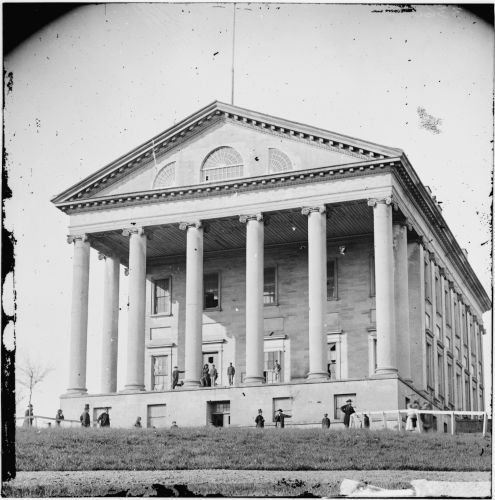
Confederate leaders consistently portrayed their struggle as a unified defense of Southern independence and social order. Political speeches, newspapers, and official proclamations emphasized the idea that white Southerners shared a common interest in resisting Northern domination and protecting the institutions that defined their society. Central among these institutions was slavery, which Confederate leaders openly described as the foundation of their political and economic system. By presenting the war as a collective defense of regional identity and social stability, Confederate authorities sought to cultivate a strong sense of national loyalty among the white population.
The idea of Confederate nationalism rested partly on shared cultural values that had developed across the slaveholding South. Many white Southerners embraced ideals of honor, local loyalty, and resistance to perceived external threats. Early victories on the battlefield reinforced this sense of unity, strengthening the belief that the Confederacy represented a legitimate and durable nation. Communities celebrated military successes and rallied around soldiers departing for the front, creating powerful emotional bonds between civilians and the armies fighting in their name.
Yet the experience of prolonged war placed significant strain on this fragile sense of unity. As casualties mounted and economic conditions deteriorated, Confederate civilians increasingly confronted the realities of wartime hardship. Inflation eroded the value of wages and savings, shortages disrupted everyday life, and transportation failures made it difficult to distribute food and supplies across the Confederacy. In many regions the war placed enormous burdens on households already struggling to maintain farms without the labor of men serving in the army. Families were often forced to adapt quickly to new responsibilities as women and children attempted to sustain agricultural production under increasingly difficult circumstances. Communities that had once celebrated the departure of soldiers now faced the daily realities of scarcity, uncertainty, and grief. These hardships forced many civilians to evaluate the war not simply as an ideological struggle but as a daily challenge to survival, reshaping how they understood the meaning and cost of Confederate independence.
The visible privileges enjoyed by wealthy slaveholders created growing tensions within Confederate society. Policies such as the “Twenty Negro Law” highlighted the unequal distribution of sacrifice among white Southerners. While Confederate leaders justified such measures as necessary for maintaining agricultural production and social stability, critics interpreted them as evidence that the government protected elite interests at the expense of ordinary citizens. The resulting resentment did not necessarily destroy support for the Confederate cause, but it complicated the effort to present the war as a shared struggle in which all classes contributed equally.
These tensions revealed the structural limits of Confederate nationalism. The Confederacy attempted to mobilize its population for a modern, large-scale war while simultaneously preserving a social hierarchy rooted in slavery and economic inequality. Elite slaveholders retained disproportionate influence over political decision making, and policies that protected plantation agriculture often reinforced existing class divisions. The government’s challenge lay in maintaining the loyalty of poorer whites whose personal sacrifices far exceeded their economic power within Southern society.
The contradictions embedded in Confederate nationalism ultimately exposed the fragility of the social coalition that sustained the rebellion. The Confederacy depended upon the cooperation of millions of white Southerners who differed widely in wealth, status, and material interests. While many continued to support the war effort out of loyalty to their communities or fear of Union occupation, the strains of prolonged conflict gradually weakened the shared sense of purpose that Confederate leaders sought to cultivate. Economic hardship, military casualties, and controversial policies concerning conscription and exemptions combined to deepen existing social divisions. As soldiers and civilians confronted the unequal distribution of wartime sacrifice, the ideal of a unified Confederate nation became increasingly difficult to sustain. The tensions surrounding class privilege and wartime sacrifice illustrate how internal social divisions complicated the Confederacy’s effort to maintain national unity in the midst of total war.
Conclusion: Class, Slavery, and the Fragile Confederate Social Order
The controversy surrounding the “Twenty Negro Law” reveals how deeply social hierarchy shaped the Confederate war effort. Although Confederate leaders attempted to present their struggle as a unified defense of Southern independence, the realities of wartime mobilization exposed tensions embedded within Southern society long before the conflict began. Slavery structured not only the region’s economy but also its distribution of power and privilege among white Southerners. Policies that protected plantation agriculture and slaveholding wealth carried political consequences that extended far beyond their immediate administrative purpose.
For poorer white Southerners serving in the Confederate army, the visible privileges enjoyed by wealthy slaveholders often reinforced the perception that the burdens of war were not shared equally. The exemption granted to large plantations became a powerful symbol of this inequality. While Confederate officials justified the law as necessary for maintaining agricultural production and preventing unrest among enslaved populations, many soldiers interpreted it as evidence that economic power translated into protection from military service. The exemption came to represent more than a technical feature of conscription policy. To many soldiers drawn from small farms or working households, it appeared to confirm that the Confederate government remained closely aligned with the interests of the plantation elite. In letters, conversations within camps, and political discussions at home, the policy was frequently cited as an example of how wealth and social status shaped the distribution of wartime sacrifice. The phrase “a rich man’s war and a poor man’s fight” captured this sentiment in language that circulated widely among Confederate soldiers and civilians alike, reflecting a growing awareness that the defense of slavery placed unequal demands upon different segments of Southern society.
These tensions did not eliminate support for the Confederate cause, but they complicated the effort to sustain a coherent sense of national unity. Confederate nationalism depended upon the cooperation of a diverse white population whose economic interests and social positions varied widely. As the war continued and hardships multiplied, policies that appeared to favor elite slaveholders risked undermining the fragile consensus that sustained the rebellion. The Confederate government faced the difficult task of balancing military necessity, economic stability, and social hierarchy within a society already marked by profound inequality.
The story of the “Twenty Negro Law” ultimately illustrates the broader contradictions within the Confederate project. A nation founded to protect slavery and preserve a rigid social order attempted to wage a modern mass war that demanded sacrifice from large segments of its population. In doing so, it exposed the limits of its own social foundations. The tensions between elite privilege and popular sacrifice did not by themselves determine the Confederacy’s defeat, but they revealed how fragile the internal unity of the slaveholding republic could be when confronted with the pressures of total war.
Bibliography
- Confederate States of America. Second Conscription Act. October 11, 1862.
- Dew, Charles B. Apostles of Disunion: Southern Secession Commissioners and the Causes of the Civil War. Charlottesville: University of Virginia Press, 2001.
- Costa, Dora L. and Matthew E. Kahn. “Forging a New Identity: The Costs and Benefits of Diversity in Civil War Combat Units for Black Slaves and Freemen.” The Journal of Economic History 66:4 (2006), 936-962.
- Escott, Paul D. After Secession: Jefferson Davis and the Failure of Confederate Nationalism. Baton Rouge: Louisiana State University Press, 1978.
- Faust, Drew Gilpin. The Creation of Confederate Nationalism: Ideology and Identity in the Civil War South. Baton Rouge: LSU Press, 1988.
- Freehling, William W. The South vs. The South: How Anti-Confederate Southerners Shaped the Course of the Civil War. New York: Oxford University Press, 2001.
- Gallagher, Gary W. The Confederate War. Cambridge: Harvard University Press, 1997.
- Genovese, Eugene D. The Political Economy of Slavery: Studies in the Economy and Society of the Slave South. New York: Pantheon Books, 1965.
- Hall, Andrew B., Connor Huff, and Shiro Kuriwaki. “Wealth, Slaveownership, and Fighting for the Confederacy: An Empirical Study of the American Civil War.” American Political Science Review 113:3 (2019), 658-673.
- Martin, Bessie. A Rich Man’s War, A Poor Man’s Fight: Desertion of Alabama Troops from the Confederate Army. Mobile: University of Alabama Press, 2003.
- McPherson, James M. Battle Cry of Freedom: The Civil War Era. New York: Oxford University Press, 1988.
- —-. For Cause and Comrades: Why Men Fought in the Civil War. New York: Oxford University Press, 1997.
- Oakes, James. The Ruling Race: A History of American Slaveholders. New York: Alfred A. Knopf, 1982.
- Pagan, Orlando R. “Defying Conscription: The Social, Political, and Military Consequences of Draft Evasion in the Union and Confederacy.” GLI MA in American History 5 (2025).
- Sacher, John M. “’Twenty-Negro,’ or Overseer Law.” Journal of the Civil War Era 7:2 (2017), 269-292.
- Weitz, Mark A. More Damning Than Slaughter: Desertion in the Confederate Army. Lincoln: University of Nebraska Press, 2005.
Originally published by Brewminate, 03.17.2026, under the terms of a Creative Commons Attribution-NonCommercial-NoDerivatives 4.0 International license.
About the Author