Discussing the distinctive nature of Hinduism and its sacred texts, drawing on the Vedas and epic compositions.

By Dr. Julius Lipner
Emeritus Professor of Hinduism and the Comparative Study of Religion
University of Cambridge
Introduction
Hinduism is hard to define, for we cannot think in terms of a mainstream faith with a number of neat offshoots. Rather, it is a religion that embraces an enormous diversity of belief and practice, developed over millennia. It may help to form some idea of the distinctive nature of Hinduism by evoking the image of an ancient banyan tree. The banyan has a central trunk, but in time shoots from overhanging branches reach the ground and take root there, growing strongly till those ‘shoots’ eventually look like trunks of the tree in their own right. As such, an ancient banyan can look like a small wood made up of many trunks all linked to each other by a single canopy of leaves and branches.
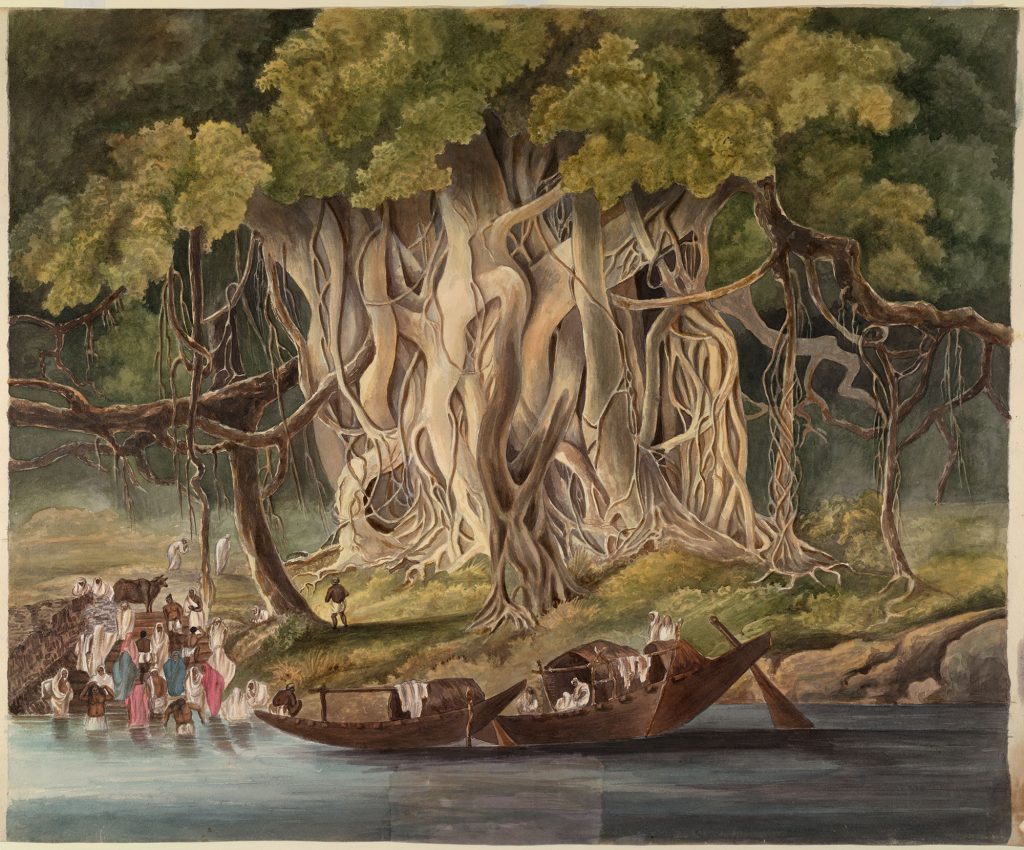
Hinduism similarly has many centres of life and growth that are nevertheless organically related, some more, some less distantly, to one another. It has many seemingly independent centres, often with distinctive sacred texts, deities, myths, rituals, saintly figures, codes of conduct, festivals and so on, but on closer scrutiny, like a great banyan, these different centres can be seen to link up more or less directly. This also explains how, while other faiths and civilisations have come and gone, Hinduism continues to thrive and put out new shoots and roots, even when old ones have died away. This article explores some of the varied sacred texts of this religion. Hinduism has a large component of oral tradition and visual imagery in its origins and development. Most of the sacred texts mentioned in this article started life in oral form well before being committed to writing, and as such ‘sacred text’ is not only the written word, but also the ‘heard’ word as well as the visual text of image and icon (mūrti, pratimā, arcā).
Where and When Did Hinduism Begin?
Hinduism developed with a group of tribes who referred to themselves as Aryans. Disputes surround where they originated from; some say they were already present in western India, others that they came from Central Asia, or further west. We do know that they began to assert their presence in the north-west of the Indian subcontinent at about the beginning of the second millennium BCE, culturally displacing, but also interacting with, the Indus civilisation that already existed there. The Indus civilisation is so named because it seems to have spread out from urban settlements on the Indus river. The language the Aryans used and expressed their religion in was Sanskrit. ‘Sanskrit’ is the anglicised form of saṃskṛta, which means ‘refined’ or ‘polished’; in time it became highly developed and rich in expression and became the language of the elite. Ārya means ‘respectable’; as this was the term the Aryans used to describe themselves, it was meant to assert their cultural and linguistic superiority. They called the Indus river ‘Sindhu’, and it is from this term that ‘Hindu’ derives. Thus Hinduism signifies the Aryans’ culture and religious traditions as they developed over time, incorporating elements from other cultures encountered along the way.
What Is the Veda?
The Aryans called their most sacred text Veda, meaning the ‘knowledge’. It was believed to have arisen from the infallible ‘hearing’ (śruti), by ancient seers, of the sacred deposit of words whose recitation and contemplation bring stability and wellbeing to both the natural and human worlds. The Veda is believed to have developed over a span of 2000 years in four traditional phases. The first phase started with hymns, chants, incantations and other compositions in an early form of Sanskrit. The hymns in particular were largely directed at transcendent powers, most of whom were called devas and devīs (misleadingly translated as ‘gods’ and ‘goddesses’). These powers, individually or in groups, were thought to exercise control over the world through cosmic forces. In this early phase of the Veda, there is reference to a One (ekam) that undergirds all being.
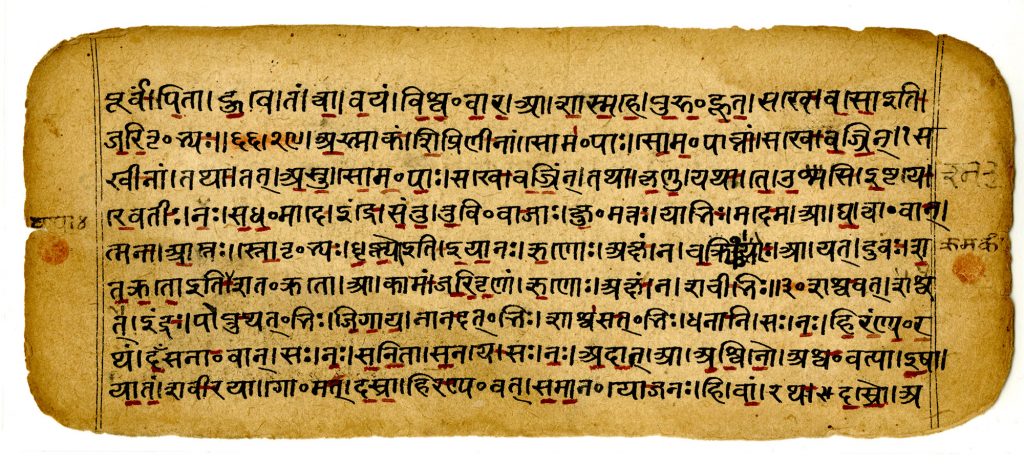
The second phase of the Vedic text, called the Brāhmaṇas, concerns the sacrificial ritual (yajña) that lay at the heart of Vedic religion. It was by the proper performance and recitation of this ritual that order and stability were thought to be established in the world. The third phase is the Āraṇyakas, ‘forest-texts’, which represented a meditative departure away from the external performance of the Vedic sacrificial ritual. A tendency had developed among some to internalise the sacrifice within the inner self (ātman), which was eventually perceived as spiritual, and as distinct from the body and other forms of matter. This tendency was taken further in the fourth and final phase of the Vedic corpus, the Upaniṣads. In some passages of the Upaniṣads, the One, mentioned in the first phase of the Veda and now known as Brahman, was identified as a single, supra-personal, indivisible spiritual Self, undergirding all change and difference in our world; in other passages, the One was given a more personal and divine status as īśvara (‘God’), distinct from but supporting the existence of individual selves and the rest of finite being. From early times the content of the Veda was divided under four genres of text into the Ṛg Veda, the Yajur Veda, the Sāma Veda and the Atharva Veda, so it is quite common to speak in terms of the ‘four Vedas.’
The correct performance of Vedic sacrificial ritual was thought to be so important for ordering the relationships between humans and the world in the early stages of Hinduism, that another cluster of texts called the Vedāṅgas emerged. These fell under the heading of ‘smṛti’, the not infallible but still authoritative ‘recall’ of received wisdom. The Vedāṅgas were concerned in different ways with the cadence, origin, meaning and proper articulation of Vedic (Sanskrit) terms used for the ritual, the appropriate times for the ritual’s performance, and so on. As Vedāṅgas or ‘limbs of the Veda’, these texts were envisaged as protecting and nurturing the body that was the Veda.
Other smṛti compositions also developed from the beginning of the Common Era in conjunction with the Vedic canon. Important among these were texts that codified a developing and central concept of Hinduism, dharma. This concept deals with the right order between the different strata and birth-groups (varṇa and jāti) of Hindu society (which we lump together under the term ‘caste’) and its male and female members. It was believed that these texts, through their prescriptions and prohibitions, elaborated on the social implementation of Vedic order.
Following the analogy of the banyan tree, all these different compositions on dharma may be viewed as contributing to the sap coursing through the Hindu banyan, helping bring together its wide-ranging parts under a common but continuously challenged and debated theme.
What Is the ‘Mahābhārata’?
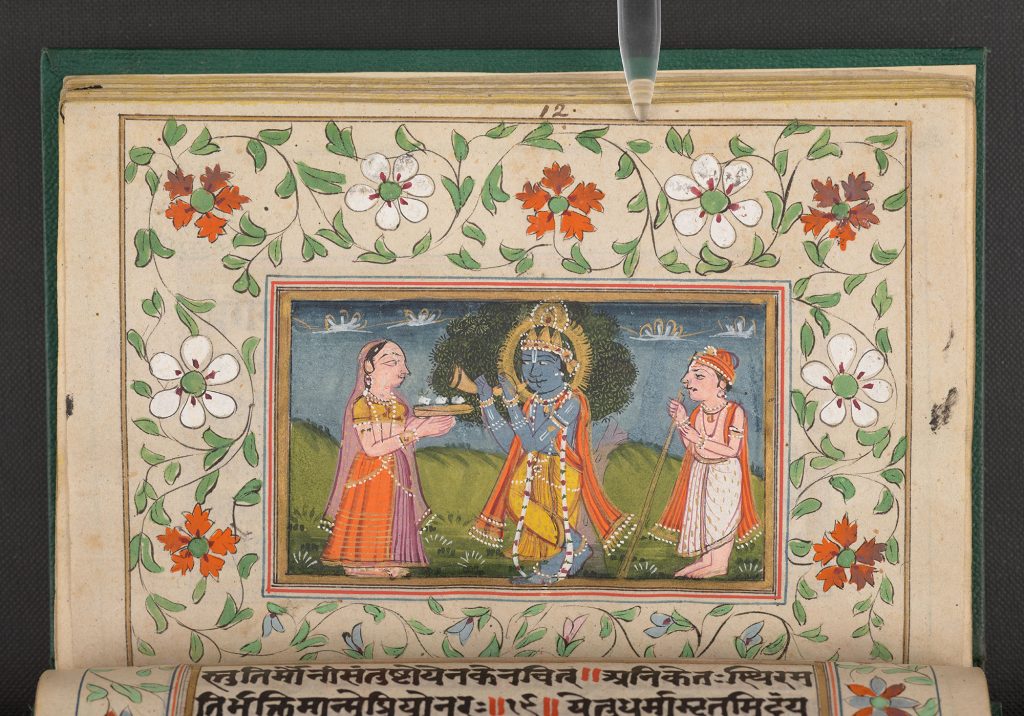
Two other major contributors in this respect were dharma-texts of a different order, the Mahābhārata (‘The Great Tale of the Bhāratas’) and the Rāmāyaṇa (‘The Coming of Rāma’). Both compositions were originally compiled in Sanskrit verse over several hundreds of years, beginning from about the middle of the first millennium BCE. In eighteen books the Mahābhārata narrates the story of the rivalry between two groups of cousin warriors, the Pāṇḍavas and the Kauravas. With the aid of hundreds of supporting characters and intriguing sub-plots, the story imparts many teachings about the nature of dharma.
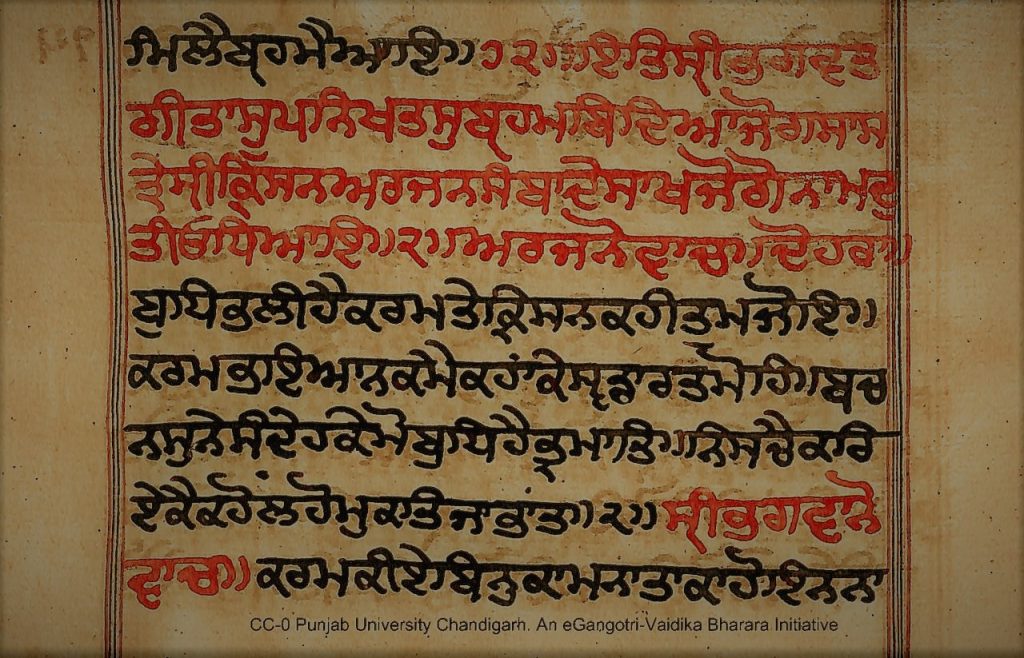
Embedded in book 6 of the Mahābhārata is perhaps the most famous devotional sacred text of Hinduism, the 700 verse Bhagavad Gītā, or ‘Song of (Krishna as) God’. The Gītā, as it is often called, mainly contains teachings by Krishna (also spelt Kṛṣṇa), as Supreme Being, to his friend and disciple Arjuna about how to attain union with him in his divine state. The Gītā, though technically smṛti, is usually treated as equivalent to śruti by its followers – hence its importance. The Mahābhārata has been called the ‘fifth Veda’ in many Hindu circles, in the belief that it cumulatively teaches, in a more accessible way, the essential truths of the Veda.
What Is the ‘Rāmāyaṇa’?
The Rāmāyaṇa consists of seven books and recounts the adventures of the exiled king Rāma and his various companions as they make their way to the island-kingdom of Laṅkā – off the southern tip of India – to rescue Rāma’s wife Sītā, who had been abducted by Rāvaṇa, the ten-headed ogre-king of Laṅkā. For a great many Hindus, the Rāmāyaṇa, and devotion to the avatar (the chief representation of the Supreme Being in human form) Rāma offers an accessible path to salvation. Thus, the Rāmāyaṇa also becomes an alternative source of Vedic instruction.
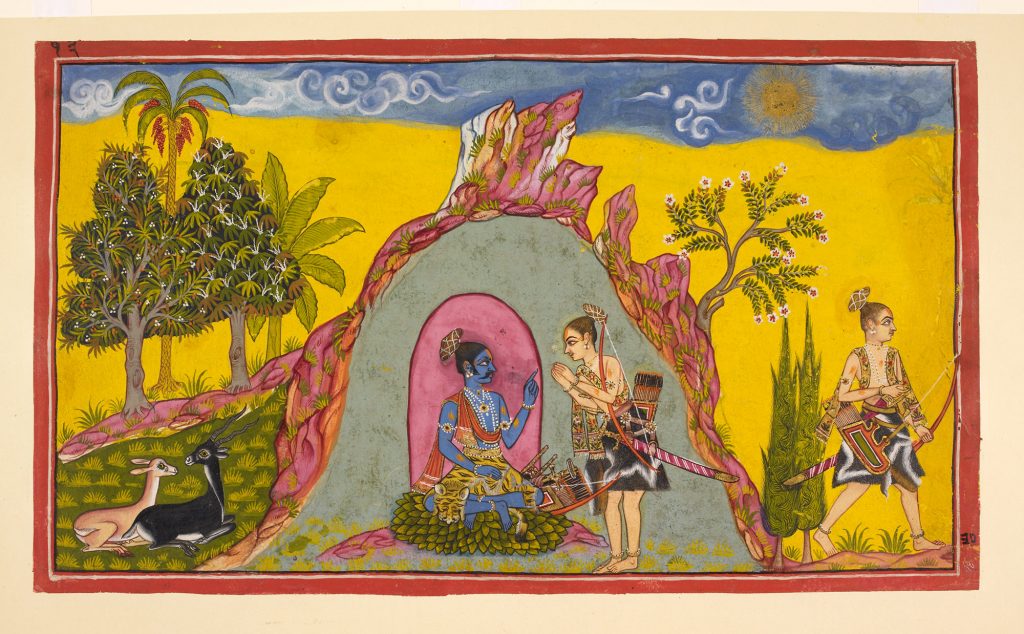
Like the proliferating banyan, both epics have developed in different Indian vernaculars, with multiple versions of their storylines scattered about the cultural landscape of Hinduism. Under this rubric falls Tulsidas’ Rāmcaritmānas, which was composed in verse in 16th century in an early dialect of Hindi, and which has become the re-telling of the Rāma story for a large proportion of north Indians. Through the multiple re-tellings of the epics Hindus can access the characters and teachings via different historical and linguistic pathways. Hindus, in general, have not been minded to seek out ‘definitive’ versions of post-Vedic sacred texts. In fact, the interpretation of sacred texts in Hinduism, whether these have been categorised as śruti or smṛti, has always been a matter for earnest discussion and debate for Hindu thinkers down the ages.
What Are the ‘Purāṇas’?
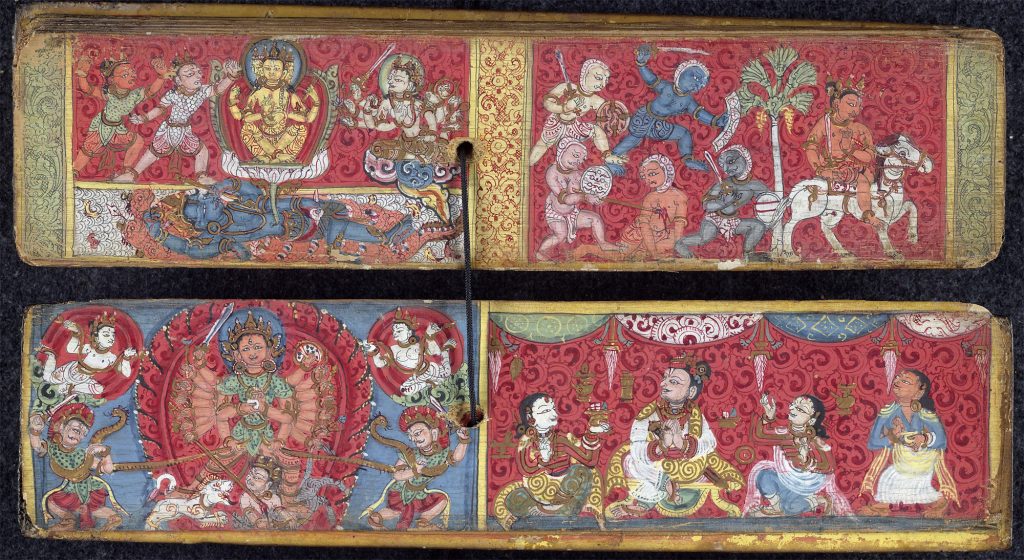
We must also mention two other types of sacred text which act as radiating supports for multiple centres of the Hindu banyan: the Purāṇas (‘Books of received wisdom’) and the Āgamas (‘Compilations of additional instructions and teachings’). The Purāṇas comprise an oral and transcribed repository of myth, folklore and other kinds of teaching and information collated and distributed from the early centuries of the Common Era onwards. Their authorised number is hard to determine, but some have been more important than others in the history of Hinduism, e.g. the Viṣṇu and Bhāgavata Purāṇas (ca. 5th and 9th centuries respectively) which have been very important in formulating Vaiṣṇava theologies, the Liṅga Purāṇa (ca. 7th to 11th centuries), important for worship of Shiva (also spelt Śiva) as Supreme Deity, and the Mārkaṇḍeya Purāṇa (ca. 5th century) which has performed the same function for worship of the Supreme Goddess.
What Are the ‘Āgamas’?
The Āgamas can be seen to represent those Hindu sacred texts that developed in non-Vedic contexts, but this does not mean that they are perceived as necessarily anti-Vedic in content. Thus, in the Tamil Śaiva Siddhānta tradition of south India, besides the Veda (which is deferred to as only part of this tradition’s scriptural canon), the twenty-eight Śaiva Āgamas (composed in Sanskrit and Tamil), and two other categories of sacred text (the twelve Tirumurai and the fourteen Meykaṇṭa Śāstras), are also regarded as giving authoritative teaching for attaining final salvation through the knowledge and worship of Shiva as the Supreme Godhead. Similarly, the Vaiṣṇavas, who hold Vishnu (also spelt Viṣṇu) to be in one form or other the Supreme Deity, also have their Āgamas that teach the path to final union with Vishnu. In these traditions, the non-Vedic texts are interpreted as being ‘Veda-congruent’, that is, as implicitly refining and completing the Veda towards a fullness of teaching that leads to final liberation from the travails of human existence.
Originally published by the British Library, 09.23.2019, under the terms of a Creative Commons Attribution 4.0 International license.
About the Author