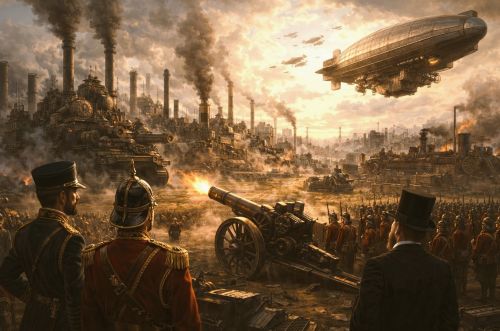
Victorian Britain fused war, industry, and empire into a powerful economic system, where corporate growth and military expansion advanced together across a global stage.

By Matthew A. McIntosh
Public Historian
Brewminate
Introduction: War and Capital in the Victorian World
The Victorian era transformed the relationship between warfare and economic power as industrialization reshaped both conflict and the systems that sustained it. War was no longer just fought on battlefields; it was built in factories, financed in markets, and sustained across global networks. Between 1837 and 1901, Britain emerged as the dominant global power, supported not only by its military capabilities but by an expanding network of industrial and financial institutions. War and its anticipation became deeply embedded in the rhythms of economic life, stimulating production, innovation, and investment. Rather than existing as separate spheres, military activity and economic development increasingly operated in tandem within a rapidly globalizing system.
Victorian Britain developed an early military-industrial system in which private companies and the state worked together to expand empire and economic power.
Although the term “military-industrial complex” belongs to the twentieth century, the Victorian period reveals the early formation of a comparable relationship, albeit in a less formalized and more diffuse form. The British state did not maintain a centralized apparatus coordinating industry and defense in the modern sense, yet it relied heavily on private enterprise to supply the material, logistical, and technological foundations of imperial power. Industrial firms, shipping companies, telegraph enterprises, and financial institutions all became integral to the projection of military force. This interdependence produced an informal system in which economic and strategic interests converged without the need for a clearly defined institutional framework.
The expansion of the British Empire created opportunities for corporations to operate on a global scale, often under the protection of military power. The acquisition and defense of overseas territories required infrastructure, communication networks, and continuous flows of capital, provided by private actors working in close alignment with state objectives. Imperial warfare was not only a matter of geopolitical competition but also a mechanism through which markets were opened, resources secured, and commercial dominance extended. The boundaries between public authority and private enterprise became increasingly blurred, as each depended on the other to sustain Britain’s global position.
The Victorian era produced a structural convergence of war and capital that prefigured the modern military-industrial complex. While lacking the bureaucratic coherence of later systems, the relationship between the British state and its corporate partners functioned in a similarly symbiotic manner. Industrial growth was stimulated by military demand, while military expansion was enabled by industrial capacity and financial investment. This reciprocal dynamic created a feedback loop in which economic success reinforced imperial expansion, and imperial expansion, in turn, generated new opportunities for profit and investment. By examining the interplay between industry, infrastructure, finance, and empire, this study seeks to demonstrate how the foundations of modern military-economic integration were established in the nineteenth century, shaping the trajectory of global power in the decades that followed.
Industrialization and the Transformation of Warfare

The nineteenth century witnessed a fundamental transformation in the nature of warfare, driven by the rapid expansion of industrial production and technological innovation. In contrast to earlier periods, when military power depended heavily on manpower and localized manufacturing, the Victorian era introduced a system in which the capacity to produce and sustain complex machinery became central to military effectiveness. Industrialization altered the tools of war as well as the scale and organization of conflict, enabling states to mobilize resources with unprecedented speed and efficiency. Warfare became an extension of industrial capability, linking the battlefield directly to the factory floor. Industrialization made warfare dependent on factories, machinery, and large-scale production.
Advancements in metallurgy and engineering played a critical role in this transformation. The development of stronger and more reliable steel allowed for the production of more durable weapons, including rifled artillery and armored warships. Innovations such as the Minié rifle and breech-loading systems significantly increased the range, accuracy, and lethality of infantry weapons, reshaping combat dynamics and reducing the effectiveness of traditional tactics. At sea, the transition from wooden sailing ships to ironclads powered by steam engines marked a decisive shift in naval warfare, enhancing both mobility and firepower. These technological changes demanded a level of industrial coordination and expertise that only large-scale manufacturing enterprises could provide.
The growing complexity of military technology required new forms of organization and standardization within industry. Factories adapted to meet the demands of large government contracts, introducing more systematic production processes and emphasizing uniformity in the manufacture of weapons and equipment. This transformation involved reconfiguring labor, introducing specialized machinery, and developing managerial practices capable of overseeing large-scale operations. Standardization not only improved efficiency but also ensured compatibility across different units and theaters of operation, an essential factor in the management of expanding imperial forces. It also facilitated the repair, replacement, and distribution of equipment across vast distances, reducing logistical friction in prolonged campaigns. This shift toward organized, large-scale production laid the groundwork for modern industrial systems, in which coordination and consistency became as important as output, and in which the demands of warfare helped shape the evolution of industrial practice itself.
War acted as a powerful catalyst for industrial growth and innovation. The demands of military supply created sustained markets for industrial goods, encouraging investment in new technologies and production methods. Government contracts provided a degree of financial stability for manufacturers, allowing them to expand operations and refine their capabilities without the uncertainties of purely commercial markets. Conflict was more than a disruption to economic life; it was a driving force behind industrial development, accelerating changes that might otherwise have unfolded more gradually.
The integration of industrial production with military systems altered the relationship between the state and private enterprise. Governments became increasingly dependent on industrial firms to supply the materials necessary for warfare, while those firms, in turn, relied on state demand to sustain and expand their operations. This blurred the boundaries between public and private sectors, creating a partnership in which economic and strategic priorities were closely aligned. Industrial firms were no longer peripheral suppliers but central actors in the conduct of war, shaping the capabilities and limitations of military power. This evolving relationship also encouraged the development of long-term contractual arrangements, institutional ties, and mutual expectations that would persist beyond individual conflicts. The ability to produce advanced weaponry and infrastructure became a key determinant of national power, reinforcing the importance of industrial capacity in geopolitical competition and embedding economic considerations within strategic planning.
The transformation of warfare during the Victorian era reflects a broader shift in the organization of society and the economy. Industrialization did not simply enhance existing military practices; it redefined the conditions under which war was conducted, embedding conflict within a network of production, technology, and capital. This development marked a significant step toward the emergence of modern military systems, in which the success of states would increasingly depend on their ability to harness industrial resources in the service of strategic objectives.
The Armaments Industry: From Manufacturing to Global Arms Trade
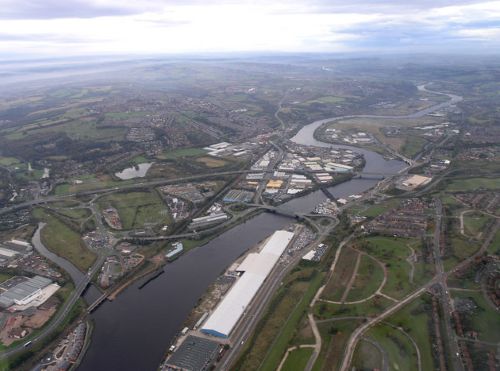
The Victorian era saw the emergence of a distinct armaments sector that grew out of broader industrial manufacturing, transforming private firms into key suppliers of military technology. As industrial capacity expanded, companies that had previously focused on general engineering or metalworking began to specialize in weapons production, responding to growing demand from both domestic and foreign governments. This shift marked a critical stage in the connection between industry and warfare, as the production of arms became a technical enterprise and a central component of economic and strategic policy. The rise of these firms reflected the increasing importance of industrial infrastructure in sustaining military power.
Among the most prominent examples were companies such as Vickers and Armstrong Whitworth, which developed into major producers of artillery, warships, and advanced weaponry. Originally rooted in civilian industry, these firms leveraged their engineering expertise to secure lucrative government contracts, gradually expanding their operations to meet the needs of modern warfare. Their growth was closely tied to technological innovation, as they invested heavily in research and development to produce more effective and sophisticated weapons. They became indispensable to the British state, providing the matériel necessary to maintain naval supremacy and imperial control.
What distinguished these firms from earlier military suppliers was their increasingly global reach. By the late nineteenth century, British armaments companies were not only serving domestic needs but actively exporting weapons to foreign powers, including potential rivals. This international trade in arms reflected both the competitive nature of global politics and the profit-driven logic of industrial capitalism. Firms sought to expand their markets wherever possible, often operating with a degree of autonomy that complicated traditional notions of national loyalty. In many cases, these companies negotiated directly with foreign governments, leveraging diplomatic channels, commercial agents, and international exhibitions to secure contracts. The globalization of arms production also meant that technological knowledge and industrial techniques were disseminated across borders, contributing to the rapid modernization of military forces worldwide. The result was a transnational arms industry in which economic interests could intersect with, and at times challenge, geopolitical considerations, revealing the extent to which industrial capitalism operated beyond the constraints of national policy.
The expansion of the global arms trade contributed to intensifying international rivalries. As nations sought to modernize their militaries, they turned to industrial producers capable of supplying advanced technology, creating a cycle in which innovation and competition reinforced one another. The availability of industrially produced weapons lowered barriers to military modernization, enabling states to expand their capabilities more rapidly than in previous eras. The involvement of private firms introduced new dynamics into the arms race, as commercial incentives encouraged the continuous development and dissemination of increasingly powerful technologies.
The relationship between armaments firms and the state was characterized by both dependence and influence. Governments relied on these companies for the production of essential military equipment, while the firms themselves depended on state contracts for financial stability and growth. This mutual reliance created opportunities for industrial actors to shape policy, particularly in areas related to military procurement and strategic planning. While not constituting a formal military-industrial complex in the modern sense, this arrangement nonetheless established patterns of interaction that would later become more institutionalized. The alignment of corporate and state interests ensured that the expansion of military capacity was closely tied to the fortunes of industrial enterprise.
The armaments industry became a central pillar of the Victorian economy, linking technological innovation, global trade, and imperial power. The transformation of manufacturing firms into international arms suppliers illustrates how industrial capitalism adapted to the demands of modern warfare, creating new opportunities for profit while reinforcing the structures of empire. By the end of the nineteenth century, the production and distribution of weapons had become a global enterprise, reflecting the broader integration of economic and military systems that defined the era. Private firms like Vickers and Armstrong became central to supplying modern weapons and shaping military capability.
Mass Production and the Economics of War
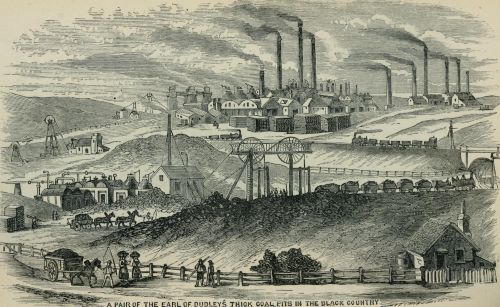
The expansion of industrial warfare in the Victorian era was inseparable from mass production, which transformed the scale and economics of military supply. As demand for weapons, ammunition, and logistical support grew, traditional methods of small-scale manufacturing proved insufficient. Industrial firms responded by reorganizing production around principles of efficiency, volume, and uniformity, enabling them to meet the sustained requirements of modern conflict. This shift marked a decisive moment in the relationship between industry and war, as the capacity to produce in large quantities became a defining feature of military power. Mass production allowed armies to be equipped faster, cheaper, and at a much larger scale than ever before.
Mass production introduced new efficiencies that significantly reduced the cost per unit of military goods, allowing governments to equip larger forces without proportional increases in expenditure. The adoption of standardized parts and mechanized processes facilitated faster production and simplified maintenance and repair in the field. These innovations were particularly important in imperial contexts, where equipment had to be transported across vast distances and used in diverse environments. Standardization ensured that components could be replaced or repaired with minimal delay, enhancing the operational effectiveness of military forces and reducing logistical complexity. Moreover, the predictability of standardized production allowed military planners to anticipate supply needs with greater accuracy, integrating industrial output more directly into strategic planning. This alignment between production and deployment represented a significant evolution in the coordination of war, reducing uncertainty and enabling sustained campaigns across geographically dispersed theaters.
The reorganization of factory systems was central to this transformation. Industrial enterprises introduced specialized labor divisions, mechanized assembly processes, and more sophisticated management structures to oversee production at scale. Workers were increasingly assigned to specific, repetitive tasks, contributing to a more streamlined and predictable manufacturing process. This restructuring increased output and allowed firms to respond more rapidly to fluctuations in demand, particularly during periods of military conflict. The factory itself became a site of strategic importance, where the rhythms of industrial labor were closely aligned with the needs of the state.
Government contracts played a crucial role in stabilizing and expanding industrial production. Unlike civilian markets, which were subject to fluctuations in demand, military procurement offered relatively consistent and often long-term sources of revenue. These contracts provided firms with the financial security needed to invest in new machinery, expand facilities, and refine production techniques. In many cases, the relationship between the state and industrial producers extended beyond simple transactions, evolving into ongoing partnerships that shaped both economic and strategic priorities. Such arrangements often included favorable terms, guaranteed purchasing agreements, and informal expectations of continued cooperation, further binding industrial success to military demand. War, or the preparation for it, became a predictable and even desirable condition for certain sectors of the economy, reinforcing a cycle in which industrial growth and military expansion mutually sustained one another.
The economics of mass production contributed to the concentration of industrial power. Firms that were able to secure large government contracts and invest in advanced production technologies gained significant advantages over their competitors, leading to increased market dominance. This process often resulted in the emergence of quasi-monopolistic enterprises that controlled substantial portions of the armaments and heavy industry sectors. The consolidation of industrial capacity not only influenced economic structures but also had implications for political power, as these firms became increasingly important to national security and imperial strategy.
The integration of mass production into the machinery of war underscores the extent to which industrial capitalism reshaped the conduct of conflict in the Victorian era. Warfare was no longer limited by the immediate availability of resources or the constraints of traditional production methods; instead, it was sustained by an industrial system capable of continuous output and innovation. This transformation reinforced the interdependence of economic and military systems, laying the groundwork for the more formalized military-industrial relationships that would emerge in the twentieth century.
Infrastructure as Strategy: Steam, Steel, and Communication
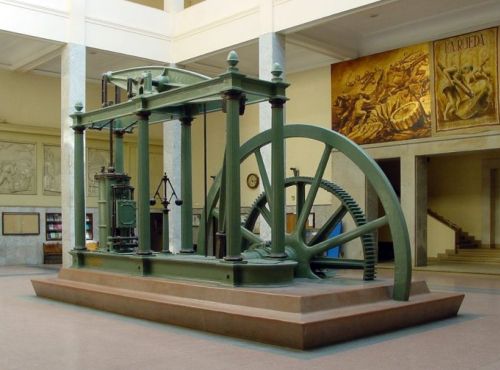
The growth of the British Empire in the Victorian era depended not only on military force but on the development of infrastructure capable of sustaining and projecting that force across vast distances. Steam power, steel construction, and advanced communication networks transformed logistics from a secondary concern into a central strategic priority. Industrial firms played a decisive role in building and maintaining this infrastructure, linking commercial enterprise with imperial governance. The ability to move troops, supplies, and information efficiently became as important as battlefield success, embedding infrastructure within the core of military planning. Railways, steamships, and telegraphs turned logistics into a core element of military strategy.
Steamships revolutionized naval logistics and global mobility, enabling faster and more reliable transportation than ever before. Unlike sailing vessels, steam-powered ships were not dependent on wind patterns, allowing for more predictable travel schedules and more precise coordination of military operations. Private shipping companies, often subsidized through government mail contracts and transport agreements, became indispensable partners in imperial expansion. These firms constructed extensive fleets capable of carrying troops, equipment, and goods across imperial networks, effectively integrating commercial shipping routes with military objectives. In peacetime, these same routes facilitated trade, reinforcing the economic value of infrastructure developed for strategic purposes.
Railways further extended the reach of imperial logistics by enabling rapid movement within territories, both in Britain and across colonial holdings. The construction of railway networks allowed for the efficient deployment of troops and the transport of resources from interior regions to coastal ports. In colonies, railways often served dual purposes, supporting both military control and economic exploitation. Built with significant investment from private capital and often backed by state guarantees, these networks exemplified the close relationship between infrastructure development and imperial strategy. The strategic placement of rail lines frequently reflected military priorities, connecting garrisons, ports, and resource-rich regions in ways that maximized both control and extraction. Railways also enabled quicker responses to uprisings or unrest, allowing imperial authorities to project force inland with unprecedented speed. This combination of economic utility and military function made rail infrastructure a cornerstone of imperial governance, illustrating how industrial development could be directly harnessed to maintain political authority.
Perhaps the most transformative innovation of the period was the global telegraph network, which fundamentally altered the nature of communication within the empire. Undersea cables and overland telegraph lines enabled near-instantaneous transmission of information between distant territories and the metropolitan center. Corporations responsible for constructing and maintaining these networks operated with government support, receiving subsidies, exclusive rights, and strategic protection. The telegraph allowed military and political leaders to coordinate actions with unprecedented speed, reducing the delays that had previously hindered imperial governance. Control over communication networks provided significant commercial advantages, as companies could dominate the flow of information essential to global trade.
The integration of these infrastructural systems created a cohesive framework that supported both military operations and economic activity. Steamships, railways, and telegraph lines were not isolated developments but interconnected components of a broader imperial network. This system allowed for the efficient circulation of goods, capital, and information, reinforcing Britain’s position as a global power. Corporations that built and operated this infrastructure benefited from state support while simultaneously contributing to the strategic capabilities of the empire. The result was a mutually reinforcing relationship in which infrastructure served both commercial and military objectives.
Infrastructure became a strategic asset in its own right, shaping the possibilities of imperial expansion and control. The ability to project power across long distances depended not only on military strength but on the underlying systems that sustained it. Victorian infrastructure represented a fusion of industrial innovation and strategic necessity, demonstrating how technological and economic developments could be harnessed to serve imperial ambitions. These systems reduced the friction of distance, allowing Britain to govern and respond to events across continents with a degree of immediacy that had previously been impossible. They entrenched corporate influence within imperial structures, as private firms became indispensable to the maintenance and operation of these networks. This integration of infrastructure into the machinery of war further illustrates the deepening connection between private enterprise and state power in the nineteenth century, highlighting the extent to which empire relied on the convergence of technological capability and economic interest.
Corporate Colonialism and Chartered Power
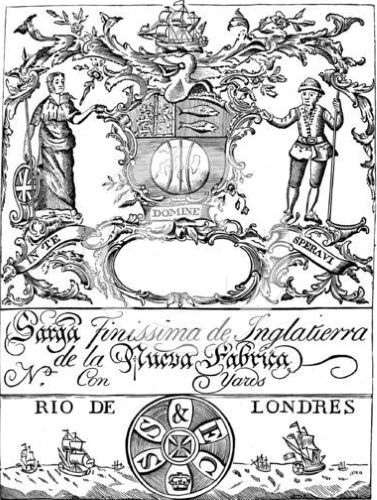
Chartered companies functioned as hybrid entities, combining commercial objectives with quasi-governmental authority. They were empowered to negotiate treaties, administer justice, levy taxes, and, crucially, maintain armed forces to protect their interests. In Africa and parts of Asia, companies such as the British South Africa Company exercised significant control over vast territories, effectively acting as proxies for imperial rule. Their authority rested on legal charters issued by the Crown, which provided legitimacy while limiting the need for direct state involvement. This model enabled Britain to expand its influence rapidly without incurring the full administrative and financial burdens of formal colonization. It created a system in which accountability was diffuse, as companies operated with considerable autonomy while still invoking imperial authority. The delegation of governance to corporate entities represented both an efficient strategy of expansion and a source of instability, as the pursuit of profit could at times conflict with broader imperial priorities.
The economic motivations behind corporate colonialism were closely tied to the extraction of resources and the establishment of new markets. Chartered companies sought access to valuable commodities such as minerals, rubber, and agricultural products, often restructuring local economies to serve the needs of global trade. The control of land and labor became central to their operations, as companies imposed systems designed to maximize production and profitability. These activities frequently disrupted existing social and economic structures, integrating colonial regions into a global capitalist system dominated by European interests.
Violence and coercion were inherent components of this system. Chartered companies maintained private security forces or militias to enforce their authority, suppress resistance, and secure access to resources. These forces operated with a degree of autonomy, often employing methods that reflected the priorities of profit rather than governance. When local opposition threatened corporate operations, the British state could intervene with formal military force, effectively reinforcing private interests through public power. This dynamic underscores the extent to which corporate and state power were intertwined, as the defense of economic assets became a justification for military action. Moreover, the presence of these private forces blurred the distinction between policing and warfare, as corporate agents exercised coercive authority in ways that mirrored state military operations. The reliance on violence to maintain economic control further reveals how deeply embedded coercion was within the structures of imperial capitalism.
The relationship between chartered companies and the state was not without tension. While companies were expected to advance imperial objectives, they also pursued their own interests, which could diverge from official policy. Instances of mismanagement, abuse, or financial instability sometimes prompted government intervention, leading to the eventual transition from corporate to direct colonial rule in certain regions. This shift reflected both the limitations of the chartered model and the growing recognition that imperial governance required more consistent oversight. Nevertheless, the initial reliance on corporate power left a lasting imprint on the structures of empire.
Corporate colonialism in the Victorian era represents a critical stage in the evolution of imperial governance, illustrating how private enterprise could function as both an agent and beneficiary of expansion. By delegating authority to chartered companies, the British state produced a system where economic and political control were deeply intertwined, enabling rapid territorial acquisition while minimizing immediate costs. This model not only facilitated the extension of imperial influence but also reinforced the broader integration of capital and coercion that defined the period. In doing so, it contributed to the emergence of a global system in which corporate power and military force operated in concert, shaping the trajectory of empire and laying the groundwork for future forms of economic imperialism.
State Protection and the Militarization of Corporate Interests
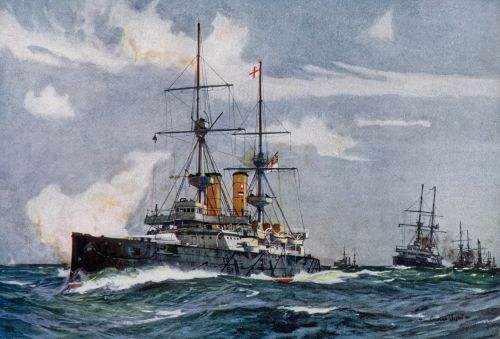
The expansion of corporate activity within the Victorian empire increasingly relied on the protection and intervention of the British state, particularly its military forces. As private enterprises extended their reach into distant and often contested regions, the risks associated with investment grew correspondingly. In response, the state assumed a more active role in safeguarding commercial interests, deploying naval and military power to secure trade routes, protect infrastructure, and suppress resistance. This development marked a significant shift in the relationship between economic and political power, as the defense of corporate assets became a central concern of imperial strategy.
One of the most visible expressions of this dynamic was the practice commonly referred to as gunboat diplomacy. The Royal Navy, the most powerful maritime force of the period, was frequently used to exert pressure on foreign governments and local authorities, ensuring favorable conditions for British trade and investment. Naval power enabled Britain to project force rapidly across the globe, compelling compliance without the need for prolonged conflict. In many instances, the mere presence of warships was sufficient to secure concessions, illustrating how military power could function as a tool of economic coercion. This strategy reinforced the perception that British commercial interests were backed by the full weight of the state.
The protection of corporate interests also extended to the suppression of local resistance within colonial territories. When indigenous populations or local leaders challenged the authority of chartered companies or commercial enterprises, the British military often intervened to restore order. These interventions were justified in terms of maintaining stability and protecting imperial interests, but they frequently served to secure the position of private actors operating within the empire. In many cases, such interventions escalated localized disputes into broader conflicts, as the deployment of imperial forces signaled a willingness to use overwhelming force to defend economic assets. The presence of the military not only suppressed immediate resistance but also established a longer-term deterrent effect, discouraging future challenges to corporate authority. This pattern reinforced the integration of coercion into the economic structures of empire, as the stability required for profitable enterprise was maintained through the threat or application of force. The use of state power highlights the extent to which economic and military objectives were intertwined, as the defense of property and profit became inseparable from the exercise of imperial authority.
The militarization of corporate interests contributed to the normalization of intervention as a feature of imperial governance. The repeated use of military force to resolve disputes and enforce economic arrangements created expectations among both corporations and state officials that such measures were legitimate and necessary. This normalization further blurred the boundaries between public and private action, as corporate demands could shape the deployment of military resources. The alignment of interests between the state and industrial or commercial actors reinforced a system in which economic expansion and military power operated in tandem.
The growing interdependence between corporate enterprise and state power in the Victorian era laid important foundations for later developments in military-industrial relations. While the system lacked the formal structures of the twentieth-century military-industrial complex, it nonetheless established patterns of cooperation and mutual reliance that would become more institutionalized. The defense of corporate interests through military means demonstrated how economic priorities could influence strategic decisions, embedding commercial considerations within the logic of imperial power. The Victorian experience reveals an early stage in the evolution of a system in which war and commerce were deeply interconnected.
Finance, War, and the Expansion of Capital
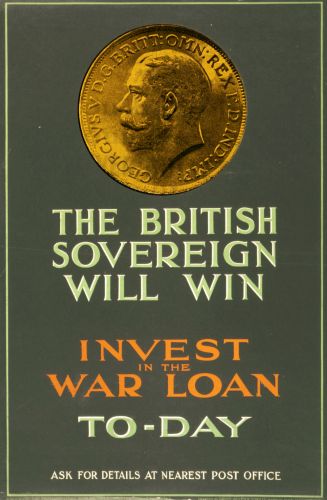
Banks and investors played a direct role in funding wars, linking financial markets to military expansion. The financial dimensions of warfare in the Victorian era were as transformative as its industrial and technological developments, embedding capital markets deeply within the machinery of imperial expansion. War required vast and sustained expenditures, far exceeding the immediate fiscal capacity of the state, necessitating the development of sophisticated systems of borrowing and credit. Financial institutions, particularly banks and investment houses, emerged as critical intermediaries in this process, facilitating the flow of capital necessary to sustain military operations. In doing so, they became integral participants in a system where economic growth and military power were increasingly interdependent.
Government borrowing during periods of conflict created lucrative opportunities for financial actors. War bonds, issued to fund military campaigns, were often underwritten and distributed by major banking institutions, providing them with reliable returns backed by the authority of the state. These instruments were widely regarded as stable investments, attracting both institutional and private capital. The steady interest payments associated with such bonds ensured that financial stakeholders had a direct interest in the fiscal health and strategic success of the state. The financing of war extended beyond the battlefield, drawing a broad segment of society into the economic structures that supported imperial expansion.
The relationship between finance and warfare also contributed to the increasing integration of global capital markets. British financial institutions operated at the center of an international network, channeling investment into both domestic industry and overseas ventures. The expansion of empire created new opportunities for capital deployment, as conquered or controlled territories were opened to investment in infrastructure, resource extraction, and commercial enterprise. War and the threat of war acted as mechanisms for the redistribution and concentration of capital, linking distant regions into a unified economic system dominated by British interests. This global integration reinforced the centrality of London as a financial hub, where decisions about investment and credit could have far-reaching geopolitical consequences.
The reliance on borrowed capital introduced new dynamics into state policy and decision-making. Governments became increasingly attentive to the expectations of financial markets, as their ability to raise funds depended on maintaining credibility and stability. This relationship created incentives to protect the economic conditions that supported investment, including secure trade routes, stable colonial governance, and the enforcement of favorable commercial arrangements. Financial considerations influenced strategic priorities, shaping the conduct of imperial policy in ways that aligned military action with the interests of capital.
The proliferation of financial systems in the context of warfare underscores the extent to which Victorian imperialism was sustained by economic as well as military power. The integration of finance into the structures of war gave rise to a system where capital was both a means and an end of imperial expansion. By facilitating the mobilization of resources and enabling long-term investment, financial institutions played a crucial role in sustaining Britain’s global dominance. Moreover, this system fostered a durable alignment between investors, industrial producers, and the state, each of whom benefited from the continuation of imperial stability and expansion. Financial markets did not merely respond to war; they actively shaped its possibilities by determining the scale and duration of military commitments that could be sustained. This convergence of finance and warfare represents a key component of the broader process through which economic and military systems became increasingly intertwined, laying the groundwork for the more formalized relationships that would define the modern era.
Markets, Resources, and “Gunboat Capitalism”
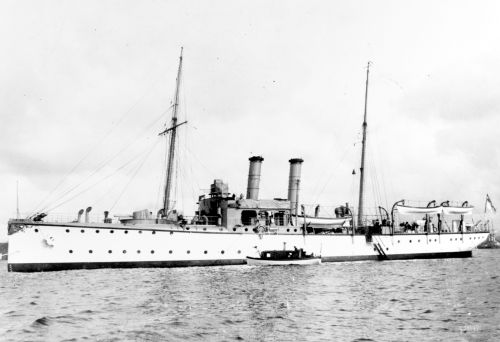
The expansion of British imperial power in the Victorian era was closely tied to the pursuit of markets and resources, with military force often serving as the mechanism through which economic access was secured. Industrial growth created an insatiable demand for raw materials such as cotton, rubber, metals, and agricultural commodities, while also generating a need for new markets to absorb manufactured goods. The projection of military power was frequently employed to dismantle barriers to trade and to establish conditions favorable to British commerce. This fusion of economic ambition and coercive force has often been described as “gunboat capitalism,” a system in which military intervention functioned as an instrument of market expansion.
One of the defining features of this system was the use of force to open previously closed or restricted economies. When local governments resisted foreign trade or sought to maintain control over their own economic systems, British military was deployed to compel compliance. The Opium Wars in China provide a well-known example of this dynamic, in which naval power was used to enforce trade agreements that favored British commercial interests. Such interventions were justified in terms of free trade and economic liberalism, yet they often resulted in unequal arrangements that disproportionately benefited British merchants and corporations. The language of economic progress masked the coercive realities underlying imperial expansion.
Once access to markets was secured, corporations moved quickly to establish dominance within these newly opened regions. Commercial enterprises invested in plantations, mines, and trading networks, restructuring local economies to align with global demand. This process frequently involved the reorientation of production toward export commodities, often at the expense of subsistence agriculture or traditional industries. Control over key resources allowed British firms to integrate colonial economies into a broader system of imperial trade, ensuring a steady supply of raw materials while creating dependent markets for finished goods. The economic transformation of these regions was both a cause and consequence of imperial intervention.
The relationship between military force and economic control also extended to the maintenance of these systems. When resistance emerged, whether in the form of local uprisings or challenges from competing powers, the British state was prepared to intervene to protect its economic interests. This ongoing reliance on military power reinforced the stability of imperial markets while discouraging efforts to alter or resist the established order. The presence of armed force served as a constant reminder of the consequences of opposition, embedding coercion within the everyday functioning of imperial economies.
“Gunboat capitalism” represents a critical dimension of Victorian imperialism, illustrating how economic objectives and military industrialization were deeply intertwined. The expansion of markets and the extraction of resources were not merely byproducts of empire but central goals that shaped its development. By examining the role of coercion in facilitating economic growth, it becomes clear that the prosperity of British industry was closely linked to the structures of power that sustained imperial dominance. This convergence of commerce and coercion further reinforces the argument that the Victorian era laid important groundwork for the modern integration of economic and military systems.
Informal Empire: The Precursor to the Modern Military-Industrial Complex
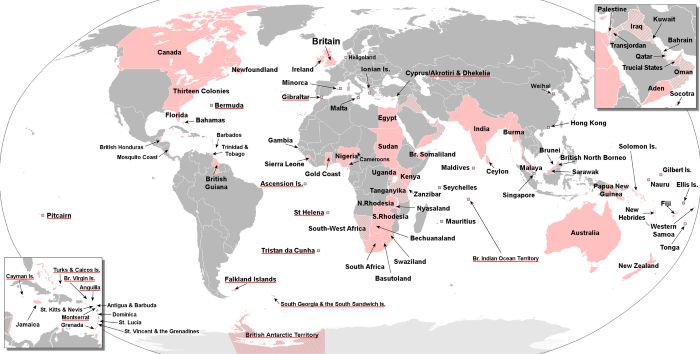
The concept of “informal empire” provides a crucial framework for understanding how Victorian Britain extended its influence without always resorting to formal territorial control. Rather than relying exclusively on direct governance, Britain often exercised power through economic dominance, diplomatic pressure, and strategic military presence. This approach allowed the state to shape global systems of trade and investment while minimizing the administrative burdens associated with formal colonization. Corporate enterprise and state power operated in close coordination, creating a system in which influence could be exerted without the visible structures of empire.
Informal empire depended heavily on the integration of financial, industrial, and commercial networks that connected Britain to regions across the globe. British banks financed infrastructure projects, industrial firms supplied machinery and technology, and trading companies facilitated the exchange of goods on terms favorable to British interests. These networks created conditions in which local economies became dependent on British capital and markets, effectively extending imperial influence through economic means. The absence of direct political control did not diminish the impact of this system; rather, it allowed Britain to exert authority through structural dependence rather than formal शासन. These economic relationships could become deeply entrenched, shaping not only trade patterns but also political decision-making within affected regions. Local elites and governments often found themselves aligned with British interests due to their reliance on external capital and markets, further reinforcing the reach of informal empire.
Military power remained an essential component of this arrangement, even in the absence of formal rule. The presence of naval bases, strategic garrisons, and the capacity for rapid intervention ensured that British interests could be defended when necessary. This latent power functioned as a deterrent, reinforcing the stability of economic relationships and discouraging resistance. In many cases, the threat of military action was sufficient to maintain compliance, allowing Britain to achieve its objectives without the need for sustained conflict. The interplay between economic influence and military power defined the operational logic of informal empire.
Private corporations played a central role in sustaining and expanding this system. Industrial firms, financial institutions, and commercial enterprises acted as agents of British influence, embedding themselves within local economies and shaping patterns of production and exchange. Their activities were often supported by diplomatic and military mechanisms that ensured favorable conditions for operation. This collaboration between state and corporate actors created a network of interdependence in which economic success and strategic stability were closely linked. In many instances, corporations operated as the practical face of imperial presence, advancing British interests through investment, infrastructure development, and trade without the need for direct political engagement. This arrangement allowed the state to extend its influence while maintaining a degree of plausible distance, even as it stood ready to intervene when corporate operations were threatened.
The structure of informal empire reveals important continuities with what would later be described as the military-industrial complex. Although the Victorian system lacked the centralized coordination and bureaucratic integration of its twentieth-century counterpart, it nonetheless exhibited a similar alignment of interests between government, industry, and finance. Military power supported economic expansion, while economic success reinforced the capacity for military projection. This reciprocal relationship created a durable framework in which the pursuit of profit and the exercise of power were mutually reinforcing, anticipating later developments in the organization of state and industry.
The Victorian informal empire can be understood as a precursor to modern military-industrial systems, demonstrating how economic and strategic objectives can become structurally intertwined. The absence of formal institutions coordinating this relationship does not diminish its significance; rather, it highlights the organic manner in which such systems can emerge from the interaction of market forces and state interests. These relationships produced patterns of cooperation and dependency that would become more formalized in the twentieth century, as governments increasingly institutionalized their partnerships with industry and finance. By examining the mechanisms of informal empire, it becomes possible to trace the historical roots of a model in which corporate power, financial capital, and military capability operate in concert, shaping the trajectory of global influence in the modern era.
Conclusion: War, Industry, and the Foundations of Modern Power
The Victorian era laid the foundation for the modern military-industrial complex by linking industry, finance, and warfare. The period reveals a decisive transformation in the relationship between war, industry, and economic power, as the expansion of empire became increasingly dependent on the integration of private enterprise and state power. Industrialization provided the material foundation for military strength, while warfare and imperial expansion created the conditions necessary for continued economic growth. This reciprocal relationship blurred the boundaries between public and private interests, embedding corporate activity within the strategic priorities of the state. The result was not a formally organized system but a deeply interconnected network in which economic and military power operated in mutual support.
Across multiple domains, from armaments production to infrastructure development and financial markets, corporations emerged as indispensable partners in the projection of imperial power. Industrial firms supplied the weapons and machinery of war, shipping and telegraph companies enabled global coordination, and financial institutions provided the capital necessary to sustain prolonged conflict. Each of these sectors benefited directly from imperial expansion, while simultaneously reinforcing the capacity of the state to pursue it. The interdependence of these sectors prevented any single element from operating in isolation; instead, industrial production, logistical infrastructure, and financial investment functioned as mutually reinforcing components of imperial शक्ति. This integration allowed Britain to sustain a global presence that would have been impossible through military means alone, demonstrating how economic organization could amplify and extend the reach of state power far beyond traditional limits.
The Victorian experience highlights the extent to which this system was driven by structural forces rather than centralized design. The alignment of interests between corporations and the state emerged organically from the conditions of industrial capitalism and global competition. Firms pursued profit and expansion, while the state sought security and influence, yet their objectives frequently overlapped in practice. This convergence produced a dynamic in which military power could be mobilized in support of economic goals, and economic growth could, in turn, sustain military capacity. The resulting system anticipated many of the characteristics associated with the modern military-industrial complex, even in the absence of formal institutional coordination.
Ultimately, the foundations of modern power were laid not only through the accumulation of military strength but through the integration of economic, industrial, and financial systems into the conduct of war. The Victorian era shows how deeply these elements became intertwined, creating a framework in which global influence was sustained by the combined force of capital and coercion. By examining this period, it becomes clear that the modern relationship between industry and warfare did not emerge suddenly in the twentieth century but developed gradually from earlier patterns of imperial expansion. The legacy of this transformation continues to shape the structures of global power, underscoring the enduring connection between economic ambition and military capability.
Bibliography
- Cain, P. J., and A. G. Hopkins. British Imperialism, 1688–2000. 2nd ed. London: Longman, 2002.
- Chandler, Alfred D. The Visible Hand: The Managerial Revolution in American Business. Cambridge, MA: Belknap Press, 1977.
- Cuff, Robert D. “An Organizational Perspective on the Military-Industrial Complex.” Business History Review 52:2 (1978), 250-267.
- Darwin, John. The Empire Project: The Rise and Fall of the British World-System, 1830–1970. Cambridge: Cambridge University Press, 2009.
- Ferguson, Niall. The Cash Nexus: Money and Power in the Modern World, 1700–2000. New York: Basic Books, 2001.
- —-. Empire: How Britain Made the Modern World. London: Allen Lane, 2003.
- Fieldhouse, D. K. The Colonial Empires: A Comparative Survey from the Eighteenth Century. London: Macmillan, 1966.
- Hacker, Barton C. “Military Technology and World History: A Reconnaissance.” The History Teacher 30:4 (1997), 461-487.
- Headrick, Daniel R. The Invisible Weapon: Telecommunications and International Politics, 1851–1945. New York: Oxford University Press, 1991.
- —-. The Tools of Empire: Technology and European Imperialism in the Nineteenth Century. Oxford: Oxford University Press, 1981.
- Hobsbawm, Eric. The Age of Empire, 1875–1914. New York: Vintage Books, 1987.
- —-. Industry and Empire: The Birth of the Industrial Revolution. London: Weidenfeld & Nicolson, 2000.
- Kennedy, Paul. The Rise and Fall of the Great Powers: Economic Change and Military Conflict from 1500 to 2000. New York: Random House, 1987.
- Landes, David S. The Unbound Prometheus: Technological Change and Industrial Development in Western Europe from 1750 to the Present. Cambridge: Cambridge University Press, 1969.
- McNeill, William H. The Pursuit of Power: Technology, Armed Force, and Society since A.D. 1000. Chicago: University of Chicago Press, 1982.
- Neal, Larry. The Rise of Financial Capitalism: International Capital Markets in the Age of Reason. Cambridge: Cambridge University Press, 1990.
- Robinson, Ronald, and John Gallagher. “The Imperialism of Free Trade.” The Economic History Review 6, no. 1 (1953): 1–15.
- Scott, J. D. Vickers: A History. London: Weidenfeld and Nicolson, 1962.
Originally published by Brewminate, 03.26.2026, under the terms of a Creative Commons Attribution-NonCommercial-NoDerivatives 4.0 International license.
About the Author