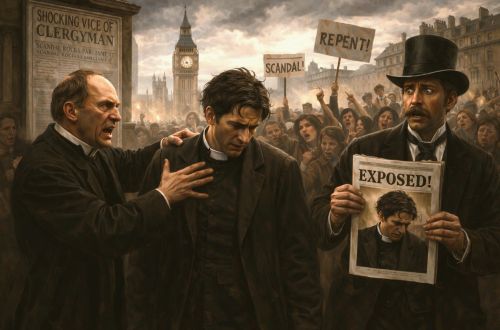
Victorian Britain’s culture of public virtue masked a volatile landscape of clerical scandal, political exposure, and institutional self-protection.

By Matthew A. McIntosh
Public Historian
Brewminate
Introduction: The Architecture of Victorian Moral Identity
Victorian Britain cultivated one of the most self-conscious moral identities in modern European history. From the accession of Queen Victoria in 1837 through the closing decades of the nineteenth century, public discourse increasingly framed national greatness in terms of domestic virtue, sexual restraint, industriousness, and religious seriousness. Evangelical revivalism, already influential in the late eighteenth century, reshaped middle-class sensibilities and infused political language with moral urgency. Public rhetoric did not merely celebrate prosperity and empire; it insisted that Britain’s power rested upon character. Moral discipline became a defining feature of national self-understanding. Industrial expansion, urban growth, and imperial administration were frequently narrated not simply as achievements of engineering or governance but as evidence of a morally superior civilization. Political speeches, philanthropic publications, and religious tracts reinforced the idea that national stability depended upon personal rectitude. The cultivation of virtue was presented as both civic duty and divine obligation. In this framework, morality operated as a form of infrastructure, supporting institutions, legitimizing authority, and distinguishing Britain from perceived continental decadence. The language of reform was not marginal to Victorian life; it was constitutive of its public identity.
Focal to this identity was the ideal of the disciplined family. The domestic sphere was elevated as the moral core of society, with clearly gendered expectations. Men were imagined as industrious providers and guardians of civic order, while women were positioned as custodians of purity and moral influence within the home. The language of separate spheres structured debates about education, philanthropy, and social reform. Respectability, particularly among the expanding middle classes, functioned as both aspiration and social boundary. To display moral propriety was to claim legitimacy within a rapidly industrializing society.
Religion anchored this architecture. The Church of England retained institutional prominence, but Nonconformist denominations and evangelical networks expanded the moral vocabulary of public life. Sermons, tract societies, and reform associations linked private piety to public responsibility. Campaigns against drunkenness, prostitution, and sexual vice framed social disorder as a moral failing requiring collective vigilance. Parliamentary debates frequently adopted this tone, invoking duty, protection of the vulnerable, and the safeguarding of national character. Moral reform was not confined to pulpits; it infused legislation and civic activism.
Yet the very intensity of Victorian moral self-definition created a distinctive public culture. To be Victorian was to perform virtue in visible ways. Dress, speech, associational membership, and philanthropic engagement signaled alignment with the era’s moral ideals. Public figures who championed reform accumulated reputational capital grounded in perceived integrity. This architecture of moral identity would shape how scandal was interpreted and managed. When virtue becomes the organizing principle of civic legitimacy, its performance acquires political weight. The framework that elevated moral reform also structured the conditions under which exposure and institutional protection would unfold.
Reform Movements and the Politics of Social Purity

Victorian moral identity did not remain rhetorical; it organized itself into movements. Reform associations proliferated across the nineteenth century, translating evangelical conviction and middle-class respectability into structured campaigns. Temperance societies, social purity organizations, rescue missions, and philanthropic committees sought to combat vice and elevate public standards. These movements framed their work as protective and restorative. Alcohol, prostitution, gambling, and sexual exploitation were depicted not merely as private failings but as threats to national vitality. Reformers positioned themselves as guardians of the vulnerable and custodians of Britain’s moral future.
Among the most influential of these campaigns were those targeting prostitution and sexual exploitation. The Contagious Diseases Acts of the 1860s, designed to regulate and medically inspect women suspected of prostitution in garrison towns, exposed the tension between moral reform and gendered control. Proponents argued that regulation protected soldiers and safeguarded public health by containing venereal disease. Critics, most prominently Josephine Butler and her allies, condemned the Acts as state-sanctioned violation of women’s civil liberties and bodily autonomy. Butler’s campaign reframed the issue from one of medical necessity to one of justice and dignity, insisting that the legislation institutionalized a sexual double standard by scrutinizing women while leaving male clients untouched. Public meetings, pamphlets, and parliamentary debates intensified national attention. The controversy revealed competing visions of purity. For some, reform meant surveillance and discipline imposed upon those labeled morally suspect; for others, it required confronting structural inequities embedded within law and custom. Social purity politics became a contested field rather than a unified crusade, exposing fissures within Victorian moral consensus.
Temperance activism likewise illustrates the interplay of morality and social order. Campaigns against alcohol consumption framed drunkenness as the root of poverty, domestic violence, and crime. Organizations such as the United Kingdom Alliance and the Women’s Christian Temperance Union mobilized petitions, public lectures, and legislative lobbying. Yet temperance rhetoric often carried implicit class assumptions. Working-class leisure and drinking practices were scrutinized more heavily than elite indulgence. Moral reform could function as a means of regulating the behavior of those deemed socially precarious. The language of uplift intersected with anxieties about disorder in rapidly expanding industrial cities.
The politics of social purity also extended to sexuality more broadly. The Criminal Law Amendment Act of 1885, which included the Labouchere Amendment criminalizing “gross indecency” between men, emerged within a climate of heightened concern about vice and exploitation. Public discourse emphasized protection of women and children from predatory behavior, especially following sensational reporting on alleged brothel networks and child prostitution. Reformers invoked the language of rescue and safeguarding, framing legislative expansion as a moral imperative. Yet the resulting statute widened the scope of criminalized sexual behavior beyond the immediate abuses that had galvanized public outrage. Enforcement patterns and prosecutorial discretion reflected existing hierarchies, often targeting individuals lacking social protection. Elite indiscretions were more likely to be managed quietly, while marginalized men faced severe penalties. Reformist zeal, while sincerely motivated in many cases, became intertwined with mechanisms of surveillance, stigma, and legal vulnerability. The boundary between protecting the innocent and policing deviance grew increasingly porous.
Women played a central role in these movements, complicating any interpretation of social purity as exclusively patriarchal imposition. Middle-class women leveraged moral authority to enter public debate, organize associations, and challenge legal inequities. Philanthropic engagement and reform activism provided avenues for political participation before full suffrage, allowing women to claim influence in shaping national policy. Figures such as Butler demonstrated how appeals to Christian conscience could mobilize broad coalitions across denominational lines. Their leadership often reinforced prevailing norms about female virtue, sexual restraint, and maternal guardianship. Activism drew legitimacy from women’s association with moral sensitivity and domestic authority. The expansion of women’s public voice occurred within the grammar of moral guardianship rather than in explicit rejection of gendered expectations. Social purity campaigns simultaneously opened space for female agency and reaffirmed cultural assumptions about sexuality and respectability.
Reform movements operated within a paradox. They addressed genuine social harms and articulated ethical concerns that resonated widely. They also reproduced hierarchies embedded in Victorian society. The rhetoric of protection and purity offered moral clarity, yet it could mask asymmetries of power. Campaigns that claimed to defend the vulnerable sometimes subjected particular populations to intensified scrutiny. In this environment, public virtue functioned not only as aspiration but as instrument. The politics of social purity would shape how scandal surfaced, how accusations were framed, and whose reputations proved resilient.
Clerical Authority and Sexual Scandal
Victorian Britain vested extraordinary moral authority in its clergy. Anglican bishops, parish priests, and prominent Nonconformist ministers occupied positions not only of spiritual guidance but of social arbitration. They officiated marriages, oversaw charitable institutions, and participated in public debate over education, poverty, and vice. Sermons reinforced ideals of chastity, fidelity, and domestic order, while clerical voices often supported campaigns for temperance and sexual restraint. This visibility endowed clergy with reputational capital grounded in perceived integrity. The pulpit functioned as a platform from which moral standards were articulated and enforced through persuasion.
Yet this authority carried inherent vulnerability. Allegations of sexual misconduct among clergy periodically surfaced, challenging the very foundations of public trust. Cases varied in scale, from improprieties involving parishioners to more serious accusations of exploitation, including coercive relationships facilitated by pastoral access and spiritual authority. Because clergy occupied positions of intimate counsel, particularly in matters of confession, marital strain, or moral anxiety, boundaries could become blurred in ways that heightened both risk and concealment. Ecclesiastical courts typically handled such matters internally, reflecting the Church of England’s institutional autonomy and desire to preserve spiritual jurisdiction over its ministers. Proceedings were often discreet, prioritizing restoration of order and protection of clerical dignity over public transparency. In some instances, accused clergy were quietly reassigned or encouraged to resign rather than subjected to highly visible trials. While certain cases resulted in formal discipline or removal from office, others concluded with minimal disclosure to congregations. The mechanisms designed to protect parishioners and uphold standards simultaneously shielded institutional reputation, creating a system in which accountability could be unevenly applied.
The structure of clerical oversight contributed significantly to this dynamic. Church governance relied on hierarchical review, episcopal authority, and canon law rather than routine civil adjudication. Investigations could be protracted, technical, and confined to narrow circles of ecclesiastical officials. Lay complainants often lacked familiarity with procedural avenues and faced social obstacles in pressing charges against respected ministers. Parishioners dependent on clerical patronage for charitable relief, educational access, or social endorsement confronted tangible risks in challenging pastoral authority. The imbalance of power between minister and congregant complicated not only reporting but also communal perception of allegations. Victorian culture invested heavily in the image of the morally upright clergyman, reinforcing presumptions of innocence grounded in spiritual vocation. Once established, moral credibility functioned as insulation. In communities where clergy were central to civic life, skepticism toward accusations could be as intense as outrage at confirmed wrongdoing. Scandal threatened not merely individuals but the symbolic architecture of religious authority that undergirded Victorian respectability.
The press played an ambiguous role in exposing clerical misconduct. Expanding newspaper circulation increased the potential for public revelation, yet libel law and editorial caution constrained reporting. Publishers risked costly litigation if accusations could not be conclusively proven. As a result, coverage of clerical scandals often navigated careful language or relied on coded references. Sensational cases attracted attention, but many incidents remained localized. The interplay between ecclesiastical discipline and journalistic restraint shaped the public visibility of misconduct. Exposure depended on legal risk as much as moral outrage.
Clerical scandal illuminated a structural paradox within Victorian moral culture. The clergy’s prominence in campaigns for sexual propriety heightened the shock of allegations against them. The institutional frameworks that elevated clerical authority also provided mechanisms of containment. Public virtue and private misconduct could coexist within a system that prioritized reputation and continuity. The moral leadership of the Church, central to Victorian identity, proved both source of legitimacy and site of fragility when confronted with accusations that unsettled its claims to moral guardianship.
Political Scandal and the Fragility of Public Virtue
Victorian political culture rested heavily on the language of character. Members of Parliament, cabinet ministers, and reform advocates were expected to embody the virtues they publicly championed. Debates over suffrage, labor regulation, imperial policy, and social reform unfolded within a rhetorical framework that linked governance to moral credibility. Political authority was not conceived as purely procedural; it was personal. The ideal statesman was disciplined, respectable, domestically stable, and publicly upright. This emphasis on personal integrity heightened the symbolic stakes of scandal. Allegations of sexual misconduct or corruption threatened not only individual careers but the moral narrative underpinning parliamentary legitimacy.
The Criminal Law Amendment Act of 1885 illustrates this fragility. While framed as a necessary measure to protect women and minors from exploitation, the Act expanded the legal regulation of sexuality in ways that would reverberate beyond its immediate context. Public rhetoric emphasized safeguarding innocence and defending national morality. Yet the statute’s breadth rendered it a potential instrument of exposure and political leverage. In linking sexual propriety to legal compliance, Parliament embedded moral scrutiny within criminal law.
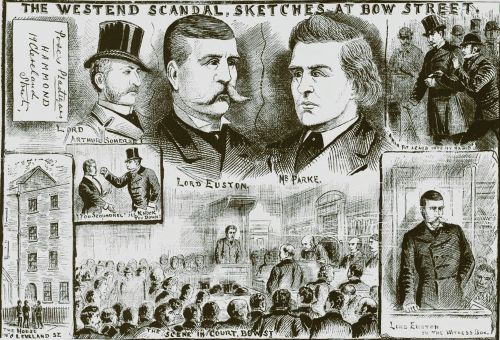
The Cleveland Street scandal of 1889 exposed the tensions embedded in this framework. Revelations that a male brothel frequented by telegraph boys had allegedly served aristocratic and possibly royal clients triggered sensational press coverage and political anxiety. Investigations implicated individuals connected to elite circles, raising questions about selective prosecution and suppression. The scandal unfolded amid cautious reporting and legal maneuvering, as newspapers navigated libel risk and political pressure. Working-class participants faced swift prosecution, while rumors surrounding prominent figures generated public speculation but limited formal accountability. The disparity between treatment of marginalized individuals and elite suspects intensified suspicion that moral rhetoric masked institutional protection.
Political scandal revealed how public virtue could be both weapon and shield. Accusations of impropriety could destroy reputations rapidly, particularly when aligned with partisan rivalry. Elite networks possessed resources to contain damage. Social standing, legal counsel, and access to sympathetic editors could mitigate exposure. Parliamentary privilege and influence over investigative processes further complicated transparency. The fragility of moral credibility coexisted with mechanisms designed to preserve it for those embedded within powerful circles.
The press operated within this delicate terrain. Newspapers were increasingly influential in shaping public opinion, yet editors balanced sensationalism with caution. Publishing allegations against prominent politicians entailed financial and legal risk, particularly under stringent libel statutes that favored plaintiffs with means to pursue litigation. Editors were acutely aware that unsubstantiated claims could result in crippling damages, fostering a culture of strategic restraint. At times, controversial information circulated first through foreign papers or private correspondence before appearing in domestic print, reflecting the limits imposed by British legal frameworks. Political alliances and personal relationships between journalists and statesmen further complicated decisions about disclosure. Sensational reporting could increase circulation dramatically, yet excessive exposure risked alienating influential patrons or provoking costly lawsuits. In this environment, scandal was mediated through calculated risk assessment as much as moral urgency. The boundaries of what could be printed shaped not only public knowledge but also the tempo and intensity of political crisis.
Victorian political scandal exposed the inherent instability of virtue-based legitimacy. When governance is intertwined with personal morality, the line between public office and private conduct becomes porous. Allegations reverberate beyond the individual, casting doubt on the institutions that elevated them. Yet the same system that demanded moral rectitude could cushion its most powerful participants. Public virtue functioned as currency, vulnerable to devaluation yet sustained by structural advantage. The fragility of moral authority lay not only in human fallibility but in the asymmetries that determined whose fall would be visible and whose would be quietly absorbed.
The Press, Libel Law, and the Machinery of Exposure

By the late nineteenth century, Britain possessed one of the most dynamic and commercially competitive press cultures in Europe. Advances in printing technology, reductions in stamp duties, and expanding literacy rates widened readership across class lines. Newspapers became central intermediaries between scandal and public knowledge. They did not merely report moral controversy; they shaped its narrative structure. Editorial framing determined whether allegations appeared as isolated lapses, systemic failures, or partisan attacks. In a society invested in moral respectability, the press functioned simultaneously as watchdog and gatekeeper.
Libel law formed a critical boundary around this machinery of exposure. British defamation statutes favored plaintiffs and imposed substantial financial risk on publishers who printed unverified accusations. Truth was a defense, but the burden of proof could be costly to establish. Wealthy individuals, particularly those embedded in elite networks, possessed the means to initiate litigation capable of bankrupting smaller papers. This legal architecture fostered caution. Editors learned to navigate scandal through implication, suggestion, or reliance on parliamentary privilege, where statements made in the House of Commons enjoyed immunity from libel claims. Exposure depended not solely on moral outrage but on legal strategy.
The growth of what contemporaries termed “New Journalism” intensified this environment. Papers such as the Pall Mall Gazette embraced investigative reporting and sensational presentation, using vivid prose, striking headlines, and serialized revelation to galvanize public response. Campaigns like W. T. Stead’s exposé on child prostitution demonstrated the power of the press to catalyze legislative reform by transforming hidden abuse into urgent public crisis. Stead framed journalism as moral intervention, positioning the editor as reformer rather than mere observer. Yet sensationalism also raised ethical questions. The boundary between moral crusade and commercial exploitation proved porous. Graphic detail, emotional appeal, and dramatic pacing increased circulation while claiming higher purpose. Critics accused such journalism of inflaming panic or distorting evidence for impact. Supporters countered that moral complacency required disruption. The press became an arena in which reformist ambition, market competition, and public appetite for scandal converged.
Class inflected the distribution of exposure. Working-class defendants and marginalized individuals were more readily named, prosecuted, and publicly scrutinized. Police court reporting frequently printed full names and lurid descriptions when cases involved those without social standing. Elite figures, by contrast, benefited from reputational buffers and legal counsel capable of constraining coverage. Even when allegations reached print, ambiguity often surrounded the identification of prominent suspects. Euphemism, initials, and oblique reference preserved plausible deniability. Editorial restraint could be justified as legal prudence, but it also reflected deference to status. The machinery of exposure operated unevenly, shaped by economic resources and social capital as much as by evidentiary strength. Public knowledge of scandal was filtered through hierarchies that mirrored broader Victorian inequalities.
The press provided a channel through which reformers challenged institutional secrecy. Journalists collaborated with activists, disseminating testimony that might otherwise have remained confined to private complaint. Parliamentary inquiries and court proceedings supplied material for broader circulation. Public opinion, amplified through print, exerted pressure on officials reluctant to pursue sensitive investigations. The machinery of exposure could destabilize established hierarchies when moral outrage aligned with credible documentation.
The Victorian press occupied a paradoxical position within moral culture. It enabled accountability by illuminating misconduct and energizing reform, transforming isolated allegations into national debate. It also mediated scandal through legal constraint, commercial incentive, editorial judgment, and class bias. Exposure was not a simple act of revelation but a negotiated process shaped by institutional power, financial risk, and reputational calculation. Newspapers could amplify outrage, but they could also dampen it through selective emphasis or silence. When moral identity functioned as public badge, the press became both magnifier and filter, determining whose virtue would be questioned and whose protected. In this interplay between publication and protection, the contours of Victorian scandal were defined, revealing a media landscape deeply entangled with the moral structures it scrutinized.
Moral Panic, Class Anxiety, and Institutional Deflection
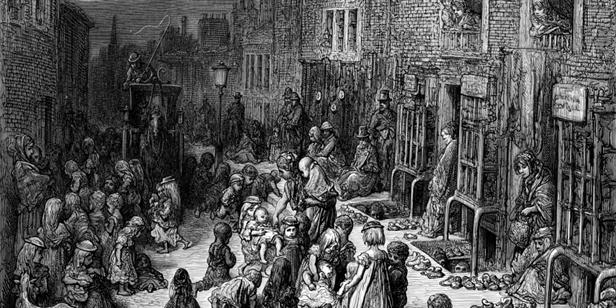
Victorian moral reform often intensified during moments of perceived social crisis. Rapid urbanization, industrial expansion, and demographic change generated anxiety about disorder in Britain’s cities. Slums, prostitution districts, and public houses became symbols of degeneration in reformist literature. Sensational reports of child exploitation, trafficking, and vice stoked fears that moral decay threatened the nation’s future. Campaigners invoked the language of protection, particularly of women and children, to rally public support. Moral panic operated as a powerful mobilizing force, simplifying complex structural problems into narratives of corruption and rescue.
These anxieties were not distributed evenly across social strata. The urban poor, migrant communities, and working-class neighborhoods were frequently depicted as breeding grounds of vice. Reform discourse mapped moral deficiency onto class location, equating poverty with susceptibility to degeneracy and moral weakness. Philanthropic investigations, social surveys, and journalistic exposés described overcrowded housing, drunkenness, gambling, and sexual commerce as emblematic of lower-class life. Visual imagery and serialized reporting amplified this association, presenting vice as geographically concentrated and socially identifiable. While such accounts sometimes aimed at humanitarian reform and public health intervention, they also reinforced hierarchical assumptions about respectability and self-control. Middle-class reformers often portrayed themselves as rational guardians confronting irrational disorder below. The rhetoric of purification implied that instability originated from marginalized communities rather than from economic structures or elite behavior. In this framing, class anxiety merged with moral alarm, directing scrutiny downward.
Moral panic could function as deflection. Public outrage directed toward visible vice in marginalized communities diverted scrutiny from misconduct within established structures. Clerical and political scandals, when exposed, competed with broader narratives about urban depravity or sexual deviance among the poor. Campaigns emphasizing the dangers of prostitution, homosexuality, or radicalism sometimes overshadowed questions about institutional accountability. The spectacle of vice at society’s margins proved easier to dramatize than the quieter operations of elite protection networks.
Child-saving movements exemplify this dynamic. Organizations dedicated to rescuing endangered youth promoted surveillance of working-class households and intervention in domestic life. Reformers justified intrusive measures as necessary safeguards against exploitation and moral neglect. Investigations into factory labor, street trading, and lodging houses often led to expanded regulatory authority over families deemed deficient. Philanthropic agencies collaborated with police and magistrates, embedding moral evaluation within bureaucratic processes. Yet the focus on rescuing children from impoverished environments could obscure exploitation occurring within more privileged contexts, including abuses facilitated by institutional authority or familial secrecy among elites. Public campaigns highlighted visible urban dangers, publishing harrowing accounts that galvanized readers and donors. Meanwhile, misconduct within respected institutions remained comparatively muted unless dramatic evidence forced exposure. The moral vocabulary of rescue framed intervention as benevolence while narrowing the field of scrutiny to socially marginal spaces.
It would be reductive to portray moral panic solely as cynical manipulation. Many reformers were sincerely motivated by compassion and outrage at genuine harm. Campaigns against child labor, trafficking, and exploitation achieved meaningful reforms. The emotional intensity surrounding such movements reflected real suffering. However, sincerity did not eliminate structural bias. Even well-intentioned activism operated within a cultural matrix that privileged certain narratives of danger and minimized others. Institutional deflection could occur without explicit conspiracy, emerging instead from entrenched assumptions about where vice was presumed to reside.
The interplay between panic and protection reveals a pattern within Victorian moral culture. When public identity centered on virtue, crises of morality demanded visible targets. Marginalized groups provided those targets more readily than insulated elites. Institutional actors, benefiting from reputational capital and legal resources, navigated scandal with greater resilience. Moral alarm functioned both as instrument of reform and as mechanism of selective attention. In the shadow of proclaimed purity, some abuses were illuminated intensely while others remained partially obscured.
Moral Identity as Institutional Armor
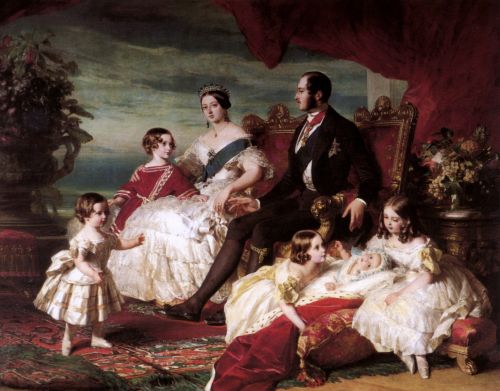
Victorian Britain’s investment in public virtue did more than structure reform movements and scandal narratives; it created a reservoir of moral capital that institutions could draw upon in moments of crisis. Clergy, parliamentarians, philanthropists, and reform advocates accumulated reputational authority by aligning themselves visibly with campaigns for purity and protection. This alignment functioned as credential. To be known as a defender of temperance, a guardian of children, or an advocate of sexual restraint was to occupy elevated moral ground. In a society that prized respectability, such standing could serve as a preemptive defense against suspicion. Moral identity became not merely ethical orientation but institutional asset.
The performance of virtue reinforced this protective dynamic. Public speeches, charitable patronage, and participation in reform societies signaled integrity in ways legible to a wide audience. Portraits, biographies, and newspaper profiles helped construct carefully curated public personas, emphasizing domestic stability, piety, and philanthropic commitment. Moral reputation was narrated repeatedly in print, embedding character into collective memory. When allegations arose against individuals so positioned, their prior moral reputation complicated reception. Accusations could be reframed as malicious, partisan, or sensationalist attacks against a proven servant of the public good. Supporters might invoke years of visible service as counterweight to emerging claims. In parliamentary debate or ecclesiastical inquiry, appeals to past virtue often shaped tone and outcome. The more loudly a figure had proclaimed moral commitment, the more incongruous misconduct appeared, encouraging disbelief among adherents who had invested trust in that identity. Moral capital accumulated over years could buffer the immediate impact of exposure, slowing momentum and providing space for strategic response.
Institutional structures amplified this insulation. Churches, political parties, and philanthropic organizations possessed internal mechanisms for managing reputational risk. Committees could investigate discreetly; allies could advocate restraint; legal counsel could negotiate settlements. Reputation operated collectively as well as individually. Defending a prominent figure often meant defending the credibility of the institution itself. Consequently, institutional loyalty sometimes tempered enthusiasm for full transparency. The very networks that enabled moral reform campaigns also facilitated containment when scandal threatened to destabilize authority.
This protective capacity did not render exposure impossible, but it shaped its trajectory. Moral identity functioned as armor that could delay, dilute, or redirect scrutiny. When reform rhetoric defined public legitimacy, institutions invested heavily in preserving the appearance of virtue. Victorian Britain illustrates how moral seriousness and institutional self-preservation can coexist within the same framework. The louder the proclamation of purity, the greater the incentive to guard those who embodied it. In that convergence of conviction and caution, the paradox of public virtue reached its most revealing expression.
Conclusion: Exposure, Authority, and the Paradox of Public Virtue
Victorian Britain constructed an elaborate architecture of moral identity that fused personal character with institutional legitimacy. Reform campaigns, clerical authority, parliamentary rhetoric, and press culture all participated in elevating virtue as the cornerstone of public life. Sexual restraint, domestic stability, and philanthropic commitment were not merely private ideals but visible markers of credibility. This architecture generated reform energy capable of addressing genuine exploitation and injustice. It created a system in which moral capital accumulated unevenly, reinforcing hierarchies of trust and suspicion.
Exposure operated within this architecture as both corrective and spectacle. The expanding press illuminated misconduct and amplified public indignation, yet it did so through legal constraints and commercial incentives that shaped what could be revealed. Clerical scandals and political controversies demonstrated that institutions committed to moral guardianship were themselves vulnerable to failure. However, the trajectory of scandal depended on power. Marginalized individuals experienced swift exposure, while elite figures often navigated accusation through networks of influence and legal defense. Public virtue did not eliminate abuse; it reframed the terrain on which accountability unfolded.
The Victorian case reveals that moral seriousness and institutional self-preservation are not mutually exclusive. Reformers who sincerely sought to protect children or combat exploitation operated within structures that could simultaneously shield prominent offenders. Moral panic about deviance among the poor coexisted with caution regarding elite misconduct, creating a moral landscape in which anxiety flowed downward more readily than upward. The rhetoric of protection, though often heartfelt and accompanied by legislative change, sometimes narrowed the field of scrutiny to those already socially vulnerable. Respectability, once conferred, could function as evidentiary presumption in favor of the accused. Institutional loyalty, concern for public confidence, and fear of reputational collapse all shaped responses to scandal. In this convergence of conviction and containment, the paradox of public virtue becomes visible with particular clarity: the louder the proclamation of purity, the more carefully reputational capital was guarded, and the more disruptive genuine exposure appeared when it finally broke through.
Exposure did not simply puncture hypocrisy. It exposed the mechanics of authority itself. When moral identity functions as public badge, it becomes both shield and vulnerability. Victorian Britain’s culture of reform demonstrates how institutions built upon virtue can generate both genuine progress and structural blind spots. The paradox endures beyond the nineteenth century. Public virtue remains powerful, yet it is never immune to the human frailties it seeks to regulate.
Bibliography
- Bland, Lucy. Banishing the Beast: English Feminism and Sexual Morality, 1885–1914. London: Tauris, 1995.
- Brown, Callum G. The Death of Christian Britain: Understanding Secularisation, 1800-2000. London: Routledge, 2001.
- Butler, Josephine. Personal Reminiscences of a Great Crusade. London: Horace Marshall & Son, 1896.
- Davidoff, Leonore, and Catherine Hall. Family Fortunes: Men and Women of the English Middle Class, 1780–1850. London: Hutchinson, 1987.
- Digby, Anne. “Victorian Values and Women in Public and Private.” Proceedings of the British Academy 78 (1992), 195-215.
- Green, S. J. D. The Passing of Protestant England: Secularisation and Social Change, c.1920–1960. Cambridge: Cambridge University Press, 2011.
- Hampton, Mark. Visions of the Press in Britain, 1850–1950. Urbana: University of Illinois Press, 2004.
- Hilton, Boyd. The Age of Atonement: The Influence of Evangelicalism on Social and Economic Thought, 1785–1865. Oxford: Clarendon Press, 1986.
- Hyde, H. Montgomery. The Cleveland Street Scandal. London: W. H. Allen, 1976.
- Jones, Aled. Powers of the Press: Newspapers, Power and the Public in Nineteenth-Century England. Aldershot: Scolar Press, 1996.
- Jones, Peter T. A. “Redressing Reform Narratives: Victorian London’s Street Markets and the Informal Supply Lines of Urban Modernity.” The London Journal 41:1 (2016), 60-81.
- Kaplan, Morris B. Sodom on the Thames: Sex, Love, and Scandal in Wilde Times. Ithaca, NY: Cornell University Press, 2005.
- Knight, Frances. The Nineteenth-Century Church and English Society. Cambridge: Cambridge University Press, 1995.
- Nsaidzedze, Ignatius. “An Overview of Feminism in the Victorian Period [1832-1901].” American Research Journal of English and Literature 3:1 (2017), 1-20.
- Poovey, Mary. Uneven Developments: The Ideological Work of Gender in Mid-Victorian England. Chicago: University of Chicago Press, 1988.
- Rowbotham, Judith. Good Girls Make Good Wives: Guidance for Girls in Victorian Fiction. Oxford: Basil Blackwell, 1989.
- Strand, Michael. “The Genesis and Structure of Moral Universalism: Social Justice in Victorian Britain, 1834-1901.” Theory and Society 44:6 (2015), 537-573.
- Thompson, F. M. L. The Rise of Respectable Society: A Social History of Victorian Britain, 1830–1900. Cambridge, MA: Harvard University Press, 1988.
- Walkowitz, Judith R. Prostitution and Victorian Society: Women, Class, and the State. Cambridge: Cambridge University Press, 1980.
- Wiener, Joel H., ed. Papers for the Millions: The New Journalism in Britain, 1850s to 1914. New York: Greenwood Press, 1988.
- Yadav, Vinod. “The Role of Morality and Social Reform in Victorian Literature.” International Journal of Multidisciplinary Trends 6:3 (2024), 62-67.
Originally published by Brewminate, 03.06.2026, under the terms of a Creative Commons Attribution-NonCommercial-NoDerivatives 4.0 International license.
About the Author