
Curated/Reviewed by Matthew A. McIntosh
Public Historian
Brewminate
“Ours is a Constitution intended to endure for ages to come, and consequently, to be adapted to the various crises of human affairs.”
Supreme Court Chief Justice John Marshall, 1819
Widespread Interest in the Founding Documents

Since the adoption of the Declaration of Independence on July 4, 1776, international interest in America’s founding documents has been widespread. The Declaration of Independence, the federal Constitution of 1787, and the Bill of Rights have been published in many different languages and have served as models for people around the world. Displayed here is a 1788 copy of the Constitution in Dutch, perhaps the earliest example of its publication in a language other than English.
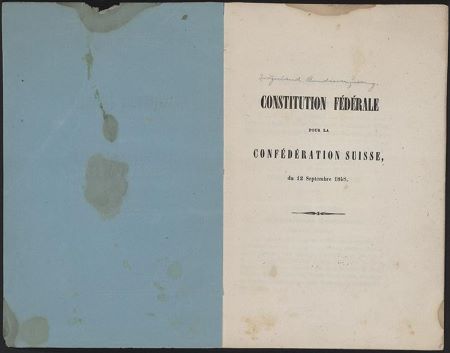
In 1847 and 1848 a wave of democratic revolutions swept through Europe. A brief civil war in Switzerland resulted in a new constitution modeled after the United States Constitution, which transformed the government of Switzerland from an alliance of republics to a federal nation.
Cherokee Nation Publishes Its First Written Constitution
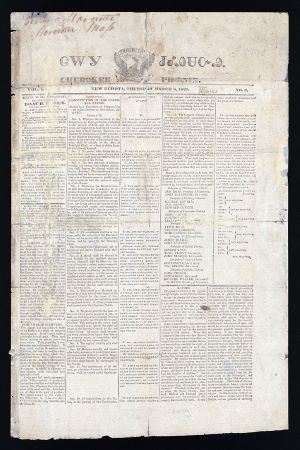
The Cherokee Phoenix was the first Native American newspaper printed in the United States. Its editor, Elias Boudinott, along with tribal leaders of the Cherokee Nation intended to reach two different audiences: Cherokee nationals and white sympathizers who supported Cherokee autonomy. This March 6, 1828, issue prints the concluding sections of the Cherokee Constitution of 1827, providing for three branches of government and defining the boundaries of the Cherokee Nation. The newspaper, partially in English and Cherokee, uses the eighty-six-character syllabary devised by Sequoyah in 1821.
Jefferson Thinks Supreme Court’s Control Must Be Limited

In this letter to Spencer Roane (1762–1822), a judge on the Virginia Court of Appeals, Thomas Jefferson cautions that the Supreme Court’s power to determine constitutionality must be curbed or it will continue to consolidate the power of the federal government. Jefferson argued that the judiciary’s independence from the will of the people upsets the checks and balances established by the Constitution.
Madison’s Thoughts on Black and Native Americans
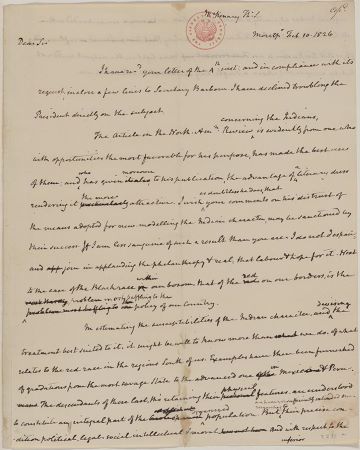
Writing to Thomas McKenney (1785–1859), former federal superintendent of Indian Trade and a strong advocate for “new-modelling the Indian character,” James Madison stated that “Next to the black race within our bosom, that of the red on our borders is the problem most baffling to the policy of our country.” Madison suggests that it would be useful to know more about “the susceptibility of the Indian character” in order to devise the treatment best suited to it.
Opponents of ERA Protest in Front of White House
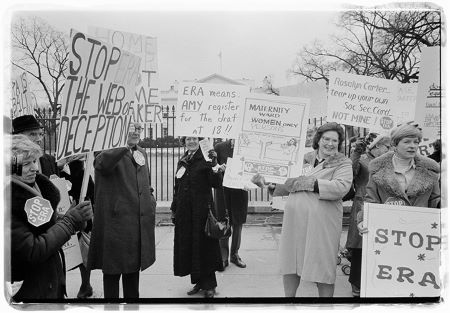
A federal Equal Rights Amendment (ERA) for women was proposed in 1923 and was finally approved by Congress in 1972 but failed to gain the support of three-fourths of the state legislatures. This 1977 photograph shows opponents of the ERA demonstrating in front of the White House.
Scrapbook Shows Women Seeking Equal Rights
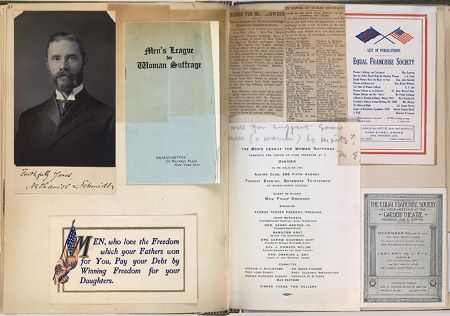
Suffragist Elizabeth Smith Miller (1822–1911) and her daughter Anne Fitzhugh Miller (1856–1912) maintained eight scrapbooks detailing the progress of women’s suffrage between 1897 and 1911. The Millers organized the Geneva Political Equality Club, based in Geneva, New York, in 1897 and represented it at national conventions and parades.
Supreme Court Upholds Cherokee Dispossession
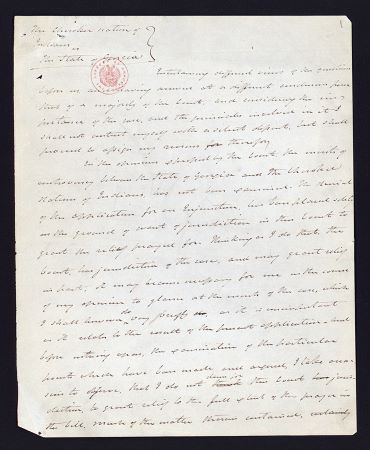
In a landmark case on the rights of Native Americans, Cherokee Nation vs. The State of Georgia, the Supreme Court refused to order an injunction against Georgia’s extensions of state laws over the Cherokee Indian Nation. The effect was to force the Cherokee to abandon their lands and move to the Federal Indian Reservation west of the Mississippi. Justice Smith Thompson (1768–1843), wrote a dissenting opinion, which was vindicated two years later by the Supreme Court ruling that states could not arbitrarily extend their laws over Indian Nations, but this was too late to save the Georgia Cherokee from “The Trail of Tears” to their western reservation.
Attempt to Dissolve the Union
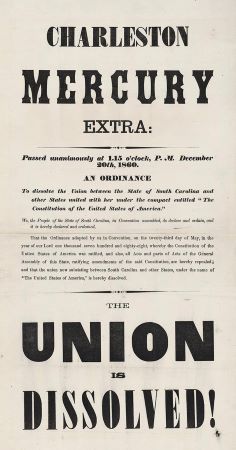
The victory in the 1860 presidential election of Republican Abraham Lincoln (1809–1865), who was widely believed to favor the abolition of slavery, triggered demands for secession from the United States throughout the southern states. On December 20, 1860, a South Carolina convention elected to consider secession voted unanimously in favor of it. Within minutes of the vote, this Charleston Mercury Extra was published.
“Your Right to Vote is Your Opportunity to Protect”

A World War II American patriotic propaganda poster shows an American exercising the right to vote. The need to protect the freedoms expounded in the Declaration of Independence, the Constitution, and the Bill of Rights was a common theme of wartime patriotic posters.
NAACP Urges Everyone to Register and Vote

The National Association for the Advancement of Colored People (NAACP) has played a leading role in the battle for civil rights for African American for a century this poster—in a long series published by the NAACP—promotes equality, voting rights, and political action by urging all Americans to exercise their constitutional duty to register on voter rolls and cast their ballot.
Protecting Constitutional Rights
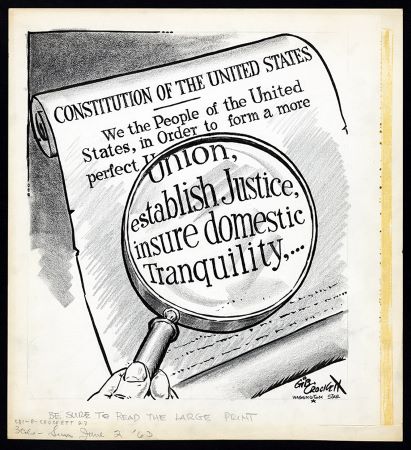
In the midst of a decade of social unrest and a surge of reform, Americans urged governmental authorities to ensure that all Americans enjoyed their constitutional rights. This drawing by Gib Crockett calls attention to the Constitution’s purpose to “form a more perfect union, establish justice, and insure domestic tranquility.”
United States Constitution as a Recruiting Tool

Common Cause used the United States Constitution as an iconic symbol in this twentieth-century recruiting poster. Common Cause is a non-profit citizen’s lobbying organization founded in 1970 by John Gardner (1912–2002) to promote open and accountable government.
“We’re Fighting to Prevent This”
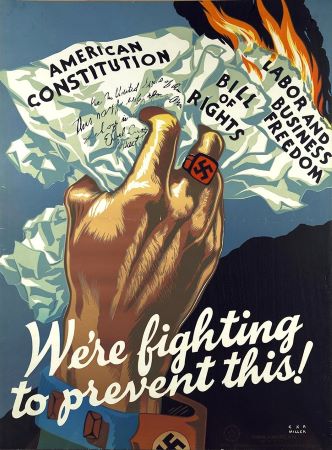
A World War II American patriotic propaganda poster shows a Nazi fist crushing America’s founding documents. The need to protect the freedoms expounded in the Declaration of Independence, the Constitution, and the Bill of Rights was a common theme of wartime patriotic posters.
Debate over States’ Rights and National Sovereignty

Over several days in January 1830, Senators Robert Hayne (1791–1839) of South Carolina and Daniel Webster (1782–1852) exchanged salvos about the sovereignty of the national government and states’ rights. Hayne interpreted the Constitution as little more than a treaty between sovereign states, which had the right to withdraw from the Union. Webster disagreed, and in his second speech, painted a dramatic picture of what would happen if the Union fell apart. He ended by praising “Liberty and Union, now and forever, one and inseparable!”
Seeking Women’s Rights to Vote
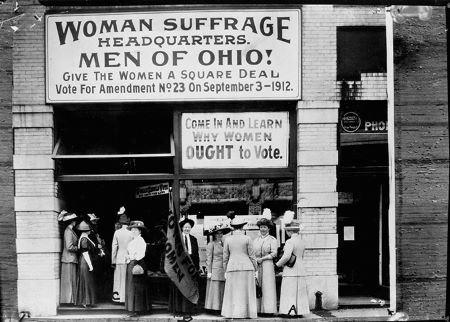
At the start of the twentieth century, women increased the pressure to secure voting rights. In this photograph, at the Cleveland, Ohio, Woman Suffrage Headquarters can be seen Belle Sherwin (1868–1955) (at extreme right) noted reformer and president of the National League of Women Voters and Florence E. Allen (1886–1966) (holding the flag), who in 1934 became the first woman to be named a federal appellate judge. A constitutional amendment to guarantee women’s right to vote did not pass Congress until 1919.
“The Evolving Nature of the Constitution”
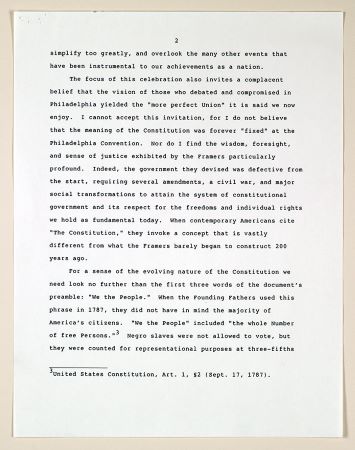
In an address on the occasion of the Bicentennial of the American Constitution, Thurgood Marshall (1908–1993), the first African American justice of the United States Supreme Court, argued that the Constitution is a document that has always been and should always be subject to change. In fact, argued Marshall, the “defective” constitution had been changed many times since its writing in 1787 and that the framers of the Constitution would barely recognize its present form and interpretation.
American Japanese Forced to Evacuate Homes
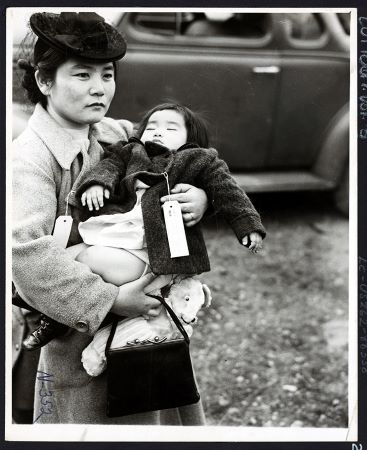
In the aftermath of the Japanese attack on Pearl Harbor, tens of thousands of American citizens of Japanese descent were rounded up, arrested, and evacuated to internment camps throughout the western states during World War II. Here a Japanese American woman and her sleeping baby await evacuation from their home on Bainbridge Island, Washington. On March 30, 1942, the approximately 270 Bainbridge islanders of Japanese descent boarded a ferry to Seattle enroute to their ultimate destination—a four-year incarceration at Manzanar Relocation Center near California’s Sierra Mountains.
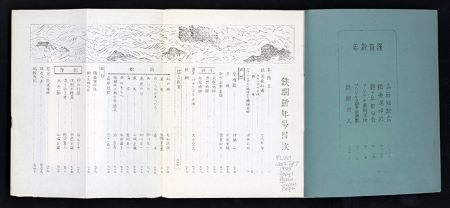
Tessaku (Barbed Wire) was a literary magazine mimeographed in a Japanese relocation camp located in Tule Lake, a desolate part of northern California, a few miles from the Oregon border. While many of the camps had community newspapers, internees also published magazines including Dotō (Raging Billows) [Tule Lake, California] and Hāto Maunten Bungei (Heart Mountain Literature) [Heart Mountain, Wyoming]. Only nine issues of Tessaku, appearing sporadically, were printed. This rare sixth issue was published in celebration of the 1945 New Year. Such ephemera, intended for a short life span, are valuable for their ability to convey the texture of life in the camps.
Questioning the Constitutionality of the New Deal

Political cartoonist Harry E. Homan (1899–1940) questioned the constitutionality of the National Recovery Administration (NRA), a key component of Franklin Roosevelt’s New Deal, in his 1935 satirical cartoon. A blue eagle, the symbol of the NRA, is pictured trying to read the word “Constitution” from an eye chart. The Act established minimum wages and allow industries to set price floors to prevent “destructive competition.”
Originally published by the United States Library of Congress, 04.12.2008, to the public domain.
About the Author