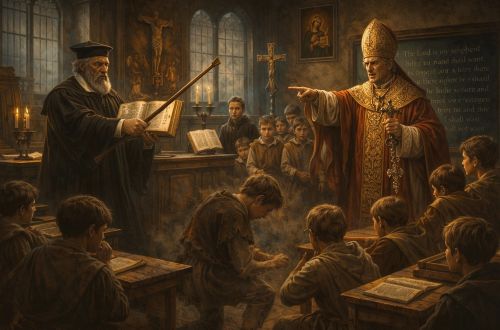
The history of confessional schooling after the Reformation makes clear that education has never been a neutral enterprise when belief is at stake.

By Matthew A. McIntosh
Public Historian
Brewminate
Introduction: When Education Becomes a Confessional Tool
The Protestant Reformation shattered the assumption that religious unity was a natural condition of political life. What had once been enforced largely through custom, clerical authority, and inherited practice now became unstable, contested, and openly defiant. Rulers across Europe faced a problem that was both theological and political: belief could no longer be assumed, yet loyalty still depended upon it. In this context, education emerged as the most reliable instrument for reconstructing religious order. Schools offered something sermons and edicts increasingly could not: early, repeated, and compulsory exposure to authorized belief.
After the Reformation, education ceased to function merely as moral instruction or basic literacy. It became a confessional project tied directly to state-building. Protestant and Catholic regimes alike embedded doctrinal teaching into compulsory schooling, requiring children to memorize catechisms as part of their civic formation. Attendance was enforced, content was standardized, and deviation was noted. The classroom became a space where religious allegiance was not debated but rehearsed. Belief itself mattered less than alignment, and alignment was produced through repetition rather than persuasion.
Crucially, these systems denied that coercion was taking place. Authorities consistently insisted that catechetical education was about moral formation, social discipline, and the cultivation of virtue rather than about enforcing religious conformity. Instruction was framed as benevolent guidance, even as it was backed by legal penalties, civic sanctions, and social stigma. This rhetorical insistence on neutrality masked a far more coercive reality. Education functioned as a screening mechanism, sorting families according to their willingness to conform. Those who resisted were not treated as conscientious objectors acting from theological conviction or parental responsibility. They were labeled disorderly, unreliable, or politically suspect. In this way, schooling became a tool for identifying loyalty as much as for shaping belief, converting classrooms into spaces of quiet surveillance as well as instruction.
What follows argues that confessional schooling after the Reformation represents a decisive moment when education was openly weaponized for religious state-building. Once schooling became compulsory and doctrinally fixed, educational neutrality collapsed in practice even as it was asserted in theory. The catechism functioned not as a teaching aid but as an ideological test, one that measured conformity rather than understanding. This historical pattern matters because it did not end with the early modern period. It persists whenever states claim that mandated religious instruction is cultural rather than ideological. When a state requires scripture in classrooms, it is not merely preserving heritage or promoting literacy. It is training citizens to recognize which beliefs are officially sanctioned and which fall outside the bounds of acceptable civic identity. The Reformation-era classroom reminds us that the moment education is used to enforce belief, it stops being education and becomes confessional discipline by another name.
The Reformation and the Problem of Religious Authority
The Protestant Reformation did not merely introduce new doctrines. It destabilized the very mechanisms by which religious authority had been maintained. For centuries, Christian belief in Western Europe had been sustained through a combination of ecclesiastical hierarchy, ritual continuity, and communal habit. Authority flowed downward from church institutions that claimed universality and permanence. The Reformation fractured this structure. Competing claims to truth proliferated, and religious allegiance became a matter of choice, persuasion, and dispute rather than inheritance.
This posed an acute problem for early modern rulers. Political authority in the sixteenth century remained deeply entangled with religious legitimacy in ways that modern secular states often underestimate. Kings, princes, and city councils governed through oaths, sacraments, and religious symbolism that bound obedience to faith. If subjects rejected the ruler’s religion, the fear was not merely theological error but political instability. Heresy was associated with sedition, dissent with disobedience. Religious plurality threatened to translate into fractured loyalty, rival allegiances, and weakened sovereignty. In this climate, toleration appeared less like a moral virtue than a gamble with state coherence.
Attempts to resolve this instability through force alone proved inadequate. Edicts, expulsions, and punishments could suppress dissent temporarily, but they did not produce durable allegiance. Moreover, open repression carried significant costs. It provoked resistance, encouraged migration, and disrupted economic life. Violent enforcement made belief visible as coercion, undermining the very legitimacy rulers sought to protect. Early modern states searched for mechanisms that could stabilize religious identity without constant resort to force, methods that would appear constructive rather than destructive, formative rather than punitive.
The appeal of schooling lay precisely in its ability to operate beneath the threshold of overt coercion. Instruction could be framed as moral guidance, civic preparation, or assistance to parents rather than as religious enforcement. By embedding doctrine within lessons on reading, obedience, discipline, and virtue, authorities could normalize confessional alignment while denying that belief itself was being compelled. Education allowed rulers to present religious conformity as a natural outcome of proper upbringing rather than as the result of state pressure. In this way, schooling collapsed religious allegiance into civic responsibility, making obedience appear voluntary even when it was structurally enforced.
In this sense, the Reformation produced not only theological division but a profound administrative challenge that schooling was uniquely suited to address. Religious authority could no longer rely on tradition, ritual, or clerical monopoly alone. It had to be reproduced deliberately, systematically, and continuously. Schools became the infrastructure through which fragmented belief was reassembled into confessional order, reaching into households and shaping subjects from childhood onward. What emerged was not a neutral educational project but a strategic response to crisis. Instruction was repurposed as a technology of governance, designed to stabilize authority by managing belief before it could become dissent.
Catechism as Civic Infrastructure
The catechism emerged after the Reformation as one of the most effective tools for reconstructing religious order, precisely because it was simple, standardized, and easily enforced. In contrast to sermons or theological treatises, catechisms reduced belief to fixed questions and answers that could be memorized, recited, and monitored. This format made doctrine portable and measurable, capable of being replicated across territories with minimal variation. It did not require theological expertise to administer, only fidelity to authorized text. As a result, catechisms could be deployed uniformly in villages, towns, and cities alike, ensuring that religious instruction no longer depended on the discretion of individual clergy or the persistence of local custom. The catechism functioned less as a teaching aid and more as an instrument of infrastructural control, embedding confessional authority into the everyday routines of schooling.
Memorization was central to this process. Catechetical instruction prioritized recall over interpretation, repetition over inquiry. Children were not encouraged to wrestle with doctrine but to internalize authorized formulations verbatim. Understanding was secondary to accuracy. This emphasis reflected a broader political logic. Memorization produced predictability. A child who could recite the correct answers demonstrated alignment regardless of private belief. The catechism transformed faith into something observable and assessable, allowing authorities to verify conformity without probing conscience directly.
In this way, catechisms served as instruments of discipline rather than persuasion. They trained subjects to associate correctness with obedience and error with deviation, reinforcing the idea that religious truth was settled and externally imposed. Religious education became an exercise in compliance, habituating children to receive belief as a closed system rather than a field of inquiry. The structure of the catechism mirrored the structure of the confessional state itself: hierarchical, uniform, and intolerant of deviation. Debate was replaced with repetition, and uncertainty was treated not as a stage of learning but as a failure requiring correction. This pedagogical model conditioned students to equate authority with truth, preparing them for civic life within a religiously defined political order.
The civic function of catechetical instruction became especially clear in its integration into compulsory schooling. Recitation was often public, conducted in classrooms, churches, or civic spaces where performance could be observed by teachers, clergy, and sometimes civic officials. Mastery of the catechism became a visible marker of social reliability. Failure to learn or repeat the prescribed answers correctly was not merely an educational shortcoming but a signal of familial or communal noncompliance. Parents could be reprimanded, fined, or subjected to additional scrutiny. In this way, the catechism linked individual learning to collective surveillance, embedding religious conformity into the routines of civic life and transforming education into a means of monitoring loyalty.
As a result, catechisms operated as a form of civic infrastructure. Like roads or legal codes, they standardized experience across a territory and reinforced central authority. They allowed states to project religious order into households without constant coercion, relying instead on routine instruction and habitual performance. What appeared to be a pedagogical innovation was, in practice, a political solution to the problem of fragmented belief. By reducing faith to repeatable formulas, confessional states converted education into a durable mechanism for producing alignment, ensuring that religious identity could be taught, tested, and reproduced at scale.
Lutheran Saxony: Schooling Loyalty into the State
Lutheran Saxony provides one of the clearest and most thoroughly documented examples of how confessional schooling functioned as a mechanism for producing civic loyalty after the Reformation. Following the territorial adoption of Lutheranism, Saxon authorities moved deliberately to reorganize education under direct state oversight. Schools were no longer peripheral institutions tied loosely to monasteries, guild charity, or parish initiative. They were reimagined as extensions of territorial governance, charged with forming subjects whose religious identity aligned seamlessly with political authority. Catechetical instruction stood at the center of this project, not as optional religious education but as a foundational requirement of civic formation. By standardizing doctrine and embedding it within compulsory schooling, Saxon rulers ensured that Lutheran belief would be learned early, reinforced continuously, and monitored by officials acting in the name of both church and state.
Attendance at school and mastery of the catechism were treated as civic obligations rather than optional forms of religious formation. Parents were expected to ensure their children’s participation, and failure to do so could result in fines or other penalties. Instruction was inspected, curricula were regulated, and teachers were evaluated for doctrinal fidelity. This system did not presume that belief would emerge naturally from conviction. Instead, it treated belief as something that had to be carefully cultivated through discipline and repetition. The goal was not theological sophistication but reliability. A properly schooled child was a predictable subject.
What distinguished the Saxon model most clearly was the way education collapsed the boundary between religious instruction and political obedience. To know the catechism was not simply to demonstrate religious competence but to affirm loyalty to the territorial church and, by extension, to the prince who governed it. Confessional identity became a proxy for civic trustworthiness. Dissent from catechetical norms was interpreted not merely as theological disagreement but as resistance to lawful authority. Children who failed to learn or recite correctly reflected poorly on their families, and families who resisted schooling attracted administrative scrutiny. Education functioned as an early warning system, allowing authorities to identify potential sources of disorder long before dissent could harden into organized resistance.
In Lutheran Saxony, schooling became a means of stabilizing the post-Reformation state without constant recourse to repression. By embedding confessional alignment into everyday educational routines, authorities normalized obedience and rendered dissent exceptional. The classroom replaced the scaffold as the primary site of religious enforcement, achieving compliance through habituation rather than spectacle. This model demonstrated the political efficiency of compulsory religious education and helped establish a template that would be replicated across confessional Europe: loyalty could be taught, tested, and enforced long before it was ever questioned.
Calvinist Geneva: Education as Moral Surveillance
In Calvinist Geneva, education functioned not only as a means of confessional instruction but as an extension of moral surveillance woven tightly into civic life. Unlike larger territorial states, Geneva’s compact size and dense social networks allowed religious authorities to monitor behavior with unusual intensity. Schooling operated within a broader system of discipline that included church courts, neighborhood oversight, and public moral regulation. Education was never confined to the classroom. It was part of a comprehensive project to shape conduct, belief, and identity simultaneously.
Genevan schools were explicitly designed to reinforce Calvinist doctrine while cultivating habits of obedience and self-scrutiny. Children were required to learn catechisms, attend sermons, and demonstrate mastery of religious instruction as evidence of proper upbringing. Instruction emphasized not only correct belief but disciplined behavior, linking theological knowledge to moral comportment in daily life. Lessons stressed order, restraint, and attentiveness, reinforcing the idea that true faith manifested itself through visible conduct. The expectation was not merely that children would know doctrine but that they would internalize norms of behavior that aligned with the reformed community’s understanding of godly life, preparing them to participate fully in Geneva’s tightly regulated civic culture.
What distinguished Geneva most sharply was the degree to which educational failure triggered broader civic consequences. Poor performance or resistance to instruction was not treated as an isolated academic issue or a private family matter. Instead, it prompted inquiry into parental authority, household discipline, and moral environment. Schools supplied information to the Consistory, the body charged with enforcing religious and moral standards, effectively integrating education into a citywide system of supervision. In this way, the classroom functioned as an early detection mechanism, identifying deviations in belief or behavior that could then be addressed through admonition, correction, or punishment. Education served as a conduit through which private life became legible to public authority.
This system blurred the line between education and policing. Teachers were not only instructors but observers, tasked with noting irregularities in belief, behavior, or attendance. Parents were held accountable for their children’s conformity, reinforcing the idea that households themselves were units of moral responsibility. Education functioned as a mechanism for extending religious authority into private life, ensuring that confessional discipline reached beyond public worship into the rhythms of family and childhood.
Genevan authorities insisted that this system was not coercive but corrective. Education was framed as care for the soul and protection of the community from moral decay. Yet the compulsory nature of schooling and the consequences of noncompliance reveal a different reality. Participation was not voluntary, dissent was not neutral, and refusal carried social and legal risks. Moral formation was inseparable from enforcement, and education served to align personal conscience with communal expectation.
In Calvinist Geneva, schooling became a powerful instrument of confessional governance. By embedding religious instruction within a dense network of surveillance, discipline, and communal accountability, authorities sought to produce citizens who not only believed correctly but behaved predictably and observably. Education did not merely transmit doctrine; it trained individuals to monitor themselves and one another, reinforcing a civic identity grounded in conformity and moral vigilance. The Genevan model demonstrates how confessional schooling could operate most effectively where education, discipline, and governance were fully integrated, transforming the classroom into a cornerstone of religious state-building and a model for later confessional regimes.
Compulsion without Neutrality
Despite their theological differences, Protestant and Catholic authorities converged on a shared educational logic after the Reformation. Both confronted the same structural problem: fractured belief threatened social cohesion, and persuasion alone was too slow, uneven, and unreliable to restore order. As a result, both confessional camps insisted that compulsory religious instruction was necessary for moral formation and civic stability. Education was described as a benevolent intervention, aimed at guiding children toward truth, discipline, and virtue rather than enforcing belief through force. By framing schooling as care for the soul and preparation for responsible citizenship, rulers and clerics alike could deny that coercion was taking place. Instruction was presented as neutral, universal, and beneficial, even as it imposed highly specific doctrinal commitments that aligned belief with state authority.
In practice, neutrality proved impossible. Once attendance was compulsory and content fixed, education ceased to be a space of open instruction and became a mechanism of alignment. The very act of requiring participation transformed learning into obligation. Children were not merely exposed to doctrine but compelled to demonstrate mastery of it. Correct belief was rehearsed publicly through recitation and examination, while deviation was made visible and actionable. Under these conditions, education did not accommodate difference. It identified it.
Catholic systems mirrored these dynamics closely, despite rhetorical differences and distinct institutional structures. Jesuit schools and other post-Tridentine educational programs emphasized discipline, memorization, and doctrinal precision, presenting religious education as rigorous intellectual formation rather than coercive conformity. Yet this intellectual framing masked an equally firm confessional boundary. Students were trained to internalize authorized interpretations of scripture and doctrine, while alternative beliefs were excluded or condemned. As in Protestant territories, refusal or resistance carried consequences. Families who failed to comply were marked as suspect, and schooling became a mechanism for reintegrating or marginalizing populations deemed unreliable. Across confessional lines, education functioned less as persuasion than as normalization, shaping behavior and belief through repetition, oversight, and expectation.
The convergence of Protestant and Catholic practices reveals a central insight of the post-Reformation period. Compulsion did not disappear when neutrality was claimed. It was simply redefined. Education became the preferred instrument through which states enforced religious conformity while maintaining the appearance of moral guidance. By relocating enforcement to the classroom, authorities could insist that belief was freely learned even as it was structurally required. Confessional schooling demonstrates that once participation is mandatory, neutrality becomes rhetorical rather than real.
Families, Fear, and Political Suspicion
Compulsory confessional education after the Reformation reached far beyond classrooms, reshaping the relationship between the state, the church, and the household in fundamental ways. Families became the primary sites through which religious conformity was enforced and assessed, effectively turning domestic life into an extension of public governance. Parents were held responsible not only for their children’s attendance but for their mastery of doctrine, their willingness to recite it correctly, and their visible compliance with confessional norms. Education collapsed the boundary between private belief and public obligation. What children learned, repeated, or failed to repeat reflected directly on the loyalty and reliability of their households, making family life newly legible to state authority.
This shift generated pervasive fear, particularly among families whose beliefs diverged from officially sanctioned doctrine or whose confessional identity was ambiguous. Parents who harbored doubts, practiced alternative forms of Christianity, or retained older religious traditions faced an impossible dilemma. Compliance required them to expose their children to instruction that contradicted their convictions and potentially undermined parental authority. Refusal, however, risked fines, public reprimand, loss of status, or legal sanction. Many families attempted to navigate this tension through partial compliance, outward conformity paired with private dissent. Education became a site of careful performance, where survival depended less on belief than on the appearance of alignment.
Authorities interpreted such strategies not as understandable acts of conscience but as evidence of duplicity. Suspicion attached easily to households that hesitated, questioned, or failed to meet educational expectations with sufficient enthusiasm. Irregular attendance, imperfect recitation, or resistance to inspection could trigger further scrutiny. In this way, schooling operated as a diagnostic tool, allowing officials to identify families who might pose a threat to confessional order. Education did not merely transmit doctrine. It produced information about loyalty, turning children into indicators of parental reliability.
The burden of this system fell unevenly. Marginalized communities, recent converts, and religious minorities were subject to heightened observation. Their children’s performance carried disproportionate weight, and minor deviations were often interpreted as intentional resistance. Education reinforced existing hierarchies, distinguishing between trusted insiders and suspect outsiders. For these families, schooling was not a neutral opportunity but a constant test, one in which failure carried consequences that extended well beyond the classroom.
Fear also reshaped family dynamics themselves. Parents were pressured to police belief within their own households, ensuring that children conformed publicly even when private instruction differed. In some cases, this led to concealment, with families practicing alternative beliefs discreetly while presenting an orthodox façade. In others, it produced internal conflict, as children absorbed state-sanctioned doctrine that challenged familial tradition. Education became a wedge between generations, aligning youth with official authority while undermining parental autonomy.
Through these mechanisms, confessional schooling transformed families into extensions of the state’s regulatory apparatus. Loyalty was no longer assessed solely through public acts of worship or overt declarations of allegiance but through the daily performance of children in educational settings. Fear and suspicion became routine features of domestic life, shaping parental behavior, household discipline, and intergenerational relationships. The result was not genuine religious unity but a brittle conformity sustained by surveillance and anxiety. By politicizing education, confessional regimes converted the family from a site of moral formation into a terrain of governance, where belief was monitored, managed, and judged through the lives of children.
Education as State-Building Technology
By the late sixteenth and seventeenth centuries, confessional schooling had proven itself to be one of the most efficient technologies available for state-building in a fractured religious landscape. Education allowed rulers to project authority deep into society without relying solely on force or spectacle. Unlike laws or punishments, schooling operated continuously and quietly, shaping behavior over time rather than reacting to it episodically. It offered a means of stabilizing religious identity by normalizing it, embedding confessional expectations into the rhythms of everyday life from childhood onward.
What made education especially valuable as a state-building tool was its capacity to operate preemptively. Schools did not merely respond to dissent once it emerged. They aimed to prevent it from forming at all. By standardizing belief at an early age, confessional regimes reduced the likelihood that alternative interpretations or rival loyalties would take root. Instruction functioned as a form of anticipatory governance, managing belief before it could become politicized resistance. In this way, education addressed the problem of religious authority at its source rather than at its endpoint.
Education also allowed states to consolidate power while maintaining a rhetoric of legitimacy that overt repression could not sustain. Unlike executions, expulsions, or public punishments, schooling could be framed as benevolent, rational, and socially beneficial. Authorities consistently described compulsory education as an investment in moral improvement, literacy, and social order rather than as an instrument of enforcement. This framing mattered politically. It enabled rulers to exercise deep influence over belief while preserving the appearance of consent and moral authority. By presenting confessional alignment as the natural outcome of proper upbringing, education disguised coercion as care and discipline as formation, making obedience appear voluntary even when it was structurally required.
At the administrative level, confessional schooling contributed directly to the expansion of bureaucratic capacity and state oversight. Schools required inspectors, standardized curricula, records of attendance, examinations, and systems for evaluating both teachers and students. These administrative demands strengthened coordination between church and state and extended governance into villages, neighborhoods, and households that might otherwise have remained loosely regulated. Education produced not only obedient subjects but also information. Attendance logs, catechetical examinations, and disciplinary reports generated data that allowed authorities to monitor populations with increasing precision. Schooling became both an ideological and an administrative technology, reinforcing state power by making belief, behavior, and loyalty measurable.
Yet the stability produced by educational discipline was inherently fragile. Because schooling prioritized conformity over conviction, it generated compliance rather than genuine consensus. Subjects learned how to perform belief correctly, not necessarily how to internalize it sincerely. When political or religious conditions shifted, this cultivated alignment could dissolve quickly. Confessional education succeeded in producing order, but it did so by suppressing difference rather than reconciling it. As a state-building technology, schooling proved powerful but limited, capable of enforcing unity in appearance while leaving underlying tensions unresolved.
From Confessional Schools to Modern Classrooms
The structures developed in confessional Europe did not disappear with the decline of overt religious states. They were adapted, secularized, and redeployed. As states gradually moved away from explicit confessional identity, the mechanisms forged during the Reformation era remained intact. Compulsory schooling, standardized curricula, moral instruction, and state oversight survived the theological shift. What changed was the language used to justify them. Education was no longer framed explicitly as salvation-oriented, but as civic, cultural, or moral formation. The underlying logic, however, remained strikingly similar.
Modern states inherited from confessional regimes the conviction that education is the safest and most effective means of shaping loyal citizens. Schools continued to function as spaces where acceptable beliefs, values, and behaviors were taught as normative rather than contested. While doctrinal catechisms were replaced by civic creeds, national narratives, or cultural traditions, the pedagogical structure remained intact. Children were still required to learn authorized content, demonstrate mastery, and perform alignment publicly. Dissent did not vanish; it was simply reclassified as deviance from shared values rather than heresy.
This continuity becomes especially visible when religious texts are reintroduced into public education under the banner of cultural heritage. Proponents often argue that mandated scripture reading is not religious instruction but historical literacy, moral grounding, or exposure to foundational texts. This distinction closely mirrors early modern claims that catechetical schooling was about virtue rather than belief. In both cases, authorities deny coercion by redefining instruction as neutral or cultural rather than doctrinal. Yet the requirement to participate tells a different story. Once scripture is mandated, neutrality collapses in practice even if it is asserted rhetorically. The classroom becomes a space where certain beliefs are implicitly endorsed through state authority, repetition, and curricular centrality, regardless of whether students are explicitly told they must believe what they read.
The political consequences of this shift mirror those of the confessional era. Families who object to mandated religious content are not treated as conscientious dissenters but as obstacles to unity. Resistance is framed as hostility toward shared culture, national identity, or social cohesion. As in the Reformation period, refusal becomes evidence of disloyalty rather than disagreement. Education once again functions as a boundary-making institution, distinguishing between those who belong comfortably within the civic order and those who are positioned at its margins.
What is often overlooked in contemporary debates is that compulsory exposure carries symbolic weight regardless of stated intent. Children learn not only content but hierarchy. They learn which texts are elevated as foundational, which beliefs are treated as culturally normative, and which objections are rendered suspect or disruptive. Even when belief is not explicitly demanded, alignment is taught through repetition, authority, and institutional framing. The lesson conveyed is not merely informational. It is political. Participation signals acceptance of the state’s moral narrative, while refusal signals dissent. These signals accumulate, shaping perceptions of legitimacy and belonging long before children are capable of articulating formal objections.
The Reformation-era classroom offers a warning rather than a relic. When education is used to enforce shared belief, even indirectly, it ceases to function as a neutral space for learning. It becomes an instrument of ideological training, normalizing authority rather than cultivating critical engagement. Modern classrooms differ in language, legal framing, and context, but the structural logic persists. Once the state mandates religious content, education is no longer merely about knowledge acquisition. It becomes a test of belonging. History suggests that such tests do not produce durable unity. They produce outward compliance, quiet resentment, and fragile conformity, leaving the deeper work of pluralism unresolved and deferred.
Conclusion: When Schooling Stops Being Education
The history of confessional schooling after the Reformation makes clear that education has never been a neutral enterprise when belief is at stake. From Lutheran Saxony to Calvinist Geneva, schooling was deliberately structured to resolve a crisis of authority by shaping loyalty early and continuously. Catechisms, compulsory attendance, and standardized instruction were not incidental features of early modern education. They were central tools through which states sought to stabilize fractured societies without relying solely on overt repression. Education succeeded precisely because it worked quietly, embedding conformity into routine rather than spectacle.
Yet this success carried inherent limits. Confessional schooling produced alignment without reconciliation, obedience without conviction. By prioritizing correct performance over genuine understanding, states trained subjects to comply rather than to believe. The resulting unity was brittle, dependent on surveillance and discipline rather than shared commitment. Families learned how to perform loyalty, children learned how to repeat sanctioned truths, and dissent was driven underground rather than resolved. Education managed difference, but it did not eliminate it.
The persistence of these structures into the modern era should prompt caution rather than confidence. When contemporary states mandate religious texts or beliefs in classrooms under the guise of culture, morality, or heritage, they reproduce the same logic that early modern authorities once defended. The language has changed, but the mechanism remains familiar. Compulsory participation transforms instruction into endorsement. Even when belief is not explicitly required, the hierarchy of ideas is taught through repetition and authority. Education becomes a test of belonging rather than a space for inquiry.
History suggests that the cost of teaching by command is always higher than it first appears. When schooling is used to enforce belief, it stops being education in any meaningful sense. It becomes ideological training, designed to produce visible conformity rather than intellectual engagement. Such systems may generate short-term order, but they undermine trust, fracture communities, and weaken the very cohesion they claim to protect. The lesson of confessional Europe is not that education is dangerous, but that it is powerful. When that power is used to police belief, the classroom ceases to be a place of learning and becomes an instrument of governance, with consequences that long outlast the lesson plan.
Bibliography
- Arendt, Hannah. Between Past and Future: Eight Exercises in Political Thought. New York: Viking Press, 1961.
- Bossy, John. Christianity in the West, 1400–1700. Oxford: Oxford University Press, 1985.
- Calvin, John. Catechism of the Church of Geneva. 1541.
- Cameron, Euan. The European Reformation. Oxford: Oxford University Press, 1991.
- Foucault, Michel. Discipline and Punish: The Birth of the Prison. New York: Pantheon Books, 1975.
- Fraser, James W. Between Church and State: Religion and Public Education in a Multicultural America. Baltimore: Johns Hopkins University Press, 1999.
- Gorski, Philip. The Disciplinary Revolution: Calvinism and the Rise of the State in Early Modern Europe. Chicago: University of Chicago Press, 2003.
- Kingdon, Robert M. Geneva and the Coming of the Wars of Religion in France, 1555–1563. Geneva: Droz, 1956.
- Luther, Martin. Small Catechism. 1529.
- Monter, E. William. Calvin’s Geneva. New York: Wiley, 1967.
- Ozment, Steven. The Reformation in the Cities: The Appeal of Protestantism to Sixteenth-Century Germany and Switzerland. New Haven: Yale University Press, 1975.
- —-. When Fathers Ruled: Family Life in Reformation Europe. Cambridge: Harvard University Press, 1983.
- Parker, Geoffrey. Europe in Crisis, 1598–1648. Oxford: Blackwell, 1979.
- Scribner, R. W. Popular Culture and Popular Movements in Reformation Germany. London: Hambledon Press, 1987.
- Spitz, Lewis W. The Reformation: Basic Interpretations. New York: Harper & Row, 1972.
- Strauss, Gerald. Luther’s House of Learning: Indoctrination of the Young in the German Reformation. Baltimore: Johns Hopkins University Press, 1970.
- Sullivan, Winnifred Fallers. The Impossibility of Religious Freedom. Princeton: Princeton University Press, 2005.
- Taylor, Charles. A Secular Age. Cambridge: Harvard University Press, 2007.
- Wien, Ulrich A. “The German Lutheran Landeskirche in Transylvania.” Lutheran Quarterly 39:1 (2025): 67-79.
Originally published by Brewminate, 02.06.2026, under the terms of a Creative Commons Attribution-NonCommercial-NoDerivatives 4.0 International license.
About the Author