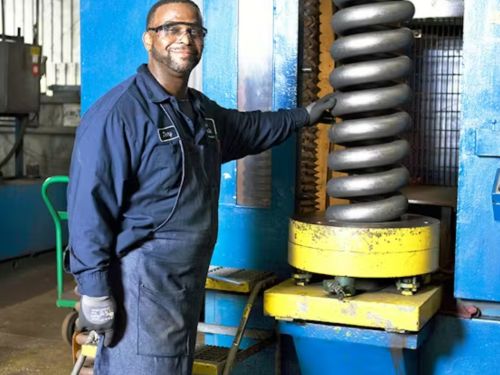
Springs are fundamental mechanical elements in industrial equipment that rely on controlled force and predictable motion. Manufacturing lines, fluid control systems, automation cells, and heavy machinery all depend on a consistent axial load response to function correctly. When spring performance shifts, safety margins narrow, and component alignment can degrade.
A compression spring plays a central role in maintaining calibrated force within these assemblies. If force output drops or varies unexpectedly, valves may leak, tooling may misalign, and actuators may fail to return to position. For this reason, engineers evaluate spring characteristics early in the design phase to protect reliability across demanding industrial duty cycles.
Force and Load Control
The springs generate force proportional to deflection within their elastic limits, creating a predictable load response. Engineers use this relationship to calculate force at specific installed heights with accuracy. In control valves, spring force maintains proper seating pressure against process loads, while actuators rely on defined rates for motion stability.
Clamping and fixturing systems depend on controlled preload to hold parts securely during machining. In stamping dies, heavy-duty springs regulate return force after forming operations. Careful stress calculations, including fatigue margins, prevent permanent set and maintain consistent force output over extended production runs.
Energy Storage and Shock Absorption
Industrial machinery is routinely exposed to impact and rapid load transitions. The springs absorb part of that energy through controlled deflection. This action reduces peak stresses transmitted to shafts, bearings, housings, and structural frames.
In automated handling systems, springs cushion end-of-stroke contact to prevent hard stops and structural damage. Heavy equipment linkages use spring elements to moderate repetitive shock during cyclic engagement. Conveyor assemblies rely on springs to dampen load spikes from uneven material flow. Fatigue analysis remains critical under repeated impact.
Preload Control and Assembly Stability
Many industrial assemblies require continuous contact between mating components. The springs provide preload that keeps interfaces engaged under vibration, pressure fluctuation, and temperature change. Without this preload, separation or micro movement can occur.
Electrical switchgear relies on spring force to maintain consistent conductive contact under load. Sealing systems depend on spring pressure to sustain gasket compression as materials relax. Fastener assemblies use spring elements to resist loosening during cyclic vibration, while engineers account for relaxation and creep at elevated temperatures.
Motion Return and Position Control
Controlled motion depends on a reliable return force. The springs restore components to defined positions once external actuation forces are removed. This function is critical in systems where consistent positioning affects accuracy or safety.
Spring return valves close automatically during power loss to protect process equipment. Industrial presses use springs to retract tooling elements after load release. Pneumatic cylinders integrate calibrated springs to maintain a home position when supply pressure drops. Proper rate selection balances response speed with fatigue life to prevent overstress.
Wear and Thermal Compensation
Mechanical systems change over time due to wear, tolerance variation, and temperature shifts. This type of spring accommodates these dimensional changes while maintaining preload and alignment stability.
Key compensation functions include:
- Maintaining gear mesh engagement as tooth wear progresses
- Preserving gasket sealing force during compression set
- Absorbing tolerance stack variation within assembled components
- Offsetting the dimensional shift caused by thermal expansion
- Sustaining preload in fastened joints under vibration
- Supporting contact pressure across sliding interfaces
Spring elasticity allows assemblies to remain stable even as components age or operating temperature fluctuates. A Compression spring performs several essential roles in industrial manufacturing systems. They regulate force, absorb shock, maintain contact stability, control return motion, and accommodate dimensional variation throughout service life. Their behavior directly affects equipment reliability, operational safety margins, and maintenance intervals. Early spring analysis, combined with proper stress evaluation and material selection, ensures consistent long-term performance.
About the Author