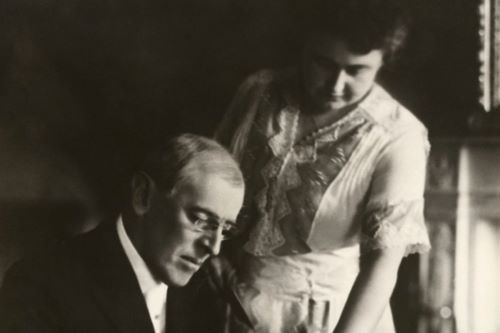
Edith Galt Wilson had to make a series of quick decisions about what the world.
By Richard Bluttal
Social Studies Consultant
It was a grueling period for both President Woodrow Wilson and his wife Edith. First, they convened with the world’s diplomats in Paris, then returned to the United States to launch a cross country trip of 8-10,000 miles to seek support for the League of Nations. They passed through scorching temperatures in the West, without any air conditioning. He complained of splitting headaches, at one stop experiencing blurred vision. She called for his doctor, and said that her husband’s face was twitching and he was gasping for breath, similar to an asthma attack. Cary T. Grayson, his doctor, drew up a series of mandates: “Complete rest, total isolation from his job, and no one should interfere with his health.” The Wilsons returned home.
On October 2, 1919, Edith Wilson went to check to see how her husband was doing. He said to her, “I have no feeling in my hand,” motioning to his left hand. Minutes later, after calling his doctor from downstairs, she heard a thump like a body falling from his bed. Running back upstairs, she found her husband unconscious and bleeding on the bathroom floor, having suffered a stroke.
How bad, in fact, was the President’s condition? In Woodrow Wilson: A Medical and Psychological Biography, Edith Weinstein writes
The symptoms indicate that Wilson suffered from an occlusion of the right middle cerebral artery, which resulted in a complete paralysis of the left side of the body, a loss of vision in the left half vision of both eyes, weakness of the muscles of the left side of his face, tongue and jaw and pharynx accounted for his inability to speak.
In layman’s terms, all additional physicians that were allowed to see him remarked, “He looked as if he was dead.”
Edith Galt Wilson had to make a series of quick decisions about what the world, let alone Woodrow’s administration and members of Congress, would learn of his health crisis. Her decision was very simple: nothing was to be said about the nature or severity of his condition. The cover up had begun, and would continue for nearly two years until the end of his administration. During this time, Edith Wilson could be said to have acted as the first woman President of the United States, albeit in a secretive arrangement that revealed the limits of the Constitution’s original treatment of presidential incapacity and still today shows the importance of public knowledge about presidential health.
Having advised Edith Wilson that the president himself should be kept unaware of the severity of his condition, Dr. Grayson was willing to conceal facts that might have led to Wilson’s replacement in office. He refused to sign a finding of disability, downplayed the severity of the stroke to the cabinet, and recommended against fully informing the public.
He also provided diagnoses that excused Wilson’s absence from the public without suggesting permanent disability. On October 3rd, the day after his collapse at home, Dr. Grayson issued a bulletin: “The President is a very sick man. Diagnosis is a nervous exhaustion.” In the remaining days and weeks, additional bulletins would provide reassurances that the president was recovering nicely.
If this lack of transparency about presidential health is shocking from our present perspective, we would also consider Wilson’s health history alarming for a prospective president. Historian Edwin A. Weinstein notes that Wilson had a history of cerebrovascular disorders dating back to 1896, sixteen years before he was elected president. Wilson was serving as an instructor at Princeton in 1896 when he suffered his first stroke. In 1913, Wilson suffered another stroke, only this time, it was his left arm that was affected. Weinstein writes:
The episode which affected Wilson’s left arm was particularly ominous from a clinical standpoint…. [It] not only increased the risk of future strokes, but also created the possibility that enduring changes of behavior, based on insufficient blood supply and impaired oxygenation of the brain, might eventually occur.
What few people also knew was that the President had kept his wife in the loop about all matters of state, including her sitting in on the League of Nations meetings. How, though, was she to govern? In her memoirs she states very clearly, “The only decision that was mine was what was important and what was not, and the very important decision of when to present matters to the President.”
In the mornings, Edith Wilson would get up and begin her “stewardship,” the word she used to refer to her relative takeover of the West Wing. She would attend meetings in place of her husband, and when information needed to be passed to him, she would insist that she be the one to do it. In the evenings, she would take all necessary paperwork back to the residence, where Woodrow was presumably waiting, and inform him of what he needed to know. The next morning, she would return the paperwork to its original owner, complete with new notes and suggestions. She would also vet the carefully crafted medical bulletins that were publicly released. Continually, she would say that the President needed bed rest and would be working from his bedroom suite.
If it seemed like an odd arrangement, the people closest to the matter didn’t comment on it. They lined up at Edith’s door day in and day out, waiting for the notes that she passed back and forth between them and their leader. They went no further than the first lady; if they had policy papers or pending decisions for him to review, edit or approve, she would first look over the material herself. If she deemed the matter pressing enough, she took the paperwork into her husband’s room where she would read all the necessary documents to him.
Perhaps the improbability of the arrangement, combined with the personal political interests of those involved, allowed the coverup to endure as a mutually self-serving fiction, despite growing doubts. While Edith maintained that she was simply a vessel for information and that all notes passed back to presidential staff were Woodrow Wilson’s own words, White House officials soon began to doubt the authenticity of the notes. For one, they had never seen the president himself write the words, and for another, they didn’t entirely trust the First Lady. William Hazelgrove, in his book Madam President: The Secret Presidency of Edith Wilson, goes further:
The issue of a presidential signature is a vexing one. Presidents must sign many documents and the operation of government can be held up for want of signature. But here was a man paralyzed on his left side going in and out of consciousness. Edith “helped” the president by “steadying his right hand in guiding his pen.”
The essence of Mrs. Wilson’s usurpation lay, therefore, in minimizing actual decision-making. She permitted only a handful of officials to see the president, and that only in the latter phase of his illness; and these audiences were often weirdly stage-managed in his darkened White House bedroom, usually in her inhibiting presence and that of Admiral Grayson. Many issues (e.g., the infamous “Red scare” raids of Attorney General Mitchell Palmer) were not brought to the president’s attention, and it is uncertain whether he had the capacity to act even if he could have focused on them. When it became absolutely necessary to indicate what Wilson thought about a pending question, Mrs. Wilson would occasionally issue in her own handwriting a kind of bulletin from the sickroom reading “the president says” thus and so — an unacceptable, yet accepted, substitute for real decision memoranda.
It was a bewildering way to run a government, but the officials waited in the West Sitting Room hallway. When she came back to them after conferring with the President, Mrs. Wilson turned over their paperwork, now riddled with indecipherable margin notes that she said were the president’s transcribed verbatim responses. To some the shaky handwriting looked less like that written by an invalid and more like that of his nervous caretaker.
She became the sole contact between the President and the cabinet. In fact, when Senator Albert Fall was sent by the Republicans to investigate the President’s true condition, Edith helped arrange Woodrow in bed so that he appeared presentable and alert. The President passed the test. The New York Times reported, perhaps creating rather than documenting reality, that “the meeting silenced for good the many wild and often unfriendly rumors of the President’s disability.”
Inevitably, the ruse wore thin. Secretary of State Robert Lansing, a man who was with Wilson in Europe and an important part of the negotiations over the League of Nations, was the first to raise the alarm that the president was in an incapacitated state. Lansing pressed Dr. Grayson about the reports that the president had fallen ill. Dr. Grayson lied to Lansing, telling the secretary of state that Wilson was only suffering from “a depleted nervous system” and that the president’s mind was “not only clear but very active.” However, Joseph Tumulty, Wilson’s private secretary and an antagonist of Edith Wilson, was more candid and suggested to Lansing that the president had suffered another stroke. Lansing immediately declared that Wilson should transfer presidential power to Vice President Thomas R. Marshall. Loyal to Wilson, both Tumulty and Dr. Grayson objected.
Robert Lansing ultimately called a cabinet meeting on October 6, 1919, something he was not supposed to do without President Wilson’s knowledge. It was an important meeting because no administration had had to address a situation when a president was alive but incapacitated. Increasingly aware of the dire state of the president’s health, the cabinet became aware of their lack of power to do anything about it. The United States Constitution’s only words for such a situation before the passage of the 25th Amendment in 1967 are found in Article II, Section 1, Clause 6. It states as follows:
In Case of the Removal of the President from Office, or of his Death, Resignation, or Inability to discharge the Powers and Duties of the said Office, the Same shall devolve on the Vice President, and the Congress may by law provide for the Case of Removal, Death, Resignation or Inability, both of the President and Vice President, declaring what Officer shall then act as President, and such Officer shall act accordingly, until the Disability be removed, or a President shall be elected.
Wilson was not dead, had not resigned, and was disputing, at least through a proxy, that he could not discharge the powers of the presidency. Vice President Marshall did not want to appear too eager to become president, so he declared he would not act unless Congress declared Wilson incapacitated.
The cabinet meeting on October 6th did little—could do little—to define or answer any Constitutional questions. Nothing was decided except to see how Wilson’s health progressed. Robert Lansing was compelled to resign the following year on February 20. His offense? He committed an “assumption of presidential authority” by calling the cabinet meeting without Wilson’s approval.
William Hazelgrove writes that
Edith Wilson’s presidency was short–less than two years–but it was groundbreaking. Woodrow Wilson after his stroke could not perform the duties of the presidency and Edith stepped in to fill the role. Edith’s guiding mandate as president was to keep her husband alive by taking over his job and restricting access to him. Edith’s presidency fits the constitutional definitions of the duties of president.
Indeed, beginning with the first constitutionally defined role of the president as commander-in-chief of the military, which she exercised by managing negotiations of the Treaty of Versailles and the push for the League of Nations, Edith Wilson could be reasonably said to have exercised 5 of the 6 defined duties of the presidency.
A paper trail of written communication gives us an indication that, by deferring to her cabinet officers, and tackling a handful of high priority issues, Mrs. Wilson managed to keep the ship of state afloat between October 1919 and March 1921. What rendered this possible was the institutional momentum of the executive branch. In the absence of direct guidance from the White House, officials filled the void with their own best judgment, and muddled through.
A few Republican critics of the president, such as Sen. Albert Fall (R-N.M.), railed against “petticoat government,” suggesting that there was some public familiarity with the idea that Edith Wilson was running the administration, but the President’s Democratic allies largely circled the wagons, ignoring his obvious impairment, while adversaries in his own party, including Vice President Thomas Marshall, remained conspicuously silent.
Unfortunately, in the absence of authoritative White House leadership, institutional forces could only keep the government machine well-oiled for so long. Eventually, Mrs. Wilson’s method of temporizing and triage proved inadequate. Wilson’s illness exacerbated his more negative qualities of stubbornness and his need to be right. He absolutely refused to compromise on the Versailles treaty to get it through Congress. Wilson was so far out of the loop due to his illness that he didn’t comprehend the extent of the opposition in the Senate and that the only way to get the treaty passed was with Henry Cabot Lodge’s reservations. Edith tried to convince him to change his mind. Because of his unwillingness, the Democrats didn’t have enough votes to ratify the treaty, and the United States ended up not joining the League of Nations.
Had Wilson resigned at the outset of his illness, and Vice President Marshall succeeded as President, or at least assumed the role until Wilson was better, a compromise might have been reached with Lodge, and the treaty might have passed. The United States could have joined the League of Nations and played an active role in the international peace organization in the years that, as it happened, ultimately led to World War II. If Edith had put the nation’s needs ahead of her husband, Wilson’s dream of America playing a significant role on the international stage would have come to fruition. As it was, his successor Warren Harding took America back to its isolationist stance.
Originally published by History News Network, 03.05.2023, republished with permission for educational, non-commercial purposes.
About the Author