

Just leave it to a group of fiercely determined women to make a name for themselves behind the wheels of the Motor Corps’ ambulances.
By Colleen Cheslak
Visitor Guide
Architect of the Capitol
As Sophia Petrillo of the Golden Girls repeatedly said, “Picture it”… it’s the turn of the 19th Century and the production of automobiles has, pun intended, revved up. It’s an age of technological innovation and Progressive reform, so quite naturally everywhere you turn are nail-biting debates about what is best for the future of the United States. One of such debates regarded the longstanding fight for women’s rights. Where did women belong? Did they belong behind the wheel of an automobile?
While only some women had access to automobiles in the early 1900s due to their costly price tag, there were those who advocated for their place in the driver’s seat. In regard to early electric cars, as opposed to gasoline-powered cars that required the use of a crank to start, writer C.H. Claudy believed that it was good for women to drive within “a circumscribed radius” as electric cars’ power supply could only take them so far. He saw the vehicle as a machine that allowed for women to pursue domestic chores, much in line with separate spheres ideology of his time that differentiated women’s place from men’s place in society. In 1907, he wrote, “What a delight it is to have a machine which she can run herself, with no loss of dignity, for making calls, for shopping, for a pleasure ride, for the paying back of some small social debt.” With something as freeing as an automobile, women’s early experiences with the machine were exemplified by limitations.
Even in 1908, Henry Ford demonstrated these limitations as he rolled his infamous Model T onto the American market but bought his wife, Clara, an electric car. Clara took to the wheel of her electric car to run errands around her town of Dearborn, Michigan. However, when trips took her beyond the confines of feminine errands, she would ride as a passenger with Henry or their son, Edsel, at the wheel. This was seen as the case for many other women of means as gasoline-powered cars required their engines be started by crank. Men cried out that the cranking of an automobile was “no job for a lady” as the task didn’t require a heavy degree of strength but could break one’s arm if he or she didn’t let go immediately and the car resultingly backfired. The task was not gender-specific as it simply required the driver to sense the correct position for holding the crank when hastening the speed of rotation.
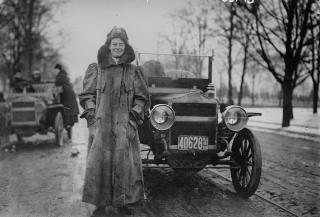
There were women who defied such circumscribed use of automobiles. In 1909, the young but determined Alice Ramsey made a cross-country trip in a 1909 Maxwell DA. The previous year, her husband had bought her a car and that summer she accumulated 6,000 miles of driving in and near her home of Hackensack, New Jersey. Setting off on a 200-mile trip to Montauk and back home, Ramsey was discovered by a representative of the Maxwell-Briscoe company who fashioned the idea for an all-expenses-paid cross-country trip to prove the reliability of Maxwell cars—so safe that it could take a woman across America! She embarked on the trip with three other women as traveling companions and kept a steady 42 mph pace but her trip was far from free of mishaps. Alice forgot to constantly check the fuel level and ran out of gas, imposing weather and muddy conditions didn’t suit the vehicle’s tread-less tires, and confusing directions that utilized landmarks created for an indirect, winding journey. Regardless, Ramsey and her companions completed the trip on August 7, 1909 after 59 days on the road.
As opportunities approached, women’s experiences with the automobile continued to accumulate. In 1916 the Girl Scouts of America even introduced the “Automobiling Badge.” The badge was to be awarded to young women who achieved skills in driving, auto mechanics, and first-aid. The requirements for this badge mirrored the requirements needed to serve in organized Motor Corps in the midst of World War I.
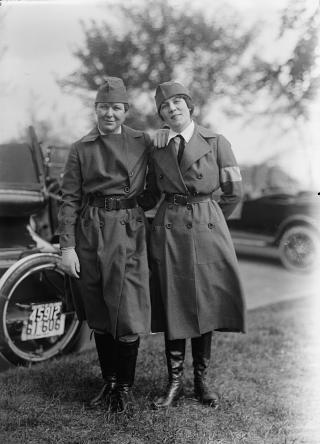
The Motor Corps was a creation of necessity as the National League for Woman’s Service (NLWS) realized that ambulance drivers were needed to transport patients, supplies, and personnel (often military and sometimes VIP guests). It was women of wealth and spare time that answered the call for drivers in early 1917. The requirements for active service within the corps were far beyond what working class women could afford as they lacked the time and expenses to acquire the necessary state chauffeur’s license and mechanic’s license. Other requirements called on volunteer drivers to take the oath of allegiance, pass a medical examination, receive a typhoid vaccine, and (at most times) own a car.
The initial drivers of the NLWS Motor Corps were in high demand, driving for a variety of organizations and events in order to support the war efforts. They were present at Liberty Loan drives, drove canned goods and other supplies for the National Council of Defense, transported garments and materials for the American Fund for French Wounded, and delivered supplies, patients, and personnel on behalf of the Red Cross. They also drove for the YMCA and the US Army. It wasn’t long until the NLWS Motor Corps was joined by the creation of the American Red Cross Women’s Motor Corps of the District of Columbia in February 1917.
This first group within the American Red Cross Women’s Motor Corps was headed by Florence J. Borden Harriman, a well-off socialite who advocated for better living conditions in New York City’s tenements as well as women’s suffrage. The group was formed at the request of Mabel Boardman, the long-time secretary of the American Red Cross (from 1904-1944). The National League’s Motor Corps and the Red Cross’s Motor Corps ran independently but often performed similar tasks that would bring them into contact with one another. Despite their similarities, the Red Cross Motor Corps emerged as the leading group.
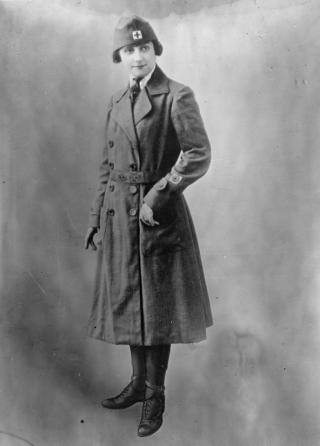
Within Harriman’s Red Cross forces, the high society women that served experienced new sensations of urgency and defiance of traditional gender stereotypes. Initial defiance can be traced to the uniform of the Red Cross Motor Corps. Harriman’s daughter, Ethel Harriman, who also served in the Motor Corps, designed the progressive look. The uniform included a “long gray coat and breeches, high boots, leather belt and a service cap.” The uniform’s design created for fiery debate. In her autobiography From Pinafores to Politics, the elder Harriman describes the reaction to the design:
“Some said their husbands would never, never let them wear such things. Some, who knew beforehand how beautifully they could wear the uniform, turned out quite incapable of driving a car. Once we got the coats and breeches made, they became so popular that the national motor service of the Red Cross followed the example of our Washington Corps and the breeches dispute became a lost cause.”
To create a more consistent look across the country, the Red Cross Motor Corps wanted to implement Ethel Harriman’s District of Columbia design nationwide. However, the controversy over the breeches rose again and even made newspaper headlines, such as “Hide ‘Em Under Short Skirts, Is Order of Red Cross to Fair Motor Drivers” in the Washington Post. Within this February 1918 article, the author quotes a Red Cross official: “Particular care will be taken in the establishment of safeguards to prevent anything that would reflect on the high character of the Red Cross and tend to bring humiliation to the body of the high-minded American young women who are enlisted in the work.” And so, the policy was decided: motor corps drivers had to hide their breeches under their skirts.
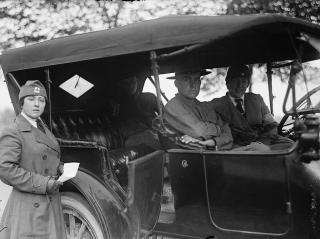
Despite disputes over wardrobe, service in Harriman’s Washington division of the Red Cross Motor Corps was popular and many signed up for job. Newspapers stated “More than Fifty Washingtonians sign for service with motor vehicle committee – many offer cars. Training as Mechanicians [Mechanics] is Now Proposed as Next Step.” Women in this group included M.F. Littrell, Florence Clarke, Wilhelmina Miller, Dorothy Moore Tremble, Isabel Weld Perkins Anderson, Juliette Williams Leiter, and Lelia Montague Gordon Barnett (pictured at right)—wife of the Marine Corps Commandant. Many of these women also offered to furnish automobiles.
Of these women, some were praised more highly than others:
“Miss Littrell is considered one of the best women drivers of automobiles in the city, and professes to be able to put on tires or do most any other repair work that might be entailed in caring for a machine. She is only 19 years old but has completed the Red Cross first-aid training course and holds a certificate.” (Florence Harriman)
Others, like Florence Clarke, spoke of the fierce patriotism that propelled them to join the Motor Corps:
“The women of the United States would do anything in their power to aid their country, should war occur, and I am simply trying to do my part. I could go anywhere that I might be called, and I would go willingly.”

Ambulance work was a busy and fulfilling experience as women were able to develop skills on a large scale as war time created for multiple calls daily, leading to labor that many society women were not accustomed to performing in their everyday life. As one may assume, the job required heavy lifting as patients and supplies would need to be loaded and unloaded from vehicles. First aid requirements were a must so that patients could receive the care needed until taken to the nearest hospital. Additionally, each driver was fully responsible for the upkeep of her vehicle, needing to rely upon herself to make necessary repairs—thereby displaying training in auto mechanics.
Despite the demands of the job, women continued to flock to the corps as representatives of the motor corps made compelling appeals for a significantly patriotic and exhilarating experience. Captain Clarinne Hunter Connolly, who had managed a group of motorists herself, appealed to the women of the nation’s capital as she was recorded in a newspaper saying, “Are you doing your bit in this war to help the cause of freedom? Be a uniformed worker in this struggle for liberty. Join the women’s ambulance corps.” She called ambulance work tiresome as there were “as many as fifteen calls a day!” and not enough drivers to meet demand. She furthermore plead to those with cars to use their vehicles while serving as members of the motor corps in the “great and noble work which the Red Cross is doing.” The corps grew to include 300 cities with 12,000 female drivers on call. These forces would prove vital in aiding the hundreds of thousands of victims suffering from the devastating Spanish influenza pandemic stateside between 1918 and 1919.
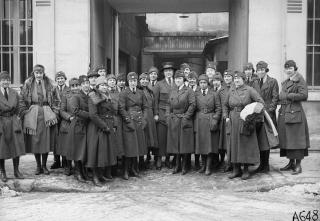
However, the work of the Red Cross Motor Corps was not contained to the United States. 300 women were recruited from the nationwide network of motor corps drivers to serve with the American Red Cross overseas beginning in October 1918. The requirements stated that prospects must be 25 years or older and hold a certificate as a Motor Corps ambulance or truck driver or pass an exam in mechanics and first aid. Transportation was provided by the Red Cross and drivers were given an allowance of 450 francs a month when working outside Paris but 600 francs while in Paris (where women were principally working). Standing as a strong guiding force from the get-go, Harriman continued in her leadership position as she ventured with the Red Cross Motor Corps overseas while Marion Hubbard Fairchild, daughter of the famed inventor Alexander Graham Bell, took over the corps stateside as a captain.
Harriman had just returned from an insightful trip to Europe in September of 1918 where she investigated the role that women played in ambulance, hospital, and general war work in England and France. Such investigation factored into her creation of the overseas forces serving with the Red Cross Motor Corps. With careful planning and the selective process for recruiting drivers, it was no surprise that the overseas corps exceeded expectations. The photograph to the left was described by the following caption written by a fellow Red Crosser:
“These are the noble women who did work which would tire any man, they managed, repaired and drove any kind of an automobile through the streets of Paris day and night during the war. In the inky nights of Paris, they plowed through the streets at all hours, never stopping. They were highly praised for their courage by all who had to do with them.”
Just leave it to a group of fiercely determined women to make a name for themselves behind the wheels of the Motor Corps’ ambulances, as they drove to the battlefront and shed layers of societal stereotypes that had previously confined them to a narrow sphere. Women of the Motor Corps didn’t take narrow confines for an answer as they persevered into the broad expanse of roadways, delivering care and comfort during the chaos of World War I.
Works Cited
- American Red Cross. “World War I and the American Red Cross.” Red Cross History.
- Browe, Amanda. “From the Archives: Women of the Motor Service,” American Red Cross: Red Cross Chat, March 13, 2014.
- “D.C. Motor Girls to Sail Next Week.” The Washington times (Washington, D.C.), Sept. 19, 1918. Chronicling America: Historic American Newspapers. Library of Congress.
- Harriman, Florence Jaffray, Carrie Chapman Catt, and National American Woman Suffrage Association Collection. From Pinafores to Politics. New York: Henry Holt and Company, 1923.
- Koestler Ruben, Marina. “Alice Ramsey’s Historic Cross-Country Drive.” Smithsonian.com, June 4, 2009.
- “Red Cross Appeals for Motor Corps Recruits.” Evening star (Washington, D.C.), May 16, 1918. Chronicling America: Historic American Newspapers. Library of Congress.
- “Society Leader Goes to France.” Los Angeles Times (1886-1922), Sep 9, 1918.
- Wachs, Martin. “The Automobile and Gender: An Historical Perspective.” University of California Berkley, 2000.
- “Women in Auto Corps.” The Washington Post (1877-1922), Feb 18, 1917.
- “Women Drivers Busy.” The Washington Post (1877-1922), Oct 6, 1918.
- “Want Women Chauffeurs.” The Washington Post (1877-1922), Aug 19, 1918.
Originally published by the National Women’s History Museum, 10.19.2018, republished with permission for educational, non-commercial purposes.
About the Author