What might our first words have been?

By Dan Falk
Science Journalist
According to Guinness World Records, the world’s fastest talker is one Sean Shannon, capable of unleashing a staggering 665 English words per minute (that’s 11 words per second). But even those of us with average tongues seem to chatter incessantly. (Usually with our fellow humans, but we carry on even when they’re not around: When Tom Hanks’ character is stuck on an uninhabited island for four years in the 2000 film “Cast Away,” he talks not only to himself but also to a volleyball.)
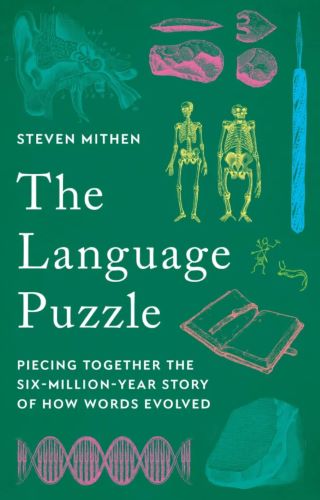
There’s no question that we love to talk — but how did it happen? Yes, humpback whales sing, vervet monkeys use alarm calls, and bees convey information about food sources through dance, but only humans have full-blown language. Steven Mithen, a professor of early prehistory at the University of Reading, would seem to be well positioned to find the answer. His new book, “The Language Puzzle: Piecing Together the Six-Million-Year Story of How Words Evolved,” is hardly the first to explore the issue — but it is perhaps the most thorough to date. Drawing on the latest findings from an array of fields, including linguistics, archaeology, anthropology, psychology, and genetics, Mithen guides the reader through some 1.6 million years of hominin evolution, from language’s earliest stirrings to the rich communication system it became for Homo sapiens.
Many elements from this timeline are difficult if not impossible to pin down; after all, words do not fossilize, and we only started writing things down around 5,000 years ago — after our species had been communicating verbally for several hundred thousand years. (Mithen puts the dawn of what he calls “fully modern language” at about 40,000 years ago.)
Still, there are some numbers we can guess at with a measure of confidence. For example, since no other species — not even our closest living relatives, chimpanzees — uses a sophisticated form of language comparable to that of humans, it’s reasonable to presume that whatever triggered the rise of linguistic capability in our own lineage must have happened after humans and chimps diverged, around 6 million years ago.
A comparison with chimps and other apes is useful, and Mithen devotes a full chapter to the subject. Chimps certainly vocalize, but Mithen says the sounds they make are not words (though he allows that they have “word-like qualities”). While there are distinct anatomical differences between humans and chimps that hamper the latter’s ability to produce nuanced speech, Mithen notes that the fundamental obstacle to chimp language is cognitive.
For starters, there’s little evidence that chimps think about what other chimps are thinking — psychologists refer to this as having “theory of mind” (a skill that human children develop by around age 4). Confronted with this limitation, chimps never developed the linguistic abilities that would allow them to plan cooperative activities, to work toward collective goals the way humans do. At some point, our own ancestors did make this leap — and the repercussions were enormous.
As an example, Mithen asks us to consider the cognitive abilities needed to coordinate a group hunt. To talk about chasing and killing an antelope, he writes, at the very least you would need to have some way to refer to an antelope even when no antelopes are within sight. (Mithen calls this skill “displacement” — the ability to talk about things not in one’s immediate view, which is essential for describing the future and the past.) We have that ability; earlier hominins may have had it to a more modest degree. Chimps do not have it. Even so, Mithen suggests it may just be a “small cognitive shift” that separates a chimp’s abilities from our own.
What might our first words have been? Mithen highlights the difference between “arbitrary” and “iconic” words: The former are more common; they’re words whose sound has no connection to the thing they stand for. (For example, there’s no connection between the English word “dog” and an actual dog, nor is there such a connection in any other language.) In contrast, iconic words (also known as sound-symbolic words) do carry a connection to the thing they represent. Onomatopoeias are the best-known examples — think of “bang” or “quack” — but an iconic word might also point to its target via the latter’s sound, size, shape, movement, or texture. Mithen believes that iconic words played a key role in the evolution of language, bridging the “barks and grunts” of our chimpanzee-like ancestors with modern language.
While comparisons between humans and chimps are intriguing, the linguistic differences between us and our fellow hominins — especially the recent ones — are even more interesting. In some parts of the Europe and Western Asia, Homo sapiens and their close cousins, the Neanderthals, shared the same environment and even interbred. But, even though the Neanderthals’ reputation has received something of a boost in recent years, Mithen stresses that they were not our equals. For one thing, they appear to have hardly innovated at all: He points out that while human tool use changed significantly over time, Neanderthals continued to use the same kinds of stone tools for some 300,000 years.
How much of this disparity comes down to the presence or absence of language? Mithen suggests that, while Neanderthals could perhaps discuss the here-and-now, they had little or no capacity for abstraction. They probably lacked metaphor. In contrast, early human language was much more fluid. Our ancestors could compare A to B even if no examples of either were within sight. We could talk about ideas just as easily as objects.
Mithen is deeply curious about the degree to which early human speech may have differed from that of the Neanderthals. Today we habitually compare things to other things; we describe space in terms of time (“the store is five minutes away”) and time in terms of space (“a 30-minute layover is too close for comfort”). Imagining how our ancestors made the first forays into this kind of language use, Mithen paints the following picture: “With cognitive fluidity, a Homo sapiens mother could describe her daughter as being as brave as a lion, while believing that lions had human-like thoughts and desires; time could be described as space; and space by words derived from the human body.”
While the ability to master metaphorical language has obvious uses, Mithen points to another development that may have come about at around the same time, whose connection to metaphor may be less than obvious: humor. “Puns, double entendres and innuendos, all reliant on metaphor and the verbal fluency of the modern mind, now pervaded language,” he writes. “These gave modern humans a joy of words that remained absent among the domain-specific Neanderthals. Homo sapiens laughed their way into modernity.”
Many questions lurk in the background. Does the way we talk influence the way we think? Or might language be an essential ingredient of consciousness itself? Mithen speculates on a possible connection between our inner voice and consciousness, but does so cautiously. “Our silently spoken words might bring our concepts to consciousness, such that inner speech itself can be considered a type of thought,” he writes — but he also notes that most of the thinking that we do occurs wordlessly.
Readers who regularly devour these sorts of books will find many familiar elements. In some sense, “The Language Puzzle” is a history of Homo sapiens, so there’s inevitably some overlap with species-explaining books like Yuval Noah Harari’s bestseller Sapiens or Leonard Mlodinow’s The Upright Thinkers. But a story so vital can bear more than one telling, and Mithen’s laser-like focus on the issue of communication and language sets his story apart.
There are plenty of surprises along the way, especially in the details. For example, Mithen points out that, in English, there’s a whole set of words relating to “unhurried movement” that are similar to one another, all of them starting with “sl” – he points to slow, slide, slur, slouch, and slime. In each case, he writes, “the movement of the tongue over the palette to make sl- captures the essense of those words — we can only describe the tongue as moving slowly and sliding.”
As our species developed its language skills, “we became entirely dependent on words for every aspect of our lives,” Mithen writes. “To maintain such dependency, evolution not only gave us the joy of words but made language the life force of being human.” Mithen’s book is engaging, detailed, and incredibly thorough — and brings a fresh and welcome perspective to a longstanding puzzle.
Originally published by Undark Magazine, 08.02.2024, republished with permission for educational, non-commercial purposes.
About the Author