His ideas altered the education of children worldwide.

By Dr. Peter Gibbon
Senior Research Scholar
Boston University
“I believe that education is the fundamental method of social progress and reform.”
John Dewey
“He was loved, honored, vilified, and mocked as perhaps no other major philosopher in American history.”
Larry Hickman
In July 1894, a train carrying a young philosopher from Ann Arbor, Michigan, pulled into Chicago Union Station. Its arrival was delayed by striking workers of the American Railway Union, who were made furious by the Pullman Company’s decision to cut their wages. The strike ended two weeks later, took the lives of thirty people, and symbolized a rapidly changing America dominated by corporations that set laborers against owners.
The philosopher had entered a city whose population was exploding with immigrants, many of whom were illiterate; a city of half-built skyscrapers and noisome meatpacking plants; a city with a new university funded by John D. Rockefeller, the University of Chicago, whose Gothic buildings and eminent faculty would rival those of Harvard and Yale. John Dewey had arrived to chair the philosophy and pedagogy department. Once in the city, he visited the strikers, applauded their “fanatic sincerity and earnestness,” praised their leader Eugene Debs, and condemned President Cleveland’s suppression of the strike. Worried about working for a university dedicated to laissez-faire capitalism, Dewey found himself becoming more of a populist, more of a socialist, more sympathetic to the settlement house pioneered by Jane Addams, and more skeptical of his childhood Christianity. He would conclude that a changing America needed different schools.
In 1899, Dewey published the pamphlet that made him famous, The School and Society, and promulgated many key precepts of later education reforms. Dewey insisted that the old model of schooling—students sitting in rows, memorizing and reciting—was antiquated. Students should be active, not passive. They required compelling and relevant projects, not lectures. Students should become problem solvers. Interest, not fear, should be used to motivate them. They should cooperate, not compete.

The key to the new education was “manual training.” Before the factory system and the growth of cities, children handled animals, crops, and tools. They were educated by nature “with real things and materials.” Dewey lamented the disappearance of the idyllic village and the departure of children’s modesty, reverence, and implicit obedience. He was, however, no reactionary: “It is radical conditions which have changed, and only an equally radical change in education suffices.” Urban children needed to sew, cook, and work with metal and wood. Manual training should not, however, be mere vocational education or a substitute for the farm. It should be scientific and experimental, an introduction to civilization.
“You can concentrate the history of all mankind into the evolution of flax, cotton, and wool fibers into clothing,” asserted Dewey. He described a class where students handled wool and cotton. As they discovered how hard it was to separate seeds from cotton, they came to understand why their ancestors wore woolen clothing. Working in groups to make models of the spinning jenny and the power loom, they learned cooperation. Together they understood the role of water and steam, analyzed the textile mills of Lowell, and studied the distribution of the finished cloth and its impact on everyday life. They learned science, geography, and physics without textbooks or lectures. Learning by doing replaced learning by listening.
Manual training revolved around the study of occupations to develop both the hand and the intellect. To know and to do were equally valuable. Cooperative learning encouraged a democratic classroom, which promoted a democratic society without elites, ethnic divisions, or economic inequality. Throughout his life, Dewey believed that humans were social beings inclined to be cooperative, not selfish individuals predisposed to conflict. Always he praised democracy as a way of life and scientific intelligence as the key to reform.
America in 1900 was preoccupied with the clash between capital and labor, debating how to make the worker more than an appendage to the machine. To science, geography, and physics, Dewey added another advantage: meaning. While the typical student did not go on to high school or attend college, manual training conducted by a skilled teacher could stimulate the imagination, enlarge the sympathies, and acquaint young people with scientific intelligence. Dewey was outraged that “thousands of young ones . . . are practically ruined . . . in the Chicago schools every year.” His new education sought to encourage students to continue in school and combat the increase in juvenile delinquency. It looked to produce an inquiring student who could change America.
Running through The School and Society is a suspicion of the intellectual who wants to monopolize knowledge and keep it abstract. Dewey opposed the academic curriculum revolving around classical languages and high culture, which he believed suited an aristocracy, not a democracy. “The simple facts of the case are that in the great majority of human beings,” he wrote, “the distinctively intellectual interest is not dominant. They have the so-called practical impulse and disposition.” With more and more Americans enrolled in schools, educators had to acknowledge this fact. Learning had to be democratized and made relevant and practical. “The school must represent present life.”

Who was this philosopher who believed that children are curious and good, who would introduce them to civilization through wool and cotton, who would create cooperative classrooms that would end divisions between managers and workers and democratize America? Dewey lived from the Civil War to the Cold War, wrote 37 books, and published 766 articles in 151 journals. In his lifetime, he was hailed as America’s preeminent philosopher. Historian Henry Steele Commager called him “the guide, the mentor, and the conscience of the American people.” In China, he was called a “second Confucius.”
John Dewey grew up in Burlington, Vermont, the son of a pious, high-minded mother and a well-read grocer father. Shy and withdrawn, the young Dewey read voraciously and graduated from the University of Vermont. Uncertain about a career, he moved to Oil City, Pennsylvania, to teach Latin and algebra at the local high school. An average teacher but an ambitious intellectual, he decided to become a philosopher and fought to gain admission to Johns Hopkins University, which was dedicated to original research. He graduated with a PhD in philosophy. The president of Johns Hopkins, Daniel Coit Gilman, encouraged Dewey to accept an offer to teach at the University of Michigan in Ann Arbor but suggested that he curtail his “reclusive and bookish habits.”
At Michigan, a newly confident Dewey published a psychology textbook and fell in love with one of his students, Alice Chipman (later described by their daughter as a woman “with a brilliant mind which cut through sham and pretense”). Influenced by Alice, Dewey paid more attention to social problems. They started a family and, observing his children, he applied his psychological insights to their upbringing, becoming increasingly more interested in education, so that his children might escape what he felt were the shortcomings of the schools he attended as a child.
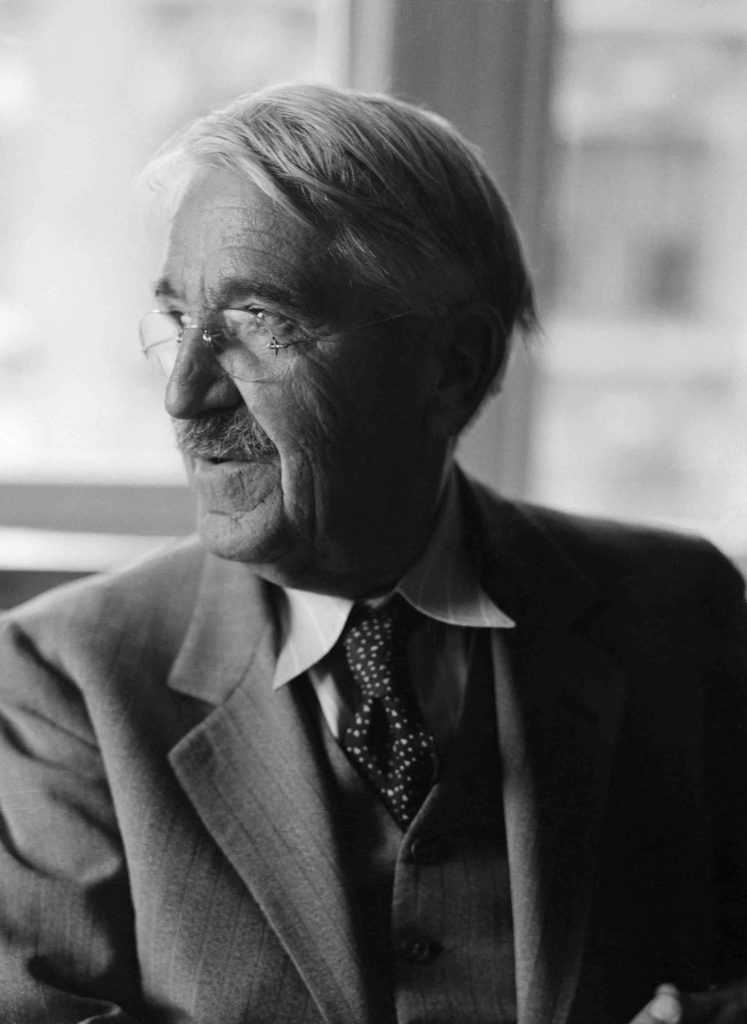
One of his students in Michigan described Dewey as “a tall, dark, thin young man with long black hair, and a soft, penetrating eye, and looks like a cross between a Nihilist and a poet.” A colleague at Michigan found him “simple, modest, utterly devoid of any affectation or self-consciousness, and makes many friends and no enemies.” Later associates would corroborate this positive portrait, stressing Dewey’s ability to accept criticism, his willingness to give credit to others, and his intellectual and physical vigor. After a lunch (hosted by T. S. Eliot) in Cambridge, Massachusetts, Bertrand Russell praised Dewey: “To my surprise I liked him very much. He has a large slow-moving mind, very empirical and candid . . . [he] impressed me very greatly, both as a philosopher and as a lovable man.” Self-effacing but not introspective, Dewey spoke little about himself, writing neither memoirs nor an autobiography.
Dewey, who seemed to fit the model of the quintessential reserved New Englander, was surprisingly complex. Arriving in Chicago during the strike, he mused, “I am something of an anarchist.” Slightly bohemian, he encouraged his children to go barefoot even in winter, and he and his wife walked naked around the house. He socialized with radicals in Greenwich Village. To understand prostitution, he visited Chicago’s brothels. He wrote passionate love letters to his wife and rhapsodized over the endearing qualities of his children. Once reclusive, he happily worked on philosophic tracts as his children crawled around his desk. His friend Max Eastman noted, “Dewey is at his best with one child climbing up his pants leg and another fishing in his inkwell.” At the age of 58, he had a brief romance (possibly platonic) with Anzia Wezierska, who wrote novels and short stories about the immigrant experience. He wrote poems to her and for himself about the anxiety of philosophizing, poems without literary flair that he never expected would be published.

Away from his family, Dewey could slip into melancholy. In 1894, he wrote to Alice, “I think yesterday was the bluest day I have ever spent.” He was twice visited by catastrophe. While vacationing in Italy in the fall of 1894, his youngest son, Morris, died of diphtheria at age two and a half, a loss from which he and Alice never fully recovered. Ten years later, during his second European trip, his eight-year-old son, Gordon, contracted typhoid fever and died in Ireland. “I shall never understand why he was taken from the world,” wrote Dewey.
Dewey marched in a suffragette parade and campaigned for women’s right to vote. He celebrated as his mentors Ella Flagg Young, the superintendent of Chicago Public Schools, and Jane Addams, the founder of Hull House. He rejected his mother’s query, “Are you right with Jesus?,” but sprinkled his essay “My Pedagogic Creed” with religious imagery. Who were Dewey’s heroes? Thomas Jefferson and Walt Whitman, the apostles of democracy; William James, the founder of pragmatism; and Eugene Debs, the champion of radical reform.
Suspicious of capitalism, this philosopher, the father of six children, had to deal with money. He demanded raises from college presidents, taught extra classes, and moved from apartment to apartment nine times between 1905 and 1914 in a gentrified New York. A workaholic, he pounded away at his typewriter and stopped reading for six months because of eyestrain.
Why were students drawn to Dewey? He was not a mesmerizing lecturer, sitting at a table in front of the class with a single piece of paper and thinking aloud. Irving Edman (who became a philosopher) was initially repelled by this method, but looking over his notes, he soon realized “what had seemed so rambling . . . was of extraordinary coherence, texture and brilliance.” Dewey’s former student and later colleague, the philosopher J. H. Randall Jr., described a man who was “simple, sturdy, unpretentious, quizzical, shrewd, devoted, fearless, genuine.” Dewey had, according to biographer Jay Martin, “a general spiritedness and joviality . . . that attracted people of all ages, genders and races.”

After leaving Ann Arbor and following his dramatic entrance into Chicago during the Pullman Strike, Dewey spent ten years at the University of Chicago, becoming more radical and more famous. Before he published his groundbreaking essay, Dewey had to test his half-formed ideas in a real school, thus he and his wife ran the Lab School at the University of Chicago from 1894 to 1905. Classes were small and select. Dewey drew on the expertise of Chicago’s professors to create age-appropriate curriculums, stressing discovery and cooperation and the talents of creative teachers to implement it. The Dewey school was distinctly middle class, with motivated students and supportive parents.
Visitors came from all over America and Dewey’s vision spread, so much so that he and his daughter Evelyn co-authored the 1915 book Schools of Tomorrow, a celebration of progressive pedagogy, complete with 27 photographs of children at work and play. In these schools, students visited fire stations, post offices, and city halls. They grew their own gardens, cooked, cobbled shoes, and tutored younger students. They staged plays dramatizing historical events. Pretending to be the heroes of the Trojan War, they held battles at recess with wooden swords and barrel-cover shields. Reading, writing, spelling, and calculating would be acquired naturally in conjunction with projects: “Studying alone out of a book is an isolated and unsocial performance,” the Deweys reminded readers of Schools of Tomorrow. The schools portrayed were chiefly elementary, and it is important to remember that Dewey’s reforms were rarely extended to rapidly growing high schools and less tractable adolescents.

Following a long-simmering conflict with University of Chicago President William Rainey Harper, Dewey—now prominent—moved to Columbia University in 1905. He remained there until 1930, teaching, lecturing in schools and community centers, traveling abroad to advise foreign educators, and writing articles for learned journals and popular magazines like the New Republic. Dewey believed that a philosopher should not only reflect but also act, both to improve society and to participate in “the living struggles and issues of his age.” His tools: reason, science, pragmatism. His goal: democracy, not only in politics and the economy but also as an ethical ideal, as a way of life.
As an activist and public intellectual, Dewey made a stunning series of contributions. He founded the American Association of University Professors and helped organize the New York City Teachers Union. He supported efforts that led to the founding of the National Association for the Advancement of Colored People and the American Civil Liberties Union. He worked in settlement houses to help assimilate immigrants, spoke out against the execution of Sacco and Vanzetti, defended Bertrand Russell when Russell’s morals were questioned, and sided with historian Harold Rugg when Rugg’s books were censored. In response to feelings of guilt he harbored about his support for World War I, Dewey led a crusade that culminated in the 1928 Kellogg-Briand Pact, an influential though controversial treaty outlawing war.
During the 1920s, Dewey’s influence became international. He traveled with Alice to Japan in 1919, where he criticized the emperor cult, and lived in China for more than two years, giving two hundred lectures. The Chinese called him “Mr. Democracy” and “Mr. Science.” His books have been translated into Mandarin, and scholars at the Center for Dewey Studies at Southern Illinois University remind me that his emphasis on discovery and ethics has influenced contemporary Chinese educators trying to encourage creativity and virtue in students. Dewey went on to travel to Turkey, South Africa, and Mexico, advising governments on how to improve their educational systems. Today, in eleven countries, ranging from Italy to Argentina, that traditionally educate their students with lectures, memorization, and exams, there are Dewey centers that look to humanize education and consider the wider aspects of his philosophy.
John Dewey’s seventieth birthday on October 20, 1929, just before the stock market crash, became a national event. He had received numerous honorary degrees, declarations from foreign nations, and a portrait bust by the famous sculptor Jacob Epstein. From all over the world came telegrams, including tributes from Supreme Court Justices Oliver Wendell Holmes and Felix Frankfurter. Twenty-five hundred notables crowded into the Astor Hotel’s Grand Ballroom to hear Dewey compared to Ben Franklin and praised by historian James Harvey Robinson as “the chief spokesman of our age and the chief thinker of our days.”

Not all Americans praised John Dewey. From his days at the Experimental School in Chicago until his death in 1952, he was the object of sharp criticism. Some parents in Chicago claimed that after a morning of chaotic play in the Dewey school, they had to teach their children how to read and write. Immigrants in New York City violently protested against manual training in 1915. They wanted a classical education so that their children could go to college and become professionals. Theologian Reinhold Niebuhr found Dewey’s view of human nature too optimistic, his view of society utopian.
The controversy surrounding Dewey continued after his death. “The 1950s was a horrible decade for progressive educators,” notes educational historian Diane Ravitch. In Educational Wastelands: The Retreat from Learning in Our Public Schools (1953), Arthur Bestor mocked the fad of “life adjustment” and called for a return of the “academic curriculum.” Admiral Hiram Rickover, the father of the nuclear-powered submarine, attributed Russia’s achievement with Sputnik to Dewey and his followers. In Life magazine, President Eisenhower blamed America’s educational failings on “John Dewey’s teachings.”
The controversy continues today. Analytic philosophers have little use for a sage who was not interested in arcane disputes over language. The champion of cultural literacy, E. D. Hirsch, insists that the education-school professors who lionize Dewey instruct future teachers to eschew facts, completion, testing, and lectures. In 2011, Human Events, a conservative weekly, listed Democracy and Education among the most dangerous books published in the past two hundred years.
Perhaps Dewey’s greatest liability was his style. Concerning clarity, the nineteenth-century philosopher Herbert Spencer once wrote: “To so present ideas that they may be apprehended with the least possible effort.” Dewey read Spencer but did not follow this advice. The editor of the New Republic regularly rewrote Dewey’s submissions. Defenders detect profundity beneath obscurity and argue that Dewey deliberately adopted an antirhetorical writing style. Critics demand clarity and example, maybe some rhythm and grace—missing in a philosopher who had no ear for music. I have met many contemporary teachers who have heard of John Dewey. I have not met one who has read his works, except reluctantly.
Of course, any philosopher who becomes famous can expect critiques and may become attractive to followers who will distort his or her message. The distortion will be magnified when the philosopher writes a lot, especially in an abstract and imprecise style. As a result, sweet-tempered John Dewey, who welcomed dialog and experimentation, is blamed for any change that opponents can label “progressive”: open classrooms, cooperative learning, life adjustment, language reading, the attacks on Latin and canonical books, the slighting of the gifted and talented, declining test scores. The assaults can be expanded to include social ills as well as educational shortcomings: communism, creeping socialism, juvenile delinquency, declining patriotism, a weakened military, and a less productive economy. Both Catholics and Communists reviled Dewey.
Patiently, Dewey defended himself. He reminded his educational disciples that students should not be allowed to do whatever they please, that planning and organization must accompany freedom, and that teachers should be guides as well as subject matter experts. While many forms of progressive education were spreading in America, he insisted in his 1938 book, Experience and Education, that education should not be without direction.
What are we to make of John Dewey? His FBI file mentioned his carelessly combed gray hair, disheveled attire, and monotonous drawl. They might have added that he was agnostic in religion and radical in politics. He was a good husband and father and a generous colleague. Optimistic, hard-working, idealistic, he rejected the Lost Generation’s cynicism and Sigmund Freud’s pessimism and preoccupation with the unconscious. Biographer Alan Ryan notes, “He was uninterested in either his own or other people’s private miseries.” He did not comment on sexuality, the obsession of contemporary America. Unlike evolutionary psychologists, he believed nurture was more powerful than nature. He overcame a natural timidity to become a giant in the world of philosophy and insisted on a new role for the philosopher, combining contemplation with action.
The words authority, discipline, deferred gratification, tradition, hierarchy, and order, were not part of his vocabulary. He favored community, equality, activity, freedom. He had no use for McGuffey Readers, designed to instill character, patriotism, and love of God. He criticized the Gilded Age, the Roaring Twenties, and the New Deal. He believed in unions, strikes, government planning, and redistribution of income. Opposed to laissez-faire capitalism, he was convinced that leaders were more dangerous than the masses.
Rejecting the specialization of contemporary philosophers, Dewey tackled logic, ethics, aesthetics, and epistemology. He commented on war and peace, labor unions, and capitalists. Above all, he transformed schools, connecting students to real life, encouraging them to become critical thinkers and idealists.

What is Dewey’s legacy? President Lyndon Johnson (once a teacher) extolled “Dr. Johnny” and connected Dewey’s ideas to the Great Society. Southern Illinois University has created a center for Dewey studies and published 37 volumes of his writings as well as twenty-four thousand pieces of his correspondence. The former editor, Larry Hickman, tells me there has been a revival of interest in Dewey after years of neglect. He argues that Dewey’s pluralism encourages “global citizenship.” He notes that after World War II, Japanese educators turned to Dewey and adds that he has a following among millions of Japanese Buddhists.
There is a John Dewey Society in America and John Dewey Study Centers around the world. Deborah Meier, the only elementary school teacher ever to receive a MacArthur “Genius” award, repeatedly cites Dewey’s influence on her democratic, project- and community-based schools. The Coalition for Essential Schools, whose slogan is “less is more,” is based on Dewey progressivism. Left-leaning public intellectuals and professors Cornel West and Noam Chomsky champion Dewey as an enemy of elites and founder of participatory democracy. The late Richard Rorty, an iconoclastic and controversial but prominent philosopher, rediscovered Dewey in the 1980s and praised Dewey’s pragmatism, political engagement, and vision for a democratic utopia (which Rorty says will never happen).
Echoing Dewey’s conclusion in “My Pedagogic Creed,” many contemporary psychologists insist that human beings are wired to be social, craving group activity and connections. In addition to evidence from brain imaging unavailable in Dewey’s time, they cite the ubiquity of iPhones and the power of Facebook. Communitarians who feel America’s celebration of individualism has gone too far quote Dewey.
“Ah, but a man’s reach should exceed his grasp,” advised Robert Browning, Dewey’s favorite poet. Dewey was a radical reformer, a socialist, a secular humanist, a meliorist, even a utopian. He dreamed of an America without sexism or racism or ethnic divisions, a community that respected capitalists as well ascraftspeople and that cultivated both science and art. His dense, turgid philosophical tracts are now of interest primarily to academicians; his more readable journalism remains of use to historians; his educational writings prove the most influential.
Contemporary Americans have opted for testing, standards, competition, choice, and academic curriculums. Education reports emphasize national security, jobs, and the achievement gap, not discovery, manual training, or community. Deliberately antiprogressive charter schools, such as the KIPP Schools and Success Academies, try to overcome the achievement gap and end poverty by content, competition, and discipline. They stress grit, not joy. Teachers, denied the status Dewey thought so important, still stand in front of the class and talk. Progressive schools are few and seem most effective in small schools staffed by “true believers.”
Still, glimmers of Dewey’s dream remain. In the New Haven middle school of my thirteen-year-old grandson, the social studies teacher started the year by asking, “Why study history?” The mathematics teacher showed the movie Stand and Deliver. The language arts teacher asked each student to share with the class their thoughts about their individually selected summer reading book. My grandson chose a trilogy, The Hunger Games, not in the canon. The science teacher asked them to construct a model bridge out of one piece of paper and Scotch tape. To build community, the principal suspended classes, led the students outside, and asked each to start a conversation with someone he or she had not talked to before that morning.
Today most K–12 teachers still believe in content, competition, evaluation, and discipline. Simultaneously, they believe in relevance, projects, group learning, and choice. The Common Core Standards, approved by most states, stress rigor but at the same time emphasize inquiry and understanding. John Dewey would be moderately pleased with a pragmatic nation that combines traditional education with the insights of progressives.
Originally published to the public domain by Humanities, the Magazine of the NEH 40:2 (Spring 2019).
About the Author