
By Dr. Samuel Perry
Associate Professor
Baylor University
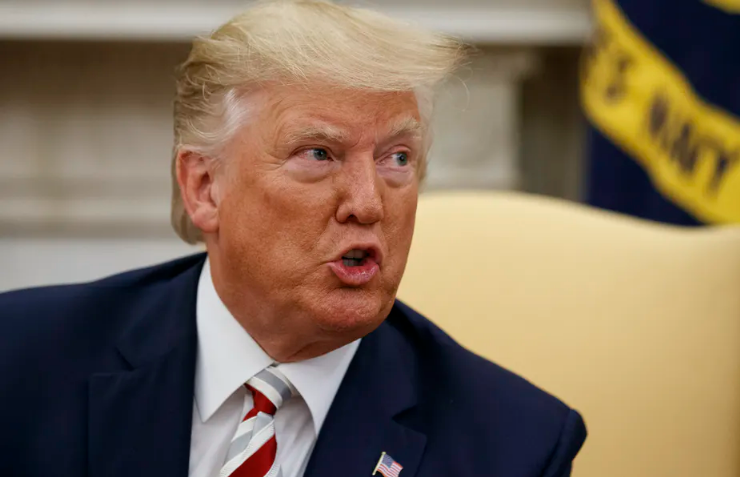
President Donald Trump sees many conspiracies around him.
He has described investigations into both Russia’s interference in the U.S. election and alleged violations of campaign finance laws, as well as the entirety of his impeachment, as “witch hunts” and a “hoax.”
He is not the only one seeing sinister forces at play. Some of his supporters do the same. A number of books on conspiracy theories chronicle alleged failed “deep state” attempts to take down Trump.
Even Trump’s COVID-19 diagnosis and hospital stay spawned a range of conspiracy theories, with some conservative sources suggesting Republicans were infected deliberately.
In my recent book, “Rhetoric, Race, and Religion on the Christian Right,” I examined conspiratorial themes and rhetoric of some of the leaders of the Christian right during the Obama administration.
I argue that the rhetoric of conspiracy, now used by Trump, was foundational for many prominent figures of the Christian right.
The Christian right and conspiracy
In the late 1970s and 1980s, evangelical leaders such as Jerry Falwell Sr., Billy Graham and others resisted social and cultural changes such as racial integration of schools. For some, social and cultural changes were signs of a fallen country.
As religious historian Randall Balmer explains, some conservative evangelicals and fundamentalists began to coalesce around resistance to desegregation in the mid-1970s. Conspiracy theories circulated in some conservative political spheres concerning civil rights protests.
These conspiracy theorists suggested that the student protesters in the civil rights movement were outside agitators. Others suggested that Martin Luther King Jr. and student protesters and organizers were in league with international Communist organizations.
Then in the late 1970s, Republican political strategist Paul Weyrich brought disparate religious factions and conservative politicians together and named them the Moral Majority.
Weyrich and his companions saw Christianity as under attack and suggested that America had fallen away from its values. In 1980 Falwell Sr. argued, “What’s happened to America is that the wicked are bearing rule. We have to lead the nation back to the moral stance that made America great.”
Falwell saw the nation as fallen and secular forces as the enemy of Christianity. Theological and political differences, rather than differences of approach or argument, were figured as a battle for America’s soul. Popular religious figures like Francis Schaeffer, a Presbyterian minister, framed the survival of Western culture as a battle between secular humanism and Christianity.
In explaining his father’s place as a foundational figure on the Christian right, Francis Schaeffer Jr. argued, “For the first time in American history, what you’ve got coming out of the ‘70s and evangelical subculture is a world that looks at its own country as the enemy to be feared.”
This new brand of evangelicalism grew quickly. According to sociologist Sara Diamond, 20 to 40 million Americans identified as evangelical by 1989. Exact numbers of evangelicals are hard to pinpoint, because the term encompasses a wide range of denominations.
Frank Newport, editor-in-chief of the Gallup Poll explained it this way: “the term has been associated with a particular group of Christians who hold conservative and generally Republican ideological and political beliefs.” According to a Gallup poll aggregating data from 1991 to 2018 about 40% of Americans identified as evangelicals or born-again Christians. The number has remained steady for the past three decades.
To clarify, not all evangelicals are conservative. But a defining feature of the Christian Right is political involvement. While younger evangelicals are less politically committed, older evangelicals associated with the Christian right remain deeply politically committed.
A Pew Research Poll shows that 79% of white Protestant evangelicals voted Republican in the 2012 presidential. Exit polls show about 80% of white evangelicals voted for Trump in 2016.
Christian values and conspiracy
Some Christian right leaders have named groups they held responsible for the fallen nature of America. Tim LaHaye, a political organizer and co-author of a series of best-selling Christian books, “Left Behind,” claimed that a group called the “Illuminati” coordinated a global conspiracy to undermine Christian values.
The historical Illuminati were members of a secret society founded in Bavaria, modern-day Germany, in 1776 to oppose the abuse of power by the state. Today, a mythological version of the Illuminati is a favorite among conspiracy theorists.
LaHaye, for example, claimed the Illuminati faltered in their attempts to establish a New World Order because the Christian right mobilized the vote for Ronald Reagan. One-time presidential candidate and televangelist Pat Robertson similarly has attributed other conspiracy theories to the Illuminati.
More than culture wars
Since the late 1970s, the rhetoric of some of the Christian right leaders has been used to wage culture war battles against racial integration, marriage and gender identity protections and compulsory public education.
In 1986, prominent evangelical leader and political activist Beverly LaHaye, wife of Tim LaHaye, lamented feminism and those advocating for the Equal Rights Amendment, saying, “Well, nobody really likes their unisex, lesbian, radical philosophy either.”
LaHaye describes equal rights and pay equality as radical and suggests feminism seeks to undo biological sex and is intrinsically linked to same-sex relationships. Rather than a civil rights issue concerning individual freedoms, LaHaye framed the women’s movement as an attack on conservative communities and their values.
Phyllis Schlafly, founder of STOP ERA, an organization formed to stop the passage of the Equal Rights Amendment, rose to national prominence in 1964 with her book “A Choice Not an Echo.” She claimed: “From 1936 to 1960 the Republican presidential nominee was selected by a secret group of kingmakers who are the most powerful opinion makers in the world.” Schlafly claimed powerful elites took the power of the conservative party from the people.
Fifty years later, in her 2014 book “Who Killed the American Family?” Schlafly claimed, “The American nuclear family made America great, but few are now defending it against forces determined to destroy it.” In Schlafly’s telling, the American family is monolithic. Variance in family structures signals destruction of conservative notions of the nuclear family.
Schlafly’s monthly newsletter, renamed the Eagle Forums Report after her death, forwards similar positions with regard to immigration. Authors on the site suggest ending birthright citizenship and make generalizations about Muslim immigrants being terrorists. They frame these matters as a means of protecting American culture and values.
Birther theories
Donald Trump seems to have joined himself with conspiracy theorists on the Christian right early in his political career.
Even before his campaign, Trump joined with conservative Christian figures like Joseph Farah, the founder and editor of WND, or World Net Daily. WND is a far-right website that entered the mainstream during President Obama’s presidency. The website was a hub for the birther conspiracy.
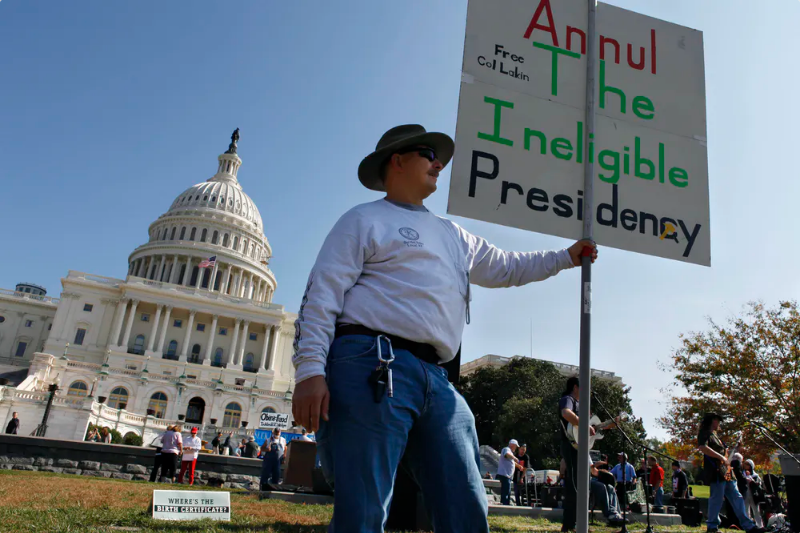
According to some birthers, Obama was a “secret” Muslim. A 2009 article in the Columbia Journalism Review noted that some of the right-wing media had attacked him for being “un-American.”
In the middle of the Obama presidency, WND attracted 4 million unique visitors a month. WND also ran a publishing house that featured book titles from conservative figures like Schlafly.
Trump and the Christian right
Trump’s presidency brings together two lines of argument from some of these evangelical leaders through his rhetoric. First, God punishes America when Americans are unfaithful to his commandments. Second, Christianity is under attack.
In an article the Rev. Billy Graham wrote in 2012 during the lead-up to Obama’s reelection, he recalled his wife, Ruth, telling him, “If God doesn’t punish America, He’ll have to apologize to Sodom and Gomorrah.”
The reference to the Old Testament story in which God laid waste to two cities for their sinful nature reinforces the idea that American leadership is responsible for American decline just as the leaders of these ancient cities were responsible for the wickedness of their people.
The underlying and unstated premise of Graham’s argument is that Obama is responsible for a fallen America that will bring God’s punishment. The Sodom and Gommorah example is telling. For Graham and some other evangelical leaders, Obama’s leadership represented an intentional move away from Christian values toward immorality.
Trump offered himself as an antidote to that fallen America and as a savior from the destruction. One way people came to accept that narrative is, I argue, through his use of conspiracy theories.
Originally published by The Conversation, 10.12.2020, under the terms of a Creative Commons Attribution/No derivatives license.