The form is thought to have originated in Kerala around the seventeenth century.

Provided by The Map Academy
Introduction
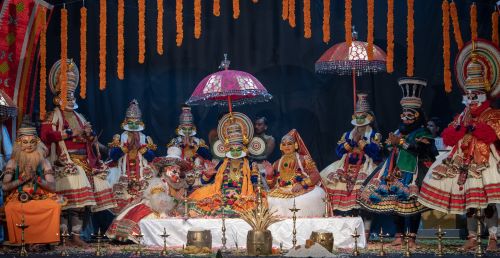
Consisting of makeup, face painting, and stylized masks, kathakali masks are used in the kathakali dance drama that use masks, colorful makeup, and costumes worn by performers. The word “kathakali” is derived from the Sanskrit words katha (story) and kali (to play or perform). The subject matter of kathakali originally included stories from the Ramayana, Mahabharata and the Puranas. The central theme of kathakali performances is the triumph of good over evil, expressed with martial dances or action-heavy climactic sequences.
The form is thought to have originated in Kerala around the seventeenth century, evolving from existing forms of devotional dance drama such as Krishnattam and Ramanattam. It is also believed to incorporate elements from martial arts such as Kalaripayattu; Koodiyattam, a temple-based drama; and ritualistic performances such as Theyyam and Mudiyettu. The Krishnattam is a theatrical dance form that narrates the life story of the Hindu god Krishna in eight parts, with each part being a separate play. It is performed in Kerala, in the Guruvayur Temple. The Ramanattam is a theatrical dance form that narrates the Ramayana, the story of the life of the Hindu god Rama, through a set of eight plays.
The Ramayana is one of the two major ancient Indian epics written in Sanskrit, it is believed to have been composed by Valmiki in c. 300 BCE. It narrates the life of the Hindu god Rama, detailing his fourteen year exile in the forest, the kidnapping of his wife Sita by the king of Lanka, Ravana, and his triumphant return to Ayodhya after the defeat of Ravana. The Mahabharata is the longest Indian epic poem, traditionally attributed to the legendary sage Vyasa and compiled into its extant recension sometime between the 3rd century B.C.E. and 3rd century C.E. The narrative was originally composed in Sanskrit and is divided into eighteen parvas (books).
The Puranas are a genre of ancient and religious texts written in Sanskrit, Tamil and other languages. The texts are encyclopedic and cover diverse topics, including cosmology, theology, mineralogy, grammar, medicine, folk tales and philosophy. The texts have over forty thousand verses, the first versions of which were likely composed c. 3rd to 10th century C.E. Puranas have been passed down through manuscripts as well as oral histories and are mostly likely to have multiple authors. From the Sanskrit word purana, meaning “ancient” or “former.”
The Performance
Early Kathakali performances were held in the compounds of family homes or outside temple walls, on a rectangular ground cordoned off with poles and cloth. The stage was generally bare, with the exception of a handheld curtain. More recently, performances are held in stage performance venues. The performers undergo a rigorous makeup and costuming process before the performance, taking up to three hours. Props such as weapons, generally made from lightweight wood, are often used. Other objects, such as chariots, are represented through mimetic actions. Performances originally lasted all night, beginning at dusk and ending at dawn. Contemporary kathakali performances reduce or remove the introductory segments entirely, making them two to three hours long.
The performance begins with the lighting of an oil lamp, accompanied by the singing of ceremonial verses. The performance then starts with introductory dances. As the story is enacted, four kinds of dances may be performed. The basic stance of a kathakali performer consists of feet placed parallel to each other at shoulder width, with the knees bent outward. The lower back of the performer is curved inwards towards the belly, allowing the arms to stretch wide. This accounts for the heavy mask and costume worn by the performers, keeping their centre of gravity low. Their footwork follows rectangular, straight, diagonal or circular patterns. Eye movements, along with facial and hand gestures, are employed to express the bhava, or inner state of the character. The performers are primarily men, though women began to join kathakali performances from the mid- to late twentieth century. Kathakali performers were traditionally from and patronized by the upper castes; its popularity today has prompted the participation of performers from more diverse social backgrounds.
Makeup and Masks

It originally used simple makeup for characters being represented: Rama and Lakshmana (Rama’s brother) had faces painted blue, while demons and monkeys wore face masks. The headgear was made of palm sheath painted with designs, and the torso was left bare. The influence of patrons like the feudal chiefs of the kingdom of Tanur led to changes in makeup and masking traditions. The blue makeup of divine characters was changed to the emerald green that is today one of the most recognizable aspects of the form. Masks for demons and monkeys were replaced with facial paint and gilded crowns began to be used as headgear.
Kathakali today uses a number of makeup types. The first, called paccu, uses green facial paint and is most frequently used for divine or noble characters. The green coloration is circumscribed by a white painted border, the cutti. The mark of Vishnu is often applied on the forehead with red and black marks upon a yellow base composed of rice paste. The eyes are framed by underlining the eyebrows and lower eyelids with a soft black pigment, extending to the sides of the face.
The “ripe” (payuppu) makeup type uses a similar design but replaces the green with a strong orange-red. It is used for characters such as Balarama (Krishna’s brother), Brahma, Shiva, and Surya. Krishna is a major deity of the Vaishnavite tradition and the eighth avatar of Vishnu. He is believed to have been born in Mathura and was raised as a cowherd in Gokul and Vrindavan by his foster parents Nanda and Yashoda. Krishna is worshipped in various forms, such as Shrinathji, Bal Gopal, Radha Krishna, Navagunjara and Vitthala, among others. The depictions of Krishna correspond with his life and are derived from legends associated with his life. In addition to his portrayals linked to the Mahabharata, he is also depicted in Pahari paintings as the archetypal lover. Brahma is a deity in the Hindu pantheon regarded as the creator of the universe, Brahma is a part of the trimurti along with Shiva and Vishnu. He is traditionally represented with four faces and four arms, holding an alms bowl, prayer beads as well as a book.
Shiva constitutes a part of a powerful triad of divine energy within the cosmos of the Hindu religion along with Brahma, the benevolent creator of the universe, and Vishnu, the sagacious preserver. Shiva is the destroyer because in Hindu religious philosophy all things must come to a natural end so they can begin anew. Shiva is the agent that brings about this end so that a new cycle can begin. From the Sanskrit for “sun,” Surya is the Sun God in Vedic and Hindu mythology.

The white beard (vella tati) type is used to signify another class of wise divine beings like Hanuman. It involves red, white and black patterns painted on the face, accompanied by a white beard either painted or worn on the cheeks. A small patch of green paint on his nose suggests his pious nature.
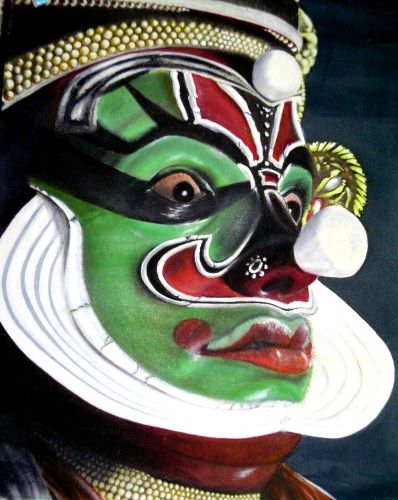
A number of makeup types are used to signify different types of antagonistic characters. The “knife” (katti) type, for example, is used for high-born characters who embody villainy or arrogance. Although the basic frame of the design is the same as in paccu, an upturned red mustache framed by white rice paste is added. The pattern is repeated above the eyes and eyebrows, and two white, bulbous extensions provided on the nose and forehead. This type is used for characters like Ravana.
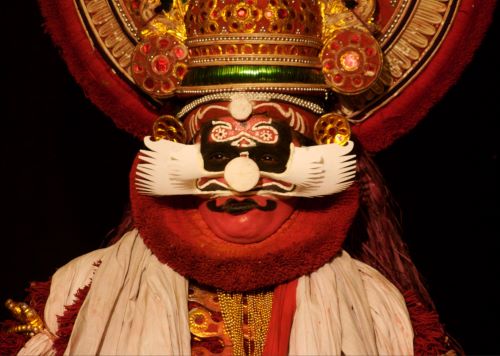
Red beard (cuvanna tati) makeup signifies characters who are also evil or vicious, such as Dussassana, who led the disrobing of Draupadi. The eyes are framed by black bands, and a white mustache extending to the ears is added. Lips are painted black to set off a ferocious mouth, and the bulbous noses and foreheads are made deliberately larger than that of the “knife” characters. A big crown is worn, with red paint around its borders.
Dussassana is amongst the antagonists of the text Mahabharata, the Kauravas, a band of a hundred brothers. He is second eldest amongst them, after Duryodhana. The mythical heroine of the Mahabharata, Draupadi was the daughter of King Drupad of Panchala. She was also the common wife of the five Pandava brothers of Hastinapur. She accompanied the Pandavas and their mother Kunti in exile and became the queen of Hastinapur after the battle of Kurukshetra.
Black beard (karutta tati) makeup is used for evil characters associated with the forest, characterized by a black beard but otherwise similar to those of the red beard type. The lower part of the face is black and the face is framed by the design of a black beard; otherwise it resembles the design of the red bearded characters.
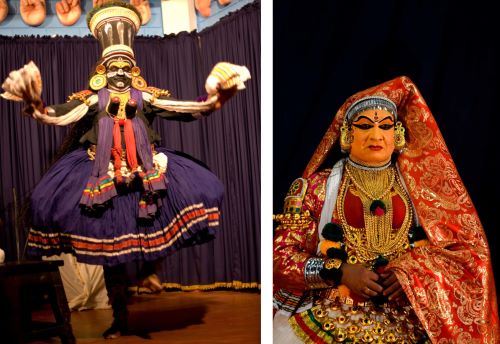
Demonesses are given jet black (kari) faces, relieved by patches of red, outlined in white rice-paste. They are usually contrasted with the “radiant” (minukku) variety, which includes “virtuous” or noble women like Sita in the Ramayana and similarly “pure” males, including Brahmins, holy men, and sages (who may wear a wooden crown). The minukku makeup type uses a warm yellow-orange paint, creating an effulgent glow.
A host of make-up styles and patterns are used for the other varieties and shades of characters and beings like Garuda and Jatayu, who are depicted with makeup resembling a bird; Bhadrakali may be given a red tongue and white rice paste spots on the face, suggesting a pockmarked appearance.
Masks are usually adopted to signal a transformation, such as from human to animal. Bali’s son Angada wears a monkey mask when he appears on stage, while Daksha, Brahma’s son who is decapitated by Virabhadra and Bhadrakali, wears a goat mask after coming back to life.
Kathakali is one of Kerala’s most popular and recognizable dance forms today.
Additional Resources
- Raina, Arjun. “The art of creating a Kathakali performer’s ‘Presence’”. Theatre, Dance and Performance Training 6, no. 3 (2015): 323-338.
- Swann, Darius L., Farley P. Richmond, and Phillip B. Zarrilli. Affiliate disclosure: Amazon links on this site are paid links. As an Amazon Associate I earn from qualifying purchases.Indian Theatre: Traditions of Performance. India: Motilal Banarsidass, 1993.
- Zarilli, Philip B. “Kathakali.” in Indian Theatre: Traditions of Performance, eds. Farley P. Richmond, Darius L. Swann and Philip B. Zarilli. Honolulu: University of Hawaii Press, 1990. 315 – 358.
- Zarrilli, Philip B. Kathakali Dance-Drama: Where Gods and Demons Come to Play. London: Routledge, 2000.
Originally published by Smarthistory, 09.12.2022, under a Creative Commons Attribution-NonCommercial-ShareAlike 4.0 International license.
About the Author