As the laws and rules on how to treat kids changed, the facility failed to keep up.

By Paige Pfleger
Criminal Justice Reporter
WPLN News
Introduction
With a glint in his eye, Richard L. Bean reminisces about the days when children in his detention center could be paddled.
“We didn’t have any problems then,” Bean says. “I’d whip about six or eight a year and it run pretty smooth. They’d say, ‘You don’t want him to get hold of you.’” Once, he chuckles, a kid had to be held down by four guards to be spanked.
Bean took the helm of this East Tennessee detention center — now named the Richard L. Bean Juvenile Service Center — in 1972. The laws and the science on how to treat children in detention have changed a bit since then.
Yet Bean has held on to an old-fashioned approach to his work. These days, he’s reliant on a different tool for keeping kids in line: locking them alone in cells for hours — sometimes even days — at a time.
“What we do is treat everybody like they’re in here for murder,” he says. “You don’t have a problem if you do that.”
Most of the children in the Bean Center are not in for murder — in fact, most have only been charged with a crime, but are awaiting court dates.
At 83, superintendent Bean uses a bamboo cane to give a tour of the 120-bed facility. It’s connected to the juvenile court by a maze of windowless corridors; kids are passed between the two buildings in uniforms and shackles.
It’s difficult to know how children have been treated inside the walls of institutions like this one because policies designed to protect the privacy of kids can also obscure what goes on in facilities that break the law.
That was the case at a juvenile court about 150 miles west in Rutherford County, where reporting from ProPublica and WPLN revealed that kids were being illegally detained — at rates far higher than anywhere else in the state — for the most minor crimes, or even, in at least one instance, crimes that didn’t exist. The proof was right there, being collected by the state and laid out, for years, in an annual report. Yet no one flagged that kids were being jailed at a staggering rate, and no one seemed to try to stop it.
Here at the Bean Center, records reveal different violations of the law.
Kids have been locked alone in a cell here more often than other facilities in the state, sometimes as punishment, and sometimes for an indeterminate length of time. And even as the state has implemented reforms that would have made seclusion less common, the Bean Center remained reliant on the practice.
Here too, these violations are not a secret: The facility’s licensing agency, Tennessee’s Department of Children’s Services, has been documenting this improper use of seclusion for years at Bean’s center and elsewhere. The Richard L. Bean Center has repeatedly been put on corrective action plans. Yet DCS continues to approve the center’s license to operate without the facility changing its ways.
The Rules of Seclusion
In 2016, a suit in Rutherford County challenged the use of solitary confinement in the juvenile detention center after a child was kept in solitary for days for disrupting class. Around the same time, research emerged showing that isolating children doesn’t actually improve their behavior — if anything, it could worsen it. Solitary confinement can cause psychological impacts like depression, anxiety or psychosis, and young people are especially vulnerable to those effects. The majority of suicides inside juvenile correction facilities in the United States happen when a child is isolated.
So in 2017, DCS mandated that juvenile detention centers throughout the state change the way they use seclusion, adding guidelines and a reporting requirement.
The new standards said that children kept in seclusion inside Tennessee’s juvenile detention centers could be locked into cells that are 50 square feet — about the size of a U-Haul cargo van — usually with a concrete slab for a bed and a metal toilet affixed to the wall.
Importantly, the standards made clear that seclusion was meant to be a last resort and should not be used as punishment.
“Seclusion shall only be used when necessary to prevent imminent harm to themselves, another person, prevent damage to property, or prevent the youth from escaping,” the standards dictate. “Staff shall never use seclusion for discipline, punishment, administrative convenience, retaliation, staffing shortages, or reasons other than a temporary response to behavior that threatens immediate harm to a youth or others.”
Shortly after, those standards were codified into state law.
In order to have their licenses renewed, which happens annually, juvenile detention centers are supposed to abide by DCS’ standards. Every few months, a DCS inspector drops into facilities unannounced to take a tour, review documentation of the use of tools like chemical sprays, and interview a few kids. The resulting inspection reports are written almost like a journal entry and provide a glimpse of life inside juvenile detention centers.
WPLN and ProPublica reviewed eight years of those inspection reports, covering 2016 to 2023, and found multiple instances of children being locked up in seclusion — sometimes for days or more than a week — for minor rule infractions like laughing during meals or talking during class. One facility put a child in seclusion for eight days for simply having head lice, which the inspector called “a little extreme.”
And while many facilities were documented using seclusion improperly, the Richard L. Bean Center emerged as particularly prolific in its use of seclusion as a means of punishment, even years after the state standards were imposed.
Tyshon Booker was 16 years old when he says he was secluded in the Richard L. Bean Center. Now he’s 24 and incarcerated at a nearby prison, serving a 51-year sentence for homicide — a sentence the state Supreme Court recently ruled amounted to cruel and unusual punishment for juveniles like Tyshon.
But even though it was years ago, he remembers his two-year stay at the Bean Center like it was yesterday. During his 2015-2017 detention there, he says he was kept in seclusion twice for several days on end, without reprieve. He was stripped to his boxers, a T-shirt and socks before being placed in a cell alone.
He says he had to get creative to keep his mind from spinning out.
“I learned how to make dice out of bread,” Booker says. “I made dice, roll the dice for hours. And then you’ve got to remember, we’re in solitary confinement, so I’d get hungry and I’d eat the dice. So, like, just imagine, the savage life in solitary confinement — rolling dice on a dirty floor for hours,” he recalled. “It was horrible.”
He says he would also lay on the ground of his cell with his face pressed against the cold floor, trying to yell to another kid who was locked in a solitary cell nearby.
He says it was worse than anything he’s experienced in adult prison. He thinks prison conditions are better because there’s more oversight. At the Bean Center, on the other hand? “They think, ‘Oh, they’re kids. Nobody is going to do this to kids, nobody would treat kids like this.’ So I don’t think it’s as much eyes as the penitentiary.”
In 2018 reports from visits to the Bean Center, one child said he was secluded after he forgot to bring his books to class. “Staff will put you in seclusion if they don’t like you,” he told the inspector. Another child said he was secluded but he didn’t really understand why.
The same inspector visited the facility twice in October of 2018. On Oct. 16 she wrote that the facility “continues to be in good standing with the DCS licensing” and that the facility had corrected all its problems and could have its license renewed for the year. But when she returned the next day, Oct. 17, documents show the facility was put on a corrective action plan for a list of problems, including using seclusion as punishment.
Then in 2019, an inspector returned and found that the Bean Center’s reliance on seclusion as punishment had escalated. Seclusions at the facility that year were about double what they had been the year before. In just a few months, it reported more than 160 instances of locking up children alone.
On that visit, the inspector talked to five kids. Each one of them had seen youth placed in seclusion for fighting or not following the rules. One child said he was secluded for talking back. That would break not only DCS’ standards but also the new state law. Despite documenting evidence that the Bean Center’s problem with seclusion had only gotten worse, the facility was taken off its corrective action plan and had its license approved for another year.
In an email to WPLN and ProPublica, DCS says it has multiple levers it can pull if a facility isn’t in compliance, including freezing or slowing admissions, decreasing capacity, or even refusing to approve a license. But DCS says it has never used any of those options at the Bean Center.
Inside the Bean Machine
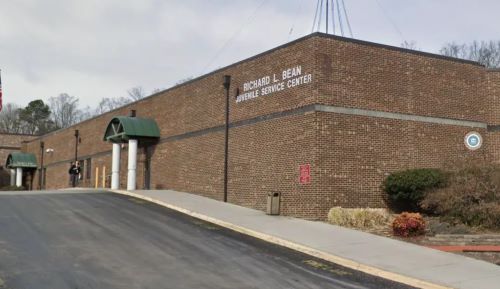
From the outside, the one-story brick Bean Center looks more like an elementary school than a junior jail. It’s situated just a few miles from downtown Knoxville, next to an ill-kempt sports field where kids play peewee football.
Inside, colorful stripes on the walls help kids navigate the hallways, an eerie counterpart to their neon orange prison outfits and the handcuffs they sometimes wear.
Bean can be found sitting behind a massive desk in his office. Where the rest of the detention center is sparse, his office is stuffed. His walls are covered in photos of himself through the years with visitors to the facility. His tenure has lasted so long that he’s run out of wall space — the photos spill out of his office and into the hallway.
The room is cluttered with memorabilia — a can of pinto beans from his family’s renowned meals with local politicians, dubbed Bean dinners; bumper stickers for the current juvenile court judge; figurines of elephants; and political tchotchkes.
He says he thinks the politicians making the rules around juvenile detention centers and seclusion don’t know what it’s like inside these facilities.
“Most people think we’re running a kindergarten,” Bean says. “We’re running the juvenile junior jail for Knox County. And there’s some tough kids — tougher than the ones in the jail, I guarantee.”
Bean doesn’t see reform laws as the state trying to do right by these kids; instead he sees it as the state making his job more difficult. He compares his relationship with the state and DCS to his marriage of 55 years.
“You have to do a lot of kissing,” he says, laughing. “A lot of, ‘Yes, ma’am.’ You can’t always have it your way in this business.”
In 2021, when the state ruled that kids could not be secluded for longer than six hours because of the damaging effects isolation had on them, Bean didn’t shy away from telling inspectors his thoughts.
An inspector wrote in August 2021 that Bean “stated that he did not feel two to six hours was enough time to lock the youth in their rooms,” a reference to the limits in the new law. “I also asked if the facility’s policy and procedures manual had been updated to reflect the new seclusion bill requirements. … The current policy and procedure manual for the facility was last updated in 1999.”
That inspector also noticed a pattern: Instead of writing down the time the child was let out of the cell, as he was supposed to do on forms for the state, Bean would just write his initials, “RLB.”
Despite DCS’ policies and the state law dictating exactly how long kids could be kept in seclusion, Bean decided to use his own discretion. He said writing “RLB” was his way of denoting that it was up to him to decide when the children were ready to be released and rejoin the other kids. He told the inspector that he’d make that decision based on how “remorseful” a child was.
“I asked them how their attitude is,” Bean says. “I can’t let the kids run the place. Sometimes you get a kid, you put him in his room, and he cuss and call you everything in the books. It’s hard to let him out.”
The use of “RLB” instead of a specific time also made it impossible for the state to discern how long kids were being locked up alone.

For those seclusion incidents that were documented properly, it was evident that Bean was keeping kids in their cells longer than he was supposed to. Most of the incidents of seclusion were “either definitively over 6 hours, or for an indeterminate amount of time,” the inspector wrote in the same report. One youth told the inspector that he had been placed in seclusion for “several weeks” for fighting.
Then in late 2021, something new happened: Bean’s seclusion numbers started dropping. It was the same year that a new law laid out the option for something called “voluntary time-out,” through which a kid can request to be left alone in their room for a few hours but is allowed to come out whenever they want to.
As the number of seclusions has fallen at the Richard L. Bean Center, the number of what inspectors called “voluntary seclusions” skyrocketed — in August of 2022, the facility reported just 44 seclusions compared with 122 the previous August.
According to the inspections, the facility also reported 344 voluntary seclusions.
“We don’t use it as punishment,” Bean explains. “So all of it’s volunteer.”
But the DCS inspector who visited that year noted that it was uncertain how voluntary the process actually was at the Bean Center.
“It is unclear whether the youth are aware that they can come out of their room by choice,” the inspector wrote. “The previous rule at the facility was that youth had to stay in their room for the remainder of the day if they chose to voluntarily go to their room.”
Recently, Bean said he started a new rule — if a kid requests a voluntary lockup to avoid going to school, he responds by secluding them until the next morning.
“And then next morning, we say, ‘You want to go to school today?’” Bean said. “Most of them say, ‘Yeah, I want to go. I don’t want to be locked up.’”
Bean doesn’t seem to worry too much about getting caught.
“If I got in trouble for it, I believe I could talk to whoever got me in trouble and get out of it.”
Run It Like a Business
When asked what happens to inspection reports after they are filled out, DCS said that evaluation summaries “are distributed to the appropriate administrative parties and filed in the licensing record.” The department also said it provides a list of violations to the facility administrator; the administrator typically has 30 days to submit compliance documentation, which is verified by licensing staff.
DCS confirms that in the time it has been licensing juvenile detention centers in Tennessee, it has never terminated a license. And records from the Bean Center illustrate that corrective action orders can be lifted without the violation being resolved.
The department declined to comment further on why it never did more to crack down on the Bean Center.
“You can write everything into statute and create some really solid legislation, but if it’s not being used or it’s not being enforced, then what’s the next step?” asks Kylie Graves, policy director of the independent state agency Tennessee Commission on Children and Youth.
Graves said that there has been a tendency for the state to look the other way when it comes to juvenile justice in Tennessee.
“The idea of this practice ever being used in a foster home or something like that would immediately raise flags and horrify people,” she said.
The Tennessee Commission on Children and Youth is calling for a third-party review of juvenile detention centers and the entire youth justice system. The agency points to Kentucky, which has proposed setting aside money to do just that. Several other organizations are likewise advocating for a review, including Disability Rights Tennessee, an organization that acts as a monitoring agency for juvenile detention facilities and has special access to the kids and documents inside.
“What seems like a good approach starting in January when the legislature reconvenes is to talk about putting in some type of mechanism for enforcing compliance,” says Zoe Jamail of Disability Rights Tennessee.
One proposal, Jamail says, could be a clean-up bill that would take oversight of juvenile detention facilities out of DCS’ purview, though she says she isn’t sure what agency could take that on. An audit last year found that nearly half of new DCS workers quit within their first year. That problem was compounded by an influx of kids entering the foster care system.
And the involvement of a third party could help mitigate a conflict of interest — DCS is invested in keeping county detention centers open and operating. In addition to being the licensing agency for the county detention centers, DCS also has contracts with most of those facilities to hold kids who have been convicted of a crime while they try to find placement for them.
DCS declined to comment on that arrangement.
It’s an arrangement that Richard Bean says is mutually beneficial — DCS pays his facility more than $175 per day per kid. He calls those kids paying customers.
Bean says that’s in addition to the $120 per day he gets from detaining kids from surrounding counties that don’t have a juvenile detention center.
Resting his chin on his cane, Bean says he doesn’t intend to slow down. He has big plans to hire more staff and get more bodies in beds — especially kids sent his way by DCS.
“I mean, you’ve got to take care of the kids,” Bean says. “But … you got to kind of run it like a business, too. I could make over one million dollars for the county.”
Originally published by ProPublica, 11.16.2023, under a Creative Commons Attribution-NonCommercial-NoDerivs 3.0 United States license.
About the Author