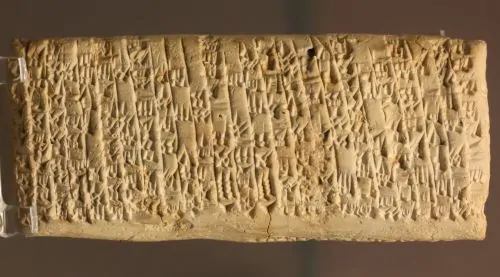
A clay tablet from ancient Ur preserves Nanni’s complaint to the merchant Ea-nasir, revealing how copper traders confronted inferior goods and the fragile trust behind distant commerce.

By Matthew A. McIntosh
Public Historian
Brewminate
Nearly 4,000 years ago, a dissatisfied buyer informed a copper merchant that he would inspect every ingot himself before accepting any more of the man’s merchandise. The buyer was Nanni, and the merchant was Ea-nasir, whose business correspondence survived beneath the ruins of Ur in present-day Iraq. Nanni’s complaint was written in Akkadian, its cuneiform signs pressed into a clay tablet small enough to hold in one hand. Across that compact surface, a commercial disagreement becomes intensely personal. A promise had been broken, and Nanni wanted the man responsible to understand that he would no longer accept such treatment.
Copper mattered far beyond this quarrel. Mesopotamian metalworkers used it directly and combined it with tin to make bronze, producing materials for tools and weapons. Southern Mesopotamia’s agricultural wealth did not supply the metal deposits its cities required, so merchants helped connect urban demand with distant sources. Ea-nasir participated in the maritime trade linking Ur with Dilmun, a trading center associated chiefly with modern Bahrain. Copper from Magan, in the Oman Peninsula, passed through this Gulf network, although the source of the ingots that offended Nanni is unknown. These were substantial commercial operations, requiring investors to commit goods or silver before an expedition could bring back its cargo. The arrangement created opportunities for profit, but it also separated people financing a purchase from the merchandise they expected to receive. A partner in Ur could not stand beside every transaction taking place overseas. Someone had to choose the cargo and account for it afterward. The dispute exposes what could happen when that reliance on an intermediary met a disagreement over quality.
According to Nanni, Ea-nasir had promised good copper but offered inferior ingots to his messenger instead. The response, as the letter reports it, amounted to an ultimatum: accept what was available or leave. Nanni regarded that exchange as an insult to his own standing, delivered through his representative. “What do you take me for, that you treat somebody like me with such contempt?” he demanded. His anger also extended to repeated journeys by messengers who returned empty-handed after traveling through territory he described as hostile. Getting an unsatisfactory transaction corrected meant more than making an inconvenient return trip. Nanni’s account places the burden of recovering his money on people facing actual danger, while the merchant holding it remained uncooperative.
The financial details reveal a business relationship with obligations on both sides. Nanni appears elsewhere in the surviving records as an investor in Ea-nasir’s trading expeditions. He was participating in the business that supplied the copper, as well as objecting to the goods offered to him. Other documents show ventures supported by numerous named contributors, with the returning cargo divided among investors. Within that arrangement, a dispute over which ingots someone received could affect the value of his return. Nanni reinforced his complaint by reminding Ea-nasir of copper he and another man had supplied to the palace on the merchant’s behalf. He also invoked a sealed document deposited in the temple of Shamash, the sun god associated with justice. These references suggest an ongoing relationship with obligations extending beyond one exchange. A sum of silver mentioned in the letter further complicates their accounting; this was a world in which silver could be weighed out for payment, centuries before coinage. Nanni was setting his grievance against a history of contributions that, in his view, entitled him to better treatment. His appeal to other Dilmun merchants served a similar purpose. He presented Ea-nasir’s conduct as a departure from the standards he expected within their commercial circle.
Excavators working under Leonard Woolley recovered the tablet in a house associated with Ea-nasir, alongside other records of his business. Additional complaints survive, but so do documents of investments and property purchases. The collection cannot establish how often his transactions went wrong. Nor does the discovery tell us why these letters survived. The popular idea that Ea-nasir kept angry correspondence as trophies supplies a motive that the archaeological evidence cannot demonstrate.
Nanni’s proposed remedy was practical. He demanded the return of his money and declared that future copper would undergo selection, ingot by ingot, in his own courtyard. That final stipulation suggests he still contemplated doing business with Ea-nasir, provided he could control what he accepted. The letter records an attempt to impose more demanding conditions on their dealings. We do not know whether the merchant complied or whether Nanni ever recovered what he demanded. His demands sought to make a supplier answer for the gap between an assurance and the goods actually offered. Its familiarity comes partly from the sharpness of the complaint, but the proposed inspection reveals something more specific about this ancient trade. Nanni could put his objections in writing and invoke earlier obligations; neither measure had spared him the need to examine the copper personally. After distant voyages and complicated accounting, the next deal would depend on what he could verify in his own yard.
Originally published by Brewminate, 10.11.2026, under the terms of a Creative Commons Attribution-NonCommercial-NoDerivatives 4.0 International license.
About the Author