
Without French and Spanish aid, the American Revolution would have faced a stronger Britain. Could colonial resistance still have secured independence, or ended in compromise?

By Matthew A. McIntosh
Public Historian
Brewminate
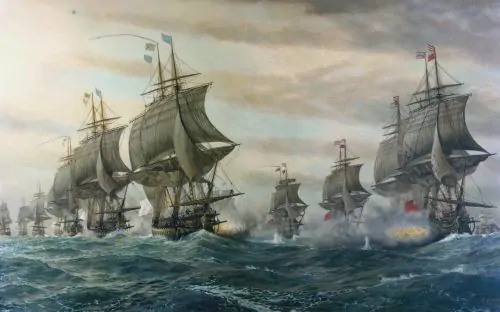
In September 1781, French warships closed the Chesapeake Bay to British relief, helping trap Charles Cornwallis’s army at Yorktown. What would George Washington have done if that fleet had never come? French assistance had begun well before the formal alliance with the United States in 1778. Spanish support followed a different path: Spain entered the war in 1779 as France’s ally, pursuing imperial objectives rather than signing an American alliance. Both monarchies had supplied covert aid beforehand. Their participation made a colonial rebellion part of a wider struggle against Britain. Remove that assistance, and the distance between declaring independence and securing it becomes considerably harder to cross.
A workable divergence comes in the spring of 1776, when Louis XVI is weighing how far to support the rebels. His finance minister, Anne-Robert-Jacques Turgot, opposed involvement in a costly war; other advisers saw an opportunity to weaken Britain after France’s defeat in the Seven Years’ War. In this scenario, the king gives financial caution greater weight and rejects government subsidies for American military purchases. Spain follows, combining reluctance to confront Britain alone with anxiety about encouraging rebellion within its own empire. Both courts withhold covert aid and subsequent loans, and neither later enters the war. Ordinary commercial purchases from willing European merchants remain possible, since neutrality would not automatically eliminate private trade. This is a stronger restriction than merely canceling the French alliance after Saratoga: the Americans lose government support before that famous victory. Keeping both monarchies neutral throughout the struggle also requires a sustained choice. We assume that even encouraging news from America fails to overcome their determination to avoid another expensive conflict.
The damage would first appear in the supplies reaching American armies. French shipments arriving in 1777 brought thousands of muskets and substantial quantities of ammunition, along with cannon used in the Saratoga campaign. Without government financing and access to royal stores, replacing those deliveries would be difficult. Domestic workshops could produce some weapons, but expanding production required skilled workers and materials that were already scarce. Commercial imports offered another route, although merchants wanted payment and ships had to evade British interception. Congress would confront these shortages while struggling to maintain an army without an independent power to tax. Its dependence on state contributions and depreciating paper money would become more dangerous without foreign financial support. Troops might go unpaid for longer, and commanders would have fewer resources for turning recruits into effective soldiers. None of this guarantees a British victory at Saratoga. John Burgoyne would still face difficult terrain and an overstretched supply line, while American militia could still gather against him. Nevertheless, weaker American equipment makes his defeat less certain. Even if the patriots captured his army, that success would no longer bring the French alliance assumed in familiar accounts of the war. A major victory could sustain American morale without resolving the material problems threatening the next campaign.
British naval power would meanwhile face fewer competing demands. In actual history, French and Spanish intervention forced Britain to defend Caribbean possessions and Gibraltar while continuing the American war. Neutrality would allow a greater concentration of ships and troops against the rebellion, though Britain would still need imperial garrisons elsewhere. Its blockade could become more effective, and coastal troop movements would face less danger. There would be no French fleet to seal the Chesapeake, or French expeditionary army to help besiege Yorktown. The decisive surrender of 1781 would become highly unlikely, assuming Cornwallis reached that position at all.
Yet greater British strength would not make governing the colonies straightforward. An army could occupy a port while revolutionary authorities remained active across the surrounding countryside. Royal troops needed provisions and reliable information, often from inhabitants who feared retaliation or distrusted their intentions. Loyalists could provide recruits and local knowledge, but their willingness to act openly depended partly on whether Britain could protect them after its field armies moved elsewhere. Additional forces might secure more districts; they could not instantly settle years of conflict over political authority. Washington had already shown an ability to preserve his army through defeats, giving the rebellion an organized center around which resistance could continue. Without outside aid, maintaining that center would become harder, but scattered resistance might survive even if the Continental Army shrank badly. Britain would then face a costly choice between prolonged occupation and concessions intended to restore allegiance. War weariness could still influence Parliament, although the absence of European enemies would reduce the urgency of compromise. Nor would American exhaustion produce a single response. Some communities might accept royal protection or negotiate their return to the empire, while others continued fighting. The revolutionary coalition could fracture before Britain achieved anything resembling complete control.
One plausible ending is a negotiated settlement granting substantial colonial self-government under the Crown, rather than the independence recognized in 1783. Britain’s actual peace initiative in 1778 offered significant concessions while withholding independence, showing that imperial reconciliation remained an option. Its timing and generosity, however, reflected military setbacks and the threat of French intervention; neither can simply be carried unchanged into this scenario. A stronger British government might demand submission, making settlement harder and prolonging resistance. Alternatively, colonial negotiators without the prospect of allied support might accept terms their counterparts rejected in actual history. Independence would become substantially less likely on the historical timetable, without becoming permanently impossible. The patriots sustained their rebellion, while European intervention transformed the cost of suppressing it. People fighting to escape a king’s authority benefited from other kings’ determination to weaken his empire. Without that convergence of interests, resistance might have survived for years while the promise of sovereignty remained unfulfilled.
Originally published by Brewminate, 10.11.2026, under the terms of a Creative Commons Attribution-NonCommercial-NoDerivatives 4.0 International license.
About the Author