
Examining the Peplos Kore reminds us that years of erosion and wear can significantly change the appearance of ancient artworks and affect our understanding of their original significance.

By Dr. Monica Bulger
Andrew W. Mellon Postdoctoral Fellow
Columbia University
The Acropolis was one of the holiest places in ancient Athens, full of temples and dedications to the gods. In 480 B.C.E., many of the sacred buildings and statues on the site were damaged by an invading army. In the decades that followed, the people of Athens carefully buried some of these broken votives in pits on the Acropolis, keeping them within the confines of the holy land but removing them from view.
Thousands of years later, in 1886, Greek archaeologists excavated one of these pits just northwest of a temple known as the Erechtheion. Within it they found several statues of young women. The most famous of them is today known as the Peplos Kore.

When she was first found, the Peplos Kore was recognized as an especially beautiful example of the kore (plural: korai) statue type. Korai are statues of richly dressed young women that were popular in the Archaic period. Archaeologists also believed she wore a simple garment called a peplos, and so she came to be called the Peplos Kore. However, new research focused on the paint and metal additions that once adorned the Peplos Kore has revealed that she is wearing a different garment altogether, and may in fact represent a goddess. In the following paragraphs, we will consider how the Peplos Kore compares to other Archaic korai and how her original appearance differs from her contemporary one.
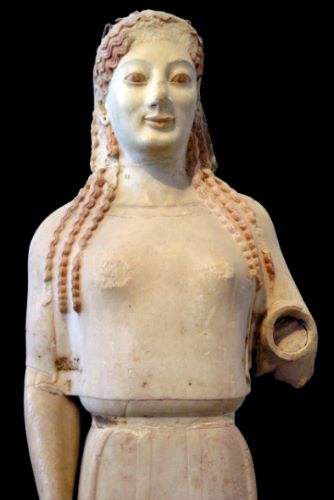
Like other korai, the Peplos Kore represents an idealized young woman. Her face is smooth and symmetrical, embodying the Archaic ideal of female perfection. Her slight smile, known as the Archaic smile, is another trait that is typical of korai and their male counterparts, kouroi (singular: kouros). The Archaic smile is meant to convey a sense of liveliness rather than signal a happy emotion. The Peplos Kore’s hair is carefully combed and styled into wavy strands, which are further detailed with carved lines that indicate individual hairs.1 Three of these strands fall in front of each of her shoulders, adding to the overall sense of symmetry in the statue. The kore’s elaborate hairstyle resembles those of other Archaic korai and contributes to the impression that the woman represented here is an idealized, if generic, elite.
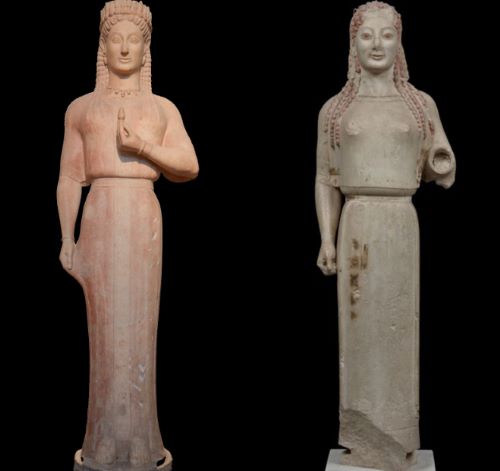
Upon first glance, the Peplos Kore seems to have the same rigid posture that we expect of Archaic korai. However, looking more closely reveals that she is slightly asymmetrical. Her shoulders are not completely straight like those of the stiffer Phrasikleia Kore. Instead, the Peplos Kore’s left shoulder is very slightly higher than her right, reacting to the movement of her arm, which (though now missing) once reached out in front of her. The bottom of her cape is not exactly parallel to her belt, rising up slightly on the right. Her head turns a tiny bit to the left.2 All of these small adjustments make the Peplos Kore appear more natural and lifelike than many other Archaic korai.3
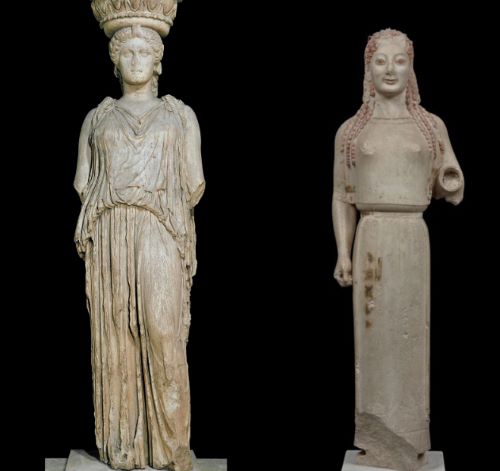
The Peplos Kore’s clothing is also unlike that of a typical kore. When she was first found, scholars believed that she was wearing a peplos, a garment that is made of a single rectangular piece of cloth. The cloth of the peplos is wrapped around the body and folded down at the top, with the flap of cloth usually hanging down to the waist. The peplos is then pinned at the shoulders and belted at the waist. As we can see on the caryatid from the Erechtheion, who sports a peplos, the garment leaves the woman’s arms bare. The so-called Peplos Kore does not have bare arms, and her garment is not pinned at the shoulders, suggesting that she is not wearing a peplos.
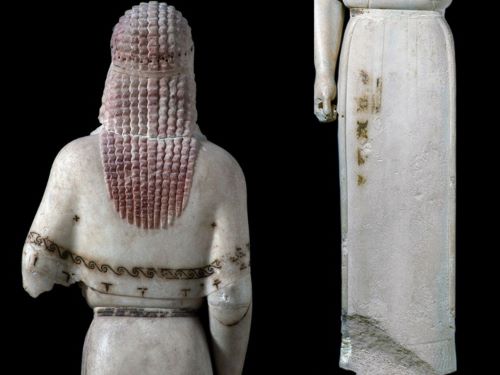
In fact, when we look at the back of the Peplos Kore, we find that she is wearing a short cloak or cape over another garment. A closer look at the front of her skirt provides another hint that she is not wearing a peplos: the marble is carved in a way that suggests two rectangular pieces of cloth are hanging vertically from just below her belt, indicating that some kind of sash held part of her garment in place.4 Just above her feet, below the hem of her skirt, part of a pleated undergarment is visible.5
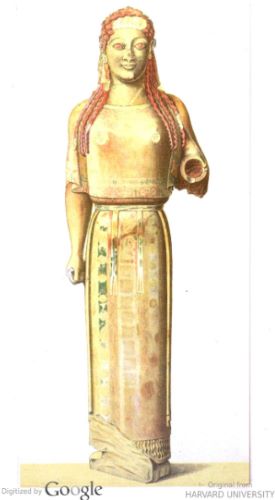
In antiquity, when the Peplos Kore was brightly painted, it would have been much easier to determine what she was wearing. When we see the statue today we might notice traces of red paint on her hair and face and dark painted patterns on her clothes. When the kore was first found in the late 1800s even more paint was visible on her, as Émile Gilliéron documented in a watercolor painting of the statue that he made shortly after she was excavated. The watercolor shows traces of blue and green paint on the kore’s cape and skirt that are no longer visible to the naked eye.
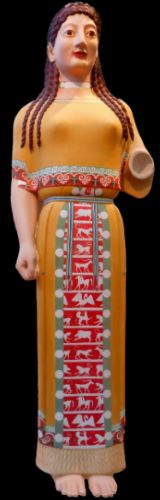
Recent research has further clarified what the Peplos Kore originally looked like and what she is wearing. In the early 2000s, a team of researchers led by Vinzenz Brinkmann used new scientific methods and technologies to analyze the paint on the Peplos Kore. Their work revealed more about the remarkable painted decoration that once adorned the statue and confirmed that she is not wearing a peplos. We can see what she is actually wearing in one of the reconstructions proposed by Brinkmann. Atop her pleated undergarment, the kore wears a long sheath-like dress that is decorated with representations of animals. That dress is partially covered by the short cloak that the kore wears around her shoulders and by a mantle that she wears wrapped around her lower half, which is held in place by the sash with hanging tassels, and left open at the front to reveal the animal decoration of the dress below.6
The creatures that decorate the kore’s garment were an especially unexpected discovery. The dress is decorated with real and mythical animals, including a lion, a goat, and a sphinx, in a series of square panels.7 This unusual decoration led scholars to reconsider the identity of the Peplos Kore: while most korai are understood to represent idealized but generic young women, this kore is distinguished by her elaborate, animal-covered dress, and more likely represents a specific individual. A gown embroidered with animals would be especially appropriate attire for Artemis, the goddess of wild animals and the hunt. Although the Peplos Kore was found buried on the Athenian Acropolis, which is sacred to the goddess Athena, Artemis also had a small sanctuary on the hill and may well have received dedications there.8
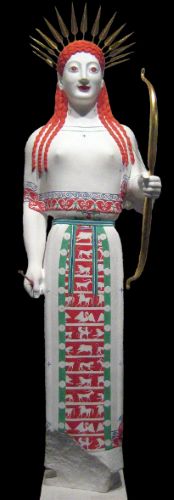
Additional details visible on the statue support the idea that the Peplos Kore is actually an image of the goddess Artemis. There is a hole in the kore’s right fist, suggesting that she once held an object made of metal. Although the kore’s left forearm is now missing, her posture reveals that she once held it out in front of her, likely grasping another object. The goddess Artemis was known to be an excellent archer, and is sometimes shown holding a bow in her left hand and an arrow in her right, as she is in one statue that is now in Boston.9 If the kore originally held a metal bow and arrow then her identity as Artemis would be unquestionable.10
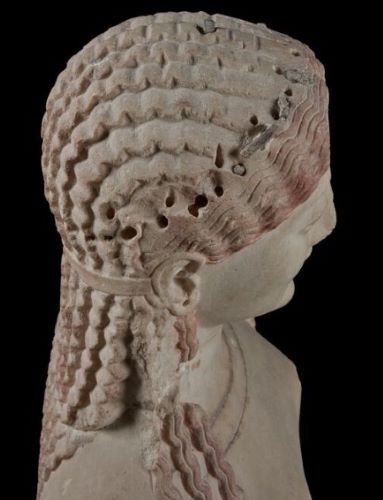
If we look at the statue from above, we see 35 holes encircling her head, as well as a central metal rod that still projects from the center of her head. These holes once secured an elaborate metal wreath or crown to the kore’s head, further distinguishing her from other, less decorated korai.11
Today, the metal attachments and elaborate paint that once enriched the Peplos Kore are absent. Without them, the kore looks quite similar to other Archaic korai. She is frontal and at first glance stiff, though further examination reveals that she is shifting slightly. She appears to wear a rectangular garment that could easily be mistaken for a peplos. It is only when we consider the decorative elements that are now missing from the Peplos Kore that we come to a better understanding of who she really was. With her brightly colored, layered garments and metal attachments, she would’ve been easily recognizable as a specific individual, quite likely the goddess Artemis. Examining the Peplos Kore reminds us that years of erosion and wear can significantly change the appearance of ancient artworks and affect our understanding of their original significance.
Endnotes
- Andrew Stewart, Affiliate disclosure: Amazon links on this site are paid links. As an Amazon Associate I earn from qualifying purchases.Greek Sculpture: An Exploration (New Haven: Yale University Press, 1990), p. 123.
- Richard Neer, Art & Archaeology of the Greek World, 2nd edition (London: Thames & Hudson, 2019), p. 163.
- Another kore found on the Acropolis, now known as Acropolis Kore 678, has similar features and is so similar to the Peplos Kore that the two are sometimes described as sisters. Mary C. Sturgeon, “The Archaic Style in Greek Sculpture,” Handbook of Greek Sculpture, edited by Olga Palagia (Berlin: Walter de Gruyter, 2019), pp. 282–84 discusses the similarities between the two and suggests that they might have been dedicated together.
- Sturgeon (2019), p. 281 describes this feature as “truly unexpected.”
- This garment is probably a chiton, another type of ancient Greek dress.
- Vinzenz Brinkmann, “Girl or Goddess? The Riddle of the ‘Peplos Kore’ from the Athenian Acropolis,” Gods in Color: Painted Sculpture of Classical Antiquity (Munich: Stiftung Archäologie Glyptothek, 2007), p. 46.
- Brinkmann (2007), p. 46. There was also likely a human riding a horse, perhaps a hunter, in one of the panels on the kore’s garment.
- Sturgeon (2019), p. 282. It is also possible that this image of Artemis was dedicated to Athena: the ancient Greeks did sometimes dedicate images of gods in sanctuaries sacred to other gods.
- Catherine Keesling, The Votive Statues of the Athenian Acropolis (Cambridge: Cambridge University Press, 2003), p. 136.
- Alternatively, if the kore held a spear in her right hand, she would have been recognizable as Athena. However, Athena is not closely associated with wild animals like Artemis is. Moreover, Keesling (2003), p. 139 points out that a statue holding a large spear horizontally in her right hand would present practical issues, as it would jut into the space of the sanctuary in which it stood.
- Brunilde Ridgway, “Birds, ‘Meniskoi,’ and Head Attributes in Archaic Greece,” American Journal of Archaeology, volume 94 (1990), p. 609.
Originally published by Smarthistory, 02.01.2024, under a Creative Commons Attribution-NonCommercial-ShareAlike 4.0 International license.
About the Author