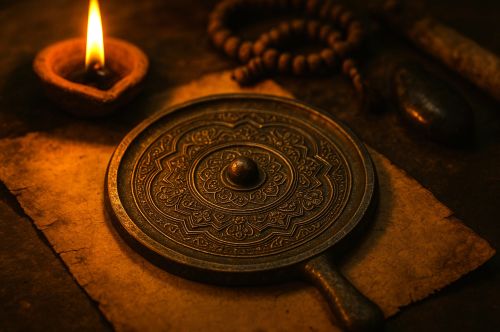
The endurance of mirror divination into late antiquity and early modernity underscores the persistent human desire to explore the unseen through crafted surfaces.

By Matthew A. McIntosh
Public Historian
Brewminate
Introduction: Mirrors as Ritual Technologies Rather Than Tools of Appearance
Mirrors are among the most symbolically charged objects in the ancient world, yet their earliest uses reveal functions far removed from familiar acts of grooming or personal reflection. Across several civilizations, reflective surfaces served as ritual technologies for mediating encounters with divine beings, ancestral spirits, hidden knowledge, or distant places. This complex practice, known as catoptromancy, comes from the Greek words katoptron for mirror and manteia for divination, a linguistic pairing that already suggests a vision directed outward rather than inward. Far from being passive tools, mirrors operated as active thresholds through which practitioners attempted to perceive meanings concealed from ordinary sight.1
The archaeological discoveries at Çatalhöyük and other Neolithic Anatolian sites provide the earliest material evidence for this ritual dimension. Excavations led by James Mellaart and later by Ian Hodder revealed highly polished obsidian discs, some small enough to fit seamlessly into the palm of the hand, buried within ritual contexts and domestic spaces that possessed ceremonial significance.2 Their placement within burials, shrines, and platforms suggests that these objects served not merely as practical instruments but as components of spiritual practice. The distinctive reflective quality of obsidian, produced by intense volcanic activity, made these early mirrors uniquely suited to imaginations shaped by ideas of luminosity, shadow, and contact with other realms.3
By situating these objects within a broader comparative history, a long and varied tradition of reflective divination emerges. In Mesoamerica, obsidian mirrors known as tezcatl were indispensable to priests, rulers, and sorcerers who engaged with the celestial and underworld spheres. Archaeologists and art historians have documented their presence in elite burials, temple caches, and iconography, often in association with deities whose powers involved vision, darkness, and transformation. Karl Taube and Elizabeth Hill Boone have shown how these mirrors functioned as portals for accessing the watery underworld or for receiving signs from deities such as Tezcatlipoca, whose very name invoked the idea of the smoking mirror.4 The role of reflection in this context therefore differs significantly from its Neolithic predecessors, but the association between polished surfaces and altered modes of perception remains constant.
Ancient Greek and Roman traditions of catoptromancy attest to similarly varied functions, though adapted to local cosmologies and ritual systems. Greek literary sources describe mirrors used in healing sanctuaries, necromantic rites, and oracular procedures in which practitioners sought glimpses of health outcomes, spiritual presences, or truths concealed from everyday understanding. Pausanias recorded a ritual at Patras in which a mirror was lowered into a well to reveal the condition of the sick through a visionary image.5 Later Roman writers, including Pliny the Elder, discussed the production and manipulation of reflective surfaces with a degree of curiosity that reveals both scientific and supernatural concerns.6 The presence of elaborately decorated bronze mirrors in both Greek and Roman contexts, many recovered from burials and sanctuaries, suggests that divination belonged to a continuum of uses that also included display, status, and ritual performance.
Catoptromancy cannot be reduced to a single method or meaning. Instead, it emerged across disparate regions as a way of transforming an optical surface into a liminal zone where human perception could reach beyond itself. What follows traces the development of mirror-based divination from its earliest known manifestations in the Neolithic Near East to its elaboration in Mesoamerica, Greece, and Rome. By examining archaeological contexts, textual accounts, and mythological associations, it explores how reflective materials became instruments for negotiating uncertainty, seeking guidance, and encountering the sacred. In doing so, it reveals a shared human desire to engage with what lies beyond the visible world through the disciplined and imaginative use of crafted surfaces.
The First Mirrors: Neolithic Anatolia and the Emergence of Reflective Ritual Objects

The earliest mirrors currently known to archaeology appear in Neolithic Anatolia, where craftsmen shaped and polished obsidian into small reflective discs long before metalworking or glass production became widespread. Excavations at Çatalhöyük, Aşıklı Höyük, and other sites have revealed mirrors with finely worked surfaces capable of producing a sharp reflection. The volcanic glass required sustained polishing, which indicates intentional labor invested in creating a tool that transformed a raw geological material into a luminous surface. Archaeologists working within Ian Hodder’s Çatalhöyük Research Project have emphasized that these objects were not scattered among utilitarian debris but clustered in locations associated with symbolic or ceremonial activity.7
The contexts of discovery point strongly toward ritual significance. Many early mirrors at Çatalhöyük appeared in burial installations where individuals were interred beneath house platforms, often in positions accompanied by objects related to social identity or spiritual practice.8 Several mirrors from both Çatalhöyük and Aşıklı Höyük exhibit wear patterns inconsistent with constant everyday handling yet show enough contact to suggest intermittent ritual use. Their presence within shrines decorated with reliefs and murals further indicates that reflective surfaces were integrated into the community’s cosmological framework. The obsidian’s natural sheen, enhanced through polishing, would have created striking visual effects in the low light conditions common within Neolithic interiors.9
Interpreting these mirrors requires understanding the broader symbolic economy of early Anatolian communities. Scholars have argued that objects of high labor investment and unusual visual properties often functioned as markers of social power or spiritual mediation.10 Within this framework, obsidian mirrors become meaningful as instruments that combined technical skill with the ability to concentrate and redirect light, qualities that could lend themselves to ritual performances involving vision, transformation, or communication with spirits. Their discovery in both domestic and non-domestic ritual spaces suggests that the reflective surface did not belong to a single social sphere but participated in a complex network of practices centered on memory, death, and the unseen.
Although the specific rituals associated with these mirrors remain unknown due to the absence of written sources, the archaeological record allows for careful inference grounded in material context rather than speculation. The placement of mirrors alongside symbolic wall paintings, animal installations, and votive objects suggests that Neolithic communities recognized reflection as a special property capable of mediating between visible and invisible realms. Unlike later mirrors in Greece, Rome, or Mesoamerica, these Anatolian examples do not appear within textual accounts that explain their use. Their meaning must therefore be reconstructed archaeologically through provenience, craftsmanship, and patterned deposition. The evidence indicates that the reflective surface was valued as a transformative material that supported ceremonial acts in which light, visibility, and spiritual presence intersected.11
Mesoamerican Catoptromancy: Obsidian Mirrors as Portals to the Otherworld
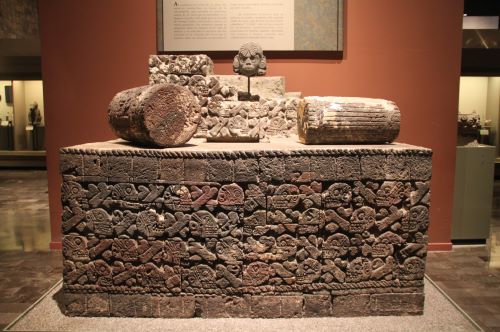
Obsidian mirrors held extraordinary importance in Mesoamerican religious life, where they served as devices for vision, transformation, and communication with divine beings. Archaeologists have recovered dozens of mirrors from temple caches, elite burials, and ceremonial precincts at sites such as Teotihuacan, Monte Albán, Tula, and among the Classic Maya. Their highly polished surfaces, often crafted from iron-rich obsidian that intensified their reflective depth, indicate a technological expertise directed toward producing objects capable of generating controlled visual phenomena. Scholars have argued that such mirrors were indispensable to ritual specialists who sought insight into realms unavailable to ordinary perception.12
The association between mirrors and divinatory power is expressed vividly in Mesoamerican iconography. In the Codex Borgia and related manuscripts, mirrors appear as circular reflective fields placed within or atop bowls of water, linking them directly to the cosmological idea of the watery underworld. These depictions do not treat mirrors merely as physical artifacts but as cosmological symbols through which vision could penetrate layers of the universe. These painted scenes encode complex ideas regarding temporality, fate, and the ordering of the cosmos, with reflective surfaces functioning as points of access into divine knowledge.13 The artistic evidence thus aligns with archaeological finds that place mirrors within ritual contexts concerned with prophecy and communication with deities.
The god Tezcatlipoca provides the clearest thematic anchor for understanding Mesoamerican catoptromancy. His name, often translated as “Smoking Mirror,” refers explicitly to the obsidian mirror associated with his power. Scholars have demonstrated that Tezcatlipoca’s mirror symbolized both omniscience and transformative danger, granting him the ability to perceive human actions and to reveal fates.14 Priests who served his cult carried mirrors as part of their ritual regalia, and historical accounts from the early colonial period describe mirrors used in acts of sorcery, political consultation, and statecraft. These practices show that reflective divination was integrated not only into religious ceremony but also into modes of governance and social control.
Material evidence reinforces these textual and iconographic associations. Mirrors discovered at Teotihuacan frequently appear in caches containing pyrite, obsidian blades, greenstone, and shells, elements that together articulate a ritual grammar of brightness, fertility, and sacred visibility. These assemblages indicate the deliberate construction of portals within ceremonial spaces, where mirrors acted as anchors for contact with deities or ancestral spirits.15 In some burials, mirrors were placed over the chest or face of the deceased, suggesting that they facilitated passage into the underworld or served as protective devices during the transition from life to death. This mortuary context reveals that the mirror’s reflective power traveled with individuals beyond ordinary existence.
The persistence of mirror symbolism across centuries and cultures within Mesoamerica highlights the unusual degree of conceptual continuity surrounding reflective surfaces. Whether rendered in stone reliefs at Tula, painted within central Mexican manuscripts, or embedded in Maya royal regalia, mirrors acted as stabilizing symbols of divinatory insight and cosmological order. Their use in ritual practices underscores a shared understanding that reflective materials mediated communication between worlds structured by water, darkness, and divine presence.16 In this tradition, the mirror did not serve primarily as an object of self-recognition but as a concentrator of cosmological forces that revealed truths unavailable by any other means.
Catoptromancy in Archaic and Classical Greece: Ritual, Oracles, and the Manipulation of Light

Greek traditions surrounding reflective divination reveal a sophisticated interplay between ritual practice, philosophical inquiry, and the manipulation of optical surfaces. The Greek term katoptron refers simply to a mirror, yet literary evidence illustrates that mirrors acquired heightened significance when used in religious or healing contexts. Among the most detailed accounts is the ritual at Patras, described by Pausanias, in which a priest lowered a mirror into a well to reveal the fate of the sick.17 The image offered in the reflective surface was interpreted not as a physical portrait but as a manifestation of deeper truth produced through a carefully staged ritual environment. This episode stands among the clearest textual descriptions of Greek catoptromancy and demonstrates that mirrors served as tools for divinatory insight rather than ordinary self-reflection.
Greek divinatory traditions involving mirrors also appear within broader necromantic practices. Scholars have shown that necromancy at sites like the Nekromanteion of Acheron involved ritual preparations that emphasized darkness, water, and altered states of perception.18 Although mirrors do not survive archaeologically in large numbers from these sanctuaries, accounts preserved in later magical texts connect reflective surfaces with communication between the living and the dead. The integration of mirrors into such rites aligns with the Greek understanding of certain objects as mediating devices capable of traversing cosmological boundaries. This conceptual association would later be systematized in the technical vocabulary of the Greek Magical Papyri, where surfaces filled with water or polished metal served as conduits for visionary encounters.
Material culture contributes essential evidence regarding the role of mirrors in Greek ritual life. Archaic and Classical mirrors were typically crafted from highly polished bronze and often bore engraved imagery depicting deities, mythological scenes, or protective symbols. Museums in Athens, Berlin, and London preserve numerous examples recovered from burials and sanctuaries, contexts that indicate symbolic value extending far beyond personal grooming.19 The reflective quality of bronze, intensified by the addition of tin, produced a surface capable of creating sharp visual contrasts in lamplight. These optical effects likely contributed to the mirror’s appeal in rites that required concentration, controlled visibility, or the cultivation of altered perception.
Greek philosophical and scientific traditions also provide a framework for understanding the cultural environment in which catoptromancy developed. Optical treatises attributed to Euclid and Hero of Alexandria analyze reflection, refraction, and the behavior of light in ways that reveal sustained interest in the capacities of mirrors to structure vision.20 These works do not describe divination directly, yet they show that mirrors were objects of intellectual curiosity, capable of supporting arguments about perception, truth, and the limits of human sight. The coexistence of scientific and ritual approaches to reflective surfaces highlights the multiplicity of meanings that mirrors carried in Greek thought.
Within magical traditions, mirrors appear in contexts that emphasize transformation and the revelation of concealed realities. Scholars have documented rituals in which practitioners used reflective surfaces to summon images or to compel disclosure from spiritual beings.21 These rites depended on creating conditions that amplified the mirror’s visual potency, such as low light environments and the use of purified surfaces. The practice of catoptromancy in Greece therefore emerges not as an isolated or marginal tradition but as part of a wider network of techniques that sought knowledge through controlled manipulation of optical materials. In these settings, the mirror functioned as a device for crossing thresholds between human and divine perception, transforming a familiar object into a medium of ritual power.
Rome and the Imperial Mirror World: Domestic Luxury, Superstition, and Spectacle

Roman engagement with reflective surfaces expanded upon Greek precedents but developed in distinctive directions shaped by luxury culture, technical innovation, and an evolving set of ritual practices. Roman mirrors were produced primarily from polished bronze, silver, and eventually glass, materials that allowed for a broad range of visual effects. Pliny the Elder records a lively interest in mirror production and describes techniques that included the incorporation of lead and the manufacture of glass mirrors in Sidon.22 His account situates mirrors firmly within a landscape of elite consumption, while still acknowledging their unusual visual properties. These textual references, supported by archaeological finds from domestic contexts across the empire, reveal that mirrors participated in a complex world of aesthetic pleasure, superstition, and symbolic display.
The archaeological record provides a rich corpus of Roman mirrors that appear in both domestic and funerary settings. Excavations at Pompeii and Herculaneum have yielded elaborately decorated bronze examples featuring engraved mythological scenes, floral patterns, and protective motifs.23 Many were discovered in triclinia, bedrooms, and bathing suites, indicating their integration into daily routines focused on appearance and social presentation. Yet the frequent placement of mirrors in graves, often alongside personal ornaments and cosmetic implements, suggests that reflective surfaces possessed symbolic functions related to identity, protection, or transition into the afterlife. Their inclusion in such contexts implies a belief that the mirror’s capacity to capture and reflect light played a role in guiding or safeguarding the deceased.
Mirrors also appear in Roman magical traditions, where they served as tools for divination, protection, and communication with spiritual beings. The Greek Magical Papyri, preserved primarily in Roman Egypt, contain rituals involving polished surfaces, water-filled bowls, and invoked spirits that respond through visionary appearances.24 These papyri, while eclectic, provide concrete evidence that practitioners across the empire relied on reflective media to seek hidden knowledge. The rituals often required purification, incense, and strict timing, suggesting that mirrors were understood as sensitive devices whose efficacy depended on controlled ritual conditions. Such practices reveal a conceptual overlap between Roman and earlier Greek uses of reflective materials, although embedded within different cultural frameworks.
Elite Roman authors occasionally expressed skepticism about divinatory practices involving mirrors, yet the persistence of cautionary remarks suggests that such activities were widespread. Pliny, for example, describes certain magical uses of mirrors with ambivalence, noting that some believed reflective surfaces could summon images of gods or spirits.25 This mixture of curiosity and concern mirrors Roman attitudes toward many forms of divination, which were tolerated when regulated by state institutions but viewed with suspicion when practiced privately. Mirrors therefore occupied a liminal space within Roman religious culture, simultaneously associated with elite adornment and with forms of knowledge that fell outside official oversight.
Art historical analyses further underscore the ritual potential of mirrors within Roman society. Scholars have examined how decorated objects acquire agency through their material qualities and visual impact.26 Applying such theoretical perspectives to Roman mirrors helps clarify how their reflective surfaces could act as dynamic participants in social and spiritual interactions. The engravings on mirror backs may have served more than decorative purposes, functioning as protective symbols or narrative cues that framed the user’s experience. These artistic and material features suggest that Roman mirrors operated as layered objects whose meaning derived from both their craftsmanship and their capacity to mediate vision.
The versatility of mirrors in the Roman world demonstrates that reflection held multiple and shifting meanings within imperial society. Mirrors facilitated practices of self-fashioning, supported rituals of healing and divination, and played roles in funerary rites that linked the living and the dead. Their presence in domestic spaces, sanctuaries, and magical texts indicates that reflective surfaces bridged spheres of luxury, religion, and speculation about the unseen.27 In Rome, the mirror became an object through which individuals negotiated identity, sought guidance, or attempted to understand forces believed to operate beyond ordinary perception.
Comparative Cosmologies: Water, Darkness, and the Mirror as a Liminal Surface
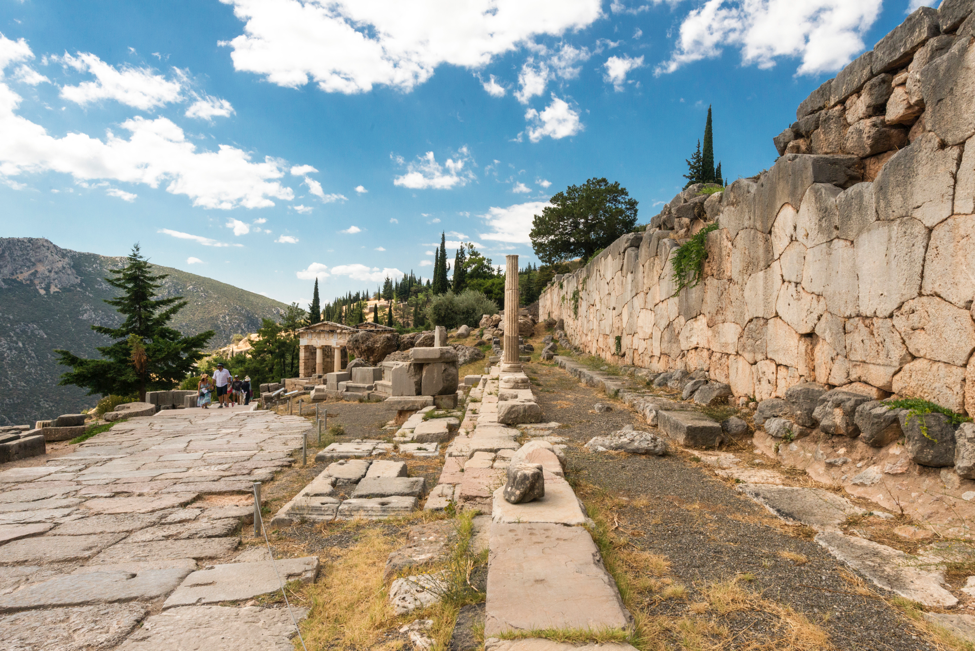
Across the ancient world, reflective surfaces consistently appear within cosmologies that emphasize boundaries between visible and invisible realms. In Mesoamerica, mirrors were linked to the watery underworld, a domain accessed through caves, pools, and reflective stones that mediated encounters with gods or ancestral spirits. Scholars have shown that water and mirrors served as parallel metaphors for depth, darkness, and otherworldly knowledge.28 Greek traditions display a similar emphasis on liminal environments, particularly in necromantic settings where wells, lakes, and subterranean spaces framed rituals of revelation. The reflective medium in these contexts transformed natural or crafted surfaces into thresholds through which practitioners sought to perceive truths unavailable by ordinary sight.
The Greek oracle at Patras, where a mirror was lowered into a well to diagnose illness, illustrates how water and reflection combined to produce divinatory insight.29 The well itself functioned as a symbolic descent into otherwise inaccessible domains, and the mirror provided a controlled field through which visionary images emerged. Comparable symbols appear in Roman magical texts, which describe water-filled vessels used for scrying and communication with spiritual beings.30 These examples reveal a shared Mediterranean understanding of reflective media as tools that intensified encounters with supernatural forces. The mirror gained efficacy through its placement within environments already charged with ritual significance.
Mesoamerican mirror traditions enrich this comparison by demonstrating how reflective surfaces could embody cosmological structures. In central Mexican manuscripts, mirrors often appear atop bowls of water, visually merging the reflective qualities of obsidian with the symbolic properties of the underworld.31 Mirrors therefore served not only as devices for viewing but as representations of cosmic order involving cycles of life, death, and divine interaction. Unlike the Mediterranean traditions, which frequently relied on enclosures or subterranean settings, Mesoamerican depictions place the mirror directly within a cosmological map that integrates celestial, terrestrial, and aquatic realms.
Anthropological theory provides a useful lens for understanding these cross-cultural patterns. Scholars have argued that objects gain ritual power by occupying liminal or transitional positions within social and symbolic systems.32 Mirrors, by virtue of their ability to create images that appear real yet immaterial, exemplify this liminal quality. Their reflective properties disrupt ordinary perception by producing an image that both belongs to and stands apart from the visible world. When used in divination, mirrors enabled practitioners to frame this ambiguity as a mode of access to spiritual or cosmological knowledge. This cross-cultural analysis demonstrates that despite significant regional differences, ancient societies consistently invested reflective surfaces with the capacity to reveal what lay beyond the limits of direct observation.
Decline, Transformation, and Survival of Scrying Traditions into Late Antiquity and Early Modernity

The shift from polytheistic to Christian religious structures in the Mediterranean brought significant changes to the status of reflective divination. Church authorities increasingly framed mirror-based practices as deceptive or dangerous, aligning them with forms of magic that threatened Christian orthodoxy. Augustine of Hippo criticized divinatory rites involving reflective or luminous media, arguing that such practices relied on demonic intervention rather than divine insight.33 His condemnation reflects a broader effort to displace older ritual technologies by redefining them as spiritually hazardous. Yet the persistence of these criticisms indicates that mirror divination continued in private settings even as official doctrine discouraged it.
Despite ecclesiastical opposition, reflective divination remained visible in late antique magical texts. The Greek Magical Papyri, circulating primarily in Roman Egypt, preserve instructions for rituals that employ polished metal surfaces or water-filled vessels for visionary purposes.34 These texts include incantations, ritual purifications, and invocations intended to guide the practitioner’s experience of the reflective medium. Their survival into the early Byzantine period shows that traditional techniques of scrying endured despite changing religious and political contexts. Rather than disappearing, catoptromancy adapted to new settings where literacy, syncretism, and secrecy shaped the preservation of magical knowledge.
During the Middle Ages, reflective divination reappeared in learned and vernacular traditions that drew upon classical sources while integrating new cosmological frameworks. Discussions of mirror magic appear in texts attributed to scholars such as Albertus Magnus and Roger Bacon, though modern scholarship debates the precise authorship of certain works, including the Speculum Astronomiae.35 These treatises framed mirror divination within natural philosophy by proposing that reflective surfaces interacted with celestial or terrestrial forces. Although often subjected to ecclesiastical scrutiny, such texts suggest a continued interest in understanding how optical materials could channel or reveal hidden influences. The shifting intellectual climate of the medieval period thus preserved aspects of ancient catoptromancy while reshaping its theoretical foundations.
The early modern period witnessed a renewed fascination with reflective devices in magical and alchemical contexts. John Dee, the Elizabethan mathematician and occult philosopher, used an obsidian mirror now identified through compositional analysis as originating from Mexico.36 Dee employed this mirror in his angelic conversations with Edward Kelley, situating a Mesoamerican object within a European ritual environment. The mirror’s cultural transfer illustrates how scrying traditions adapted to global exchanges and how reflective materials accumulated new layers of meaning. Dee’s practices, documented in his diaries, demonstrate that catoptromancy persisted not as a relic of antiquity but as a technique integrated into Renaissance esotericism.
By the seventeenth century, reflective divination occupied an ambiguous position between curiosity, superstition, and learned experimentation. Individuals engaged in scrying sometimes framed their work as investigations into natural optical phenomena, while critics continued to associate mirror visions with deception or spiritual danger.37 The coexistence of these perspectives reveals that the mirror’s liminal status endured across centuries. Rather than vanishing, catoptromancy reconfigured itself to fit shifting intellectual, religious, and social landscapes. Its survival into early modernity underscores the enduring human desire to explore the boundaries of perception through crafted surfaces that mediate between appearance and hidden truth.
Conclusion: Mirrors as Instruments of Knowledge and the Reach Beyond Sight
The history of catoptromancy demonstrates that mirrors occupied roles far beyond their capacity to return an image. Across ancient societies, reflective surfaces served as active participants in rituals that sought to reveal concealed truths, whether through the shimmering depths of obsidian, the interplay of light on bronze, or the stillness of water. These materials became potent because they transformed ordinary perception, offering practitioners a glimpse into realities structured by cosmological, spiritual, or metaphysical principles. Their function depended on the belief that certain crafted objects could mediate encounters with realms situated outside the limits of everyday experience.38
Although separated by geography and cultural tradition, the peoples of Neolithic Anatolia, Mesoamerica, Greece, and Rome recognized in reflective materials a capacity to shape states of awareness that could not be achieved by direct observation. Archaeological and textual evidence shows that mirrors were placed within environments designed to heighten sensory experience, from subterranean chambers and water-filled basins to temple caches and ritual platforms. These settings indicate that catoptromancy relied on a carefully constructed relationship between the reflective surface and the space around it. Vision, in these contexts, was not passive but disciplined, requiring a practitioner to enter a state of focused attention shaped by ritual form.
The endurance of mirror divination into late antiquity and early modernity underscores the persistent human desire to explore the unseen through crafted surfaces. Christian authors condemned the practice, while magical texts preserved the techniques, and Renaissance scholars adapted mirror scrying to new intellectual and global contexts. John Dee’s use of a Mexican obsidian mirror, for instance, reveals how reflective technologies circulated across continents and acquired new meanings within different ritual and philosophical systems.39 These continuities and transformations show that the mirror’s role in divination was continually reinvented rather than abandoned.
Across millennia, catoptromancy reveals a shared effort to extend perception beyond the visible world through the disciplined use of reflective materials. Mirrors served as thresholds where human inquiry met cosmological speculation, enabling practitioners to seek guidance, confront uncertainty, or approach the divine. Their history illuminates not only ancient divinatory practices but also a broader intellectual pattern in which material objects facilitated engagements with questions that exceeded empirical knowledge.40 In this sense, the reflective surface stands as both an archaeological artifact and a testament to the enduring impulse to look beyond what the eye alone can see.
Appendix
Footnotes
- Henry George Liddell and Robert Scott, A Greek English Lexicon, revised by Henry Stuart Jones (Oxford: Clarendon Press, 1996), s.v. “katoptron” and “manteia”.
- James Mellaart, Çatal Hüyük: A Neolithic Town in Anatolia (London: Thames and Hudson, 1967), 181–183.
- Ian Hodder, Çatalhöyük: The Leopard’s Tale (London: Thames and Hudson, 2006), 154–156.
- Karl Taube, “The Iconography of Mirrors at Teotihuacan,” in Art, Ideology, and the City of Teotihuacan, ed. Janet Catherine Berlo (Washington, DC: Dumbarton Oaks, 1992), 169–204; Elizabeth Hill Boone, Cycles of Time and Meaning in the Mexican Books of Fate (Austin: University of Texas Press, 2007), 98–105.
- Pausanias, Description of Greece 7.21.12.
- Pliny the Elder, Natural History, trans. H. Rackham, Loeb Classical Library (Cambridge, MA: Harvard University Press, 1938), 34.140–150.
- Hodder, Çatalhöyük, 154–156.
- Mellaart, Çatal Hüyük, 181–183.
- Hodder, The Leopard’s Tale, 157–159.
- Colin Renfrew, The Archaeology of Cult: The Sanctuary at Phylakopi (London: British School at Athens, 1985), 19–21.
- Hodder, The Leopard’s Tale, 160–162.
- Esther Pasztory, Teotihuacan: An Experiment in Living (Norman: University of Oklahoma Press, 1997), 145–148; Taube, “The Iconography of Mirrors at Teotihuacan, 169–172.
- Boone, Cycles of Time and Meaning in the Mexican Books of Fate, 98–105.
- Guilhem Olivier, Moqueries et Métamorphoses: Les Ruses de Tezcatlipoca (Paris: Institut d’Ethnologie, 1997), 55–63.
- Taube, “Iconography of Mirrors,” 177–181.
- Boone, Cycles of Time and Meaning, 112–115.
- Pausanias, Description of Greece 7.21.12.
- Daniel Ogden, Greek and Roman Necromancy (Princeton: Princeton University Press, 2001), 75–82.
- Susan Woodford, An Introduction to Greek Art (Ithaca: Cornell University Press, 1986), 112–114.
- Euclid, Optics, in Euclid’s Optics, trans. H. L. L. Busard (New York: Springer, 2015), 7–15; Hero of Alexandria, Catoptrica, in The Works of Hero of Alexandria, ed. and trans. T. L. Heath (Cambridge: Cambridge University Press, 1899), 301–315.
- Christopher A. Faraone, Ancient Greek Love Magic (Cambridge, MA: Harvard University Press, 1999), 64–70.
- Pliny the Elder, Natural History, 34.140–150.
- Museo Archeologico Nazionale di Napoli, Bronze Mirrors Collection, accession records published in Stefano De Caro, Pompei: L’arte e la vita (Naples: Electa, 1994), 212–215.
- Hans Dieter Betz, ed., The Greek Magical Papyri in Translation, vol. 1 (Chicago: University of Chicago Press, 1986), 52–59, 108–112.
- Pliny the Elder, Natural History, 34.151–156.
- Alfred Gell, Art and Agency: An Anthropological Theory (Oxford: Clarendon Press, 1998), 6–15.
- De Caro, Pompei – L’arte. L’area Archeologica di Pompei. https://www.pompeionline.net/pompei-scavi/la-pittura-pompeiana/larte-a-pompei.
- Boone, Cycles of Time and Meaning in the Mexican Books of Fate, 98–105; Taube, “The Iconography of Mirrors at Teotihuacan,” 169–204.
- Pausanias, Description of Greece 7.21.12.
- Betz, ed., The Greek Magical Papyri in Translation, vol. 1, 52–59.
- Boone, Cycles of Time and Meaning, 112–115.
- Victor Turner, The Ritual Process: Structure and Anti Structure (Chicago: Aldine, 1969), 94–97; Alfred Gell, Art and Agency (Oxford: Clarendon Press, 1998), 6–15.
- Augustine, City of God, trans. Henry Bettenson (London: Penguin Classics, 2003), 8.19.
- Betz, ed., The Greek Magical Papyri in Translation, vol. 1, 52–59.
- Paola Zambelli, The Speculum Astronomiae and Its Enigma (Dordrecht: Kluwer, 1992), 44–52.
- Stuart Campbell and Andrew Meirion Jones, “Material Analysis of John Dee’s Obsidian Mirror,” Antiquity 90, no. 352 (2016): 1–5.
- Keith Thomas, Religion and the Decline of Magic (London: Weidenfeld and Nicolson, 1971), 265–268.
- Turner, The Ritual Process, 94–97.
- Stuart Campbell and Andrew Meirion Jones, The Mirror, the Magus and More: Reflections on John Dee’s Obsidian Mirror (Cambridge: Cambridge University Press, 2021), 3-5.
- Gell, Art and Agency, 6–15.
Bibliography
- Albertus, Magnus (attrib.). Speculum Astronomiae. Attribution discussed in modern scholarship; see Paola Zambelli.
- Augustine. City of God. Translated by Henry Bettenson. London: Penguin Classics, 2003.
- Betz, Hans Dieter, ed. The Greek Magical Papyri in Translation. Vol. 1. Chicago: University of Chicago Press, 1986.
- Boone, Elizabeth Hill. Cycles of Time and Meaning in the Mexican Books of Fate. Austin: University of Texas Press, 2007.
- Busard, H. L. L., trans. Euclid’s Optics. In Euclid’s Optics. New York: Springer, 2015.
- Campbell, Stuart, et.al. The Mirror, the Magus and More: Reflections on John Dee’s Obsidian Mirror. Cambridge: Cambridge University Press (2021): 1–5.
- De Caro, Stefano. Pompei – L’arte. L’area Archeologica di Pompei. https://www.pompeionline.net/pompei-scavi/la-pittura-pompeiana/larte-a-pompei.
- Faraone, Christopher A. Ancient Greek Love Magic. Cambridge, MA: Harvard University Press, 1999.
- Gell, Alfred. Art and Agency: An Anthropological Theory. Oxford: Clarendon Press, 1998.
- Hero of Alexandria. Catoptrica. In The Works of Hero of Alexandria, edited and translated by T. L. Heath, 301–315. Cambridge: Cambridge University Press, 1899.
- Hodder, Ian. Çatalhöyük: The Leopard’s Tale. London: Thames and Hudson, 2006.
- Liddell, Henry George, and Robert Scott. A Greek English Lexicon. Revised by Henry Stuart Jones. Oxford: Clarendon Press, 1996.
- Mellaart, James. Çatal Hüyük: A Neolithic Town in Anatolia. London: Thames and Hudson, 1967.
- Olivier, Guilhem. Moqueries et Métamorphoses: Les Ruses de Tezcatlipoca. Paris: Institut d’Ethnologie, 1997.
- Ogden, Daniel. Greek and Roman Necromancy. Princeton: Princeton University Press, 2001.
- Pausanias. Description of Greece. Various editions; cited section: 7.21.12.
- Pasztory, Esther. Teotihuacan: An Experiment in Living. Norman: University of Oklahoma Press, 1997.
- Pliny the Elder. Natural History. Translated by H. Rackham. Loeb Classical Library. Cambridge, MA: Harvard University Press, 1938.
- Renfrew, Colin. The Archaeology of Cult: The Sanctuary at Phylakopi. London: British School at Athens, 1985.
- Taube, Karl. “The Iconography of Mirrors at Teotihuacan.” In Art, Ideology, and the City of Teotihuacan, edited by Janet Catherine Berlo, 169–204. Washington, DC: Dumbarton Oaks, 1992.
- Thomas, Keith. Religion and the Decline of Magic. London: Weidenfeld and Nicolson, 1971.
- Turner, Victor. The Ritual Process: Structure and Anti-Structure. Chicago: Aldine, 1969.
- Woodford, Susan. An Introduction to Greek Art. Ithaca: Cornell University Press, 1986.
- Zambelli, Paola. The Speculum Astronomiae and Its Enigma. Dordrecht: Kluwer, 1992.
Originally published by Brewminate, 12.08.2025, under the terms of a Creative Commons Attribution-NonCommercial-NoDerivatives 4.0 International license.
About the Author