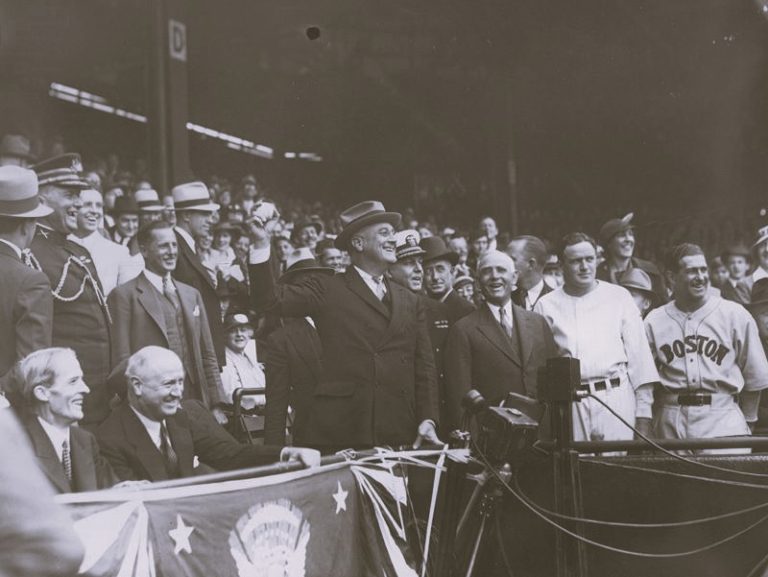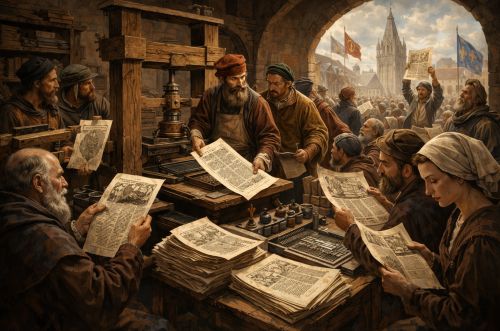
By lowering barriers to access and multiplying texts beyond institutional control, print redistributed intellectual power outward.

By Matthew A. McIntosh
Public Historian
Brewminate
Introduction: From Scriptoria to the Street
For much of the medieval world, knowledge moved slowly and selectively. Books were copied by hand, stored in monasteries, and guarded by institutions that controlled both access and interpretation. Texts were scarce, expensive, and embedded within hierarchies that treated learning as a privilege rather than a public good. Authority over meaning flowed downward from clerical and scholarly elites to lay audiences who encountered ideas primarily through sermons, lectures, and oral repetition. Knowledge existed, but circulation was limited by design.
The invention of the printing press fundamentally altered this equilibrium. By dramatically reducing the cost and time required to produce books, print transformed texts from rare objects into reproducible commodities. Knowledge no longer depended solely on institutional preservation. It could move outward into towns, markets, and households. Readers who had once relied on intermediaries could now encounter texts directly, privately, and repeatedly. This shift did not merely expand access. It changed the social location of knowledge itself.
As books moved from scriptoria to the street, authority over interpretation began to fragment. Readers were no longer bound to a single authorized explanation delivered from pulpit or lectern. Printed texts invited comparison, rereading, and dissent. Errors could be identified, arguments challenged, and meanings debated. This emerging culture of reading fostered habits of critical engagement that reshaped how individuals understood religion, politics, and the past. Knowledge became something one could argue with rather than simply receive.
These changes also laid the groundwork for public opinion as a social force. While modern mass politics lay centuries in the future, the printing press created the conditions for sustained collective engagement with ideas. Pamphlets, treatises, and vernacular books allowed arguments to circulate beyond courtly and clerical settings. Readers began to recognize themselves as part of wider communities of interpretation, connected not by proximity but by shared texts. Authority increasingly had to persuade rather than merely pronounce.
The story of the printing press is not simply one of technological innovation. It is a story about power, legitimacy, and participation. By altering who could access knowledge and how ideas traveled, print reshaped the relationship between institutions and the public. It did not eliminate hierarchy, but it destabilized monopolies over meaning. In doing so, it inaugurated a new intellectual landscape in which ideas could escape their custodians and enter the unpredictable arena of public judgment.
References
- Eisenstein, Elizabeth L. The Printing Press as an Agent of Change. Cambridge University Press.
- Febvre, Lucien, and Henri-Jean Martin. The Coming of the Book. Verso.
The Invention of Print and the Democratization of Knowledge

The invention of movable-type printing marked a decisive break with the economics of manuscript culture. Before print, the production of books required skilled labor, costly materials, and immense time. Each manuscript was effectively a unique object, copied line by line, vulnerable to error, loss, and decay. This scarcity reinforced intellectual hierarchy. Institutions that could afford scriptoria controlled what survived, what circulated, and who encountered written knowledge at all.
Print inverted this logic. Once a press was established, the marginal cost of producing additional copies dropped dramatically. A single typeset page could yield hundreds or thousands of near-identical texts. Books became reproducible at a scale previously unimaginable, and that reproducibility reshaped access. While early printed books were still expensive by modern standards, they were vastly more affordable than manuscripts. Merchants, artisans, professionals, and increasingly even skilled laborers could purchase texts outright rather than rely on institutional mediation.
This economic shift relocated knowledge from cloistered spaces into urban life. Bookshops emerged as sites of intellectual exchange. Private libraries, once the preserve of monasteries and aristocrats, expanded among the urban middle classes. Ownership mattered. Possessing a book meant control over when and how it was read, revisited, or shared. Knowledge no longer required physical presence within an institution. It could travel, accumulate, and persist within households.
The democratization of knowledge did not imply universal literacy or equal access, but it did expand the range of participants in intellectual culture. Readers who stood outside traditional centers of learning could now engage texts directly. Practical manuals, devotional works, histories, and polemics circulated alongside classical and theological texts. Print diversified not only audiences but genres, accommodating everyday concerns as well as elite scholarship. Knowledge increasingly reflected the interests of its consumers rather than solely the priorities of its custodians.
This expansion also altered the authority of the written word itself. Manuscripts often carried the weight of tradition and sanctity, tied to institutions that validated their content. Printed texts, by contrast, appeared in multiple editions, sometimes with corrections, sometimes with contradictions. Readers encountered variation and learned to evaluate reliability. The very abundance of print encouraged comparison and judgment, weakening the assumption that a single text or voice held unquestionable authority.
The printing press did more than make books cheaper. It redistributed epistemic power. Knowledge became something that could be owned, contested, and circulated outside institutional control. While inequalities persisted, the center of gravity shifted decisively toward the public. Print did not abolish hierarchy, but it fractured monopolies over learning and opened intellectual life to negotiation, debate, and reinterpretation.
References
- Febvre and Martin. The Coming of the Book.
- Burke, Peter. A Social History of Knowledge. Polity.
Print, Individual Interpretation, and the Erosion of Clerical Authority
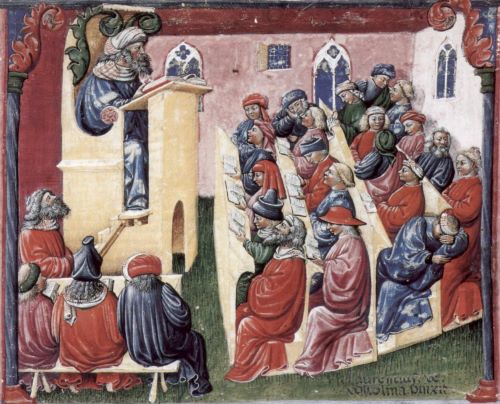
The spread of printed texts transformed not only who could access knowledge, but how meaning itself was produced. In manuscript culture, interpretation was mediated through institutional authority. Scripture, theology, and doctrine were explained by clergy who functioned as custodians of both text and meaning. The act of reading was often communal and guided, reinforcing dependence on authorized interpreters. Print disrupted this relationship by enabling private, silent, and repeated reading, shifting interpretive agency toward the individual.
Private reading altered the psychology of belief. Readers could pause, reflect, compare passages, and return to texts without clerical supervision. This fostered an interiorized relationship with written authority, particularly in religious contexts. Scripture no longer existed solely as something proclaimed from the pulpit. It became an object of personal engagement. The possibility of divergent interpretation emerged not from rebellion alone, but from the simple fact of access.
As texts circulated more widely, contradictions and inconsistencies became harder to contain. Readers encountered multiple commentaries, translations, and editions, often presenting competing interpretations. This plurality undermined the assumption that doctrinal meaning was fixed and singular. Clerical authority, long grounded in interpretive monopoly, now faced readers who could cite texts directly and question official explanations using the same written sources.
Print also amplified disputes that might once have remained local. Interpretive disagreements could be reproduced, distributed, and sustained across regions. A contested reading in one city could appear in pamphlet form hundreds of miles away within weeks. Clerical institutions struggled to suppress or control these debates because the mechanisms of circulation lay outside ecclesiastical structures. Authority increasingly had to argue rather than decree.
The erosion of clerical authority was therefore not simply the result of ideological opposition. It was structural. Print reconfigured the relationship between text, reader, and institution. By empowering individuals to engage written sources directly, it weakened the foundations of mediated interpretation. Clerical authority persisted, but it now existed within a competitive environment in which belief was shaped as much by reading and comparison as by instruction and tradition.
References
- Eisenstein. The Printing Press as an Agent of Change.
- Ozment, Steven. The Age of Reform. Yale University Press.
Print and the Protestant Reformation

The Protestant Reformation cannot be understood apart from the printing press. While theological dissent had existed long before the sixteenth century, earlier reform movements struggled to sustain momentum beyond local contexts. Print changed the scale and speed of religious controversy. Ideas that might once have circulated orally or through limited manuscript exchange now moved rapidly through pamphlets, sermons, and short treatises designed for wide distribution. The Reformation became not only a theological rupture but a media phenomenon.
Printed pamphlets proved especially powerful. They were inexpensive, portable, and accessible to readers with modest literacy. Reformers used them to distill complex theological arguments into sharp, memorable claims. Satire, woodcut illustrations, and vernacular language expanded their reach beyond university-trained elites. Religious debate entered taverns, marketplaces, and homes, transforming faith from an inherited structure into a contested public conversation.
The rapid spread of reformist ideas owed less to centralized organization than to decentralized reproduction. Printers, motivated by profit as much as conviction, reproduced texts that sold quickly. Controversy generated demand, and demand accelerated circulation. Once reformist arguments proved popular, they became difficult to suppress. Ecclesiastical authorities could condemn heresy, but they could not easily halt presses operating across political jurisdictions.
Print also reshaped the authority of scripture itself. Translations into vernacular languages allowed lay readers to encounter biblical texts without Latin mediation. This access reinforced the principle that scripture could be read and judged by individuals rather than interpreted exclusively by clerical hierarchies. Competing translations and commentaries further emphasized that meaning was not singular or uncontested. Religious truth became something argued from texts rather than imposed by office.
The Reformation’s endurance depended on this sustained textual ecosystem. Pamphlets responded to pamphlets. Sermons were printed and reprinted. Confessions of faith circulated as reference points for belief. Print allowed reform movements to stabilize doctrine, train followers, and maintain coherence across distance. Without this infrastructure, reformist energy might have dissipated as earlier movements had done.
Print did not merely assist the Reformation. It structured it. The medium shaped the movement’s tactics, tone, and longevity. Religious authority shifted from institutional continuity toward persuasive argument addressed to a reading public. The Reformation demonstrated that control over belief increasingly depended on control over circulation, a lesson that would echo through later political and ideological struggles.
References
- Pettegree, Andrew. Brand Luther. Penguin.
- Ozment. The Age of Reform.
Literacy, Critical Thought, and the Expansion of the Reading Public

The growth of print culture and the expansion of literacy reinforced one another in a mutually accelerating cycle. As printed materials became more common and affordable, the incentive to learn to read increased. Literacy was no longer useful only for clerics, administrators, or scholars. It became a practical skill tied to commerce, devotion, and social mobility. Reading opened access not merely to sacred texts but to manuals, news, histories, and arguments that shaped everyday understanding of the world.
This expansion did not occur evenly or universally. Literacy remained stratified by region, gender, and class. Yet even partial literacy transformed intellectual life. Readers did not need exhaustive education to engage pamphlets, broadsheets, or short devotional works. The rise of simplified formats encouraged participation by those previously excluded from sustained textual culture. Reading became less a marker of elite status and more a shared social practice embedded in urban life.
As literacy spread, so did habits of critical engagement. Printed texts invited scrutiny in ways oral transmission did not. Readers could linger over passages, question claims, and compare arguments across different works. Disagreement became visible on the page. Contradictory pamphlets, marginal notes, and revised editions encouraged readers to recognize that texts were constructed, not immutable. This awareness fostered skepticism toward authority grounded solely in tradition or office.
The act of reading itself changed cognitive expectations. Print encouraged linear argumentation, cross-referencing, and systematic reasoning. Readers became accustomed to weighing evidence and following chains of logic rather than relying on memorization or repetition. These skills extended beyond religious or scholarly contexts into political and social debate. Literacy thus functioned not only as a technical ability but as a training ground for critical thought.
Reading also became a collective activity despite its private form. Books and pamphlets circulated through lending, reading aloud, and discussion. Households, guilds, and informal gatherings functioned as interpretive communities where texts were debated and contested. Literacy did not isolate individuals. It connected them through shared reference points, enabling collective judgment even among those with limited access to formal education.
The expansion of the reading public therefore altered the balance between authority and audience. Institutions could no longer assume passive reception of their claims. Readers increasingly evaluated arguments, questioned legitimacy, and formed opinions grounded in textual comparison. Literacy did not guarantee dissent, but it made acquiescence less automatic. In this way, the spread of reading transformed intellectual culture from one of transmission to one of engagement.
References
- Chartier, Roger. The Cultural Uses of Print. Princeton University Press.
- Burke. A Social History of Knowledge.
Vernacular Printing and the Standardization of Language

The expansion of printing in vernacular languages marked a decisive cultural shift away from Latin as the exclusive medium of learning and authority. While Latin had long functioned as a unifying scholarly language, it also limited participation to educated elites. Printing in local tongues broadened access to texts and anchored knowledge within everyday speech. Readers could now encounter religious, historical, and political ideas in the language they used at home and in the marketplace.
This shift had profound standardizing effects. Before print, vernacular languages existed primarily as spoken forms, marked by regional variation in vocabulary, spelling, and grammar. Manuscripts often reflected local usage and personal preference. Printing imposed consistency. Printers had to choose spellings, grammatical forms, and syntactic conventions that could be reproduced across editions. Over time, these choices stabilized usage and created recognizable linguistic norms.
Standardization reinforced shared cultural identity. As readers across regions encountered the same printed forms of their language, differences softened and common reference points emerged. Language became a marker of collective belonging rather than purely local custom. This process did not erase dialects, but it established a dominant written form that carried social and cultural authority. Print thus helped transform language into a unifying national medium.
Vernacular printing also altered the relationship between language and power. When religious texts, laws, and political arguments appeared in local languages, authority became more transparent and more contestable. Readers could scrutinize claims without relying on clerical or scholarly translation. This accessibility intensified debate and widened participation in intellectual life. Language ceased to function solely as a barrier protecting expertise and increasingly served as a bridge connecting institutions to the public.
The standardization of vernacular languages through print therefore shaped both communication and consciousness. It provided the linguistic infrastructure for broader public discourse, enabling readers to imagine themselves as part of larger communities bound by shared language and texts. In doing so, print laid foundations for cultural cohesion that would later support political and national identities, long before the emergence of modern nation-states.
References
- Anderson, Benedict. Imagined Communities. Verso.
- Eisenstein. The Printing Press as an Agent of Change.
Print and the Rise of Political and Scientific Discourse

The spread of print reshaped political and scientific communication by creating durable publics for sustained argument. Before print, political ideas circulated largely through courtly correspondence, proclamations, or oral transmission. Scientific knowledge moved within narrow scholarly networks, often preserved in manuscript form and guarded by institutional gatekeepers. Print altered these conditions by allowing arguments to persist beyond the moment of delivery and to reach audiences far removed from centers of power.
Printed pamphlets and treatises enabled political debate to move into public view. Arguments about governance, law, taxation, and authority could now be presented to readers who were neither officials nor scholars. Writers addressed an imagined audience capable of judgment, persuasion, and disagreement. Political legitimacy increasingly depended on the ability to justify actions through reasoned explanation rather than sheer command. This shift marked an early transformation of power from performative authority to discursive persuasion.
The reproducibility of print also stabilized political ideas over time. Texts could be referenced, quoted, and contested across generations. Political thought became cumulative rather than episodic. Readers could compare past arguments with present claims, exposing contradictions and continuities. This archival function strengthened accountability by preserving records that could be used to challenge authority or defend reform.
Scientific discourse underwent a similar transformation. Print enabled scholars to share observations, experiments, and hypotheses with unprecedented precision and consistency. Errors could be identified and corrected across editions. Discoveries could be replicated and debated rather than confined to isolated intellectual circles. Scientific knowledge increasingly depended on public scrutiny and peer evaluation rather than personal reputation or institutional rank.
Printed scientific works also reshaped expectations about evidence and method. Diagrams, tables, and standardized terminology allowed readers to follow arguments step by step. Knowledge became something that could be verified through comparison rather than accepted on trust. This emphasis on transparency reinforced habits of skepticism and inquiry that extended beyond science into broader intellectual life.
Political and scientific texts frequently intersected. Arguments about natural law, sovereignty, and human nature drew on emerging scientific frameworks. Conversely, scientific inquiry often depended on political support and legitimacy articulated through print. The circulation of ideas across domains fostered an intellectual environment in which authority was increasingly provisional, contingent on persuasion rather than tradition.
The rise of political and scientific discourse through print thus contributed to a new public sphere defined by debate, reference, and continuity. Ideas acquired influence not simply through proclamation but through circulation and response. Print did not eliminate hierarchy or inequality, but it altered the mechanics of legitimacy. Power now operated within a landscape shaped by readers who could compare, remember, and judge.
References
- Habermas, Jürgen. The Structural Transformation of the Public Sphere. MIT Press.
- Chartier. The Cultural Uses of Print.
The Preservation and Revival of Classical Learning

The printing press played a crucial role in rescuing classical Greek and Roman texts from the fragility of manuscript transmission. Before print, many ancient works survived in only a handful of copies, vulnerable to loss, corruption, or neglect. Errors introduced through repeated hand-copying accumulated over centuries, and entire texts disappeared when manuscripts decayed or libraries were destroyed. Print stabilized this precarious inheritance by allowing texts to be reproduced accurately and preserved across multiple locations.
Printed editions transformed classical scholarship by enabling comparison and correction. Scholars could collate multiple manuscript versions of a single work, identify inconsistencies, and produce standardized texts. Once printed, these editions fixed a reference point that could be shared widely. Classical authors were no longer confined to isolated archives. Their works became accessible to scholars across Europe, creating a shared intellectual foundation for study and debate.
This accessibility fueled the revival of classical learning associated with Renaissance humanism. Ancient texts were read not merely as historical curiosities but as sources of insight into ethics, politics, rhetoric, and human nature. Print allowed these ideas to circulate beyond elite scholarly circles into schools, universities, and private libraries. Classical learning thus became a living resource rather than a preserved relic, shaping education and intellectual life on a broad scale.
The standardization provided by print also reshaped how the past was understood. Readers encountered ancient authors in relatively consistent forms, encouraging close reading and systematic interpretation. Commentary traditions developed around printed texts, fostering dialogue between classical sources and contemporary concerns. Print enabled scholars to situate themselves within a continuous intellectual lineage, reinforcing the authority of antiquity while also inviting critical engagement with it.
The preservation and dissemination of classical learning through print therefore had consequences beyond antiquarian interest. By making ancient texts widely available, the printing press reintroduced models of inquiry, argument, and civic reflection that challenged medieval intellectual frameworks. Classical ideas informed debates about governance, morality, and human potential, contributing to a broader transformation of thought. Print ensured that the voices of antiquity could speak again, not as echoes preserved by institutions, but as participants in an evolving public conversation.
References
- Grafton, Anthony. Defenders of the Text. Harvard University Press.
- Burke, Peter. The Renaissance Sense of the Past. St. Martin’s Press.
Conclusion: Print, Power, and the Birth of Public Opinion
The invention of the printing press reshaped not only how information circulated but how authority itself functioned. By lowering barriers to access and multiplying texts beyond institutional control, print redistributed intellectual power outward. Knowledge ceased to belong exclusively to clerics, courts, and scholars. It became something that readers could possess, question, and compare. This shift did not immediately produce democracy or equality, but it created the conditions under which authority increasingly had to justify itself to an audience capable of judgment.
Print transformed belief into a negotiable space. Religious doctrine, political legitimacy, and scientific claims were no longer insulated by scarcity or mediation. They entered a world of reproduction and response, where arguments could be answered and contradictions exposed. Public opinion emerged not as a single voice but as a process shaped by circulation, debate, and memory. The permanence of print allowed ideas to accumulate, confront one another, and endure beyond the moment of their articulation.
This transformation revealed a fundamental relationship between media and power. Institutions that once governed meaning through control of access now faced publics formed through shared texts. Authority shifted from proclamation to persuasion. The success of ideas depended increasingly on their ability to circulate, resonate, and withstand scrutiny. Print did not eliminate hierarchy, but it altered its mechanics, embedding power within networks of readers rather than isolating it within institutions.
The legacy of the printing press endures precisely because it exposed a truth that remains relevant across media revolutions: control over information is inseparable from control over legitimacy. By moving knowledge from scriptoria to the street, print inaugurated an age in which ideas could escape their custodians and enter collective judgment. In doing so, it laid the structural foundations of public opinion, ensuring that power would henceforth be contested not only by force or tradition, but by readers.
References
- Eisenstein. The Printing Press as an Agent of Change.
- Anderson. Imagined Communities.
Bibliography
- Anderson, Benedict. Imagined Communities: Reflections on the Origin and Spread of Nationalism. Verso, 1983.
- Burke, Peter. A Social History of Knowledge: From Gutenberg to Diderot. Polity Press, 2000.
- Burke, Peter. The Renaissance Sense of the Past. St. Martin’s Press, 1969.
- Chartier, Roger. The Cultural Uses of Print in Early Modern France. Princeton University Press, 1987.
- Eisenstein, Elizabeth L. The Printing Press as an Agent of Change: Communications and Cultural Transformations in Early-Modern Europe. Cambridge University Press, 1979.
- Febvre, Lucien, and Henri-Jean Martin. The Coming of the Book: The Impact of Printing, 1450–1800. Verso, 1976.
- Grafton, Anthony. Defenders of the Text: The Traditions of Scholarship in an Age of Science, 1450–1800. Harvard University Press, 1991.
- Habermas, Jürgen. The Structural Transformation of the Public Sphere: An Inquiry into a Category of Bourgeois Society. MIT Press, 1962.
- Ozment, Steven. The Age of Reform, 1250–1550: An Intellectual and Religious History of Late Medieval and Reformation Europe. Yale University Press, 1980.
- Pettegree, Andrew. Brand Luther: How an Unheralded Monk Turned His Small Town into a Center of Publishing, Made Himself the Most Famous Man in Europe, and Started the Protestant Reformation. Penguin Press, 2015.
Originally published by Brewminate, 12.25.2025, under the terms of a Creative Commons Attribution-NonCommercial-NoDerivatives 4.0 International license.
About the Author