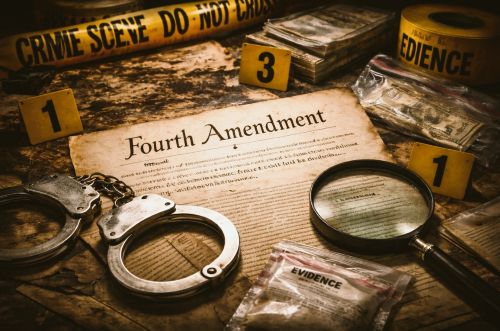
The modern Fourth Amendment is not the product of a single constitutional moment, but of a long judicial construction that linked principle to remedy.

By Matthew A. McIntosh
Public Historian
Brewminate
Introduction: The Fourth Amendment before Enforcement
For much of its early history, the Fourth Amendment functioned as a constitutional principle without a dependable mechanism of enforcement. Its language articulated a clear distrust of arbitrary search and seizure, grounded in colonial experience with general warrants and writs of assistance, yet it provided no explicit remedy when violations occurred. As a result, the Amendment’s promise remained largely theoretical. Courts acknowledged its moral authority, but individuals whose rights were violated often found themselves without meaningful judicial recourse.
This gap between principle and protection reflected a broader feature of early American constitutionalism. The founding generation assumed that constitutional limits would be respected largely through institutional self-restraint rather than judicial sanction. Remedies for unlawful searches were expected to arise through common-law actions against offending officers, political accountability, or legislative correction. The idea that courts would systematically exclude evidence obtained through unconstitutional conduct had not yet taken hold. Rights existed, but enforcement mechanisms were indirect and uncertain.
The absence of a clear remedy weakened the Fourth Amendment’s practical force. Even when courts recognized that government officials had acted unlawfully, evidence obtained through illegal searches was often admitted at trial. The logic was pragmatic rather than principled. Courts prioritized truth-seeking and conviction over deterrence, reasoning that excluding relevant evidence imposed too high a social cost. In this environment, the Amendment constrained official behavior only at the margins, offering little protection to individuals once the state had overstepped its bounds.
It was this structural deficiency that set the stage for a judicial transformation in the early twentieth century. The Fourth Amendment could not function as a genuine individual right so long as violations carried no consequence. Enforcement required a doctrinal shift that would link constitutional violation to judicial remedy. That shift began not with incorporation or privacy theory, but with a more basic insight: a right without an enforceable remedy is no right at all. The emergence of the exclusionary rule would mark the moment when the Fourth Amendment moved from aspiration to protection.
Weeks v. United States (1914): The Birth of the Exclusionary Rule

The Supreme Court’s decision in Weeks v. United States marked a decisive break with the Fourth Amendment’s long-standing status as a largely unenforced constitutional principle. The case arose from a routine federal prosecution in which law enforcement officers, acting without a warrant, entered Fremont Weeks’s home on multiple occasions and seized private papers later used to secure his conviction. The constitutional violation was clear. What remained unsettled was whether that violation carried any judicial consequence. The Court’s answer would fundamentally reshape the meaning of the Fourth Amendment.
In Weeks, the Court held that evidence obtained through an unconstitutional search and seizure by federal officers could not be admitted in a federal criminal trial. To permit such evidence, the Court reasoned, would render the Fourth Amendment meaningless. Constitutional protections could not survive if courts themselves became instruments for legitimizing illegal conduct. The exclusionary rule thus emerged not as an act of leniency toward defendants, but as a necessary safeguard of constitutional structure. Judicial integrity, not individual sympathy, formed the core of the Court’s reasoning.
The significance of Weeks lay in its insistence that rights require remedies. The Court rejected the notion that post hoc civil suits or internal discipline provided adequate deterrence against constitutional violations. Instead, it linked enforcement directly to the trial process, where the government’s interest in conviction intersected most sharply with individual liberty. Exclusion ensured that constitutional violations would carry tangible consequences for law enforcement agencies and prosecutors, reshaping investigative incentives at their source.
At the same time, Weeks imposed important limitations. The exclusionary rule announced by the Court applied only to federal officers and federal courts. State governments remained free to admit illegally obtained evidence, even when the same conduct would have been unconstitutional if committed by federal agents. This distinction reflected the prevailing understanding of federalism and the non-incorporation of the Bill of Rights. The Fourth Amendment had become enforceable, but only within a limited jurisdictional sphere.
Nevertheless, Weeks established a doctrinal foundation upon which later protections would be built. By insisting that constitutional violations must carry procedural consequences, the Court transformed the Fourth Amendment into a functional legal right. The decision introduced a new constitutional logic, one in which enforcement was inseparable from meaning. Although incomplete and confined to federal practice, the exclusionary rule announced in Weeks marked the moment when the Fourth Amendment began its evolution from principle to protection.
Federal Right, State Vulnerability: The Pre-Incorporation Gap

The exclusionary rule established in Weeks v. United States created an immediate asymmetry in Fourth Amendment enforcement. Federal officials were bound by a constitutional remedy that rendered illegally obtained evidence inadmissible, while state and local law enforcement operated under no such constraint. This divide reflected the prevailing constitutional doctrine that the Bill of Rights did not apply to the states, but it also exposed a structural weakness in rights protection. Individuals enjoyed robust safeguards against federal intrusion, yet remained vulnerable to identical abuses committed by state authorities.
State courts responded to this gap in divergent ways. Some adopted exclusionary rules as a matter of state law, either through constitutional interpretation or judicial policy. Others explicitly rejected exclusion, favoring alternative remedies such as civil suits or internal discipline. These alternatives, however, proved largely ineffective. Civil actions were costly, uncertain, and often unavailable to criminal defendants, while internal sanctions rarely deterred misconduct. In practice, many state courts continued to admit evidence obtained through unconstitutional searches, reasoning that the social interest in prosecution outweighed concerns about police behavior.
The Supreme Court initially declined to resolve this inconsistency. In Wolf v. Colorado (1949), the Court acknowledged that the Fourth Amendment’s core protections were fundamental and therefore applicable to the states through the Fourteenth Amendment. Yet it stopped short of requiring the exclusionary rule as a necessary component of that protection. The Court held that states were free to adopt other means of enforcing the Amendment, despite mounting evidence that such alternatives failed to curb violations. This compromise preserved the federal-state divide while gesturing toward incorporation without fully embracing it.
The pre-incorporation period thus revealed a central tension in Fourth Amendment jurisprudence. A right recognized as fundamental lacked a uniform remedy, leaving its enforcement dependent on geography rather than principle. The exclusionary rule existed, but only partially, undermining its deterrent effect and creating incentives for state law enforcement to disregard constitutional limits. This vulnerability underscored a growing realization within the Court that without a national standard, the Fourth Amendment could not function as a coherent individual right. The stage was set for a doctrinal shift that would close the gap between recognition and enforcement.
Incorporation and Transformation: Mapp v. Ohio (1961)
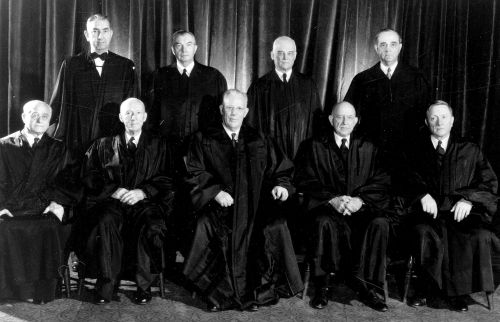
Beyond its doctrinal holding, Mapp signaled a recalibration of constitutional priorities. The Court placed the protection of individual liberty above the convenience of law enforcement and the expediencies of prosecution. By insisting that constitutional rights must be enforced uniformly, the decision acknowledged that the legitimacy of the criminal justice system depended on adherence to constitutional limits, not merely on outcomes. The Fourth Amendment was no longer treated as an aspirational guide for good policing, but as a binding rule governing state power.
The decision also reflected the broader jurisprudential ethos of the Warren Court, which viewed constitutional rights as living guarantees requiring active judicial protection. In this context, incorporation was not an act of federal intrusion for its own sake, but a corrective to historical failure. State systems had demonstrated an inability or unwillingness to police themselves where search and seizure abuses were concerned. Mapp thus framed federal judicial oversight as a necessary response to systemic inadequacy rather than an abandonment of federalism.
Dissenting justices warned of the costs of this transformation. They argued that exclusion would allow guilty defendants to escape punishment and would impose rigid national standards on diverse state systems. These concerns foreshadowed later retrenchment, but they did not prevent the immediate consolidation of the Fourth Amendment as an enforceable right. The majority accepted that constitutional guarantees entail social costs, and that the protection of liberty sometimes requires tolerating inefficiency or error within the justice system.
In the years following Mapp, its impact was unmistakable. State courts recalibrated procedures, police departments revised training and protocols, and the Fourth Amendment became a central feature of criminal litigation nationwide. The decision did not eliminate constitutional violations, but it altered incentives by attaching meaningful consequences to unlawful conduct. Mapp thus stands as the moment when incorporation became operational reality, completing the Fourth Amendment’s transition from a federal limitation into a national individual right.
Expansion of Protection: Privacy, Reasonableness, and the Modern Fourth Amendment
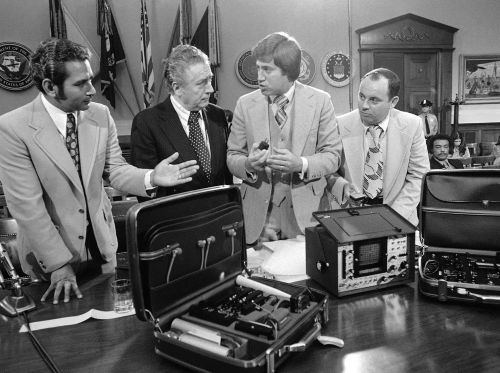
Following incorporation, the Supreme Court confronted a fundamental problem that the Fourth Amendment’s text did not neatly resolve. The Amendment speaks in the language of “persons, houses, papers, and effects,” a vocabulary rooted in eighteenth-century property concepts. Yet modern law enforcement increasingly relied on surveillance techniques that did not involve physical trespass. Wiretaps, electronic listening devices, and later digital monitoring challenged the assumption that searches required tangible intrusion. The Court was forced to decide whether the Fourth Amendment could adapt to new forms of investigation without losing its coherence.
That adaptation took decisive form in Katz v. United States (1967). In rejecting a property-based approach, the Court held that the Fourth Amendment protects people rather than places. The government’s attachment of an electronic listening device to a public phone booth constituted a search because it violated the individual’s reasonable expectation of privacy. This doctrinal shift marked a turning point. Constitutional protection no longer depended on ownership, location, or physical penetration, but on whether government conduct intruded upon a sphere of privacy society was prepared to recognize as legitimate.
The reasonable expectation of privacy test expanded the Fourth Amendment’s reach while simultaneously introducing new ambiguity. Unlike property boundaries, expectations of privacy are contingent and socially constructed. What society is prepared to recognize as reasonable may change over time, shaped by technology, cultural norms, and judicial perception. This flexibility allowed the Amendment to remain relevant, but it also placed substantial interpretive power in the hands of judges, who were tasked with defining the contours of privacy in an evolving landscape.
In the decades that followed Katz, the Court applied this framework to a wide range of investigative practices. Decisions addressing aerial surveillance, thermal imaging, and beeper tracking reflected ongoing tension between law enforcement innovation and constitutional restraint. In some cases, the Court emphasized diminished expectations of privacy in public spaces. In others, it reaffirmed that technological enhancement of surveillance could cross constitutional boundaries even where physical presence would not. The Fourth Amendment thus became increasingly context-dependent, balancing investigative necessity against privacy interests rather than enforcing categorical rules.
The concept of reasonableness emerged as the organizing principle of modern Fourth Amendment doctrine. Courts evaluated searches by weighing the degree of intrusion against the government’s asserted interests. This balancing approach permitted nuanced judgments but also diluted the clarity of constitutional protection. Searches were no longer presumptively unreasonable absent a warrant. Instead, reasonableness became a flexible standard that could accommodate expanding state power under the right conditions.
Despite these ambiguities, the expansion of privacy-based protection represented a significant strengthening of the Fourth Amendment as an individual right. By severing constitutional safeguards from rigid property concepts, the Court ensured that technological progress would not render the Amendment obsolete. The modern Fourth Amendment became dynamic rather than static, capable of responding to new forms of surveillance while preserving its core purpose. At the same time, this evolution introduced vulnerabilities. A right defined by reasonableness rather than rule is inherently subject to recalibration, leaving its future dependent on judicial interpretation as much as constitutional text.
The “Fruit of the Poisonous Tree”: Strengthening the Exclusionary Framework

The exclusionary rule announced in Weeks and nationalized in Mapp addressed only the most direct form of constitutional violation: the admission of evidence seized through unlawful searches. Yet this protection proved incomplete. Law enforcement could still benefit indirectly from unconstitutional conduct by using illegally obtained information as a lead to discover additional evidence through ostensibly lawful means. Without further doctrinal development, the Fourth Amendment’s deterrent effect risked erosion through strategic circumvention rather than overt defiance.
The Supreme Court confronted this problem in Silverthorne Lumber Co. v. United States (1920), where federal agents seized documents illegally, made copies, and then sought to compel their production through a subpoena. The Court rejected this maneuver, holding that the government could not exploit knowledge gained from unconstitutional searches. Justice Holmes famously warned that allowing such practices would reduce the Fourth Amendment to a formality, easily evaded by indirect means. The metaphor that emerged from this reasoning, later termed the “fruit of the poisonous tree,” captured the principle that constitutional violations taint not only their immediate products but their derivative consequences.
This doctrine reached fuller articulation in Wong Sun v. United States (1963), where the Court refined the scope and limits of derivative exclusion. The decision recognized that not all evidence causally linked to an illegal search must be excluded. Instead, courts were instructed to examine whether the connection between the constitutional violation and the challenged evidence had become sufficiently attenuated. This approach preserved the core deterrent function of exclusion while acknowledging practical limits. The Fourth Amendment’s enforcement mechanism thus became more sophisticated, balancing constitutional integrity against evidentiary necessity.
The strengthening of the exclusionary framework through derivative exclusion marked a crucial maturation of Fourth Amendment doctrine. By preventing law enforcement from capitalizing on unconstitutional conduct at any stage of investigation, the Court closed a significant loophole. Exclusion was no longer confined to the initial moment of violation. It extended forward through the investigative chain, reinforcing the principle that constitutional compliance must precede, rather than follow, evidentiary success.
At the same time, the development of attenuation, independent source, and inevitable discovery doctrines signaled an emerging judicial effort to contain the breadth of exclusion. These qualifications did not negate the fruit of the poisonous tree doctrine, but they introduced flexibility that would later serve as a foundation for retrenchment. Even in its strengthened form, exclusion remained a contested remedy, shaped by competing concerns over deterrence, fairness, and institutional cost. Nonetheless, the expansion of the exclusionary framework represented a high-water mark in the Court’s commitment to ensuring that Fourth Amendment violations carried meaningful and enduring consequences.
Retrenchment and Exceptions: Limiting the Exclusionary Rule
Beginning in the late twentieth century, the Supreme Court reassessed the costs and benefits of the exclusionary rule, signaling a shift from expansion toward limitation. While the Court did not repudiate exclusion outright, it increasingly framed the rule as a judicially created remedy rather than a constitutional requirement inherent in the Fourth Amendment itself. This reframing altered the analytical baseline. Instead of asking whether exclusion was necessary to vindicate a right, the Court asked whether exclusion would meaningfully deter police misconduct in particular circumstances.
The most consequential expression of this shift came in United States v. Leon (1984), where the Court announced the good-faith exception to the exclusionary rule. Evidence obtained pursuant to a defective warrant would not be excluded, the Court held, if law enforcement officers acted in objectively reasonable reliance on the warrant’s validity. The emphasis moved away from the violation itself and toward the culpability of police conduct. Exclusion was no longer automatic. It became contingent on a showing that suppression would serve a deterrent purpose.
Related doctrines soon followed, further narrowing the rule’s reach. The independent source and inevitable discovery exceptions permitted the admission of evidence if the government could demonstrate that it would have been discovered through lawful means, even if an initial constitutional violation occurred. These doctrines preserved the appearance of deterrence while reducing its practical scope. The focus shifted from safeguarding constitutional boundaries to preventing what the Court increasingly characterized as undue interference with the truth-seeking function of trials.
This retrenchment marked a significant recalibration of Fourth Amendment enforcement. The exclusionary rule survived, but its application became conditional, fact-specific, and increasingly rare in contested cases. Critics argued that the proliferation of exceptions undermined deterrence by signaling that constitutional violations would often carry no consequence. Supporters countered that exclusion had become overbroad and socially costly. What emerged was a Fourth Amendment defined less by categorical protection than by balancing tests and judicial discretion. The Amendment remained enforceable, but its remedies were no longer assured.
Technology, Surveillance, and the Struggle for Relevance

As law enforcement capabilities advanced in the late twentieth and early twenty-first centuries, the Fourth Amendment confronted challenges that its architects could not have anticipated. Digital communications, location tracking, and data aggregation enabled forms of surveillance far more pervasive than physical searches. These developments raised a fundamental question. Could constitutional doctrines crafted in an era of tangible intrusion adequately restrain investigative techniques that operated invisibly and continuously?
The Supreme Court’s response revealed both adaptability and uncertainty. In United States v. Jones (2012), the Court held that long-term GPS tracking of a vehicle constituted a search, grounding its reasoning in the physical trespass involved in attaching the device. While the decision curtailed warrantless tracking, it also exposed the limitations of relying on property concepts to address digital surveillance. Concurring opinions signaled growing concern that prolonged monitoring itself, rather than physical intrusion, posed the greater constitutional threat.
This concern became more explicit in Riley v. California (2014), where the Court recognized that modern cell phones contain vast quantities of personal information, rendering traditional search-incident-to-arrest doctrines inadequate. By requiring warrants for most cell phone searches, the Court acknowledged that digital devices demand heightened constitutional protection. The decision reaffirmed the Fourth Amendment’s relevance by adapting its principles to contemporary realities, emphasizing privacy interests over investigatory convenience.
Yet these decisions also underscored the fragility of Fourth Amendment protection in the digital age. Doctrines such as the third-party rule, which permits warrantless access to information voluntarily shared with others, continued to erode privacy in an era defined by data dependence. The Court’s efforts to recalibrate constitutional standards have been cautious and incremental, leaving unresolved tensions between technological innovation and constitutional restraint. The Fourth Amendment persists as a meaningful safeguard, but its future effectiveness depends on whether judicial interpretation can keep pace with the expanding reach of surveillance.
The Contemporary Fourth Amendment: Right, Remedy, or Balancing Test?
In its contemporary form, Fourth Amendment jurisprudence reflects a persistent tension between categorical rights and contextual balancing. While the Amendment continues to be described as a fundamental individual protection, its practical application increasingly turns on judicial assessments of reasonableness, cost, and institutional competence. Courts ask not only whether a search occurred, but whether suppressing evidence would meaningfully deter misconduct, whether officers acted in good faith, and whether societal interests outweigh the intrusion. The result is a constitutional right whose enforcement varies with circumstance rather than operating as a fixed boundary.
This evolution has shifted the Fourth Amendment’s center of gravity away from warrants and toward post hoc evaluation. Although the warrant requirement remains a formal touchstone, numerous exceptions permit searches based on exigency, consent, administrative necessity, or diminished expectations of privacy. In many cases, courts uphold searches by emphasizing the absence of flagrant misconduct rather than the presence of constitutional authorization. This approach reframes the Amendment as a flexible standard to be optimized rather than a rule to be enforced, blurring the distinction between legality and expedience.
Remedies have undergone a similar transformation. Exclusion persists as the primary enforcement mechanism, yet its application is increasingly rare in practice. Courts routinely deny suppression by invoking good faith, attenuation, or inevitable discovery, even when constitutional violations are acknowledged. This remedial narrowing has prompted renewed debate over whether the Fourth Amendment still functions as a meaningful constraint on state power. If violations produce no consequence, critics argue, the Amendment risks returning to its pre-Weeks condition as a principle honored in theory but diluted in effect.
At the same time, the Court has occasionally reaffirmed robust protection in contexts involving especially sensitive information or invasive technologies. Decisions addressing digital data, long-term surveillance, and biometric identification suggest an awareness that unchecked state access threatens core privacy interests. Yet these interventions are selective rather than comprehensive. They coexist uneasily with doctrines that permit broad data collection through intermediaries, administrative regimes, or national security rationales. The Fourth Amendment thus oscillates between affirmation and accommodation, expanding in some domains while contracting in others.
The contemporary Fourth Amendment, then, resists simple characterization. It remains an individual right in doctrine, a remedial system in practice, and a balancing test in application. Its effectiveness depends less on textual command than on judicial willingness to impose consequences for violation. The enduring question is not whether the Amendment protects privacy, but under what conditions that protection yields to competing interests. As enforcement becomes increasingly contingent, the Fourth Amendment’s future as a solid individual right rests on whether courts continue to treat remedies as essential rather than optional.
Conclusion: A Right Built by Courts, Sustained by Vigilance
The modern Fourth Amendment is not the product of a single constitutional moment, but of a long judicial construction that linked principle to remedy. From Weeks v. United States onward, the Amendment acquired practical force only when courts attached consequences to violation. Exclusion, incorporation, and the development of derivative doctrines transformed a broadly worded prohibition into an enforceable individual right. This history makes clear that constitutional text alone did not secure privacy. Judicial willingness to enforce it did.
That same history also reveals the Amendment’s fragility. Each stage of expansion was accompanied by qualification. Each doctrinal advance was followed by retrenchment. The exclusionary rule, once framed as essential to constitutional meaning, came to be treated as a discretionary tool. Privacy, once grounded in warrants and categorical protections, became subject to balancing tests and contextual exceptions. The Fourth Amendment survived these shifts, but its solidity increasingly depended on judicial judgment rather than constitutional command.
The digital age has intensified this dependence. As surveillance becomes more comprehensive and less visible, the distance between intrusion and accountability grows. Courts have shown an ability to adapt doctrine to new realities, yet they have done so selectively. Where remedies are narrowed, rights thin. Where exceptions proliferate, deterrence weakens. The lesson of Fourth Amendment history is consistent. Rights endure only when violations carry consequences that matter to the state.
The Fourth Amendment as it exists today is therefore best understood as a right built by courts and sustained by vigilance. Its protections are neither automatic nor self-executing. They persist through interpretation, enforcement, and resistance to erosion. If the Amendment has become a solid individual right, it is because courts chose to make it so. Whether it remains one will depend on whether future courts continue to treat remedies not as optional costs, but as essential to constitutional meaning.
Bibliography
- Amar, Akhil Reed. “Fourth Amendment First Principles.” Harvard Law Review 107, no. 4 (1994): 757–819.
- Carpenter v. United States, 585 U.S. 296 (2018).
- Davies, Thomas Y. “Recovering the Original Fourth Amendment.” Michigan Law Review 98, no. 3 (1999): 547–750.
- Hall, Kermit L. The Magic Mirror: Law in American History. New York: Oxford University Press, 1989.
- Herring v. United States, 555 U.S. 135 (2009).
- Katz v. United States, 389 U.S. 347 (1967).
- Kerr, Orin S. “The Fourth Amendment and New Technologies: Constitutional Myths and the Case for Caution.” Michigan Law Review 102, no. 5 (2004): 801–888.
- Kim, Matthew D. “The Exclusionary Rule and Judicial Integrity: An Empirical Study of Public Perceptions of the Exclusionary Rule.” Missouri Law Review 87:4 (2022): 1-74.
- Kyllo v. United States, 533 U.S. 27 (2001).
- Mapp v. Ohio, 367 U.S. 643 (1961).
- Murray v. United States, 487 U.S. 533 (1988).
- Nardone v. United States, 308 U.S. 338 (1939).
- Nix v. Williams, 467 U.S. 431 (1984).
- Olmstead v. United States, 277 U.S. 438 (1928).
- Riley v. California, 573 U.S. 373 (2014).
- Silverthorne Lumber Co. v. United States, 251 U.S. 385 (1920).
- Strauss, David A. The Living Constitution. New York: Oxford University Press, 2010.
- United States Constitution, amend. IV.
- United States v. Jones, 565 U.S. 400 (2012).
- United States v. Leon, 468 U.S. 897 (1984).
- Weeks v. United States, 232 U.S. 383 (1914).
- Wolf v. Colorado, 338 U.S. 25 (1949).
- Wong Sun v. United States, 371 U.S. 471 (1963).
Originally published by Brewminate, 01.26.2026, under the terms of a Creative Commons Attribution-NonCommercial-NoDerivatives 4.0 International license.
About the Author