Allegations of abuse on Capri did more than scandalize Rome; they shaped imperial memory, revealing how rumor, morality, and politics intertwined.

By Matthew A. McIntosh
Public Historian
Brewminate
Introduction: Moral Horror as Political Memory
Ancient accounts of Emperor Tiberius’ later years on Capri are among the most lurid in Roman historiography. Suetonius describes secluded gatherings, sexual transgression, and the corruption of youth, while Tacitus frames the emperor’s withdrawal from Rome as a descent into moral darkness. The imagery is calculated to shock. Young boys, hidden chambers, secret practices. The emperor becomes not merely distant but depraved. Yet the historian’s task is not to rehearse scandal. It is to interrogate the conditions under which scandal survives as memory.
The evidentiary problem is immediate and unavoidable. The most detailed narratives come from senatorial authors writing after Tiberius’ death, in a political culture shaped by elite resentment toward imperial authority and lingering anxieties about the erosion of republican norms. Tacitus, composing his Annals in the early second century, presents Tiberius as a ruler whose inner corruption gradually surfaced once he withdrew from Rome’s public gaze. His portrait is structured around suspicion, secrecy, and the corrosive effects of unaccountable power. Suetonius, writing in a biographical mode, collects anecdotes that emphasize personal vice and sensational detail, often without sustained analysis of political context. Both authors worked within a literary tradition that cast tyrants as sexually excessive, cruel, and morally inverted, drawing upon long-standing rhetorical associations between deviance and illegitimacy. Their accounts were shaped not only by evidence, but by genre expectations, audience assumptions, and the moralizing conventions of Roman elite culture. The Capri allegations emerge not as transparent documentation, but as texts embedded in factional politics, narrative patterning, and the enduring Roman impulse to explain autocracy through the language of vice.
Whether exaggerated, selectively reported, or partially grounded in fact, these stories perform political work. They construct an image of imperial power untethered from oversight, where distance from Rome becomes synonymous with moral collapse. Sexual deviance is not incidental; it functions as proof of illegitimate authority. Roman historiography repeatedly deploys the body as a site of political meaning. A ruler who violates natural or social boundaries symbolically violates the res publica itself. Moral horror becomes a language through which elite authors articulate broader anxieties about autocracy.
Yet an uncomfortable tension remains. During the years in which these alleged atrocities occurred, Rome did not fracture. Administration continued. Provincial governance functioned. Senators complied, competed, and survived within the structures of imperial rule. The endurance of institutions alongside narratives of depravity reveals the deeper significance of the Capri allegations. They demonstrate not only the character attributed to Tiberius, but the mechanics through which reputational narratives crystallize into historical memory long after the immediate political moment has passed.
The Sources: Senatorial Hostility and the Construction of Tyranny
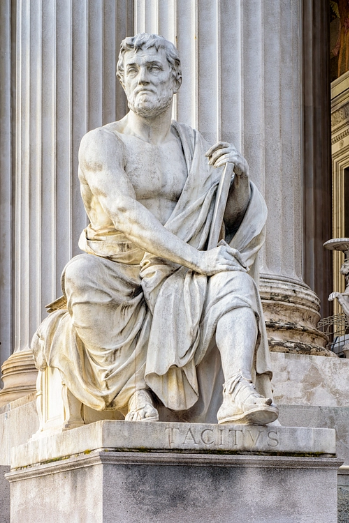
The image of Tiberius that dominates later memory is inseparable from the senatorial authors who transmitted it. Tacitus, Suetonius, and Cassius Dio wrote under emperors who ruled long after Tiberius’ death, in a political environment where retrospective judgment carried both literary and ideological weight. Their works reflect not merely recollection but interpretation. Each author confronted the problem of explaining how a system that preserved republican forms had consolidated monarchical authority. In that explanatory effort, character became a central analytic tool. Tiberius’ alleged moral descent functioned as a narrative key through which the transformation of Roman governance could be dramatized.
Tacitus is particularly significant. His Annals portray Tiberius as a master of concealment whose outward moderation masked a darker interior. The emperor’s withdrawal to Capri becomes, in Tacitus’ telling, the moment when dissimulation gives way to exposure. The narrative arc suggests inevitability, as though tyranny were a latent quality that distance merely allowed to flourish. Tacitus’ broader project was not biography alone but the moral diagnosis of imperial politics. He consistently emphasizes fear, suspicion, and the corrosive atmosphere of court life. Within that framework, sexual accusations intensify the portrayal of a ruler detached from civic virtue. The charge of exploitation is not isolated; it reinforces a pattern of moral inversion that Tacitus associates with unchecked power.
Suetonius approaches the material differently, yet the effect is complementary. Writing in a biographical mode, he arranges imperial lives around virtues and vices, cataloging anecdotes that reveal temperament and excess. His account of Tiberius’ activities on Capri is more sensational than analytical, dwelling on explicit detail and rumor. However, Suetonius was not simply indulging scandal. Roman biography often used personal conduct to signal political legitimacy. Excess, cruelty, and sexual deviance operated as recognizable markers of tyrannical rule. By assembling these stories, Suetonius situates Tiberius within a moral typology familiar to Roman readers, where private corruption mirrors public disorder.
Cassius Dio, composing in Greek more than a century later, further entrenches this tradition. His history integrates earlier narratives while adding interpretive commentary shaped by his own elite perspective. Dio underscores the tension between Tiberius’ administrative competence and his alleged moral failings. The coexistence of effective governance and personal depravity complicates the portrait, yet it also heightens the sense of contradiction that defines the emperor’s memory. In Dio’s account, the depravity of Capri does not negate Tiberius’ political skill; it coexists with it, producing a figure at once capable and corrupt.
These sources reveal less about isolated acts than about the construction of tyranny as a literary and political category. Roman elite authors repeatedly employed sexual transgression as a metaphor for constitutional violation, drawing on a long-standing rhetorical vocabulary in which bodily excess symbolized civic decay. To depict a ruler as predatory was to imply that he consumed the state itself, collapsing the boundary between private appetite and public authority. Senatorial hostility toward imperial centralization found expression in narratives of bodily excess and moral collapse, allowing grievance to assume a moralized form. The Capri allegations must be read within this rhetorical economy, where scandal serves not only as accusation but as interpretive framework. They are part of a broader discourse in which character, rumor, literary convention, and political resentment converge to produce a durable image of autocratic degeneration that would shape Tiberius’ legacy for centuries.
Autocratic Distance: Capri and the Politics of Withdrawal
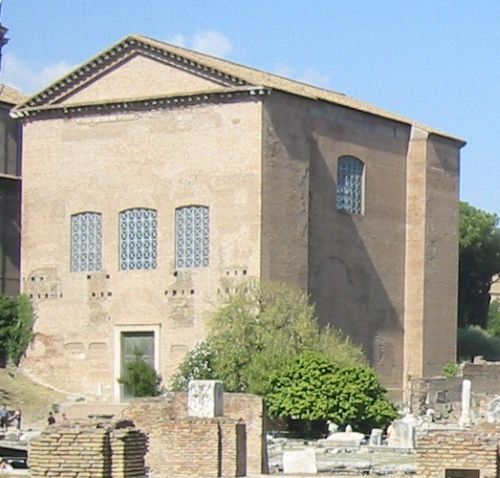
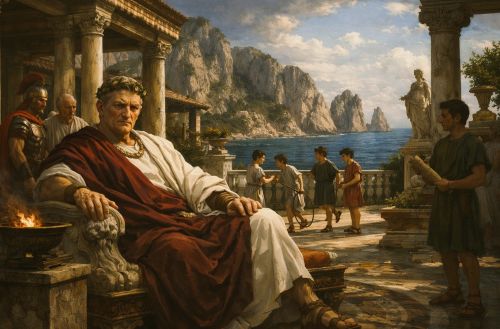
Tiberius’ withdrawal to Capri in 26 CE marked a turning point not merely in geography but in political perception. Roman governance had long depended upon visibility as a stabilizing principle. Even under the Principate, where monarchical authority operated beneath republican forms, the emperor’s presence in the city functioned as a symbolic reassurance that power remained anchored in Rome’s civic core. Public rituals, Senate meetings, judicial hearings, games, and ceremonial appearances reinforced a sense of accessibility, however managed and hierarchical that accessibility may have been. The emperor’s body in the city mattered. It signaled continuity with republican space and allowed elites to perform loyalty within a recognizable framework. When Tiberius relocated to an island villa off the Campanian coast, he did more than remove himself from Rome’s daily rhythms. He altered the spatial relationship between ruler and ruled, creating a physical and symbolic gap that redefined how authority was seen, imagined, and narrated.
Distance reshapes authority by transforming perception into interpretation. In republican tradition, proximity implied accountability, even if that accountability had narrowed under imperial consolidation. Withdrawal disrupted that expectation and unsettled elite habits of access. From Capri, Tiberius governed through correspondence, trusted freedmen, and intermediaries who mediated imperial will. This arrangement was administratively workable and not unprecedented in Roman command structures, yet it was politically unfamiliar at the heart of the empire. The absence of routine visibility created informational asymmetry. Decisions continued to be made, but their origin appeared obscured. In such conditions, rumor thrives where observation fails. Reports of secretive behavior, moral excess, and hidden practices acquired plausibility precisely because verification was impossible. Capri became not simply a residence but a symbolic space onto which anxieties about autocratic opacity and unreviewable power could be projected.
The island setting intensified these perceptions. Roman political culture attached meaning to space. The city itself embodied civic order, memory, and shared participation. An emperor removed from that landscape could appear detached from its norms. Suetonius’ descriptions of hidden chambers and secluded practices draw rhetorical power from this geography. Seclusion suggests concealment, and concealment suggests transgression. Whether exaggerated or not, the imagery of isolation reinforced the idea that Tiberius had stepped outside the moral and institutional boundaries that structured Roman public life.
Yet withdrawal did not equal abdication. Administrative correspondence continued, provincial governors operated within established frameworks, and the machinery of imperial governance remained intact. The paradox of Capri lies here. Political distance generated moral suspicion without immediately destabilizing authority. Autocratic systems can function effectively even when the ruler is physically remote, provided institutional incentives and elite interests remain aligned. The politics of withdrawal demonstrate a broader dynamic: absence magnifies narrative, but narrative alone does not dismantle power.
Elite Compliance amid Moral Rumor
Elite survival strategies absorbed moral controversy into patterns of cautious accommodation, demonstrating how personal risk often outweighs collective indignation in autocratic settings. The Roman Senate continued to convene. Magistracies were filled. Provincial commands were assigned. Judicial proceedings advanced through established channels. Even as Tacitus records whispers of cruelty and excess, he also describes routine administrative business and senatorial maneuvering. This coexistence of scandal narrative and bureaucratic continuity reveals a central feature of the early Principate. Political systems do not dissolve simply because moral allegations circulate. They persist when institutional incentives remain intact and when elites calculate survival as preferable to confrontation.
Elite compliance under Tiberius was not necessarily enthusiastic endorsement. It was structured adaptation shaped by fear, ambition, and institutional dependency. Senators depended upon imperial favor for advancement, security, and protection from prosecution. The emperor influenced appointments, governed access to patronage networks, and played a decisive role in trials, particularly those involving charges of maiestas. In such an environment, public dissent carried enormous personal risk. Tacitus’ narratives of treason trials reveal how accusation itself could destroy reputations and fortunes, reinforcing caution among the political class. Moral revulsion, if it existed, could be privately expressed while outward loyalty was carefully performed. Tacitus’ depictions of flattery, guarded speech, and strategic silence illustrate how elite behavior adjusted to perceived danger. Compliance was not simply cowardice. It was a rational response to a system in which proximity to power offered opportunity but also exposure, and where miscalculation could prove fatal.
The persistence of loyalty amid rumor also reflects the asymmetry between information and action. Even if allegations about Capri were believed, they did not necessarily translate into coordinated resistance. Roman political culture lacked mechanisms for institutional removal short of conspiracy or military intervention. The Senate possessed symbolic authority but limited coercive capacity. As long as the legions remained loyal and the administrative system functioned, scandal alone could not dislodge the emperor. Elite frustration coexisted with structural constraint. Compliance was reinforced not only by fear but by the absence of viable alternatives.
This dynamic complicates simplistic readings of moral outrage as politically transformative. The Capri narratives demonstrate that public revulsion and institutional stability can operate simultaneously without contradiction. Elites may condemn in retrospect what they tolerated in practice, reshaping memory to distance themselves from earlier accommodation. Tacitus’ later moralization of senatorial behavior underscores this tension, portraying accommodation as both understandable within context and morally compromised in hindsight. The endurance of Tiberius’ rule despite persistent rumor illustrates a broader principle of autocratic governance. Power structures often survive moral crisis because the calculus of risk, reward, and institutional inertia favors continuity over rupture. Administrative durability in the early Principate depended less on personal virtue than on procedural continuity and distributed command.
Allegation, Propaganda, and the Problem of Truth
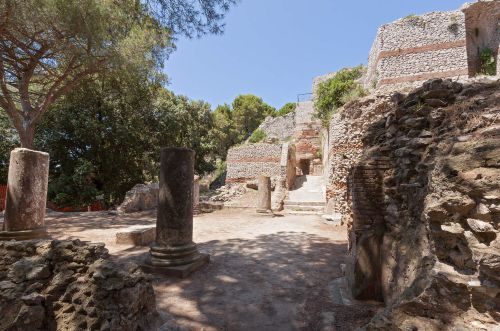
The Capri narratives force a methodological question that extends beyond Tiberius himself. How should historians treat allegations embedded in hostile literary traditions, particularly when those allegations concern acts designed to provoke disgust? The sources offer vivid detail but limited corroboration. Tacitus implies hidden vice revealed through distance, while Suetonius catalogs scandal as character evidence. Neither writer presents forensic proof in the modern sense. Instead, they rely on report, inference, and moral framing. The historian must navigate between credulity and reflexive dismissal, recognizing both the possibility of misconduct and the likelihood of rhetorical amplification.
Roman political culture did not sharply separate biography from moral judgment. Accusations of sexual deviance, cruelty, or ritual perversity were part of a recognizable repertoire used to depict tyrannical rulers. This repertoire predated Tiberius and persisted long after him. Charges against earlier and later emperors often follow similar narrative patterns, suggesting the operation of literary convention alongside possible fact. In this context, the Capri narratives participate in a broader discursive tradition in which moral outrage communicates political critique. The more extreme the vice, the clearer the indictment of autocratic power.
Propaganda, however, need not be fabricated to function politically. Selective emphasis can distort as effectively as invention. A ruler’s private behavior, if reprehensible, might be magnified to stand as a totalizing explanation of governance. Conversely, rumor may substitute for evidence when direct access to the ruler is limited. Capri’s seclusion made verification difficult and speculation attractive. The island becomes not only a setting but a narrative device that legitimizes hearsay. In such circumstances, the boundary between documented act and interpretive construction grows porous.
The problem of truth is further complicated by temporal distance and retrospective framing. Tacitus and Suetonius wrote under regimes that had little incentive to rehabilitate Tiberius’ reputation, and their works were shaped by the moral and political climates of their own times. Memory of his rule was filtered through subsequent developments, including the excesses attributed to later emperors and the evolving ideology of the Principate. Retrospective comparison can subtly reorder chronology, aligning earlier reigns within a moralized sequence of degeneration or warning. What may have been ambiguous, contested, or only partially known in lived experience becomes definitive in literary memory. Allegation hardens into character, and character becomes explanatory shorthand for political transformation. In this process, narrative coherence can override evidentiary uncertainty, giving the impression of inevitability where historical contingency once prevailed.
Modern scholarship has approached the Capri stories with measured caution rather than categorical rejection or uncritical acceptance. Some historians argue that while certain elements may reflect genuine misconduct consistent with broader patterns of elite exploitation in antiquity, the scale and sensationalism of the accusations reflect senatorial hostility and entrenched literary convention. Others emphasize the structural anxieties of Rome’s ruling class, suggesting that moral narratives offered a relatively safe medium through which to criticize the concentration of authority without directly challenging imperial legitimacy. The debate does not resolve the factual question entirely, nor can it, given the nature of the surviving evidence. Instead, it reframes the inquiry toward context, motive, and narrative function. The issue is not simply whether Tiberius committed specific acts, but how those acts, real or imagined, were mobilized to structure understanding of his reign and to encode elite judgment into the historical record.
The Capri allegations illustrate the instability of truth within autocratic contexts. Where transparency is limited and documentation scarce, narrative fills the void. Allegation can operate simultaneously as warning, weapon, and memory. For historians, the task is neither to sanitize nor to sensationalize, but to situate such stories within the political and literary ecosystems that produced them. In doing so, the focus shifts from isolated scandal to the mechanisms through which scandal acquires authority, shaping the afterlife of imperial power long after the emperor himself has vanished.
Moral Horror as Political Instrument
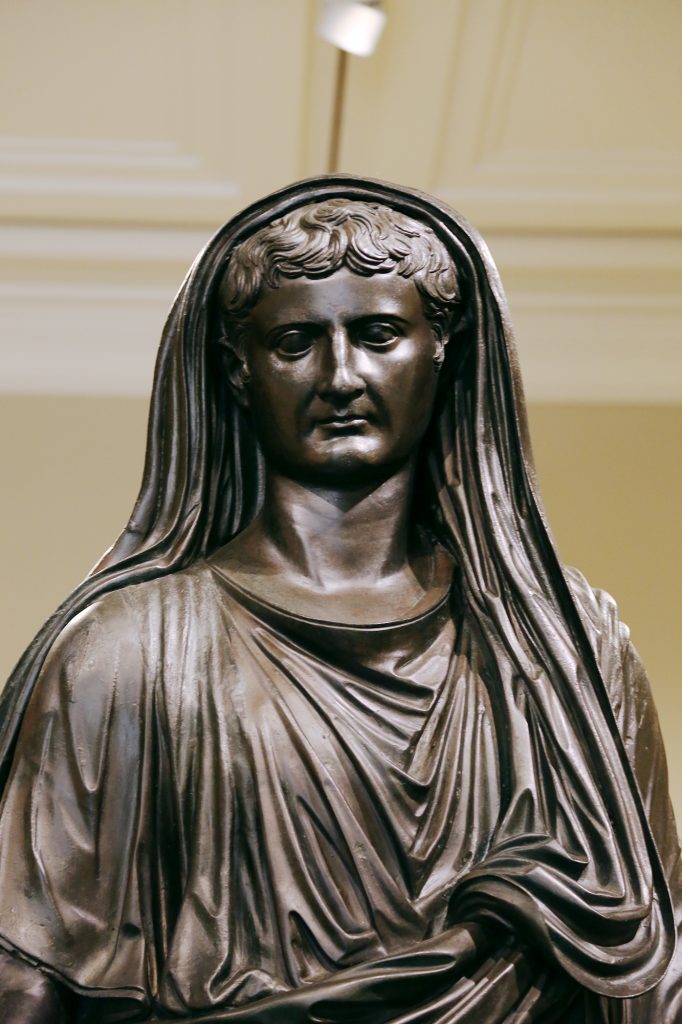
Narratives of moral horror do not arise in a vacuum. In Roman political writing, accusations of sexual deviance, cruelty, and ritual excess functioned as tools for defining the boundaries of legitimate rule. To depict an emperor as morally monstrous was to assert that he had crossed not merely ethical lines but constitutional ones. The language of outrage became a vehicle for political critique. In the absence of formal mechanisms to indict imperial authority, elite authors deployed scandal as a substitute courtroom, rendering judgment in prose rather than in law.
This pattern is visible across Roman historiography. Emperors portrayed as tyrannical are frequently associated with transgressive sexuality, theatrical cruelty, and contempt for traditional norms. Such depictions communicate more than personal failing. They encode a theory of power in which moral corruption mirrors political distortion. When a ruler’s private appetites appear unrestrained, the implication is that public authority has likewise slipped its limits. The body becomes allegory. Excess in the palace signals excess in governance. In this way, moral horror acquires explanatory force, transforming anecdote into political diagnosis.
The Capri allegations fit comfortably within this rhetorical structure. By emphasizing exploitation of the vulnerable and secret indulgence removed from civic oversight, the narratives present Tiberius as a ruler whose authority has become predatory. Whether every detail withstands scrutiny is, in a sense, secondary to the effect. The stories crystallize anxieties about concentrated power operating beyond the reach of collective supervision. They transform seclusion into symbol and rumor into indictment. Moral revulsion becomes a shorthand for constitutional imbalance.
Moral horror can operate as factional weapon rather than impartial critique. Elite competition within the Roman political class was intense, even under imperial consolidation. Patronage networks, rivalries for influence, and anxieties over proximity to imperial favor shaped the writing of history as much as the conduct of politics. Narratives that stain a ruler’s reputation may reflect not only principled opposition but strategic positioning within this competitive environment. By framing imperial authority as morally aberrant, authors could distance themselves and their class from complicity, presenting senatorial identity as the custodian of virtue and tradition. The sharper the denunciation, the clearer the implied contrast between corrupt autocrat and morally grounded elite. In this way, scandal becomes a mechanism of self-definition. It allows the political class to reclaim moral authority symbolically, even if it lacked the institutional capacity to restrain imperial power in practice.
Yet moral horror is rarely purely fabricated. Autocratic environments generate real opportunities for abuse, particularly where oversight is minimal and loyalty is rewarded over transparency. The concentration of authority, the insulation of the ruler from routine scrutiny, and the dependence of subordinates upon favor create conditions in which exploitation can occur with limited accountability. The problem lies in scale, emphasis, and interpretive framing. Genuine misconduct can be expanded into emblematic depravity, while rumor may attach itself to plausible patterns of elite excess. The political instrumentality of scandal does not negate the possibility of wrongdoing; rather, it shapes how that wrongdoing is narrated and remembered. Allegation becomes a lens through which broader fears about unregulated power are refracted. The historian must hold two possibilities simultaneously: abuse may have occurred within structures that permitted it, and its narrative amplification may have served broader rhetorical and ideological aims.
Moral horror functions as both revelation and construction. It exposes anxieties about power while constructing a durable image of illegitimacy. For Tiberius, the Capri stories became a defining element of his posthumous reputation, shaping how later generations interpreted his reign. The endurance of these narratives suggests that scandal can outlive administrative achievement and policy competence. Moral outrage, once embedded in literary tradition, becomes a political artifact in its own right, influencing memory long after the immediate circumstances have faded.
Stability amid Scandal: Why Institutions Endure
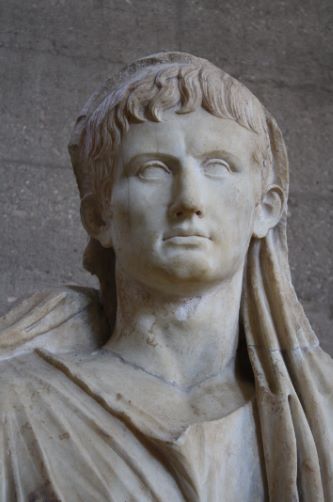
The endurance of Roman governance during the Capri years challenges any assumption that moral scandal necessarily produces political collapse. While senatorial authors later framed Tiberius’ withdrawal as a descent into depravity, the structures of imperial administration continued to operate with remarkable consistency. Provincial taxation proceeded, military frontiers remained guarded, and legal cases moved through established channels. The Principate had by this point developed routines and hierarchies that did not depend upon the emperor’s daily visibility in the capital. Institutional continuity rested less on charisma than on bureaucratic adaptation and entrenched incentives.
One reason for this durability lies in the distribution of power across administrative layers. Governors, procurators, and military commanders exercised delegated authority within defined parameters, guided by precedent and supervised through correspondence rather than constant personal oversight. Their careers depended upon stability, not upheaval, and their authority was embedded within a broader system of imperial command that did not dissolve with rumor. Even if moral stories about Capri circulated among Rome’s elites, those charged with managing distant provinces were more concerned with order, revenue collection, legal adjudication, and the maintenance of frontier security. The empire’s vast geography diluted the immediate political impact of metropolitan scandal, creating buffers between narrative crisis and administrative function. Provincial governance relied upon predictable chains of command and institutional memory. These structures enabled continuity even when the emperor’s reputation was contested at the center.
Elite self-interest further reinforced continuity. Senators and equestrians had invested heavily in the imperial system, whether through patronage networks, financial ties, or judicial responsibilities. The cost of systemic rupture was high. Conspiracy required coordination and military backing, both of which carried enormous risk. In contrast, accommodation allowed careers to proceed and fortunes to grow. Tacitus’ portrayal of cautious compliance illustrates this pragmatic calculation. Even if private disapproval simmered, public alignment with the reigning emperor remained the rational strategy for most political actors.
Institutional inertia also plays a role in understanding endurance. Political systems develop momentum through habit, precedent, and procedural repetition. Once established, they resist sudden disruption absent external shock such as military defeat or succession crisis. The Roman Principate had already survived the volatile transitions following Augustus’ death, including tensions surrounding the consolidation of Tiberius’ authority. By the time of the Capri withdrawal, mechanisms of succession, patronage distribution, and command hierarchy were sufficiently embedded to withstand reputational turbulence. Administrative offices continued to function because their operation depended upon procedural continuity rather than the daily moral standing of the emperor. Moral narratives, however powerful rhetorically, do not automatically dismantle fiscal systems, military loyalties, or bureaucratic routines. They operate in the realm of perception, while institutions operate in the realm of structured practice.
The case of Capri illustrates a broader principle of political resilience. Scandal may reshape legacy, alter elite memory, and provide later historians with dramatic material, yet it does not necessarily erode the operational core of governance. Institutions endure when incentives align, when coercive structures remain intact, and when alternatives appear more dangerous than continuity. The Roman state under Tiberius exemplifies this dynamic. Moral horror narratives intensified, but the imperial framework they targeted persisted, revealing the complex relationship between reputational damage and structural stability
Conclusion: Memory, Power, and the Afterlife of Accusation
The Capri accusations endure not because they destabilized Rome, but because they provided a compelling narrative through which later generations could interpret imperial power. Suetonius and Tacitus did more than preserve rumor. They encoded moral judgment into the historical record, shaping how Tiberius would be remembered long after the administrative realities of his reign had faded. In their hands, the island retreat became emblematic of a ruler withdrawn from civic virtue and consumed by hidden vice. Memory, once structured in this way, proved durable. The scandal narrative attached to Capri became inseparable from the emperor’s name.
Yet the persistence of these stories also reveals the limits of scandal as a political force. During Tiberius’ lifetime, the institutions of empire continued to function with relative stability. Elites complied, provinces were governed, and military authority remained intact. The distance between reputational damage and structural collapse underscores a central theme of this study. Moral accusation proved far more effective at shaping retrospective judgment than at disrupting the functioning architecture of imperial rule. The Roman case illustrates how political systems can absorb moral crisis while preserving operational continuity.
The afterlife of accusation demonstrates how narrative can outlast administrative achievement. Tiberius’ fiscal prudence, military restraint, and managerial competence occupy less space in popular memory than the lurid scenes described by later writers. Moral horror, once embedded in literary tradition, commands attention and shapes interpretation. It provides a dramatic frame that simplifies complexity and renders political critique emotionally accessible. In this sense, scandal operates not only as a contemporary instrument but as a mechanism of historical selection, determining which aspects of a reign are foregrounded and which recede.
The Capri narratives invite reflection on the relationship between power and memory. Autocratic distance generates suspicion, elite hostility generates moral language, and retrospective historiography crystallizes both into enduring reputation. Whether every detail recorded by Tacitus and Suetonius reflects lived reality remains uncertain. What is certain is that the stories themselves became part of Rome’s political inheritance. They reveal how accusation, amplified through literary authority, can shape the afterlife of a ruler long after the structures of governance that sustained him have vanished.
Bibliography
Affiliate disclosure: Amazon links on this site are paid links. As an Amazon Associate I earn from qualifying purchases.
- Beard, Mary. Twelve Caesars. Princeton: Princeton University Press, 2021.
- Cassius Dio. Roman History. Translated by Earnest Cary. Cambridge, MA: Harvard University Press, 1914–1927.
- Edwards, Catharine. The Politics of Immorality in Ancient Rome. Cambridge: Cambridge University Press, 1993.
- Gladhill, Bill. “Tiberius on Capri and the Limits of Roman Sex Culture.” Eugesta: Journal of Gender Studies in Antiquity 8:2018.
- Houston, George W. “Tiberius on Capri.” Greece & Rome 32:2 (1985), 179-196.
- Levick, Barbara. Tiberius the Politician. London: Routledge, 1976.
- Suetonius. The Twelve Caesars. Translated by Robert Graves. London: Penguin Classics, 2007.
- Tacitus. The Annals. Translated by John Jackson. Cambridge, MA: Harvard University Press, 1931.
- Shotter, David. Tiberius Caesar. 2nd ed. London: Routledge, 1992.
- Woodman, A. J. Tacitus Reviewed. Oxford: Oxford University Press, 1998.
Originally published by Brewminate, 02.23.2026, under the terms of a Creative Commons Attribution-NonCommercial-NoDerivatives 4.0 International license.
About the Author