Ancient fracture care could be practical, skillful, and surprisingly effective until open wounds, infection, pain, and poverty pushed healing beyond its limits.

By Matthew A. McIntosh
Public Historian
Brewminate
Introduction: The Broken Bone as an Ancient Emergency
A broken bone was one of the most visible emergencies in the ancient world. Unlike fever, stomach pain, wasting illness, or madness, fracture announced itself through the body’s shape: a limb bent at the wrong angle, a shoulder fallen out of line, a thigh shortened, a forearm swollen and useless, a rib cage made painful by every breath. The injury could come from war, animal labor, building work, farming, sport, household accident, punishment, childbirth trauma, or a simple fall on a bad road. It was sudden, public, and terrifying. A person who could walk, work, fight, carry, kneel, climb, or grind grain in the morning might be immobilized by evening. The broken bone was never merely a medical problem. It was an interruption of labor, movement, dependency, status, and survival.
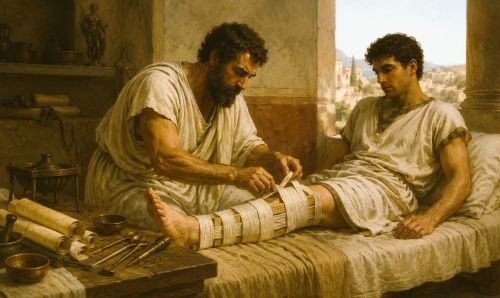
Ancient healers faced this emergency with a mixture of observation, craft, inherited procedure, and courage. They could not see beneath the skin with X-rays, could not stabilize complex fractures with internal plates or screws, and could not rely on antiseptic surgery, antibiotics, or modern anesthesia. Yet they were not helpless. Egyptian, Greek, Roman, Indian, and later Arabic medical traditions all preserved techniques for recognizing, reducing, binding, splinting, and nursing broken limbs. The basic principles were often strikingly practical: pull the bone back toward alignment, compare the injured limb with the sound one, pad the limb, wrap it firmly but not too tightly, immobilize it with splints or stiff bandages, watch swelling and pain, and allow time for the body to knit itself together. Bone-setting was one of the places where ancient medicine became tactile and mechanical. The healer’s hands mattered. So did linen, wood, reeds, bamboo, wax, oil, wine, honey, bandages, assistants, and the patient’s endurance.
The difference between a closed fracture and an open one shaped everything. When the skin remained intact, ancient treatment could sometimes be impressively effective. A well-reduced, well-splinted fracture might heal with enough straightness and strength for the patient to return to ordinary life. But when bone pierced flesh, or when a weapon, cartwheel, falling stone, or crushing blow tore open the limb, the danger changed. The injury was no longer only a matter of alignment. It became a wound, a contamination, a source of bleeding, suppuration, smell, fever, gangrene, and possible death. Ancient physicians understood that such cases were more dangerous, even if they did not possess a modern microbial explanation for infection. They learned, through repeated suffering, that exposed bone and torn tissue could overwhelm skill. In those cases, the healer’s art stood at the edge of catastrophe, where amputation, permanent disability, or death might follow despite every effort.
Fracture care reveals ancient medicine at its most concrete and revealing. It was not simply a world of charms, guesses, and passive waiting, though ritual and uncertainty were never absent. Nor was it modern orthopedics in embryo, merely lacking technology. It was a practical art shaped by touch, experience, materials, textual tradition, and the body’s own capacity for repair. Broken bones forced ancient healers to confront a problem that could be seen, handled, tested, and judged over time. In that sense, fracture treatment offers one of the clearest windows into both the achievements and limits of premodern healing: closed fractures could display real therapeutic competence, while open fractures exposed how quickly pain, infection, poverty, and trauma could defeat even the best ancient care.
Sources, Bones, and the Problem of Knowing Ancient Treatment
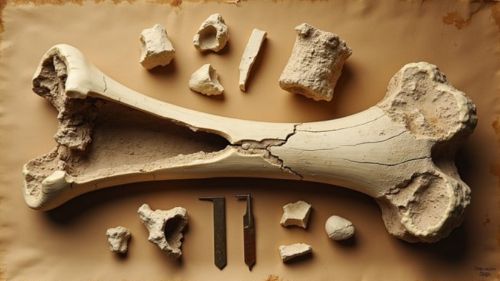
Writing the history of ancient fracture treatment begins with a difficulty: broken bones leave evidence, but they do not leave simple answers. A healed femur, a crooked forearm, a skull with signs of trauma, or a mummy with splints still attached can tell us that injury occurred and that the patient survived long enough for the body to respond. Yet the bone alone rarely tells us who treated the injury, what the treatment involved, how much pain the patient endured, or whether healing resulted from skilled intervention, household care, luck, or the body’s own capacity for repair. Ancient fracture care has to be reconstructed from several kinds of evidence at once: medical texts, human remains, archaeological objects, artistic images, surgical instruments, and the broader social history of labor, war, disability, and care.
The written sources are both invaluable and misleading. The Edwin Smith Papyrus, the Hippocratic writings on fractures and joints, Celsus’s De Medicina, Galen’s anatomical and therapeutic works, and the surgical sections of the Sushruta Samhita preserve detailed traditions of diagnosis, reduction, bandaging, splinting, prognosis, and aftercare. They show that learned healers thought seriously about fracture patterns, limb alignment, swelling, pain, wound complications, and the timing of treatment. But these texts usually represent literate, elite, professional, or semi-professional medicine. They do not necessarily describe what happened in every village, army camp, mine, farm, household, or slave quarter. A patient might be treated by a trained physician, a temple healer, a military practitioner, a midwife, an experienced family member, a barber-surgeon in a later period, or no specialist at all. The text tells us what some learned traditions recommended; it does not automatically tell us what most patients received.
Human remains give the historian a different kind of evidence. Paleopathologists can identify fractures, callus formation, malunion, infection, shortening, amputation, trepanation, and other signs of trauma and healing. A well-aligned healed fracture may suggest effective immobilization, especially when the injury would have made ordinary use impossible without some kind of support, and a fracture that healed with little shortening or angulation may point toward careful positioning during the critical early period of repair. A badly healed fracture may suggest neglect, poor technique, reinjury, poverty, or simply the severity of the original trauma. But even here interpretation must be cautious. Bones heal because living tissue remodels itself, not because medical treatment is always good. A straightened limb may reflect expert reduction, but it may also reflect a fracture that was never badly displaced, a young body with strong healing capacity, or a break protected by the patient’s own immobility. A crooked limb may reflect bad treatment, but it may also reflect a severe wound no ancient healer could have managed successfully. Archaeology gives us the injured body, but rarely the full story of the treatment room. It can show that someone lived long enough for healing to begin, but not whether they were comforted, restrained, splinted, abandoned, or repeatedly examined. For that reason, skeletal evidence is most powerful when read not as a single verdict on ancient medicine, but as a record of bodily experience: trauma, survival, deformity, adaptation, and sometimes care.
Mummies, splints, and burial contexts can narrow that gap. Some remains preserve linen wrappings, bark, wood, reed, or other stabilizing materials associated with injured limbs. These objects show that immobilization was not merely a textual ideal; it could be physically applied to the body. Yet even preserved splints must be interpreted carefully. Some may have been used in life, while others may have been arranged after death as part of funerary preparation. Some may represent practical medical care, others ritual concern for bodily wholeness in the afterlife, and some perhaps both. The same object can belong to medicine, mortuary practice, family devotion, and religious imagination all at once. This is why ancient fracture treatment cannot be studied only as a technical history of splints and bandages. It is also a history of how bodies were cared for, displayed, buried, remembered, and restored.
Images and instruments add further evidence, but they also require restraint. Ancient art sometimes depicts wounded soldiers, disabled bodies, surgical scenes, crutches, bandaged limbs, and medical tools. Excavated instruments (forceps, knives, probes, hooks, needles, cauteries, and other devices) show that ancient practitioners possessed specialized equipment for bodily intervention. But an instrument found in a medical context does not prove it was used for fracture care, and an image of injury may be symbolic, heroic, punitive, or mythological rather than clinical. A spear wound on a vase, a limping figure in relief, or a heroic warrior carried from battle may tell us about cultural ideals of suffering as much as medical practice. Even surgical tools are often polyvalent: a probe might explore a wound, a hook might retract tissue, a knife might cut flesh, drain an abscess, or prepare a corpse, and none of these uses can be assumed without context. The historian must resist turning every artifact into a treatment manual. The most reliable reconstruction comes when several kinds of evidence converge: a text describing reduction and splinting, skeletal remains showing healed trauma, and archaeological materials confirming that suitable bandages, splints, and instruments existed within the same medical culture. When these traces are read together, they do not produce certainty, but they do produce a historically plausible field of practice, one in which ancient healers had the materials, concepts, and repeated bodily encounters necessary to develop recognizable fracture care.
The problem of evidence ultimately strengthens rather than weakens the history of ancient bone-setting. It forces us to hold two truths together. On one hand, we cannot assume that every healed fracture proves good medicine, or that every medical text reflects ordinary practice. On the other hand, the repeated attention to fractures across Egyptian, Greek, Roman, Indian, and later medical traditions is too detailed to dismiss as mere theory. Ancient healers knew that bones could break in different ways, that alignment mattered, that tight bandages could harm, that swelling had to be watched, that open wounds were more dangerous than closed injuries, and that recovery took time. The surviving evidence does not let us see every patient clearly, but it does reveal a durable practical tradition: ancient fracture treatment was built from observation, touch, material skill, and hard experience with bodies that could heal, fail, or die.
Before the Medical Texts: Injury, Survival, and Early Bone-Setting
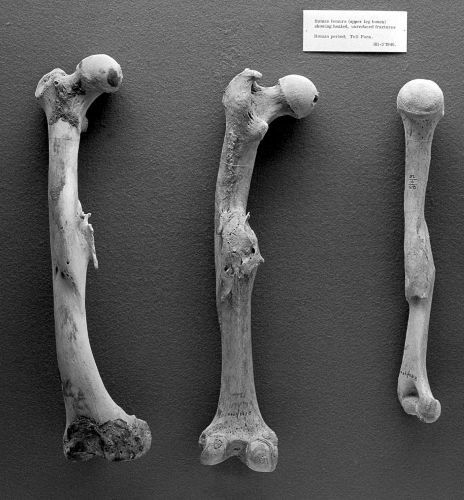
Long before fracture treatment was written down in ancient medical texts, broken bones belonged to the ordinary emergencies of human life. Hunting, falling, fighting, carrying loads, climbing, childbirth, animal handling, and accidents around fire, stone, water, and tools all made skeletal injury a constant possibility. A fracture was not an abstract medical category at first. It was a crisis in movement. A person could no longer walk, lift, flee, dig, grind, hunt, weave, nurse, fight, or protect themselves in the same way. The injury changed the body immediately, but it also changed the injured person’s place within the group, because survival now depended on others.
Paleopathology shows that many people in prehistoric and early ancient communities survived serious trauma. Skeletons with healed fractures reveal that the injured lived long enough for callus to form and bone to remodel. Some fractures healed cleanly, others with deformity, shortening, angulation, stiffness, or evidence of infection. These remains do not prove the existence of professional bone-setters, but they do show something just as important: injured bodies were not always abandoned. Survival after a serious fracture often required food, shelter, protection, rest, and practical assistance. A broken leg, for example, could prevent a person from foraging, fleeing danger, or performing daily labor. If that person survived for weeks or months, someone else had to make survival possible.
This does not mean early communities practiced “medicine” in the later textual sense. It means that care preceded medical literature. People learned from bodies before they learned from books, and they learned in settings where injury was visible, urgent, and repeated. A limb that moved unnaturally needed to be kept still. A bent arm or leg might be pulled straighter. Pain taught where the injury lay. Swelling warned against rough handling. Repeated failure taught that some bindings were too loose to help and others too tight to endure. A wrapped limb that turned cold, dark, or unbearable would have taught a grim lesson about pressure, even if no one could explain circulation in anatomical terms. A broken arm that healed crooked after being left unsupported would have taught another lesson about alignment. Even without formal anatomy, the difference between a bruise, a dislocation, a closed fracture, and a mangled open wound could be grasped through touch, sight, and experience. Early bone-setting likely emerged from this practical world: not as a single invention, but as a repeated human response to the same visible catastrophe. It was knowledge accumulated through watching people recover, fail, limp, die, or return to work.
The materials required for basic fracture care were available almost everywhere. Wood, bark, reeds, grasses, leather, fiber, cloth, clay, hide, and plant stems could all be used to support or bind an injured limb. Padding could be made from leaves, wool, hair, linen, moss, or other soft materials. A splint did not need to be technologically sophisticated to be useful. It needed to limit motion, protect the injury, and allow the body enough time to begin repair. The same communities that made baskets, shelters, bindings, sandals, nets, weapons, and clothing already possessed the manual skills needed to wrap, brace, lash, and stabilize. In that sense, early bone-setting belonged as much to the history of craft as to the history of medicine.
The body itself also made fracture treatment possible. Bone can heal in a way many internal diseases cannot. When broken ends are brought into reasonable proximity and kept still, the body begins to form callus, bridge the fracture, and remodel the injured area. This natural process meant that even imperfect ancient or prehistoric treatment could produce visible success. A healer, relative, or companion did not need to understand osteoblasts, blood supply, or cellular repair to notice that immobilized limbs often healed better than limbs constantly disturbed. The same fact complicates interpretation. When archaeologists find a healed fracture, they are seeing the body’s repair as much as the caregiver’s skill. Ancient bone-setting worked partly because it cooperated with a powerful natural process already underway.
Early fracture care was probably communal before it was professional. The injured person needed someone to fetch water, prepare food, keep insects or animals away, replace wrappings, move the body, clean wounds, and help with pain. They might also need someone to protect them from being left behind during seasonal movement, conflict, scarcity, or migration. This kind of care may have been given by kin, companions, elders, ritual specialists, experienced hunters, midwives, or practical healers whose authority came from having seen injuries before. In small communities, medical knowledge was not necessarily separated from household skill, ritual knowledge, animal care, craft, and memory. Someone who knew how to bind a tool handle, brace a broken cart part, set a trap, splint an animal limb, or wrap a wound might also know how to stabilize a human arm. The fracture made expertise visible because the result could later be judged: the limb straightened or crooked, strengthened or failed, closed or festered. It also made care visible, because recovery required time and repeated attention. A fractured body needed more than a single dramatic setting of the bone. It needed days and weeks of watching, feeding, lifting, cleaning, waiting, and deciding when the limb could bear weight again. Before medicine became a written profession, this slow work of keeping the injured alive belonged to the community around the patient.
Before the medical texts, there was already a long history of injury, survival, and practical repair. Written medicine did not create the basic logic of fracture treatment from nothing. It inherited, organized, criticized, and refined older habits of touch, immobilization, support, and care. The later instructions found in Egyptian trauma texts, Hippocratic medicine, Roman surgery, and Indian surgical literature make more sense when placed against this deeper background. They did not arise in a world where no one knew what to do with a broken limb. They arose in a world where broken limbs had always demanded action, and where human beings had long understood that the injured body needed both mechanical support and social protection.
Egypt: Splints, Linen, and the Practical Medicine of Trauma

Egypt offers one of the clearest early windows into fracture care because it preserves both bodies and texts. In a dry landscape where mummified remains, linen wrappings, and skeletal injuries could survive for millennia, historians can sometimes see trauma not only as a written problem but as a physical fact. Broken arms, damaged skulls, injured ribs, healed long bones, and limbs supported by splints all suggest a world in which accidents, violence, labor, and disease left permanent marks on the body. Yet Egypt’s importance is not simply archaeological. Its medical writing also shows a tradition that could look at trauma with remarkable practicality. The injured body was examined, touched, classified, treated, and judged. Some cases were manageable, some dangerous, and some beyond help. That habit of sorting injury by prognosis is one of the most striking features of Egyptian trauma medicine.
The Edwin Smith Papyrus, usually dated as a copy from around the seventeenth or sixteenth century BCE but preserving older medical traditions, is central to this story. Unlike some other Egyptian medical texts that mix remedies, ritual language, and magical formulae more freely, the Edwin Smith Papyrus is famous for its sober attention to wounds, fractures, dislocations, and surgical observation. Its cases move anatomically from the head downward, describing injuries, symptoms, diagnoses, and treatments. The physician is instructed to inspect, palpate, question, and decide whether the condition is one he will treat, one he will contend with, or one he will not treat. That last category is important. It shows that Egyptian medicine did not always imagine healing as guaranteed. In trauma, the healer’s authority could include the grim recognition of limits.
Fractures in the Egyptian tradition were treated as mechanical injuries that required mechanical care. When a bone was displaced, the first problem was not humoral imbalance or divine punishment, but position. The limb had to be brought back toward its proper shape, supported, and held still long enough for recovery. The Edwin Smith Papyrus includes descriptions of fractures and related injuries in which the practitioner examines deformity, pain, and movement before deciding how to proceed. For some upper-limb fractures, the recommended treatment involved manual reduction by traction and then binding with linen. This combination (pulling, aligning, wrapping, and immobilizing) would remain recognizable across later medical cultures. It was simple in principle but difficult in practice. Too little pressure could fail to stabilize the injury; too much pressure could worsen pain, swelling, or tissue damage. The Egyptian healer needed not only materials, but judgment.
The materials themselves mattered. Linen was one of Egypt’s great medical technologies: flexible, available, cleanable, and adaptable to bandaging, padding, dressing, and wrapping. It could be folded into compresses, wound tightly around a limb, layered to distribute pressure, or combined with other substances to hold dressings in place. Bark, wood, reeds, palm materials, and other stiff supports could be used to brace injured limbs, while pads and wrappings protected the skin from pressure. Such materials were not incidental. A splint that was too rigid without padding could abrade the flesh; a wrapping that slipped could allow the fracture to move; a bandage drawn too tightly could turn treatment into further injury. The practical art lay in combining softness and stiffness, pressure and protection, restraint and circulation. Some archaeological finds have been interpreted as splints applied to fractured limbs, though caution is necessary because splints found on mummies may have been therapeutic, funerary, or both. Egyptian mortuary practice valued bodily wholeness, and a limb stabilized after death might express religious restoration rather than clinical treatment. Still, the overlap between medical and funerary care should not lead us to dismiss the practical side. Egyptian healers and embalmers both worked in a culture deeply attentive to the integrity of the body. The same civilization that wrapped the dead with such precision also developed sophisticated habits of binding, supporting, and protecting the injured living. In fracture care, linen was not merely a passive covering. It was a tool of alignment, compression, cleanliness, and time, helping transform a sudden bodily disaster into an injury that might be managed.
Egyptian fracture care complicates any simple picture of ancient medicine as merely magical or symbolic. Egyptian healing certainly included gods, spells, amulets, ritual language, and religious meaning, but trauma demanded a different kind of response. A broken bone could be felt. A displaced joint could be compared to the healthy side. A wound could bleed, swell, smell, suppurate, or close. Success or failure unfolded in the patient’s body over days and weeks. This made fracture care one of the most concrete forms of ancient medical practice. Egyptian physicians did not possess modern anatomy, antisepsis, anesthesia, or imaging, but they had hands, linen, splints, case experience, and a disciplined awareness that some injuries could be treated while others could only be endured. In that realism lies the historical importance of Egyptian trauma medicine: it shows ancient healing at the point where observation, craft, and humility met the injured body.
The Healer’s Hands: Diagnosis Without X-Rays
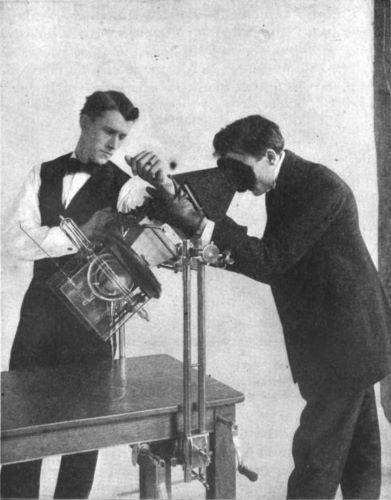
To treat a broken bone in the ancient world, the healer first had to know what kind of injury lay beneath the skin. This was the hardest and most intimate part of the work. Without X-rays, CT scans, antiseptic exploratory surgery, or modern anatomical imaging, diagnosis depended on the body’s surface and the healer’s senses. The practitioner looked for deformity, swelling, bruising, shortening, unnatural angles, loss of movement, and the patient’s response to touch. He compared one limb with the other, watched how the patient held the injured part, asked where the pain was sharpest, and tested whether movement was possible or unbearable. The body had to be read like a damaged structure: not opened first, but inspected, handled, questioned, and interpreted.
Touch was central, but touch was dangerous. To palpate a suspected fracture was to enter the patient’s pain. Fingers could trace swelling, feel irregularity, detect abnormal motion, and sometimes recognize the grating sensation of broken ends moving against one another. Yet every diagnostic movement risked making the injury worse. Pull too hard, twist too suddenly, or press too deeply, and the healer might turn a manageable fracture into a more severe one, tear soft tissue, worsen bleeding, or intensify shock. Ancient medical writers understood this tension. The Hippocratic texts, Celsus, and later surgical authorities repeatedly stress not only what to do, but how carefully to do it. The healer’s hands had to be firm enough to know, but gentle enough not to destroy.
Diagnosis also required distinguishing fractures from injuries that could look similar. A dislocation might deform a joint without breaking the bone. A severe sprain or bruise might swell dramatically and prevent use of the limb. A head wound might conceal a skull fracture beneath blood and hair. A rib fracture might show little external deformity but reveal itself through painful breathing, coughing, or pressure. A spinal or pelvic injury might leave the patient unable to move, yet offer the healer few safe ways to intervene. Ancient diagnosis was not a single act of recognition but a process of sorting possibilities. The healer had to decide whether the problem was bone, joint, flesh, tendon, nerve, vessel, or some combination of these. Mistaking one injury for another could mean useless treatment, worsening deformity, or death.
The absence of imaging made prognosis important. Ancient practitioners did not merely ask, “What is broken?” They also asked, in effect, “Can this be treated?” Egyptian trauma medicine famously sorted cases according to whether the physician would treat, contend with, or refuse treatment. Greek and Roman authors also recognized that not every fracture offered the same hope. A simple fracture of the forearm was very different from a crushed thigh, an exposed bone, a shattered joint, or a wound complicated by fever and gangrene. The healer had to judge not only the bone itself but the whole situation around it: the patient’s strength, the amount of bleeding, the presence of a wound, the location of the injury, the possibility of immobilization, and whether the household could support the long period of recovery. A fracture that might be survivable in a settled home with attendants, food, and rest could become disastrous on campaign, in poverty, or in a body already weakened by illness. The healer’s diagnosis included a moral and social burden. To name an injury was also to tell the patient, family, master, commander, or household what could be expected: recovery, disability, prolonged danger, or no realistic hope. Prognosis was not a secondary addition to diagnosis. It was part of the ancient diagnostic act itself, because the practical question was never simply what had happened inside the limb, but what could still be done.
This made ancient fracture diagnosis a profoundly embodied form of knowledge. It was learned through repeated contact with pain, failure, deformity, recovery, and death. The best practitioners were not merely those who knew inherited rules, but those who could translate sight and touch into judgment. They had to know when to pull and when to stop, when swelling warned against tight binding, when a wound made the fracture more dangerous, when a patient’s agony signaled more than ordinary pain, and when the injury lay beyond the reach of craft. Modern medicine often begins by seeing inside the body. Ancient bone-setting began with the hands. Its successes and failures rested on the healer’s ability to make the invisible fracture legible through the visible, audible, and palpable signs of the suffering body.
India: Sushruta, Classification, Splints, and Rehabilitation
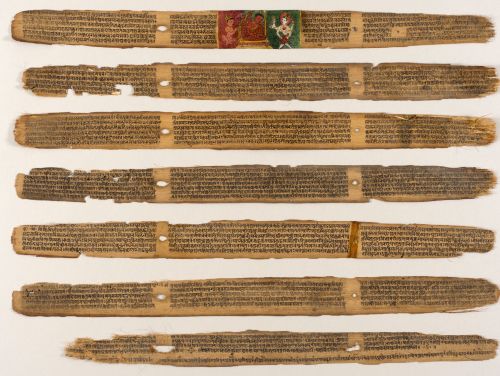
Ancient Indian fracture care is most closely associated with the surgical tradition preserved in the Sushruta Samhita, one of the foundational Sanskrit medical texts of Ayurveda. Its exact date is difficult to fix, because the work was shaped through layers of composition, transmission, commentary, and revision rather than appearing as a single authorial book at one moment. Even so, the text preserves a remarkably organized approach to bodily injury. It does not treat broken bones as vague accidents or divine mysteries alone. It classifies them, names their varieties, describes their signs, and lays out practical methods for restoring the injured part. In the history of fracture treatment, that classificatory impulse matters. It shows a medical culture trying to turn traumatic chaos into ordered knowledge.
The Sushruta Samhita is important because it places fracture care within a wider surgical world. Sushruta’s medicine includes wounds, abscesses, foreign bodies, burns, dislocations, obstetric dangers, amputations, and reconstructive procedures, but fractures receive careful and systematic attention. The text distinguishes different kinds of breaks and displacements, recognizing that a cracked bone, a crushed bone, a bent bone, a displaced bone, and a joint injury do not pose the same problem. This was not classification for its own sake. To name the injury was to guide treatment. A fracture that could be reduced and stabilized called for one response; an injury associated with severe soft-tissue damage, deformity, or systemic danger called for another. Like Egyptian and Greek trauma medicine, the Indian tradition understood that prognosis began with recognition. Classification also helped create authority. The healer who could name the injury precisely could present himself as someone who understood the hidden structure of the damage, not merely someone reacting to pain and swelling. In a world without X-rays, this kind of ordered vocabulary mattered because it made the invisible injury discussable, teachable, and repeatable. It allowed medical knowledge to be transmitted from teacher to student, from text to practitioner, and from one difficult case to the next. The broken limb became part of a system: observed, named, compared, treated, and remembered.
Treatment in the Sushruta tradition centered on reduction, traction, manipulation, bandaging, and immobilization. A displaced bone had to be drawn back toward its proper place, sometimes by pulling, pressing, rotating, or adjusting the limb according to the direction of injury. Splints made of bamboo, wood, bark, or other suitable materials could then support the limb, while cloth bandages held the injured part in position. These were not crude gestures. They required attention to the shape of the limb, the tenderness of the tissues, the force used in manipulation, and the tightness of the wrapping. Too little support allowed the bone to move; too much pressure could increase pain, swelling, or damage to the flesh. The basic problem was the same one faced by bone-setters across the ancient world: the broken part had to be restrained without strangling the living body around it.
The Indian material also stands out for its attention to aftercare. Fracture treatment did not end when the bone was set. The patient needed rest, diet, oiling, massage, bandage changes, protection from premature movement, and eventually gradual return to use. This emphasis reflects a broader Ayurvedic understanding of the body as something restored through regimen as well as intervention. A bone could not be healed by force alone. It had to be supported through time, nourishment, and controlled recovery. Medicated oils, herbal preparations, and dietary rules belong to this therapeutic environment, not as decorative additions but as part of a larger medical logic in which tissue repair depended on the patient’s strength, balance, and disciplined care.
Pain and endurance were also central. Setting a fracture could be agonizing, and ancient Indian medicine, like other ancient traditions, had only partial means of dulling suffering. Wine, herbal preparations, oil applications, and sedating or pain-relieving substances might help, but they did not remove the violence of reduction. The patient still had to submit to being pulled, pressed, wrapped, and restrained. That made trust essential. The healer’s authority depended not simply on theory but on the ability to perform a painful act convincingly: to hurt in order to heal, to control the limb without appearing to torture the patient, and to promise that temporary suffering might prevent permanent deformity. The social scene around treatment mattered as well. Family members, attendants, students, or assistants might help steady the patient, hold the limb, prepare bandages, heat oils, or enforce rest afterward. The pain of fracture care was not only a private physical experience; it was a public test of the healer’s competence and the patient’s confidence. A botched manipulation could destroy trust immediately, while a well-set limb could make surgical authority visible with passing time as swelling decreased, pain lessened, and function slowly returned. Fracture care joined surgical skill to social persuasion.
The importance of Sushruta’s fracture treatment lies not in proving that ancient India possessed modern orthopedics, but in showing how sophisticated premodern trauma care could become without modern technology. The Sushruta Samhita recognized variety among fractures, linked diagnosis to prognosis, used traction and splinting, and treated recovery as a process requiring continued care. Its medicine was textual, technical, bodily, and practical. It also reminds us that ancient fracture care was not a single Mediterranean story moving from Egypt to Greece to Rome. Across South Asia, healers developed their own disciplined traditions for reading injured bodies, naming broken bones, stabilizing damaged limbs, and guiding patients through the long uncertain passage from trauma to repair.
Greece: Hippocrates, Traction, Bandages, and the Mechanics of Reduction
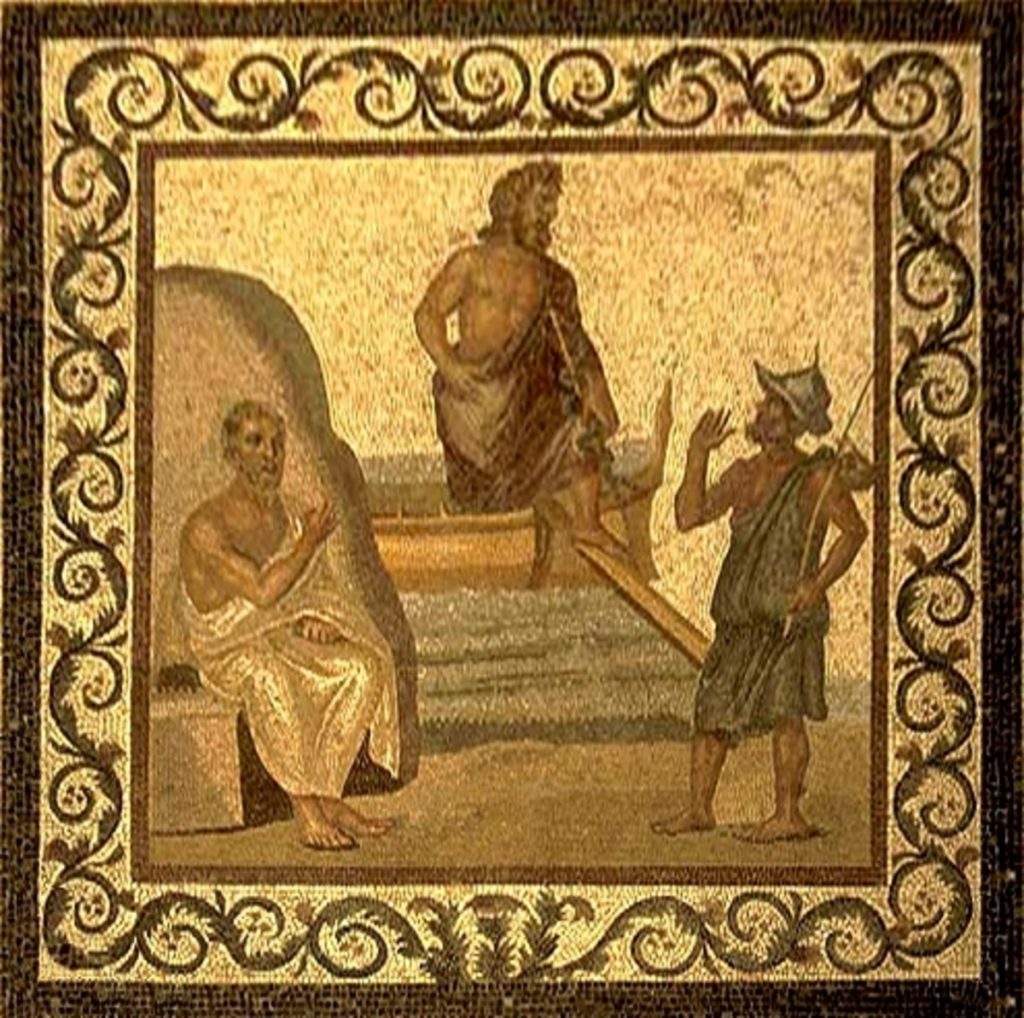
Greek fracture care is most closely associated with the Hippocratic surgical writings, such as On Fractures, On Joints, On the Surgery, and the related manual tradition preserved in Mochlicon. These texts do not present bone-setting as guesswork or as a marginal craft beneath learned medicine. They treat it as a disciplined practice requiring observation, timing, technique, and bodily judgment. The Hippocratic physician was expected to examine the injured part, compare it with the healthy side, recognize displacement, restore alignment, apply bandages properly, and understand how swelling and pain gradually changed. In this tradition, the broken bone became a problem of mechanics as much as medicine. The body had been pulled out of order; the healer’s task was to bring it back into order without making the damage worse.
The central act was reduction: restoring the fractured bone or displaced joint as nearly as possible to its proper position. This usually required traction and countertraction. One force pulled the limb in one direction, while another held the body or the upper part of the limb steady. Assistants might be needed. Straps, hands, benches, levers, or other devices could help apply controlled force. The principle was simple, but the performance was not. The healer had to pull enough to overcome muscle tension and displacement, but not so violently as to tear tissues, worsen bleeding, or exhaust the patient. Hippocratic fracture care depended on a practical understanding of resistance. Bone was not being repaired in isolation. It was surrounded by muscle, skin, vessels, nerves, swelling, and pain, all of which pushed back against the healer’s attempt to restore shape.
Bandaging was treated with equal seriousness. The Hippocratic texts repeatedly emphasize that wrapping a fracture was not merely covering it. Bandages shaped the healing environment. They held the limb in position, managed swelling, distributed pressure, and prevented the broken ends from shifting again. But bandages could also harm. Too loose, and they failed to support the injury; too tight, and they could increase pain, swelling, numbness, discoloration, or tissue damage. The skill lay in pressure that was firm, even, and responsive to the changing condition of the limb. This is one reason Hippocratic surgery pays close attention to rebandaging. The injured body was not static. Swelling rose and fell, pain changed, and the dressing that was safe on one day might become dangerous on another. Bandaging also had to account for the direction of displacement and the shape of the part being treated. A forearm, thigh, shoulder, rib cage, or lower leg could not all be wrapped as though they were the same object. The bandage had to conform to anatomy while also correcting it, holding the limb in a desired position without producing new injury through friction, bunching, or uneven compression. The bandage functioned almost like a medical argument made in cloth: it expressed the healer’s judgment about where the bone should be, how much force the tissues could bear, and how healing should proceed.
Splints added another layer of control. In Hippocratic practice, splints were not always applied immediately in every case, because swelling and early inflammation had to be considered. Once the initial period had passed and the limb could tolerate firmer support, splints helped preserve alignment and prevent renewed movement. This reveals a sophisticated sense of timing. The healer did not simply pull the bone straight and immobilize it as tightly as possible. He watched the sequence of injury: the first pain, the swelling, the need for reduction, the application of bandages, the later use of splints, and the gradual return toward function. Fracture care was a process, not a single dramatic moment. Its success depended on repeated attention over days and weeks.
The Hippocratic tradition also shows how closely ancient fracture care was tied to space, posture, and apparatus. On the Surgery is concerned with the physical arrangement of the treatment room: light, the position of the patient, the placement of instruments, the stance of the practitioner, and the usefulness of assistants. This matters because bone-setting was not only intellectual knowledge. It was staged manual work. The patient’s body had to be positioned so the healer could see, touch, pull, wrap, and judge symmetry. A poorly arranged space could make treatment clumsy; a well-arranged one could make difficult manipulation possible. Greek surgical writing gives us a rare glimpse of medicine as performance in the literal sense: a procedure carried out by bodies in a room, under conditions that affected the outcome.
Greek writers were also aware that not all fractures were equally hopeful. A simple break of the arm or lower leg was different from a fracture near a joint, a crushed bone, a complicated dislocation, or a wound in which bone and flesh were both damaged. A clean, closed fracture might allow the physician to act with confidence: reduce, bind, support, and wait. A fracture complicated by lacerated flesh, exposed bone, severe swelling, or deformity demanded a darker calculation. The Hippocratic concern with prognosis did not mean resignation; it meant discrimination. The physician had to know which injuries could be reduced cleanly, which would leave deformity, which required prolonged care, and which might bring severe complications. He also had to manage expectation, because a visible injury produced visible judgment. Patients, families, patrons, fellow soldiers, or household authorities could see whether a limb remained crooked, whether pain grew worse, whether swelling spread, or whether a wound began to rot. Prognosis protected the patient from impossible promises, but it also protected the practitioner from claiming power where the injury gave little room for success. This is where the Greek material connects strongly with Egyptian trauma medicine and later Roman surgery. In each case, practical medicine required limits. To promise too much was dangerous, both medically and reputationally. A good healer needed not only confidence but restraint.
The importance of Hippocratic fracture care lies in its mechanical clarity. It made reduction, traction, bandaging, splinting, timing, and observation into teachable principles. It also helped establish a long Western tradition in which bone-setting belonged to the serious work of medicine, even when later social hierarchies sometimes separated learned physicians from manual surgeons or practical bone-setters. The Hippocratic texts did not solve the ancient problems of infection, open fracture, anesthesia, or internal injury. But they did preserve a powerful therapeutic logic: align what is displaced, immobilize what must not move, protect the living tissues, and let the body heal. In that logic, Greek fracture care became one of the clearest examples of ancient medicine working through craft, force, patience, and disciplined hands.
Rome: Celsus, Galen, and the Practical Latin Tradition

Roman fracture care inherited much from Greek medicine, but it did not merely repeat it in another language. In the Roman world, bone-setting belonged to a broad practical culture of surgery, military treatment, household medicine, and learned compilation. Greek physicians worked in Roman cities, Roman elites read Greek medical theory, and Latin authors translated, summarized, and reorganized inherited knowledge for new audiences. Fractures were treated within a mixed medical environment: part Greek intellectual tradition, part Roman pragmatism, part battlefield necessity, and part everyday craft. A broken arm, shattered leg, dislocated shoulder, or crushed rib could appear in a villa, barracks, arena, farm, workshop, street, or siege camp. Roman medicine had to be portable enough for war, practical enough for households, and authoritative enough for literate medical readers.
Celsus is the crucial figure for understanding this practical Latin tradition. His De Medicina, written in the early imperial period, is not a narrow surgical manual, but its surgical books preserve some of the clearest Latin discussions of wounds, fractures, dislocations, splints, bandages, and complications. Celsus writes with a directness that makes trauma feel like a problem faced at the bedside rather than an abstract medical puzzle. He distinguishes injuries by location and severity, discusses the reduction of broken bones, warns about the dangers of excessive force, and repeatedly attends to the condition of the surrounding flesh. Like the Hippocratic writers, he understands that fracture care depends on restoring alignment and maintaining it. But his value lies in the way he joins bone treatment to wound management. For Celsus, the fracture is never only a broken object inside the body. It is part of a living limb, vulnerable to inflammation, pain, swelling, suppuration, gangrene, and death.
The Roman approach remained strongly mechanical. A displaced bone had to be returned as closely as possible to its natural position, and the injured part had to be held there. Bandages, splints, pads, and careful positioning all mattered. Celsus warns against wrapping too tightly, because pressure could worsen suffering and damage the tissues, but he also knew that insufficient support allowed the bone to shift. This balance between firmness and restraint was the old problem of bone-setting in a Roman key. The practitioner had to control the injured limb without strangling it. He had to use the patient’s body as a guide, watching pain, swelling, color, heat, and function. Roman fracture care was not simply a matter of applying a standard wrapping. It required repeated adjustment, and repeated adjustment required observation. The injury was not “set” once and forgotten; it was monitored as a changing condition.
Roman medicine also forces the historian to think about social setting. A wealthy patient might receive a learned physician, attendants, rest, special diet, and time away from labor. A soldier might be treated in a military environment where speed, triage, and future usefulness mattered. A gladiator or arena worker might receive skilled surgical attention because the body was economically valuable, but that care existed within a violent world that produced injuries for spectacle. Enslaved laborers, miners, sailors, builders, and agricultural workers faced high risks of fracture but uneven access to sustained treatment. The same Roman medical principles could produce very different outcomes depending on status, location, and support. A fracture required immobilization, but immobilization required time; and time, in a slave society and military empire, was not distributed equally. Rest was itself a treatment, and not everyone could afford it. The patient who could remain indoors, be fed, be washed, have bandages changed, and avoid weight-bearing had an advantage over the patient forced back into labor or movement too soon. Even the best reduction could fail if the injured limb was disturbed repeatedly, if a wound was left dirty, or if the patient had to sleep in crowded, damp, or unstable conditions. Roman fracture care exposes a central truth of ancient medicine: technique mattered, but social power shaped whether technique could be carried through to recovery.
Galen belongs differently in this story. He was less important as a plain practical guide to fracture treatment than as a towering medical authority whose anatomical, physiological, and therapeutic writings shaped later understandings of the body. His experience with gladiators at Pergamum gave him direct familiarity with wounds, trauma, exposed tissues, and the demands of surgical care. That experience mattered because it joined anatomical knowledge to violent injury. Galen’s broader medical system also helped later readers think about bones, joints, nerves, muscles, inflammation, and healing within an integrated theory of the body. Yet Galen’s authority could cut both ways. It preserved valuable observations and organized medical learning, but it also contributed to a later tradition in which ancient names could become almost unchallengeable. In fracture care, as in other areas of medicine, Roman and post-Roman practitioners inherited not just techniques, but reputations.
The Roman tradition stands between Greek surgical mechanics and later medieval transmission. Celsus preserved a clear Latin account of practical trauma care; Galen helped secure the intellectual authority of Greek medicine within the Roman world and beyond. Together, they show fracture treatment as both manual craft and learned tradition. Roman medicine still lacked modern imaging, anesthesia, antisepsis, and antibiotics, and open fractures remained terrifying injuries. But Roman authors understood alignment, immobilization, swelling, wounds, gangrene, deformity, and prognosis with a seriousness that deserves attention. They also understood, at least practically, that the broken body could not be treated as a dead structure. It was warm, painful, swelling, bleeding, and socially situated. The physician or surgeon had to manage not only bone but flesh, not only technique but circumstance, not only the moment of setting but the weeks of uncertainty afterward. Their fracture care was not modern orthopedics, but neither was it helpless improvisation. It was a practical medicine of hands, bindings, judgment, social inequality, and dangerous bodies in a world where broken bones were common, visible, and consequential.
Pain, Opium, Wine, Willow, and the Problem of Endurance
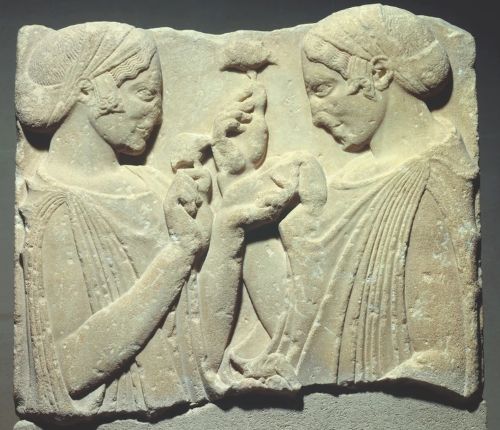
Setting a broken bone was not only a technical act; it was an ordeal of pain. The healer might have to pull a limb against contracted muscle, press displaced bone back toward alignment, rotate an injured joint, tighten bandages over swelling flesh, or hold the patient still while splints were applied. Even diagnosis could hurt, because palpation, comparison, and testing motion brought the practitioner’s hands directly into the injury. Ancient fracture care depended on endurance as much as anatomy. The patient had to survive not merely the accident, but the treatment. Every successful reduction required a temporary bargain with suffering: pain now in the hope of straighter healing later.
Ancient healers did possess pain-relieving and sedating substances, but they did not possess safe modern anesthesia. Wine was one of the most common aids, useful as a drink, solvent, cleanser, and ritual comfort. Opium, derived from the poppy, was known in several ancient medical cultures and could dull pain or induce sleep, though its strength and danger were also part of its power. Mandrake, henbane, and other narcotic plants appear in classical pharmacology, where they might be used to soothe, sedate, or stupefy, but the boundary between medicine and poison was thin. Willow and related plant remedies could be used for pain and inflammation in some traditions, though we should be careful not to treat ancient willow use as if it were modern aspirin in disguise. These substances mattered, but they did not erase agony. They softened the experience, confused it, slowed it, or made it more bearable. They did not create the controlled surgical unconsciousness that later anesthesia would make possible.
This meant that fracture treatment unfolded in a social theater of restraint. Assistants might hold the patient down, stabilize the body, pull in opposition to the healer, or keep a limb from jerking away. Family members could encourage, plead, pray, or panic. The healer had to maintain authority in the middle of cries, sweat, fear, and visible distress. Pain threatened the procedure because a patient who flinched, fought, fainted, or lost trust could make reduction impossible. The practitioner needed more than pharmacological knowledge. He needed timing, command, confidence, and sometimes persuasion. To set a bone was to convince the patient and the surrounding household that controlled violence was different from cruelty. The healer hurt the body to restore it, but that distinction had to be made believable in the moment.
Pain also shaped the limits of ancient technique. A modern surgeon can reduce certain fractures under anesthesia, image the result, and fix the bone internally. Ancient practitioners often had to work quickly and externally, with a conscious or semi-conscious patient whose suffering imposed a practical boundary on what could be attempted. Too little manipulation might leave deformity; too much could exhaust the patient or deepen shock. A long, difficult reduction was not simply a test of the healer’s strength or skill. It was a test of how much the injured body could tolerate before treatment itself became another form of trauma. A child, an elderly patient, a wounded soldier, an enslaved laborer, or someone already weakened by blood loss might not tolerate the same intervention as a strong adult with attendants and rest. Social condition mattered here as well. A wealthy patient might be steadied, soothed, dosed with wine, watched afterward, and allowed to recover in bed; a soldier in the field or a laborer whose value lay in work might be treated more hurriedly, with less privacy and fewer chances for repeated adjustment. Pain became diagnostic and ethical at once. Ordinary pain was expected, but extreme pain could warn of deeper damage, tight bandaging, vascular injury, nerve involvement, or treatment gone wrong. The patient’s suffering was not merely background noise. It was information, and the healer who ignored it risked confusing necessary force with destructive force.
The history of ancient fracture care is also a history of incomplete relief. Wine, opium, oils, poultices, cooling applications, narcotic plants, prayers, reassurance, and skilled hands all helped patients endure what had to be done, but none removed the brutal fact of reduction before anesthesia. This does not make ancient care irrational or careless. On the contrary, it helps explain why practical judgment mattered so much. The healer had to decide how much force the body could bear, how long the patient could endure, when pain signaled necessary correction, and when it signaled danger. Broken bones made ancient medicine intensely human because the repair of the body passed through fear, trust, restraint, and suffering. The fracture was mechanical, but the treatment was never merely mechanical. It was an encounter between pain and hope.
Honey, Wine, Resin, Oil, and the Care of the Wound
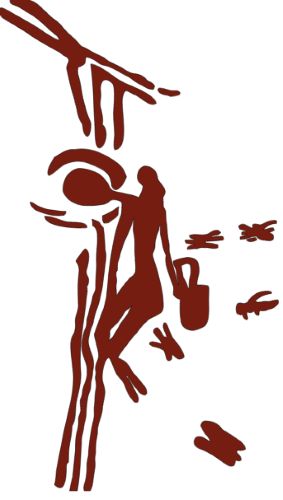
A broken bone became far more dangerous when it was also a wound. In a closed fracture, the healer confronted alignment, swelling, pain, and immobilization. In an open injury, the problem widened at once: torn flesh, bleeding, exposed bone, dirt, cloth fibers, weapon fragments, splinters, animal matter, or soil could enter the body. The fracture was no longer hidden beneath the skin. It was visible, wet, and vulnerable. Ancient healers did not understand infection through germ theory, but they knew that some wounds darkened, swelled, suppurated, smelled, produced fever, or turned gangrenous. They could see that an injury open to the air and world was more dangerous than one contained beneath intact skin. Wound care became the line between repair and rot.
Honey, wine, resin, oil, and related substances belonged to this practical world of wound management. Honey was valued in several ancient medical traditions for dressing wounds, soothing tissue, and resisting corruption. Its thickness helped it cling to the injured surface, its sweetness and preservative qualities made it seem naturally opposed to decay, and its long use in both food and medicine gave it a familiar authority. Wine could wash, sting, cleanse, and serve as both medicine and ritual reassurance. Its sharpness mattered: the sensation of burning could be interpreted as evidence that the wound was being purified, even when ancient practitioners lacked a microbial explanation for what washing might accomplish. Resins and gums could help seal, protect, scent, or bind dressings, while oils softened skin, carried herbal ingredients, and eased the removal or application of bandages. Oils might also make treatment feel gentler, particularly when inflamed flesh had to be uncovered, cleaned, and wrapped again. These substances should not be treated as modern antiseptics in a simple one-to-one way, but neither were they meaningless. They were part of an empirical pharmacy shaped by texture, smell, preservation, sensation, and repeated observation. A wound that was washed, dressed, covered, and watched had a better chance than one left exposed to filth, flies, and constant disturbance.
The challenge was that wounds changed. A fresh wound might bleed freely, then clot, swell, heat, ooze, dry, reopen, or begin to stink. A dressing useful on the first day might be harmful if left too long. A bandage that protected the limb might trap discharge. A splint that stabilized the bone might press into inflamed flesh. Ancient wound care required repeated attention, not a single application of a remedy. The healer or caregiver had to remove dressings, inspect the color and odor of the wound, wash or reapply substances, judge whether swelling was spreading, and decide whether the limb remained viable. This was slow, unpleasant, intimate work. It belonged not only to the dramatic moment of surgery or reduction, but to the days afterward, when the patient’s fate often became clearer.
The ancient medical literature is full of attempts to manage this unstable border between healing and corruption. Egyptian trauma medicine distinguished injuries that could be treated from those that placed the healer in a struggle with the body’s decline. Hippocratic and Roman writers paid close attention to inflammation, pus, fever, and the dangers of wounds involving bone. Celsus understood that a fracture accompanied by torn flesh was a graver injury than a simple break. The logic was practical: the open wound allowed pain, swelling, contamination, and tissue death to complicate the mechanical problem of alignment. Even when the bone could be set, the flesh might fail. A limb might look straighter after reduction and still become hot, discolored, swollen, foul-smelling, or insensible in the days that followed. The problem was not merely that ancient healers lacked germ theory; it was that the open fracture created too many dangers at once. The bone needed stillness, but the wound needed cleaning and inspection. The splint needed firmness, but the flesh needed relief from pressure. The patient needed rest, but fever, pain, and discharge demanded repeated disturbance. The ancient healer had to treat the limb as a living whole, not as a broken stick. Bone, blood, skin, muscle, and wound discharge all belonged to the same crisis, and each could undo the work done on the others.
This is why the care of wounds is central to the history of fracture treatment. Ancient bone-setting could succeed when it cooperated with the body’s ability to knit bone together, but open wounds exposed the limits of that cooperation. Honey, wine, resin, oil, linen, poultices, drainage, cautery, and repeated dressing changes were efforts to hold decay at bay long enough for repair to begin. Sometimes they worked. Sometimes they delayed disaster. Sometimes they failed completely. Before antisepsis and antibiotics, wound care was a contest against processes ancient healers could observe but not fully control. The open fracture made that contest uniquely stark: a limb could be aligned and still be lost, wrapped and still rot, treated carefully and still kill the patient.
When the Bone Broke Through: Compound Fractures, Gangrene, and Amputation
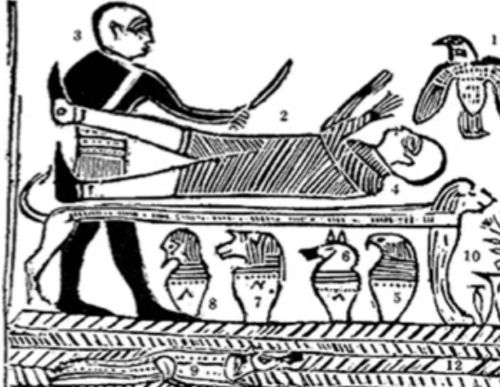
The most frightening fracture was the one that did not stay hidden. When broken bone pierced the skin, or when a weapon, fall, wheel, stone, or crushing blow tore flesh open around the break, the injury crossed a dangerous threshold. A closed fracture could be treated as a problem of position and stillness: reduce the displacement, bind the limb, protect it from movement, and wait for the body to knit the bone. A compound fracture was different. It joined the mechanical crisis of broken bone to the biological crisis of an open wound. Blood, dirt, splinters, cloth, metal fragments, animal matter, soil, and the healer’s own hands might all enter the damaged tissues. The limb was no longer simply broken. It was exposed to corruption. Ancient physicians did not explain infection through microbes, but they recognized many of its signs. They saw wounds grow hot, swollen, painful, dark, foul-smelling, and wet with discharge. They knew that fever could follow trauma, that tissue could die, and that a limb might become a threat to the entire body. Gangrene was not an abstract later diagnosis for them; it was a visible disaster. The flesh changed color, sensation failed, smell announced decay, and the patient’s strength could collapse. The healer’s earlier success in setting the bone might become irrelevant. A limb could be straightened and still be doomed. Alignment mattered, but living tissue mattered more. If the flesh failed, the bone could not save the patient.
Celsus is valuable here because he treats fractures with wounds as graver injuries than simple breaks. His concern is practical and unsentimental. The physician must attend not only to the broken bone but to inflammation, swelling, suppuration, and the possibility that the wound will turn destructive. A protruding or separated fragment of bone could complicate healing; a deep wound near a major joint or large muscle group could become disastrous; a thigh injury, because of the size and force of the limb, could be dangerous. This Roman material preserves a hard-won clinical realism. Some fractures could be reduced and dressed. Others might leave deformity. Still others could not be safely managed by ordinary binding and waiting. The open fracture forced ancient medicine to admit that the body could become its own enemy.
Amputation belonged to this desperate edge of treatment. It was not the normal answer to a broken bone, and it should not be imagined as an easy or routine ancient procedure. To remove a limb was to confront hemorrhage, shock, pain, infection, social ruin, and the possibility that the patient would die from the attempted cure. Yet when gangrene threatened to spread, or when a limb was crushed beyond repair, amputation might appear as the last remaining way to preserve life. The decision was brutal because it asked whether part of the body could be sacrificed to save the rest. Ancient surgical texts and later traditions knew this logic, but knowing it did not make it safe. Without modern anesthesia, blood transfusion, antiseptic technique, or antibiotics, amputation was itself a mortal gamble. The social consequences were nearly as severe as the medical ones. A lost limb could mean the end of military service, agricultural labor, craft work, household independence, athletic identity, or sexual and marriage prospects. In a world where survival often depended on bodily usefulness, disability could alter a person’s entire status. Wealth might soften the blow: a rich patient could rely on servants, family property, or household support. The poor, enslaved, conscripted, or displaced had fewer protections. Even when a patient survived an open fracture or amputation, survival could mean chronic pain, dependency, social exposure, and economic precarity. The ancient medical problem did not end when fever passed or the wound closed. A mangled limb, crooked healing, or missing leg could reshape the rest of a life.
Compound fractures reveal the outer limit of ancient fracture care. They show why bone-setting could be both impressive and fragile. Ancient healers had real techniques for reduction, splinting, bandaging, cleansing, and dressing wounds, and these techniques could make a decisive difference in closed or relatively manageable injuries. But when bone broke through flesh, the healer faced forces that ancient medicine could observe better than it could control. Gangrene, sepsis, hemorrhage, shock, and tissue death could defeat skill. This does not mean ancient treatment was foolish. It means the open fracture exposed the boundary between practical craft and biological catastrophe. The broken bone could sometimes be guided back toward healing; the infected wound could drag the whole body toward death.
Disability, Malunion, and Life After the Fracture
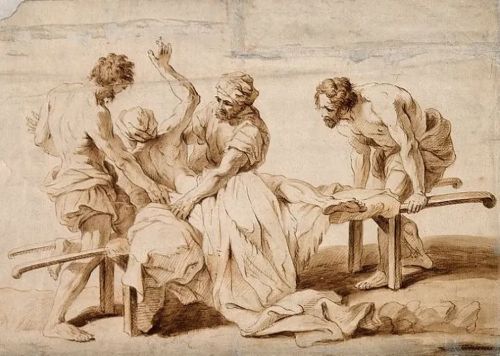
Survival was not the same as recovery. A patient might live through a fracture, endure the setting, escape gangrene, and still never return to the body they had before. Ancient fracture care has to be judged not only by whether the patient died, but by what kind of limb remained afterward. Bones could heal crooked, shortened, rotated, thickened, painful, weak, or stiff. Joints could lose motion. Muscles could waste. Nerves could remain damaged. A badly aligned leg might leave a permanent limp; a shortened femur could tilt the pelvis and alter the whole gait; a stiff elbow or wrist could make ordinary work difficult. The ancient healer’s goal was not simply to close the crisis, but to preserve future use.
Malunion was one of the most visible failures of fracture care. When broken ends healed in poor alignment, the result could remain written on the body for life. Ancient medical writers understood this danger, even without modern radiology. They knew that a limb should be compared with its healthy counterpart, that deformity mattered, and that the early position of the injured part shaped the eventual outcome. Celsus, like the Hippocratic writers before him, paid attention to shortening, crookedness, and the lasting consequences of neglected or poorly managed fractures. This concern tells us something important: ancient bone-setting was not only about immediate pain relief. It was about preventing the body from healing badly. The body’s power to repair itself was a gift, but it was also a threat. If the bone healed in the wrong position, nature could make deformity permanent.
The risk of disability made timing crucial. Reduction had to happen before swelling, muscle contraction, and early healing made the bone harder to reposition. Bandages had to be tight enough to hold but loose enough to avoid strangling the tissues. Splints had to preserve alignment without creating pressure sores or worsening inflammation. Rest had to last long enough for the bone to knit, but prolonged immobility could bring stiffness, weakness, and dependency. Ancient practitioners did not always possess the language of modern rehabilitation, but they recognized that the injured limb had to pass through stages: pain, swelling, setting, support, consolidation, and gradual return to use. The body changed during each of those stages. A limb that could not bear touch on the first day might need firmer support later; a wrapping that relieved pain early might become too tight as swelling increased; a patient who seemed stable might suffer renewed displacement if moved carelessly. The healer had to think ahead, not only react to the injury as it first appeared. A patient who bore weight too soon could undo the setting; a patient immobilized too long might never fully recover motion. This balance between protection and movement was difficult because the signs were imperfect. Pain might mean normal healing, excessive pressure, renewed injury, or infection. Stiffness might mean necessary rest or harmful over-rest. Ancient fracture care required a practical sense of sequence: when to pull, when to bind, when to loosen, when to strengthen support, when to permit use, and when to fear that the body was healing in the wrong direction. Healing required patience, but also judgment about when patience had become stagnation.
The social consequences of malunion could be severe. In a world where most people depended on bodily labor, a damaged limb could threaten livelihood as surely as health. Farmers, builders, sailors, potters, soldiers, enslaved workers, herders, porters, and household laborers needed arms, legs, backs, and hands that could bear repetitive strain. A crooked wrist might make craft labor awkward; a stiff shoulder could limit lifting; a shortened leg could make long walking painful; a badly healed jaw or rib injury might affect eating or breathing. Disability also shaped status. A wealthy person might adapt through servants, property, or lighter work. A poor or enslaved person had fewer cushions. The same fracture could be an inconvenience in one life and a catastrophe in another.
Life after fracture also depended on how communities interpreted visible impairment. A limp, missing limb, shortened arm, or twisted hand could mark a person socially. It might invite pity, contempt, accommodation, exclusion, religious interpretation, or practical reassignment. Ancient societies were not uniform in their treatment of disabled bodies, and disability did not always mean helplessness. Many people adapted, worked, married, fought, traveled, and participated in household or civic life with impairments. But adaptation required circumstances that made adaptation possible: tools, kin, patrons, altered duties, or social tolerance. A healed fracture belonged to a larger history of disability, not simply to the history of surgery. The question was not only whether the bone mended, but whether the person could continue to inhabit a meaningful and sustainable place in the world.
This makes the aftermath of fracture one of the most revealing parts of ancient medicine. The dramatic moment of treatment (the pull, the crack, the binding, the splint) was only the beginning. Weeks or months later, the outcome appeared in walking, lifting, kneeling, grasping, sleeping, working, and being seen by others. Ancient healers could improve those outcomes by aligning and immobilizing the bone well, but they could not erase every consequence of trauma. Malunion, stiffness, pain, weakness, infection, and social vulnerability remained. Broken bones show ancient medicine in its long duration. Healing was not a single event. It was a negotiation between body, technique, time, labor, and social support, and sometimes the final result was not cure but survival with alteration.
War, Work, Sport, and the Social Geography of Broken Bones

Broken bones were not distributed evenly across ancient societies. They followed the routes of violence, labor, transport, poverty, age, and public display. A fracture might come from a spear thrust, sword blow, sling stone, fall from a horse, collapsed scaffold, runaway cart, agricultural accident, mine injury, wrestling match, athletic fall, or punishment. The body broke where life placed it under stress. Soldiers, farmers, builders, sailors, enslaved laborers, porters, herders, athletes, charioteers, gladiators, children, and the elderly all faced fracture risk, but not in the same ways or with the same chances of recovery. The history of broken bones is also a social geography of danger: who worked at height, who carried weight, who fought, who rode, who was beaten, who had time to rest, and who had to return to use before the body was ready.
War made fracture care urgent and often brutal. Battlefields produced crushed limbs, skull injuries, broken ribs, shattered arms, damaged hands, and wounds in which bone and flesh were injured together. A soldier struck by a missile or edged weapon might suffer not a clean break but a mixed trauma of fracture, laceration, bleeding, and contamination. Military contexts also changed the meaning of treatment. The question was not only whether the man could live, but whether he could march, fight, carry equipment, or avoid burdening the unit. An arm that healed crooked might still end a soldier’s usefulness with shield, spear, bow, sling, or sword; a fractured leg might make him unable to keep formation, flee, or carry supplies. Triage, movement, and scarcity could all shape care. A fracture that might be treated patiently in a settled household could become far more dangerous during retreat, siege, heat, hunger, or transport. The wounded might have to be moved before the bone was stable, or left in place because moving them would be worse. Bandages could loosen during marching, wounds could foul under armor or dirty cloth, and the repeated jolting of carts, litters, or animals could undo a reduction that had been technically successful. Ancient military medicine belonged to a harsher world of urgent decisions, where the injured body had to be managed amid noise, fear, and limited time.
Work created another landscape of skeletal injury. Most ancient economies depended on bodies doing repetitive, heavy, and dangerous tasks: plowing, harvesting, lifting stone, hauling water, carrying amphorae, cutting timber, tending animals, rowing, mining, building walls, loading ships, and grinding grain. Falls, kicks from animals, crushed hands, broken feet, injured spines, and fractured limbs were occupational hazards long before modern industrial labor. Enslaved and coerced workers were vulnerable because their bodies were instruments of someone else’s profit and command. Even when treated, they might not be granted adequate rest. A master, overseer, army officer, or employer might value a body enough to seek repair, but not enough to allow slow recovery. This tension is crucial. Ancient fracture treatment required immobilization and time, while ancient labor systems often demanded movement and productivity.
Sport and spectacle added a different but related geography of injury. Greek athletics celebrated disciplined bodies, but wrestling, boxing, pankration, running, jumping, and throwing could produce falls, dislocations, facial injuries, broken fingers, damaged ribs, and limb fractures. These injuries occurred in a culture that admired bodily excellence, but admiration did not protect the body from damage. In combat sports, the athlete’s strength and training could become the very conditions that made injury more violent: a hard throw, a locked joint, a missed landing, or a blow delivered by another trained body. Roman spectacle intensified the issue. Gladiators and arena performers could receive skilled medical attention, especially when their bodies represented training, investment, and entertainment value, but their injuries were produced by a culture that staged violence for public consumption. The same society that might preserve a gladiator’s body through expert wound care also exposed that body to repeated trauma. A gladiator school could function as both a place of training and a place where accumulated injuries were managed so that the performer could return to risk. Sport and spectacle reveal a paradox: some of the most injured bodies may have had access to unusually practiced trauma care, while the institutions around them normalized the breaking of bodies as competition, discipline, or display. The fracture was not an accidental interruption of these worlds. It was one of their expected costs.
Age and domestic space also mattered. Children broke bones in play, falls, animal encounters, and household accidents; their bodies might heal quickly but deform if poorly set. Older people were vulnerable to falls and fractures made more dangerous by frailty, poor nutrition, or chronic illness. Women’s fracture risks could be shaped by domestic labor, water carrying, textile work, agricultural work, childbirth-related injury, and household violence, though ancient sources often make such injuries less visible than male battlefield wounds. The home was not a safe counterpoint to war and labor. It contained stairs, tools, animals, fire, grinding stones, crowded rooms, and interpersonal violence. A history focused only on armies and famous medical authors misses this quieter landscape of broken bones, where much fracture care likely occurred away from formal medical writing.
The social geography of fracture also shaped outcomes after treatment. A wealthy urban patient might summon a physician, obtain clean linen, receive repeated visits, and rest for weeks. A rural laborer might rely on family skill, local healers, and improvised splints. A soldier might be treated efficiently but under campaign constraints. An enslaved worker might be repaired only insofar as repair restored usefulness. An athlete or gladiator might receive expert attention but remain trapped in a cycle of bodily risk. Ancient fracture care was never just a set of techniques. It was a system of possibilities distributed across social worlds. The same principles (reduce, bind, splint, rest, watch) could mean very different things depending on whether the patient lay in a villa, barracks, arena school, farm hut, ship, workshop, mine, or battlefield tent.
Late Antique and Islamic Afterlives: From Splints to Hardened Casts
Fracture care did not end with the classical Greek and Roman authors. The techniques of reduction, traction, bandaging, splinting, wound care, and prognosis passed into late antique and medieval medical traditions, where they were copied, translated, reorganized, criticized, and adapted. This afterlife matters because ancient fracture treatment was not a single moment of discovery but a long practical inheritance. The broken limb remained the same urgent problem across languages and empires: the bone had to be brought back toward alignment, held still, protected from swelling and wound corruption, and nursed through the slow work of healing. Late antique and Islamic physicians inherited this core logic, but they also worked within new institutional, linguistic, and scholarly worlds.
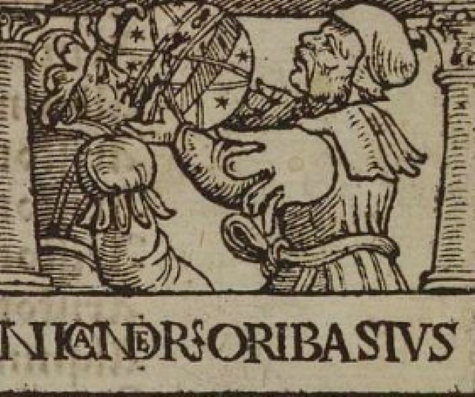
Late antique medicine formed an important bridge. Writers such as Oribasius, Aëtius of Amida, Alexander of Tralles, and Paul of Aegina compiled and transmitted older Greek medical knowledge while adding their own arrangements and emphases. Paul of Aegina became a major surgical authority for later readers. His surgical books drew on earlier Greek traditions but presented them in a form useful for practitioners who needed organized guidance. In fracture care, this meant preserving the familiar principles of reduction, bandaging, splinting, and treatment of complications. Late antique medicine was not merely a period of decline or passive copying. Compilation itself was a form of medical labor. By selecting, condensing, and arranging older material, these authors helped determine which parts of ancient trauma care would remain available to later worlds.
The rise of Islamic medicine transformed this inheritance. Beginning in the Abbasid period, Greek medical texts were translated into Arabic, studied, commented upon, and incorporated into a vast learned medical culture. Hippocrates, Galen, Paul of Aegina, and other authorities entered Arabic medicine not as museum pieces but as working sources. Physicians such as al-Razi, Ibn Sina (Avicenna), and al-Zahrawi engaged with inherited medicine while also writing for their own clinical and surgical contexts. This is where the history of fracture care becomes part of a broader story of translation and transformation. Greek and Roman practical knowledge moved through Syriac and Arabic scholarship, into hospitals, courts, libraries, teaching circles, and eventually back into medieval Latin Europe. The broken bone became a problem shared across intellectual geographies. Islamic medical authors preserved the old mechanical logic of fracture treatment but often described it with great practical care. A broken limb still required reduction, extension, bandaging, splinting, and attention to swelling, pain, and wound danger. Ibn Sina’s Canon of Medicine organized medical knowledge into an enormously influential system, while al-Razi’s clinical writings preserved a more case-oriented and observational spirit. Al-Zahrawi’s surgical work is important because it treated surgery as a serious technical art and described instruments, procedures, cautery, wounds, and bodily repair. In this tradition, the surgeon’s hand remained central, but it was increasingly supported by a rich written culture of classification, commentary, and instruction. Ancient bone-setting survived because it could be taught, repeated, and fitted into new systems of medical authority.
One of the most interesting developments in this later tradition was the use of hardening materials to support injured limbs. Splints and bandages had always been central, but medieval Islamic and later European surgical traditions also experimented with mixtures that stiffened as they dried, including preparations involving egg white, flour, lime, gums, resins, or other binding substances. These were not modern plaster casts in the nineteenth-century sense, and they should not be described as if they were identical to contemporary orthopedic casting. Yet they represent a significant extension of the old principle of immobilization. If a bandage could be made to harden, it could hold the limb more securely, distribute support more evenly, and reduce the chance that splints would shift. The aim was the same as in Egypt, Greece, Rome, and India: restrain movement without destroying the living tissues. The materials changed, but the therapeutic problem remained ancient.
The Islamic afterlife of fracture care also complicates the usual story of medical progress. It was not a simple line from ignorance to enlightenment, nor a clean handoff from Greece to Rome to Europe. It was a braided history of preservation, translation, commentary, experiment, and practical need. Arabic-writing physicians did not simply “save” classical medicine for Europe; they practiced medicine in their own right, within their own institutions and intellectual traditions. They evaluated inherited authorities, incorporated Persian, Indian, and local knowledge, and developed surgical and pharmacological practices suited to their worlds. In fracture treatment, this meant that the ancient principles of traction and splinting survived because they remained useful, not because they were merely revered. A broken bone tested every tradition by results. If the limb healed straighter and stronger, the method earned its place.
By the time these traditions moved into medieval Latin medicine, the ancient art of fracture care had already been reshaped many times. The healer setting a bone in a later medieval town or hospital might be working through layers of knowledge that passed from Hippocratic surgery to Galenic authority, from late antique compilers to Arabic encyclopedists and surgeons, from translation schools to local practice. The continuity is striking, but so is the adaptation. Splints, linen, traction, bandages, wound dressings, and prognosis remained recognizable; hardening supports and new textual syntheses added further tools. This long afterlife shows why ancient fracture treatment should not be treated as a dead chapter before modern orthopedics. It was a living practical tradition, repeatedly remade wherever bodies broke and healers tried to hold them together.
Why Ancient Fracture Care Sometimes Worked and Sometimes Failed

Ancient fracture care worked when technique, timing, injury type, materials, patient strength, and social support aligned. This is why broken bones occupy such an important place in the history of premodern medicine. Unlike many internal illnesses, fractures could sometimes be treated through visible, practical action. The displaced limb could be pulled closer to its proper shape. The broken part could be wrapped, padded, splinted, and rested. The patient’s progress could be watched over days and weeks. A healer did not need modern radiology or cellular biology to see that a straightened and immobilized limb often healed better than one left crooked and unstable. Ancient bone-setting could succeed because it addressed a real mechanical problem with real mechanical means.
The body itself made this success possible. Bone is living tissue with a remarkable capacity to repair. When broken ends are brought into reasonable contact and protected from repeated movement, the body forms callus, bridges the fracture, and gradually remodels the injured area. Ancient healers did not describe this process in modern biological terms, but they could observe its effects. Pain lessened, swelling declined, the limb became less mobile at the break, and function slowly returned. The injured person, family, and healer could see whether the limb was becoming more stable or whether something had gone wrong. A fracture that had once shifted under the skin might begin to feel firm; a patient who could not move without agony might slowly tolerate touch, then limited motion, then partial use. This gave fracture care a clearer feedback loop than many other ancient treatments. A remedy for fever or wasting disease might be hard to judge, because illness could rise and fall unpredictably. A splinted fracture, by contrast, offered visible results: straighter or crooked, stable or unstable, healed or festering, useful or disabled. That visibility made fracture treatment a powerful school of experience. Repeated cases could teach that early alignment mattered, that movement delayed repair, that some swelling was expected, and that certain wounds were ominous. Fracture care rewarded practical learning.
It also worked because many ancient techniques were well matched to the injuries they could reasonably treat. Closed fractures of the forearm, lower leg, clavicle, ribs, or humerus might be painful and disabling, but they were not always beyond help. If the fracture was not severely displaced, or if reduction was achieved early, splints and bandages could hold the limb well enough for healing. The repeated attention in Egyptian, Hippocratic, Roman, Indian, and later Islamic texts to traction, bandage tension, splint timing, and prognosis suggests that ancient practitioners recognized the importance of sequence. They knew that swelling mattered, that tight bandages could harm, that neglected displacement could leave deformity, and that rest was part of treatment. They also understood, in practical terms, that not every broken bone should be handled in the same way. A simple arm fracture, a rib injury, a joint dislocation, a crushed leg, and an open wound involving bone demanded different expectations and different levels of caution. The best ancient treatment was selective. It did not apply force blindly; it judged the injury, the patient, the swelling, the wound, and the likelihood that the body could cooperate with care. Their success did not come from magic hidden inside the splint. It came from cooperating with the body’s own repair while preventing the most obvious causes of bad healing: movement, misalignment, pressure injury, contamination, premature use, and neglect.
Materials mattered as well. Linen, wool, leather, bark, reeds, bamboo, wood, palm material, pads, oils, waxes, resins, and later hardening mixtures all helped transform loose knowledge into physical care. A fracture could not be healed by a diagnosis alone. It had to be held. Ancient healers used what their environments and economies provided, adapting common materials into medical tools. Cloth distributed pressure. Padding protected skin. Splints limited movement. Oils eased dressing changes. Honey, wine, and resin helped dress wounds, soothe tissue, cover exposed areas, and discourage visible decay. None of this should be exaggerated into modern antiseptic surgery or orthopedic casting, but it should not be dismissed either. Premodern medicine often worked best when it turned ordinary materials into disciplined technique.
Ancient fracture care failed when the injury exceeded the limits of external manipulation and support. A severely displaced femur, crushed joint, shattered bone, spinal injury, pelvic fracture, or compound wound could defeat even a skilled practitioner. Without X-rays, the healer could not always know whether the bone was truly aligned. Without internal fixation, he could not stabilize many complex fractures. Without modern anesthesia, he could not always manipulate the limb long enough or forcefully enough to restore position. Without blood transfusion, vascular surgery, antisepsis, or antibiotics, he could not reliably rescue a patient from hemorrhage, deep contamination, gangrene, or sepsis. The ancient healer could pull, bind, splint, dress, and watch, but some bodies were already moving beyond the reach of those actions. Failure could also come from treatment itself. A bandage pulled too tightly might intensify swelling, compress tissues, produce numbness, or contribute to tissue death. A splint applied without enough padding might create sores. A limb manipulated too violently might tear soft tissue or worsen displacement. A wound covered too long might trap discharge. A fracture allowed to bear weight too soon might shift and heal crooked. Even a correct treatment at the wrong time could become harmful. This is why ancient medical writers were so concerned with judgment. Bone-setting was not simply a list of steps. It was a sequence of decisions made under uncertainty, with a patient in pain and the injured limb changing from day to day. Failure often lived in the difference between a principle and its application.
Social conditions could decide the outcome as much as medical skill. A wealthy patient could rest, receive repeated visits, eat well, keep the limb clean, and avoid premature labor. A poor worker, enslaved laborer, soldier, sailor, or farmer might be forced back into movement too early. A patient on campaign might be transported roughly before the fracture was stable. A household without clean cloth, food, attendants, or secure shelter might struggle to maintain even a well-applied splint. Recovery required time, and time was unequally distributed. Ancient fracture care failed not only because ancient medicine lacked modern technology, but because bodies healed inside social worlds. Poverty, war, enslavement, hunger, displacement, and labor demands could undo what the healer had begun.
The best interpretation is neither triumphalist nor dismissive. Ancient fracture care sometimes worked because it was grounded in real observation: align the displaced bone, immobilize the injured part, protect the tissues, manage wounds, and allow time for repair. It sometimes failed because trauma could be too severe, infection too powerful, diagnosis too uncertain, pain too limiting, materials too crude, or social conditions too harsh. Broken bones reveal ancient medicine at one of its most practical points, but also one of its most honest. The same tradition that could return a closed fracture to useful function might stand helpless before an open, crushed, infected limb. Its achievements and failures came from the same place: the healer working with hands, cloth, splints, experience, and hope at the edge of what the ancient body could survive.
Are We Mistaking Natural Bone Healing for Ancient Medical Skill?
The following video from “Chronology” discusses healing fractures in the ancient world:
It is important to remember that bones can heal without professional treatment. A fractured limb does not require a theory of medicine to form callus, knit, and remodel. The body begins its work whether or not a healer understands the process. This matters because much of the archaeological evidence for ancient fracture care comes from healed bones, and a healed bone does not automatically prove that someone set it well, splinted it carefully, or visited the patient repeatedly. A simple, non-displaced fracture might heal acceptably with little more than rest. A person immobilized by pain might protect the limb without any formal technique. A well-aligned skeleton may show survival and biological repair more than medical success.
This caution is important when interpreting skeletal remains. A straight healed fracture may look like evidence of skill, but it may simply have been an injury that did not shift badly in the first place. A crooked healed fracture may look like evidence of neglect, but it may have resulted from a severe injury no ancient healer could have managed well. Even splints found with bodies, particularly in Egyptian contexts, must be read carefully because some may have been connected to funerary restoration rather than treatment in life. Ancient burial practice often cared about bodily wholeness, and a limb supported after death might express ritual repair rather than clinical intervention. The material record is powerful, but it is not self-explanatory. It can show fracture, survival, deformity, and sometimes support; it cannot always show intention.
The textual evidence also has limits. The Edwin Smith Papyrus, the Hippocratic surgical writings, Celsus, the Sushruta Samhita, Paul of Aegina, and later Arabic surgical authorities preserve organized systems of fracture treatment, but written medicine is not the same as ordinary practice. These texts often represent learned traditions, ideal procedures, and expert voices. They do not tell us how often patients had access to such care, how carefully practitioners followed the instructions, or how many fractures were handled by household members, local bone-setters, midwives, soldiers, enslaved attendants, or practical healers whose knowledge never entered elite medical writing. It is possible to overstate the reach of ancient medicine by treating medical texts as mirrors of everyday care. The ancient world was full of broken bodies, but not every broken body lay before a literate physician.
This complicates my arguments, but it does not overturn them. The argument is not that ancient healers invented bone healing or that every healed fracture proves professional skill. The stronger claim is that ancient medical traditions recognized conditions under which natural bone healing could be helped or harmed. They understood that alignment mattered, that motion could disturb repair, that bandages could support or injure, that splints required timing and padding, that wounds involving bone were more dangerous, and that prognosis differed from case to case. These insights are too specific and too widely repeated to dismiss as lucky guesswork. Ancient healers did not control bone repair in the modern orthopedic sense, but they learned how to cooperate with it. Their skill lay not in making bone heal from nothing, but in giving the body a better chance to heal usefully.
The counterpoint sharpens the final interpretation. Ancient fracture care should not be praised as proto-modern orthopedics, nor dismissed as accidental success wrapped in medical language. It occupied a middle ground. The body healed; the healer guided, restrained, aligned, protected, and sometimes failed. Natural repair and medical skill were not rival explanations but intertwined forces. A broken bone could heal despite poor treatment, fail despite good treatment, or recover well because human hands helped nature work in the right direction. That is what makes fracture care such a revealing subject in the history of medicine. It shows ancient healing at its most practical and its most dependent: a craft built around the body’s own power, limited by pain, infection, inequality, and uncertainty.
Conclusion: The Bone, the Body, and the Limits of Ancient Medicine
A broken bone was one of the ancient world’s most revealing medical emergencies because it forced healers to confront the body as matter, structure, pain, and social necessity all at once. The fracture could be seen in deformity, felt beneath the fingers, heard in the patient’s cry, and judged in the long aftermath of healing or failure. It demanded action that was immediate and practical: pull, align, bind, splint, dress, rest, watch. Across Egypt, India, Greece, Rome, and later Islamic medicine, ancient healers developed methods that were often far more disciplined than modern stereotypes of premodern medicine allow. They could not see inside the body, but they learned to read its surface. They could not command bone repair, but they learned how to help or hinder it.
The achievement of ancient fracture care lay in this cooperation with nature. The healer did not make bone heal from nothing. The body did that. But the healer could improve the conditions under which healing occurred. A straightened limb healed better than a crooked one; a supported fracture healed better than an unstable one; a padded splint protected better than a careless binding; a wound washed, covered, and watched had a better chance than one left open to dirt, flies, and neglect. This was not modern orthopedics, but it was real therapeutic knowledge. It came from repetition, observation, craft skill, and the memory of outcomes. Ancient bone-setting belongs among the most practical branches of early medicine, precisely because its results could be seen in whether people walked, lifted, grasped, limped, suffered, or returned to work.
Yet the same history also shows the hard limits of ancient medicine. Open fractures, crushed limbs, gangrene, deep infection, severe displacement, spinal injury, and massive bleeding could overwhelm the healer’s tools. Pain limited what could be attempted. Poverty limited rest. War limited patience. Enslavement limited care. The absence of anesthesia, antisepsis, antibiotics, imaging, transfusion, and internal fixation meant that many injuries remained beyond reliable treatment. Even when a patient survived, the result might be a shortened leg, a stiff joint, a crooked arm, chronic pain, dependency, or a changed social identity. Ancient fracture care was not a story of simple progress or simple failure. It was a story of skill operating under conditions of uncertainty and danger.
The broken bone finally reveals ancient medicine at its most honest. It shows healers neither as fools nor as modern surgeons in primitive clothing, but as practitioners working with hands, materials, inherited rules, and hard experience at the edge of what their worlds could sustain. Their medicine was tactile, procedural, and observant, but also unequal, painful, and vulnerable to infection and social circumstance. In fracture treatment, the ancient healer met the body where it was most visibly damaged and most visibly capable of repair. Sometimes the limb healed and the patient returned to life. Sometimes the bone knit badly, the wound rotted, or the body failed. Between those outcomes lay the fragile art of ancient fracture care: the attempt to hold broken bodies together long enough for nature, skill, and fortune to do what they could.
Bibliography
Affiliate disclosure: Amazon links on this site are paid links. As an Amazon Associate I earn from qualifying purchases.
- Al-Zahrawi. Albucasis on Surgery and Instruments. Translated and edited by M. S. Spink and G. L. Lewis. Berkeley: University of California Press, 1973.
- Aufderheide, Arthur C., and Conrado Rodríguez-Martín. The Cambridge Encyclopedia of Human Paleopathology. Cambridge: Cambridge University Press, 1998.
- Avicenna. The Canon of Medicine (Al-Qanun fi’l-Tibb). Translated by Laleh Bakhtiar. Chicago: Great Books of the Islamic World, 1999.
- Baker, Patricia A. The Archaeology of Medicine in the Greco-Roman World. Cambridge: Cambridge University Press, 2013.
- Bliquez, Lawrence J. Roman Surgical Instruments and Other Minor Objects in the National Archaeological Museum of Naples. Mainz: Philipp von Zabern, 1994.
- Blomstedt, Patric. “Orthopedic Surgery in Ancient Egypt.” Acta Orthopaedica 85:6 (2014), 670–676.
- Breasted, James Henry. The Edwin Smith Surgical Papyrus. 2 vols. Chicago: University of Chicago Press, 1930.
- Brier, Bob and Ronald S. Wade. “Surgical Procedures during Ancient Egyptian Mummification.” Chungara: Revista de Antropología Chilena 33:1 (2001), 117-123.
- Brorson, Stig. “Management of Fractures of the Humerus in Ancient Egypt, Greece, and Rome: An Historical Review.” Clinical Orthopaedics and Related Research 467:7 (2009), 1907–1914.
- Buikstra, Jane E., and Douglas H. Ubelaker, eds. Standards for Data Collection from Human Skeletal Remains. Fayetteville: Arkansas Archeological Survey, 1994.
- Celsus. De Medicina. Translated by W. G. Spencer. Cambridge, MA: Harvard University Press, 1935.
- Conrad, Lawrence I., et.al. The Western Medical Tradition: 800 BC to AD 1800. Cambridge: Cambridge University Press, 1995.
- Craik, Elizabeth M. The “Hippocratic” Corpus: Content and Context. London: Routledge, 2015.
- Dioscorides. De Materia Medica. Translated by Lily Y. Beck. Hildesheim: Olms-Weidmann, 2005.
- Dols, Michael W. Medieval Islamic Medicine: Ibn Riḍwān’s Treatise “On the Prevention of Bodily Ills in Egypt.” Berkeley: University of California Press, 1984.
- Eakins, J. Kenneth. “Human Osteology and Archeology.” The Biblical Archaeologist 43:2 (1980), 89-96.
- Galen. On Anatomical Procedures. Translated by Charles Singer. Oxford: Oxford University Press, 1956.
- Garland, Robert. The Eye of the Beholder: Deformity and Disability in the Graeco-Roman World. London: Bristol Classical Press, 1995.
- Ghalioungui, Paul. The House of Life: Per Ankh; Magic and Medical Science in Ancient Egypt. Amsterdam: B. M. Israel, 1973.
- Grauer, Anne L., ed. A Companion to Paleopathology. Malden, MA: Wiley-Blackwell, 2011.
- Gutas, Dimitri. Greek Thought, Arabic Culture: The Graeco-Arabic Translation Movement in Baghdad and Early ʿAbbāsid Society. London: Routledge, 1998.
- Hippocrates. On Wounds in the Head. In the Surgery. On Fractures. On Joints. Mochlicon. Translated by E. T. Withington. Loeb Classical Library. Cambridge, MA: Harvard University Press, 1928.
- Jackson, Ralph. Doctors and Diseases in the Roman Empire. Norman: University of Oklahoma Press, 1988.
- Jacquart, Danielle, and Françoise Micheau. La médecine arabe et l’Occident médiéval. Paris: Maisonneuve et Larose, 1990.
- Jouanna, Jacques. Hippocrates. Translated by M. B. DeBevoise. Baltimore: Johns Hopkins University Press, 1999.
- Junkelmann, Marcus. Gladiators and Caesars: The Power of Spectacle in Ancient Rome. Berkeley: University of California Press, 2000.
- Kirkup, John. A History of Limb Amputation. London: Springer, 2007.
- Kyle, Donald G. Sport and Spectacle in the Ancient World. 2nd ed. Malden, MA: Wiley-Blackwell, 2014.
- Laes, Christian. Disabilities and the Disabled in the Roman World: A Social and Cultural History. Cambridge: Cambridge University Press, 2018.
- Lagercrantz, Sture. “The Splinting of Fractures in Africa.” Paideuma: Mitteilungen zur Kulturkunde 36:II (1990), 115-137.
- Larsen, Clark Spencer. Bioarchaeology: Interpreting Behavior from the Human Skeleton. Cambridge: Cambridge University Press, 1997.
- Lloyd, G. E. R. Hippocratic Writings. London: Penguin Classics, 1978.
- Majno, Guido. The Healing Hand: Man and Wound in the Ancient World. Cambridge, MA: Harvard University Press, 1975.
- Martin, Debra L., Ryan P. Harrod, and Ventura R. Pérez. Bioarchaeology: An Integrated Approach to Working with Human Remains. New York: Springer, 2013.
- Mattern, Susan P. Galen and the Rhetoric of Healing. Baltimore: Johns Hopkins University Press, 2008.
- Meulenbeld, G. Jan. A History of Indian Medical Literature. 5 vols. Groningen: Egbert Forsten, 1999–2002.
- Nunn, John F. Ancient Egyptian Medicine. Norman: University of Oklahoma Press, 1996.
- Nutton, Vivian. Ancient Medicine. 2nd ed. London: Routledge, 2012.
- Ortner, Donald J. Identification of Pathological Conditions in Human Skeletal Remains. 2nd ed. San Diego: Academic Press, 2003.
- Paul of Aegina. The Seven Books of Paulus Aegineta. Translated by Francis Adams. 3 vols. London: Sydenham Society, 1844–1847.
- Pormann, Peter E., and Emilie Savage-Smith. Medieval Islamic Medicine. Washington, DC: Georgetown University Press, 2007.
- Riddle, John M. Dioscorides on Pharmacy and Medicine. Austin: University of Texas Press, 1985.
- Ritner, Robert K. “Innovations and Adaptations in Ancient Egyptian Medicine.” Journal of Near Eastern Studies 59:2 (2000), 107-117.
- Roberts, Charlotte, and Keith Manchester. The Archaeology of Disease. 3rd ed. Ithaca, NY: Cornell University Press, 2007.
- Salazar, Christine F. The Treatment of War Wounds in Graeco-Roman Antiquity. Leiden: Brill, 1999.
- Savage-Smith, Emilie. “Medicine.” In Encyclopaedia of the History of Science, Technology, and Medicine in Non-Western Cultures, edited by Helaine Selin, 1600–1605. Dordrecht: Springer, 2008.
- Scarborough, John. Pharmacy and Drug Lore in Antiquity. Farnham: Ashgate, 2010.
- —-. Roman Medicine. Ithaca, NY: Cornell University Press, 1969.
- Scheidel, Walter, and Sitta von Reden, eds. The Ancient Economy. Edinburgh: Edinburgh University Press, 2002.
- Suśruta. An English Translation of the Sushruta Samhita. Translated by Kaviraj Kunja Lal Bhishagratna. 3 vols. Calcutta: Bhishagratna, 1907–1916.
- Totelin, Laurence M. V. Hippocratic Recipes: Oral and Written Transmission of Pharmacological Knowledge in Fifth- and Fourth-Century Greece. Leiden: Brill, 2008.
- Veiga, Paula. “Studying Mummies and Human Remains: Some Current Developments and Issues.” Journal of the Washington Academy of Sciences 98:2 (2012), 1-21.
- Vlahogiannis, Nicholas. “Disabling Bodies.” In Changing Bodies, Changing Meanings: Studies on the Human Body in Antiquity, edited by Dominic Montserrat, 13–36. London: Routledge, 1998.
- Wiedemann, Thomas E. J. Emperors and Gladiators. London: Routledge, 1992.
- Wujastyk, Dominik. The Roots of Ayurveda: Selections from Sanskrit Medical Writings. 3rd ed. London: Penguin, 2003.
- Zysk, Kenneth G. Asceticism and Healing in Ancient India: Medicine in the Buddhist Monastery. New York: Oxford University Press, 1991.
Originally published by Brewminate, 06.25.2026, under the terms of a Creative Commons Attribution-NonCommercial-NoDerivatives 4.0 International license.
About the Author