The Brahmashira Astra was more than a world-ending weapon: it was a test of sacred knowledge, self-command, and whether destructive power could ever remain under human control.

By Matthew A. McIntosh
Public Historian
Brewminate
Introduction: The Weapon That Could End the World
The greatest threat in the Mahabharata appears after the great war has ostensibly ended. The armies assembled at Kurukshetra have been shattered, Duryodhana lies mortally wounded, and the Pandavas have gained the kingdom for which generations of the Kuru family have sacrificed nearly everything. Yet victory has not restored order. Ashvatthama, the son of the fallen teacher Drona, enters the camp of the sleeping victors and massacres warriors who can no longer defend themselves, including the sons of Draupadi. When the Pandavas pursue him, the violence of the war reaches beyond conventional battle and approaches the destruction of the world itself. Cornered, enraged, and unable to defeat his enemies by ordinary means, Ashvatthama invokes the Brahmashira Astra, a celestial weapon whose release threatens not merely the men before him but the land, its inhabitants, and the continuity of life. The war that began as a struggle over succession arrives at its most terrible possibility only when the military contest is already over: the victors and defeated alike may inherit nothing but ashes.
The Brahmashira belongs to a conceptual world in which weapons cannot be separated neatly from sacred speech, disciplined memory, divine authority, and the moral condition of the person who wields them. An astra is not simply a physical object comparable to a sword, spear, or mechanical projectile. Its destructive force is activated through specialized knowledge, usually transmitted by a teacher and governed by formulas, concentration, and rules of use. Ashvatthama does not retrieve the Brahmashira from an arsenal. He takes up an ordinary blade of grass and transforms it into the vehicle of an apocalyptic power, demonstrating that the true weapon resides in knowledge joined to intention. Arjuna answers by invoking the same weapon under Krishna’s direction, creating the prospect of a collision whose consequences would extend far beyond either combatant. The sages Vyasa and Narada intervene, commanding both warriors to withdraw what they have released. Arjuna succeeds. Ashvatthama cannot. His inability to recall the weapon reveals that invocation and mastery are not identical: one may possess the knowledge required to unleash destruction without possessing the discipline necessary to stop it. Unable to reverse his action, Ashvatthama redirects the weapon toward the wombs of the Pandava women, turning a final act of battlefield desperation into an attempted annihilation of an entire lineage. The endangered unborn child Parikshit consequently becomes more than a dynastic heir. He represents the possibility that a human future might survive the accumulated hatreds of the present.
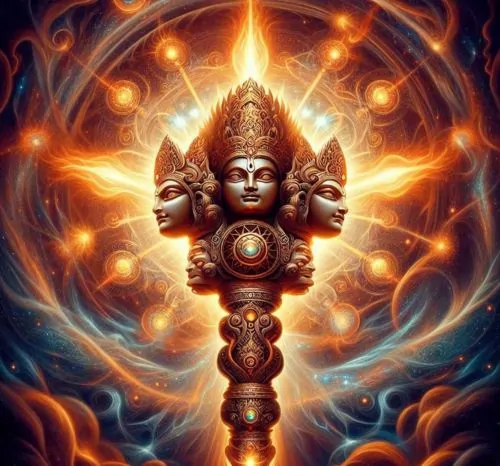
Modern descriptions frequently present the Brahmashira as the supreme “superweapon” of Hindu mythology, often assigning it precise power levels, comparing its effects directly to nuclear warfare, or depicting four or five heads of Brahma blazing from its tip. Such images may draw upon the weapon’s name, Brahma’s conventional four-faced iconography, traditions concerning the deity’s former fifth head, and the spectacular visual demands of modern television, illustration, gaming, and digital mythology. They should not be treated automatically as uncontested features of the principal epic narrative. The Sauptikaparvan unquestionably portrays the weapon as capable of catastrophic destruction and associates the confrontation with fire, cosmic disorder, and prolonged barrenness. It does not thereby provide a technical account of an ancient nuclear device. The language of apocalypse belongs first to the epic’s religious, poetic, and ethical imagination.
The Brahmashira episode is most revealing when approached not as evidence of forgotten technology but as a meditation on the possession of irreversible power. Throughout the Mahabharata, martial ability is inseparable from questions of dharma, yet the final crisis exposes the inadequacy of defining heroism solely through strength, courage, or victory. Ashvatthama is not powerless. He is one of the most learned and formidable survivors of the war, trained by the same master who instructed Arjuna. His catastrophe arises precisely because knowledge and character have become divided. Grief over his father, humiliation in defeat, fury toward the Pandavas, and the desire to extinguish their future overwhelm every restraint attached to the weapon he has inherited. Arjuna, by contrast, proves his mastery not by producing a greater explosion but by recalling the force he has already summoned. The decisive distinction is not between one warrior who possesses the Brahmashira and another who does not, but between two wielders who stand in radically different relationships to their own power. One can release and withdraw; the other can only release and redirect. The Brahmashira becomes the epic’s ultimate test of martial authority, sacred knowledge, and human self-government. Its enduring question is not whether humanity can discover the means to destroy the world, but whether those entrusted with such means can master their anger, accept restraint, and preserve a future they may never live to see.
Before the Brahmashira: Divine Weapons in the Sanskrit Epic World
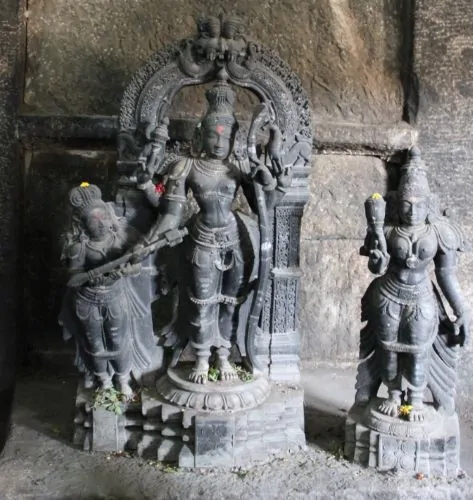
The Brahmashira emerges from a much larger imaginative world in which warfare, ritual knowledge, ascetic discipline, and divine authority overlap. The Sanskrit epics describe warriors who fight with bows, clubs, swords, spears, and chariots, but they also possess astras whose effects exceed the capabilities of ordinary weapons. These may unleash fire, wind, water, darkness, serpents, sleep, confusion, or destruction on a cosmic scale. Their presence does not make conventional arms irrelevant. Instead, divine weapons occupy a higher and more dangerous register of combat, usually appearing when normal martial skill has reached its limit or when a confrontation has acquired religious and cosmic significance. The Brahmashira is intelligible only within this broader system. It is terrifying not because it introduces supernatural warfare into an otherwise realistic battlefield, but because it stands near the extreme end of a continuum already populated by weapons associated with gods, elements, and primordial powers.
Sanskrit terminology provides a useful starting point, although the distinctions should not be made more rigid than the literature itself allows. Shastra commonly denotes a weapon wielded directly by the body, such as a sword, mace, or spear, whereas astra frequently refers to a weapon projected toward an enemy. In epic usage, an astra is rarely just an unusually powerful arrow. Its identity lies in the knowledge through which it is activated. A warrior may fit an ordinary shaft to a bow, recite or recollect the proper formula, concentrate upon a divine power, and transform that shaft into the vehicle of an Agneya weapon of fire, a Varuna weapon of water, an Aindra weapon associated with Indra, or another celestial force. In some episodes even a reed, stalk, or blade of grass can become the material carrier of a devastating astra. The physical object is secondary. What matters is the union of matter with mantra, intention, memory, and authority. The epic weapon does not exist solely in an armory; it also exists in the trained consciousness of the warrior who has been taught how to summon it.
This feature distinguishes divine weapons from modern machines without making them merely metaphorical. Within the narrative world of the epics, their effects are real, visible, and often catastrophic. Yet they operate according to a ritual rather than mechanical logic. Their use requires the correct relationship among teacher, pupil, deity, formula, target, and circumstance.
The acquisition of an astra consequently resembles initiation into restricted knowledge. Great warriors do not simply discover celestial weapons through experimentation. They receive them from gods, sages, or martial preceptors after demonstrating courage, austerity, obedience, or unusual concentration. During his exile, Arjuna performs severe ascetic practices and encounters Shiva before receiving the Pashupata weapon; he later acquires further celestial weapons through his association with Indra and the gods. Drona transmits specialized knowledge to selected students, while other teachers withhold particular weapons from those they judge unworthy, undisciplined, socially ineligible, or personally dangerous. Such episodes reveal that the transmission of weapons is also the transmission of status. To possess an astra is to have been admitted into a lineage of sacred and martial expertise. Yet the epics repeatedly expose the instability of that system. A teacher’s judgment may be compromised by affection, rivalry, ambition, or political obligation. A student who appears disciplined at the moment of instruction may later be transformed by grief or humiliation. Knowledge, once communicated, can leave the ethical control of the person who taught it. Divine weapons embody both the prestige of initiation and the danger that power may outlive the moral conditions under which it was granted.
The fullest mastery of an astra includes more than the ability to invoke it. A properly trained warrior must also know how to restrain, counter, or withdraw the weapon after release. Epic battles frequently unfold through sequences of action and counteraction: fire is opposed by water, darkness is dispelled by radiance, and one celestial missile is neutralized by another. These encounters can resemble an elaborate martial grammar in which each divine force has an answering force. The system is not perfectly consistent across the many layers and traditions of the Sanskrit epics, and later attempts to place every astra within a fixed hierarchy can create an order more precise than the texts themselves provide. What remains consistent is the association between control and legitimacy. A warrior who releases a weapon without understanding its consequences, who directs it at an improper target, or who cannot recall it has not merely made a technical error. He has revealed a failure of character. The Brahmashira will bring this principle to its most terrible conclusion. In the confrontation between Arjuna and Ashvatthama, the difference between mastery and possession will become the difference between preserving the world and rendering it barren.
The Paradox of a Creator’s Weapon
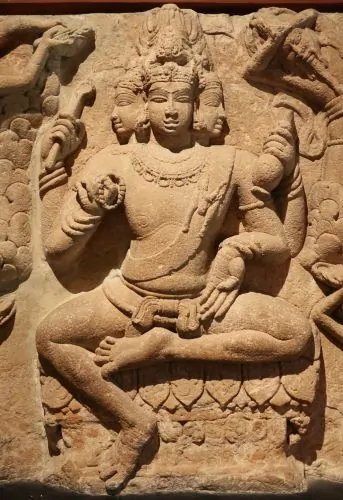
At first glance, the Brahmashira appears to embody a theological contradiction. Brahma is remembered above all as the creator, the divine figure associated with the generation of beings, the ordering of the cosmos, and the transmission of sacred knowledge. A weapon bearing his name threatens to reverse creation by consuming the world and rendering the earth incapable of sustaining life. This contradiction becomes less puzzling when Brahma is understood not simply as a benevolent artisan but as a personification of cosmic authority. In Sanskrit religious thought, the power that produces order is not necessarily separate from the power that can dissolve, withdraw, or overturn it. Creation is not imagined as a single irreversible event but as part of a vast rhythm in which worlds arise, endure, and eventually disappear. The Brahmashira represents destruction at the level of origins: not merely the killing of enemies within the world, but the turning of formative divine power against the conditions that allow the world to continue.
Brahma’s connection with sacred speech and revelation further deepens the meaning of the weapon. He is frequently associated with the Vedas, ritual knowledge, and the intellectual structures through which cosmic and social order become intelligible. His four faces are conventionally linked with the four directions and, in later interpretation, with the four Vedas, presenting him as a deity whose vision and utterance extend across the ordered universe. A weapon derived from Brahma’s authority is more than a burst of supernatural fire. It is knowledge converted into force. The wielder does not merely borrow the strength of a powerful god; he gains temporary access to a principle that stands close to the foundations of creation itself. This helps explain why such a weapon must be transmitted through disciplined instruction and guarded by restrictions. The danger lies not only in its destructive effects but in the possibility that a finite human mind, governed by anger, rivalry, or grief, may command a power whose scale belongs to the cosmos rather than the battlefield. The weapon’s divine origin does not guarantee its righteous use. On the contrary, its sacred pedigree makes the moral condition of the wielder even more important, because a power associated with order can become an instrument of disorder when separated from restraint.
The name Brahmashira, commonly understood in relation to the “head of Brahma,” also invites a visual and symbolic interpretation. Brahma’s multiple heads suggest comprehensive vision, sacred knowledge, and authority extending in every direction. Later descriptions of the weapon as displaying four or five heads may have arisen from this iconography and from myths in which Brahma once possessed a fifth head. Yet the image should be treated cautiously. The principal epic episode is more concerned with the weapon’s capacity and consequences than with supplying a fixed visual design.
The paradox of the creator’s weapon reflects the Mahabharata’s wider distrust of power detached from moral judgment. Creation requires differentiation, proportion, and order: beings must occupy places, relationships must be maintained, and life must remain capable of reproducing itself across generations. The Brahmashira threatens all of these at once. Its fire does not merely defeat an opponent; it risks erasing the distinction between victor and vanquished, warrior and civilian, present grievance and future life. When Ashvatthama redirects the weapon toward the wombs of the Pandava women, the association with Brahma becomes charged. A force bearing the creator’s name is aimed at the biological process through which creation continues. The attack is an inversion of generative power, turning sacred knowledge against birth itself. This inversion also clarifies why the weapon cannot be evaluated solely by asking whether its target deserves punishment. Its scale makes proportionality impossible. To invoke it is to claim authority over fields, families, unborn descendants, and the continued fertility of the earth. The Brahmashira stands as a terrible image of borrowed divinity: human beings receive access to a power associated with cosmic creation, yet their passions tempt them to use it in ways that unmake the very order from which their authority derives.
Problem of Mythological Taxonomy
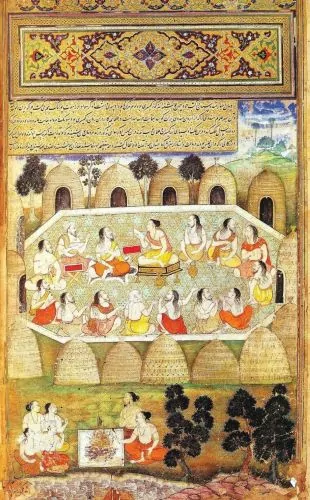
The relationship between the Brahmastra and the Brahmashira is frequently presented as though Sanskrit epic literature offered a single, systematic catalogue of celestial weapons. Popular summaries commonly describe the Brahmastra as an immensely destructive divine missile and the Brahmashira as its upgraded form, sometimes exactly four times more powerful because Brahma possesses four faces. Other accounts place the Brahmashira above every weapon except the Pashupata, the Brahmanda Astra, or whichever divine armament occupies the highest position in a particular modern list. Such classifications create an appealingly ordered mythology, but they are far more precise than the surviving textual tradition. The Mahabharata developed over centuries, preserves material from different narrative and theological strata, and does not consistently arrange its astras according to a universal scale of measurable force. Weapons acquire significance through particular episodes, wielders, divine associations, and narrative needs rather than through a stable hierarchy comparable to the statistics of a modern game.
The Brahmastra is best understood as a weapon associated with the authority and potency of Brahma, although its exact effects vary from one episode to another. It may appear as a supreme missile, a devastating counterweapon, or a mark of advanced martial knowledge possessed by an elite warrior. Its name combines Brahma with astra, a projected weapon activated through specialized knowledge. Brahmashira, or Brahmashiras, adds a term meaning “head,” “summit,” or “highest part,” allowing the name to be interpreted as the weapon of Brahma’s head or as a culminating form of Brahma’s power. This linguistic distinction may support the idea that the Brahmashira is more elevated or dangerous than an ordinary Brahmastra, but it does not by itself establish the elaborate visual and numerical properties often attributed to it. The name need not mean that four literal heads appear upon the weapon, nor does the number of Brahma’s faces prove a fourfold multiplication of destructive energy. The Sauptikaparvan treats the Brahmashira as a particular and exceptionally dangerous weapon known to Drona, Arjuna, and Ashvatthama. Krishna describes it as capable of consuming the world, and the collision of two such weapons threatens prolonged drought and devastation. These narrative statements establish its catastrophic status more securely than later calculations of relative power.
The distinction is further complicated because “the weapon of Brahma” can function as a broad description rather than a consistently technical name. Manuscripts, recensions, translators, commentators, and later retellings do not always preserve identical terminology. A weapon called Brahmashira in one account may be described more generally as a Brahma weapon elsewhere, while an attack popularly remembered as a Brahmastra may belong to a passage using a more specific designation. Taxonomic certainty can conceal the fluidity of epic language.
The problem becomes even more pronounced when the Brahmashira is compared with other supreme astras. Shiva’s Pashupata weapon is portrayed as so destructive that Arjuna is warned not to use it casually against human opponents. The Narayana weapon overwhelms resistance through the divine energy of Narayana but can be escaped through submission rather than superior force. The Brahmadanda, the “staff of Brahma,” belongs to the authority of Brahmin sages and may absorb or neutralize celestial weapons rather than simply surpass them through a larger explosion. Other astras summon fire, water, wind, serpents, darkness, sleep, delusion, or showers of projectiles. Their powers are qualitatively different, making simple rankings misleading. A weapon that is irresistible in one circumstance may be ineffective against a particular countermeasure, divine protection, vow, or form of conduct. The Narayana weapon, for example, becomes more dangerous when resisted, while its force subsides before those who lay down their arms. The Pashupata derives significance from Shiva’s terrible sovereignty and from the restrictions imposed upon its bearer. The Brahmashira’s distinctive horror lies in its capacity to extend destruction beyond the chosen enemy into the fertility of the land and the survival of future generations. Asking which of these is objectively “strongest” imposes a single standard upon weapons whose meanings depend upon different manifestations of divine power.
The urge to construct a definitive hierarchy nevertheless reveals something important about the modern reception of mythology. Encyclopedias, television serials, comics, online discussions, and fantasy games encourage audiences to treat divine weapons as individually designed artifacts with recognizable appearances, named owners, fixed capabilities, and numerical ranks. The epics operate according to a less rigid logic. Their astras express relationships among divine energy, sacred instruction, heroic identity, and moral eligibility. A weapon’s greatness cannot be separated from the person who invokes it, the opponent against whom it is directed, and the consequences that follow its release. The Brahmashira may reasonably be distinguished from the more widely mentioned Brahmastra as an elevated and apocalyptic Brahma weapon, but the distinction should remain rooted in narrative function rather than speculative arithmetic. In the Mahabharata, its supremacy is demonstrated not by a statement that it carries four times the force of another missile, but by the terror of sages who see two such weapons approaching one another and recognize that the warriors’ private hatred may condemn the entire world.
Weapons as Knowledge
The celestial weapons of the Sanskrit epics are dangerous precisely because they cannot be reduced to objects. A warrior may carry a bow, quiver, sword, or mace, but the effective existence of an astra lies in knowledge that has been lodged within the mind. The arrow or other projectile provides a temporary material form; the weapon itself is realized when the wielder recollects the appropriate teaching, directs consciousness toward the associated divine power, and releases that power against a chosen target. This is why an ordinary shaft, reed, or blade of grass can become the vehicle of extraordinary destruction. Removing the physical instrument does not necessarily disarm the warrior, because the true arsenal consists of formulas, memories, and disciplined capacities that travel with the person who has acquired them. The Brahmashira most clearly exposes this feature when Ashvatthama, apparently deprived of conventional military advantage, transforms a piece of grass into the carrier of world-threatening force. What makes him dangerous is not what he holds in his hand but what he retains in his mind.
Mantra is central to this process, although it should not be understood simply as a magical password that activates an otherwise dormant machine. In Sanskrit ritual and religious traditions, mantra is sacred speech whose efficacy depends upon correct transmission, pronunciation, recollection, concentration, and context. Epic descriptions do not always explain the verbal formula attached to each astra, and they rarely offer readers a reproducible sequence of sounds. The secrecy is part of the weapon’s identity. A mantra is received from an authorized teacher and becomes effective through disciplined mastery rather than casual repetition. To “know” a divine weapon means more than knowing its name. The warrior must be capable of bringing the relevant power fully into consciousness, joining it to intention, and directing it without allowing distraction or fear to disrupt the act. Memory in this setting is not passive storage. It is an active faculty through which teaching becomes present again at the moment of danger. The teacher consequently serves as both instructor and gatekeeper. Drona, Parashurama, divine beings, and ascetic sages do not distribute astras indiscriminately; they transmit them within relationships shaped by service, loyalty, austerity, lineage, and judgment. Arjuna receives celestial weapons only after proving himself repeatedly through martial excellence and self-denial. His encounter with Shiva before acquiring the Pashupata weapon dramatizes the principle that supreme force must be preceded by a test of the person who will bear it. Even then, possession is accompanied by prohibition. Arjuna is warned that the weapon should not be used rashly against ordinary human enemies because its uncontrolled effects could destroy beings who have no part in the conflict. Instruction includes both capacity and restraint. The teacher communicates how the weapon may be invoked, but also establishes the circumstances in which invocation would violate the order the weapon is supposed to defend.
Such safeguards remain fragile because knowledge cannot be morally purified once and for all. A student may receive instruction while disciplined and later become consumed by resentment, grief, ambition, or fear. The epic traditions repeatedly distinguish technical accomplishment from the deeper self-command required to govern it. Asceticism, celibacy, obedience, attentiveness, and control of anger are not decorative virtues added to martial skill; they are conditions that make dangerous knowledge operable without immediately becoming catastrophic. The warrior’s inner state shapes the weapon’s outer consequences. Anger narrows judgment, causing the wielder to treat personal injury as though it justified unlimited retaliation. Fear encourages escalation before the target or situation has been properly understood. Pride makes withdrawal appear humiliating even when continued action threatens everyone present. A celestial weapon magnifies the character of its user. In the hands of a disciplined warrior, it may remain unused, be directed toward a proportionate end, or be recalled. In the hands of one whose judgment has collapsed, the same knowledge turns private passion into public disaster.
The ability to withdraw an astra is the final proof that its knowledge has been mastered rather than merely memorized. Invocation moves from thought into destructive manifestation, but recall demands that the wielder reverse this movement after the weapon has acquired momentum and purpose. The task requires concentration under conditions more difficult than those surrounding release: fear has intensified, pride has become invested in the outcome, and an opponent may already have answered with another celestial force. In the confrontation between Arjuna and Ashvatthama, both men possess sufficient knowledge to summon the Brahmashira, but only Arjuna possesses the mental and ethical discipline required to call it back. Ashvatthama’s failure reveals the inadequacy of instruction separated from self-government. He remembers the weapon but cannot master the consequences of remembering it. The episode makes memory itself morally ambiguous. Sacred knowledge preserves divine power across generations, yet it also preserves the possibility of catastrophe. The Brahmashira is not most frightening because a warrior can learn how to release it. It is frightening because the formula for destruction may be transmitted more easily than the discipline required to reverse it.
Drona as Teacher and Gatekeeper of Catastrophic Knowledge
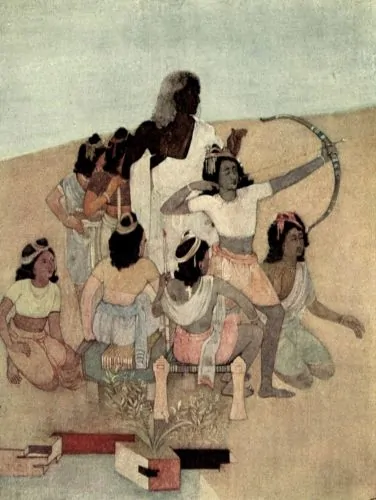
Drona occupies one of the most unstable positions in the moral architecture of the Mahabharata. Born a Brahmin and trained in sacred and martial disciplines, he becomes the instructor of the Kuru princes and the principal authority responsible for shaping them into warriors. His status gives him access to forms of knowledge that ordinary fighters cannot acquire, including celestial weapons whose destructive capacities exceed the limits of conventional combat. Yet Drona is not an impartial sage standing outside dynastic politics. He depends upon the Kuru court, carries old grievances, favors particular students, seeks vengeance against Drupada, and eventually commands the Kaurava army. His life joins roles that the epic repeatedly places in tension: Brahmin and warrior, teacher and political servant, father and judge, guardian of sacred knowledge and participant in mass violence. The transmission of the Brahmashira cannot be separated from this divided identity. Drona is entrusted with knowledge capable of threatening the world, but he must decide who among his students is sufficiently disciplined to receive it while he himself remains entangled in affection, ambition, and rivalry.
Arjuna emerges as Drona’s ideal pupil because he combines exceptional ability with relentless concentration. The teacher recognizes not only his technical brilliance but also his obedience, attentiveness, and determination to surpass every rival. Drona’s preference for Arjuna is repeatedly displayed through special instruction, tests of skill, and promises that no other student will equal him. Such favoritism has a darker side, especially in the treatment of Ekalavya and Karna, whose exclusion reveals that access to martial knowledge is shaped by hierarchy as well as merit. Drona’s school is not a neutral institution. It distributes power within an already unequal political order.
Ashvatthama complicates this structure because he is both Drona’s student and his son. The Sauptikaparvan recalls that Drona communicated the Brahmashira to Arjuna and, under pressure, also transmitted it to Ashvatthama. The distinction between the two recipients is crucial. Arjuna receives the weapon as the culmination of demonstrated discipline; Ashvatthama seeks equal possession partly because he cannot tolerate the superiority granted to another pupil. Drona appears to understand the danger in his son’s temperament and warns him against using the weapon recklessly, particularly against human beings. This warning reveals that transmission does not amount to unrestricted authorization. The teacher attempts to place a moral boundary around knowledge that, once learned, can no longer be physically retrieved. Yet the episode also exposes the inadequacy of warning without enforceable restraint. Drona knows that Ashvatthama is proud, volatile, and consumed by rivalry, but paternal attachment prevents him from withholding the weapon entirely. The father yields where the gatekeeper hesitates. By teaching his son how to invoke the Brahmashira, Drona transfers a capacity whose consequences will emerge only after his own death, when neither command nor affection can control the pupil who possesses it.
Drona’s failure is not simply that he trained a man who later committed atrocities. The deeper problem is that he treated catastrophic knowledge as though it could remain governed by personal loyalty and verbal prohibition. His authority depended upon the belief that the teacher’s discipline would survive within the student, but Ashvatthama inherits the formula without preserving the restraint that was meant to accompany it. The weapon outlives the relationship through which it was transmitted. After Drona is killed and the Kaurava cause collapses, Ashvatthama acts without the institutional, paternal, or spiritual structures that once limited him. The result is a central warning of the Brahmashira narrative: a teacher may judge a pupil worthy at one moment, yet no initiation can guarantee how that pupil will behave when grief, humiliation, and vengeance transform his character. Drona’s tragedy as gatekeeper lies in recognizing the danger of the knowledge he possesses while still allowing love, status, and rivalry to determine who receives it.
Arjuna and Ashvatthama: Two Students and Two Forms of Mastery
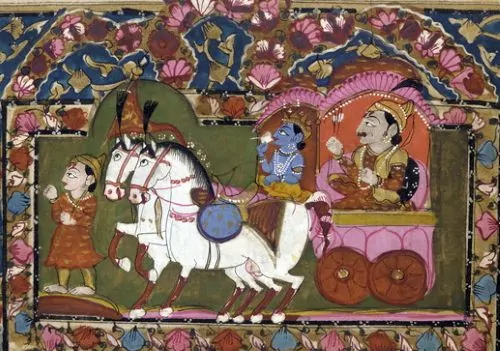
Arjuna and Ashvatthama stand before the Brahmashira as products of the same martial world but not as equivalent possessors of its knowledge. Both are trained by Drona, both belong to the highest ranks of epic warriors, and both survive long enough to confront the moral wreckage left by Kurukshetra. Their difference cannot be reduced to talent. Ashvatthama is no ordinary fighter who has stumbled into power beyond his comprehension; he is the son of the preceptor, a formidable combatant, and one of the few remaining men capable of invoking the most dangerous celestial weapons. Arjuna’s superiority lies instead in the relationship he has established between skill and self-command. The contrast between them is sharper than a simple opposition between knowledge and ignorance. Both know how to summon the Brahmashira. Only one has made restraint part of what that knowledge means.
Arjuna’s mastery is built throughout the epic through repeated demonstrations of attention, discipline, and submission to instruction. He distinguishes himself among Drona’s pupils not merely by physical aptitude but by the intensity with which he listens, practices, and organizes his life around martial excellence. His encounters with divine beings deepen this pattern. Celestial weapons are granted to him only after austerity, testing, and obedience, and the most terrible among them are accompanied by prohibitions against careless use. The acquisition of power becomes inseparable from the acceptance of limits. Arjuna is not morally flawless, nor does the Mahabharata present him as untouched by anger, pride, or grief. He participates fully in a war whose conduct repeatedly violates its own ideals. Yet when confronted with the Brahmashira crisis, he retains the capacity to recognize an authority higher than immediate victory. He listens to Krishna, obeys Vyasa and Narada, and accepts that the preservation of the world outweighs the destruction of the enemy before him.
Ashvatthama’s relation to mastery is more fractured. His skill is immense, but it is shadowed by rivalry with Arjuna and by the knowledge that Drona regarded another student as the fullest realization of his teaching. As Drona’s son, Ashvatthama might expect privileged access to his father’s knowledge; instead, Arjuna repeatedly occupies the position of the chosen pupil. The resulting tension does not make Ashvatthama’s later crimes inevitable, but it helps explain why possession of the Brahmashira becomes bound to status and wounded pride. To know the same weapon as Arjuna is to claim equality with him. The weapon is never merely an instrument in Ashvatthama’s hands. It becomes proof that he has not been surpassed, forgotten, or diminished.
The differences between the two men become decisive only after the social and emotional structures that once contained them have collapsed. Arjuna enters the final confrontation as a victor, but he is also a bereaved father and kinsman pursuing the murderer of sleeping warriors and children. He has every reason to feel rage. Ashvatthama, meanwhile, has lost his father, his king, his cause, and the military order that gave his life meaning. His night assault on the Pandava camp is driven by grief and vengeance, but it also reflects the desperation of a warrior who can no longer recover honor through ordinary battle. Their encounter does not oppose an emotional man to an emotionless one. Both are wounded by the war. What separates them is the capacity to prevent grief from claiming unlimited authority. Arjuna’s sorrow remains subject to judgment; Ashvatthama’s sorrow becomes a justification for extermination. This contrast appears most clearly in the purposes for which they invoke the Brahmashira. Ashvatthama releases it while cornered, directing its force toward the destruction of the Pandavas. His action extends the logic of the night massacre, in which distinctions between sleeping and armed, adult and child, combatant and descendant have already begun to disappear. Arjuna answers with the same weapon, but his stated purpose is defensive: he seeks to neutralize the force approaching him and his brothers. The difference in intention does not make his response harmless. Once two Brahmashiras have been released, the world is endangered regardless of which warrior first acted unjustly. The sages’ intervention demonstrates that even defensive escalation can produce consequences beyond the moral control of its initiator. Arjuna’s legitimacy depends not only on why he releases the weapon but on what he does when commanded to withdraw it. He accepts that a justified beginning does not guarantee a justified conclusion.
Ashvatthama’s inability to recall the Brahmashira completes the comparison. His failure is sometimes treated as a technical deficiency, as though Drona had taught him only part of the weapon’s operation. The episode’s moral structure suggests something deeper. Withdrawal requires concentration, obedience, purity of intention, and the willingness to relinquish the outcome toward which one has already committed immense power. Arjuna can reverse his action because his identity as a warrior remains connected to discipline beyond the self. Ashvatthama cannot because rage has consumed the distinction between his desire and justice. When he redirects the weapon toward the wombs of the Pandava women, he converts incapacity into renewed vengeance, choosing an unborn generation as the substitute target for enemies he cannot destroy directly. The contrast between the two students is not that one possesses power while the other lacks it. Arjuna demonstrates mastery by limiting what he can do; Ashvatthama reveals his failure by allowing what he can do to determine what he believes he may do.
The War After the War: Ashvatthama’s Night Massacre
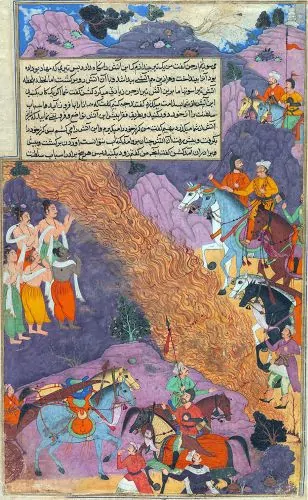
The Brahmashira crisis cannot be understood apart from the atrocity that immediately precedes it. By the end of the eighteenth day at Kurukshetra, the Kaurava army has ceased to exist as an organized force. Bhishma, Drona, Karna, Shalya, and nearly every major commander are dead, while Duryodhana lies mortally wounded after his mace duel with Bhima. Only a small number of important Kaurava warriors remain, among them Ashvatthama, Kripa, and Kritavarma. The political and military contest has effectively concluded, but Ashvatthama refuses to accept that defeat should impose a boundary upon violence. His father has been killed through deception, his king has fallen, and the martial order in which he possessed rank and purpose has collapsed. Rather than surrender, withdraw, or seek honorable combat, he converts loss into a determination to destroy the victors while they sleep. The resulting attack is not another battle within the war. It is a deliberate extension of war beyond the conditions that had once made combat intelligible.
The Sauptikaparvan gives the decision a dark natural omen. Resting beneath a tree, Ashvatthama watches an owl descend upon sleeping crows and slaughter them while they are helpless. He interprets the scene not as a warning against predation but as instruction. Night, concealment, and vulnerability offer him the advantage that open battle no longer can. Kripa initially counsels deliberation and acknowledges the moral disgrace attached to killing sleeping enemies, but Ashvatthama’s grief has already hardened into a logic of retaliation. Because the Pandavas and their allies used deception against Drona, he reasons, no obligation of honorable warfare remains binding upon Drona’s son. One violation becomes the justification for another, and dharma is reduced from a limiting principle to a language through which vengeance excuses itself.
Before entering the camp, Ashvatthama encounters a terrifying guardian whom ordinary weapons cannot overcome. He then turns toward Shiva, offering himself in a desperate act of devotion and receiving the terrible power necessary to proceed. This divine association does not render the massacre righteous. Instead, it surrounds the event with the destructive imagery of Rudra and the dissolution that follows when violence escapes ordinary human limits. Ashvatthama enters the sleeping encampment and begins with Dhrishtadyumna, the commander born for the purpose of killing Drona. Refusing him the warrior’s death he requests, Ashvatthama kicks, strangles, and crushes him like an animal. He then moves through the camp killing Shikhandin, the sons of Draupadi, Panchala warriors, and other survivors who awaken confused, unarmed, or unable to organize resistance. Kripa and Kritavarma guard the exits, cutting down those who attempt to flee. Fire, darkness, panic, and indiscriminate killing replace the ordered formations of daylight battle. The camp becomes a space in which the categories that once distinguished combat from murder have disintegrated. The Pandavas themselves are absent, as are Krishna and Satyaki. Ashvatthama annihilates their dependents, allies, and children while failing to kill the men against whom his vengeance is principally directed. His apparent triumph is already hollow.
The massacre transforms the moral meaning of the surviving war. Throughout the Mahabharata, both sides violate rules, manipulate vows, and employ deception, but the night assault concentrates those violations into a single act of exterminatory violence. Sleeping men are treated as active enemies, children become substitutes for fathers, and the destruction of military resistance expands into an attempt to erase the social body that supported it. When Ashvatthama returns to the dying Duryodhana and announces what he has done, the Kaurava king receives the news as a final victory. Yet the satisfaction cannot reverse defeat, restore the dead, or provide a kingdom for anyone to govern. It merely ensures that grief will generate another pursuit and another escalation. Draupadi’s sons are dead, the Pandavas demand justice, and Ashvatthama soon finds himself cornered without an army or defensible cause. The Brahmashira enters the narrative at this point because the night massacre has already destroyed every lesser restraint. Having extended war into murder, Ashvatthama next extends murder toward apocalypse.
The Blade of Grass: When the Ordinary Becomes Apocalyptic
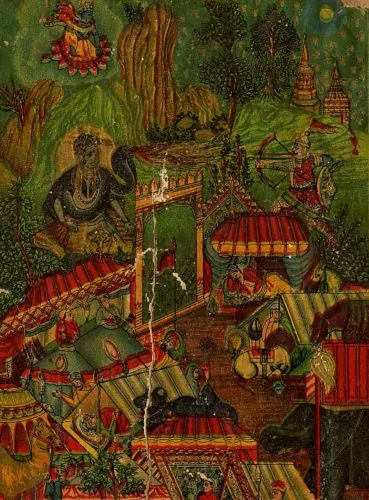
When the Pandavas finally overtake Ashvatthama, he no longer commands an army, occupies a fortified position, or possesses the conventional advantages of a warrior prepared for battle. Bhima approaches him demanding vengeance for the slaughter in the sleeping camp, while Arjuna, Krishna, and Yudhishthira follow close behind. Ashvatthama appears cornered, isolated, and materially overmatched. Yet this apparent helplessness conceals the most dangerous knowledge remaining in the world. The confrontation reveals that celestial weapons cannot be secured by seizing an arsenal or disarming a warrior of his bow. As long as Ashvatthama remembers the Brahmashira and retains the concentration necessary to invoke it, almost any object can become the carrier of catastrophic force.
In his desperation, Ashvatthama takes up a blade of grass and invests it with the power of the weapon through the appropriate sacred knowledge. The disparity between the object and the force it carries is deliberately shocking. Grass ordinarily belongs to the most fragile and abundant forms of life. It bends beneath the feet of warriors, feeds animals, covers fields, and returns after being cut or burned. Nothing about it resembles the elaborately forged weapons through which heroic status is usually displayed. Yet the blade becomes sufficient once joined to mantra, intention, and the fiery energy of the astra. The scene makes visible a principle already present throughout the epic tradition: matter does not determine the ultimate capacity of a divine weapon. An arrow may serve as its vehicle, but so may a stalk, reed, or other seemingly insignificant object. The decisive component is the knowledge that transforms ordinary matter into a manifestation of divine force. Ashvatthama’s blade of grass is thereore not itself the Brahmashira in any permanent sense. It becomes the weapon only because a trained but enraged mind uses it to embody and direct a power received from Drona. The moment overturns the familiar relationship between material wealth and military power. A king may lose his chariots, elephants, soldiers, and fortresses yet remain capable of destroying those who defeated him. The smallest object in his surroundings can become an arsenal if he possesses the knowledge required to transform it.
The blade of grass also joins creation to its own threatened destruction. Like the association between Brahma and the Brahmashira, the episode depends upon inversion. A living fragment of the earth becomes the means by which the earth may be scorched and deprived of rain. The ordinary fertility of the landscape is turned against itself. This is particularly appropriate to the weapon’s eventual consequences, for the Brahmashira does not threaten only the warriors standing before Ashvatthama. Its collision with Arjuna’s answering weapon would disturb the natural order and condemn the affected region to prolonged drought. The grass foreshadows the ecological meaning of the crisis. What begins with one piece of vegetation may end with the disappearance of vegetation across an entire land. The transformation also reflects Ashvatthama’s own moral condition. He can no longer distinguish between the immediate object of his fear and the world surrounding that object. The Pandavas approach him, but fields, animals, families, and unborn generations become exposed to the violence he directs against them. His intention takes a limited confrontation and expands it toward universal consequence.
There is also a disturbing concealment in the image. A sword announces danger through its edge, an arrow through its point, and a mace through its weight. Grass carries no such warning. The destructive potential of the Brahmashira remains invisible until the act of invocation has already begun. This hiddenness makes catastrophic knowledge difficult to govern. Observers cannot determine from Ashvatthama’s possessions what he is capable of doing, and no physical barrier separates peaceful matter from weaponized matter. The danger lies within the trained wielder, where memory, resentment, and sacred formula meet. Divine weaponry consequently makes intention more important than appearance. The same landscape can nourish life or supply the vehicle through which life is attacked.
Yet the episode does not suggest that matter is irrelevant. The blade of grass gives Ashvatthama’s intention a point of entry into the visible world. His thought must become directed action, and the humble stalk marks the instant when inward rage assumes outward form. That transition carries the deepest warning of the scene. Ashvatthama has already imagined the extermination of his enemies, but the weapon becomes apocalyptic only when he chooses to embody that desire and release it. He is neither possessed by an autonomous artifact nor forced into action by a machine operating beyond him. The grass emphasizes human agency because it contributes almost nothing of its own. The destructive decision belongs to the wielder. Once that decision has activated the Brahmashira, the balance changes: the power now exceeds Ashvatthama’s ability to withdraw it. The ordinary has become apocalyptic, and the man who transformed it can no longer restore it to harmlessness. The blade of grass compresses the entire moral structure of the episode into a single image. Knowledge can turn the smallest element of creation into an instrument of annihilation, but knowledge alone cannot guarantee that the one who performs the transformation will remain master of what he has made.
Weapon Against Weapon: The Threat of Cosmic Collision
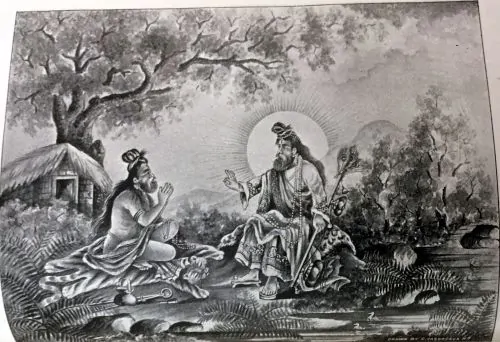
Ashvatthama’s release of the Brahmashira immediately changes the scale of the confrontation. What begins as the pursuit of a defeated murderer becomes a crisis involving the survival of the world. The weapon is not directed toward an opposing army arranged for battle but toward the Pandavas as they approach with Krishna. Faced with a force that ordinary arms cannot stop, Krishna instructs Arjuna to answer with the same celestial weapon. Arjuna takes up his bow, invokes the Brahmashira according to Drona’s teaching, and directs it against Ashvatthama’s missile. His purpose is protective rather than exterminatory: he seeks the safety of his brothers and the neutralization of the approaching threat. Yet the epic does not allow this difference of intention to remove the danger. Once weapon has answered weapon, the conflict no longer belongs entirely to either warrior. The encounter exposes the peril inherent in symmetrical escalation. Ashvatthama’s Brahmashira cannot safely be ignored, but Arjuna’s countermeasure introduces a second source of catastrophic power into the world. The logic is understandable: only an equivalent force appears capable of stopping the first. The consequences threaten to exceed the original danger. A response may be justified by necessity and still create conditions more destructive than those it was meant to prevent. The epic distinguishes between moral responsibility for beginning the crisis and practical responsibility for ending it. Ashvatthama bears the greater blame because he releases the weapon from fear and vengeance, but Arjuna must still govern the force he summons in reply. Defensive intention does not exempt him from accountability for what happens next.
As the two Brahmashiras advance, the landscape of the encounter becomes cosmic rather than merely military. Flames rise with terrible radiance, the earth trembles, and the heavens appear disturbed by the convergence of powers that should never have been directed against one another. The natural world registers the danger before the weapons physically meet. Their approach unsettles the boundaries among earth, atmosphere, divine space, and human conflict, as though the private hatred of warriors has begun to infect the structure of creation itself. The imagery belongs to the epic language of divine manifestation, in which extraordinary energy is recognized through heat, brilliance, noise, darkness, trembling, and fear among living beings. These are not technical measurements of explosive yield. They are signs that martial action has escaped the ordinary human scale.
The threatened collision also exposes the limits of the epic warrior’s authority. Kings and fighters may decide when armies march, but they cannot claim an unlimited right to endanger the world that gives kingship meaning. If the Brahmashiras consume the land, there will be no realm left to inherit, protect, or rule.
At the point when military agency has produced a danger it cannot safely resolve, Vyasa and Narada intervene between the two weapons. Their appearance is essential to the moral structure of the episode. Neither sage arrives as an additional combatant seeking victory for one side. They represent forms of knowledge and authority that stand above the immediate demands of vengeance, survival, and dynastic loyalty. Their presence interrupts the closed logic by which each warrior’s action seems to require another action of equal or greater force. The sages judge the confrontation according to consequences that neither Ashvatthama nor Arjuna is entitled to dismiss. They warn that the meeting of the weapons will injure the land and disrupt rainfall, extending the violence of two men into the lives of populations not present at the scene. Their command to withdraw the Brahmashiras restores a moral perspective larger than the battlefield. The question is no longer which warrior has the stronger claim but whether either claim can justify collective devastation.
The threatened collision marks the point at which the Brahmashira becomes more than an exceptionally powerful astra. It becomes an image of violence that defeats its own purpose. Ashvatthama releases it to escape defeat and destroy the Pandavas; Arjuna releases it to preserve himself and his brothers. If the weapons collide, neither purpose will remain contained within its intended target. The distinction between aggressor and defender will still matter morally, but the earth will suffer from both fires. This is why Arjuna’s later withdrawal carries greater significance than the successful invocation itself. The weapon cannot be mastered through superior force because adding power to power only enlarges the catastrophe. It can be mastered only when a wielder accepts interruption, relinquishes escalation, and restores control over what has already been set in motion. The crisis shifts the epic’s measure of heroism away from the ability to defeat an enemy and toward the ability to prevent a justifiable response from becoming an unjustifiable end of the world.
The Twelve-Year Drought and the Ecology of Divine Violence
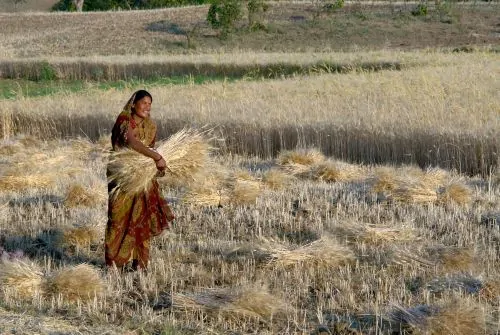
The sages’ warning gives the Brahmashira crisis an ecological dimension that extends far beyond the immediate lives of Arjuna and Ashvatthama. If the two weapons are allowed to collide, the affected land will endure twelve years without rain. The consequence is striking because it does not describe destruction solely through bodies, shattered fortifications, or defeated armies. The weapon threatens the systems that make organized life possible: rainfall, cultivation, pasture, rivers, vegetation, and the seasonal rhythms upon which human and animal communities depend. A battlefield may be abandoned after combat, but a drought lasting twelve years would transform violence into a condition inherited by those who never chose to participate in the war. The Brahmashira carries destruction out of the heroic present and into the long duration of environmental suffering.
In the agrarian world imagined by the Mahabharata, the withdrawal of rain signifies much more than inconvenient weather. Rainfall sustains crops, replenishes rivers and wells, nourishes cattle, and affirms the proper relation among kingship, sacrifice, divine favor, and cosmic order. Its absence means failed harvests, hunger, migration, disease, social fragmentation, and the collapse of political authority. A king may claim victory over rivals, but he cannot govern a realm whose soil no longer produces food. The twelve-year drought exposes the absurdity of absolute military success. If the power used to secure the kingdom destroys the ecological foundations of the kingdom, conquest has devoured its own purpose. The Brahmashira is terrifying not only because it kills but because it makes survival after killing increasingly impossible.
The drought also expands the circle of victims. The warriors who release the weapons act in response to personal danger, grief, and vengeance, yet the consequences would fall upon farmers, herders, children, animals, forests, and communities far removed from the confrontation. The epic does not present these populations individually, but their dependence upon rainfall is implicit in the sages’ alarm. Divine violence refuses to remain within the boundaries imagined by the wielder. This environmental consequence is important because the Brahmashira is invoked through a blade of grass. A fragment of vegetation becomes the vehicle of a force capable of eliminating vegetation across an entire region. The symbolism is severe: the living earth is recruited into an attack upon its own fertility. Ashvatthama’s act converts something ordinary, renewable, and nourishing into the beginning of barrenness. The threatened drought represents more than collateral damage added to an otherwise successful strike. It reveals a deeper inversion of order. The weapon draws upon sacred knowledge associated with Brahma, the creator, and directs that knowledge toward a condition in which creation can no longer reproduce itself. Fields cannot yield grain, cattle cannot find pasture, and human generations cannot be sustained without the cycles that link rain, soil, plant life, and nourishment. When Ashvatthama later turns the weapon toward the wombs of the Pandava women, the same logic becomes visible on another scale. The attack on fertility encompasses both the body and the land.
Modern readers may be tempted to interpret the twelve-year drought as a description of radioactive fallout, nuclear winter, or some other scientifically identifiable aftereffect of advanced weaponry. Such comparisons may be suggestive, particularly because modern warfare has demonstrated that weapons can poison landscapes and burden generations beyond their original targets. They should not replace the religious and ecological meanings available within the epic itself. Drought was already a powerful sign of cosmic disorder, failed kingship, broken ritual relations, and divine displeasure in ancient South Asian thought. The Brahmashira episode draws upon that imaginative world to show that uncontrolled martial power can disturb more than human politics. It can rupture the relationship between heaven and earth upon which every political community depends. The sages intervene because they understand what the warriors, absorbed in vengeance and defense, have temporarily forgotten: the earth is not an empty surface upon which heroic conflict occurs. It is a living foundation shared by victors, enemies, descendants, animals, and strangers alike. To preserve it is not secondary to justice. It is the condition that allows any future justice to exist.
Withdrawal as the Highest Form of Martial Power
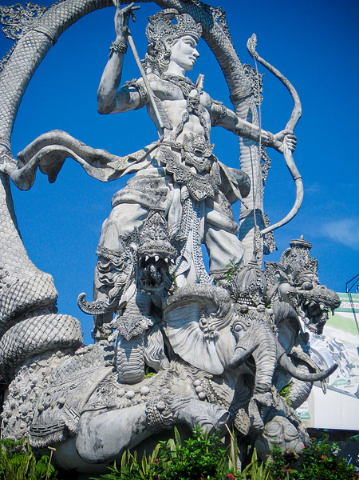
When Vyasa and Narada command the two warriors to withdraw their weapons, the Brahmashira episode overturns the usual expectations of heroic combat. Epic warriors ordinarily demonstrate excellence by striking accurately, enduring pain, defeating rivals, and refusing retreat. Arjuna now faces a different test. He must reverse an action already undertaken, relinquish the destructive advantage he has summoned, and accept that victory over Ashvatthama is less important than preventing devastation to the earth. Withdrawal is not presented as weakness or indecision. It is an act of deliberate control performed at the moment when fear, anger, and martial pride would make continued escalation easier. Arjuna’s greatness lies not merely in possessing the Brahmashira or in matching Ashvatthama’s power, but in remaining capable of subordinating that power to a judgment larger than his own immediate survival.
Recalling the weapon requires a form of mastery more demanding than invocation. To release an astra, the warrior gathers attention around a target and converts intention into force. To withdraw it, he must interrupt that intention after the weapon has already been launched and after his emotional commitment to its success has intensified. Arjuna has pursued the murderer of his son’s brothers and of numerous sleeping allies; he is not emotionally detached from the confrontation. Nor can he be certain, when ordered to withdraw, that Ashvatthama will do the same. His obedience exposes him to danger. He must trust the sages’ authority, control the impulse to secure his enemies’ destruction, and separate justice from annihilation. He must also overcome the momentum created by his own previous decision. Once a warrior has invoked a supreme weapon, pride may encourage him to interpret withdrawal as humiliation, indecision, or surrender, particularly when the enemy remains defiant. Arjuna must reject that interpretation and recognize that persistence is not automatically courage. The weapon has already become larger than the grievance that called it forth, and continuing to direct it toward Ashvatthama would mean accepting consequences for fields, animals, families, and future generations who had no part in the crime. Withdrawal requires an expansion of moral attention. Arjuna must see beyond the visible enemy and imagine the unseen victims who would suffer if the Brahmashiras met. The act combines technical knowledge with ethical discipline. A warrior who knows only how to advance a weapon toward its target has learned merely the first half of its use.
The Mahabharata connects Arjuna’s ability to recall the Brahmashira with the disciplined life that made him a worthy recipient of celestial knowledge. His self-command is not suddenly produced in the crisis but has been cultivated through obedience to teachers, austerity, concentration, and repeated encounters with limits upon divine weapons. This does not make Arjuna morally perfect. He has participated in deception, vengeance, and the destruction of his kin, and the epic does not permit victory to erase those burdens. His withdrawal matters precisely because it occurs within that compromised world. Restraint does not require innocence. It requires the capacity to recognize that even a defensible act can become indefensible when its consequences expand beyond its original purpose. By calling back the Brahmashira, Arjuna accepts responsibility not only for what he intended when he released it but also for what it would do if allowed to continue.
The scene consequently redefines martial sovereignty. The highest warrior is not the person who can unleash the greatest force without opposition, but the person who remains sovereign over himself after that force has been unleashed. Ashvatthama can invoke the Brahmashira, yet his knowledge ends at release; once the weapon moves toward destruction, he cannot restore it to stillness. Arjuna possesses a more complete form of power because he can act, reconsider, obey, and reverse. His withdrawal preserves the land, protects those who have no part in the duel, and prevents retaliation from becoming indistinguishable from the aggression it answers. The episode does not condemn all force, since Arjuna’s initial response is portrayed as necessary to meet an otherwise unstoppable threat. It instead locates legitimacy in the continued governance of force after necessity has passed. Under this standard, restraint is not the opposite of heroism but its culmination. The ability to destroy may establish a warrior’s strength; the ability to call destruction back establishes whether that strength deserves to exist.
Ashvatthama’s Failure: Power Without the Capacity to Recall It
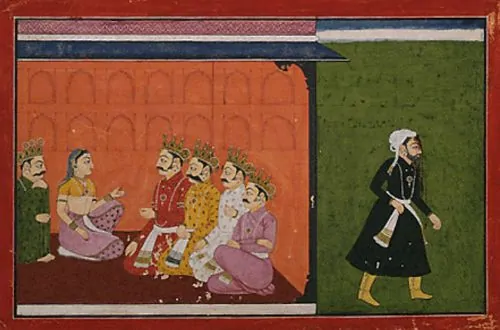
Ashvatthama’s inability to withdraw the Brahmashira reveals the difference between possessing a weapon and mastering it. He has received the necessary instruction from Drona, remembers the formula of invocation, and can invest an ordinary blade of grass with catastrophic force. In every outward sense, he belongs among the epic’s most accomplished warriors. Yet when Vyasa and Narada order both men to recall their weapons, Ashvatthama admits that he cannot do what Arjuna has done. His knowledge carries him as far as release but no farther. The failure exposes a dangerous incompleteness within his training: he can initiate a sequence whose consequences exceed the battlefield, but he cannot restore the power he has summoned to a harmless state. The Brahmashira becomes the instrument through which his apparent strength is revealed as dependence. Once the weapon is released, Ashvatthama no longer governs it; he must search for another target capable of receiving the destruction he cannot prevent.
The epic frames this inability as more than a missing technical procedure. Withdrawal depends upon the moral and mental qualities that permit a warrior to reverse his own intention under pressure. Ashvatthama has reached the confrontation after the collapse of nearly every restraint that once ordered his life. His father is dead, Duryodhana is dying, the Kaurava army has been annihilated, and his massacre of the sleeping camp has committed him to a path from which honorable recovery appears impossible. Rage has become the organizing principle of his action. He does not merely desire protection from Bhima and the approaching Pandavas; he seeks the complete destruction of those whom he blames for his losses. Such an intention cannot easily be recalled because it has consumed the distinction between justice and vengeance. To withdraw the Brahmashira would require Ashvatthama to accept limitation, submit to the sages’ authority, and relinquish the exterminatory outcome he has come to regard as his final compensation for defeat. His mental failure is inseparable from his ethical one. The weapon remains beyond recall because the wielder himself has lost the inner order upon which recall depends.
Ashvatthama’s response to this failure confirms rather than mitigates it. Unable to extinguish the Brahmashira, he does not surrender himself to its consequences or seek a target removed from human life. Instead, he directs it toward the wombs of the Pandava women. The decision preserves the original purpose of his vengeance while altering its victims. Since he cannot destroy the adult Pandavas standing before him, he attacks the descendants through whom their lineage might continue. His inability to recall the weapon becomes a second opportunity for deliberate violence. Technical incapacity does not absolve him because he retains control over the direction in which the remaining force is sent. The Brahmashira’s movement toward the unborn is not an accidental aftereffect of a failed procedure; it is a conscious transformation of battlefield defeat into dynastic extermination.
Ashvatthama consequently represents power severed from the virtues that might justify its possession. His case demonstrates that supreme weapons do not simply amplify the strength of their wielders; they expose weaknesses that lesser instruments might conceal. With a sword or bow, uncontrolled anger may destroy those within reach. With the Brahmashira, the same anger can threaten the fertility of the earth and the survival of generations not yet born. Drona’s instruction gave Ashvatthama access to divine force without ensuring that his character would remain equal to it. The resulting catastrophe cannot be blamed solely upon grief, incomplete training, or the provocations of war, although each contributes to the moment. Ashvatthama repeatedly chooses escalation when restraint remains possible, and when full withdrawal is no longer possible, he chooses the most vulnerable substitute target available. His failure marks the darkest inversion of martial mastery in the episode. Arjuna proves that power remains legitimate only while it can be governed; Ashvatthama proves that the ability to release destruction may coexist with complete helplessness before one’s own hatred.
From Battlefield to Womb: The Assault on the Pandava Future
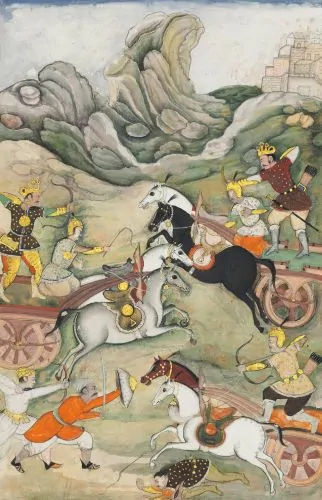
When Ashvatthama redirects the Brahmashira toward the wombs of the Pandava women, the weapon crosses a final moral boundary. The immediate confrontation has involved adult warriors who possess celestial arms and have chosen to participate in a violent political struggle. The unborn do not belong to that world of reciprocal combat. They cannot threaten Ashvatthama, answer his challenge, or bear responsibility for the death of Drona and the defeat of the Kauravas. By choosing them as substitute targets, he abandons even the damaged conventions of warrior vengeance. His purpose is no longer to defeat living enemies but to prevent those enemies from having descendants. Violence moves from the battlefield into the body, and the womb becomes the last contested territory of the Kuru war.
This shift reflects the political importance of lineage throughout the Mahabharata. Dynasties survive through succession, inheritance, marriage, and the production of recognized heirs. The struggle between Pandavas and Kauravas begins as a conflict within a single royal family over legitimacy and sovereignty, but the deaths at Kurukshetra leave that family almost completely destroyed. The sons of Draupadi have already been murdered in Ashvatthama’s night assault. Abhimanyu, Arjuna’s son, fell earlier in the war after being surrounded and killed by multiple Kaurava warriors. The unborn child carried by Abhimanyu’s widow Uttara bears an extraordinary burden. He is not simply one more descendant among many but the remaining possibility that the Pandava branch of the Kuru line will continue. His existence also gives political meaning to a victory that has otherwise produced little except bereavement. Without an heir, the Pandavas might occupy the throne temporarily, but their restored sovereignty would end with them, leaving the lineage for which so many fought without a future. Ashvatthama understands that dynastic survival depends not only upon the men who currently rule but upon women whose pregnancies carry succession beyond the battlefield. By targeting their wombs, he attacks the biological and political structures through which kingship reproduces itself. His violence enters a sphere often obscured by heroic accounts of warfare: the bodies of women become essential to the preservation of male genealogies, and their vulnerability becomes a means by which defeated enemies may continue the struggle. Ashvatthama’s attack is directed against that continuity. Unable to reverse military defeat, he attempts to make victory genealogically empty by ensuring that the victors leave no durable future. the Brahmashira becomes more than a weapon of mass destruction. It becomes an instrument of dynastic erasure.
The assault upon the womb also reveals how totalizing vengeance converts the innocent into extensions of the guilty. Ashvatthama treats unborn descendants as though they already embody the identity, claims, and offenses of their fathers. Their lives matter to him only as vessels through which the Pandavas might endure. This logic eliminates individual moral status and replaces it with inherited enmity. The child is condemned not for an act but for belonging to a lineage. Such reasoning intensifies the intergenerational structure of the epic’s violence. Sons inherit rivalries, vows, obligations, and consequences created before their birth; Ashvatthama now seeks to resolve that cycle by preventing birth itself. Yet his action does not end inherited violence. It completes its most extreme expression. The war’s hatred becomes so absolute that even the possibility of another generation is interpreted as a threat.
Krishna’s intervention prevents Ashvatthama from achieving complete annihilation. The unborn Parikshit is struck, endangered, and in some tellings rendered lifeless before Krishna restores or preserves him through divine power. His survival ensures the continuation of the Kuru lineage and allows the world of the Mahabharata to possess a future beyond the generation that destroyed itself at Kurukshetra. Parikshit will later become king, preserving the continuity of rule after the Pandavas withdraw from political life. His survival also reconnects the shattered dynasty to a longer genealogical history, transforming what might have been the extinction of the Kuru house into a wounded but continuing succession. The rescued child represents more than biological survival. He embodies the survival of memory, political continuity, and the possibility that catastrophe can be narrated rather than merely repeated. Within the epic’s framing traditions, Parikshit’s descendants belong to the audience before whom the history of the Kuru disaster is recounted, making his preservation necessary not only for kingship but for the transmission of the epic itself. Had Ashvatthama succeeded completely, the war would have destroyed both its participants and the lineage capable of remembering them. Krishna’s protection of the unborn heir saves a future community of memory as well as a royal family. Ashvatthama attempts to make the war final by carrying destruction into the womb; Krishna prevents that finality by preserving a life not yet capable of defending itself. The confrontation places two opposed uses of divine power side by side. One seeks to erase the future because the present has become unbearable; the other protects the future precisely because the present has failed.
The Punishment of Endless Memory
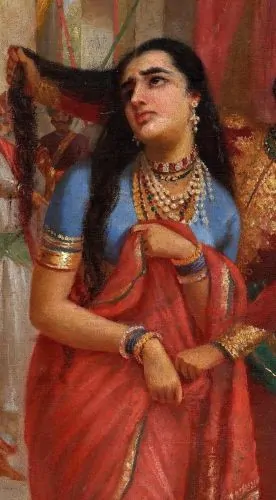
Ashvatthama’s punishment begins with a paradox: after committing acts that demand death, he is denied the release of dying. He has slaughtered sleeping warriors, murdered the sons of Draupadi, unleashed the Brahmashira, and directed its remaining force toward unborn heirs. Yet Krishna does not permit him to end his life as a warrior upon the battlefield. Instead, Ashvatthama is condemned to continue living after the destruction of the social world that gave his identity meaning. His father, king, comrades, and cause are gone; the future he attempted to extinguish will survive without him. Life, normally treated as a blessing or reward, becomes the form through which judgment is imposed.
The removal or surrender of the jewel from Ashvatthama’s forehead marks his passage from formidable warrior to exposed wanderer. The jewel had signified extraordinary protection, rank, and supernatural potency. Without it, he loses not only an object of power but the visible emblem of the exceptional status inherited from his birth and training. Draupadi’s demand for justice is answered through this humiliation rather than through immediate execution. The jewel is carried back as proof that Ashvatthama has been defeated and stripped of the power that once made him nearly unassailable. He remains alive, but the identity through which that life possessed honor has been dismantled. Krishna’s curse intensifies this deprivation. Ashvatthama is condemned to wander apart from human society, afflicted by disease, foulness, pain, and isolation. The epic describes a punishment measured across thousands of years, giving his suffering a duration far beyond the ordinary human lifespan. His body, which had been trained as an instrument of elite martial power, becomes the site of continuing degradation. The warrior who violated the sleeping camp and attacked the unborn is deprived of community, dignity, and restorative death. He is forced to inhabit a world in which the people he hated have disappeared and the consequences of his actions remain.
The structure of the punishment mirrors the structure of the crime. Ashvatthama attempted to prevent the Pandava lineage from entering the future, but he himself is compelled to enter that future without belonging to it. He sought to make vengeance final; instead, his own existence becomes interminable. He attacked vulnerable bodies and is left with a body that continually suffers. He attempted to erase memory by erasing descendants, yet he becomes a bearer of memory who cannot escape the events he helped create. The curse does more than prolong physical pain. It denies Ashvatthama the transformations through which grief might otherwise be absorbed into family, ritual, kingship, or historical continuity. He cannot return to the Kaurava court, reconcile with the victors, establish a new household, or regain the status of Drona’s son and heir. Wandering separates him from the reciprocal bonds that make a human life socially meaningful. His survival is biologically continuous but politically, ritually, and emotionally barren.
Later traditions expand this punishment by treating Ashvatthama as one of the chiranjivis, enduring beings who remain alive across the ages. Regional stories, pilgrimage traditions, oral accounts, and modern popular culture repeatedly imagine encounters with a wounded wanderer identified as Drona’s son. These traditions should be distinguished from the more specific temporal curse presented in the epic, but they develop a possibility already latent in the narrative: Ashvatthama cannot be confined securely to the past. He survives as the remainder of a war that has ended without truly being resolved. His continuing presence embodies the endurance of trauma, guilt, and violent knowledge after kingdoms and battlefields have disappeared. The Brahmashira does not destroy the world, yet its wielder becomes a living fragment of the apocalypse it nearly produced. Ashvatthama’s punishment is not immortality as triumph, divine favor, or liberation from death. It is survival emptied of renewal, the endless memory of destruction without the consoling possibility of beginning again.
Dharma and the Ethics of Ultimate Weapons
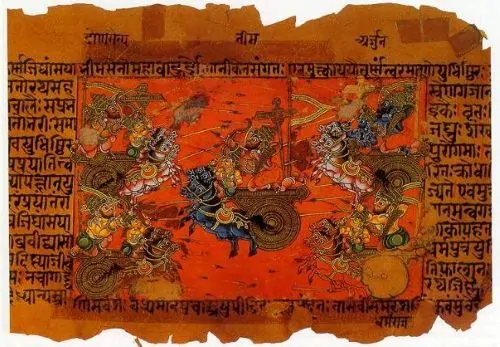
The Brahmashira crisis forces the Mahabharata to confront a question that ordinary rules of battle cannot adequately answer: can any target justify a weapon whose effects cannot be confined to that target? The epic’s warriors operate within a martial ethic that distinguishes, however imperfectly, between legitimate and illegitimate forms of violence. Combat is ideally conducted between armed opponents of comparable status; sleeping men, the unarmed, fugitives, children, and those who surrender possess varying degrees of protection. These norms are repeatedly violated during the Kurukshetra War, and the poem rarely allows either side to claim moral purity. Yet the persistence of violation does not make the rules meaningless. On the contrary, the epic’s horror often depends upon the reader recognizing that a boundary has been crossed. Ashvatthama’s night massacre is condemned because he attacks men who cannot defend themselves. His later direction of the Brahmashira toward the unborn carries the same logic to its most extreme conclusion, replacing combat with an assault upon those who have not yet entered the world.
Dharma in the Mahabharata does not function as a simple legal code capable of resolving every situation through mechanical application. It is contextual, contested, and frequently obscured by conflicting obligations. A warrior may owe loyalty to a king, obedience to a teacher, protection to dependents, vengeance to slain kin, and restraint toward vulnerable enemies, all at the same time. The Brahmashira episode intensifies this conflict because the scale of the weapon makes ordinary calculations of desert inadequate. Even if Ashvatthama believes the Pandavas responsible for Drona’s death, his grievance cannot establish the guilt of every person who would suffer from drought, fire, or dynastic extinction. The greater the reach of a weapon, the less plausible it becomes to treat its consequences as a direct expression of justice. Dharma appears not only in the choice of cause but in the limitation of means. A warrior may possess a legitimate grievance and still act adharmically by pursuing it through force that destroys the innocent along with the guilty.
Arjuna’s response illustrates the difficulty of defensive force. He invokes the Brahmashira because Ashvatthama has already released it and because no ordinary weapon can protect the Pandavas from its approach. His action is more defensible than Ashvatthama’s initial attack, but it is not morally self-validating. Once the answering weapon threatens collision with the first, the distinction between defensive and aggressive purpose no longer contains the material consequences. The land cannot distinguish between fire released in vengeance and fire released in protection. The sages’ intervention insists that the justice of Arjuna’s motive does not remove his obligation to prevent devastation.
This distinction between motive and consequence is central to the ethics of ultimate weapons. Martial traditions often judge an action by asking whether the enemy deserved attack, whether the warrior acted courageously, and whether the cause was just. The Brahmashira requires a broader inquiry. What happens to those beyond the target? Can the weapon be recalled after release? Will its effects persist after the conflict has ended? Does its use destroy the political and ecological order that victory is supposed to preserve? The threatened twelve-year drought makes these questions unavoidable. Farmers, animals, forests, and future generations do not become legitimate targets merely because they inhabit the same territory as the enemy. The weapon’s inability to discriminate is not a secondary defect that can be weighed against its effectiveness. It is part of the moral definition of the act. A force that predictably extends beyond combatants challenges the very possibility that it can be used proportionately. The episode also raises the question of who possesses authority to restrain warriors when rulers and military institutions have failed. Drona’s warnings did not prevent Ashvatthama from invoking the weapon, and the collapse of the Kuru political order has left no functioning king capable of governing him. Intervention instead comes from Vyasa and Narada, figures whose authority derives from ascetic knowledge, sacred insight, and a perspective extending beyond dynastic interest. They do not debate which claimant deserves the kingdom. They order both weapons withdrawn because the preservation of the world takes precedence over the immediate claims of the combatants. Their judgment places limits upon warrior sovereignty. Possession of a divine weapon does not grant the wielder final authority over its use, and technical mastery does not make him competent to decide alone what consequences others must bear. The sages speak for a moral community larger than the armies, one that includes the land, the unborn, and those whose lives remain invisible to heroic narrative.
It would be misleading to transform this scene into a fully developed ancient equivalent of modern humanitarian law or nuclear ethics. The Mahabharata does not formulate universal treaties, institutional inspection systems, or abstract doctrines of deterrence. Its concerns arise from the religious and social world of dharma, kingship, lineage, ascetic authority, and cosmic order. Nevertheless, the episode articulates principles with enduring ethical force. Legitimate targets must be distinguished from innocent life; defensive necessity does not erase responsibility for consequences; possession of overwhelming power increases rather than diminishes the obligation of restraint; and a weapon that cannot be controlled after release exposes the inadequacy of the person who uses it. The Brahmashira is not condemned simply because it is powerful. Its danger lies in the ease with which private grievance can claim the language of justice while transferring suffering to bodies, landscapes, and generations that had no voice in the decision. Dharma survives in the episode not as a guarantee that violence will remain pure, but as the demand that even warriors at the edge of annihilation recognize that not everything they can destroy has become theirs to judge.
The Brahmashira as a Myth of Irreversible Knowledge
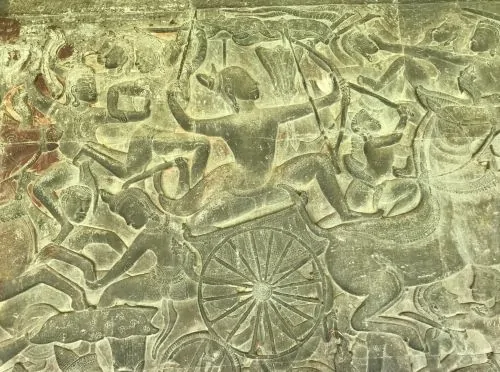
The Brahmashira can be read as a myth of knowledge that becomes impossible to contain once it has been transmitted. Unlike a sword, jewel, or chariot, its essential power does not remain attached to a physical object that can be confiscated, broken, hidden, or returned to its maker. It survives within memory. Drona may warn his pupils against improper use, but once he has taught the formulas of invocation, the knowledge exists independently of his continued supervision. His death removes the teacher without removing what he taught. Ashvatthama carries the Brahmashira beyond the destruction of Drona, the fall of the Kaurava state, and the collapse of the institutions within which his training originally possessed meaning. The weapon reveals a central asymmetry between the transmission of knowledge and the preservation of control: instruction can occur in a moment, while responsibility for what has been taught may extend across generations.
The epic does not portray restricted knowledge as inherently corrupt. Celestial weapons may defend the vulnerable, counter supernatural threats, or enable a warrior to fulfill obligations that conventional arms cannot meet. Arjuna’s use of divine weapons repeatedly demonstrates that extraordinary knowledge can serve legitimate ends when governed by discipline and circumstance. The danger arises because the qualities required to receive knowledge cannot be guaranteed permanently. A pupil may demonstrate obedience during training and later be transformed by grief, rivalry, political collapse, or humiliation. No teacher can preserve a student’s character in the condition it occupied at the moment of initiation. Ashvatthama receives the Brahmashira within a relationship of paternal and instructional authority, but he invokes it after that relationship has been destroyed. Drona’s warning survives only as remembered prohibition, while the formula survives as effective power. The prohibition depends upon voluntary obedience; the weapon does not. This imbalance makes catastrophic knowledge structurally unstable. Its moral restraints remain fragile, but its destructive capacity remains available.
The Brahmashira also illustrates that discovering how to begin a process may be easier than discovering how to reverse it. Ashvatthama knows enough to summon the weapon but not enough, or is no longer sufficiently disciplined, to recall it. Knowledge is divided into unequal parts. Invocation produces immediate and visible power, whereas withdrawal requires a deeper mastery that includes self-command, submission to judgment, and the ability to renounce an intended outcome. A society fascinated by acquisition may mistake the first capacity for complete understanding. The episode warns that operational success at the moment of release says little about whether the wielder can govern what follows.
This problem extends beyond Ashvatthama’s personal failure. Drona’s role makes the Brahmashira part of a chain of transmission in which each generation inherits both the achievements and unresolved dangers of the previous one. The teacher received martial knowledge from earlier authorities and communicated it selectively to pupils whom he expected to preserve its discipline. Yet succession introduces uncertainty. Knowledge passes from person to person, while context changes around it. Political institutions fall, loyalties shift, and inherited powers become available for purposes their earlier guardians did not anticipate. The weapon resembles a permanent alteration in the range of human possibility. Before its transmission, a particular catastrophe may be unimaginable or inaccessible; afterward, it remains possible even if every responsible authority condemns its use. Secrecy can slow dissemination but cannot make the knowledge undiscovered. The memory of the weapon becomes an invisible inheritance carried through the destruction of armies and kingdoms.
The myth’s deepest anxiety is consequently not that dangerous knowledge exists, but that human beings may acquire it faster than they acquire the wisdom necessary to live with it. Arjuna and Ashvatthama possess the same general capacity, yet their difference in character determines whether that capacity can be brought back under control. The episode does not offer a secure institutional solution. Restraint depends upon teachers, vows, sages, personal discipline, and the willingness of wielders to obey limits at the moment when obedience is most difficult. Such safeguards succeed with Arjuna and fail with Ashvatthama. The Brahmashira leaves the problem deliberately unresolved. Knowledge cannot simply be returned to Brahma, forgotten by decree, or confined forever within a worthy lineage. Once it has entered the human world, every future bearer must confront the same moral test anew. The weapon becomes irreversible not only because its effects may devastate the earth, but because its possibility survives every individual act of restraint. Arjuna saves the world by withdrawing his Brahmashira, yet he does not eliminate the knowledge that made the crisis possible. The future remains protected, but it is never again innocent of what can be done.
Modern Nuclear Analogies
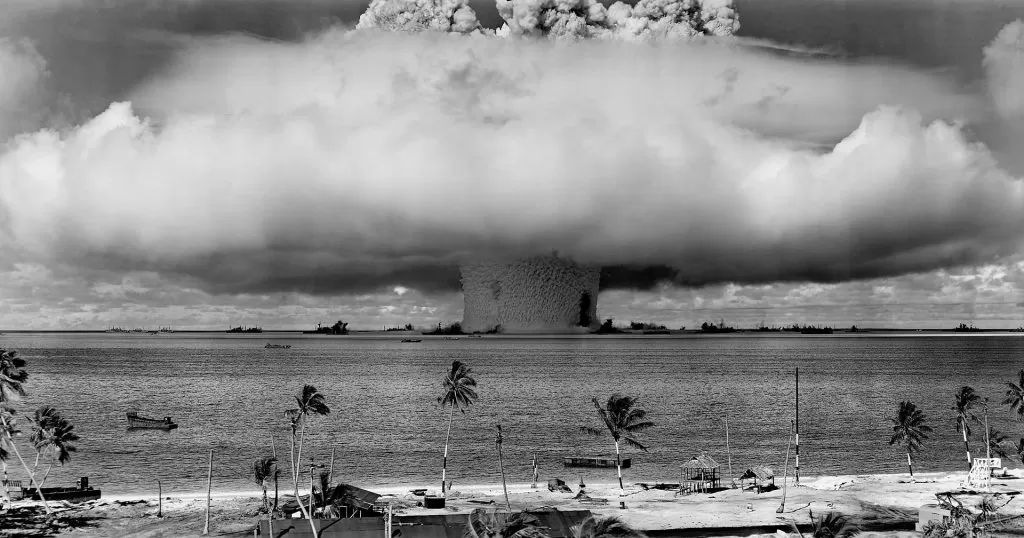
The imagery surrounding the Brahmashira almost inevitably invites comparison with nuclear weapons. Two supreme powers advance toward collision amid terrible radiance, consuming fire, trembling earth, disturbance in the heavens, and fear that the world itself may be destroyed. The threatened consequences do not end with the immediate targets: the affected land may receive no rain for twelve years, exposing entire populations to famine and social collapse. Ashvatthama then directs the weapon toward unborn descendants, extending destruction from living combatants into generations that have not yet entered the world. To readers formed by Hiroshima, Nagasaki, radioactive contamination, nuclear testing, and the prospect of global war, these elements appear strikingly familiar. Both the epic weapon and the modern bomb raise the possibility that a conflict among a few political and military actors may impose irreversible consequences upon humanity and the earth.
The analogy becomes useful at the level of ethics. The Brahmashira crisis resembles the nuclear dilemma because the possession of ultimate power transforms the meaning of responsibility. Ashvatthama’s first use prompts Arjuna to answer with an equivalent weapon, producing a pattern of escalation in which each combatant can justify his action through the threat posed by the other. Yet weapon answering weapon does not restore security. It creates the possibility that neither side will survive the means chosen for survival. The sages intervene because the warriors’ immediate reasoning has become too narrow: one thinks of vengeance, the other of defense, while both have endangered land, rainfall, animals, civilians, and descendants. The episode anticipates a moral problem central to the nuclear age without needing to predict nuclear physics. Deterrence may discourage attack, but it also requires permanent readiness to produce consequences so vast that carrying out the threat would destroy much of what the weapons supposedly protect. The Brahmashira expresses this contradiction through mythic narrative. Its effectiveness as an ultimate weapon cannot be separated from the possibility that its successful use would make victory meaningless.
The comparison becomes misleading when ethical resemblance is converted into historical identity. The Mahabharata does not describe uranium, plutonium, nuclear fission, radiation sickness, engineered warheads, or the industrial systems required to manufacture atomic weapons. Fire, blinding brilliance, trembling earth, darkened skies, failed rain, and universal terror belong to a widespread language of divine manifestation and cosmic disorder. Ancient epics regularly describe supernatural violence through signs in nature because the disturbance of earth and heaven demonstrates that the event exceeds ordinary human warfare. The twelve-year drought should likewise be understood first within an agrarian and religious world in which failed rainfall signifies ecological ruin, broken kingship, divine displeasure, and the collapse of cosmic balance. It is not a technical description of radioactive fallout merely because both drought and radiation may render land dangerous or unproductive. Similar consequences do not establish identical causes. The modern association between Sanskrit epic and atomic destruction was strengthened by J. Robert Oppenheimer’s engagement with the Bhagavad Gita. Reflecting upon the Trinity nuclear test, Oppenheimer famously connected the sight of the explosion with Krishna’s declaration in the Gita that he is world-destroying Time or Death. That verse belongs to Krishna’s revelation of his universal form to Arjuna, not to the Brahmashira episode. Nevertheless, the association joined the birth of the atomic age to the language of the Mahabharata in the modern imagination. The connection carried genuine philosophical force. The Gita confronts action, duty, death, and responsibility on a battlefield, while the Brahmashira narrative examines the danger of divine force entrusted to human warriors. Yet Oppenheimer’s invocation of the epic has often encouraged a backward projection in which every fiery astra becomes a nuclear missile and every apocalyptic passage becomes evidence of prehistoric atomic science. A modern reader’s recognition of the epic in the nuclear age does not prove that the epic’s composers possessed the technology of that age.
Claims that the Brahmashira or Brahmastra preserves a literal memory of ancient nuclear warfare commonly depend upon selective resemblance. Descriptions of brightness become eyewitness reports of nuclear flashes; drought becomes fallout; celestial chariots become aircraft; mantra becomes a coded launching system; and divine weapons become missiles. Such arguments remove the weapons from the ritual, theological, and ethical structures that make them intelligible within Sanskrit epic. An astra does not function as a concealed machine awaiting rediscovery. It is a divine power joined to sacred instruction, mental concentration, the authority of a teacher, and the spiritual condition of a wielder. The ability to transform a blade of grass into the vehicle of the Brahmashira does not suggest miniature engineering hidden within vegetation. It demonstrates that the material carrier is less important than the knowledge and intention invested in it. Treating this ritual conception as a primitive description of machinery does not honor ancient Indian thought by proving it secretly modern. It replaces the epic’s own categories with contemporary technological expectations.
The strongest nuclear comparison is moral and interpretive rather than archaeological. Nuclear weapons allow modern readers to understand why the Brahmashira’s scale changes every ethical question surrounding its use. An ordinary weapon may be judged by whether the warrior strikes a legitimate opponent; an ultimate weapon must be judged by effects that spread across geography, ecology, political order, and generations. The analogy also clarifies the significance of recall. Arjuna’s greatness lies in retaining command over the power he has released, while Ashvatthama embodies the nightmare of destructive capacity separated from reliable control. Modern weapons systems similarly depend upon command structures, judgment under pressure, resistance to unauthorized use, and the hope that escalation can be stopped before it becomes irreversible. These parallels make the Brahmashira powerfully relevant to the nuclear age, but relevance does not require literal prediction. The epic offers something more enduring than a disguised technical report: a story about human beings who acquire world-destroying knowledge before proving that they possess the discipline to govern it.
From Sanskrit Epic to Modern Digital Mythology
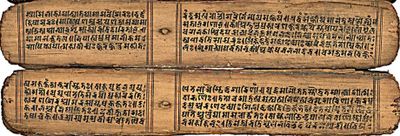
The movement of the Brahmashira from Sanskrit epic into modern visual culture changes more than its appearance. In the Mahabharata, the weapon is embedded within narration, ritual language, moral qualification, and the unstable relationship between teacher and pupil. Its material form remains secondary to the knowledge through which it is invoked. Television, comics, animation, games, and online mythology must make that abstract power visible. They tend to give the Brahmashira a recognizable shape, color, trajectory, sound, and moment of impact. What the epic presents as sacred knowledge entering matter becomes, on the screen or page, an object that audiences can see, compare, and remember.
Television adaptations have been influential because they transform the recited and literary epic into a shared national spectacle. B. R. Chopra’s Mahabharat, first broadcast on Doordarshan between 1988 and 1990, helped establish a visual vocabulary through which generations of viewers encountered the epic’s characters, divine interventions, and celestial weapons. Astras appear as beams, flames, radiant missiles, or supernatural energies whose identities must be communicated immediately through music, dialogue, color, and reaction shots. Later serials, working with digital effects and audiences accustomed to fantasy cinema, intensify this tendency. The destructive force of the Brahmashira can be represented through expanding fire, darkened skies, shaking landscapes, divine faces, or colliding streams of energy. Such imagery gives spectators an intuitive understanding of scale, but it may also narrow the weapon’s meaning. A visually spectacular projectile can overshadow the quieter but more important distinction between knowing how to invoke the weapon and possessing the discipline to withdraw it. The requirements of dramatic pacing often place attention upon release and collision, while the epic’s deeper concern lies in restraint, intention, and the moral state of the wielder. Comics create a similar transformation through still images. A weapon that exists primarily as mantra and concentrated consciousness must be represented by lines, symbols, flames, faces, and captions. The result is often a more stable iconography than the Sanskrit narrative itself supplies.
Amar Chitra Katha and related traditions of illustrated mythology have played a major role in making epic stories accessible to younger readers and mass audiences. Their panels condense long and morally complex episodes into sequences that can be grasped quickly: a warrior raises his weapon, invokes a deity, releases a blazing force, and confronts an answering power. This compression is not necessarily a distortion; all adaptation requires selection. Yet it favors clarity over ambiguity. The Brahmashira may acquire a fixed appearance, while the distinctions among Brahmastra, Brahmashira, Pashupata, Narayana, and other celestial weapons become increasingly systematized. Visual cues begin to function as taxonomic markers. Four heads of Brahma, a specific pattern of fire, or a particular color may distinguish one weapon from another even where the epic offers no consistent visual code. Once repeated across comics, posters, fan art, and televised retellings, these inventions can acquire the authority of tradition. Viewers may later assume that an image created for narrative convenience reproduces an ancient textual description.
Games and digital fantasy push this process further by requiring powers to operate according to explicit rules. A game designer must decide how much damage the Brahmashira inflicts, how long invocation takes, what resources it consumes, whether another weapon can counter it, and which character is permitted to use it. Moral and ritual qualifications are converted into mechanics: meditation becomes a charging period, mantra becomes an activation command, divine favor becomes an unlockable ability, and catastrophic consequences become an area-of-effect attack. The weapon’s danger can then be expressed numerically through damage ratings, rarity levels, cooldowns, or rankings among other legendary arms. These systems are useful for play because they make outcomes intelligible and balanced. They also encourage audiences to ask questions foreign to the epic’s moral structure: Which astra is strongest? How many times more powerful is the Brahmashira than the Brahmastra? Could it defeat the Pashupata? Could a particular hero survive it? The weapon becomes less a test of responsibility than a unit within a competitive hierarchy.
Digital mythology extends these tendencies beyond professionally produced media. Online encyclopedias, videos, discussion forums, social-media posts, and fan-created databases continually combine Sanskrit passages, regional traditions, televised images, comic-book designs, speculative archaeology, and fantasy conventions. Claims are repeated across platforms until their origins become difficult to identify. The description of the Brahmashira as exactly four times stronger than the Brahmastra, the image of four or five heads appearing at its tip, and the assertion that it produced effects identical to nuclear radiation may circulate together as though they belonged to a single ancient source. Digital culture does not merely transmit mythology; it reorganizes it. Fragmented traditions are assembled into coherent profiles, uncertainties become facts, and symbolic associations become physical specifications. Yet this process also demonstrates the continuing vitality of the weapon. The Brahmashira persists because it can be reimagined as sacred missile, apocalyptic beam, game ability, nuclear allegory, or visual emblem of forbidden knowledge. The challenge for historical interpretation is not to dismiss these modern forms as inauthentic, but to distinguish them from the textual traditions they transform. Each medium reveals what its own age expects an ultimate weapon to be.
The Four or Five Heads of Brahma: Textual Tradition or Later Visualization?
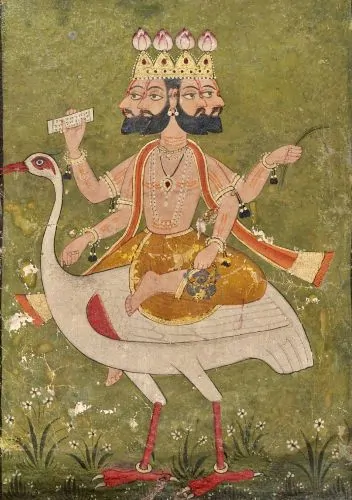
One of the most persistent modern descriptions of the Brahmashira claims that the weapon manifests four heads of Brahma at its tip. Some versions add a fifth head, presenting the weapon as a fiery embodiment of the creator deity’s complete or original form. The image is memorable, symbolically coherent, and well suited to television, illustration, and digital fantasy. It should not be treated automatically as a direct description preserved in the central Mahabharata episode. In the Sauptikaparvan, the Brahmashira is identified through its name, its transmission from Drona, its capacity to consume the world, and the environmental disaster threatened by its collision with an answering weapon. The narrative emphasizes what the weapon can do and whether its wielder can withdraw it; it does not pause to describe four or five divine faces visibly appearing upon its point. The name itself helps explain how the later image could arise. Brahmashiras or Brahmashira combines Brahma with a word meaning “head,” “top,” or “summit.” The compound can evoke the head of Brahma, the highest power of Brahma, or a supreme Brahma weapon without necessarily functioning as a literal description of the missile’s appearance. Sanskrit weapon names often identify divine association, power, or origin rather than providing a visual blueprint. Yet once the name is translated as “the weapon of Brahma’s head,” the step toward picturing an actual head upon the weapon becomes easy. Visual storytellers must give form to a power that the epic presents primarily through mantra, radiance, and consequence. A divine face, or a group of faces, offers an immediate sign that distinguishes the Brahmashira from a general Brahmastra. What may have begun as a grammatical and theological association becomes an iconographic feature.
The four-headed version draws upon Brahma’s most familiar artistic form. In sculpture, painting, and later devotional imagery, Brahma is conventionally represented with four faces oriented toward the cardinal directions. These faces are frequently interpreted as signs of comprehensive vision and associated with the four Vedas. A weapon displaying four heads can signify power extending throughout the ordered cosmos.
The fifth head belongs to a different but related body of mythology. Several Shaiva and Puranic traditions remember Brahma as originally possessing five heads, one of which is severed by Shiva or by Bhairava acting under Shiva’s authority. The details vary. In some accounts the removal punishes Brahma’s pride, falsehood, rivalry, or inappropriate desire; in others it establishes Shiva’s supremacy and produces the condition of skull-bearing penance associated with Bhairava or Kapalin forms of Shiva. The surviving four-headed Brahma consequently represents a deity whose iconography already contains the memory of a lost fifth face. When modern descriptions assign five heads to the Brahmashira, they may be drawing upon this earlier or more complete form of Brahma. Such an interpretation is symbolically possible, but it does not follow that the epic weapon was consistently imagined with five visible heads. The traditions concerning Brahma’s decapitation explain why the number five became available to later imagination; they do not prove that it belonged to the original visual identity of the astra.
The uncertainty between four and five is itself evidence of reception rather than stable textual description. Had the Sauptikaparvan supplied an explicit and memorable account of four heads burning upon the weapon, the recurring fifth-head variation would be harder to explain. Instead, later interpreters appear to be combining the weapon’s name with whichever form of Brahma best suits their theological or artistic purpose. Four heads correspond to the deity’s standard iconography; five evoke primordial completeness, the upward-looking face, or the mythology of Shiva’s severing act. Online encyclopedias and popular summaries may then place both possibilities side by side, giving the impression that ancient sources disagree about the weapon’s physical construction when the underlying sources may not describe that construction at all.
Modern visualization should not be dismissed merely because it goes beyond the principal epic passage. Mythological traditions have always developed through performance, commentary, regional narration, painting, sculpture, and reinterpretation. Giving the Brahmashira four heads can express genuine ideas about Brahma’s cosmic vision, the four directions, sacred knowledge, and the weapon’s ability to threaten the totality of the ordered world. Five heads can connect the astra to a more archaic or transgressive image of creative power before its limitation by Shiva. These images belong to the reception history of the weapon and may possess considerable symbolic richness. Historical analysis simply requires that their status be stated accurately. The Mahabharata securely presents the Brahmashira as an apocalyptic form of weaponized sacred knowledge; later visual traditions make that power concrete by giving it the faces of its divine namesake. The distinction does not impoverish the mythology. It reveals how a weapon described chiefly through terror, mantra, and consequence acquired the fixed appearance that many modern audiences now assume it always possessed.
Comparative Perspectives: Other Weapons That Endanger Creation
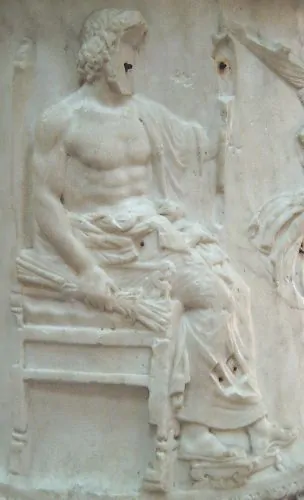
The Brahmashira belongs to a wider family of mythic weapons whose significance exceeds ordinary combat. Across ancient traditions, certain weapons do not merely kill opponents; they reveal or threaten the foundations of cosmic order. Their destructive force is often inseparable from divine sovereignty, sacred knowledge, or the right to judge entire communities. Comparison can clarify what makes the Brahmashira distinctive, but only if the differences among traditions remain visible. Zeus’s thunderbolt, Shiva’s Pashupata weapon, Vishnu’s Sudarshana Chakra, and the apocalyptic instruments of the Book of Revelation all express overwhelming power, yet they do not operate according to identical moral or theological systems. Some affirm the authority of a ruling god, others destroy demonic disorder, and still others mark the collapse or renewal of an age. The Brahmashira is unusual because it becomes most meaningful when human warriors, rather than gods alone, acquire access to a force capable of injuring creation.
The Pashupata weapon provides the closest comparison within the Sanskrit epic world. Arjuna receives it from Shiva after severe austerity and a direct test of his courage, but he is warned that it must not be used casually against ordinary human opponents. Its power can destroy beings on a vast scale, and its legitimacy depends upon the circumstances of its use. Like the Brahmashira, it is inseparable from initiation, divine authorization, and the moral fitness of the recipient. The difference lies largely in narrative function. The Pashupata remains primarily a withheld possibility, a sign of Arjuna’s access to Shiva’s terrible power and of the restraint required to bear it. The Brahmashira, by contrast, is actually released in a moment of moral collapse. It dramatizes not only the danger of possessing an ultimate weapon but the consequences of allowing one to enter circulation among rival human agents. Vishnu’s Sudarshana Chakra offers another contrast. It is a divine discus associated with preservation, kingship, and the destruction of forces that threaten cosmic order. Although it can be terrifyingly destructive, its activity remains closely linked to Vishnu or Krishna as the agent of divine judgment. The chakra may sever heads, annihilate enemies, or enforce divine will, but it does not generally become an uncontrolled force that its rightful wielder cannot recall. The Brahmashira’s horror lies precisely in that possibility. Ashvatthama can release it without possessing complete command over its return. Authority and capacity have become separated. The weapon no longer guarantees that the person who wields divine power also possesses divine judgment.
Greek mythology presents a different model in the thunderbolt of Zeus. Forged by the Cyclopes and associated with the defeat of the Titans, the thunderbolt is a weapon of sovereignty. It destroys challengers, punishes rebellion, and marks Zeus as ruler of the cosmic order established after primordial conflict. Its overwhelming force is not primarily a technological problem or a test of human restraint. It belongs to the god whose victory has made the current world possible. Yet Greek myth also recognizes that divine weapons can endanger creation when used in anger. The destruction of Phaethon by Zeus’s bolt prevents the sun chariot from burning the earth, while other myths imagine divine conflict shaking the cosmos itself. Here, as in the Brahmashira episode, the weapon’s scale makes ordinary political or personal grievance inadequate to explain its consequences. The difference is that Zeus acts to restore control, whereas Ashvatthama’s release demonstrates what happens when a mortal warrior becomes the source of cosmic instability.
Apocalyptic literature offers still another point of comparison. In the Book of Revelation, seals, trumpets, plagues, celestial warfare, and fiery destruction afflict earth, sea, sky, and human society. These images resemble the Brahmashira in their refusal to confine violence to individual combatants. Creation itself becomes the arena of judgment. Yet apocalyptic destruction is embedded within a theology of divine conclusion and renewal. The devastation belongs to a final drama in which corrupt powers are judged and a transformed order emerges. The Brahmashira crisis has no such guaranteed teleology. Its threatened drought would not cleanse the world according to a divine plan; it would result from the rage of one defeated warrior and the escalating response of another. The catastrophe is more arbitrary and politically intimate. The end of the world nearly occurs not because cosmic time has reached its appointed fulfillment, but because grief and vengeance escape the restraints meant to govern them.
Comparative mythology shows that many traditions imagine supreme weapons as tests of sovereignty, legitimacy, and the moral quality of power. A divine weapon may confirm the authority of a god, defend cosmic order, destroy monstrous enemies, or bring one age to an end. The Brahmashira participates in all these themes while reversing their usual direction. A power associated with Brahma, creation, and sacred knowledge becomes dangerous because it is transmitted to human beings whose passions are not equal to its scale. Its decisive heroic act is not conquest but withdrawal. Zeus’s bolt establishes rule, the Sudarshana Chakra executes divine judgment, and apocalyptic weapons complete a providential history. The Brahmashira, by contrast, forces the world to depend upon whether a warrior can stop himself. Its deepest question is not who possesses the greatest weapon, but whether any mortal should be trusted with a force whose misuse turns private hatred into a threat against creation.
Is the Brahmashira Really an Ethical Warning?
The following video from “Truth Teller” discusses the Brahmashirastra:
Interpreting the Brahmashira as a warning about catastrophic power risks making the Mahabharata sound more systematic and modern than it is. The episode does not present a philosophical treatise on weapons control, nor does it formulate a universal prohibition against divine arms. Celestial weapons appear throughout the epic as legitimate components of heroic warfare, and Arjuna’s ability to command them contributes to his stature. The Brahmashira confrontation may function first as a spectacular climax to Ashvatthama’s story: the defeated warrior commits one final act of vengeance, the favored hero proves superior, and Krishna ensures the survival of the Pandava line. From this perspective, the weapon’s apocalyptic scale magnifies the greatness of the protagonists rather than expressing a sustained critique of overwhelming military power.
The contrast between Arjuna and Ashvatthama may also be read as an instrument of partisan characterization. Arjuna receives instruction properly, invokes the weapon defensively, obeys the sages, and demonstrates the purity required to withdraw it. Ashvatthama seeks equality with his father’s preferred pupil, violates Drona’s warning, massacres sleeping enemies, and cannot recall what he has released. The moral structure is so sharply arranged that it reinforces the legitimacy of the Pandava side at the moment when its own wartime conduct has become difficult to defend. Drona was killed after Yudhishthira participated in a deception concerning Ashvatthama’s supposed death; Bhima struck Duryodhana below the waist in violation of mace-fighting rules; Karna was killed while vulnerable; and Abhimanyu had earlier been overwhelmed through collective rule-breaking by the Kauravas. The epic does not conceal these violations, but the final Brahmashira episode restores a clearer distinction between the disciplined Pandava hero and the Kaurava survivor consumed by vengeance. Arjuna’s withdrawal may serve less as a universal ethics of restraint than as proof that he remains morally qualified to possess the very power that disqualifies Ashvatthama.
A further interpretation emphasizes social and religious authority. Vyasa and Narada intervene when warriors can no longer govern the consequences of their own actions, placing ascetic and Brahmanical judgment above kshatriya violence. The episode may dramatize not the rejection of ultimate weapons but the claim that martial power must remain subordinate to those who understand cosmic and ritual order. Drona’s failed transmission and Ashvatthama’s misuse reveal the danger of sacred knowledge becoming too fully absorbed into dynastic warfare. Arjuna succeeds because he listens when the sages speak.
Modern nuclear analogies can intensify the ethical reading while also distorting it. Readers who live under the possibility of technological annihilation naturally recognize escalation, environmental devastation, attacks upon future generations, and the difficulty of recalling destructive force once released. These parallels are illuminating, but they can encourage the assumption that the ancient composers shared modern anxieties about impersonal weapons systems, deterrence policy, and scientific responsibility. The epic’s concerns are organized instead through dharma, ascetic discipline, divine favor, lineage, purity, and the moral condition of individual wielders. The Brahmashira is not controlled by institutions, treaties, or collective command structures. Its safety depends upon the virtue and concentration of exceptional men. To call the episode an ancient theory of weapons control would obscure the aristocratic and spiritual assumptions that shape its solution. The world is preserved not because destructive knowledge is abolished, but because Arjuna proves worthy of retaining it.
Yet the Brahmashira narrative can exalt Arjuna, condemn Ashvatthama, affirm the authority of sages, and dramatize the superiority of disciplined sacred knowledge while still warning that destructive power may escape the intentions of those who wield it. The Mahabharata rarely confines an episode to a single lesson. Its moral imagination works through competing obligations, compromised agents, and consequences that exceed every participant’s justification. The weapon is not condemned in itself, and Arjuna’s possession of it remains legitimate. What the narrative condemns is the separation of power from restraint, instruction from character, and vengeance from any limit imposed by the lives of others. The Brahmashira is an ethical warning, but not a simple pacifist one. It does not declare that ultimate force must never exist. It asks whether the social, spiritual, and personal disciplines surrounding that force can survive grief, rivalry, political collapse, and the death of the teacher who once guarded it. Ashvatthama’s failure suggests that they may not; Arjuna’s withdrawal preserves the hope that they sometimes can.
Conclusion: The Warrior Who Can Call the Weapon Back
The Brahmashira stands at the end of the Kurukshetra catastrophe as the weapon that reveals what victory has failed to resolve. The armies are gone, the principal kings and commanders are dead, and the surviving heirs of both sides are surrounded by grief. Yet the war continues because Ashvatthama refuses to let defeat impose a limit upon vengeance. By invoking the Brahmashira, he expands a dynastic conflict into a threat against the earth, the unborn, and the continuity of human life. The weapon marks the point at which warfare loses every remaining claim to proportion. A struggle once fought for a kingdom now risks leaving no fertile kingdom, no secure lineage, and no future capable of inheriting the result.
The confrontation between Ashvatthama and Arjuna gives the weapon its deepest symbolic force. Both men possess knowledge transmitted through Drona. Both can invoke the Brahmashira. Both stand within the same martial tradition and have been shaped by the same war. Their difference appears only when the sages command withdrawal. Arjuna obeys, recalls the weapon, and accepts that preserving the world matters more than completing the destruction of his enemy. Ashvatthama cannot do the same. His knowledge extends to release but not reversal, and his rage converts failure into a renewed attack upon the unborn. The epic locates mastery not in possession, spectacle, or destructive capacity, but in the ability to remain sovereign over one’s own power. The warrior who can summon the weapon is formidable. The warrior who can call it back is worthy of trust.
This distinction also explains why the Brahmashira should not be reduced to an ancient nuclear missile, a ranked fantasy weapon, or a literal object bearing four or five heads of Brahma. Such interpretations capture fragments of its later reception, but they miss the structure of the epic episode. The weapon is sacred knowledge joined to intention, memory, lineage, and character. It can pass from teacher to pupil, survive the collapse of kingdoms, and transform the smallest piece of matter into an instrument of annihilation. Its danger lies not only in what it can destroy but in the possibility that those who inherit it may no longer possess the discipline that once justified its transmission.
The Brahmashira endures as a myth of catastrophic power and moral incompleteness. It imagines a world in which human beings can acquire access to forces greater than their wisdom, preserve formulas more reliably than restraint, and carry inherited violence into generations not yet born. Yet the episode does not end in total despair. Arjuna’s withdrawal, the intervention of Vyasa and Narada, and the survival of Parikshit preserve the possibility that destruction can still be interrupted. The future survives because one warrior accepts limitation and because others possess the authority to demand it. The final meaning of the Brahmashira lies in that fragile achievement. Civilization does not depend only upon whether ultimate weapons remain unused. It depends upon whether those who possess them can still listen, relinquish vengeance, and call destruction back before the world becomes the final casualty of their grief.
Bibliography
- Abraham, Itty. The Making of the Indian Atomic Bomb: Science, Secrecy and the Postcolonial State. London: Zed Books, 1998.
- Bailey, Greg. The Mythology of Brahmā. Delhi: Oxford University Press, 1983.
- Banerjea, Jitendra Nath. The Development of Hindu Iconography. 3rd ed. Calcutta: University of Calcutta, 2002.
- Brockington, John. The Sanskrit Epics. Leiden: Brill, 1998.
- Brodbeck, Simon. The Mahābhārata Patriline: Gender, Culture, and the Royal Hereditary. Farnham: Ashgate, 2009.
- Chopra, B. R., producer. Mahabharat. Directed by Ravi Chopra. Doordarshan, 1988–1990.
- Collins, John J. The Apocalyptic Imagination: An Introduction to Jewish Apocalyptic Literature. 3rd ed. Grand Rapids, MI: Eerdmans, 1984.
- Crosby, Kate, trans. Mahabharata Books Ten and Eleven: “Dead of Night” and “The Women.” New York: New York University Press and JJC Foundation, 2009.
- Fitzgerald, James L. “Dharma and Its Translation in the Mahābhārata.” Journal of Indian Philosophy 32:5-6 (2004): 671–685.
- —-, trans. The Mahābhārata: Book 11, The Book of the Women; Book 12, The Book of Peace, Part One. Chicago: University of Chicago Press, 2004.
- Goldman, Robert P., trans. The Rāmāyaṇa of Vālmīki. Volume 1: Bālakāṇḍa. Princeton, NJ: Princeton University Press, 1984.
- Hesiod. Theogony. Translated by Glenn W. Most. Cambridge, MA: Harvard University Press, 2006.
- Hiltebeitel, Alf. Dharma: Its Early History in Law, Religion, and Narrative. Oxford: Oxford University Press, 2010.
- —-. Rethinking the Mahābhārata: A Reader’s Guide to the Education of the Dharma King. Chicago: University of Chicago Press, 2001.
- Hopkins, E. Washburn. Epic Mythology. Strasbourg: Karl J. Trübner, 1915.
- Hudson, Emily T. Disorienting Dharma: Ethics and the Aesthetics of Suffering in the Mahābhārata. New York: Oxford University Press, 2012.
- Johnson, W. J., trans. The Sauptikaparvan of the Mahabharata: The Massacre at Night. Oxford: Oxford University Press, 1998.
- Kinsley, David R. Hindu Goddesses: Visions of the Divine Feminine in the Hindu Religious Tradition. Berkeley: University of California Press, 1986.
- Kramrisch, Stella. The Presence of Śiva. Princeton, NJ: Princeton University Press, 1981.
- Mankekar, Purnima. Screening Culture, Viewing Politics: An Ethnography of Television, Womanhood, and Nation in Postcolonial India. Durham, NC: Duke University Press, 1999.
- Matilal, Bimal Krishna, ed. Moral Dilemmas in the Mahābhārata. Delhi: Motilal Banarsidass, 1989.
- McLain, Karline. India’s Immortal Comic Books: Gods, Kings, and Other Heroes. Bloomington: Indiana University Press, 2009.
- O’Flaherty, Wendy Doniger, trans. Hindu Myths: A Sourcebook Translated from the Sanskrit. London: Penguin Classics, 1975.
- Prakash, Gyan. Another Reason: Science and the Imagination of Modern India. Princeton, NJ: Princeton University Press, 1999.
- Rajagopal, Arvind. Politics after Television: Hindu Nationalism and the Reshaping of the Public in India. Cambridge: Cambridge University Press, 2001.
- Rao, T. A. Gopinatha. Elements of Hindu Iconography. 2 vols. Madras: Law Printing House, 1914–1916.
- Sukthankar, Vishnu S., et al., eds. The Mahābhārata. 19 vols. Poona: Bhandarkar Oriental Research Institute, 1933–1966.
- Sullivan, Bruce M. Kṛṣṇa Dvaipāyana Vyāsa and the Mahābhārata: A New Interpretation. Leiden: Brill, 1990.
- Thapar, Romila. Cultural Pasts: Essays in Early Indian History,. New Delhi: Oxford University Press, 2000.
- van Buitenen, J. A. B., trans. The Mahābhārata. Volume 2: Book 2, The Book of the Assembly Hall; Book 3, The Book of the Forest. Chicago: University of Chicago Press, 1975.
- Weart, Spencer R. Nuclear Fear: A History of Images. Cambridge, MA: Harvard University Press, 1988.
- West, M. L. Indo-European Poetry and Myth. Oxford: Oxford University Press, 2007.
- Whitaker, Jarrod L. “Divine Weapons and ‘Tejas’ in the Two Indian Epics.” Indo-Iranian Journal 43:2 (2000), 87–113.
- —-. “How the Gods Kill: The ‘Nārāyaṇa Astra’ Episode, the Death of Rāvaṇa, and the Principles of ‘Tejas’ in the Indian Epics.” Journal of Indian Philosophy 30:4 (2002), 403–430.
- Young, Katherine K. “Hinduism and the Ethics of Weapons of Mass Destruction.” In Ethics and Weapons of Mass Destruction: Religious and Secular Perspectives, edited by Sohail H. Hashmi and Steven P. Lee, 277–307. Cambridge: Cambridge University Press, 2004.
Originally published by Brewminate, 07.27.2026, under the terms of a Creative Commons Attribution-NonCommercial-NoDerivatives 4.0 International license.
About the Author