More than a sacrificial knife, the tecpatl embodied divine power, calendrical order, cosmic violence, and the transformation of death into renewal across Aztec myth and ritual life.

By Matthew A. McIntosh
Public Historian
Brewminate
Introduction: The Knife That Was More Than a Knife
Among the sacred objects of Central Mexico, few appear more immediately comprehensible (or more easily misunderstood) than the tecpatl. To a modern observer, its elongated point, sharpened edges, and frequent association with opened bodies seem to identify it plainly as a knife, especially the knife used by priests to perform human sacrifice. That identification is correct, but it is radically incomplete. In Nahua thought, the tecpatl belonged simultaneously to the worlds of material technology, calendrical notation, divine embodiment, warfare, ancestral origins, celestial fire, and ritual transformation. It could appear in a priest’s hand, within an offering deposited beneath a temple, as the name of a day or year, as part of a deity’s face, or as an animate being furnished with eyes, teeth, and a consuming mouth. Its significance did not begin when its edge entered human flesh, nor did it end when a victim’s heart was raised toward the sun. The blade condensed a much larger religious proposition: that boundaries had to be opened for life, motion, and sacred power to pass between the different levels of existence. Stone became fire when struck; the body released blood when cut; the earth received offerings through wounds and cavities; and the gods, whose own sacrifices had set the cosmos in motion, continued to enter the human world through images, bundles, costumes, natural substances, and consecrated objects. The tecpatl was more than an implement employed during a ceremony. It was one of the forms through which the dangerous productivity of division became visible.
The word itself requires caution. Tecpatl most commonly designated flint, chert, or a knife fashioned from such stone, while itztli referred more specifically to obsidian and could likewise denote an obsidian cutting blade. Yet neither colonial vocabulary nor preconquest imagery always preserves the tidy mineralogical classifications preferred by modern archaeology, and the symbolic fields of flint and obsidian frequently overlapped. Both substances possessed qualities that distinguished them from ordinary stone: they fractured into edges sharper than most metal tools available in preconquest Mesoamerica, reflected or refracted light, emerged from particular places within the sacred landscape, and could be fashioned into forms whose effectiveness seemed to reveal an inherent potency. Flint added the ability to produce sparks, joining a seemingly cold stone to fire, lightning, stars, and celestial violence. Obsidian joined lethal sharpness to blackness, brilliance, reflection, divination, and the dangerous vision associated with figures such as Tezcatlipoca. The sacrificial tecpatl must be approached not as a single standardized artifact but as part of a wider lithic complex in which material properties, ritual functions, and supernatural identities reinforced one another. Some surviving examples are finely worked bifacial knives capable of cutting flesh; others are oversized, delicately fashioned, elaborately decorated, or deposited in contexts suggesting that they were created principally as offerings rather than practical instruments. Pictorial manuscripts complicate the category further. There the tecpatl might retain the outline of a pointed blade while acquiring a staring eye, bared teeth, colored bands, a tongue, or an entire anthropomorphic countenance. Such images should not be reduced to decorative fantasy. They indicate that a knife could be imagined as a participant in ritual action, a bearer of divine attributes, or a temporary manifestation of a power that exceeded the physical object. The question is consequently not whether the tecpatl was literally a god or merely represented one, since that opposition assumes a distinction between object and divinity that Nahua ritual practice did not always maintain. A sacred object could be made, clothed, fed, carried, buried, addressed, and activated without ceasing to be materially stone.
This complexity also requires resistance to the familiar colonial and popular image of Aztec religion as an obsessive theater of blood. Human sacrifice was real, institutionally important, and at times deliberately spectacular, particularly within the ceremonial and political landscape of Tenochtitlan. It cannot responsibly be minimized, transformed into harmless metaphor, or dismissed as Spanish invention. Yet concentrating exclusively on the instant of killing reproduces the very narrowing imposed by conquistadors and missionaries who treated sacrificial knives as self-evident proofs of demonic barbarism. Their accounts preserve indispensable testimony, often derived from Nahua informants and pictorial records, but they also translate Indigenous practices into Christian categories of idolatry, diabolism, cruelty, and false worship. The tecpatl consequently arrives in the historical record already burdened by interpretation. To recover something of its preconquest significance, the knife must be returned to the cycles that made sacrifice intelligible: divine precedent, reciprocal obligation, calendrical recurrence, agricultural renewal, military capture, bodily transformation, and the maintenance of movement within a cosmos perpetually vulnerable to exhaustion and collapse.
The argument developed here is that the tecpatl embodied a principle of sacred division extending far beyond the anatomy of sacrifice. Its edge separated one condition of being from another: interior from exterior, captive from offering, stone from spark, darkness from radiance, stillness from motion, undifferentiated duration from calendrically ordered time, and primordial unity from the multiplicity of gods and peoples inhabiting the earth. Cutting was destructive, but destruction did not necessarily constitute an ending. Nahua narratives repeatedly imagined creation through opening, breaking, piercing, burning, dismemberment, or descent. Gods sacrificed themselves so that the sun might move; human beings shed blood in acknowledgment of inherited debts; maize had to be divided, buried, and transformed before it could nourish life; defeated divine bodies could become stars, stones, sacred bundles, or features of the landscape. Within this conceptual world, the knife did not simply extinguish vitality. It revealed, redirected, and transferred it. Nevertheless, there was no single, universally worshipped “god Tecpatl” possessing a stable biography comparable to that expected of a character in classical mythology. The celestial flint cast from heaven, the calendrical sign Tecpatl, the anthropomorphized knives of the codices, the blades associated with Xipe Totec or Tezcatlipoca, and the instruments used in temple sacrifice belonged to an interconnected sacred complex rather than to one perfectly unified mythology. Their relationship must be reconstructed from pictorial manuscripts, archaeological deposits, Nahuatl descriptions, colonial narratives, and modern scholarship, each preserving different fragments of meaning. Seen through those fragments, the tecpatl emerges not as a passive weapon awaiting the hand of a priest, but as a volatile point of contact between divine violence and generative order, the edge upon which death could become nourishment, matter could become presence, and rupture could become creation.
What Was a Tecpatl?
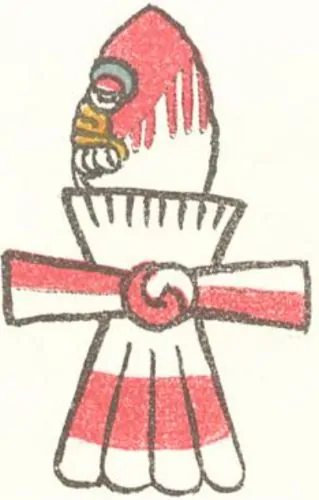
The Nahuatl term tecpatl occupied a semantic field broader than the English word “knife.” Alonso de Molina’s sixteenth-century vocabulary rendered it most directly as pedernal, or flint, indicating that the name referred first to a kind of stone and only by extension to an implement made from it. In other contexts, tecpatl could designate a sharpened blade, a sacrificial knife, a calendrical sign, a year designation, or an anthropomorphized sacred presence. The object and its substance were linguistically difficult to separate: the knife was called by the name of the material whose fracture produced its penetrating edge. Modern descriptions that translate tecpatl simply as “Aztec sacrificial knife” capture its most famous ritual use but conceal this larger range of meanings. A tecpatl might be held and used, painted within a manuscript, invoked through a calendrical date, deposited in an offering, or represented as a living being with the ability to see, bite, and consume.
Flint, chert, and obsidian must also be distinguished without imposing a precision that the surviving sources do not always maintain. Flint and chert are closely related forms of cryptocrystalline silica that break conchoidally, allowing skilled workers to detach controlled flakes and produce durable cutting edges. Obsidian is volcanic glass, generally designated in Nahuatl by the word itztli, and it can fracture into edges of extraordinary sharpness. Colonial vocabularies and modern translations sometimes allow tecpatl to include an obsidian knife, while archaeological and art-historical discussions frequently apply the term to ritual blades regardless of whether they were made from flint, chert, or volcanic glass. This flexibility does not mean that Nahua speakers regarded the substances as identical. Obsidian carried associations with brilliance, darkness, mirrors, divination, and deities such as Tezcatlipoca, while flint was connected with sparks, fire making, lightning, and the stony points of weapons. Nevertheless, both materials shared qualities that made them appropriate for sacred cutting: they emerged from powerful landscapes, possessed visually arresting surfaces, fractured in seemingly dramatic ways, and could produce edges capable of opening flesh. Rather than assigning every surviving knife rigidly to one symbolic system, it is more useful to recognize a partially overlapping complex in which mineral substance, visual appearance, technological form, and ritual context shaped the object’s meaning.
The familiar tecpatl is usually described as lanceolate or leaf-shaped, pointed at one or both ends, and sharpened along two converging sides. Many examples were bifaces, meaning that stoneworkers removed flakes from both faces to thin and shape the implement while creating two usable edges. Yet “double-edged sacrificial knife” should not be treated as a universal definition, since Central Mexican cutting technologies also included flakes, scrapers, projectile points, prismatic blades, and composite tools whose forms differed greatly from the iconic leaf-shaped biface. Nor did every pointed biface necessarily serve in human sacrifice. Similar stoneworking principles could produce weapons, domestic implements, ritual offerings, ceremonial insignia, and objects made primarily for display.
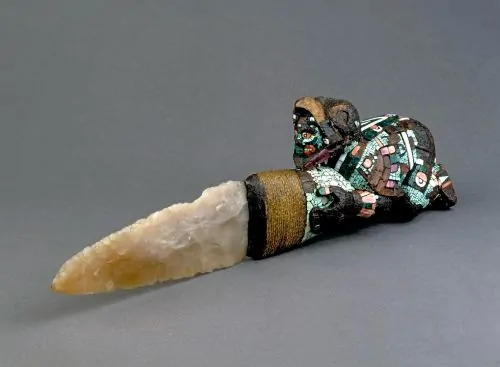
Manufacturing a fine tecpatl required far more than breaking a convenient stone into a sharp fragment. A craftsperson first selected raw material of appropriate size, texture, purity, and fracture quality, then reduced it through carefully directed percussion before refining its thickness, symmetry, point, and edges through smaller removals and pressure flaking. Mistakes made late in this process could snap the nearly completed blade, making large and exceptionally thin bifaces demonstrations of controlled skill as well as useful objects. Some knives remained unhafted, while others were inserted into handles of wood or other organic materials and secured with fiber, resin, or adhesive compounds. Elite ceremonial examples could combine a flint blade with carved wood, turquoise or malachite mosaic, shell, pigment, and elaborate bindings, turning a cutting implement into a composite image whose costly components came from distant ecological regions. The celebrated mosaic knife now in the British Museum, for example, joins a flint blade to a handle shaped as a crouching eagle warrior and covered with turquoise, shell, malachite, fiber, and resin. Such objects materialized political reach as well as religious meaning, because their manufacture depended upon specialized labor and the acquisition of valued substances through tribute, commerce, diplomacy, or conquest. Obsidian likewise connected Tenochtitlan to extensive extraction and distribution systems, including the celebrated green material from the Sierra de Pachuca and stone obtained from several other volcanic sources. The sacred power of a knife did not erase this economic and technological history; it depended upon it. Quarry workers, transporters, merchants, knappers, mosaicists, priests, and political authorities all participated in bringing the finished object into ritual existence.
Archaeological context further warns against equating every tecpatl with a knife actually used to remove a human heart. Some excavated blades possess forms and dimensions consistent with practical cutting, but others are too fragile, oversized, heavily decorated, or symbolically arranged to have functioned primarily as ordinary tools. At the Templo Mayor, knives were deposited in offerings alongside shells, animal remains, sculptures, masks, weapons, pigments, and other objects selected to represent particular deities or portions of the cosmos. A blade placed upright, furnished with eyes and teeth, wrapped as a sacred bundle, or buried in a carefully ordered cache communicated something different from a discarded implement found in a work area. Even when a knife could have been used in sacrifice, its final deposition might have transformed it from ritual equipment into an offering with a new identity. Use-wear, residues, and microscopic damage can sometimes clarify an object’s history, but preservation conditions rarely permit certainty about the exact ceremony in which an individual blade participated.
The tecpatl was also a graphic form capable of communicating without reproducing a particular physical knife in documentary detail. In Central Mexican pictorial manuscripts, it commonly appears as an elongated oval or pointed shape marked by contrasting bands of red and white, sometimes with serrations, teeth, an eye, or a complete face. The red has often been interpreted as blood and the white as the natural color of flint, although the sign’s conventions should not be reduced to a single literal color code. As the eighteenth day sign of the 260-day tonalpohualli, Tecpatl identified a recurring division of divinatory time and could be combined with numerical signs to form dates such as One Flint or Five Flint. It also participated in year-naming systems and in the notation of personal names, historical events, ritual sequences, and divine attributes. Its meaning changed according to what surrounded it: joined to a skull, severed limb, stream of blood, smoking mirror, bundle of down, or deity costume, the sign could contribute to a larger pictorial statement about sacrifice, death, dismemberment, punishment, or divine identity. The glyph was not merely an illustration inserted beside a text. It was a flexible unit within a visual language, carrying phonetic, calendrical, material, and metaphorical associations at the same time. A reader trained in those conventions would not see only the outline of a knife but a cluster of meanings activated by position, combination, color, and ritual context.
To ask what a tecpatl was is consequently to ask a question for which no single English noun is sufficient. It was stone fashioned into an edge, but it was also the name and image through which that edge entered calendars, histories, offerings, and divine bodies. Its physical sharpness made it effective, while its material origin, color, brilliance, capacity to produce sparks, and susceptibility to personification made it conceptually powerful. Nahua religion did not require the knife to stop being an object before it could become a sacred agent. The tecpatl could remain worked stone while simultaneously functioning as tool, glyph, offering, embodiment, and active participant in the transformations accomplished by ritual.
Living Stone: The Problem of “Soul”
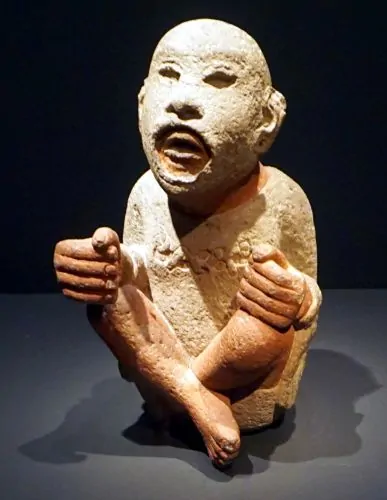
To say that the tecpatl possessed a “soul” offers an attractive shorthand, but it also introduces assumptions that can distort the religious categories preserved in Nahuatl sources. The English word usually implies an invisible, individualized essence inhabiting a material body and capable of surviving its destruction, a model shaped heavily by Greek philosophical and Christian theological traditions. Nahua understandings of life, personhood, and sacred presence were neither organized around one equivalent concept nor divided neatly between animate subjects and inert objects. Human beings themselves contained several interacting vital forces associated with the head, heart, liver, breath, blood, heat, destiny, and social identity. Gods could become present through human impersonators, stone images, wooden figures, paper constructions, dough effigies, animal bodies, sacred bundles, clothing, or natural phenomena without being permanently imprisoned within any one of them. A flint knife depicted with eyes and teeth need not be imagined as a stone shell occupied by a detachable spiritual personality. It is more accurate to ask how ritual, image, material, name, and divine association allowed the blade to acquire presence and agency in a particular setting.
The Nahuatl term teotl is central to that question, although it cannot safely be translated by one unchanging English word. Depending upon context, it could refer to a god, a sacred being, a divine quality, something marvelous or perilous, or a power recognized through an extraordinary material manifestation. Its plural form, teteo, was routinely used for multiple gods possessing names, personalities, desires, rivalries, and distinct ritual cults, which cautions against reducing all Nahua divinity to an impersonal cosmic energy. Yet the sacred was not confined to distant anthropomorphic personalities comparable to the Olympian gods of Greece. Mountains, springs, winds, fire, celestial bodies, stones, plants, images, and ritual objects could become sites where divine capacities were concentrated, encountered, or made active.
The concept most useful for understanding such embodiment is ixiptla, frequently appearing in the more explicitly divine compound teixiptla. Translators have rendered the term as image, representative, substitute, impersonator, embodiment, delegate, or manifestation, but each English choice captures only part of its range. A human selected to wear a deity’s costume during a festival did not merely act the role of the god in the modern theatrical sense. Through bodily preparation, fasting, instruction, adornment, naming, public recognition, and the careful assembly of insignia, that person became a localized form in which the deity could be approached and ritually engaged. The same logic could extend to statues, effigies, bundles, and other constructed bodies, although different kinds of embodiments were produced through different procedures. Divine identity did not always precede its material image as a complete, invisible personality awaiting representation; it could be assembled through the joining of significant substances, colors, garments, emblems, names, and actions. Scholars have shown that images of Central Mexican gods often functioned as combinations of meaningful components rather than portraits of beings with permanently fixed appearances. A smoking mirror, flayed skin, feather ornament, shield, facial stripe, knife, or particular color could introduce a name, capacity, mythic relationship, ritual office, or temporal aspect into the resulting divine figure. Changing the combination altered what dimension of the deity became visible without necessarily producing an entirely different god. The sacred knife could participate in this context as an attribute held by a deity, the material sign of a sacrificial function, or the very form assumed by the divine figure.
Nor should tonalli be treated as the precise Nahuatl equivalent of an object’s soul. It referred to an animating force strongly associated with solar heat, the head, hair, vigor, character, calendrical destiny, and the circumstances of birth. People possessed tonalli, but so could animals, plants, days, and other entities participating in a cosmos ordered by differential concentrations of heat and power. The term helps explain why vitality was distributed more broadly than the modern category of biological life, yet it does not establish that every ritual knife contained an individualized tonalli identical to that of a human person.
Sacred presence was also something made and maintained through ritual rather than a quality modern observers can infer from unusual appearance alone. Images and embodiments were painted, dressed, perfumed, incensed, offered food, addressed in formal speech, carried in processions, protected within temples, and sometimes destroyed, consumed, buried, or renewed at the conclusion of a ceremony. Such actions did not simply express a private belief that an object was alive; they established relationships among communities, ritual specialists, rulers, ancestors, and divine powers through the object’s prepared body. The tlaquimilolli, or sacred bundle, demonstrates this principle with particular clarity. A bundle might contain stones, bones, ashes, garments, fragments of wood, deity insignia, or other precious materials associated with an ancestor or god, all carefully enclosed within layers of cloth and bindings. What mattered was not only the hidden contents but also the wrapping that gathered separate materials into a coherent and portable presence. Bundles could anchor the histories of migrating peoples, authorize rulers and priestly lineages, receive offerings, and accompany communities into new territories. Their efficacy arose from the convergence of relic, narrative, enclosure, ritual treatment, and collective recognition. A tecpatl wrapped, adorned, deposited, or incorporated into such an assemblage could similarly become more than an isolated piece of worked stone without losing its stone identity.
The personified knives of Central Mexican pictorial manuscripts make this layered identity visible. Some bear a single eye within the blade, while others display mouths, exposed gums, teeth, facial paint, limbs, clothing, or the insignia of named deities. In certain representations associated with Xipe Totec or the deity Itztli, the distinction between a god holding a knife and a god appearing as a knife becomes deliberately unstable. The blade may frame or replace the face while the remaining costume introduces agricultural, solar, martial, nocturnal, or sacrificial qualities. These figures are not straightforward evidence that every physical knife was worshipped as an autonomous knife god, but neither are they merely decorative cartoons applied to an otherwise inert implement.
The most defensible interpretation lies between two inadequate extremes. The tecpatl should not be described as lifeless equipment whose religious meaning existed only in the minds of the priests who used it, because Nahua ritual and pictorial practice repeatedly attributed perception, appetite, identity, and agency to material forms. It should also not be imagined as universally containing a discrete, humanlike soul that remained permanently attached to the stone from quarry to burial. Sacred identity could be situational, relational, and cumulative, intensifying through an object’s material qualities, craftsmanship, name, calendrical associations, adornment, ritual history, and proximity to blood or divine insignia. A blade might function as an ordinary implement in one context, become a consecrated ritual instrument in another, and finally enter the earth as an offering or embodied divine sign. Its movement among these conditions was not evidence that its sacredness was unreal; it reveals that Nahua categories of being were more flexible than a strict division between person and thing permits. The phrase “living stone” is most useful when it describes an active relationship rather than a literal biological claim: stone capable of seeing in an image, consuming through sacrifice, speaking through a calendrical name, carrying divine identity, and participating in the transformations for which its edge had been prepared.
Born in Heaven: The Cosmic Flint

The most striking account of the tecpatl’s celestial origin survives in the Historia eclesiástica indiana of the Franciscan chronicler Gerónimo de Mendieta, who drew upon Indigenous testimony and the now-lost researches of Andrés de Olmos. Mendieta reports that his informants placed a divine couple in heaven: a god called Citlalatonac and a goddess called Citlalicue, whose names evoke the brilliance and garment of the stars. Citlalicue then gave birth not to an ordinary anthropomorphic child but to a great knife or piece of flint called tecpatl. The appearance of this stony offspring astonished and frightened the other divine children, who resolved to cast it out of heaven. The flint descended to the earth and reached Chicomoztoc, the Place of Seven Caves, from which 1,600 gods were said to have emerged. In a few compressed sentences, the narrative joined childbirth, celestial expulsion, stone, divine multiplicity, and ancestral emergence into one of the most unusual creation episodes preserved from Central Mexico.
The title Omecihuatl is often introduced into modern retellings because Citlalicue could be understood as a manifestation or alternate designation of the primordial female creator. Omecihuatl, “Two Lady,” was paired with Ometecuhtli, “Two Lord,” while Tonacacihuatl and Tonacatecuhtli represented another closely related naming of the supreme generative couple. Citlalicue and Citlalatonac similarly form a celestial pair whose names locate generative power among the stars and in the highest levels of heaven. Nahua deities could divide, merge, exchange attributes, or appear under titles emphasizing different ritual and cosmological functions, so these names need not identify entirely separate divine personalities. Nevertheless, the surviving version should be allowed to speak precisely: Mendieta names the mother Citlalicue, and the equation with Omecihuatl is an interpretive identification rather than wording found in that passage.
The birth itself overturns any modern expectation that a divine mother must produce a child resembling either herself or the other gods. What emerges from Citlalicue is a sharp, apparently lifeless stone whose form already anticipates cutting, sacrifice, fire making, and violent separation. The other children respond not with affection but with alarm, suggesting that the newborn tecpatl enters heaven as a disruptive or excessive presence. Mendieta does not explain exactly why the knife terrifies them, and later interpreters should resist filling that silence with a fixed story of jealousy, deformity, or moral corruption. The blade may have appeared dangerous because it embodied the capacity to wound divine bodies, but it may also have represented a form of generative power whose place was not in the undivided celestial realm. Its expulsion transformed rejection into a second birth, for the knife passed from the body of its mother through the vertical structure of the cosmos and entered the terrestrial place of origins. Heaven did not destroy the disturbing object; it transferred its potency downward. The tecpatl consequently became a mediator between levels of existence before it became an instrument placed between priest and victim. Its trajectory established a pattern repeated throughout Nahua mythology, in which descent, defeat, exile, and dismemberment could prepare the conditions for creation rather than merely record catastrophe.
Popular summaries frequently state that the flint shattered into 1,600 pieces and that each fragment became a god, but Mendieta’s wording is less mechanically explicit. He says that the knife fell at Chicomoztoc and that 1,600 gods came out of it, leaving the exact manner of their emergence undefined. Fragmentation is a plausible interpretation because flint divides through fracture and because one stone becoming many gods accords powerfully with the material’s properties. It should not be presented as though the source describes 1,600 individually numbered shards scattered by the impact.
Chicomoztoc intensifies the episode’s imagery of gestation and collective birth. The Place of Seven Caves was remembered in numerous Central Mexican traditions as an ancestral point of emergence from which peoples entered history, although different communities located, depicted, and politically appropriated it in different ways. Caves were openings into the interior of the earth, places where ancestors, water, seeds, wealth, and supernatural forces could remain enclosed before appearing in the inhabited world. When the celestial tecpatl enters this subterranean matrix, the motion can be read simultaneously as a fall, a penetration, a burial, and an act of insemination. The knife born from a heavenly mother enters an earthly womb and generates a new population of gods, binding celestial maternity to terrestrial fertility. Such an interpretation does not require reducing the myth to a disguised account of sexual reproduction, but the conjunction of blade and cave makes bodily imagery difficult to ignore. The tecpatl opens or activates a place already associated with emergence, and the result is not a solitary being but an abundant divine collectivity. Stone occupies both sides of the generative process: it is the strange child expelled from heaven and the seed from which terrestrial sacred life multiplies.
Mendieta’s Christian framework must be separated carefully from the Indigenous structure of the account. After describing the 1,600 gods as fallen and exiled, he compares their descent to the fall of the rebellious angels, an analogy shaped by his missionary purpose rather than necessarily supplied by Nahua informants. The gods themselves do not behave like Christian demons rebelling against an omnipotent creator; they experience displacement, deprivation, and the absence of human beings who might serve and sustain them. They send a messenger back to their divine mother requesting permission and means to create humanity, extending the flint’s descent into a larger narrative of divine need and human obligation. The episode reveals a cosmos in which gods are powerful but not self-sufficient, and in which creation develops through negotiations among celestial parents, exiled children, underworld substances, and future human providers. The cosmic tecpatl stands at the beginning of that relationship, not yet as the knife that takes human life but as the divine object whose arrival makes a populated sacred world possible. Born from the stars and planted in the earth, it transforms the violence of expulsion into the fertility of origins.
The Fall into Chicomoztoc and the Birth of the 1,600 Gods
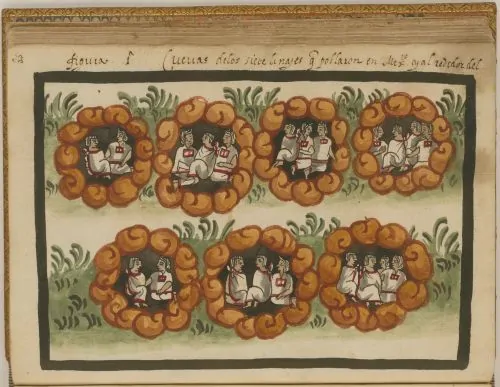
The descent of the celestial tecpatl did not end with its removal from heaven. According to the account preserved by Gerónimo de Mendieta from the earlier investigations of Andrés de Olmos, the great flint fell at Chicomoztoc, and 1,600 gods emerged from it. The source does not describe a long fall through named layers of the heavens, the sound of the impact, or the scattering of divine fragments across the landscape. Its brevity makes the episode more enigmatic rather than less important, for the knife passes almost instantaneously from rejected offspring to progenitor of an entire terrestrial divine population. The same object that had been born from Citlalicue now becomes the origin from which other beings are born. Descent transforms the tecpatl’s dangerous singularity into sacred multiplicity.
Modern retellings frequently make the event more physically explicit by saying that the knife struck the earth, shattered into 1,600 pieces, and produced one god from every fragment. Such a reconstruction possesses considerable symbolic appeal because flint naturally divides through fracture, and a stone broken into many sharp pieces provides an elegant material analogy for one divine being becoming a multitude. Mendieta says only that the gods “came out of it,” leaving open whether they emerged from the intact knife, from its broken body, or through the place activated by its arrival. This ambiguity should be preserved because it permits several related meanings to remain active at once. The tecpatl may be understood as a container holding an unexpressed divine population, a seed whose entry into the earth releases life, or a compressed ancestral substance whose division produces many distinct powers. It may also function as an opening instrument: the celestial blade reaches Chicomoztoc and makes possible the passage of beings from enclosure into the visible world. In each interpretation, creation depends upon a movement from unity to plurality and from concealment to manifestation. The knife does not create through peaceful fabrication but through expulsion, descent, impact, opening, or implied rupture. The birth of the gods establishes early in the mythic sequence that division can be generative rather than merely destructive.
The number 1,600 likewise communicates more than an exact census of divine individuals. Central Mexican numerical symbolism repeatedly employed multiples of 400 to denote immense groups, as in the Four Hundred Southerners opposed by Huitzilopochtli or the Four Hundred Rabbits associated with pulque and intoxication. Sixteen hundred is four times 400, amplifying the impression of abundance while also suggesting a totality distributed across four directions or cosmic divisions. The figure may indicate a vast host of gods rather than invite the reader to imagine a surviving catalogue containing precisely 1,600 names. Mendieta does not identify the members of the group individually, assign each one a local cult, or explain how they relate to every deity worshipped in later Central Mexico.
Chicomoztoc was an appropriate destination for such a collective emergence because it already belonged to a widespread language of ancestral origins. Its name combines the Nahuatl words for seven, cave, and place, but it was not simply a cave network that could be located unambiguously on a modern map. Different Nahua and neighboring communities remembered themselves as having emerged from Chicomoztoc, passed through it during migration, or descended from peoples whose legitimacy began there. The Historia Tolteca-Chichimeca represents it as a mountain or enclosed body containing seven cavernous compartments, each associated with a distinct Chichimec group awaiting entrance into political history. Other manuscripts and annalistic traditions connected Chicomoztoc with Aztlan, Colhuacan, Quinehuayan, or ancestral territories farther north, producing overlapping rather than uniform geographies. The place could be claimed, relocated, and reinterpreted as communities constructed accounts of their origins and rights to land. Its caves did not merely preserve memories of where ancestors had once lived; they gave political communities a sacred form of birth. To emerge from Chicomoztoc was to move from an interior state of latency into the social world of named peoples, rulers, alliances, temples, and territories.
The image of seven caves also invited comparison with a divided womb, although the analogy should not be treated as a simple translation of what Chicomoztoc “really meant.” Mesoamerican caves were entrances into the living earth and sources from which water, clouds, seeds, animals, ancestors, and valuable substances could appear. They joined interiority with fertility, concealment with potential, and burial with future emergence. When the tecpatl descended from the celestial mother into this terrestrial place of generation, the myth linked two reproductive spaces across the vertical cosmos. The knife had first passed from the body of Citlalicue; it now entered the body of the earth and released a second divine birth. What appeared in heaven as a frightening anomaly became in Chicomoztoc the means by which sacred life multiplied.
Yet the 1,600 gods did not emerge as triumphant rulers of a completed world. Mendieta describes them as fallen and exiled, aware that they had been separated from their mother and deprived of the celestial company from which the tecpatl had been expelled. More urgently, they found themselves without human beings to serve them, since humanity had not yet been created. They sent Tlotli, the hawk, upward as a messenger to request from their mother the authority and means to produce worshippers. Her reply was reproachful: had they been what they ought to have been, they would have remained with her, but since they desired service on earth, they must seek a bone or the ashes of earlier dead beings from Mictlantecuhtli and sacrifice themselves over those remains. Mendieta interpreted this exchange through the Christian story of rebellious angels cast from heaven, but the Indigenous narrative does not require the gods to be morally equivalent to demons. Its deeper concern is the incompleteness of divine existence without reciprocal relations to human communities. The gods need servants, offerings, memory, and ritual attention, while the humans eventually created from death will depend upon divine powers for rain, food, time, fertility, and cosmic continuity. The fall into Chicomoztoc produces not only a multitude of gods but the conditions for a lasting relationship of mutual dependence. From the tecpatl’s descent arises a terrestrial sacred order in which gods require humanity, humanity emerges through divine blood, and sacrifice becomes embedded in the very account of how the inhabited world began.
Chicomoztoc and the Creation of Humanity
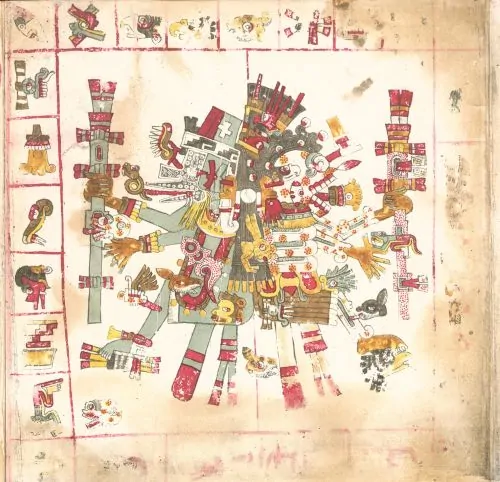
The 1,600 gods who emerged from the celestial tecpatl entered an earth that was sacred but socially incomplete. They possessed divine identities and powers, yet there were no human beings to acknowledge them, maintain their temples, offer them food, or preserve their names through ritual memory. In the account gathered by Andrés de Olmos and transmitted by Gerónimo de Mendieta and Juan de Torquemada, this absence is experienced as a genuine deprivation. The gods describe themselves as cast down and exiled, separated from the celestial mother whose flint offspring had carried them into the terrestrial world. Their first collective undertaking is consequently not the conquest of territory or the organization of a divine hierarchy but an attempt to establish relations with humanity. Divine existence on earth requires worshippers, just as future human existence will require rain, warmth, food, fertility, calendrical order, and protection supplied by the gods.
The exiles send Tlotli, the hawk, back to the celestial mother with a request for permission and the means to create human servants. Her reply does not simply grant them the power to speak humanity into existence. She reminds them that, had they been worthy to remain with her, they would not have suffered exile, and she directs them instead toward Mictlantecuhtli, the lord of the realm of the dead. From him they must obtain a bone or the ashes of those who had died before, place the recovered remains in a vessel, and sacrifice themselves over them. The gods’ desired servants can be created only from two substances that none of the exiles possesses independently: the residue of previous life guarded in the underworld and blood willingly released from divine bodies. Their mother’s instructions make death the indispensable material of renewed life and sacrifice the action that activates it. Humanity is not manufactured from untouched earth, nor does it arise solely through divine command. It emerges from remains, retrieval, bodily offering, and the joining of powers drawn from different regions of the cosmos. Even before human beings exist to make sacrifices, sacrifice has already become the condition of their existence.
Mictlantecuhtli’s role in this account is more complex than that of a malevolent being who hoards life out of spite. As lord of Mictlan, he possesses the bones and ashes because the underworld is the destination and repository of what previous beings have become. Death preserves the durable residue from which another generation can be formed, making Mictlan both a terminus and a reservoir. The dead cannot return unchanged because their remains must be removed, broken, gathered, combined with blood, and subjected to a new process of generation. The gods choose Xolotl to undertake the descent, warning him that Mictlantecuhtli is duplicitous and may regret surrendering the remains once they have left his hands. Xolotl secures a bone and ashes, then immediately flees rather than waiting for the underworld lord to reconsider. Mictlantecuhtli pursues him, and during the escape Xolotl falls, breaking the bone, described as approximately a fathom long, into pieces of unequal size. The fracture is used in the colonial account to explain why human beings vary in stature, another instance in which bodily difference arises from a primordial break rather than from deliberate manufacture according to a single ideal form. Xolotl collects what he can and brings the fragments to the waiting gods, who place them in a large vessel and draw blood from throughout their bodies. Four days later a boy emerges, and after the divine sacrifice is repeated, a girl appears four days afterward. Xolotl receives the children and nourishes them with the milk or sap of the thistle until they can become the progenitors of a multiplying humanity. The sequence once again transforms apparent failure into productive difference: the stolen bone is dropped and shattered, but its pieces still become the foundation of human life. Xolotl’s identity is particularly appropriate to this unstable passage, for he repeatedly appears in Nahua traditions at thresholds involving twins, deformity, descent, death, and transformation. He is neither an immaculate creator nor a triumphant conqueror of the underworld. He is the endangered carrier who preserves enough of the past to permit an imperfect and variable humanity to begin.
A related but distinct account in the Leyenda de los Soles assigns the underworld journey to Quetzalcoatl and gives the episode a more elaborate sequence of tests, deceptions, and transformations. After the gods ask who will inhabit the newly ordered earth, Quetzalcoatl descends to Mictlan and requests the “precious bones” guarded by Mictlantecuhtli and Mictlancihuatl. He is ordered to sound a conch shell that has no openings and to carry it around the underworld, but worms pierce the shell and bees enter it, enabling him to complete the impossible task. Mictlantecuhtli initially agrees to release the bones and then orders his servants to prevent their removal, whereupon Quetzalcoatl attempts to escape with the bones of men and women. He falls into a pit prepared for him, the bones scatter, and quail peck at them, accounting in this version for the diminished size of later humanity. Quetzalcoatl nevertheless carries the damaged remains to Tamoanchan, where Quilaztli, also identified with Cihuacoatl, grinds them and places them in a precious vessel. Quetzalcoatl sheds blood from his body over the ground bones, and the other gods perform penance so that human beings may be formed. The two narratives should not be collapsed into one supposedly original text, but their shared logic is unmistakable: humanity must be recovered from death, its ancestral substance is fractured during the passage, and divine blood supplies the force by which dead matter becomes living people.
These creation accounts make human dependence upon the gods primordial, but they also reveal divine dependence upon humanity. The gods desire servants before people exist, while the people come into being because the gods injure themselves and surrender part of their own vitality. Sacrifice begins not as an arbitrary tribute imposed by omnipotent beings but as an act the gods themselves perform to establish the relationship. Later human bloodletting and sacrifice could be interpreted as repayment of an inherited obligation, commonly expressed through the language of debt, service, and reciprocal nourishment. Yet reciprocity did not make the relationship equal, voluntary in every circumstance, or free from political coercion; it provided the cosmological vocabulary through which obligation could be understood and enforced. The tecpatl remains implicit within this exchange even when no knife is explicitly named in every version, because the divine blood that animates the bones must be released through opened bodies. The cosmic flint’s descent has initiated a complete circuit: a divine stone falls from heaven, gods emerge upon the earth, ancestral remains are carried upward from Mictlan, and blood passes from divine bodies into the substance of humanity. Human beings are born between heaven and the underworld, composed of the dead and animated by sacrifice. Their first condition is neither independence nor innocence but participation in a world of inherited life, divine need, and obligations that must be renewed.
The Cutting Sky
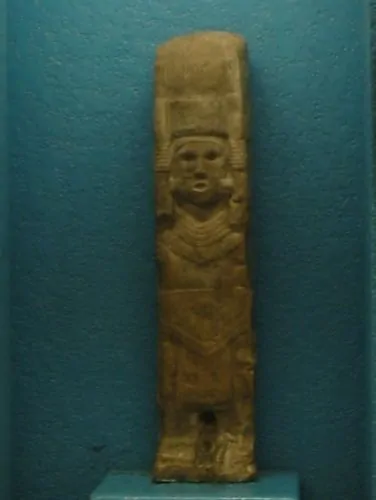
Flint presented Nahua observers with a material paradox: a stone that appeared cold and motionless could release sudden light when struck against an appropriate mineral or hard surface. Its conchoidal fracture produced an edge through a violent instant of separation, while the detached flakes flashed as they turned in the light. These properties encouraged connections among flint, sparks, stars, fire, weapon points, and the abrupt brilliance of lightning. The association was not based upon abstract symbolism alone, since the stone’s behavior provided a visible demonstration of energy concealed within apparently inert matter. Yet flint did not ordinarily burst into flame by itself, and fire making in Central Mexico relied heavily upon the friction drill rather than upon a simple collision of two pieces of stone. The sacred significance of tecpatl arose from a convergence of observed qualities and mythic interpretation rather than from one exclusive method of producing fire. What mattered was the broader proposition that stone could contain or reveal a fiery potency whose release required pressure, impact, friction, and rupture.
That proposition appears within traditions surrounding Mixcoatl, the Cloud Serpent, a deity whose domains included hunting, warfare, ancestral migration, fire, and the star-filled sky. The Historia de los mexicanos por sus pinturas recounts that the red Tezcatlipoca assumed the name Mixcoatl and produced fire from sticks, placing the invention of the fire drill within a sequence of cosmic transformations. The practical act of rotating one piece of wood against another became simultaneously an imitation of celestial movement, with friction converting ordered motion into heat and flame. Mixcoatl’s fire was consequently not detached from his identity as a hunter, for both fire making and hunting transformed substances concealed within the landscape into powers available for human use. The god who taught or embodied the production of fire also carried the bow, arrows, net, and other instruments through which animals were found, penetrated, killed, and converted into nourishment.
Mixcoatl’s name, usually translated as “Cloud Serpent,” joined the deity to a sky imagined as both atmospheric and animate. Clouds could move like enormous serpents, conceal the sources of rain, and suddenly produce thunder, lightning, hail, or destructive winds. His association with the Milky Way and stellar hunters further transformed the heavens into a vast field across which divine beings pursued, attacked, and sacrificed one another. The Mimixcoa, whose name also evokes cloud serpents, appear in several narratives as numerous celestial or ancestral hunters armed with bows and arrows. In the Leyenda de los Soles, the sun gives weapons to the Mimixcoa and commands them to obtain nourishment for him and for the earth, but the first group neglects its duty and abandons itself to intoxication and sexual pleasure. Five younger Mimixcoa, including Mixcoatl, then receive weapons and defeat their disobedient counterparts, whose deaths provide the sacrificial sustenance demanded by the sun. Hunting and sacrifice become structurally inseparable: the celestial target is pursued, struck, killed, and offered just as earthly game passes from living animal to distributed food. The arrow’s stone point performs at a distance what the tecpatl performs at the altar, piercing a protected surface so that the life within can be captured or released. Lightning could be understood through the same language of celestial penetration, resembling an incandescent dart cast from the clouds toward the earth. This does not mean that every Nahua source states literally that Mixcoatl shot lightning bolts or that every arrowhead was a miniature tecpatl. It means that clouds, serpents, stars, arrows, sparks, fire, and sharpened stone belonged to a shared field of images through which sudden heavenly power could be made intelligible.
The sky itself could consequently be imagined as something cut, pierced, or opened. Lightning divided darkness with a brilliant line, shooting stars crossed the heavens like discharged weapons, and solar rays extended outward as pointed or blade-like signs. Central Mexican manuscripts often made these relationships visible by giving divine weapons fiery curls, flint markings, eyes, teeth, or contrasting bands associated with tecpatl imagery. Such graphic combinations did not constitute a fixed code in which every pointed sign meant lightning, but they encouraged viewers to perceive resemblance among the knife, the fang, the ray, the arrowhead, and the descending bolt.
Fire also connected the tecpatl to warfare, for martial violence was repeatedly described through images of burning, smoking, and consuming heat. The Florentine Codex presents the xiuhcoatl, the turquoise or fire serpent, as a weapon through which Huitzilopochtli projected destructive force, while other traditions joined fire drills, fiery serpents, darts, and celestial weapons to the commencement of war. Although the xiuhcoatl was not identical to the tecpatl, both transformed concentrated divine energy into a penetrating action. One appeared as a serpent of fire cast against enemies; the other opened bodies and converted blood into an offering. Flint stood between these modes because it could form the point of a projectile, the blade of a ritual instrument, the sign of a calendrical date, and the material image of fire enclosed within stone. Its edge did not merely divide matter but exposed what had previously been hidden, whether a spark, a wound, blood, or the inner vitality of a sacrificial body. The claim that the sacred tecpatl “shot lightning” should be treated as a modern condensation of several related traditions rather than as the literal biography of a single magical knife. Its deeper meaning lies in the conceptual resemblance among actions: stone struck to reveal fire, an arrow released to pierce prey, lightning descending from a cloud, and a knife entering the body to release life. In each case, the world’s surface is opened by a sudden edge, and concealed power becomes visible through the wound.
The Weaponization of the Heavens
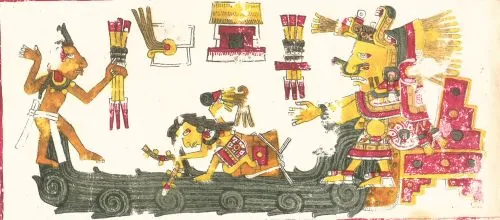
Mixcoatl was not a deity with one stable genealogy, appearance, and sphere of authority across every Central Mexican tradition. His name, conventionally translated as “Cloud Serpent,” connected him with the atmosphere, the Milky Way, hunting, warfare, ancestral migration, and the acquisition of fire, but particular communities emphasized different combinations of these powers. Mexica narratives sometimes identified him with the red Tezcatlipoca or described Tezcatlipoca assuming his name and functions, while Tlaxcalan and Huejotzincan traditions worshipped a closely related hunting and war deity called Camaxtli. Otomi, Chichimec, and other peoples of Central Mexico likewise claimed distinctive relationships with Mixcoatl or with gods who shared his weapons, bodily paint, and ritual calendar. He could appear as a primordial creator of hunters, the father of Quetzalcoatl, an ancestral conqueror, a slain ruler, or one member of a younger group of celestial warriors. These identities were not necessarily regarded as contradictions requiring theological resolution. They reveal a religious world in which divine names, ritual offices, ethnic memories, and historical figures could overlap, allowing Mixcoatl to personify both the dangerous sky and the mobile hunting peoples who understood themselves as having descended from it.
The Mimixcoa extended that identity from a singular Cloud Serpent into a numerous celestial population. Their collective name is commonly interpreted as the plural of Mixcoatl, making them “Cloud Serpents,” although colonial narratives also treated them as hunters, Chichimecs, ancestral warriors, or star-like beings. Some accounts speak of 400 Mimixcoa, using a conventional number for an immense host, while others concentrate upon five younger figures who oppose and defeat the larger group. Mixcoatl may be their creator, their leader, their brother, their surviving representative, or their most prominent embodiment, depending upon the source being followed. The term consequently designated less a fixed divine family than a recurring category of beings joined by celestial origin, hunting weapons, sacrifice, and movement between the sky and the human world.
The Leyenda de los Soles provides the most elaborate surviving account of the conflict that transformed the Mimixcoa into sacrificial victims. Iztac Chalchiuhtlicue gives birth in a cave to 400 Mimixcoa and later produces five younger figures: Cuauhtlicoauh, Mixcoatl, Tlotepe, Apantecuhtli, and their sister Cuitlachcihuatl. After the children have passed through an initial period of concealment and nourishment, the sun distributes shields and richly feathered arrows to the elder host. These weapons are not presented as gifts for private hunting or ornaments of celestial rank. The sun commands the Mimixcoa to use them in his service and to provide drink and nourishment for both himself and the earth. Instead, the 400 pursue animals for their own consumption, become intoxicated on maguey drink, and sleep with women, withholding from the cosmic powers the prey their weapons were intended to obtain. Their failure is not simply laziness or sexual misconduct but a refusal of sacrificial reciprocity. The sun then arms the five younger Mimixcoa, who conceal themselves in a tree, upon the ground, within a mountain, in the water, and at the ballcourt before launching their attack. By defeating their elder counterparts, the younger hunters convert disobedient celestial warriors into the nourishment that those warriors had failed to supply. The first proper use of the weapons is directed not against animals alone but against armed beings who themselves become prey.
This narrative collapses the modern distinction among hunting, warfare, and sacrifice without making the three activities identical in every circumstance. The hunter stalked and pierced an animal, the warrior captured or killed an enemy, and the sacrificer opened a consecrated body, yet each action transferred life from one domain into another through pursuit, restraint, penetration, and distribution. Feathered arrows could be more than military equipment: they were extensions of solar command, material obligations placed in the hands of those expected to feed the sun and earth. The Mimixcoa became exemplary victims because their own weapons marked them simultaneously as hunters, warriors, servants of the sun, and potential offerings. Their defeat established a sacred warfare in which the boundary between predator and prey remained unstable, for anyone armed to obtain nourishment for the gods could also be transformed into that nourishment.
The celestial battle did not remain confined to a remote age of divine origins. During the month of Quecholli, Central Mexican communities renewed the complex of Mixcoatl through fasting, the manufacture of arrows, ritual hunting, processions into the countryside, the sacrifice of game, and the killing of human victims identified with the Mimixcoa. Sahagún’s account describes hunters preparing arrows and cords before traveling toward the mountain, where deer, rabbits, coyotes, and other animals were driven together and killed. The hunt organized participants into a temporary martial community whose movements reproduced the pursuit of celestial prey. Human captives associated with Mixcoatl were subsequently sacrificed, joining animal death to the political economy of warfare and tribute. The ritual did not suggest that deer and captives were interchangeable in every respect, but it placed both within a sacrificial sequence governed by pursuit, capture, opened bodies, and offerings to divine powers. Mixcoatl’s striped body paint, black eye mask, hunting net, bow, and arrows made the god recognizable while also supplying insignia that priests, impersonators, and sacrificial victims could assume. Through costume and action, terrestrial participants entered the identities of celestial hunters and reenacted the moment when the Mimixcoa were divided into those who fulfilled the sun’s demand and those who became its food. The weaponization of the heavens provided a model for organizing earthly violence, transforming successful hunting and warfare into signs that cosmic obligations were being met.
The tecpatl belonged to this celestial armory even when the narratives placed arrows rather than knives in the hands of Mixcoatl. Flint formed projectile points as well as ritual blades, allowing the same substance to pierce prey from a distance and open an offering at close range. Stars could be imagined as warriors, shooting stars as discharged weapons, clouds as serpentine beings, and the Milky Way as the path or body of a divine hunter crossing the night. Lightning intensified this network of resemblance because it descended suddenly, cut through darkness, struck the earth, and seemed to reveal the fiery violence concealed within the sky. Yet the surviving sources do not present Mixcoatl as the owner of one named magical tecpatl that consistently fires literal bolts of lightning. What they preserve is more extensive and more revealing: a cosmology in which the heavens were armed, celestial beings hunted and sacrificed one another, and sharpened stone mediated the conversion of living bodies into sustenance. The sacred knife inherited its cosmic force from this wider system of arrows, sparks, rays, wounds, and divine appetites, becoming the terrestrial edge of a warfare already unfolding among the stars.
Itzpapalotl and the Colored Flints
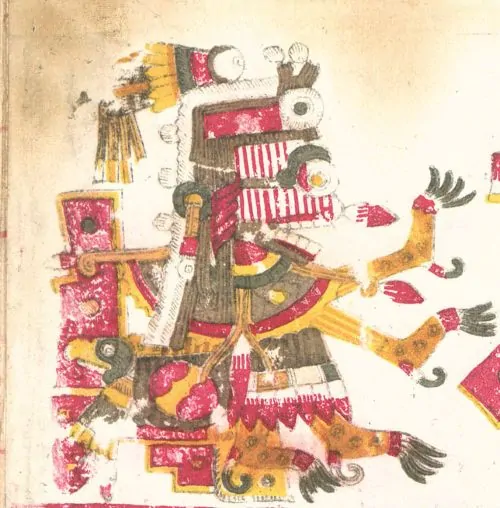
Itzpapalotl, conventionally translated as “Obsidian Butterfly,” joined qualities that modern classifications tend to separate: beauty and terror, maternity and predation, flight and stone, celestial radiance and underworld danger. In the divinatory manuscripts she may appear with skeletal features, jaguar-like claws, and wings edged by pointed forms resembling obsidian or flint blades. She was associated with Tamoanchan, ancestral Chichimec traditions, sacrifice, fire, and the dangerous stellar beings commonly called tzitzimime. Her relationship to Mixcoatl was similarly variable, for different traditions could present her as his mother, ancestor, enemy, victim, or the divine substance he carried after her death. She was not merely another goddess who happened to possess a stone knife as an attribute. Her body itself occupied the unstable boundary between animate deity and sharpened mineral.
The Leyenda de los Soles places Itzpapalotl within the violent mythic history of the Mimixcoa. Two surviving Cloud Serpents, Xiuhnel and Mimich, encounter two two-headed deer who temporarily assume the forms of women, one of whom is identified as Itzpapalotl. She offers Xiuhnel blood to drink, seduces him, and then suddenly devours him by tearing open his breast, reversing the expected relationship between hunter and prey. Mimich escapes and takes refuge within a thorny barrel cactus, but Itzpapalotl throws herself after him and becomes vulnerable to attack. Mimich emerges, shoots her repeatedly, and calls upon the dead Mimixcoa, who appear and join in the assault. In related Chichimec traditions, Itzpapalotl has consumed or overcome a large company of Mimixcoa before the surviving Iztac Mixcoatl engineers her defeat. The goddess who opened and consumed the body of a celestial hunter is consequently pierced by the weapons of those hunters and transformed into the victim of the sacrificial structure she had previously enacted. Her death does not remove her from the sacred order because defeat becomes the preliminary stage of a new divine manifestation.
After Itzpapalotl is killed, her body is burned, and the fire produces a succession of colored flints. The first to emerge is described as blue or turquoise-colored, followed by white, yellow, red, and black stones. The participants take the white flint and wrap it, while the others are observed but left where they appear. Mixcoatl then venerates the wrapped white stone as a god and carries it upon his back when he goes to war at Comallan. The episode does not depict cremation as the annihilation of the goddess. Fire separates her composite body into multiple sacred substances, one of which becomes a portable embodiment through which her power continues to accompany a warrior.
The five flints have often been interpreted through the directional color system widely attested in Mesoamerican cosmology. Red could correspond to the east, black to the north, white to the west, and yellow or blue-green to the south or center, although the assignments varied among sources and ritual contexts. Their sequence may express the distribution of Itzpapalotl’s body through the ordered spaces of the cosmos rather than the accidental production of stones in several decorative colors. But the account should not be forced into a rigid directional diagram that its text does not explicitly provide. Color in Central Mexican thought could simultaneously mark direction, substance, heat, rank, deity, bodily condition, and ritual function. Blue-green evoked preciousness, water, fire, turquoise, and celestial value; white could suggest bone, brilliance, dawn, flint, or ancestral purity; yellow could recall maize, ripeness, dryness, skin, and solar heat; red could signify blood, fire, dawn, and sacrificial vitality; black could invoke obsidian, night, smoke, death, and the northern realm. The burning goddess becomes a spectrum of sacred possibilities rather than one homogeneous relic. Her transformation resembles other Nahua narratives in which a divine body is dismembered, burned, or broken and its parts become stars, stones, plants, ritual insignia, or features of the landscape. Destruction releases distinctions previously gathered within a single being, allowing divine potency to be redistributed without being extinguished. The colored flints are both remnants and new bodies: products of Itzpapalotl’s death that remain capable of carrying her identity into later ritual and warfare.
The selection of the white flint is significant because it becomes a tlaquimilolli, a wrapped sacred bundle, rather than an exposed weapon immediately placed in Mixcoatl’s hand. Wrapping concealed the stone while simultaneously giving its dispersed sacred associations a coherent social body that could be carried, protected, worshipped, and transmitted. Mixcoatl did not merely take a useful piece of flint from the ashes; he assumed responsibility for a divine presence produced from the defeated goddess. The text even preserves the paradox that he travels carrying his flint god, Itzpapalotl, so that the conquered enemy becomes a source of martial legitimacy and power. This transformation should not be simplified into the claim that Itzpapalotl permanently “became Mixcoatl’s magical knife,” since the white flint functions as relic, bundle, deity embodiment, ancestral power, and possible weapon without being reducible to any one category. The episode instead reveals a recurring Nahua principle: gods could survive defeat by changing material form, and the remains of a sacrificed body could become more politically and ritually potent than the intact being had been. In the colored flints, the tecpatl appears not only as the instrument that divides bodies but as the sacred body created by division.
Teotihuacan and the Sacrificial Birth of the Sun
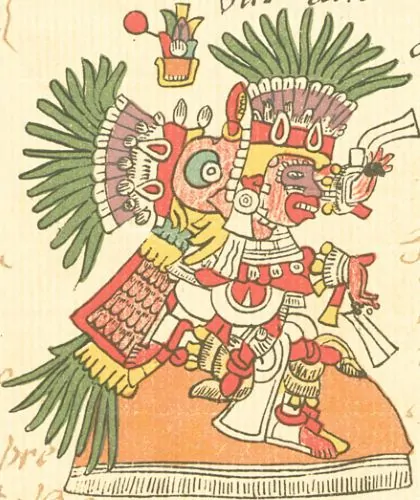
In later Nahua memory, Teotihuacan was not merely the monumental ruin of an ancient city but the place where the present sun and moon had been made. The historical metropolis had flourished and declined centuries before the rise of Tenochtitlan, leaving the Mexica to encounter pyramids, avenues, temples, and compounds whose builders belonged to a remote and only partially recoverable past. Rather than regard those ruins as meaningless debris, Nahua tradition placed them within sacred history as the setting for the transition from cosmic darkness to the age of the Fifth Sun. The gods gathered there while the world remained without light and asked which among them would assume the burden of illuminating it. Teotihuacan consequently became a threshold between completed creations and a world not yet capable of sustaining ordinary life. Its monuments were interpreted through a story of divine assembly, penitence, fire, death, and celestial emergence. The city’s sacred importance rested not simply upon the appearance of a sun but upon the proposition that even the gods could create an ordered cosmos only by sacrificing themselves.
Two deities were chosen to approach the divine hearth. Tecuciztecatl, wealthy, confident, and magnificently equipped, volunteered first, while the assembled gods selected the impoverished and afflicted Nanahuatzin when no second candidate stepped forward. For four days both performed penitential rites upon separate heights, but the contrast between their offerings revealed the moral structure of the contest. Tecuciztecatl presented precious feathers, gold, coral, and costly substances, while Nanahuatzin offered humble reeds, balls of grass, maguey spines marked with his own blood, and the scabs of his diseased body. Material splendor did not guarantee courage. When the moment arrived, Tecuciztecatl advanced toward the flames four times and retreated from their unbearable heat. Nanahuatzin closed his eyes, mastered his fear, and cast himself directly into the fire. Shamed by the humble god’s resolve, Tecuciztecatl followed him into the blaze. An eagle and a jaguar also entered or approached the pyre in the Florentine Codex account, receiving the scorched markings that later identified them with the most prestigious warrior orders. The birth of the sun was inseparable from the exemplary courage expected of warriors who accepted suffering, crossed the boundary of fear, and offered their bodies for a purpose larger than themselves.
After a prolonged period of waiting, the gods turned in different directions to discover where the new light would appear. Nanahuatzin rose first in the east as a radiant sun, followed by Tecuciztecatl, whose own brilliance initially equaled that of his companion. The presence of two identical suns threatened the distinctions required for cosmic order, so one of the gods struck Tecuciztecatl’s face with a rabbit and diminished his light, transforming him into the moon. The lunar rabbit preserved the mark of that reduction while also commemorating the failed precedence of the wealthy volunteer. Solar authority belonged not to the deity who possessed the most valuable offerings or first claimed the honor, but to the one whose self-surrender proved complete.
Light alone did not make the world habitable. The newly emerged sun and moon remained stationary at the edge of the sky, shining without beginning the ordered courses by which days, nights, seasons, and calendrical time could unfold. The gods understood that another sacrifice was required, and the Florentine Codex assigns Ehecatl, the wind aspect of Quetzalcoatl, the task of killing them. Most accept the necessity of death, but Xolotl attempts to escape by changing himself successively into a double maize stalk, a double maguey plant, and the aquatic creature later called the axolotl. Each disguise fails, and he too is finally killed. Ehecatl then directs his wind against the sun, whose movement begins only after divine blood has been released and the force of air has been applied. Other accounts arrange the crisis differently. In the Leyenda de los Soles, Tlahuizcalpantecuhtli, the Lord of the Dawn, shoots a dart at the newly born sun and misses, after which the sun shoots back and strikes him, while Mendieta describes gods killing themselves after the defeat of their companion. These versions should not be combined into a single artificial sequence in which every deity dies by precisely the same procedure. They agree instead upon the structural point that celestial emergence remains incomplete until resistance, stillness, and divine bodily integrity have been overcome. Fire produces the luminous bodies, sacrifice supplies the vitality of motion, and wind converts that released power into the journey of the sun across the heavens.
The tecpatl is not named with equal explicitness in every surviving version of the Teotihuacan narrative. Nanahuatzin and Tecuciztecatl enter the fire voluntarily, and the deaths of the remaining gods may be described as self-sacrifice, killing by Ehecatl, mutual destruction, or defeat by solar weapons. It would be misleading to insert one personified cosmic knife into every stage of the myth and claim that it alone creates the sun. Yet the tecpatl belongs unmistakably to the sacrificial logic through which divine bodies are opened, destroyed, and converted into celestial movement. Where a god must kill other gods, the ritual blade supplies a culturally intelligible means by which bodily integrity gives way to released vitality. Its conceptual role is more important than the reconstruction of a single imagined procedure: like the pyre, dart, and cutting wind, the knife transforms a bounded body into energy capable of sustaining a larger order.
The Teotihuacan creation establishes a twofold sacrifice rather than one isolated heroic death. Nanahuatzin’s self-immolation creates radiance, but the collective death of the gods makes that radiance move and thereby produces meaningful time. Human sacrifice did not literally recreate the sun from nothing at every ceremony, nor did Nahua worshippers necessarily believe that one missed offering would cause the immediate collapse of the heavens. Ritual nevertheless returned human communities to the divine precedent upon which the present age depended. The gods had burned, bled, and died before demanding offerings from humanity, making their own bodies the first payment toward the continuity of the world. Later bloodletting, captive sacrifice, warfare, and New Fire ceremonies could be understood as renewals of an obligation established at creation rather than arbitrary efforts to appease insatiable beings. This cosmology could also serve political institutions by presenting the acquisition and sacrifice of captives as participation in the work first undertaken by the gods, but political usefulness did not exhaust its religious significance. At Teotihuacan, death becomes the condition of sunrise, and the tecpatl takes its place among the instruments through which stationary brilliance is transformed into the living motion of the cosmos.
Celestial Movement: The Knife and the Sun
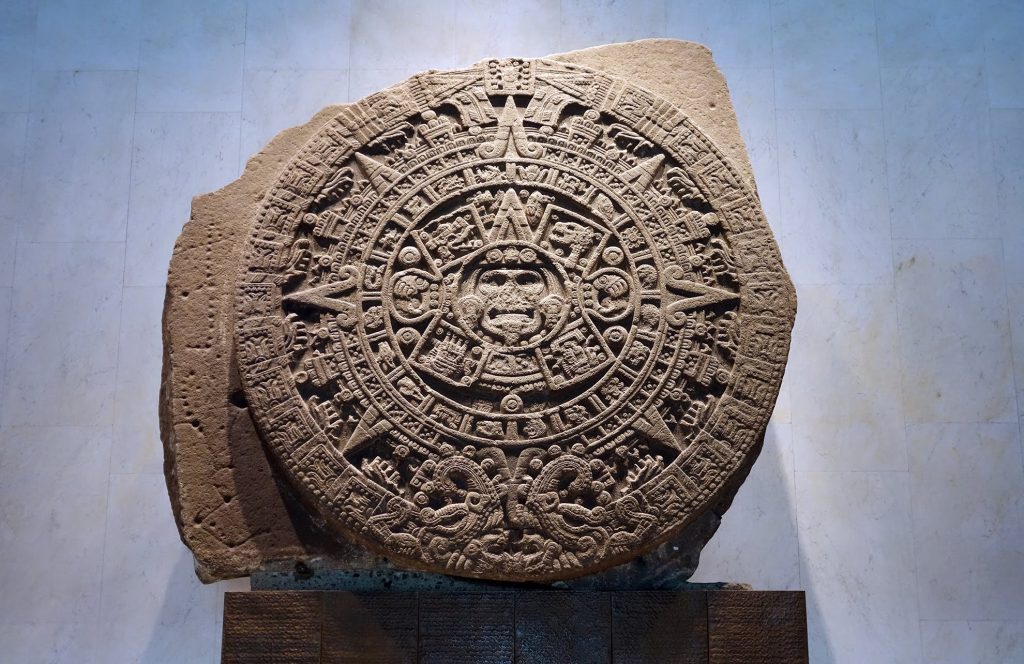
The most concentrated visual union of tecpatl and solar power appears at the center of the monumental sculpture commonly called the Sun Stone. Within the great sign Nahui Ollin, or Four Movement, a frontal face projects a flint knife from its open mouth while clawed hands grasp human hearts on either side. The knife is unmistakably shaped as a tongue, making speech, appetite, cutting, and sacrifice converge within a single organ. Around this central image appear the signs of previous cosmic eras, the twenty day signs, solar rays, calendrical dates, and the bodies of enormous fire serpents. The monument is more than a device for calculating days, just as the central tecpatl is more than an identifying attribute attached to a solar portrait. Its concentric design presents cosmic time as an ordered but vulnerable structure centered upon a being that gives light while demanding nourishment. At the monument’s heart, the present age is imagined through movement, and movement is joined visually to a mouth armed for sacrifice. The identity of that central face has generated one of the most persistent debates in Mexica iconography. It was long identified straightforwardly as Tonatiuh, the sun god, whose placement within Four Movement would represent the sun governing the present creation. Other scholars have emphasized features associated with Tlaltecuhtli, the earth deity or earth monster, including the open mouth, clawed extremities, and consuming relationship to hearts and bodies. Still others have proposed Yohualtecuhtli, the Lord of the Night, or a deliberately composite figure joining solar, terrestrial, nocturnal, and sacrificial powers. More recent interpretations have even explored the possibility that royal identity was incorporated into the central image, making the cosmic face simultaneously an idealized representation of Mexica rulership. None of these proposals makes the tecpatl tongue irrelevant; rather, the blade helps explain why the image can move between categories, since both sun and earth were life-giving powers sustained through the receipt of sacrificial vitality.
The transformation of the tongue into a knife gives bodily form to the sun’s hunger. Tongues normally communicate through speech, taste food, and emerge from the interior of the mouth, but the tecpatl tongue projects outward as an edge capable of entering another body. It reverses the ordinary movement of eating: instead of passively receiving nourishment, the mouth extends a weapon toward the offering. The two hearts held in clawed hands reinforce this appetite, yet the imagery should not be reduced to a crude picture of a monster literally chewing human organs. Hearts and blood were concentrated carriers of life, heat, courage, identity, and sacrificial value, making their presentation a transfer of vital substance rather than ordinary consumption. Nahua descriptions regularly speak of gods being fed, given drink, or provided with offerings, but divine nourishment operated across several registers at once. Burned offerings became smoke, blood entered the earth, hearts were lifted toward the sun, and ritual speech formally identified what was being transferred and to whom it belonged. The knife-shaped tongue gathers these movements into one image: it names the appetite, opens the source of nourishment, and becomes the channel through which interior vitality enters cosmic circulation. Its pointed form can also resemble a ray or dart, linking the sun’s outgoing force to the cutting implement that brings sustenance back toward it.
The placement of this hungry face within the sign Four Movement makes sacrifice inseparable from celestial motion. The four surrounding compartments recall the previous suns and the catastrophes that ended them, while the central age is expected to perish through movement or earthquake. Beyond them, the ring of twenty day signs converts recurring time into a visible circuit, and the enclosing fire serpents bind solar heat, rulership, warfare, and calendrical completion together. The monument presents motion not as an automatic property of nature but as a precarious achievement established by divine sacrifice and maintained through ritual action. Just as the gods at Teotihuacan had to die before the newborn sun would move, the flint tongue announces that continued solar passage remains bound to opened bodies and transferred life.
The central tecpatl also exposes the reciprocity underlying the sun’s apparent contradiction. Solar heat ripened maize, warmed bodies, marked the sequence of days, governed agricultural labor, and made the visible world possible, yet the sun itself could be portrayed as vulnerable to exhaustion and dependent upon nourishment. The earth followed a comparable pattern, producing crops while receiving seeds, rain, blood, corpses, and offerings through openings in its surface. This parallel helps explain why a central face combining solar and terrestrial characteristics may have been meaningful rather than iconographically confused. The monument’s ambiguity allows the same mouth to belong to the sun above, the earth below, and the political order that claimed responsibility for sustaining communication between them. Its knife tongue is consequently both threatening and generative: it announces the capacity to consume, but it also represents the cut through which offerings become effective. Positioned at the center of ordered time, the tecpatl marks the boundary where divine speech becomes command, hunger becomes ritual obligation, and sacrificial death becomes celestial movement. The sun does not merely shine upon the knife; through the tongue of flint, the sun itself becomes an edge.
Tecpatl in the Tonalpohualli: Cutting and Ordering Time
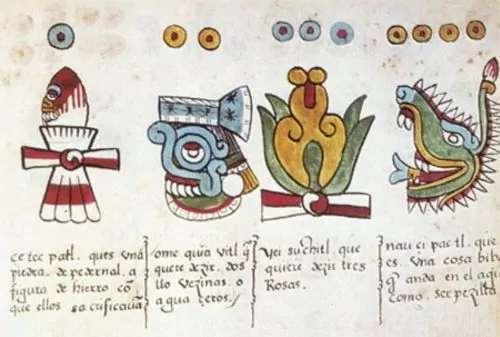
The tonalpohualli, or “count of the days,” organized time through the continuous interaction of twenty named signs with a sequence of thirteen numbers. Because the two sequences advanced together but contained different totals, each combination recurred only after 260 days. Tecpatl occupied the eighteenth position among the twenty day signs, following Ollin, Movement, and preceding Quiyahuitl, Rain. It returned with a different numeral every twenty days until all thirteen possible numerical combinations had occurred. The resulting dates were not interchangeable units placed within an empty chronology. Each possessed a distinctive configuration of names, numbers, divine patrons, directional associations, and accumulated ritual meanings that could influence how an event was interpreted.
A person born on a Tecpatl day did not simply inherit the character of a knife in the manner of a modern astrological stereotype. The day sign contributed one influence among several, including its numeral, the ruling deity of the day, the lord of the night, the trecena in which it occurred, and other calendrical sequences consulted by a trained diviner. Chalchiuhtotolin, the “Jade Turkey” or “Precious Turkey,” was closely associated with Tecpatl as a patron of the day sign in several pictorial traditions. This deity, often treated as a manifestation or companion of Tezcatlipoca, joined contamination, sorcery, punishment, disease, confession, and purification. Tecpatl could consequently suggest danger and judgment while also carrying the possibility that corruption might be exposed, cut away, or transformed.
When combined with the numeral one, Tecpatl named the tenth trecena of the 260-day cycle. The thirteen-day period Ce Tecpatl, One Flint, was represented under the patronage of Tonatiuh and Mictlantecuhtli in important Central Mexican manuscripts, bringing the sun and the lord of the dead into a deliberately tense conjunction. In the Codex Borbonicus, Tonatiuh presides over the trecena while carrying solar regalia and imagery that also points toward decline, death, and the sun’s nightly passage into the underworld. In the Codex Borgia, Mictlantecuhtli occupies a prominent place within the corresponding composition, emphasizing the proximity of sacrificial vitality to death. These were not contradictory patronages so much as complementary dimensions of a single cosmic movement. The sun rose through heat and brilliance, crossed the ordered sky, and then descended toward the region of the dead before returning again. Flint belonged naturally to this cycle because its edge released the blood associated with solar nourishment while its cold stone and skeletal imagery connected it to death. Sahagún’s informants described One Flint as a favorable sign associated with Huitzilopochtli and Camaxtli, under which men were expected to become courageous and successful in warfare and women were thought capable, prosperous, and forceful. A festival was held for Huitzilopochtli at the beginning of the period, and all thirteen days could be described as fortunate. Such testimony warns against assigning Tecpatl a uniformly ominous meaning merely because knives, blood, and death appear within its imagery.
Calendrical prognostication operated through combinations rather than a simple opposition between lucky and unlucky signs. A potentially favorable day might be modified by an adverse numeral, a dangerous lord of the night, or the larger trecena in which it fell. Conversely, a sign associated with death, cutting, or punishment could become productive when used for warfare, purification, naming, or the commencement of an appropriate ritual undertaking. Diviners interpreted time much as readers interpreted pictorial manuscripts: by examining the relationship among multiple signs rather than isolating one image from its surrounding composition. The tecpatl did not dictate events mechanically, but it identified the particular qualities, risks, and possibilities present within a moment.
Tecpatl also extended from the 260-day count into the naming of years. In the Central Mexican system, only four day signs (Calli, House; Tochtli, Rabbit; Acatl, Reed; and Tecpatl, Flint) served as year bearers, each combining successively with the numbers one through thirteen. The complete sequence produced fifty-two named years before the same sign and number returned, forming the calendrical bundle commonly known as the Binding of the Years. Tecpatl years marked one quarter of the larger cycle and were often associated with the north within directional arrangements of the four year bearers. Yet the meaning of a particular Flint year depended upon its numeral and historical context rather than upon the sign alone. One Flint, Two Flint, or Thirteen Flint were distinct dates, capable of identifying accessions, migrations, conquests, temple dedications, births, deaths, or remembered cosmic events. The year name transformed the knife from a ritual object into a public chronological marker under which an entire community located its history.
Tecpatl’s calendrical role reveals that cutting was not confined to the opening of bodies. The tonalpohualli divided the uninterrupted passage of existence into named and qualitatively different moments, giving each day an edge that separated it from what preceded and followed. Numbers cut across signs, signs crossed trecenas, trecenas passed through years, and the year bearers gathered historical experience into the fifty-two-year cycle. A person could carry Tecpatl as a birth date or personal name, while a polity could remember an event as having occurred under a Flint year. The same pointed glyph that marked a blade also distinguished moments within ritual books and historical annals. The tecpatl ordered time by performing conceptually what the physical knife performed materially: it created meaningful difference through division.
The Obsidian Complex

Within many Central Mexican cosmological arrangements, Tecpatl belonged to the north, but “north” signified more than a point on a geographical compass. It could evoke Mictlan, coldness, aridity, darkness, hunting territories, ancestral migrations, and the mobile Chichimec peoples from whom rulers traced prestigious origins. The association was not completely uniform, since colors, year bearers, gods, and directions could be rearranged according to the calendrical or ritual construct represented in a particular manuscript. Nevertheless, Flint repeatedly occupied the northern quarter in diagrams of the four year signs, joining the sharpened stone to a region imagined as both deadly and generative. The north contained the road of the dead, yet it was also the direction from which ancestors, hunters, warriors, and founding peoples entered the Central Mexican world. Its darkness was not simple nonexistence, and its coldness was not merely the opposite of life. Like the cave and the underworld, it preserved powers capable of returning in altered forms.
Mixcoatl helped join this northern complex to the tecpatl. His identity as a hunter, Cloud Serpent, celestial warrior, and ancestral leader connected the starry sky with the dry landscapes remembered as the homeland of Chichimec peoples. Flint arrowheads, fire drills, sacrificial victims, and sacred bundles accompanied the narratives through which those peoples transformed wandering into legitimate ancestry. The northern hunter did not stand outside civilization as its absolute opposite; his austerity and martial ability could become sources of dynastic authority within settled states. Tecpatl consequently marked a dangerous frontier where death, mobility, and ancestral potency entered the political center.
Obsidian introduced another range of meanings into this northern and nocturnal field. Unlike pale flint, black obsidian could absorb the surrounding light while returning a dark and unstable reflection from its polished surface. The same material could be fractured into nearly transparent blades, shaped into weapons, ground into ornaments, or polished into circular mirrors. These transformations allowed itztli to unite concealment and revelation: the stone was dark, yet it permitted vision; it reflected the observer, yet its depth seemed to open beyond the ordinary surface of the world. Obsidian mirrors were used in divinatory and ritual practices through which hidden causes, distant events, illnesses, enemies, or possible futures might be sought. The mirror did not function simply as a window offering objective information. It was an instrument of dangerous encounter whose images depended upon trained interpretation, ritual preparation, and the powers believed to become present within its dark surface. Smoke strengthened that ambiguity by both revealing and obscuring, rising from fire while veiling whatever lay behind it. Obsidian, smoke, night, and divination converged around the possibility that true knowledge might emerge from darkness rather than from uncomplicated illumination.
No deity embodied that convergence more completely than Tezcatlipoca, the “Smoking Mirror.” In pictorial manuscripts, circular mirrors could appear at his temple, upon his chest, or in place of the foot lost during the creation of the earth. Smoke or flame curls emerging from the disk transformed the object into a readable image of the god’s name while also declaring his capacity to perceive what others could not. Tezcatlipoca watched human conduct, disclosed concealed wrongdoing, distributed fortune and disgrace, tested rulers, encouraged conflict, and overturned identities that had appeared secure. His mirror was connected not merely with prophecy but with the instability of social and cosmic position. A king might rise because Tezcatlipoca favored him and fall because the same god withdrew that favor. The dark stone that returned a person’s image also exposed the possibility that rank, beauty, virtue, and power were temporary surfaces vulnerable to reversal.
Other divine figures demonstrate why the obsidian complex should not be reduced to Tezcatlipoca alone. Itztli, whose name means “Obsidian,” belonged among the Nine Lords of the Night and could be represented as an anthropomorphized blade, sometimes in a form visually difficult to distinguish from tecpatl. Itztlacoliuhqui, often translated as “Curved Obsidian Blade,” combined sharpened stone with coldness, frost, blindness, punishment, and the hard consequences of transgression. In the Leyenda de los Soles, Tlahuizcalpantecuhtli, the Lord of the Dawn, shoots unsuccessfully at the newly created sun and is struck in return, after which he assumes the identity of Itztlacoliuhqui. The brilliant weapon of Venus is transformed through defeat into a cold, bent, and darkened stone, making punishment itself a change of substance and bodily condition. Itztlacoliuhqui was also linked with Ixquimilli, the “Eye Bundle,” whose covered or blinded eyes expressed a form of perception radically different from ordinary sight. Blindness here did not necessarily mean ignorance; concealment could indicate judicial impartiality, invisible power, or vision redirected away from the apparent world. These figures overlapped with Tezcatlipoca through obsidian, darkness, fate, and correction, but they retained distinct calendrical positions and iconographic combinations. Their relationships are best understood as a network of shared attributes rather than evidence for one universal god of black stone.
The tecpatl stood at the edge of this network because flint and obsidian remained materially distinct while repeatedly exchanging graphic and sacred qualities. A personified Itztli might appear in the form of a flint knife, and a tecpatl sign could enter compositions dominated by Tezcatlipoca, Xipe Totec, death gods, or nocturnal powers. Both stones produced wounds, formed divine faces, and marked the threshold between a body’s surface and the hidden forces within it. Yet flint emphasized sparks, lightning, and fire emerging from stone, whereas obsidian intensified blackness, reflection, smoke, secrecy, and dangerous vision. Their convergence did not erase these differences; it made the sacred blade capable of moving among them. In the northern obsidian complex, the knife became more than an instrument of physical death: it was the edge between visible and concealed worlds, the cold stone through which judgment arrived, and the dark surface in which uncertain destiny revealed itself.
The Tecpatl as Consuming Being
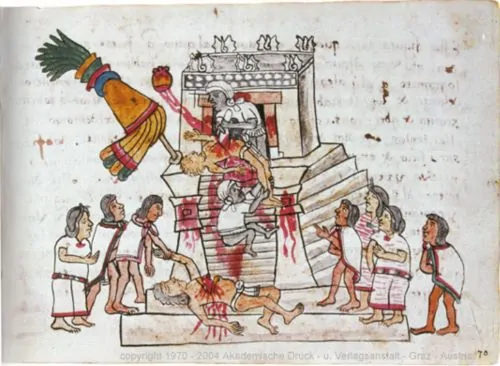
When Central Mexican artists gave the tecpatl an eye, mouth, or row of teeth, they did more than impose a human face upon an inanimate tool. The additions drew attention to capacities already latent in the blade: it could perceive a victim, penetrate a body, divide flesh, and participate in the transfer of blood. Some pictorial examples contain only a single eye embedded within the flint sign, while others develop the blade into a complete profile with gums, fangs, lips, facial paint, limbs, or deity costume. The resulting form remains visibly a knife even as it becomes an actor capable of looking, biting, drinking, or receiving identity. This instability was central to its effectiveness as an image. A tecpatl did not need to cease being stone to acquire the properties of a face, just as a deity did not need to possess one fixed body in every representation. The blade could function at once as material substance, ritual instrument, calendrical sign, divine attribute, and the body of the power that wielded it.
The relationship between knife and tooth was direct because both were hard projecting forms used to cut, tear, and expose what lay beneath a surface. A mouth armed with flint-like teeth transformed consumption into a visible act of bodily division, while a knife furnished with teeth implied that the implement itself could devour. The sharpened edges of the tecpatl became an extended jaw, and the mouth became a living sheath of blades. Such imagery did not require Nahua viewers to decide whether the knife merely resembled a tooth or whether the tooth was conceptually a knife. Their equivalence arose from shared action: each crossed the boundary between exterior and interior through pressure, rupture, and penetration.
Excavated offerings demonstrate that this graphic principle was translated into carefully constructed objects. At the Templo Mayor, flint knives were provided with applied eyes, teeth, masks, pectorals, weapons, ornaments, pigments, and bases of copal, turning worked stone into figures with recognizable social and divine identities. Eleven “knife-faces” from Offering 123 carried shell pieces arranged as eyes and teeth, while other deposits contained blades dressed as dead warriors, stellar combatants, elite figures, or named gods such as Ehecatl-Quetzalcoatl. Some were accompanied by miniature darts, spear-throwers, shields, obsidian clubs, pendants, and martial insignia, so their personification extended well beyond the attachment of a generic face. Their identities depended upon combinations of attributes, location within the deposit, orientation, material, and relationship to animals or human remains placed nearby. A knife situated beside an eagle in an upper layer did not necessarily signify the same being as one placed with a wolf among marine materials representing the watery underworld. The offering functioned as a composed ritual scene in which blades could stand for warriors, deities, mountains, dead persons, or supernatural agents. These objects were not ornaments added to a sacrifice after its essential meaning had already been determined. Their assembly and placement created the relationships through which the buried offering became a reduced but active model of the cosmos.
The mouth of the tecpatl also belonged to a wider Mesoamerican imagery of cosmic consumption. Earth deities were frequently represented with open jaws, fangs, claws, and bodies positioned to receive blood, corpses, seeds, rain, and offerings. Caves could be pictured as mouths leading into the earth’s interior, while temple openings, ritual cavities, and offering boxes created constructed entrances through which valuable substances passed into hidden sacred space. The earth consumed the dead but also produced maize, water, plants, and renewed life, making its appetite generative as well as destructive. A toothed knife participated in the same cycle on a smaller scale: it opened the offering so that the earth and gods could receive what had been enclosed within the body.
Tongue imagery intensified this connection because the tongue joined speech, taste, bloodletting, appetite, and projection from the body’s interior. A tecpatl placed in a deity’s mouth could be a tongue demanding nourishment, but it could also resemble the cutting speech through which commands, prophecies, names, and ritual formulas became effective. Xipe Totec was sometimes represented not merely carrying flint knives but with the knife form embracing or replacing his face, while other anthropomorphized blades combined flayed skin, hanging mouths, empty eyes, maize symbolism, and sacrificial attributes. The deity could consequently appear as both victim and sacrificer, the body opened and the edge that opened it. This double role helps explain why the consuming knife should not be imagined as an independently bloodthirsty monster. Its appetite expressed a larger process in which gods, humans, sun, and earth received life through substances released from other bodies. The mouth consumed, but consumption redistributed vitality rather than simply eliminating it. By giving the tecpatl eyes, teeth, and tongue, Nahua artists made visible the agency of the cut itself: the sacred edge saw its target, entered the body, drank what emerged, and transformed destruction into an exchange among worlds.
From Quarry to Temple: Making a Sacred Knife
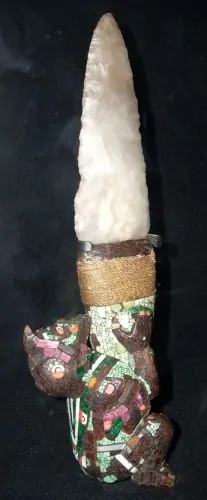
A tecpatl began not at the altar but within a landscape of stone. Flint and chert could be obtained from deposits distributed across Central Mexico, while obsidian came from volcanic sources whose differing colors and chemical compositions allow archaeologists to reconstruct patterns of extraction and exchange. The Sierra de Pachuca supplied the celebrated green obsidian favored for many elite objects, but material also circulated from Otumba, Tulancingo, Ucareo-Zináparo, and other sources beyond the Basin of Mexico. Stone might travel as raw nodules, partly reduced blocks, prepared cores, finished blades, or reusable fragments, depending upon its quality, distance from the source, and intended function. These movements connected quarry workers and provincial communities with merchants, market institutions, tributary authorities, urban workshops, and temple establishments. Flint was often less visually spectacular than green obsidian, yet its ability to hold a durable bifacial edge and produce sparks gave it practical and sacred value that could not be measured by rarity alone. The future knife entered ritual history before it acquired its final shape, because its substance already carried the geography, labor, and associations of the place from which it had been taken.
Producing a large bifacial knife required a sequence of controlled reductions rather than the accidental breaking of a stone. A knapper selected material free from disruptive flaws, established the general outline through percussion, thinned both faces by removing carefully directed flakes, and refined the edges and point through increasingly precise work. Every removal altered the angles available for the next, and a poorly placed blow could snap a nearly completed blade after considerable labor had already been invested. Pressure flaking allowed the maker to improve symmetry and sharpness, but unusually thin or elongated knives demanded technical judgment that cannot be recovered simply by looking at the finished object.
Obsidian prismatic blades were produced by a related but distinct technology. Specialists prepared cylindrical or conical cores from which long, narrow blades could be detached successively, creating standardized cutting tools whose edges were exceptionally sharp. Such blades served household, craft, medical, martial, and ritual purposes, and their abundance cautions against treating every sharp stone recovered from a ceremonial precinct as sacrificial equipment. The iconic leaf-shaped tecpatl, by contrast, was generally a biface whose two worked surfaces converged at sharpened edges and a penetrating point. Practical ritual knives had to balance sharpness with strength, since a blade too thin or brittle could fail under pressure, while a ceremonial offering intended for burial might privilege extraordinary size, symmetry, or delicacy over repeated use. Copper and bronze implements were known in Late Postclassic Mesoamerica, but the survival of stone knives did not represent technological backwardness or ignorance of metal. Flint and obsidian could produce cutting edges of remarkable effectiveness, and their established associations with divine bodies, calendrical signs, lightning, mirrors, death, and sacrifice made them irreplaceable within many ceremonies. The decision to fashion a sacred knife from stone was simultaneously technical and theological. Its material performed the work required of it while connecting that work to powers believed to reside in the earth, sky, and underworld.
The blade could then be hafted, wrapped, painted, or incorporated into a more elaborate composite body. A celebrated Late Postclassic example now in the British Museum combines a flint blade with a cedro-wood handle carved as a crouching eagle warrior. Turquoise, malachite, conch, thorny-oyster shell, and mother-of-pearl form the mosaic surface, while maguey fiber and plant resins secure the blade and its decoration. The object gathered stone, wood, shell, fiber, and minerals from widely separated environments into a single martial and ritual image, although its precise place of manufacture and cultural attribution remain uncertain. Its workmanship demonstrates that making a sacred knife could require cooperation among knappers, woodcarvers, mosaicists, adhesive specialists, and patrons able to acquire costly materials. The eagle warrior did not merely embellish the blade; the handle gave it a social and divine body, joining the cutting stone to solar warfare, elite military identity, and the capture of sacrificial victims.
No surviving source identifies one universal ceremony through which every newly made tecpatl became sacred. Some blades may have acquired special status through their material and form, while others were transformed by naming, dressing, incensing, blood contact, dedication, or placement within a temple offering. Archaeological deposits at the Templo Mayor contain knives standing upright in copal bases, furnished with shell eyes and teeth, equipped with miniature weapons, or positioned among animals, human remains, marine substances, and deity insignia. These arrangements indicate that sacred identity could be assembled after knapping through the object’s adornment, orientation, companions, and ritual destination. A knife capable of practical cutting might pass through several conditions during its existence: exchange commodity, workshop product, temple property, sacrificial instrument, personified divine image, and buried offering. Its deposition did not necessarily mark disposal in the modern sense, because burial could install the blade within a lasting cosmological arrangement beneath a structure. From quarry to temple, the tecpatl accumulated relationships until worked stone became something capable of representing a warrior, receiving offerings, opening a body, or embodying a god. The sacred knife was made more than once, first by removing stone, then by joining materials, and finally by placing the completed object within a network of ritual obligations that gave its edge a divine purpose.
The Sacrificial Knife in Ritual Practice

The tecpatl entered ritual practice within a sacrificial system far more varied than the single image of heart extraction usually associated with Mexica religion. Human beings could be killed by opening the chest, decapitation, burning, drowning, shooting with arrows, gladiatorial combat, or other procedures chosen according to the deity, festival, victim, and intended offering. Animals were likewise sacrificed, while blood drawn through autosacrifice made sacred cutting part of religious life beyond the comparatively exceptional killing of human victims. Each procedure carried its own sequence of preparation, costume, movement, ritual speech, music, and treatment of the body. The method of death was not an interchangeable means of producing a corpse but an element through which the offering was identified with a divine narrative or natural process. Children sacrificed to rain deities, captives offered to solar and martial powers, and impersonators killed after embodying particular gods did not occupy the same ritual category. The sacrificial knife was prominent but not universal, and even where it appeared, its significance depended upon the ceremony of which it formed one carefully ordered part.
The best-known use of the tecpatl occurred during the extraction and presentation of the heart. Colonial descriptions commonly place the victim upon a convex sacrificial stone called the techcatl, where several priestly assistants restrained the arms, legs, and head while the principal officiant opened the torso with a flint knife. The elevated shape of the stone exposed the chest and transformed the victim’s body into the central surface of a public ritual tableau. The sources differ in anatomical detail, and modern attempts to reconstruct one standard incision or surgical technique often claim more certainty than the evidence permits. What mattered ritually was that the chest was opened, the still-potent heart was removed, and the organ was raised toward the sun or presented before the image of the deity receiving the offering. Blood might then be placed upon a divine image, temple surface, sacred vessel, or other consecrated object, while the heart could be burned, deposited, or otherwise transferred according to the ceremony. The action required coordinated priestly labor rather than the isolated skill of one spectacular executioner. Assistants controlled the victim, officiants handled the offering, attendants managed incense and ritual equipment, and musicians, dancers, rulers, warriors, and gathered spectators established the larger ceremonial setting. The tecpatl occupied the decisive instant within this sequence, but the knife alone did not make the killing a sacrifice; preparation, dedication, performance, and presentation transformed death into an offering.
The identities of sacrificial victims were equally important to the knife’s ritual work. Many were warriors captured in battle, and the captor might accompany, sponsor, or participate in the ceremonies that transferred the enemy from military prisoner to divine offering. Other victims were enslaved persons purchased for particular festivals, children selected for rites connected with rain and mountains, or men and women prepared as ixiptla, living embodiments of named gods. Some impersonators were maintained for weeks or months, taught appropriate conduct, dressed in divine regalia, carried through public spaces, and treated with forms of honor before their deaths. These distinctions shaped how victims approached the altar, what they wore, how their bodies were killed, and what happened to their remains. The tecpatl consequently opened more than an anonymous human body: it completed a transformation already produced through capture, naming, purification, costume, fasting, public recognition, and identification with a deity.
The knife itself also passed through ritual conditions that distinguished it from an ordinary cutting implement. It could be stored within a temple, wrapped, incensed, adorned, placed beside deity images, or handled by priests whose offices authorized them to perform particular ceremonies. Blood contact may have intensified an individual blade’s sacred history, but no evidence establishes one universal procedure for consecrating, cleaning, or retiring every sacrificial knife. Nor can every archaeological tecpatl be assumed to have opened a human chest, since many examples were manufactured as offerings, divine images, calendrical signs, or miniature ritual actors. The object’s meaning depended upon its use, treatment, and location as much as upon its sharpness.
Sacrifice continued after the moment of death, and the postmortem treatment of the body often revealed the ceremony’s social and cosmological purpose. In some rites, the victim’s head was removed and displayed upon a tzompantli, where the skull entered a durable public assemblage of conquest, death, fertility, and divine nourishment. Bodies could be cast down temple steps, carried away by the captor’s household, buried in sacred precincts, placed in deposits, divided among participants, or subjected to further ritual processing. During ceremonies dedicated to Xipe Totec, flayed skins became garments worn by ritual specialists, allowing the sacrificed body to furnish a temporary divine covering associated with renewal, warfare, and agricultural transformation. Limited ritual consumption of human flesh occurred in particular contexts, but it was neither ordinary subsistence nor an indiscriminate feast shared by the entire population. The victim’s body was distributed according to regulated relationships among deity, ruler, priest, captor, kin group, temple, and community. Heads, hearts, blood, skin, bones, clothing, and other components could acquire different destinations and meanings after death. The tecpatl initiated this redistribution by breaching bodily integrity, but subsequent actions determined how the separated substances entered the sacred and political order.
Sacrificial practice cannot be understood adequately as either pure theology or calculated political terror. Hearts and blood were offered as nourishment, payment, thanksgiving, communication, and renewal within a cosmos established through the earlier sacrifices of the gods themselves. Public ceremonies displayed the state’s ability to wage war, acquire captives, command priestly institutions, mobilize tribute, and transform defeated enemies into participants in Mexica sacred history. The victim’s death could simultaneously reenact divine precedent, repay an inherited debt, affirm the prestige of a warrior, honor a festival patron, and communicate imperial dominance to assembled witnesses. These meanings did not become insincere merely because rulers benefited from them, nor did sincere religious conviction make the violence politically neutral. The tecpatl joined the two dimensions at the point where cosmology became bodily and state power became ritual action. The sacred knife was neither an autonomous magical weapon nor a passive tool of human cruelty; it was the authorized edge through which priests, rulers, warriors, victims, and gods enacted their unequal obligations to one another.
The Release of Vital Force

Nahua understandings of the human body did not locate life within one indivisible soul that temporarily inhabited flesh. The body contained several interacting centers of vitality, consciousness, emotion, destiny, breath, heat, and social identity, each associated with particular organs and bodily substances. The heart, yollotl, occupied an important place because it was connected with perception, intention, courage, memory, and the continuity of personal identity. Nahuatl speech located thought and moral feeling in the heart, describing people as possessing a firm, divided, saddened, frightened, or enlightened inner center. The heart was not simply an anatomical pump whose religious value arose from its dramatic removal. It was one of the principal places where a person’s interior being became concentrated and from which purposeful action appeared to originate. When a priest extracted and presented the heart, the offering involved more than flesh: it transferred the organ most closely associated with the victim’s living center.
Alfredo López Austin identified teyolia as the animating entity most strongly associated with the heart. Unlike an abstract spirit completely separable from bodily existence, teyolia participated in consciousness, character, emotional life, and the identity that continued beyond physical death. Its connection with the heart helps explain why that organ could represent the person in concentrated form. Yet the removal of the heart should not be described mechanically as the priest “freeing the soul,” because surviving Nahua sources do not provide one standardized doctrine in which every extracted heart released an identical substance in precisely the same way.
The presentation of the heart transformed the victim’s interior vitality into an offering visible to gods and human witnesses. Colonial accounts describe priests lifting newly extracted hearts toward the sun, placing them in vessels, offering them before divine images, or casting them into ritual fires. Smoke could carry the transformed substance upward, while blood flowed across temple stones, entered vessels, marked sacred images, or passed into the earth. The rising heart was sometimes understood through solar and floral imagery, joining heat, brilliance, fragrance, beauty, and sacrificial death. Nahua metaphor frequently associated an honorable or ritually meaningful death with flowers, especially in contexts of warfare and sacrifice, because the opened body produced something precious rather than merely displaying physical ruin. This language did not deny suffering or make the victim’s death metaphorical. It placed violent death within a cosmology in which the body could be cultivated, opened, and transformed much as a flower opened to release color, fragrance, and reproductive potential. The heart offered to the sun became the most concentrated expression of that transformation: a hidden organ brought into light and redirected toward the power believed to sustain terrestrial life.
Blood carried a related but distinct significance. It was warmth, moisture, color, ancestry, nourishment, and visible proof that an interior boundary had been crossed. Nahua ritual language could describe blood as precious liquid, emphasizing its value without reducing it to ordinary food. Gods received blood from human sacrifice, but they also received it through the far more common practice of autosacrifice, in which worshippers pierced ears, tongues, legs, arms, or other parts of their own bodies. These smaller openings allowed rulers, priests, warriors, and householders to participate personally in the sacrificial economy without surrendering their lives.
Autosacrifice reveals that sacred cutting operated along a continuum rather than through a simple opposition between life and death. Maguey spines, bone perforators, obsidian blades, and other sharp implements opened the body so that blood could be offered on paper, smeared upon divine images, burned, buried, or deposited at sacred places. The pain, fasting, sleeplessness, and bodily discipline accompanying these rites transformed bloodletting into a deliberate act of service rather than an accidental injury. In some contexts, the blood offered by rulers strengthened their claims to mediate between the community and the gods, while priestly bloodletting demonstrated the physical obligations attached to religious office. The practice also recalled the self-sacrifice of the gods, whose blood had animated ancestral remains and helped establish the present cosmic order. Human beings did not repay that original gift in an equal exchange, because divine and human capacities remained radically unequal. They renewed a debt whose value lay precisely in its inability to be settled permanently. Every offering acknowledged that life had been received through prior sacrifice and remained dependent upon forces beyond the individual body.
The broader Nahua model of vital forces makes the tecpatl’s function more complex than the release of one substance. Tonalli, associated with the head, hair, solar heat, temperament, and calendrical destiny, differed from the heart-centered teyolia. Ihiyotl, linked with breath, the liver, desire, emotion, and potentially harmful emanations, constituted another dimension of embodied life. These forces interacted during life but could separate, transform, or follow different destinies after death, depending upon the person and the manner of dying. Heart, blood, breath, heat, and identity were related without being interchangeable. The sacrificial knife did not simply open a container holding a single supernatural essence; it disrupted an entire organization of bodily and social existence. Ritual then assigned the separated components new destinations, directing the heart toward the sun or deity, blood toward sacred surfaces and the earth, the head toward display or burial, and the remaining body toward further ceremonial treatment. Through that ordered redistribution, the tecpatl converted a living person into several forms of sacred substance. Its cut was destructive in the most literal sense, but within Nahua ritual reasoning it also released, redirected, and differentiated powers that the intact body had held together.
Sacrificer and Sacrificed: Transformation Through the Blade

The tecpatl did not encounter an undifferentiated victim whose identity remained unchanged until the instant of death. Long before the blade entered the body, ritual procedures had separated the intended offering from ordinary social life and placed that person within a new network of names, costumes, obligations, and divine associations. A captive had first been transformed by defeat, restraint, removal from familiar territory, and incorporation into the ceremonial institutions of the victorious community. A purchased victim might be bathed, purified, trained, adorned, and publicly identified with the deity of a particular festival. Children selected for rain ceremonies were associated with mountains, water, maize, and the tears believed to anticipate precipitation, while other victims embodied fire, earth, maize, the sun, or ancestral powers. These transformations did not erase the person’s humanity, terror, resistance, or physical vulnerability. They made the human body ritually legible as a particular kind of offering. By the time the tecpatl was raised, the victim had already crossed several boundaries between outsider and participant, captive and sacred property, person and divine embodiment.
The war captive’s relationship with the warrior who had seized him reveals how sacrifice created social bonds even while preparing their violent termination. Nahua accounts sometimes describe the captor and captive through the language of father and son, making battlefield possession resemble an unequal form of ritual kinship. The captor could dress, feed, display, and accompany the prisoner, gaining rank and public honor through the body he had delivered to the gods. During the sacrifice, he did not necessarily claim that body as the product of his individual strength, for ritual speech could credit the sun or the god with having made the capture. In some ceremonies, the captor refrained from eating the victim’s flesh because the captive had become like his own son and, in a charged ritual sense, like his own body. The victim’s death nevertheless elevated the captor, whose achievement became visible through insignia, privileges, ceremonial participation, and advancement within the military hierarchy. Sacrifice joined two men in a relationship that was intimate without being reciprocal and socially productive precisely because one possessed the power to deliver the other to death.
Deity impersonators underwent an even more explicit transformation through the category of ixiptla or teixiptla. The term has often been translated as representative, image, impersonator, substitute, or embodiment, but none of these words alone conveys the extent to which ritual preparation produced a temporary divine body. A chosen person might receive the god’s name, clothing, painted designs, ornaments, characteristic objects, dietary restrictions, attendants, and expected forms of behavior. During the festival of Toxcatl, the young man embodying Tezcatlipoca was trained to play flutes, dressed with the deity’s insignia, permitted to move through the city, and treated with extraordinary reverence before his sacrifice. His final ascent involved breaking the flutes he had carried, discarding one stage of his divine life as he climbed toward death. The ceremony did not merely disguise a victim as Tezcatlipoca so that observers might imagine the god more vividly. Through collective recognition and ritual construction, the young man became the accessible body through which Tezcatlipoca was present among human beings. Yet that elevated status did not eliminate coercion, because the honor accorded to an ixiptla existed within a system that had already determined the person’s death. The victim’s simultaneous humanity and divinity made the sacrifice effective: a human body could be killed, while the divine identity assembled through it could survive, withdraw, or be renewed in another embodiment. When the tecpatl opened the ixiptla’s chest, it did not kill the god as though destroying a mortal individual. It completed the temporary divine body for which death had been the anticipated culmination.
The sacrificer was also transformed by the act, though in a different and institutionally privileged manner. Priests fasted, performed bloodletting, observed rules of purity, wore deity insignia, and acquired ritual knowledge that authorized them to handle bodies and substances dangerous to ordinary participants. The officiant did not act as a private murderer pursuing an individual grievance but as the representative of a temple, deity, ruler, and ceremonial community. That authorization did not diminish the physical violence of the killing; it classified the violence as a sacred duty whose correct performance affected relations among gods and humans.
The blade stood between sacrificer and sacrificed as both boundary and point of contact. It distinguished the hand permitted to cut from the body prepared to be opened, but it also joined them in the same transformative action. The priest became the authorized maker of an offering, the captive became the nourishment or embodiment presented to a god, and the captor’s military achievement became service to the cosmic order. Blood, heart, skin, head, bones, clothing, and flesh could then be assigned different ritual destinations, dissolving the victim’s former bodily unity and creating several new sacred and social objects. None of this requires imagining that the tecpatl possessed an autonomous will or relieved human participants of responsibility for the death. Its agency arose from the relationships concentrated around it: divine precedent, priestly office, political authority, the victim’s prepared identity, and the material capacity of stone to open the body. The knife was more than neutral equipment because its personification, calendrical meaning, celestial origins, and history of consecration made it an active sign of the transformation being accomplished. The tecpatl completed a process through which people were reassigned from one condition of existence to another. Its edge converted capture into offering, costume into embodiment, human vitality into divine nourishment, and an individual death into a public statement about the order of the world.
The Political Life of the Knife

The tecpatl completed a process that usually began far from the temple precinct, amid the confusion and physical danger of war. Mexica armies fought to punish rebellion, defend allies, acquire tribute, expand political influence, secure strategic routes, and demonstrate the power of the Triple Alliance. Captives intended for sacrifice formed one important product of warfare, but they were not the sole reason campaigns were undertaken or battles were fought. Territorial and tributary objectives often demanded the defeat of opposing forces, the seizure of towns, and the imposition of political settlements that could not be reduced to the collection of victims. Even so, the capture of enemies alive carried extraordinary religious and social value because it allowed battlefield victory to continue into temple ritual. A prisoner taken at the frontier could be marched into Tenochtitlan, displayed before rulers and gods, prepared for sacrifice, and opened by the tecpatl in a ceremony visible to the political center. Through that movement, a local military encounter became evidence that Mexica power operated within a cosmic order.
Capturing an opponent alive was more difficult than simply killing him, and success became an important measure of masculine achievement. Young men trained in military institutions entered battle under experienced warriors and advanced through a system in which the number and status of captives affected rank, dress, privileges, and public reputation. The first capture marked a major transition, while repeated success could authorize distinctive clothing, hairstyles, ornaments, and participation in elite military orders. Captives were sometimes taken jointly, especially by inexperienced warriors, requiring formal rules for dividing credit among participants. The social value of capture depended not merely upon possessing a prisoner but upon public recognition that the warrior had converted personal courage into service for the polity and its gods.
The captive’s journey transformed him from an armed defender of another community into a controlled body through which several forms of authority could be displayed. His weapons were removed, his movement was restricted, and his original political identity was subordinated to the ritual name and role assigned by his captors. Yet the prisoner did not become socially invisible. He might be presented publicly, dressed in ceremonial clothing, made to dance, identified with a deity or ancestral enemy, and linked through ritual kinship to the warrior who had captured him. During ceremonies such as Tlacaxipehualiztli, selected captives fought in gladiatorial sacrifice upon the temalacatl, tethered and provided with inferior or symbolic weapons while experienced Mexica warriors confronted them under carefully controlled conditions. The contest preserved the victim’s identity as a warrior even as its outcome had already been determined. His resistance displayed courage, but it also magnified the prestige of the captor and the supremacy of the state that had converted an enemy combatant into ceremonial prey. After the contest or another prescribed rite, the tecpatl completed the transformation by opening the captive’s body and transferring its most valuable substances to the gods. The knife stood at the end of a political itinerary that began with military defeat and continued through forced movement, public display, ritual incorporation, and sacred death. Its cut declared that the victor possessed not only the power to overcome an enemy but also the authority to determine the religious meaning of that enemy’s body.
The so-called flower wars occupy a particularly contested place within this relationship between warfare and sacrifice. Later sources describe recurrent, sometimes prearranged conflicts among the Mexica, Tlaxcalans, Huexotzincas, and other powers, and these battles could provide trained warriors with opportunities to take captives. They should not be imagined as harmless tournaments fought solely to maintain a steady supply of sacrificial victims. Such wars also expressed enduring rivalries, tested military readiness, weakened adversaries, negotiated status, and operated within a political landscape in which conquest remained a possible objective.
Sacrificial ceremony made the consequences of war visible in the imperial capital. Processions of captives, displays of tribute, temple dedications, royal accessions, and large calendrical festivals brought representatives of conquered or hostile communities before audiences that could include nobles, commoners, merchants, provincial leaders, allied rulers, and foreign emissaries. The public killing of captives demonstrated the state’s capacity to mobilize armies, transport prisoners, provision ceremonies, coordinate priesthoods, and command the labor and valuables required for elaborate ritual. It also placed defeated enemies before the images of Mexica gods, making their deaths appear as acknowledgments of a sacred hierarchy centered upon Tenochtitlan. Accounts of unusually large sacrifices at temple inaugurations must be treated critically because colonial writers could exaggerate numbers, compress ceremonies, or emphasize violence for polemical purposes. The political message did not require every reported total to be accepted literally. Even smaller ceremonies could transform individual bodies into durable signs of military reach, while skull racks, sculpted monuments, ritual vessels, and deposited remains extended the memory of conquest beyond the day of sacrifice. The tecpatl acquired political force from this setting because its action was witnessed, narrated, and preserved within institutions capable of turning a death into public history. A blade used in an isolated killing would not communicate imperial order in the same way as one raised atop a temple before a city assembled around the event.
Religious meaning and political utility were not rival explanations from which one must be selected. Mexica rulers and warriors could believe that sacrificial offerings sustained divine relationships while also recognizing that the capture and ceremonial death of enemies strengthened hierarchy, rewarded military service, and intimidated opponents. Provincial communities likewise possessed their own sacrificial traditions, divine patrons, and political interests, preventing the capital’s ideology from representing every Nahua perspective without variation or resistance. Subject peoples might participate in imperial rites, negotiate their place within them, or remember Mexica demands as burdens rather than as universally accepted cosmic obligations. The tecpatl stood at the center of these unequal interpretations. To the victorious polity, it could transform conquest into sacred service; to the captive and his community, it marked the final exercise of an enemy’s power over his body and memory. Its political life lay precisely in this capacity to make domination appear simultaneously military, social, historical, and divine.
The Templo Mayor: Stone Knives in Archaeological Context

At the center of Tenochtitlan’s sacred precinct, the Templo Mayor gave monumental form to relationships among warfare, rain, agriculture, sacrifice, rulership, and the layered structure of the cosmos. Its twin summit sanctuaries were dedicated to Huitzilopochtli on the southern side and Tlaloc on the northern side, joining the martial and solar patron of the Mexica with the ancient provider of rain and agricultural abundance. The building could evoke Coatepec, the Serpent Mountain where Huitzilopochtli defeated Coyolxauhqui, while also participating in broader conceptions of the sacred mountain as a container of water, fertility, ancestral power, and wealth. Knives deposited within and around this structure must be interpreted in relation to the temple’s architecture rather than as isolated illustrations of human sacrifice. A tecpatl placed beneath a floor, beside a stairway, near a monumental sculpture, or within a stone chest occupied a deliberately chosen point within a sacred landscape. Its position could determine whether it referred primarily to a deity, a warrior, a victim, a direction, a cosmic level, or the opening through which offerings entered the divine world.
Modern knowledge of these deposits expanded dramatically after workers uncovered the great stone disk of Coyolxauhqui in 1978, prompting the creation of the Proyecto Templo Mayor under Eduardo Matos Moctezuma. Excavation revealed that the apparent ruin was composed of successive construction stages, each enlarging or enclosing earlier versions of the temple. Offerings had been placed during foundations, renovations, dedications, royal ceremonies, and other moments when the building’s sacred identity required renewal or material confirmation. The chronological association of a cache with a particular architectural stage can connect its contents with a reign, military expansion, temple dedication, or changing ritual program. Archaeology transforms the tecpatl from a timeless “Aztec knife” into an object deposited at a specific moment within the developing history of Tenochtitlan.
The dressed flint knives discovered in the plaza west of the Templo Mayor provide the clearest evidence for the tecpatl as a constructed ritual person. Eight deposits associated with the sixth architectural stage, dating approximately from 1486 to 1502 CE, contained more than one hundred knives furnished with miniature garments and insignia. Their adornments included wooden masks, pectorals, shell and greenstone pendants, gold disks, bloodletting implements, darts, spear-throwers, shields, and other objects associated with gods, priests, warriors, and sacrificial figures. Offering 125 alone contained twenty-seven dressed flint knives arranged within a small masonry chest. Nineteen surrounded the body of an elaborately adorned canid and were covered by more than two thousand marine and freshwater organisms, while eight additional knives and two golden eagles occupied a higher portion of the deposit. Archaeologists recorded roughly 3,800 objects within a container measuring only about fifty by eighty by forty-six centimeters. Two knife assemblages bore combinations of attributes closely corresponding to Ehecatl-Quetzalcoatl and Xolotl, while others appear to have represented warriors, priests, nocturnal beings, or mythic personages whose precise identities remain uncertain. These were not simply knife blades decorated to make them visually attractive. Flint served as the axial body around which costume, weapons, ornaments, and divine signs were assembled into miniature social beings.
The condition of such deposits also demonstrates how much meaning can be lost when an artifact is removed from its archaeological setting. Organic bindings, wooden parts, feathers, textiles, skin, and adhesives often decay, leaving shell eyes, stone pendants, gold ornaments, or miniature weapons displaced around what appears to be a bare blade. Without careful recording, these scattered pieces might be catalogued separately and the original personified figure would disappear. Conservation and restoration become interpretive acts, guided by excavation photographs, drawings, sediment relationships, surviving adhesives, and comparison with pictorial manuscripts.
Not every flint knife recovered at the Templo Mayor had necessarily been used to cut human flesh. The conventional archaeological label “sacrificial knife” often describes a recognizable form or ritual association rather than a function demonstrated for each individual object. Some blades possess proportions and edges compatible with practical cutting, while others were apparently produced, dressed, and deposited as images or offerings without evidence of repeated use. Microscopic wear, residues, polish, edge damage, and adhering substances can sometimes contribute to interpretation, but centuries of burial, cleaning, mineral alteration, and conservation complicate such analyses. Blood cannot be assumed merely because a blade came from a temple, just as the absence of preserved blood does not prove that it was never used. A knife might also have passed through several ritual lives, beginning as an effective implement and later becoming an adorned offering. Conversely, a blade created for deposition could represent the idea of sacrifice without ever performing the physical act. Archaeological caution does not weaken the tecpatl’s sacred meaning; it prevents one famous function from erasing the full variety of roles revealed by the deposits.
The knives acquired further significance through their association with animals, human remains, plants, minerals, incense, and substances brought from distant environments. Eagles, jaguars, wolves, pumas, serpents, fish, mollusks, coral, starfish, and other creatures were sometimes arranged according to their habitats, divine associations, martial qualities, or positions within the imagined cosmos. Marine organisms could establish an aquatic or underworld layer, terrestrial predators could evoke the inhabited earth and its warriors, and birds might introduce the celestial realm above them. Dressed knives placed among these bodies became inhabitants of a composed sacred scene rather than disconnected offerings. Yet not every deposit reproduced the whole universe according to one universal template, and the meaning of one cache cannot automatically be transferred to another.
The Templo Mayor offerings reveal that burial did not necessarily terminate an object’s ritual effectiveness. A cache sealed beneath stone was removed from ordinary sight, but it was also installed permanently within the body of the temple, where its relationships could continue beneath later construction. The tecpatl’s orientation, clothing, companions, and architectural position allowed it to act as a warrior, god, dead person, guardian, victim, or concentrated sign of sacrificial power. Archaeology consequently challenges the sensational expectation that the importance of a sacred knife must be demonstrated by proving that it once opened a human chest. Some blades undoubtedly belonged to the practice of bodily sacrifice, but others materialized sacrifice through personification, arrangement, concealment, and dedication. Their sacred agency resided not only upon the cutting edge but within the complete offering assembled around them. Beneath the Templo Mayor, the knife became part of a buried society through which Tenochtitlan renewed the covenant among its gods, its empire, and the ordered cosmos.
The Knife in Codices and Pictorial Writing
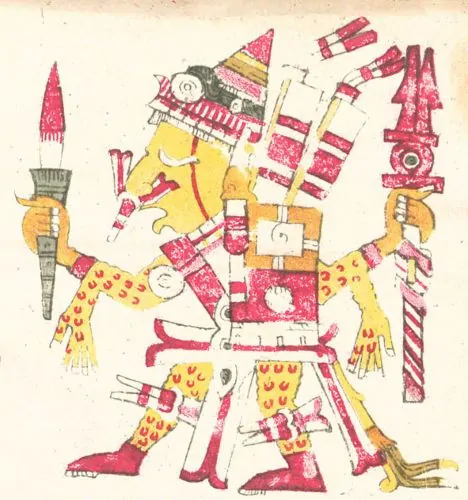
The tecpatl did not enter Central Mexican manuscripts as a picture placed beside an independently complete text. It belonged to a system of graphic communication in which recognizable objects, calendrical signs, phonetic elements, deity attributes, numerical notations, bodily gestures, spatial relationships, and conventional colors worked together. Nahua painters and scribes, commonly called tlacuiloque, could use the same visual form differently according to whether they were recording a date, naming a person, identifying a place, describing a sacrifice, or constructing the body of a god. Some painted books organized ritual and divinatory time, others narrated migrations and dynastic histories, while still others recorded tribute, property, genealogy, or political obligations. Their images were not intended merely to reproduce the visible world with naturalistic accuracy. They selected and combined features capable of communicating names, actions, qualities, relationships, and sacred identities to viewers trained in their conventions.
In its simplest manuscript form, the tecpatl usually appears as an upright pointed oval or leaf-shaped blade divided by a diagonal band. Many examples are painted red and white, although uncolored colonial manuscripts may preserve only the outline and dividing line. The red has frequently been interpreted as blood and the white as flint, but the combination may also have signified the blade’s sharpened or cutting quality rather than representing two literal substances. Small variations altered the sign’s emphasis without making it unrecognizable. One end might be squared rather than pointed, the blade could lean to one side, or the central stripe might curve like the markings used to identify stone. More elaborate examples contain an eye, gums, teeth, a mouth, facial paint, or divine ornaments, transforming the knife from a simple noun sign into a personified ritual being. Similar forms could also denote itztli, an obsidian blade, demonstrating that pictorial writing did not always preserve the mineral distinction demanded by modern archaeological classification. The correct reading depended upon surrounding signs, accompanying alphabetic glosses, manuscript context, and the larger name or action in which the blade participated.
Calendrical notation supplied one of the tecpatl’s most consistent uses. As the eighteenth day sign of the tonalpohualli, it could be joined to one or more dots representing numerals, producing dates such as One Flint, Two Flint, or Five Flint. The same blade also appeared within year signs, where additional framing conventions distinguished a Flint year from an ordinary day designation. Because calendrical names were given to human beings, a tecpatl accompanied by a numeral might identify a historical person as readily as a ritual date. Colonial manuscripts preserve men and women named Tecpatl, One Flint, or Two Flint, demonstrating how a temporal sign could become a personal identity carried through life.
The knife also functioned logographically and phonetically within place-names, titles, and personal names. A single tecpatl could stand for the word tecpatl, while its combination with a hill sign created names such as Tecpatepec, the place associated with a hill of flint knives. In glyphs for Tecpatlan, the blade supplied the principal lexical element while a locative ending completed the spoken place-name. Tecpatzinco combined the knife with other graphic components representing the reverential or locative portions of the name. The same tecpatl form could also serve primarily for its sound rather than for its literal meaning as a knife. In colonial records from Huexotzinco, for example, a flint blade could supply the opening syllables of Tecpanecatl, a personal name or title associated with the palace. Such uses demonstrate that Nahua writing was not confined to pictures communicating ideas without reference to spoken language. Signs could act as logograms, phonetic cues, semantic indicators, or several of these simultaneously. A stone marking inside the knife might identify its material while also reinforcing the sound te, and the full image might contribute only part of the word being written. Reading required knowledge of Nahuatl vocabulary, place-name structure, calendrical naming, and graphic convention rather than the simple recognition that the picture showed a blade.
Within ritual and divinatory manuscripts, the tecpatl acquired further meanings through combination with other signs. Danièle Dehouve has shown that flint, skulls, down balls, smoking mirrors, severed limbs, and related elements formed recurring compounds associated with sacrifice and dismemberment. A tecpatl joined to a skull could communicate more than “knife beside dead person,” because the standardized pairing evoked a specific field of bodily opening, death, and ritual transformation. When incorporated into the costume or face of Xipe Totec, Itztli, or another deity, the blade contributed one component to a composite divine identity. Its significance arose from the complete pictorial statement rather than from an isolated dictionary definition.
Painted books were also objects of performance, consultation, and interpretation. Diviners opened screenfold manuscripts to determine the qualities of particular days, while historians and specialists could use pictorial records as frameworks for spoken narratives far more extensive than the images alone appear to contain. Reading order varied among genres and manuscripts: annals might follow a line of years, cartographic histories moved through landscapes, and Borgia Group books organized signs across dense ritual compositions whose sequences remain debated. Regional traditions shared many graphic conventions without employing every sign identically, and colonial painters adapted Indigenous writing to alphabetic glosses, European paper, legal institutions, and Christian supervision. The tecpatl survived these changes because it could continue to name a date, person, place, object, deity, or sacrificial action even as the manuscript surrounding it served a new audience. In pictorial writing, the knife was not one symbol with one permanent meaning. It was a mobile graphic unit whose edge divided and connected language, image, ritual, history, and divine presence.
Sacrifice and the Grammar of Creation
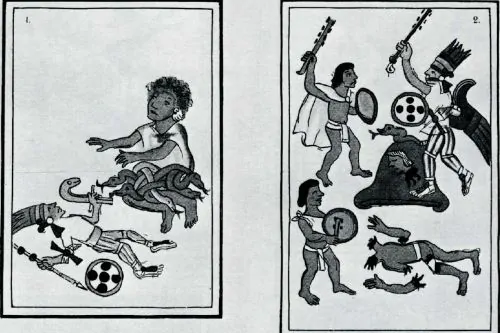
Across Nahua mythology, bodies rarely remained passive containers whose destruction produced only absence. Gods, ancestral beings, celestial warriors, animals, mountains, and human victims could be pierced, burned, decapitated, flayed, broken, ground, or scattered, after which their separated substances entered new relationships with the cosmos. This repetition does not mean that every violent episode communicated the same doctrine or originated within one unified mythic system. It does indicate that bodily division offered Nahua narrators and ritual specialists a powerful language for explaining how one condition of existence became another. Intact bodies contained distinctions that had not yet been expressed, while rupture could release blood, heat, seeds, stars, stones, divine identities, or territorial forms. The tecpatl belonged at the center of this language because its material action supplied a model for transformation through separation. Its edge did not create matter from nothing; it opened, redistributed, and reassigned what a body already held.
The fall of the celestial flint provides the most compressed expression of this principle. One divine stone descends from heaven and becomes the origin of 1,600 gods at Chicomoztoc, whether they are imagined as emerging from it, being released by its impact, or multiplying through its implied fracture. The knife’s movement from celestial singularity to terrestrial plurality makes rupture productive before human sacrifice has even begun. Creation appears not as the peaceful completion of a divine design but as the consequence of birth, rejection, descent, opening, and multiplication.
The dismemberment of Coyolxauhqui placed this same logic at the mythic and architectural center of Tenochtitlan. According to the narrative preserved by Sahagún, Coyolxauhqui and the Centzon Huitznahua resolved to kill their mother, Coatlicue, after she became mysteriously pregnant upon placing a ball of feathers against her body. Huitzilopochtli emerged fully armed at Coatepec, attacked his sister, decapitated her, and cast her body down the mountain, where it broke apart. The monumental Coyolxauhqui Stone at the foot of the Huitzilopochtli stairway transformed that defeat into a recurring visual and ritual pattern. Human victims cast down the temple steps could be understood in relation to the goddess whose dismembered body marked the base of the sacred mountain. Yet Coyolxauhqui’s destruction did not make her insignificant or erase her from divine history. Her separated body became one of the most powerful images in Mexica ritual art, occupying a privileged place where myth, sacrifice, warfare, architecture, and imperial identity converged. The defeated goddess was politically subordinated, but her broken form remained necessary to the victorious identity of Huitzilopochtli. Dismemberment established hierarchy while preserving the victim as an enduring sacred presence.
Itzpapalotl and the Mimixcoa reveal another version of transformation through bodily destruction. The celestial hunters who fail to nourish the sun become sacrificial prey, while Itzpapalotl is attacked, burned, and converted into differently colored flints. Her white flint is wrapped and carried as a sacred presence, allowing the defeated being to continue in a new material and martial form. In both cycles, the victim’s body becomes more widely distributed and ritually useful after its original integrity has been destroyed.
The gods sacrificed at Teotihuacan extend this grammar from divine bodies to celestial motion. Nanahuatzin and Tecuciztecatl enter the fire and emerge as sun and moon, but illumination remains motionless until the other gods surrender their lives and Ehecatl applies the force of wind. Death does not merely accompany cosmic creation; it supplies the transition from dormant brilliance to ordered movement. The creation of humanity follows a comparable sequence when ancestral bones are removed from Mictlan, broken during the escape, ground, placed in a vessel, and animated with divine blood. Agricultural life offered an equally familiar field of transformation, since maize had to be broken from the cob, ground upon the metate, mixed with water, shaped, cooked, eaten, and incorporated into human flesh before it could nourish a community. Seeds disappeared beneath the earth before returning as plants, while harvested stalks were cut so that food might enter social circulation. Childbirth likewise involved the dangerous opening of the maternal body and the emergence of a new being from blood, pain, and separation. Hunting transformed a living animal into meat, hide, bone, sinew, tools, offerings, and distributed shares, while warfare converted an enemy warrior into captive, victim, ancestral sign, and source of prestige. These processes were not interchangeable, and childbirth or agriculture should not be reduced to disguised forms of human sacrifice. They nevertheless made comprehensible a world in which generation often required the loss of a previous bodily condition. The tecpatl condensed this wider experience into a single sacred action: the edge separated what had been joined so that hidden substances could acquire new destinations.
This grammar of creation should not be mistaken for a claim that Nahua religion celebrated destruction indiscriminately. Uncontrolled rupture could produce disorder, famine, defeat, pollution, and the irreversible loss of valuable life, while legitimate sacrifice depended upon calendrical timing, authorized performers, appropriate victims, ritual preparation, and correct distribution. The sacred cut was meaningful because it occurred within an ordered system that distinguished creation from waste and offering from unauthorized killing. Even then, the cosmological interpretation of sacrifice did not eliminate the suffering of victims or the political power of those who controlled their bodies. It explains instead how violent transformation could be represented as productive, necessary, and continuous with divine precedent. The tecpatl was the material sign of that dangerous proposition: what the blade destroyed as an intact body might reappear as nourishment, motion, memory, divine presence, or ordered difference.
Spanish Conquest and the Demonization of the Blade
When Spaniards entered Central Mexico, the tecpatl became one of the most powerful objects through which they interpreted the religious world they intended to conquer. A sharpened stone knife associated with opened bodies, blood-covered temples, divine images, and human remains could be fitted readily into Christian narratives of idolatry and demonic deception. Conquistadors and missionaries did not encounter the blade as a neutral artifact awaiting objective description; they approached it through inherited categories formed by biblical denunciations of pagan sacrifice, medieval demonology, classical accounts of barbarous peoples, and the violent religious conflicts of early modern Europe. The knife appeared to them less as a calendrical sign, divine embodiment, ancestral substance, or instrument of cosmic reciprocity than as the unmistakable tool of a false priesthood. Its material features seemed to confirm the judgment already imposed upon it. Flint and obsidian became the cutting edges of satanic worship, while blood was read as evidence that the devil had taught Indigenous peoples a monstrous parody of legitimate religion. The colonial history of the tecpatl began with this narrowing of its meanings into a weapon that supposedly revealed the moral essence of an entire civilization.
The conquest narratives of Hernán Cortés and Bernal Díaz del Castillo made temples, idols, skull displays, sacrificial victims, and blood-stained priests central to their portrayal of Tenochtitlan. Such descriptions may preserve observations of real ritual places and practices, but they were also literary and political constructions directed toward Spanish readers. Cortés needed to present the destruction of Indigenous temples as Christian reform rather than unlawful aggression, while veterans such as Díaz sought recognition for having overcome an empire depicted as wealthy, powerful, and religiously abhorrent. Sacrificial violence served both purposes. The more terrifying the cult appeared, the more conquest could be narrated as liberation, evangelization, and divine victory rather than invasion and appropriation.
Missionaries expanded this interpretation by translating Nahua sacred categories into a Christian vocabulary that rarely permitted neutrality. Teotl could become “god” when referring to a being treated as analogous to a classical deity, but it could also be rendered as devil, demon, false god, or idol when missionaries wished to condemn the practices surrounding it. A teixiptla could be described as an idol or image, terms that concealed the processes through which Nahua communities constructed temporary divine bodies from people, garments, stone, paper, dough, wood, and ritual insignia. The tecpatl likewise became a sacrificial knife in the most reductive sense, an instrument whose function supposedly required no explanation beyond cruelty and error. Christian writers could recognize sacrifice as a meaningful category within their own religion, where Christ’s death, the Eucharist, martyrdom, relics, fasting, and bodily mortification occupied sacred positions. They nevertheless denied that Nahua sacrifice could possess an intelligible theology of its own. Indigenous rites were instead represented as inversions of Christian truth: demons demanded blood because they envied God, priests imitated legitimate clergy, temples counterfeited churches, and sacrificial victims became distorted echoes of Christ. The blade’s cosmological meanings were not merely overlooked; they were reorganized into a theory of satanic imitation.
The Franciscan project associated with Bernardino de Sahagún reveals the contradictions of colonial translation with particular clarity. Sahagún and his Indigenous collaborators produced extensive Nahuatl descriptions of gods, ceremonies, calendars, natural substances, political institutions, and the conquest itself, preserving knowledge that ecclesiastical authorities simultaneously sought to eradicate. Nahua scholars educated at the Colegio de Santa Cruz de Tlatelolco gathered testimony, interpreted pictorial materials, composed or refined Nahuatl prose, and participated in the intellectual construction of what became the Florentine Codex. Their presence means that the work cannot be treated simply as a Spanish account of passive informants. Yet its contents were organized within a missionary investigation intended to expose idolatry, identify surviving practices, and facilitate Christian conversion. The tecpatl survives in this archive because colonial authorities wanted Indigenous religion documented sufficiently well to defeat it.
Other missionaries differed in method and temperament but often shared the conviction that sacrificial religion demonstrated demonic government. Motolinía described Indigenous sacrifices while emphasizing the suffering from which Christianity supposedly rescued Native peoples. Diego Durán recorded festivals, deity costumes, ritual speeches, and sacrificial procedures in extraordinary detail, yet repeatedly interpreted parallels between Nahua and biblical traditions as signs that the devil had imitated sacred history. Gerónimo de Mendieta placed the celestial flint and the 1,600 gods within a Christianized narrative resembling the fall of rebellious angels. These writers preserved myths and ceremonies unavailable elsewhere, but their preservation was inseparable from theological correction. Indigenous accounts entered colonial books through selection, questioning, paraphrase, comparison, translation, and editorial framing. Even where Nahuatl terminology remained visible, the surrounding narrative could direct readers toward sin, punishment, diabolism, or providential conquest. The sacred knife became a translated object whose original range of meanings remained partially legible beneath an imposed Christian explanation.
The conquest also transformed the material lives of knives and other ritual objects. Temples were dismantled, sacred images were broken or burned, precious coverings were stripped away, and ceremonial objects could be confiscated, buried, hidden, dispersed, or sent to Europe as curiosities. A tecpatl removed from an offering lost its architectural position, ritual companions, orientation, wrapping, and local history, leaving European collectors with an impressive blade detached from the relationships that had made it sacred. Some objects survived precisely because they were no longer recognized as dangerous, while others were preserved as trophies demonstrating the triumph of Christianity over idolatry. Indigenous communities also concealed ritual materials, adapted older practices to Christian settings, and continued to use flint and obsidian in healing, divination, calendrical knowledge, and local devotion. Colonial suppression was extensive, but it was never so complete that sacred meanings disappeared at once.
The demonized blade became one of the enduring foundations of the European image of the Aztec world. Later histories inherited the conquistadors’ temple scenes and the missionaries’ language of bloodthirsty gods, often treating the tecpatl as the natural emblem of a civilization defined by human sacrifice. Rejecting that tradition does not require denying the reality of ritual killing or dismissing every Spanish account as fabricated propaganda. It requires reading colonial testimony as evidence produced within conquest rather than as a transparent window onto preconquest religion. The same source can preserve a Nahua term, describe an authentic ceremony, misunderstand its theology, exaggerate its scale, and use it to justify colonial power. Indigenous collaborators could contribute essential knowledge while writing under institutions committed to transforming their communities. Missionaries could condemn what they recorded while inadvertently preserving the materials from which later generations reconstructed it. The colonial tecpatl has two inseparable histories: the sacred blade understood through Nahua relations among gods, bodies, time, and sacrifice, and the demonic knife created through Christian translation and imperial victory.
From Sacred Instrument to Museum “Masterpiece”
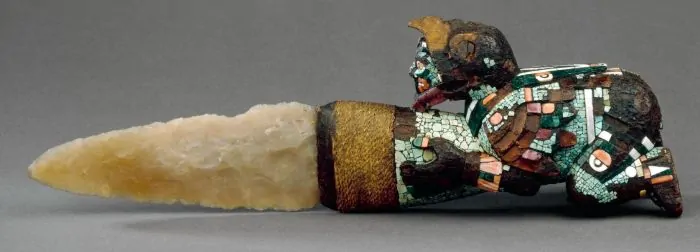
Once removed from the ritual environments that had given it meaning, the tecpatl entered a succession of foreign categories. Spanish conquest transformed sacred implements into condemned idols, confiscated objects, trophies of conversion, and evidence of a defeated religion. Early modern collectors then absorbed Mexican antiquities into princely treasuries and cabinets of curiosity, where their rarity and unfamiliar workmanship mattered more than their original placement within temples, bundles, calendars, or offerings. A knife might be displayed beside minerals, weapons, fossils, Christian relics, exotic animals, and objects gathered from entirely unrelated societies in these collections. By the nineteenth century, expanding museums reclassified these materials as archaeological or ethnographic specimens whose arrangement was intended to illustrate the development, beliefs, or supposed racial character of civilizations. Each change preserved the physical blade while imposing a new intellectual framework upon it. The sacred instrument survived, but its survival often depended upon its transformation into something Europeans believed they could possess, classify, and explain.
The celebrated mosaic knife in the British Museum illustrates both the possibilities and the losses created by this history. Its known collecting history begins in nineteenth-century Europe rather than within an excavated Mexican setting. By 1854, the knife, a turquoise-covered mask, and a mosaic human skull were recorded in a London auction catalogue among objects belonging to the dealer and collector Bram Hertz. Henry Christy later acquired the group, and the knife entered the British Museum through the trustees of his collection after his death. The surviving paper trail documents movement among collectors, auction houses, and museums but does not securely reveal when the object left Mexico, who first carried it to Europe, or what ritual setting originally contained it. Museum records have preserved claims that the mosaics came from an old Italian collection, but the earlier stages of the story remain uncertain and should not be converted into an unsupported tale linking the knife directly to Moctezuma, Hernán Cortés, or the treasures sent to a particular European ruler. The absence of archaeological context also complicates its cultural attribution. The eagle-warrior handle and many of the object’s symbols connect it strongly with the religious and military world of Central Mexico, yet the workmanship of turquoise mosaics has encouraged debate over whether it should be classified as Mexica, Mixtec, or more broadly within the interconnected Mixteca-Puebla tradition. Its designation as a “sacrificial knife” is plausible, but the title gives an appearance of functional certainty that the object’s documented history cannot fully provide. The museum possesses an extraordinary ritual object while lacking much of the information once carried by its location, ritual companions, Indigenous name, and history of use.
Conservation science has restored some of the complexity lost through decontextualization. Examination of the British Museum knife has identified a flint blade joined to a carved cedro-wood handle with maguey fiber, plant resins, turquoise, malachite, conch shell, thorny-oyster shell, and mother-of-pearl. Such analysis reveals the object as the product of multiple specialists and extensive networks of material acquisition rather than the work of a solitary priest sharpening a weapon. Museum lighting and isolated display encourage visitors to admire symmetry, color, craftsmanship, and technical virtuosity before considering sacrifice, warfare, tribute, or divine embodiment. The label “masterpiece” can restore respect to an object once dismissed as primitive, but it can also replace the colonial image of savagery with an equally incomplete celebration of aesthetic beauty.
Museums in Mexico have created a different, though not uncomplicated, framework by treating preconquest objects as national patrimony and evidence of Indigenous civilizations foundational to Mexican history. Excavations at the Templo Mayor have been important because many personified knives were recovered within recorded offering deposits rather than acquired from dealers without provenience. There, a blade can be interpreted according to its architectural level, orientation, ornaments, associated animals, human remains, marine substances, and relationship to other objects in the same cache. This contextualized archaeology demonstrates how much information disappeared when earlier collectors separated visually impressive artifacts from the deposits that had given them meaning. The contrast is not simply between responsible Mexican museums and irresponsible foreign ones, since national institutions have also inherited histories of centralization, restoration, selective display, and the appropriation of local or Indigenous heritage into state narratives. Nevertheless, archaeological context permits visitors to encounter the tecpatl as part of a composed ritual world rather than as an isolated emblem of Aztec violence. Modern efforts to prevent illicit trafficking and recover Mexican archaeological property have made provenance an increasingly important part of museum ethics. Repatriation debates consequently concern more than the transfer of legal ownership; they ask who may interpret sacred objects, whose histories museums privilege, and whether artifacts removed through colonial systems can remain ethically detached from the communities and nations from which they came.
Calling a tecpatl a museum masterpiece is neither wholly wrong nor sufficient. The term acknowledges technical sophistication, the intelligence of its makers, and the extraordinary ability of fragile materials to communicate across centuries. Yet it can also domesticate the object, converting a dangerous sacred presence into a beautiful artwork protected behind glass and separated from blood, incense, movement, speech, architecture, and ritual obligation. Responsible display requires museums to preserve both dimensions without returning to sensationalism. Provenance should be presented openly, uncertainty should not be disguised as fact, and the brilliance of workmanship should be connected to the political and religious systems that made such labor meaningful. Institutions can also place long-unprovenanced objects in dialogue with excavated examples, pictorial manuscripts, colonial testimony, conservation evidence, and present-day Mexican and Indigenous perspectives. The sacred instrument did not cease to possess history when it became museum property. Its modern display is another chapter in that history, shaped by conquest, collecting, scholarship, national identity, scientific investigation, and disputes over cultural ownership. A museum can call the tecpatl a masterpiece only responsibly when admiration does not silence the worlds from which the knife was taken.
Modern Reinvention: The Tecpatl in Popular Culture and National Memory

Modern culture has rarely preserved the tecpatl as the complex sacred category reconstructed from Nahua manuscripts, archaeological deposits, and colonial testimony. Instead, the blade has usually been divided between two opposing images of the Aztec past. In one, it is the blood-covered weapon of a cruel priesthood, a visual shorthand for barbarism, fanaticism, and the terrifying otherness of preconquest Mexico. In the other, it becomes an emblem of Indigenous strength, resistance, cosmic knowledge, and cultural authenticity recovered after centuries of Spanish denigration. Both interpretations respond to real aspects of history, but each tends to simplify the object by selecting the meaning most useful to a modern audience. Horror emphasizes the knife’s ability to kill while stripping sacrifice of its calendrical, theological, and political contexts. Romantic recovery may celebrate the stone’s celestial origin, craftsmanship, or divine energy while minimizing the bodies opened by its edge. The modern tecpatl consequently oscillates between atrocity and empowerment, seldom retaining the full tension of an object that could be simultaneously beautiful, sacred, coercive, generative, and lethal.
Postrevolutionary Mexican nationalism transformed the Mexica past into a monumental prehistory of the modern nation. Archaeological sites, museum galleries, public education, currency, official emblems, and the murals of artists such as Diego Rivera presented Tenochtitlan as evidence that Mexico possessed a great civilization before European conquest. The Sun Stone, the eagle upon the cactus, monumental pyramids, Cuauhtemoc, feathered warriors, and Indigenous marketplaces proved easier to integrate into a progressive national narrative than the sacrificial knife. The tecpatl remained visible, but it was often contained within images of priestly ritual or placed safely behind museum glass. Its uneasy position reveals a larger contradiction within indigenismo: the nation claimed the grandeur of the Indigenous past while frequently marginalizing living Indigenous communities and selecting only those ancient symbols compatible with modern ideals of unity, progress, and state authority.
Chicano cultural nationalism and later movements of Indigenous revival gave Mexica imagery different political work to perform. Aztlan, the eagle warrior, Coatlicue, the Sun Stone, Nahuatl names, and the remembered city of Tenochtitlan could provide alternatives to identities imposed by colonial history, anti-Mexican racism, and pressure toward cultural assimilation. Artists and activists did not simply reproduce the official nationalism of Mexico; they reworked preconquest symbols to express migration, dispossession, resistance, mestizo and Indigenous ancestry, border conflict, and collective dignity. Mexicayotl and related ceremonial movements similarly sought to recover dances, calendrical knowledge, sacred places, Nahuatl terminology, and Indigenous philosophies, although their practices differ greatly and cannot be treated as one unified revival. Within these settings, the knife and sacrifice are often interpreted selectively. Sacrifice may be reframed as self-discipline, service to the community, the surrender of selfish desire, or a metaphor for the historical suffering of Indigenous peoples rather than restored as a demand for human death. Bloodletting and sacred cutting may be discussed as ancestral obligations, but most contemporary practitioners distinguish symbolic, theatrical, or limited devotional acts from preconquest state ceremonies. Such reinterpretations are not necessarily fraudulent merely because they depart from fifteenth-century practice; living traditions regularly transform inherited symbols to address new circumstances. They become historically misleading only when modern reconstructions are presented as unchanged survivals or when one group claims exclusive authority to define what all ancient Nahua communities believed. The modern tecpatl can become an instrument of cultural recovery without being identical to the object once buried in offerings beneath the Templo Mayor.
Commercial popular culture usually removes even these historical negotiations. Novels, comics, films, fantasy art, tattoos, tabletop games, and video games repeatedly present obsidian or flint knives as magical daggers powered by blood, capable of awakening gods, opening portals, transferring souls, or unleashing apocalyptic forces. The distinction between tecpatl and itztli often disappears, as does the difference between a sacrificial knife, an obsidian prismatic blade, and the cutting elements of a macuahuitl. Mexica, Maya, and other Mesoamerican cultures may be blended into one generalized civilization of pyramids, calendars, skulls, jungle ruins, and human sacrifice. Games such as Aztez deliberately exaggerate bloodshed into a stylized system of imperial combat, while broader strategy franchises reduce Aztec culture to a selectable package of warriors, monuments, religious bonuses, and sacrificial associations. These inventions can produce memorable art and occasionally encourage interest in Mesoamerican history, but they also strengthen the expectation that every sacred blade possessed a singular magical personality or supernatural combat power.
Digital culture has accelerated both mythmaking and correction. A dramatic image of a turquoise-handled knife can circulate without provenance, be labeled as Moctezuma’s personal weapon, and acquire an invented story about lightning, souls, or mass sacrifice through repetition across videos, social media, commercial mythology sites, and automatically generated summaries. At the opposite extreme, corrective enthusiasm can produce the equally misleading assertion that Aztec sacrifice was entirely invented by Spaniards and that every archaeological or Indigenous account must be colonial propaganda. The most responsible interpretation rejects both sensationalism and denial. The tecpatl was genuinely connected with sacrificial killing, imperial power, divine embodiment, calendrical time, fire, death, and cosmic renewal, but no surviving evidence supports a single magical knife possessing every power later attributed to it. Its modern appeal arises precisely because its documented meanings are already extraordinary: a stone could descend from heaven, generate gods, embody a deity, name a day, represent a warrior, and open the human body within a ceremony intended to sustain relations among worlds. Popular reinvention becomes most revealing when treated not as evidence about ancient belief but as evidence about what modern societies desire from the Aztec past. The blade continues to cut, separating barbarism from civilization, colonizer from Indigenous ancestor, horror from admiration, and historical knowledge from the myths created to replace it.
Was the Tecpatl Really Considered a Divine Being?
The following video from “ASMR Historian” provides a history of Aztec sacrifice:
The strongest objection to describing the tecpatl as a divine being is that no surviving Nahua source presents one universally recognized “God Tecpatl” with a stable genealogy, personality, cult, and narrative biography. The celestial flint born from Citlalicue, the day sign Tecpatl, the anthropomorphized knives of the codices, the white flint carried by Mixcoatl, the deity Itztli, and the sacrificial blades of the temple do not appear together as the successive adventures of one supernatural individual. Their relationships have been reconstructed by comparing manuscripts produced in different regions, colonial accounts shaped by different informants, and archaeological objects deposited for different ritual purposes. Modern treatments can easily convert these recurring associations into a falsely unified mythology because a single divine knife is more narratively satisfying than a network of overlapping signs and substances. The result may resemble a magical weapon from heroic literature: born in heaven, armed with lightning, worshipped as a god, and used to open the bodies of sacrificial victims. Such a composite figure is compelling, but it exceeds what the sources securely preserve. The skeptical position begins with a necessary warning: similarity of form does not prove identity of being.
Personification provides equally ambiguous evidence. An eye, mouth, teeth, limbs, or divine costume may indicate agency, but graphic traditions regularly gave animate qualities to days, places, weapons, mountains, and natural forces without necessarily establishing separate cults for each image. The face within a tecpatl could help identify Itztli, Xipe Totec, Mictlantecuhtli, or another deity whose attributes had been combined with the blade. It could also communicate sacrifice, appetite, death, or the action of cutting rather than depict the literal inhabitant of every physical knife. Pictorial anthropomorphism should be read within the complete composition, not treated as automatic proof that Nahua worshippers regarded all knives as persons.
Archaeology complicates the divine interpretation further. Dressed knives from the Templo Mayor were furnished with eyes, teeth, masks, weapons, ornaments, and deity insignia, but they did not all possess the same appearance or occupy the same position within offering deposits. Some appear to have represented named gods, while others may have embodied warriors, priests, dead persons, stellar beings, sacrificial victims, or collective categories whose identities remain uncertain. The flint blade provided a durable central body upon which these identities could be assembled, but the identity may have arisen from the entire combination rather than from the stone alone. Removing the shell eyes, costume, miniature weapons, architectural location, and associated animal remains can leave what looks like a self-contained divine knife even though the original ritual figure depended upon all those elements. Nor does sacred deposition prove that the object itself was worshipped as an autonomous god. Shields, vessels, animal bodies, shells, weapons, food, incense, and valuable stones could all enter offerings without becoming independent deities with permanent personalities. A tecpatl might represent a god, belong to a god, act on behalf of a god, or materialize one aspect of a god without being identical to every other blade. The skeptical argument is not that the knives lacked sacred significance, but that modern language too quickly converts contextual embodiment into fixed divine individuality.
Yet the opposing interpretation identifies a different danger: skepticism can impose a modern separation between representation and reality that Nahua ritual practice did not consistently observe. The category of teixiptla allowed divine beings to become locally present through human bodies, costumes, stone images, dough figures, bundles, and composite objects. These embodiments were made, adorned, addressed, fed, carried, sacrificed, renewed, or buried, and their material construction did not make their divine presence merely theatrical. A person dressed as Tezcatlipoca was not simply an actor pretending to be the god, just as a wrapped sacred stone was not necessarily a symbol pointing toward a deity located elsewhere. Divine identity could emerge through the correct conjunction of substance, name, image, ritual action, and collective recognition. From this perspective, asking whether a knife was “really” a god or “only” represented one may divide possibilities that Nahua participants allowed to coexist.
The most defensible conclusion is that the tecpatl constituted a sacred complex rather than one universal divine personality. A particular blade could remain ordinary stone, become a ritual implement, embody a deity, represent a calendrical force, stand for a sacrificed warrior, or enter an offering as a supernatural agent. Its identity changed according to material, adornment, location, ritual history, and the relationships constructed around it. This variability does not make its divinity imaginary or reduce sacred personification to artistic convention. It means that divine being was often relational and situational rather than permanently contained within an object from the moment it left the quarry. The celestial flint, the personified knife, the calendrical sign, and the sacrificial instrument were connected because each concentrated the power of cutting, division, death, fire, and transformation, not because they were necessarily manifestations of one named god. To call the tecpatl divine is justified when the term describes the conditions under which stone became sacred presence and ritual agent. It becomes misleading only when that presence is recast as a single magical knife possessing a coherent biography that the surviving evidence never supplies.
Conclusion: The Edge Between Creation and Destruction
The tecpatl began as stone, but Nahua thought refused to leave it there. Flint could descend from heaven, generate a multitude of gods, produce sparks, arm celestial hunters, name a day, designate a year, embody a deity, and open the human body within sacrifice. These functions did not belong to one perfectly coherent mythology, nor did every physical knife carry all of them at once. Their recurrence nevertheless reveals a shared understanding of sharpened stone as a concentrated form of transformative power. The tecpatl divided surfaces that concealed something valuable within them: flint concealed fire, caves enclosed ancestors, bodies held blood and hearts, darkness preceded solar emergence, and unmarked duration contained the patterned differences of calendrical time. Its edge made those hidden possibilities available by creating an opening through which they could pass. The sacred knife was most fully itself at the threshold between states, where matter became presence and destruction initiated another form of existence.
This transformation was neither peaceful nor morally neutral. Human sacrifice inflicted real suffering, served political hierarchies, and allowed victorious states to determine the fate and meaning of captive bodies. The theological language of debt, divine nourishment, and cosmic renewal did not erase the coercion through which many victims reached the altar. Yet political interpretation alone is equally insufficient, because rulers and priests did not need to choose between sincere cosmological obligation and the public display of imperial power. The tecpatl belonged to a world in which religious conviction, warfare, social advancement, calendrical ceremony, and state authority could operate through the same ritual action.
Its power also depended upon a conception of material existence that did not separate objects, images, bodies, and gods as rigidly as modern categories often demand. A stone blade could remain a manufactured implement while becoming a calendrical sign, a dressed warrior, a divine attribute, a buried offering, or a localized embodiment of sacred presence. Eyes, teeth, mouths, costumes, miniature weapons, and architectural placement did not merely decorate the knife; they established relationships through which its identity became active. At the Templo Mayor, personified flints entered carefully composed deposits whose animals, shells, pigments, ornaments, and human remains situated them within larger models of the cosmos. In manuscripts, the same pointed form moved among language, time, deity, place-name, sacrifice, and dismemberment. The tecpatl was not universally a god, but neither was it merely a symbol of one. Its divinity was often conditional and relational, produced through substance, form, ritual treatment, collective recognition, and proximity to other sacred bodies. That flexibility explains why the celestial flint, Mixcoatl’s weapons, Itzpapalotl’s colored remains, the solar knife-tongue, and the sacrificial blade could belong to one sacred complex without becoming a single supernatural object possessing a fixed biography. The knife’s unity lay in its action rather than in one divine personality: it cut, separated, released, and reassigned.
The tecpatl reveals a cosmos in which life did not stand securely apart from death. Gods burned so that the sun might rise, sacrificed themselves so that it might move, and shed blood over ancestral remains so that humanity could exist. Seeds entered the earth, bodies returned to its interior, celestial beings became stones, and defeated gods survived as images, relics, stars, or ritual bundles. Within this order, creation did not erase destruction but passed through it, while destruction became meaningful only when ritual redirected what had been divided. The tecpatl occupied the dangerous boundary between these possibilities. It was the edge where heavenly singularity became earthly multiplicity, where an intact body became an offering, where hidden vitality entered circulation, and where the violence of rupture could be claimed as the beginning of renewed order.
Bibliography
- Aguirre Molina, Alejandra. “Los cuchillos de pedernal ataviados de las ofrendas del Templo Mayor de Tenochtitlan.” Master’s thesis, Universidad Nacional Autónoma de México, 2021.
- Arellano, Irán Rivera, Adrián Velázquez Castro, and Emiliano Melgar Tísoc. “Los materiales de concha utilizados en la manufactura de atavíos en las ofrendas del Templo Mayor de Tenochtitlan.” Clio Arqueológica 36:2 (2021), 297–318.
- Baquedano, Elizabeth, ed. Tezcatlipoca: Trickster and Supreme Deity. Boulder: University Press of Colorado, 2020.
- Bassett, Molly H. The Fate of Earthly Things: Aztec Gods and God-Bodies. Austin: University of Texas Press, 2015.
- Berdan, Frances F. and Patricia Rieff Anawalt. The Codex Mendoza. 4 vols. Berkeley: University of California Press, 1992.
- Bernardino de Sahagún. Florentine Codex: General History of the Things of New Spain. Translated by Arthur J. O. Anderson and Charles E. Dibble. Santa Fe: School of American Research, 1950.
- Bierhorst, John, trans. History and Mythology of the Aztecs: The Codex Chimalpopoca. Tucson: University of Arizona Press, 1992.
- Boone, Elizabeth Hill, ed. The Codex Magliabechiano and the Lost Prototype of the Magliabechiano Group. Berkeley: University of California Press, 1983.
- —-. Cycles of Time and Meaning in the Mexican Books of Fate. Austin: University of Texas Press, 2007.
- —-. “Incarnations of the Aztec Supernatural: The Image of Huitzilopochtli in Mexico and Europe.” Transactions of the American Philosophical Society 79:2 (1989), 1–107.
- —-. Stories in Red and Black: Pictorial Histories of the Aztecs and Mixtecs. Austin: University of Texas Press, 2000.
- British Museum. Guide to the Christy Collection of Prehistoric Antiquities and Ethnography. London: British Museum, 1868.
- —-. “Sacrificial Knife; Mosaic.” Collection no. Am,St.399. London: British Museum.
- Brumfiel, Elizabeth M. “Technologies of Time: Calendrics and Commoners in Postclassic Mexico.” Ancient Mesoamerica 22:1 (2011), 53–70.
- Burkhart, Louise M. The Slippery Earth: Nahua-Christian Moral Dialogue in Sixteenth-Century Mexico. Tucson: University of Arizona Press, 1989.
- Carrasco, David. City of Sacrifice: The Aztec Empire and the Role of Violence in Civilization. Boston: Beacon Press, 1999.
- Caygill, Marjorie. “Henry Christy, A. W. Franks and the British Museum’s Turquoise Mosaics.” In Turquoise in Mexico and North America: Science, Conservation, Culture and Collections, edited by J. C. H. King, et.al., 183–196. London: Archetype Publications, 2012.
- Chávez Balderas, Ximen, et.al. “Los cuchillos ataviados de la Ofrenda 125: Templo Mayor de Tenochtitlan.” Arqueología Mexicana 103 (2010), 70–75.
- Chávez Balderas, Ximena. Sacrificio humano y tratamientos postsacrificiales en el Templo Mayor de Tenochtitlan. Mexico City: Secretaría de Cultura and Instituto Nacional de Antropología e Historia, 2017.
- Chimalpahin Quauhtlehuanitzin, Domingo. Codex Chimalpahin: Society and Politics in Mexico Tenochtitlan, Tlatelolco, Texcoco, Culhuacan, and Other Nahua Altepetl in Central Mexico. Edited and translated by Arthur J. O. Anderson and Susan Schroeder. 2 vols. Norman: University of Oklahoma Press, 1997.
- Clendinnen, Inga. Aztecs: An Interpretation. Cambridge: Cambridge University Press, 1991.
- Codex Borbonicus. Facsimile edition. Paris: Bibliothèque de l’Assemblée Nationale, late fifteenth century.
- Cortés, Hernán. Letters from Mexico. Translated by Anthony Pagden. New Haven: Yale University Press, 1986.
- De la Peña, Guillermo. “A New Mexican Nationalism? Indigenous Rights, Constitutional Reform and the Conflicting Meanings of Multiculturalism.” Nations and Nationalism 12:2 (2006), 279–302.
- Declercq, Stan. “‘The Dear Little Flower Babe Has Arrived!’: Blade Stones, Cradles, and Child Warriors in Ancient Mesoamerica.” Ancient Mesoamerica 36:1 (2025), 1–13.
- Dehouve, Danièle. “Combination of Signs in the Codices of Central Mexico: Examples from Sacrifice and Dismemberment Representations.” Ancient Mesoamerica 34:1 (2023), 85–103.
- —-. “The Rules of Construction of an Aztec Deity: Chalchiuhtlicue, the Goddess of Water.” Ancient Mesoamerica 31:1 (2020), 7–28.
- Díaz, Gisele, and Alan Rodgers. The Codex Borgia: A Full-Color Restoration of the Ancient Mexican Manuscript. Introduction and commentary by Bruce E. Byland. New York: Dover Publications, 1993.
- Díaz del Castillo, Bernal. The True History of the Conquest of New Spain. Translated by Alfred Percival Maudslay. London: The Hakluyt Society, 1910.
- Domenici, Davide. “Mesoamerican Mosaics from Early European Collections: Style, Provenance and Provenience.” Estudios de Cultura Náhuatl 59 (2020), 7–65.
- Durán, Diego. The Book of the Gods and Rites and The Ancient Calendar. Translated and edited by Fernando Horcasitas and Doris Heyden. Norman: University of Oklahoma Press, 1971.
- —-. The History of the Indies of New Spain. Translated by Doris Heyden. Norman: University of Oklahoma Press, 1994.
- Firaxis Games. Sid Meier’s Civilization VI: Aztec Civilization and Scenario Pack. Novato, CA: 2K Games, 2016. Video game.
- Garibay K., Ángel María, ed. and trans. Veinte himnos sacros de los nahuas. Mexico City: Universidad Nacional Autónoma de México, Instituto de Historia, 1958.
- Gillespie, Susan D. The Aztec Kings: The Construction of Rulership in Mexica History. Tucson: University of Arizona Press, 1989.
- González Torres, Yolotl. El sacrificio humano entre los mexicas. Mexico City: Fondo de Cultura Económica and Instituto Nacional de Antropología e Historia, 1985.
- —-, et al. “Técpatl o cuchillo de pedernal.” Arqueología Mexicana 5, no. 27 (1997), 72–73.
- Graulich, Michel. “Las peregrinaciones aztecas y el ciclo de Mixcóatl.” Estudios de Cultura Náhuatl 11 (1974), 311–354.
- —-. Myths of Ancient Mexico. Translated by Bernard R. Ortiz de Montellano and Thelma Ortiz de Montellano. Norman: University of Oklahoma Press, 1997.
- —-. “Myths of Paradise Lost in Pre-Hispanic Central Mexico.” Current Anthropology 24:5 (1983), 575–588.
- Gruzinski, Serge. The Conquest of Mexico: The Incorporation of Indian Societies into the Western World, 16th–18th Centuries. Translated by Eileen Corrigan. Cambridge: Polity Press, 1993.
- Hassig, Ross. Aztec Warfare: Imperial Expansion and Political Control. Norman: University of Oklahoma Press, 1988.
- —-. Mexico and the Spanish Conquest. 2nd ed. Norman: University of Oklahoma Press, 2006.
- —-. Time, History, and Belief in Aztec and Colonial Mexico. Austin: University of Texas Press, 2001.
- —-. War and Society in Ancient Mesoamerica. Berkeley: University of California Press, 1992.
- Hidalgo, Jacqueline M. Revelation in Aztlán: Scriptures, Utopias, and the Chicano Movement. New York: Palgrave Macmillan, 2016.
- Hvidtfeldt, Arild. Teotl and Ixiptlatli: Some Central Conceptions in Ancient Mexican Religion, with a General Introduction on Cult and Myth. Copenhagen: Munksgaard, 1958.
- Isaac, Barry L. “Aztec Warfare: Goals and Battlefield Comportment.” Ethnology 22:2 (1983), 121–131.
- Jennings, Gary. Aztec. New York: Atheneum, 1980.
- Johansson Keraudren, Patrick. “Análisis estructural del mito de la creación del Sol y de la Luna en la variante del Códice Florentino.” Estudios de Cultura Náhuatl 24 (1994), 93–124.
- —-. “La fecundación del hombre en el Mictlan y el origen de la vida breve.” Estudios de Cultura Náhuatl 27 (1997), 69–88.
- —-. Xochimiquiztli, la muerte florida: El sacrificio humano entre los mexicas. Mexico City: Universidad Nacional Autónoma de México, Instituto de Investigaciones Históricas, 2023.
- Kirchhoff, Paul, Lina Odena Güemes, and Luis Reyes García, eds. Historia tolteca-chichimeca. Mexico City: Instituto Nacional de Antropología e Historia, 1976.
- Klein, Cecelia F. “The Identity of the Central Deity on the Aztec Calendar Stone.” The Art Bulletin 58:1 (1976), 1–12.
- Lockhart, James. The Nahuas after the Conquest: A Social and Cultural History of the Indians of Central Mexico, Sixteenth through Eighteenth Centuries. Stanford: Stanford University Press, 1992.
- López Austin, Alfredo. The Human Body and Ideology: Concepts of the Ancient Nahuas. Translated by Thelma Ortiz de Montellano and Bernard Ortiz de Montellano. 2 vols. Salt Lake City: University of Utah Press, 1988.
- —-. “Mitos de una migración.” Arqueología Mexicana 1:4 (1993), 10–17.
- —-. The Myths of the Opossum: Pathways of Mesoamerican Mythology. Translated by Bernard R. Ortiz de Montellano and Thelma Ortiz de Montellano. Albuquerque: University of New Mexico Press, 1990.
- —-. Tamoanchan, Tlalocan: Places of Mist. Translated by Bernard R. Ortiz de Montellano and Thelma Ortiz de Montellano. Niwot: University Press of Colorado, 1994.
- López Luján, Leonardo. The Offerings of the Templo Mayor of Tenochtitlan. Translated by Bernard R. Ortiz de Montellano and Thelma Ortiz de Montellano. Albuquerque: University of New Mexico Press, 1994.
- López Luján, Leonardo. Tezcatlipoca: Burlas y metamorfosis de un dios azteca. Mexico City: Fondo de Cultura Económica, 2004.
- —-, et.al. “Un portal al inframundo: Ofrendas de animales sepultadas al pie del Templo Mayor de Tenochtitlan.” Estudios de Cultura Náhuatl 44 (2012), 9–40.
- Martin, Robert William. “A Reevaluation of the Role of War Captives in the Aztec Empire.” Latin American Antiquity 34:2 (2023), 423–37.
- Matos Moctezuma, Eduardo. The Great Temple of the Aztecs: Treasures of Tenochtitlan. Translated by Doris Heyden. New York: Thames and Hudson, 1988.
- McEwan, Colin, et.al. Turquoise Mosaics from Mexico. London: British Museum Press, 2006.
- Mendieta, Gerónimo de. Historia eclesiástica indiana. 2 vols. Mexico City: Consejo Nacional para la Cultura y las Artes, 1870.
- Metropolitan Museum of Art. “Tecpatl (Mictlantecuhtli, Lord of the Underworld).” 1502–1520 CE. New York: Metropolitan Museum of Art.
- Mikulska, Katarzyna. “¿Cuchillos de sacrificio? El papel del contexto en la expresión pictórica mesoamericana.” Itinerarios 12 (2010), 125–154.
- —-. “The Deity as a Mosaic: Images of the God Xipe Totec in Divinatory Codices from Central Mesoamerica.” Ancient Mesoamerica 33:3 (2022), 432–458.
- Molina, Alonso de. Vocabulario en lengua castellana y mexicana y mexicana y castellana. 1571. Facsimile edition. Mexico City: Editorial Porrúa, 1970.
- Motolinía, Toribio de Benavente. Motolinía’s History of the Indians of New Spain. Translated and edited by Elizabeth Andros Foster. Berkeley, CA: Cortés Society, 1950.
- Mundy, Barbara E. The Death of Aztec Tenochtitlan, the Life of Mexico City. Austin: University of Texas Press, 2015.
- Navarrete, Carlos, and Doris Heyden. “La cara central de la Piedra del Sol: Una hipótesis.” Estudios de Cultura Náhuatl 11 (1974), 355–376.
- Navarrete Linares, Federico. Los orígenes de los pueblos indígenas del valle de México: Los altépetl y sus historias. Mexico City: Universidad Nacional Autónoma de México, Instituto de Investigaciones Históricas, 2011.
- Nicholson, H. B. “The Problem of the Identification of the Central Image of the ‘Aztec Calendar Stone.’” In Current Topics in Aztec Studies: Essays in Honor of Dr. H. B. Nicholson, edited by Alana Cordy-Collins and Douglas Sharon, 3–15. San Diego: San Diego Museum of Man, 1993.
- Nowotny, Karl Anton. Tlacuilolli: Style and Contents of the Mexican Pictorial Manuscripts with a Catalog of the Borgia Group. Translated and edited by George A. Everett Jr. and Edward B. Sisson. Norman: University of Oklahoma Press, 2005.
- Olivier, Guilhem. Cacería, sacrificio y poder en Mesoamérica: Tras las huellas de Mixcóatl, “Serpiente de Nube.” Mexico City: Fondo de Cultura Económica; Universidad Nacional Autónoma de México; Centro de Estudios Mexicanos y Centroamericanos, 2015.
- —-. “El simbolismo sacrificial de los Mimixcoa: Cacería, guerra, sacrificio e identidad entre los mexicas.” In El sacrificio humano en la tradición religiosa mesoamericana, edited by Leonardo López Luján and Guilhem Olivier, 453–482. Mexico City: Instituto Nacional de Antropología e Historia and Universidad Nacional Autónoma de México, 2010.
- —-. Mockeries and Metamorphoses of an Aztec God: Tezcatlipoca, “Lord of the Smoking Mirror.” Translated by Michel Besson. Boulder: University Press of Colorado, 2003.
- —-. “The Sacred Bundles and the Coronation of the Aztec King in Mexico-Tenochtitlan.” In Sacred Bundles: Ritual Acts of Wrapping and Binding in Mesoamerica, edited by Julia Guernsey and F. Kent Reilly III, 199–225. Boulder: University Press of Colorado, 2012.
- Pastrana, Alejandro. La explotación azteca de la obsidiana en la Sierra de las Navajas. Mexico City: Instituto Nacional de Antropología e Historia, 1998.
- Prem, Hanns J. Manual de la antigua cronología mexicana. Mexico City: Centro de Investigaciones y Estudios Superiores en Antropología Social and Miguel Ángel Porrúa, 2008.
- Quiñones Keber, Eloise. Codex Telleriano-Remensis: Ritual, Divination, and History in a Pictorial Aztec Manuscript. Austin: University of Texas Press, 1995.
- Read, Charles Hercules. “On an Ancient Mexican Head-piece, Coated with Mosaic.” Archaeologia 54, no. 2 (1895): 383–398.
- Read, Kay Almere. Time and Sacrifice in the Aztec Cosmos. Bloomington: Indiana University Press, 1998.
- Restall, Matthew. When Montezuma Met Cortés: The True Story of the Meeting That Changed History. New York: Ecco, 2018.
- Rivera, Diego. The History of Mexico. Fresco mural cycle. National Palace, Mexico City.
- Rostas, Susanna. Carrying the Word: The Concheros Dance in Mexico City. Boulder: University Press of Colorado, 2009.
- Ruiz de Alarcón, Hernando. Treatise on the Heathen Superstitions That Today Live among the Indians Native to This New Spain, 1629. Translated and edited by J. Richard Andrews and Ross Hassig. Norman: University of Oklahoma Press, 1984.
- Smith, Michael E. The Aztecs. 3rd ed. Malden, MA: Wiley-Blackwell, 2011.
- Tavárez, David. The Invisible War: Indigenous Devotions, Discipline, and Dissent in Colonial Mexico. Stanford, CA: Stanford University Press, 2011.
- Tena, Rafael, ed. Mitos e historias de los antiguos nahuas. Mexico City: Consejo Nacional para la Cultura y las Artes, 2011.
- Tenorio-Trillo, Mauricio. Mexico at the World’s Fairs: Crafting a Modern Nation. Berkeley: University of California Press, 1996.
- Torquemada, Juan de. Monarquía indiana. 7 vols (1723). Edited by Miguel León-Portilla. Mexico City: Universidad Nacional Autónoma de México, Instituto de Investigaciones Históricas, 1975–1983.
- Tremain, Cara G., and Donna Yates, eds. The Market for Mesoamerica: Reflections on the Sale of Pre-Columbian Antiquities. Gainesville: University Press of Florida, 2019.
- Villela, Khristaan D., and Mary Ellen Miller, eds. The Aztec Calendar Stone. Los Angeles: Getty Research Institute, 2010.
- Whittaker, Gordon. Deciphering Aztec Hieroglyphs: A Guide to Nahuatl Writing. London: Thames & Hudson, 2021.
- Whittaker, John C. Flintknapping: Making and Understanding Stone Tools. Austin: University of Texas Press, 1994.
Originally published by Brewminate, 07.29.2026, under the terms of a Creative Commons Attribution-NonCommercial-NoDerivatives 4.0 International license.
About the Author