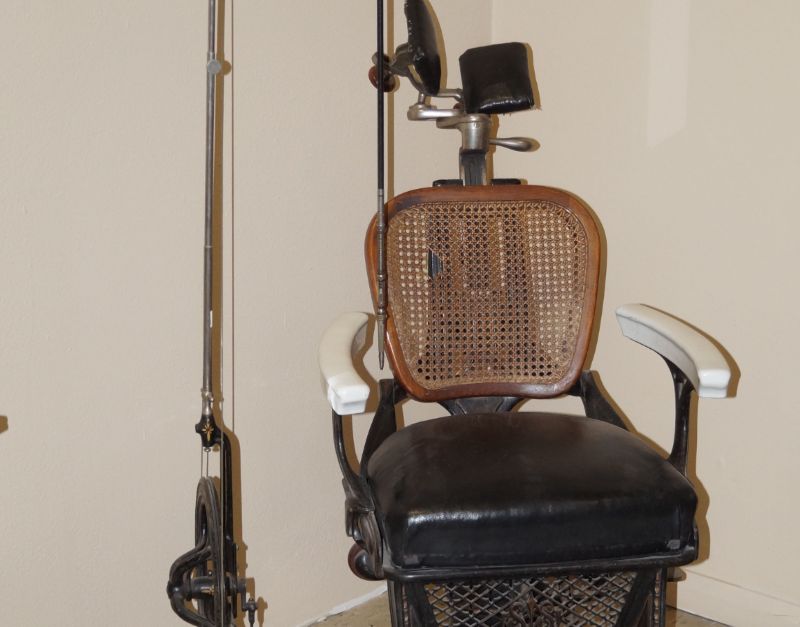
Thirty-two dollars. That is roughly what a mid nineteenth century dental chair cost, and for that money you got a wooden armchair, no headrest, and a dentist standing over you in a room that smelled like coal oil. If you have ever sat in a modern chair that tilts back, raises your feet, and holds your head steady while someone works on your back molars, you are sitting in the product of about a hundred and fifty years of arguing over a single question: how much should comfort matter?
This is a history piece, not a checklist. It traces the ordinary object that sits in every dental office, from a modified kitchen chair to a piece of equipment designed around the human body. The story runs through a Civil War veteran turned inventor, a refrigeration magnate, and a slow shift in how societies thought about the person in the chair.
By the end you will see why the furniture, the lighting, the noise, and the scheduling all carry the same idea. Comfort is not decoration. It shapes whether people show up at all.
Before the chair, there was just a stool
Early dentistry was mobile work. A practitioner set up in a market square, a barber shop, or a patient’s own parlor, pulled a chair over, and got to work. The chair was whatever was already in the room. Nobody designed it for the job.
That changed in the 1790s when the first purpose built dental chair appeared, a wooden model with a reclining back. It was crude by any standard, and it solved exactly one problem, the angle of the patient’s head. Everything else, the light, the reach, the patient’s neck, stayed a guess.
You can trace how long that guessing lasted by looking at surviving examples. The Smithsonian Institution holds early medical and dental artifacts that show the slow creep from ordinary furniture toward specialized equipment, and the gap between a parlor chair and a clinic chair stayed narrow for decades. Dentists of that era worked standing, twisted sideways, and relied on window light. The patient was an inconvenience to be positioned, not a person to be accommodated.
My honest read on this period: the profession treated discomfort as proof of seriousness. If it hurt, it must be working. That logic is wrong, and it took a long time to die.
The Civil War veteran who reinvented the chair
James Beall Morrison, a Missouri dentist who served as a Confederate surgeon during the Civil War, patented a dental chair in 1867 that moved in ways no previous chair could. It reclined, it raised and lowered, and it let the dentist sit down. That last part sounds small. It was not, because it changed the dentist’s posture, reach, and stamina over a full day of work.
Morrison later built an engine driven drill, which is its own story of noise and fear, but the chair is the piece that stuck. His design let the patient’s head rest instead of hang, and it gave the operator a stable working position.
His contemporary, Basil Manly Wilkerson, took the opposite approach and built a chair on a hydraulic base in the 1870s. Two inventors, two answers, one shared insight: the person doing the work and the person receiving it both needed better positioning. That idea sounds obvious now. In 1870 it was a small revolution.
Ritter, refrigeration, and the chair that became furniture
Frank Ritter started building dental chairs in 1876 in New York, and his company spent the following decades iterating on hydraulics, upholstery, and foot controls. Ritter had trained in cabinetry and furniture making, which mattered. He approached the chair as a piece of seating first, which is why his models looked less like surgical tables and more like something a person might actually relax into.
There is a strange footnote in this history that I find genuinely funny. The Ritter family money also helped build the refrigeration company that carries the name today. So the same household that made dental chairs easier to sit in also changed how food was stored. Two very different kinds of comfort, one family.
By the early twentieth century the chair had become a system. A cuspidor, an adjustable light, a bracket table, and a foot pedal all attached to one base. The equipment stopped being separate tools and started being a single station built around one seated person. That is the moment dentistry stopped being an errand you endured and started being an appointment you kept.
What a modern chair actually does for you
Look at the chair in your dental office next time you sit in it and you will see decisions layered on top of each other. Here is what each one buys you.
- Recline and leg support: keeps your head, neck, and lower back from carrying your weight for half an hour. Your body stays still, which means the hands working near your face stay steady.
- Adjustable headrest: positions your mouth at a workable angle without you craning. Craning is what makes your jaw ache by the time you leave.
- Overhead light on an arm: puts the beam exactly where it is needed and keeps it out of your eyes. Better light means fewer second passes at the same spot.
- Built in suction and rinse lines: means you are not swallowing what should be removed. Small thing. Big difference in how the visit feels.
- Foot controls: let the operator move the chair without breaking rhythm or reaching across you.
None of this is luxury. Every item on that list shortens the appointment or lowers the odds you leave with a stiff neck, and both of those affect whether you come back in six months.
Why comfort changed who sees a dentist
The World War II draft is the moment this history becomes a public health story. Millions of young men were examined, and the rate of dental problems found during those exams was high enough to become a national concern. That is a well documented turning point in how governments and professional bodies thought about access to dental care, and the American Dental Association traces part of its own modern advocacy work to that era.
Once dental care became a matter of public interest rather than private endurance, the experience of the visit started to matter at scale. A patient who dreads the chair skips appointments. A patient who skips appointments shows up years later with problems that cost more, hurt more, and take longer to fix. The furniture, in other words, is downstream of a health outcome.
That is why you see sedation options, evening and weekend hours, and offices that look more like living rooms than operating theaters. A dentist competing for nervous patients is competing on comfort, and the chair is where that competition gets physical.
How to judge an office before you commit
You can learn a lot in the first five minutes of a visit, and you can learn some of it before you ever book. Here is what I would check.
- Watch the intake. Does the front desk explain costs before treatment, or after? Clear answers up front are a sign of how the whole practice operates.
- Sit down and notice the chair. Does it move smoothly? Does the headrest adjust to your height, or do you have to bend to it?
- Listen to the explanation. You should hear options, not a single verdict. If a dentist tells you what they would choose and why, that is a good sign.
- Check the schedule. Weekend and evening slots matter if your job does not bend around a Tuesday morning.
- Ask about payment plans. Programs like the Canadian Dental Care Plan and in house financing have changed who can say yes to treatment, and the Bureau of Labor Statistics tracks dentistry as a steady, growing field, which means you have real choices in most cities.
If you happen to be in southwestern Ontario, this is the same set of questions people use when they compare Kitchener dentists, and the answers vary more than you would expect. Two offices on the same street can feel completely different depending on whether the team treats your comfort as part of the job or as an extra. My bias here is simple: pick the practice that explains things to you like an adult and lets you sit down before they start talking.
Where the chair goes next
The next chapter is already visible in some offices. Sensors that track your bite, imaging that skips the uncomfortable film tray, and seats molded to a broader range of body types, because the average patient of 1900 was not built like the average patient now. Every one of those changes answers the same old question about the person in the chair. So here is what I would ask you to do with this. Next time you are in the waiting room, look at the chair through the door and notice how much thought went into a piece of furniture you sit in for twenty minutes a year. Then ask yourself whether the rest of the visit got the same attention.
About the Author