Images of women making textiles meant more than daily labor in ancient Iberia. As household production expanded, their depiction linked women’s work to elite status and economic power.

By Dr. Ricardo E. Basso Rial
Postdoctoral Researcher
University of Alicante
Abstract
Images of the women related to the textile activities of the Iberian culture have been interpreted as rites of passage, as depictions of everyday activities or as status symbols of powerful women. This paper proposes that their meaning can only be interpreted with reference to the important process of the intensification of household textile production which takes place from the Middle Iberian Period (late 5th–4th century BC onwards). Archaeological evidence demonstrates that the textile tools in settlements and burials increases considerably at this time and classical sources emphasise the social significance of Iberian textile production and its importance in Mediterranean trade. Using these data and an analysis of these images, this paper proposes that their significance reaches beyond their symbolism to the ideology of an elite with important interests in textile products and their increased production.
Iberian Iconography, Women, and Textile Production
Overview
One of the main reasons that the Iberian culture contrasts so dramatically with what went before lies in its capacity to develop a more complex iconography both in terms of the composition and media used and of the subjects represented. It is a phenomenon which can be defined as an absolute explosion of iconography represented in the sculptures, reliefs, ex-votos and painted pottery that heralded unprecedented creativity on the Iberian Peninsula.2
Many different conclusions have been drawn from the research so far undertaken. The dominant interpretation proposes a dialectic relationship between not only the iconographic originality of the Iberian world and the imaginary of Mediterranean societies but also the political and religious processes experienced by those who created and consolidated city-state like projects.3 From this perspective, such artistic manifestations can be understood to be a form of ideological expression of the groups that held the economic and political power which was used to consolidate and legitimate the existing order.4 These prominent figures, both men and women, began to show themselves to the world accompanied by their power symbols in the form of statues, a practice which became particularly important from the late 5th century BCE onwards. However, in terms of analysing Iberian iconography with regard to politics and gender, it is the narrative and symbolic styles of painted pottery5 that provide the clearest picture of the ideological strategies pursued by the dominant lineages. This pottery essentially developed in the central area of Iberia from the 3rd century BCE onwards; and these styles offer a richly nuanced depiction of socially distinguishing activities and elements.6
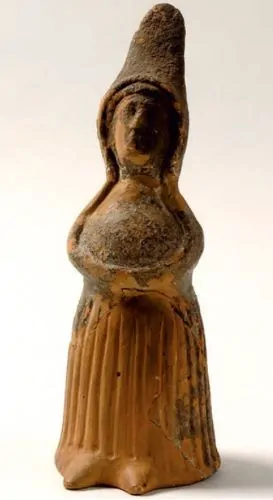
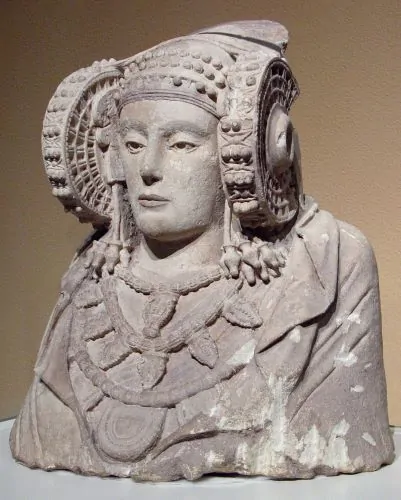
During this time, women held prominent positions and were frequently depicted on ex-votos (Fig. 2), sculptures and paintings in association with all the signs of aristocratic distinction, as seen with great realism in remarkable creations such as the so-called ‘Dama de Elche’ (Lady of Elche)7 and the ‘Dama de Baza’ (Lady of Baza).8 Women are depicted in images painted on pottery as key figures not only in ceremonial and ritual activities such as public celebrations, funeral corteges, wedding processions, playing instruments, etc. but also as carrying out a specific type of activity, that of textile making. An analysis of the different known images of Iberian women producing textiles follows below.
Relief Sculpture of l’Albufereta
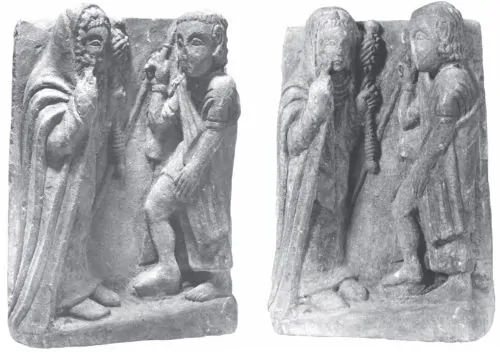
In the Iberian necropolis of l’Albufereta, a relief sculpture with polychrome painted decoration associated with tomb F-100 has been documented (Fig. 3), dated between the 4th century and the last third of the 3rd century BCE.9 It is a small plaquette, measuring 17 cm high by 12 cm wide and 5 cm thick, and is made from very fine-grained yellow sandstone, with two human figures – a woman and a man–sculpted on one of the sides in high relief.
Although missing since 1969, this relief is one of the most famous and discussed pieces of sculptural work in Iberian iconography because of the quality and complexity of its imagery. On the right side of the plaquette, there is a man standing, interpreted as a warrior because he is holding a spear in his right hand, which rests on the floor. On the left side, in front of him, a woman can be seen, slightly bending over, whose right hand is in contact with her lips and whose left hand is holding tools that have led to her being interpreted as a spinner.10 The tools are a distaff bearing textile fibres and a spindle with a large amount of thread wound around it which is held with a biconical spindle whorl.11 Accordingly, an interpretation of the gesture she is making with her right hand is that she is moistening her lips with saliva in order to spin.12
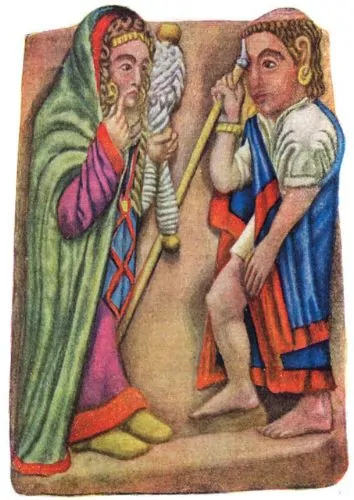
The sculpture is outstanding for two reasons: the quantity and quality of the details represented in both the man and the woman; and the symbolic complexity and dialectical
nature of the scene. In terms of the details, the quality of the realism achieved in the sculpture itself and the preservation of the pictorial imagery during the moment of its discovery endow the two figures with greater interpretative depth. The level of detailing in the hairstyle, clothing and the adornments worn is important and chosen specially to highlight the social status of the couple. The female figure’s head is covered by a long veil from which can be seen emerging two long plaits that reach down to her waist; and she is wearing a long plain tunic covered by a large rectangular cape. The survival of some of the pigments used to paint the sculpture (Fig. 4) indicates that the woman’s tunic was purple in colour and decorated with red stripes and a cobalt blue background and that the cape was a light apple green, with the selvage in red.13 The female is also richly bejewelled with a wide diadem, multiple necklaces and small pin earrings, all of which retain traces of yellow pigmentation, which are possibly intended to represent golden adornments.
The funerary context in which this sculpture was documented, together with the type of scene depicted, have given rise to the widely held interpretation that it is a farewell scene or a rite of passage towards death.14 Isabel Izquierdo,15 however, has made an important observation by highlighting the ‘rich interplay of opposites’, contrasting the feminine/masculine aspects of each figure: the objects they are carrying, thread and distaff (spinning and weaving) and spear (weaponry); and the spaces they occupy: interior (domestic sphere) and exterior (war sphere).
Lady of the Loom of La Serreta
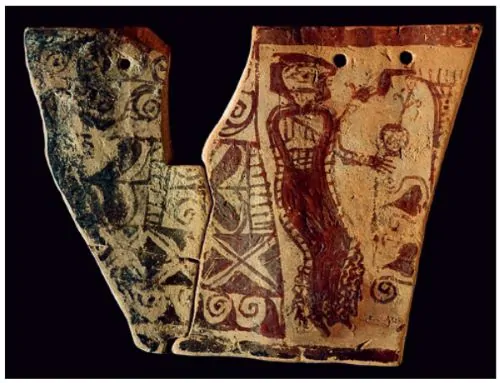
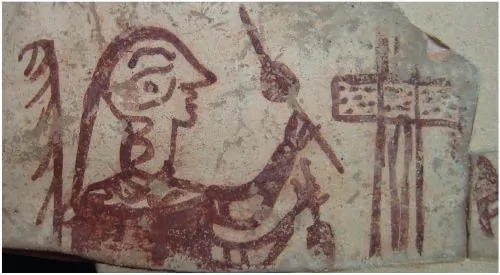
This is one of the most famous representations in painted Iberian iconography (Fig. 5). It was found in the important settlement of La Serreta16 and is a fragment from a painted ceramic plaque with a series of perforations at the top. Accordingly, it has been interpreted as a small pinakion (asmall identity plate), intended for public display.17
This is one of the most frequently discussed images among researchers due to the complexity of its composition. In it can be identified a female figure who is associated with spinning and weaving tools, and a possible decorated cloth. The female figure is located on the right side of the fragment although she would have been in the centre of the original scene. Her hands are occupied with what seem to be two different activities. Her left hand is holding a long object at one end. The fact that it bulges out in the middle and then opens out at the other end suggests that it might be a distaff with textile fibres. Underneath the hand of the female figure, a thin line runs from the end of this object, getting wider and then thinner again at the other end; this seems to be a schematic representation of a thread that is hanging down with a spindle whorl at the bottom. This scene is surprising because, with her right hand, the woman is turning a kind of crankshaft connected to a rectangular structure comprising vertical and horizontal lines, of which only the top left corner has survived. There is almost unanimous agreement among researchers that this image depicts a warp-weighted loom18 and that the woman is turning the roller located on the warp beam around which the fabric is wound as it is woven.
Regardless of whether this is a human woman spinning and weaving,19 or an idealistic model, or perhaps a goddess,20 it is nonetheless true that this female figure is dressed in garments that link her directly with women of high social ranking. She is wearing a headdress and a long flowing tunic that reaches down to her feet and which, both on account of its perfect representation and the fact that the woman is shown standing, brings movement into the scene. However, it is impossible to rule out that the intention was to depict a woman in a seated position because, despite the absence of a chair or throne, the curvature of the legs from the waist down to the knees might suggest that.
On the left side of the piece, in contrast to the figurative representation, a series of overlapping strips have been depicted, delimited longitudinally by vertical and horizontal lines and comprising various motifs with repeated geometric and vegetable elements. Given the arrangement of these elements and the presence of similar motifs in the clothing of women found in other figures of La Serreta and El Tossal de Sant Miquel, it has been suggested that this might possibly be the representation of a decorated cloth.21 If this is so, then this is an iconographic composition that aims to represent the entire process of textile production: spinning, weaving and the final product, the fabric itself.
Women Spinning and Weaving in El Tossal de Sant Miquel
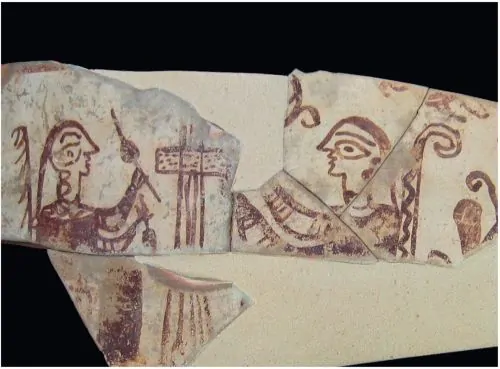
Some of the most important pieces of Iberian decorative ceramics have been found at El Tossal de Sant Miquel, an important Iberian settlement which has been identified as the Iberian town of Edeta.22 Among them, a fragment of decorated pottery stands out; it represents an intriguing scene of two women engaged in textile activities (Fig. 6). This fragment comes from the top half of a vessel used to store food; only 20% of its decorative structure remains, making it difficult to make a full iconographic interpretation.23
The scene of women spinning and weaving is part of the iconographic structure. It depicts two women shown in profile, facing one another, sitting on sumptuously decorated thrones. The woman on the left has both hands occupied in the spinning process. With one of them, at head height, she is holding a bulky shaft at the bottom, which seems to be representing a distaff loaded with fibres, whereas a little lower down the other hand seems to be twisting from the top a spindle around which a large quantity of thread has already been wound.
The other woman, sitting opposite her, is weaving. She is sitting on a throne with a figure of a bird on top of it.24 One of her hands is occupied with what has been interpreted as a warp-weighted loom. The loom is represented with two horizontal beams, one at the top and the other below it, and with a series of vertical lines, running transversally to the beams, which represent the warp of the fabric, the threads of which culminate on the loom weights. Even though the piece is broken, it is possible to see that in her right hand she is holding a flower, a palmette or a hand fan.
The fact that both women have their hair arranged in a long plait and that, unlike the Lady of La Serreta (Fig. 5), they are not wearing a veil or a headpiece, suggests that these are two young women.25 They are both dressed and adorned in similar fashion, as young ladies from a distinguished social class, wearing round-necked tunics with decorated sleeves and possibly adorned with chokers, bangles and bracelets. This association between youth and textile production, where fibre is transformed into thread and then into fabric, has been interpreted as a possible textile metaphor for a rite of initiation marking the transition from young girls to women.26
Although there are some similarities with the Lady of La Serreta, there are other important differences in addition to their age which merit closer examination. Most interestingly, perhaps, is that whereas the two women depicted in the image from Edeta are each carrying out one of the fundamental activities of textile production, i.e. spinning and weaving respectively, the image from La Serreta shows just one woman doing both actions. Nevertheless, both fragments, though narrated differently, transmit the same idea of the complete textile process.
Hand with Spindle from the Necropolis of Coimbra del Barranco Ancho
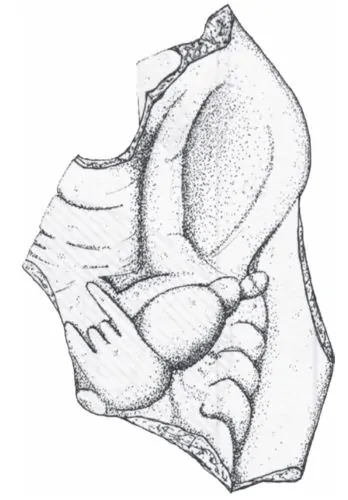
In the necropolis of Coimbra del Barranco Ancho, in the exterior space close to the tomb ‘C’, a small fragmented terracotta plaque has been documented (Fig. 7), dated by archaeologists to between the 4th and 3rd centuries BCE.27 This piece shows the folds of a dress and the presence of a hand holding a rod-shaped object that widens out at the top end. Because of these details, the object has been identified as a spindle with a ritual significance28 despite its small size and the fact that the decoration is highly schematic; and its image the depiction of a spinner woman’s hand.29 What can be seen is that the hand holding the tool is gesturing in a particular way, which has been interpreted as a symbol to ward off evil.30
Contextualizing Images: Written Sources and Archaeological Evidence
Overview
In order to interpret the meaning of the images discussed, it is essential that they are tied in with what is known about the time and the type of space in which they were produced. There are two main sources to draw upon here: the testimony of classical authors, chiefly Roman, who observed and discussed from an external perspective the lifestyles and customs of Iberian communities; and, most importantly, the archaeological record which offers particularly plentiful and valuable information.
Classical Sources and Textile Production
Classical sources shed considerable light on textile production and fabrics in relation to the Iberian communities. Their significance lies not so much in terms of the number of citations but rather in the importance they give to this production in Iberian society and its economy. The overwhelming focus of these references, which have been systematically catalogued by a number of researchers,31 has been to describe the quality of textile products – especially wool, linen and dyed fabrics – and on the celebrations and events linked to women and textile production.
When evaluating the quality of Iberian fabrics, it is important to remember how much other societies, such as the Romans, also valued them. The most ancient reference to Iberian fabrics can be found in Ennius, according to whom the Iberian sagum (rectangular wool cloak often associated with soldiers) was already a popular garment in Rome (Ann. 508–509) by the end of the 3rd century BCE. Pliny the Elder, on the other hand, writing a few centuries later, highlighted the fact that the best linen cloth came from the Iberian town of Saetabis (NH 19.2). Furthermore, Strabo (3.2.6) and Martial (5.37.7; 12.65.6) emphasise the quality of various wools made in the Iberian Peninsula; and Polybius (3.14) and Livy (22.46) noted the singularity and excellence of Iberian purple-dyed tunics.
However, some classical quotations, which have been analysed in depth, are particularly striking in this context since they link female labour and textile production with festive celebrations. These provide an insight into not only how important this type of production would have been in social terms but also how integrated it was into everyday Iberian life. One of these comments is attributed to Ephorus, who notes:
every year, the Iberian women put the fabrics they have woven on public display. Men, chosen by means of a vote, judge and honour preferably the fabric that has required the highest amount of work. They also have a certain waist measurement, and if any of their bellies cannot be covered by the fabric, this is taken to be deeply disgraceful.
Fragmenta Historicorum Graecorum 3.456
Another comes from a repertoire of singularities compiled by E. Rohde,32 according to which ‘among the Iberians, it is their custom, at certain festivities, to honour with gifts the women who have woven the most and the most beautiful fabrics’ (Paradoxographus vaticanus 25).
Archaeological Record and Textile Production
Nevertheless, it is the archaeological record which offers the most complete insights into important changes that took place in relation to textile production from the Middle Iberian period onwards (late 5th century onwards).33 The exponential increase in the tools of textile production testifies to the intensification of textile production. These tools have been documented in the many different contexts in which the Iberians carried out their social practices – not only in the settlements where they lived and worked but also in funerary contexts, in the grave goods found in tombs in necropolises, and in other religious settings such as the sanctuaries where offerings were made.
In practically all the Iberian necropolises excavated to date, spindle whorls were frequently found among the grave goods,34 marking a different local ritual practice from that found during Late Prehistory. Right up until the 1980s, this archaeological evidence was used by researchers to determine whether the cremated bodies were female or not. However, the lack of scientific rigour of this methodology and its sexist assumptions became self-evident when it was found that spindle whorls were not only to be found in women’s graves.35 Linking such artefacts with women became more problematic when it was discovered that some tombs contained far more spindle whorls than would have been needed for one or two individuals to produce different qualities of thread. For example, tomb F-42, found in the necropolis of l’Albufereta, contained 19 spindle whorls;36 tomb no. 200 of El Cigarralejo produced 56 spindle whorls;37 and tomb no. 586 of Cabecico del Tesoro held a total of 58.38
The symbolic nature of spindle whorls in Iberian rituals can also be shown in the way they were offered to deities in sacred places.39 The frequency with which such tools have been documented in sanctuaries such as Collado de los Jardines,40 as votive deposits at El Amarejo41 and in domestic spaces such as room 2 in Castellet de Bernabé42 or room 1 in El Puntal de Llops where their purpose has linked to worship,43 points to their strong association with ritual. This association emphasises the importance of spinning in the everyday life of the Iberian women, specifically among the lower classes.44 It is evident that both the clothes and the textiles themselves had a prominent role to play as offerings. Even though they have not been preserved, hundreds of fibulae have been documented in sanctuaries such as Collado de los Jardines and La Algaida, among others, which seem to bear witness to this.45
However, the relevance of textile production from the Middle Iberian period onwards can be most directly assessed from the type of spaces where production areas were located. The majority of these correspond to domestic contexts. The most significant example is the site of Castellet de Bernabé, a fortified farm almost fully excavated.46 This site reveals differences in wealth between dwellings and also the places where textile activities were carried out. The most distinguished dwelling in the settlement, based on its size (five rooms), location and wealth, is House E, the so-called ‘large aristocratic house’.47 Here, four concentrations of loom weights were documented in rooms 1, 2, 5 and 9 which have been interpreted as warp-weighted looms,48 demonstrating the importance of textile production for the highest-ranking family in the settlement, an importance that has also been noted in distinguished houses in the settlements of Mas Boscà49 and Puig Castellar.50 However, evidence of looms, often associated with mills,51 has also been found in numerous medium-sized and smaller dwellings, such as numbers 6, 7, 24, 35, 36, 37 and 40, which indicates that this textile activity was not carried out exclusively by the upper-status family. This can be seen more evidently in the case of spindle whorls, found in almost all the domestic spaces in the settlement – rooms 1, 2, 5, 6, 9, 22, 24, 28, 31, 33, 35, 36, 37, 38, 40 and 42 – and in large quantities, in open spaces and the main street.52
Similar distributions can be found in La Bastida de les Alcusses where evidence of looms has been found in different sized dwellings: in large houses between 80 and 120 m2; in medium-sized houses of around 50 m2; and in small houses of between 20 and 30 m2. Spindle whorls also appear in large numbers, i.e. in concentrations of between 12 and 39 units.53 Findings such as these can also be extrapolated to other important settlements such as Los Villares54 or El Tossal de Sant Miquel.55
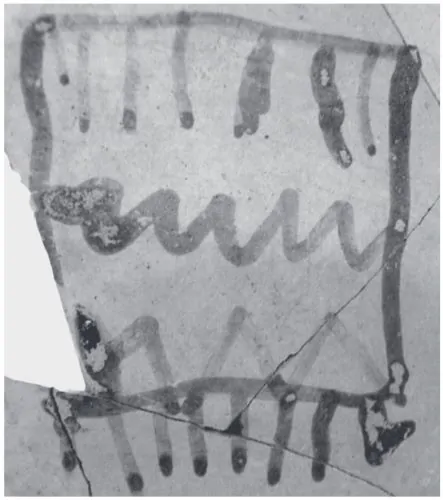
It is perhaps surprising that only one space has been found in the whole of the Iberian territory that specialised exclusively in textile production: the linen treatment and textile-making workshop in the settlement of Coll del Moro which operated until the second half of the 3rd century BCE.56 This building had spaces for the preparation and soaking of linen fibres in waterproofed basins on the ground floor,57 as well as a possible upper floor where the warp-weighted looms would have been located. Interestingly, among the painted pottery documented here, a fragment of a kalathos (basket used to hold wool fibre for spinning) was found, decorated with what has been interpreted as a loom (Fig. 8).58 The fact that, to date, this place is still unique, since no other textile workshops have been identified, seems to indicate that Iberian textile production was organised fundamentally around the domestic space and household unit.
Beyond the Symbolic: Ideology, Gender, and Textile Production
The symbolic content of Iberian iconography whereby high-ranking women are represented with the attributes of textile production has been considered by numerous authors. As with other Mediterranean societies (such as the Greeks, Etruscans, Punics)59 where similar images are also frequently found, the importance of fabric and textile tools in Iberian images has been associated with the symbology of gender, age groups, social status and rites of passage, as well as fate, memory and death.60 However, to draw such conclusions from the imagery demands that textile iconography be analysed within its particular context. To do this requires an understanding of the complexity of iconography as an art form intended to have specific social effects, to produce an impact both on those who create and exhibit it and on who view it.61 It is a form of material culture that not only presents and reinforces the dominant ideologies but has a layered meaning,62 being able to unite, divide or position the people it touches.63
Because of this complexity of meaning, it is important firstly to evaluate the importance of textile production and textiles within the social context of the Iberians. As has already been shown, there is a presence of large quantities of textile tools such as loom weights and, especially, spindle whorls in practically all the domestic spaces of the Iberian settlements so far excavated in numbers far exceeding the needs of each domestic group. This, together with the absence of specialised production spaces such as workshops, strongly suggests that textile production was highly important in the everyday economy of all Iberian social groups.64
However, not all social groups are represented in Iberian iconography. In terms of the images analysed, it is only elite women, or idealised or divine women dressed aristocratically, that are represented. This raises questions about who was allowed to see the iconography and at whom was it aimed. The material formats or objects where textile scenes were depicted fall into two groups. In the first group, the iconography painted on ceramics such as the vessel of Edeta or the plaque of La Serreta were found in private rooms where access would surely have been restricted to elite groups. In the second, the iconography on reliefs or funeral stelae such as the relief of l’Albufereta or the plaque of Coimbra del Barranco Ancho were documented in exterior spaces and places with unrestricted access such as the necropolis. These two aspects of the same iconographic content suggest two different meanings. In the case of the art destined to be exhibited and observed by members of the same dominant social group, it indicates a consensus within the elite about the importance of textile production as an activity worthy of aristocratic women. By contrast, its display on the stelae or plaques located in the necropolis promotes an iconographic message intended to be seen by the general public.
It is important here to understand the significance of textile production from the point of view of the elite and to do so it is necessary to observe differences in the way in which men and women are represented in Iberian iconography. The relief sculpture of l’Albufereta (Fig. 3) offers the best opportunity to evaluate dialectically the binary conception held by the dominant groups with regard to the two genders. In this sculpture there are two constructed genders. The man, in this case a warrior with a spear in his hand, seems to represent the ultimate masculine values in portraying the main role assigned to aristocratic men. The woman as an Iberian ‘lady’, who, though dressed in clothes and jewels that are distinctive of her aristocratic social position, evokes, by means of the distaff and spindle in her hand, the work of all Iberian women and thereby personifies them all.
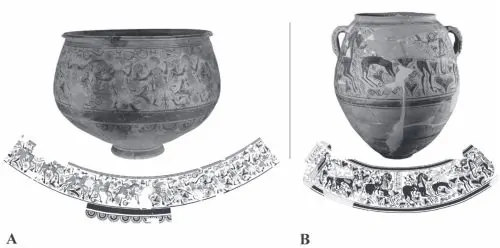
Something similar can also be seen in painted Iberian iconography with its signalled ‘aristocratic’ activities.65However, whereas in the painted images men are depicted carrying out activities that are exclusive to the aristocratic culture such as dancing, hunting, warring competitions and processions,66 the elite women are also depicted spinning and weaving. In short, the women are shown carrying out tasks that were not only regarded as being equally ‘virtuous’ for their rank but that were also typical of Iberian women of all ranks. Herein lies the most significant contrast. The ideology of the dominant groups which puts the figure of the warrior and the rider in a central position (Fig. 9) does not seem to be about constructing the image of the Iberian man in general. Instead, it seems to be focused on highlighting those features which served to socially distinguish elite men: it was a means of legitimising an unequal social order. By contrast, the images of women promoted a series of characteristics that could be attributed to all Iberian women, regardless of their social position or status, thus reinforcing the association between women and the domestic productive domain and confirming their value and contribution to society.
This association has been readily linked to the overarching role of the Iberian woman as a guarantor of the oikos (the unit of the family, house and its possessions)67 who performs an essential role in running and maintaining the home and in ensuring the reproduction of the household. These are all elements that would serve as a foundation of the female identity; they would be promoted through the examples of the imagery of high-ranking women.
Although this interpretation is likely to be correct, the meaning of this female imagery may be closely linked to a productive dimension that is intended at the same time to reinforce the social and economic importance of textile production not only for women and the Iberian society in general but also most importantly for the dominant lineages.68 It appears, for women themselves, textile production was one of the most highly valued social activities. They dedicated much of their time to this activity over the course of their lives, which might explain its use as a basic component both of ritual practices and of the imagery related to the transition from girlhood to womanhood: the festivities, rites, myths and the like. The dignity bestowed by such associations would have allowed aristocratic women themselves to feel comfortable about being linked to these activities. This in turn might well explain why textile work is one of the few productive activities represented in the iconography and is shown to be on a par with other aristocratic themes which were used to legitimise social status. It is worth noting here that only the most skilled artisans could produce fabrics fine enough to identify and distinguish the elites.
The intensification of production, including textile production, that took place from the 4th century BCE onwards69 could be a key factor here in explaining the role played by certain social groups during this period. Given that the Iberian economic structure articulated fundamentally around domestic production, the intensification of such activities must have involved an increase in production capacity. The need for the dominant lineages both to stimulate this intensification and to control it might have necessitated the development of an ideological strategy that would work to bind women tightly to the domestic sphere.
Examples of festivities and public exhibitions linked to the production of textiles by Iberian women can also be interpreted in this light. Both the quotation about the annual exhibition of garments at which a male jury honours ‘the woman who has worked the most’, and the one that narrates the giving of gifts to the ‘women who have woven the most and the most beautiful fabrics’, could be references not only to female labour, with a marked gender bias. It may also indicate the overwhelming demand for quality and, particularly, quantity of textile, an aspect proposed by certain authors as the possible raison d’êtrefor many women.70
These conjectures point to the existence of a dominant ideology that sought to highlight the relationship between women and textiles as symbolising the association between women and the domestic world (Fig. 10). It may well be that the depiction of Iberian women accompanied by textile tools was the manifestation of a pre-existing gender identity, as seen in other Mediterranean societies. In this case, however, it was also an imagery that could be harnessed politically to reproduce and consolidate the role of women as domestic producers.
It is worth considering here the role played by the women of dominant lineage in overseeing and managing this textile production. The female figure itself emerges in Iberian iconography from the 4th century BCE onwards.71 This leads to the belief that the elite women were consolidating their social position not only among Iberian women in general but also at the very heart of their society. From this perspective, this strengthening of elite women’s position in society might be linked to their need to exercise greater control over a type of production which was at the same time both a subsistence production and of strategic importance to the elites. It was in their interests to intensify it72 both to consolidate their dominant role within their communities and to control products with a high value of exchange.
Conclusion
The emergence of a recurring iconography related to textile production raises a number of questions. On the one hand, there is the social importance that elite women acquired in Iberian society through being represented in numerous images relating to textiles and textile production from the 4th century BCE onwards. On the other hand, the fact that textile production was the only productive activity depicted both in objects of public and private exhibition emphasises its social and economic significance from that point on.
A direct link can therefore be made between this social and economic process and the images of women associated with textile production. Archaeology has uncovered a great many indicators pointing to the intensification of textile household production in Iberian territories, at least from the 4th century BCE onwards. The evidence of textile tools in all areas of Iberian social life, and most significantly in the settlements, suggests that the production of thread and cloths had become a productive activity fundamental to their economy, perhaps thanks to the participation of Iberian textile products in the Mediterranean trade routes.73 However, the absence of specialised places of production (other than the textile workshop in Coll del Moro)74 with the sufficient scale and productive capacity to sustain such demand inevitably shifts the focus back onto household production.
It is important to emphasise here just how significant textile production had become to the dominant groups, groups who proudly displayed the female members of their class engaged in such activities. Textile production is the most frequently represented production activity seen in the iconography; its occurrence is on a par with other activities and practices that were distinctive and exclusive to the elite; and the value bestowed on this activity can be related to the benefits – economic, social and political – that this activity brought with it. Without doubt, textile production must have played a unique part in the accumulation of wealth among the Iberian elite, a fact reflected in the presence of so many spindle whorls in some of the wealthy tombs.75
Nevertheless, textile production was not an exclusive activity of the dominant groups; and the evidence for the existence of specialised workshops remains lacking from the archaeological record. If textile production did not expand beyond the sphere of household production at a time it was undergoing a process of intensification,76 it can be argued that ideology must have had a key role to play in stimulating this process and ensuring that it would lead to the accumulation of wealth and power amongst the dominant lineages. Textile iconography, directly or indirectly, would have been an important part of that process.
Appendix
Endnotes
- Masvidal etal. (2000); Bonet etal. (2015).
- Olmos (1999); González and Rueda (2010).
- Aranegui etal.(1997); Olmos (1999); Grau (2006).
- Grau (2014); Amorós (2019).
- Aranegui (2012).
- Grau (2014); Amorós (2019).
- Olmos and Tortosa (1997).
- Chapa and Izquierdo (2010).
- Figueras (1946, 328); Verdú (2014, 1523).
- Alfaro (1984, 75); Aranegui (1996, 96).
- Verdú (2014, 1529).
- Llobregat (1966).
- Llobregat (1966, 44).
- Aranegui (1996, 94).
- Izquierdo (2001, 301).
- Grau etal. (2017).
- Aranegui (1996, 114); Izquierdo (2001, 301).
- Alfaro (1984, 75); Izquierdo (2001, 301); Fuentes (2006, 59).
- Alfaro (1984, 75); Maestro (1989, 259–261).
- Olmos (1999); Izquierdo (2001, 302).
- Izquierdo (2001, 298); Fuentes (2006, 61).
- Bonet (1995).
- Izquierdo and Pérez (2005, 87).
- Izquierdo and Pérez (2005, 94).
- Izquierdo and Pérez (2005, 95).
- Izquierdo and Pérez (2005, 100).
- García (1997).
- García (1997, 275).
- Izquierdo (2001, 308).
- García (1997, 275).
- Castro (1983–1984); Izquierdo (2001).
- See Giannini 1965.
- Masvidal etal. (2000); Gorgues (2009).
- Prados (2011).
- Rafel (2007).
- Rubio (1986, 72).
- Cuadrado (1987, 162).
- García (1997, 189).
- Vílchez (2015).
- Vílchez (2015, 288).
- Broncano (1989).
- Guérin (2003).
- Bonet and Mata (2002).
- Grau and Rueda (2018, 65).
- Moneo (2003).
- Guérin (2003).
- Guérin (2003, 314).
- Guérin (1999; 2003).
- Junyent and Baldellou (1972).
- Masvidal etal. (2000, 113).
- Guérin (1999).
- Guérin (2003, 210).
- Bonet and Vives-Ferrándiz (2011).
- Pla (1980).
- Bonet (1995).
- Rafel etal. (1994).
- Alonso and Juan (1994).
- Rafel etal. (1994, 131).
- Picard (1967); Rouveret and Pontrandolfo (1983); Cassimatis (1990); Gleba (2008); Harlow and Nosch (2014), among others.
- Aranegui (1997); Izquierdo (2001); Izquierdo and Pérez (2005).
- Dissanayake (1995); Gell (1998); DeMarrais and Robb(2013).
- DeMarrais and Robb (2013).
- Bourdieu 1984; DeMarrais (2011); Robb (2015).
- Gorgues (2009).
- Aranegui (1997); Olmos (1999); Grau (2014).
- Grau (2014); Amorós (2019).
- Aranegui (1997); Izquierdo (2001); Izquierdo and Pérez (2005); Rísquez (2016).
- Gorgues (2009).
- Masvidal etal. (2000).
- Guérin (2005).
- Aranegui (1994).
- Masvidal etal. (2000).
- Sanmartí (2000).
- Rafel etal. (1994).
- Rafel (2007); Rísquez and García (2007); Rísquez (2016).
- Masvidal etal. (2000).
Bibliography
Affiliate disclosure: Amazon links on this site are paid links. As an Amazon Associate I earn from qualifying purchases.
- Alfaro, C. (1984) Tejido y cestería en la Península Ibérica. Historia de su técnica e industrias desde la Prehistoria hasta la Romanización. Bibliotheca Praehistorica Hispana XXI. Madrid, Instituto Español de Prehistoria.
- Alonso, N. and Juan, J. (1994) Anexo Fibras de lino en las piletas de poblado ibérico de Coll del Moro (Gandesa, Terra Alta). Estudio paleobotánico, Trabajos de Prehistoria 51.2, 137–142.
- Amorós, I. (2019) Ideología, poder y ritual en el paisaje ibérico: procesos sociales y prácticas rituales en el área central de la Contestania. Serie de Trabajos Varios-SIP 123. Valencia, Diputación de Valencia.
- Aranegui, C. (1994) Iberica Sacra Loca. Entre el Cabo de la Nao, Cartagena y el Cerro de los Santos. Revista de Estudios Ibericos 1, 115–138.
- Aranegui, C. (1996) Signos de rango en la sociedad ibérica. Distintivos de carácter civil y religioso. Revistas de Estudios Ibericos 2, 91–121.
- Aranegui, C. (ed.) (1997) Damas y caballeros en la ciudad ibérica: las cerámicas decoradas de Liria (Valencia). Madrid, Cátedra.
- Aranegui, C. (2012) Los Iberos, ayer y hoy. Arqueologías y cultura. Madrid, Ed. Marcial Pons, Colección de Historia.
- Aranegui, C., Bonet, H., Martí, M.A., Mata, C. and Pérez, J. (1997) La cerámica con decoración figurada y vegetal del Tossal de Sant Miquel (Llíria, València): una nueva propuesta metodológica. In R. Olmos and J.A. Santos (eds), IconografíaIbérica. Iconografía itálica. Propuestas de interpretación ylectura. Coloquio Internacional (Roma, 1993), Serie Varia 3, 153–175. Madrid, Universidad Autónoma de Madrid.
- Bonet, H. (1995) El Tossal de Sant Miquel de Liria. La antigua Edeta y su territorio. Valencia, Diputación de Valencia.
- Bonet, H. and Mata, C.(2002) El Puntal de Llops: un fortín ede-tano. Serie de Trabajos Varios-SIP 99. Valencia, Diputación de Valencia.
- Bonet, H. and Vives-Ferrándiz, J. (eds) 2011 La Bastida de les Alcusses (Moixent, Valencia): 1928–2010. Valencia, Diputación de Valencia.
- Bonet, H., Grau, I. and Vives-Ferrándiz, J. (2015) Estructura social y poder en las comunidades ibéricas de la franja central mediterránea. In M.C. Belarte, D. Garcia and J. Sanmartí (eds), Les estructures socials a la Gàl·lia i a Ibèria. Homenatge a Aurora Martín i Enriqueta Pons. Actes de la VII Reunió Internacional d’Arqueologia de Calafell (Calafell, 7 al 9 de marc de 2013), Arqueo Mediterrànea 14, 251–272. Barcelona, Universitat de Barcelona; Institut Català d’Arqueologia Clàssica.
- Bourdieu, P. (1984) Distinction: A Social Critique of the Judgment of Taste. London, Routledge.
- Broncano, S. (1989) El depósito votivo ibérico de El Amarejo. Bonete (Albacete). Madrid, Ministerio de Cultura.
- Cassimatis, H.(1990) Propos sur le calathos dans le céramique italiote. In J.-P. Descouedres (ed.), EYMOYΣIA: Ceramic and Iconographic Studies in Honour of Alexander Cambitoglou, 195–201. Sidney, Meditarch.
- Castro, Z. (1983–1984) Notassobre laproblemáticadeltejido. Kalathos 3–4, 95–111.
- Chapa, T. and Izquierdo, I. (2010) La Dama de Baza. Un viaje femenino al más allá. Actas del Encuentro Internacional Museo Arqueológico Nacional, 27 y 28 noviembre 2007. Madrid, Ministerio de Cultura, Subdirección General de Publicaciones, Información y Documentación.
- Cuadrado, E. (1987) La necrópolis ibérica de ‘El Cigarralejo’ (Mula, Murcia), Biblioteca Praehistorica Hispana XXIII. Madrid, CSIC.
- DeMarrais, E. (2011) Figuring the Group. Cambridge Archaeological Journal 21, 165–187.
- DeMarrais, E. and Robb, J. (2013) Art Makes Society: An Introductory Visual Essay. World Art 3.1, 3–22.
- Dissanayake, E. (1995) Homo aestheticus: Where Art Comes From and Why. Seattle, University of Washington Press.
- Figueras, F. (1946) El grupo escultórico de Alicante. Archivo Español de Arqueología 19, 309–333.
- Fuentes, M.M. (2006) Propuesta de definición del estilo pictórico de La Serreta (Alcoi, Cocentaina, Penàguila; Alacant). Recerques del Museu d’Alcoi 15, 29–74.
- García, J.M. (1997) Las necrópolis ibéricas de Coimbra del Barranco Ancho (Jumilla, Murcia): las excavaciones y estudio analítico de los materiales. Murcia, Universidad de Murcia, Servicio de Publicaciones.
- Gell, A. (1998) Art and Agency. An Anthropological Theory. New York, Oxford University Press.
- Gleba, M. (2008) Textile Production in Pre-Roman Italy. Ancient Textiles Series 4. Oxford and Oakville, Oxbow Books.
- Giannini, A. (1965) Paradoxographorum Graecorum reliquiae. Milan, Istituto Editoriale Italiano.
- González, S. and Rueda, C. (2010) Imágenes de los iberos. Comunicar sin palabras en las sociedades de la antigua Iberia. Madrid, CSIC.
- Gorgues, A. (2009) La production textile dans le nord-est du monde ibérique (VI–Is. av.J.-C.). Les spécificités d’une production domestique.Cahiers des thèmes transversaux d’ArScAn 9 (2007–2008), 59–68.
- Grau, I. (2006) Verlo para creerlo: reflexiones sobre las imágenes ibéricas de la Serreta, Alcoy. arqueología y museo. Museos municipales en el Marq, 60–69. Alicante, Diputación de Alicante.
- Grau, I. (2014) Imagen del poder y estrategias políticas en el área oriental de Iberia. In P. Bádenas, P. Cabrera, M. Moreno, A. Ruiz, C. Sánchez and T. Tortosa (eds), Homenaje a R. Olmos, Per speculum in aenigmate. Miradas sobre la Antigüedad, 355–362. Madrid, Asociación Cultural Hispano-Helénica.
- Grau, I. and Rueda, C. (2018) La religión en las sociedades iberas: una visión panorámica. Revista de historiografía 28, 47–72.
- Grau, I., Amorós, I. and Segura, J.M. (2017) El santuario ibérico y romano de La Serreta (Alcoi, Cocentaina, Penàguila): prácticas rituales y paisaje en el área central de la Contestania. Alcoi, Museu d’Alcoi.
- Guérin, P. (1999) Hogares, Molinos, Telares ... El Castellet de Bernabé y sus ocupantes. Arqueología Espacial 21, 85–99.
- Guérin, P. (2003) El Castellet de Bernabé y el horizonte Ibérico Pleno edetano. Serie de Trabajos Varios-SIP 101. Valencia, Diputación de Valencia.
- Guérin, P. (2005) Ideología y género en Contestania y Edetania. In L. Abad, F. Sala and I. Grau (eds), La Contestania Ibérica, treinta años después, 259–266. Alicante, Universidad de Alicante.
- Harlow, M. and Nosch, M.-L. (eds) (2014) Greek and Roman Textiles and Dress: An Interdisciplinary Anthology. Ancient Textiles Series 19. Oxford and Philadelphia, Oxbow Books.
- Izquierdo, I. (2001) La trama del tejido y el vestido femenino en la Cultura Ibérica. In M. Marín (ed.), Tejer y vestir: De la Antigüedad al Islam, Estudios Árabes e Islámicos, Monografías 1, 287–311. Madrid, CSIC.
- Izquierdo, I. and Pérez, J. (2005) Grupos de edad y género en un nuevo vaso del Tossal de Sant Miquel de Llíria (Valencia). Saguntum 37, 85–103.
- Junyent, E.J. and Baldellou, V. (1972) Estudio de una casa Ibérica en el poblado de Mas Boscá, Badalona (provincia de Barcelona). Príncipe de Viana 126–127, 5–68.
- Llobregat, E. (1966) La escultura ibérica en piedra en el País Valenciano. Bases para el estudio crítico contemporáneo del arte ibérico. Archivo de Arte Valenciano 37, 41–57.
- Maestro, E.M. (1989) Cerámica ibérica decorada con figura humana. Monografías arqueológicas 31. Zaragoza, Universidad de Zaragoza.
- Masvidal, C., Picaza, M. and Curià, E. (2000) Desigualdad política y prácticas de creación y mantenimiento de la vida en la Iberia septentrional. Arqueología espacial 22, 107–122.
- Moneo, T. (2003) Religio Iberica. Santuarios, ritos y divinidades (Siglos VII–I a. C.). Bibliotheca Archaeologica Hispana 20. Madrid, Real Academia de la Historia.
- Müller, K. (1849) Fragmenta Historicorum Graecorum. Vol. III. Paris, Ambrosio Frimin-Didot.
- Olmos, R. (ed.) (1999) Los iberos y sus imágenes. Madrid, Ed. Micronet/CSIC.
- Olmos, R. and Tortosa, T. (eds) (1997) La Dama de Elche: Lecturas desde la diversidad. Madrid, Agepasa.
- Picard, C.G. (1967) Sacra Punica. Etude sur les masques et rasoirs de Carthage. Karthago 13, 1–115.
- Pla, E. (1980) Los Villares (Caudete de las Fuentes). Serie de Trabajos Varios-SIP 68. Valencia, Diputación de Valencia.
- Prados, L. (2011) Género e identidad en los contextos funerarios ibéricos (V–I a. C.). In L. Prados (ed.), Arqueología y género: mujer y espacio sagrado. Haciendo visible a las mujeres en los lugares de culto de la época ibérica, 201–220. Madrid, Universidad Autónoma de Madrid.
- Rafel, N. (2007) El textil como indicador de género en el registro funerario ibérico. In P. González, C. Masvidal, S. Montón and M. Picazo (eds), Interpreting Household Practices: Reflections on the Social and Cultural Roles of the Maintenance Activities, Treballs d’Arqueologia 13, 115–146. Bellaterra, Universitat Autònoma de Barcelona, Centre d’Estudis del Patrimoni Arqueològic de la Prehistòria.
- Rafel, N., Blasco, M. and Sales, J. (1994) Un taller ibérico de tratamiento de lino en Coll del Moro de Gandesa (Tarragona). Trabajos de Prehistoria 51.2, 121–136.
- Rísquez, C. (2016) Cuidadoras, gestoras y productoras: trabajos de mujeres en el registro arqueológico de las sociedades iberas. In A. Delgado and M. Picazo (eds), Los trabajos de las mujeres en el mundo antiguo. Cuidado y mantenimiento de la vida, 45–57. Tarragona, Institut Català d’Arqueologia Clàssica.
- Rísquez, C. and García, A. (2007) ¿Actividades de mantenimiento en el registro funerario? el caso de las necrópolis iberas. In P. González, C. Masvidal, S. Montón and M. Picazo (eds), Interpreting Household Practices: Reflections on the Social and Cultural Roles of the Maintenance Activities, Treballs d’Arqueologia 13, 147–173.
- Robb, J. (2015) Prehistoric Art in Europe: A Deep-time Social History. American Antiquity 80.4, 635–654.
- Rouveret, A. and Pontrandolfo, A. (1983) Pittura funeraria in Lucania e Campania. Puntualizzazioni cronologiche e proposte di letura. Dialoghi di Archeologia 2, 91–130.
- Rubio, F. (1986) La necrópolis de la Albufereta de Alicante (Valencia. España). Academia de Cultura valenciana, Serie Arqueológica 11. Valencia, Academia de Cultura Valenciana.
- Sanmartí, J. (2000). Les relacions comercials en el món ibèric. In C. Mata and G. Pérez-Jordà (eds), Ibers: agricultors, Artesans i comerciants, III Reunió sobre Economia en el Mon Ibèric, Saguntum Extra 3, 311–328. Valencia, Universitat de València.
- Verdú, E. (2014) La necrópolis ibérica de l’Albufereta. Ritos y usos funerarios en un contexto de interacción cultural. PhD thesis, Universidad de Alicante.
- Vílchez, M. (2015) Tejido y rito en espacios de culto Iberos: las fusayolas como objeto de estudio. Revista Atlántica-Mediterránea de Prehistoria y Arqueología Social 17, 281–288.
Chapter 8 (107-119) from Textiles in Ancient Mediterranean Iconography (Ancient Textiles Series 38), edited by Susanna Harris, Cecilie Brøns AND Marta Zuchowska, (Oxbow Books, 02.03.2022), published by OAPEN under the terms of a Creative Commons Attribution 3.0 Unported license.
About the Author