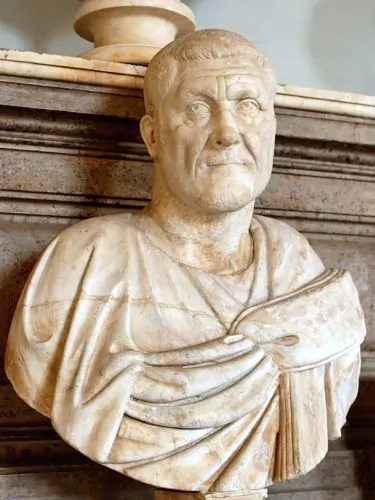
In 238 CE, Rome’s Senate defied Maximinus Thrax, recognized the Gordians, and elected Pupienus and Balbinus. Victory at Aquileia could not protect its emperors from Rome’s own guards.

By Matthew A. McIntosh
Public Historian
Brewminate
Introduction: The Rebellion That Survived Its Emperors
In 238 CE, a revolt in the Roman province of Africa challenged Emperor Maximinus Thrax. Its supporters proclaimed the provincial governor, Gordian I, and his son, Gordian II, rival emperors; the Senate in Rome recognized them. Forces loyal to Maximinus then defeated the uprising near Carthage. Gordian II died in the fighting, and his father took his own life. News of their deaths reached senators who had publicly rejected Maximinus, although he still commanded an army and was advancing toward Italy. The men the Senate had endorsed could no longer lead its cause. Whether the senators would seek new leaders or face the ruler they had condemned became the immediate question.
The Senate’s position had developed through choices made at different moments. Soldiers had elevated Maximinus in 235 CE, and senators subsequently confirmed his rule and served under him. Their endorsement of the Gordians three years later was a decision to abandon an existing emperor, rather than the culmination of continuous, united resistance. The African revolt offered senators an alternative with aristocratic standing and ties to Rome, but recognizing its leaders required more than expressing a preference. The Senate treated Maximinus as a public enemy and appealed to governors beyond Italy, asking officials with provincial responsibilities and troops to take its side. Its authority to confer imperial honors could give the Gordians a powerful claim; it could not compel those governors to accept them. Nor can the surviving accounts establish that every senator acted from the same conviction. Hostility to Maximinus, concern over his government, loyalty to the Gordians, and calculation about the revolt’s prospects could all bear on a decision whose consequences were shared. The defeat in Africa changed those prospects abruptly. It left the Senate’s opposition exposed while removing the emperors around whom that opposition had gathered.
The senators answered by choosing two of their own members, Pupienus and Balbinus, as joint Augusti. An extraordinary committee of twenty senators helped direct resistance, though the evidence does not settle every question about when it was formed. The choice of emperors also met opposition from people in Rome who wanted the Gordian family represented; the young Gordian III received the lesser title of Caesar. A senatorial decision had to contend with demands outside the meeting place in which it was made. As the new rulers prepared for war, armed conflict within the capital showed how difficult it would be to govern in the name of a united opposition.
My purpose is to examine what the Senate did after the African revolt failed. Its central argument is that the senators sustained a rebellion already made public and used their institutional authority to give it new leadership and practical direction. Fear of Maximinus was part of that decision, but the subsequent appointments, appeals, and defense of Italy require examination as acts of government as well as self-preservation. Their results were substantial and limited. Resistance at Aquileia stopped Maximinus’s advance, and his own soldiers killed him; praetorians later murdered Pupienus and Balbinus. Herodian supplies the fullest narrative of these events, while the later Historia Augusta preserves additional claims that must be handled cautiously. Their accounts cannot make the Senate a single-minded actor or establish that its decrees controlled every outcome attributed to them. They do allow us to ask how far senators could make their choice of emperor effective and why success against Maximinus did not secure the emperors they chose.
Maximinus and the Limits of Senatorial Acceptance
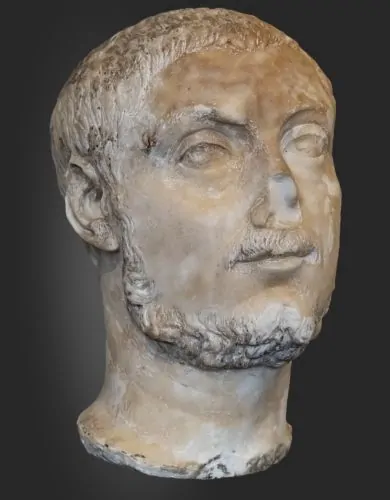
Maximinus owed his elevation to soldiers who had lost confidence in Severus Alexander, but he was already an experienced officer in Alexander’s service. Herodian places him in charge of training recruits and describes the men’s admiration for a commander who shared their work and rewarded it. When they acclaimed him in 235 CE, Alexander was killed and the Senate faced a ruler selected outside Rome. It confirmed Maximinus’s position, giving his reign the customary public recognition that military support alone did not supply. That acknowledgment did not require senators to admire his accession or forget Alexander’s death. It did give them a place in a government whose decisive choice had been made elsewhere. Herodian’s stories of Maximinus’s childhood as a Thracian shepherd heighten the social distance between the new emperor and Rome’s aristocracy; they are less secure evidence for his origins than for the way a writer could make his rise appear disturbing.
Maximinus spent his reign with the frontier armies, first campaigning beyond the Rhine and then directing operations along the Danube. Herodian credits him with courage in battle even while depicting his conduct toward Romans harshly. A commander facing threats on those frontiers had strong reasons to remain with his troops, and victories gave him something to offer constituencies far from the fighting. He sent accounts of a German campaign to the Senate and the Roman people and ordered a large representation of a battle displayed outside the Senate house. The picture made his service visible in the capital and asked its viewers to recognize military achievement as a reason for accepting his rule. Such communication was politically purposeful. It also had limits. A report could announce success, but it could not reproduce the meetings and ceremonies through which emperors ordinarily managed relationships with leading senators. Maximinus never visited Rome as emperor. His absence reduced opportunities to hear objections directly, resolve disputes over appointments, or show deference in person to an assembly whose formal approval he had sought. None of this proves that he was incapable of politics. It shows that he pursued support through victories, messages, and officeholding while foregoing forms of contact that might have helped sustain senatorial confidence when difficulties arose.
Those appointments complicate the image of an emperor at war with the entire senatorial order from the outset. Senators continued to govern provinces and command legions during his reign, and advancement remained possible for men serving him. Cooperation did not erase resentment among those who felt excluded or threatened, but service under Maximinus cannot be treated as a mere pause before an inevitable revolt. Herodian says that he removed advisers associated with Alexander and describes a conspiracy involving the senator Magnus; he also concedes that the alleged plot was never properly investigated and might have been invented. His sweeping portrait of suspicion cannot tell us how every senator judged the emperor. The evidence instead points to relationships that differed according to office, personal ties, and exposure to imperial decisions.
Money put additional strain on those relationships. Herodian reports prosecutions and confiscations affecting prominent men, followed by demands upon civic funds and valuables dedicated to the gods. His account is arranged to show an emperor exhausting the property of the wealthy before reaching resources used by whole communities. It is a forceful explanation of how private grievances could spread, but its scale and its assignment of motive require scrutiny. The same narrative says that no enemy was under arms while describing an emperor whose campaigns required substantial expenditure. Paying, equipping, and supplying the armies offers a more credible reason to seek revenue than the assertion that Maximinus simply coveted everything he could seize. Military necessity would not have made an assessment less painful for those required to pay it or protected them from an official using the demand as an opportunity for extortion. Senators and provincial landowners could experience the government’s financial reach differently from soldiers who depended on its proceeds. Nor can every seizure Herodian alleges be verified independently. The important question here is how pressure to finance the reign could create opponents without requiring us to accept his account of a single, universally hated tyrant.
By early 238, Maximinus possessed an army, an established administration, and senators who still worked within it. He also faced sources of discontent that military success could not necessarily settle, which included anxieties about the treatment of prominent men, demands for resources, and the lack of a durable personal relationship with Rome’s governing elite. Their relative importance is difficult to measure, especially when the fullest surviving narrative explains events through the emperor’s character. The revolt that began in Africa did not reveal a Senate that had secretly acted as one body against Maximinus for three years. It offered senators with differing histories under his rule a new decision about where their interests and duties lay. Understanding why they made that decision requires looking at the African challengers, the news that reached Rome, and the actions the Senate took while Maximinus still commanded his armies.
The First Public Break: Recognition of the Gordians
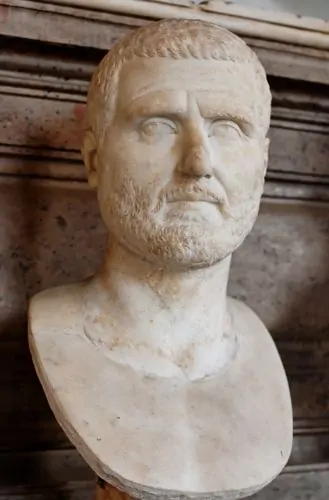
The challenge to Maximinus began at Thysdrus, where an imperial procurator’s demands brought him into conflict with young men from wealthy local families. Herodian says that he used legal proceedings to threaten their property and inheritances. They asked for time to pay, gathered others who feared similar treatment, and summoned laborers from their estates with weapons concealed beneath their clothing. The young men killed the procurator; the laborers helped drive off his guards. This was an uprising in which landowners and those working for them played different parts, not evidence that every social group in Africa shared the same grievance. Herodian presents the official’s conduct as an expression of Maximinus’s greed, but the precise instructions he had received are unknown. The killing left its organizers facing imperial punishment. To survive it, they needed to extend their defiance beyond the men who had carried out the attack.
They approached Gordian I, the elderly proconsul of Africa, and proclaimed him emperor. His career made him a plausible choice for men hoping to attract support in Rome. He was a senator and former consul who had governed other provinces before receiving the African proconsulship. Herodian portrays Gordian as surprised and threatened into accepting the purple, then allows that the prospect of imperial honor also appealed to him. Neither part of that portrait establishes what Gordian had intended before the procurator’s death. Within days he moved from Thysdrus to Carthage, where a large city could sustain the ceremonies and administration expected of an emperor. His son, Gordian II, shared the imperial title, and supporters replaced Maximinus’s images with those of the new rulers. The name Africanus advertised where their claim had arisen. Each step gave a local act of violence a wider political form, but none supplied the military strength needed to make the claim secure. The Gordians’ connections and standing help explain why their supporters might expect a favorable reception from senators; they do not prove that the Senate had planned the African outbreak.
Gordian also sought that reception directly. According to Herodian, he sent personal letters to prominent men in Rome, including senators among his friends and relatives, as well as public messages addressed to the Senate and people. He promised to curb informers, reconsider unjust judgments, recall exiles, and provide payments to soldiers and civilians. His agents then killed Vitalianus, the praetorian prefect and a supporter of Maximinus, by presenting sealed dispatches that gained them a private audience. The Historia Augusta instead attributes the killing to the Senate’s command. Its version cannot simply be combined with Herodian’s to produce a settled sequence of orders and decisions. Both accounts show why control of the prefecture mattered. An armed official in Rome could have obstructed the Gordians’ appeal before senators had openly endorsed it.
Events in the capital moved amid rumor as well as formal deliberation. Herodian reports that word spread that Maximinus himself had been killed, although he remained with his army. People tore down his statues and other honors; even the representation of his German victory displayed near the Senate house was removed. The senators met and recognized Gordian I and Gordian II as Augusti. The Historia Augusta also presents Maximinus’s declaration as a public enemy, though its purported record of the meeting, complete with speeches and acclamations, should not be treated as a transcript. What matters is the action the sources broadly attest. The assembly accepted rival emperors and repudiated the man whose rule it had previously confirmed. That decision supplied the African claimants with recognition from Rome while exposing the senators to the consequences if Maximinus prevailed. The surrounding violence must remain part of the account. People attacked officials and suspected informers, but Herodian also describes killings arising from private feuds and the death of Sabinus, the city prefect, while he tried to restrain the disorder. Senatorial recognition occurred in a capital where no single body controlled what opposition to Maximinus would become.
The Senate next tried to carry its decision into the provinces. It sent delegations of senators and distinguished equestrians to governors with letters asking them to support the Senate and the commonwealth. Herodian describes an appeal to Rome as the traditional seat of authority belonging to its people. That language made the conflict larger than a contest between two households. A governor who sided with Maximinus could now be depicted as resisting Rome’s declared choice. An appeal was not an order that every provincial commander would execute. Herodian says many governors welcomed the embassies, while others detained or killed the envoys; evidence for individual provincial loyalties remains uneven. Governors had troops, local obligations, and reasons to judge which claimant might survive. The letters show what the Senate sought to organize and how it justified that effort, but they cannot by themselves measure the support it had obtained across the empire.
Maximinus still commanded forces capable of answering the challenge. Herodian gives him a speech that dismisses the African claimants and the Roman opposition as weak, then describes his preparations to march on Italy. Its words are best read as the historian’s presentation of the emperor’s case, not a reliable record of what Maximinus said to his soldiers. Closer to Carthage, the governor of Numidia, Capellianus, remained loyal to him and commanded experienced troops. Recognition in Rome had changed the political standing of the Gordians without resolving the military contest on which their survival depended. The Senate’s first public break was consequential because it turned an African succession claim into a choice presented to officials throughout the empire. Whether that choice could be sustained would soon be decided first in Africa.
Defeat in Africa and the Danger of Return
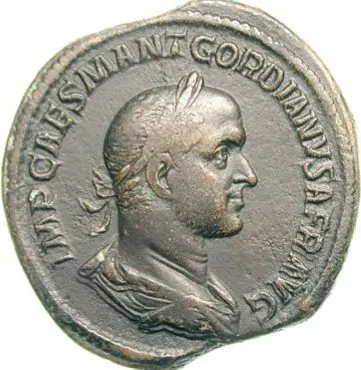
The threat to the Gordians came from a neighboring province whose governor answered to Maximinus. Capellianus, a senator appointed to govern Numidia, commanded troops that included the experienced Third Augustan Legion. Gordian I governed Africa Proconsularis, where his supporters had acclaimed him, but his new imperial title did not give him control of Capellianus’s command. Herodian says the two men had previously been involved in a lawsuit. After becoming emperor, Gordian ordered Capellianus to leave office and sent a replacement; the governor instead called on his soldiers to honor their oath to Maximinus. The personal dispute may help explain his decision, though loyalty to the ruler who had appointed him also gave him a clear political reason to resist. Capellianus’s rank matters here. A senator with a substantial army chose Maximinus over the emperors recognized by his fellow senators in Rome.
Capellianus marched toward Carthage with men trained for warfare on the Numidian frontier. Gordian II went out to meet them at the head of the forces his father’s supporters could assemble. Herodian describes Carthaginians carrying household weapons and making shields from leather and wood; his contrast between inexperienced townspeople and practiced soldiers is drawn for dramatic effect. Even allowing for that presentation, the difference in military resources was decisive. The Gordians’ supporters had gained a major city and recognition from Rome, but neither achievement had supplied a force comparable to the legion advancing against them. Their fighters broke before Capellianus’s troops, and the retreat became particularly deadly as people pressed toward the city gates. Gordian II was killed; Herodian says his body could not be recovered among the dead. The disaster showed how quickly an imperial claim could lose its position in the province where it had begun. It also left Carthage exposed to a commander whose authority the Gordians had tried to remove.
The elder Gordian’s final hours are less certain than a simple sequence of battle, news, and suicide suggests. Herodian preserves one account in which Gordian I took his life when he learned Capellianus was approaching, before his son fought. He gives another in which Gordian acted after news of the defeat reached him. The Historia Augusta follows the latter order, but its further details do not settle the disagreement. Both accounts agree on the outcome. Gordian II died in the fighting, Gordian I killed himself, and neither remained to direct the rebellion. The uncertainty matters because it prevents us from turning the father’s death into a confidently reconstructed response to a particular report. It does not lessen the political consequences of losing both emperors within so short a time.
Victory brought violence beyond the battlefield. Herodian says that Capellianus executed prominent survivors in Carthage, seized public and private funds, and allowed property to be plundered. He then describes punishment in other communities that had removed Maximinus’s honors, including killings, exile, and damage to farms and villages. The extent of every reported action cannot be independently established, and Herodian’s suggestion that Capellianus was cultivating an army for a possible bid of his own is an interpretation of motive rather than a demonstrated plan. Yet the accounts of reprisals make clear what allegiance had come to mean for people who had visibly supported the Gordians. Those people were not a single political class with identical reasons for joining the revolt. Local interests at Thysdrus, connections to the Gordians, and identification with Rome could coexist in African communities. The defeat exposed them all to decisions made by the victorious governor and his soldiers. Senators awaiting news in the capital had reason to consider that example, while also recognizing that Maximinus would decide for himself how to deal with Rome.
Their danger was serious without being identical for every member of the Senate. The assembly had granted imperial honors to Maximinus’s rivals and sought support from governors elsewhere; some individuals had taken prominent roles, while others may have followed the majority with reservations. Accounts of violence in Rome further complicated the position of anyone hoping to make peace. Vitalianus, the praetorian prefect loyal to Maximinus, had been assassinated by agents from Africa, although Herodian and the Historia Augusta differ over who directed them. Sabinus, the city prefect, had been killed amid disorder that the Senate did not control. Herodian also reports harsh treatment of envoys who fell into Maximinus’s hands.
These events offered grounds to fear retaliation, but they do not establish that the emperor had drawn up one sentence for all senators or that negotiation was impossible. The difficulty was political as well as personal. Men who had urged others to reject Maximinus would have to explain any reversal to those still acting on their appeal. Selecting new leaders offered a way to protect themselves while continuing to defend the authority they had exercised.
Maximinus had set his army in motion toward Italy before the collapse at Carthage became known in Rome. The African victory removed the Gordians but did not end the conflict with the Senate, and it gave his advance a more alarming prospect for those who had opposed him. Capellianus’s success did not prove that every governor or community would now return to Maximinus. Reports traveled at different speeds, and the extent of support for either side remained uncertain. The senators had to act under that uncertainty, with the emperor’s forces approaching and no living Augustus of their own. Their next meeting would address the problem the African defeat had created. Who could lead the opposition now, and by what authority could the Senate place them in command?
The Vote on the Capitol: Choosing Pupienus and Balbinus
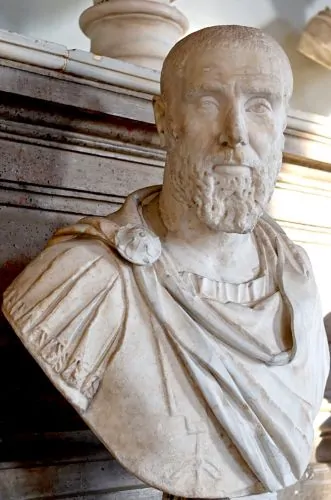
With the Gordians dead, the Senate had to appoint leaders for the war it had declared against Maximinus. Herodian places its emergency meeting inside the temple of Jupiter on the Capitoline Hill, where the senators deliberated behind closed doors. In his telling, the setting placed their decision before Rome’s chief deity, although that description may owe something to the historian’s wish to give the vote solemnity. The Historia Augusta names the Temple of Concord instead and has the newly chosen emperors ascend the Capitol afterward. It also assigns the meeting a July date that cannot be trusted. The sources establish the Senate’s choice more securely than they establish the room in which it was made.
Herodian describes a contest among candidates of senior standing. Several men received votes, but Marcus Clodius Pupienus Maximus and Decimus Caelius Calvinus Balbinus won the greatest support; the Senate then proclaimed both Augusti and conferred the imperial honors upon them. His account permits no reconstruction of the vote totals, the nominations, or the arguments made before ballots were cast. The Historia Augusta supplies what Herodian leaves out. A senator nominates the pair in a lengthy speech, and his colleagues answer with unanimous acclamations. That neatly staged agreement is poor evidence for the words spoken at an emergency meeting. Another passage in the same work says that the two were selected from a commission of twenty senators previously appointed to protect the state. The commission is independently attested, and its members may well have furnished the candidates, but Herodian does not identify them as the voting field. What matters for this meeting is the authority the Senate claimed to exercise; it chose emperors from its own membership and gave its decision the form of an imperial appointment.
Pupienus offered experience suited to the approaching conflict. Herodian knew him chiefly as Maximus and credits him with military commands as well as service as prefect of Rome; his coinage confirms that Pupienus and Maximus belonged to the same man. The Historia Augusta adds a long sequence of earlier posts and campaigns, though every detail of that career cannot be verified. His tenure as urban prefect gave senators a more immediate measure of him. He had administered the capital firmly enough to be respected for diligence and feared for severity, two judgments that Herodian places surprisingly close together. The apparent inconsistency suggests that a reputation among senators and officials need not have matched the experience of residents subjected to his policing. For an assembly seeking someone who could direct armed preparations and enforce decisions in Rome, that record was a reason to choose him. It also made his reception beyond the assembly uncertain.
Balbinus brought a different record of public service. Herodian identifies him as an aristocrat, twice consul, and a former provincial governor whose administration had attracted no complaint. The Historia Augusta enlarges that portrait with a long list of provinces, inherited wealth, literary accomplishments, and an agreeable temperament. Its biographer even invites readers to treat the two emperors as a literary pair, one stern and the other genial. Such characterization makes a tidy explanation for their selection, but the evidence for Balbinus’s individual posts is thinner than the portrait suggests. His consular rank and standing among his peers supplied a credible partner for Pupienus; a supposed division between a soldier and a civilian explains too much too easily.
Why give both men the title Augustus? Herodian attributes the decision to a desire to keep supreme power from resting with one ruler, lest another tyrant emerge. The Historia Augusta offers a practical argument in its purported senatorial speech. One emperor could manage affairs at home while the other conducted the war. Neither account preserves a reliable transcript of the Senate’s reasoning, and the two considerations could have appealed to different voters at once. Rome had known joint emperors before, including Marcus Aurelius and Lucius Verus, while Gordian I and II had recently shared the title as father and son. Pupienus and Balbinus were unrelated senators elevated together during an active civil war. Each received imperial honors in his own right, rather than serving as the other’s designated heir or junior deputy. Their subsequent assignments would fit the contrast between military and urban experience, but the vote itself established equal rulers. The arrangement may have evoked Rome’s older habit of paired magistrates without restoring republican government; the Senate had entrusted its cause to two emperors.
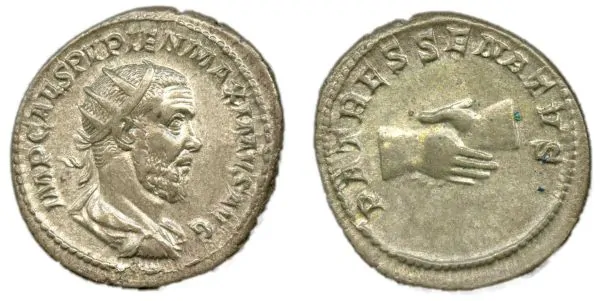
Coinage shows how the new regime presented that arrangement outside the meeting. Issues in the names of both rulers carry CONCORDIA AVGG, proclaiming harmony between the Augusti. A silver coin bearing Pupienus’s portrait places PATRES SENATVS beside clasped hands, giving unusual prominence to the emperors’ relationship with the Senate. These are statements issued after the election, rather than records of its debate. They show that cooperation between the two men, and their closeness to the body that chose them, needed public expression. The images cannot establish that their partnership was already secure or that the senators had agreed on a detailed constitutional program. They do reveal a distinctive claim of this reign. Imperial authority would be exercised jointly by men whose selection the Senate could present as its own act.
The vote turned the Senate’s opposition into a government capable of issuing commands under the names of recognized Augusti. That was a substantial achievement after the loss of the Gordians, yet its formal completion reached only those inside the assembly. Maximinus still commanded an army, and no ballot on the Capitol could determine how Rome’s inhabitants or its soldiers would receive the men chosen above them. Herodian reports that a crowd was gathering outside while the senators deliberated. Its presence did not undo the election, but it exposed a question the vote had left unsettled: whose acceptance would the new emperors need in order to leave the Capitol and rule?
The Twenty Men and an Emergency Government
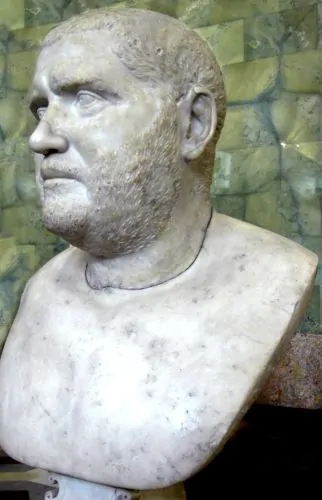
The commission of twenty appears to have preceded the election of Pupienus and Balbinus, although its date cannot be fixed securely. The Historia Augusta places its creation when the Senate recognized the Gordians. Twenty senators were chosen and assigned districts of Italy to defend against Maximinus. The same work later says that Pupienus and Balbinus were selected from their number after the Gordians died. Herodian recounts the election but does not describe the commission’s formation. If the earlier dating is substantially right, the Senate had begun organizing the defense of Italian territory while the African emperors were still alive.
An inscription recording the career of Lucius Caesonius Lucillus Macer Rufinianus gives the commission firmer documentary footing. It identifies him among the twenty appointed by senatorial decree to care for the commonwealth. The wording establishes a public assignment, though it does not specify how the commissioners voted, how long they served, or what authority they exercised in relation to the new emperors. Caesonius’s inscription also records his earlier service as a judicial decemvir, one of the minor magistrates who made up the ordinary vigintiviri at the beginning of a senator’s career. His later appointment was to an extraordinary body of senior men during a civil war. Both offices appear in one career record, but they belonged to different stages of political life and answered different needs.
Only seven members of the emergency body can now be identified or plausibly proposed, so its full composition remains unknown. Their recorded careers nevertheless show why administrative experience mattered alongside military standing. Before 238, Caesonius had overseen the Tiber channel and Rome’s water and grain services; he had also held municipal curatorships at Suessa and possibly Puteoli. Other known members came from both patrician families and less established senatorial lines. That range suggests a group able to deal with civic resources as well as armed defense, although the surviving names cannot establish precisely how the Senate chose all twenty.
Dividing Italy among commissioners imposed work on communities far beyond Rome. In its account of preparations after Pupienus departed, the Historia Augusta describes senators of several ranks sent to towns to organize provisions, weapons, and repairs to their walls. Those envoys cannot all be identified as members of the twenty, but their instructions show the wider effort within which the commission’s regional assignments operated. Moving produce from fields into fortified towns could feed residents during an attack and leave less for Maximinus’s army to seize on its march. It also required people to transport supplies and reinforce defenses at considerable risk if the opposing emperor prevailed. Herodian reports that young men were summoned from across Italy and armed with whatever equipment was available, a sign of the haste with which a defensive force was assembled. He later describes former consuls and selected men guarding roads and harbors to restrict the movement of supplies and information. The ancient accounts report these measures at different points in the campaign, and neither allows every order to be traced to a meeting of the twenty. What the regional assignments required is clearer. Italian towns had to provide the labor, food, and compliance that decrees issued in Rome could not supply by themselves.
Aquileia shows how a senatorial appointment worked in one threatened city. This port on the northeastern approach to Italy had substantial resources, but Herodian says its walls had deteriorated during a long period of peace. Its inhabitants repaired the defenses, while two former consuls, Rutilius Pudens Crispinus and Tullius Menophilus, directed preparations and assembled provisions. An inscription independently identifies Crispinus as a commander chosen by senatorial decree for the Aquileian war. The evidence gives him a formal mandate and credits the townspeople with essential work. Defending Aquileia depended on both.
The twenty constituted an emergency government in the limited sense that the Senate entrusted named members with responsibility for defending parts of Italy. Their appointment let it organize commands and regional preparations while Pupienus and Balbinus held imperial office. No surviving decree defines the commissioners’ full powers, and there is no evidence that they enacted laws. Nikolas Hächler connects their charge to older Roman ideas of caring for the commonwealth, while observing that the Senate continued to govern through emperors rather than abolishing imperial rule. The commission’s most demonstrable achievement was organizational; it assigned senior senators to a war whose demands would be met in towns, ports, and fortified approaches. Whether those assignments could stop Maximinus depended on the people carrying them out as his army entered Italy.
Gordian III and the Limits of a Senatorial Vote
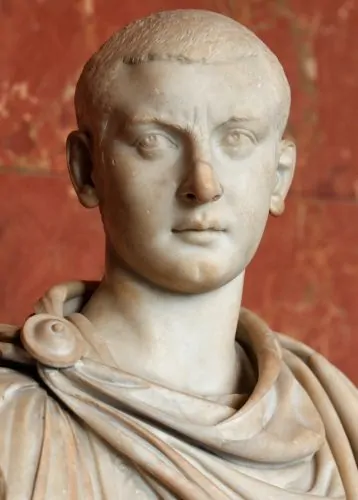
Pupienus and Balbinus had been proclaimed Augusti, but they could not leave the Capitol unchallenged. Herodian describes a crowd armed with stones and clubs blocking their way to the palace. Its anger fell notably on Pupienus, whose strict conduct as prefect of Rome had made him feared. The protesters demanded a ruler from the Gordian family and threatened the two men the senators had just chosen. The vote had filled the imperial offices; it had not secured the crowd’s acceptance of their occupants.
The demand had force because the Senate had already made the Gordian name central to its rebellion. The boy later known as Gordian III was the grandson of Gordian I through his daughter and the nephew of Gordian II. He had held no office and commanded no troops, but his grandfather and uncle had been recognized as emperors by the same Senate that now preferred two unrelated senators. Neither African Gordian had reached Rome during his brief reign, so the boy’s appeal cannot be explained by the city’s experience of their government. Their deaths in the struggle against Maximinus gave his kinship a different value. He was a living connection to the men under whose names the break with Maximinus had first been made public. Herodian also attributes the protest to fear of Pupienus’s severity. Attachment to the Gordians and distrust of one new emperor could readily coexist among the demonstrators, even if they had no common plan for how a child should rule.
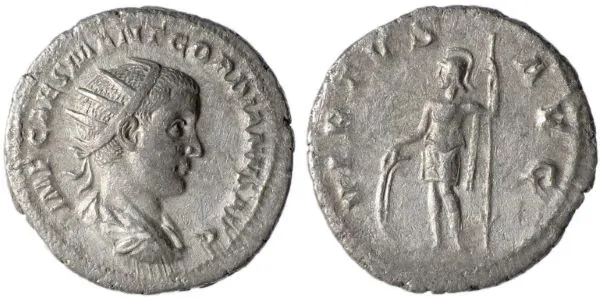
A carefully limited appointment allowed the Augusti to proceed. In Herodian’s account, attendants brought the young Gordian from his home and displayed him to the cheering crowd; the Senate then named him Caesar. The title gave him a place in the imperial hierarchy without making him the equal of Pupienus and Balbinus. A silver denarius struck at Rome calls him M ANT GORDIANVS CAES and refers on its reverse to the Augusti in the plural. A coin issued at Aegeae in Cilicia places his portrait between theirs while likewise identifying him as Caesar. The distinction made amid the protest was carried into official representations of the new government.
Who brought the demand into the streets remains uncertain. Herodian suggests that Gordian’s associates may have informed people of the vote, but he also allows that the news spread by rumor. He calls the presentation of the child a deception without explaining precisely what the crowd believed it had obtained. The Historia Augusta places a demand for Gordian after the emperors addressed the people at the Rostra and includes some soldiers among those calling for him; elsewhere it agrees that the emperors could not pass from the Capitol until he received the title. Matthias Scholler considers organized support for the Gordian family possible, while acknowledging that its part in assembling the protest cannot be measured. Herodian’s account, with its emphasis on the threatening crowd and the emperors’ need for an escort, likewise tells us more securely what happened than why every participant acted. Discharged soldiers in that escort, soldiers among the protesters in the Historia Augusta, and the praetorian guard should not be treated as one body with a single allegiance. The evidence establishes that public pressure changed the Senate’s decision. It does not establish who directed that pressure or how far acceptance of Gordian as Caesar extended among Rome’s armed men.
The appointment resolved the confrontation on the Capitol. Herodian says the crowd let the Augusti continue to the palace. It also gave each side something different from what it had first sought. Pupienus and Balbinus retained the authority to govern and confront Maximinus, while supporters of the Gordians gained a recognized place for the family within the regime. Caesar was a junior title, and its grant did not determine whether Gordian would ever become Augustus. Yet the senators could no longer treat his claim as a demand voiced only outside their meeting. They had conferred the title themselves and permitted his image and name to appear alongside the emperors they had elected. Their vote remained effective, but its final form had been shaped beyond the Senate’s chamber.
Civil War Inside Rome

In 238, the praetorian camp on Rome’s edge still housed men who had served Maximinus, although the Senate had proclaimed rival emperors. Maximinus and his main army were elsewhere, but the soldiers remaining in the capital were close enough to attend senatorial meetings and return quickly to a fortified base. Pupienus was preparing to confront Maximinus; Balbinus would be responsible for order in Rome. Neither emperor knew how the remaining praetorians would respond to the change of ruler. An encounter at the Senate house made that uncertainty violent.
Herodian describes several praetorians joining the onlookers who gathered outside the Senate house to learn what was being discussed. They wore civilian clothes and carried no weapons; two or three stepped into the chamber, passing the statue of Victory. Gallicanus, a senator who had held the consulship, and Maecenas, another senator of praetorian rank, drew concealed daggers and stabbed them. Maecenas’s rank meant that he had held the praetorship; it did not make him a member of the guard. Herodian says senators had armed themselves because they feared plots, yet he describes no attack by these visitors before their deaths. The men died beneath the statue, inside the room where the Senate conducted its business. No surviving account records a vote authorizing the killings. Herodian’s account assigns the first lethal act to two senators acting on their suspicions.
Gallicanus came out holding his bloodied dagger and called on the crowd to pursue the other praetorians. He denounced them as enemies of the Senate and Roman people, treating their service under Maximinus as proof of hostility to his opponents. People threw stones as the unarmed soldiers fled toward their camp. There the praetorians shut the gates, took up weapons, and occupied the walls. Herodian blames Gallicanus for starting a civil war, but the conflict soon depended on decisions made well beyond the Senate house.
Gallicanus opened public arsenals to equip the pursuers, although Herodian says much of their armor was intended for display rather than battle. He brought gladiators from their training schools and gathered swords, spears, and axes from houses and shops; other participants fashioned weapons from tools. This varied force attacked the camp’s gates and walls. The defenders had shields, missiles, military experience, and the advantage of height, while the attackers had to approach fortifications under fire. Arrows and long spears drove them back. Toward evening, as the assault faltered and people began to withdraw, the praetorians charged out and killed gladiators and others caught in the retreat before returning behind the gates. Gladiators could fight, but their presence gave the crowd no clear method for taking a fortified camp. Herodian calls the attackers “the people,” a collective description that leaves the size and makeup of the force uncertain.
The first repulse did not end the assaults. Herodian reports further attacks on the camp and more losses among those trying to reach its walls. Balbinus issued an edict calling for a truce and promising amnesty to the soldiers for their actions. The offer required civilians to stop attacking men they now regarded as enemies and praetorians to trust a government under which their comrades had been killed. Neither side accepted it. Herodian says the attackers resented being held off by a small garrison, while the defenders resented an assault by the city’s inhabitants.
The next attempt to force the praetorians out targeted the camp’s water supply. Once the flow was obstructed, the soldiers broke out and pursued their opponents through the streets. People who could not prevail in close fighting climbed onto roofs and threw tiles, stones, and household pots at the men below. With doors barred, the praetorians could not easily follow them into the buildings. Herodian says the soldiers set fire to houses with wooden balconies, allowing flames to spread through nearby structures. Residents were trapped by the fires; others lost homes and possessions, while soldiers and thieves plundered wealthy properties. The camp’s walls had confined the earlier assaults to one place, but cutting its water brought the defenders into inhabited streets. Buildings became positions from which to fight and, in turn, targets of attack. The costs reached people whom the sources never identify among the original crowd.
The surviving accounts cannot establish the fire’s exact extent or settle the order of every disturbance. Herodian describes watercourses diverted from the camp; the later Historia Augusta speaks of severed pipes and divides the unrest into two outbreaks. It also places an appearance by the young Gordian within this later sequence, whereas Herodian puts the dispute over his appointment earlier. François Paschoud’s comparison shows how the Historia Augusta rearranges material it drew from Herodian, so agreement between them does not supply two independent witnesses. Herodian’s claim that the burned area exceeded the size of any other intact city in the empire conveys catastrophe, but it cannot serve as a measurement. The evidence supports lethal fighting and destructive fires, without yielding a dependable death toll or map of the damage. Responsibility for the outbreak cannot be assigned to one group alone. Herodian identifies Gallicanus and Maecenas as the first killers, though he does not say the Senate ordered them to act. Armed civilians repeatedly attacked the camp; praetorians pursued them among homes and set buildings alight. Balbinus offered terms, but his edict could not reverse the killings that had made each side distrust the other. The Historia Augusta attributes his failure to a mild temperament, a judgment that says little about how he could have stopped fighting once it had spread into residential streets. Pupienus could prepare to meet Maximinus outside Rome. Within the capital, the emperors needed to restrain supporters, reach an accommodation with the garrison, and protect households caught between them. The revolt against an absent ruler had already cost Romans lives and homes.
Defending Italy and Extending the Claim to Rule
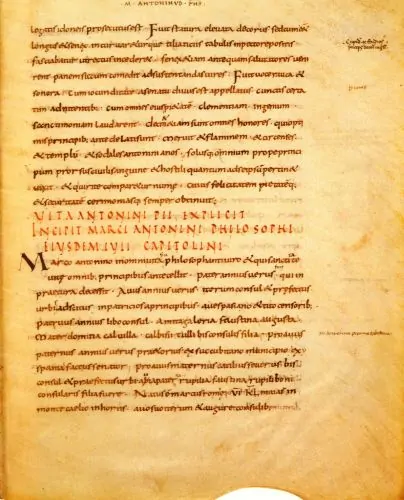
Maximinus’s march from the Danubian frontier gave the Senate’s new government a military problem that could not be settled in Rome. Pupienus traveled north to direct the opposition, while Balbinus remained in the capital. Maximinus still commanded veteran troops, cavalry, auxiliaries, and the baggage needed to sustain their advance. Pupienus could issue orders as emperor, but their effect depended on what officials and inhabitants did as the army approached. Each community on its route faced an immediate decision about shelter, provisions, and passage.
Herodian places Pupienus at Ravenna, selecting men from Rome and Italian towns for military service. He also reports that Germans came to assist him because they remembered his conduct during an earlier governorship. If that explanation is sound, an established relationship supplied help to a ruler whose imperial title was still new. Herodian gives no dependable figure for either group, and their arrival does not reveal whether the wider frontier commands accepted the Senate’s choice. Maximinus, meanwhile, had brought an organized army into motion, with its baggage protected within the marching force. The men assembling around Pupienus had yet to demonstrate that they could meet it in battle. His position at Ravenna allowed him to gather support near the threatened region, but developments farther along Maximinus’s route would determine how much time he had.
At Emona, on the site of modern Ljubljana, resistance took the form of an emptied town. Its inhabitants withdrew with supplies and burned doors before the army arrived. According to Herodian, Maximinus took their flight as a sign that communities ahead would also give way. His soldiers found little food, an early indication of the difficulty awaiting them. For the residents, depriving the army of provisions had meant leaving their own homes.
The obstruction described by Herodian reached beyond individual settlements. He reports guards posted at roads, beaches, and harbors, and says that wagons and boats were kept from Maximinus’s forces; the Historia Augusta likewise describes instructions intended to prevent provisions from reaching him. Food taken at one stop still had to be carried to the next, so the removal of transport could hamper an army even where supplies remained available. A watched landing place could have a similar effect on deliveries by sea. Such measures also imposed burdens on the people the new emperors claimed to protect. Closed routes disrupted travel and trade, while anyone abandoning a town surrendered the use of a home and its contents for an uncertain length of time. Herodian’s sweeping account does not establish that every Italian road or port was controlled by the Senate’s supporters, and neither source measures the civilian losses. It does show how decisions made by residents and local officials could affect a campaign before the opposing armies met. Their reasons need not have been identical. Fear of an approaching force, concern for their towns, and support for the Senate could all lead people to withhold assistance from Maximinus.
Aquileia brought the rival claims before the inhabitants of a major city on the northeastern approach to Italy. Its connections with inland routes and Adriatic trade made admission valuable to Maximinus. He sent a military tribune from Aquileia, whose relatives lived inside, to promise pardon if the citizens opened their gates. That offer might appeal to people confronting the prospect of an attack, even though Crispinus and Menophilus had taken command of the defense. Crispinus urged the citizens to stand by the Senate and Roman people and presented their resistance as a defense of Italy. Herodian’s speeches cannot be treated as transcripts, but they identify the competing arguments he understood the citizens to face. Aquileia’s inhabitants had to judge those promises while deciding whether to admit the army waiting outside.
The effort to secure recognition beyond Italy had begun before Pupienus and Balbinus were elected. During the Senate’s support for the Gordians, senators and equestrians carried letters to provincial governors. Herodian reports sharply different receptions. Some governors according to him welcomed the envoys, while others detained or killed them. His account supplies no reliable list of provinces prepared to support the two later emperors. Egyptian documents offer evidence of another kind. A receipt from Thebes and a contract from the Arsinoite nome name Pupienus and Balbinus in their dating formulas, placing the new rulers in the record of ordinary transactions far from Rome. A papyrus now in Heidelberg preserves part of Balbinus’s name in a similar formula, although its findspot is unknown and other names in the damaged text require reconstruction. These records establish that the emperors’ names entered documentary use in Egypt. They cannot tell us what Egyptian soldiers would have done if ordered to fight for them.
Herodian says Maximinus’s troops heard that all Italy had turned against them and that further armies were gathering abroad. He calls those reports exaggerated, so rumor cannot stand as evidence of universal allegiance. The firmer record consists of particular actions. Emona’s evacuation, recruitment at Ravenna, restrictions on transport, and the use of the new emperors’ names in Egyptian documents. Other governors had resisted the Senate’s envoys, and Maximinus remained at the head of the army moving toward Italy. Aquileia now faced that army directly. Its decision about the gates would give the competing assertions of imperial authority immediate consequences for its inhabitants.
Aquileia and the Death of Maximinus
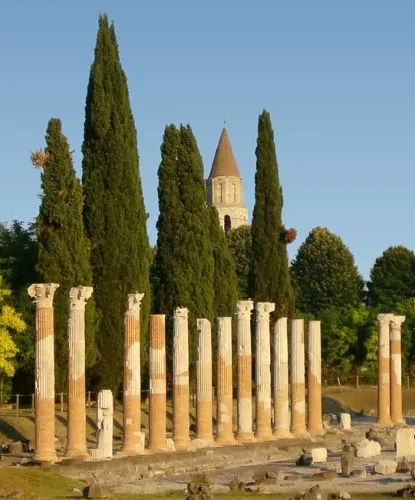
The Pannonian troops sent ahead against Aquileia had already failed to breach its walls when Maximinus brought up the main army. His approach met another obstacle at the Isonzo. The Aquileians had demolished the bridge, and melting mountain snow had swollen the river. Herodian reports that men and horses were swept away in attempts to cross. After a brief halt, engineers joined empty wine barrels into a floating support and laid a roadway over them. This improvised passage allowed Maximinus to reach Aquileia. There he faced defenders who had repelled his advance force and refused his offer of terms.
Maximinus assigned sections of the wall to his legions and ordered repeated assaults. His troops felled trees, destroyed vineyards, and stripped abandoned suburban buildings of timber for siege engines. The defenders met attacks from above with stones and arrows, then poured burning mixtures that included pitch, oil, and sulfur onto men approaching the walls. They also set fire to the attacking machines. Herodian depicts women and children alongside other inhabitants on the parapets, an image of collective resistance that does not tell us who fought in each engagement. He gives no reliable total for casualties on either side. The damage beyond the walls nevertheless forms part of his account of the fighting. The army dismantled homes and cultivated land as it sought a way into a Roman city. Maximinus and his son Maximus, who held the rank of Caesar, rode among the soldiers urging further effort and promising rewards. The assaults used men and equipment without opening the route toward Rome.
Aquileia had food inside its walls and water from its wells. Many besiegers, meanwhile, lived in makeshift shelters or in the open as their provisions diminished. Maximinus’s soldiers had damaged orchards and crops that might otherwise have fed them. Herodian also describes a nearby river polluted by blood and bodies. He reports deaths from hunger without providing figures that can be checked. The army remained capable of surrounding the city, but sustaining its position there grew harder.
Frustration reached the officers responsible for pressing the attacks. Maximinus accused commanders of insufficient effort, according to Herodian; the later Historia Augusta alleges that he executed some of them. Herodian does not confirm those executions, so they cannot securely be treated as a cause of the revolt that followed. The soldiers still faced costly assaults and dwindling supplies under an emperor who blamed his officers for the delay. Herodian identifies the men who acted against Maximinus as troops based near Mount Alba, commonly associated with the Second Parthian Legion. Their wives and children remained near Rome, giving continued warfare in Italy a possible personal cost. He attributes their decision partly to unwillingness to keep ravaging the country for Maximinus, although his hostile portrait of the emperor cannot establish every conspirator’s motive. Grievances within this group should not be taken as the views of every unit outside Aquileia.
During a lull in the fighting, conspirators moved against Maximinus’s tent. Herodian places the attack around midday and says members of the imperial bodyguard participated. They tore his images from military standards; when Maximinus and his son emerged, the men refused to hear them and killed both, together with senior members of their entourage. Zosimus, writing centuries later, instead describes the son pleading for his father before their deaths. That exchange cannot be established from the differing accounts. The bodies were abused, and the heads of father and son were sent toward Rome. Pupienus had been preparing to meet Maximinus in the field, but no force under his command killed the emperor in battle.
The murder did not cause Aquileia’s commanders to open the gates at once. When soldiers from the former besieging army approached without their weapons, Crispinus and Menophilus displayed images of Pupienus, Balbinus, and Gordian III, then pressed the men to acclaim them. Herodian says the Aquileians also announced that the two Gordians who had died in Africa had joined the gods. The inhabitants offered food, drink, clothing, and shoes for sale from the walls, allowing the hungry soldiers to buy supplies while the city controlled entry. Some troops accepted the change reluctantly. Herodian singles out Pannonian and Thracian soldiers as distressed by Maximinus’s death. Messengers reached Pupienus at Ravenna while he was still assembling forces for the campaign. Aquileia’s resistance had helped make continued service to Maximinus untenable for the conspirators, and his killing ended the siege. The acclamations outside the gates gave the new emperors an army whose agreement was uneven.
Victory Without a Secure Settlement
Rome received confirmation of Maximinus’s death in a public display. Messengers showed the heads of the emperor and his son, ending uncertainty about whether the army advancing through Italy still had a commander. Herodian describes crowds filling temples and the Circus Maximus as Balbinus presided over sacrifices and senators celebrated their escape from reprisals. Heralds carried the announcement to the provinces. Herodian’s claim that everyone rejoiced gives the scene a unanimity no source can verify. For those who had openly opposed Maximinus, the immediate prospect of his arrival had vanished.
Leaving Ravenna, Pupienus traveled to Aquileia and entered the city that had resisted Maximinus. Herodian describes Italian delegations meeting him with gold crowns and images of their ancestral gods, honors that turned the end of the siege into a succession of civic receptions. Soldiers of the dead emperor carried laurel branches as they approached Pupienus. Herodian regards their courtesy as compelled by circumstance; the display reveals what they were prepared to do in the new emperor’s presence. Pupienus spent his first days in the city conducting sacrifices before summoning the army to hear him. His reception by the citizens was complete, but he still had to decide how to govern the men who had attacked them.
The address Herodian assigns to Pupienus offered those soldiers a place in the new reign. Pupienus described imperial rule as a responsibility entrusted by the Roman people and appealed to the force of the military oath. He promised an amnesty for offenses committed during the conflict. Maximinus’s soldiers had obeyed commands, he argued, while those who rose against him had responded to injustice. This account let former enemies accept the same rulers without requiring either group to renounce its earlier conduct. Herodian presents the address as a continuous speech, so its wording is best treated as his reconstruction of Pupienus’s position. The emperor also promised substantial gifts of money, although Herodian gives no amount or account of their payment. He sent most of the army back to provincial stations and set out for Rome with a smaller escort. Dispersal ended the concentration of Maximinus’s troops around Aquileia and returned them to regular duties. Whether amnesty, promised money, and new orders had won their lasting loyalty remained beyond what the ceremony could show.
Balbinus and the young Gordian Caesar came out to meet Pupienus on his return. The Senate and populace received him with acclamations that Herodian compares to a triumphal welcome; his comparison does not establish that Rome awarded a formal triumph. German auxiliaries entered the capital with Pupienus, giving him a contingent personally loyal to him. Balbinus had spent the campaign dealing with violence in Rome, and the two emperors now had to govern together there. The Historia Augusta says the Senate voted Pupienus exceptional honors and portrays Balbinus as resentful, although its account of his private reaction cannot be corroborated. The welcome celebrated the campaign directed by one emperor while giving little public acknowledgment to the difficulties the other had faced.
Coins struck during the joint reign presented cooperation as a governing virtue. Types bore CONCORDIA AVGG with the figure of Concordia, while silver antoniniani showed clasped hands beneath legends including AMOR MVTVVS AVGG and FIDES MVTVA AVGG. Issues bearing each emperor’s portrait asserted mutual attachment between two unrelated men who held the same supreme title. Their dates cannot all be placed after Aquileia; the coins document a message maintained across the short reign. As Maya Lerner observes, reciprocal concord was a distinctive emphasis of their coinage within the established language of imperial rule. Herodian later attributes a desire for precedence to both rulers, though his account cannot establish what either man privately wanted. The coin types provide firmer evidence of the relationship the government presented to its subjects. That presentation had practical stakes. Officials and soldiers receiving orders in the names of two Augusti needed to recognize both, however unevenly their recent duties had attracted public acclaim.
The praetorians posed a separate problem. Herodian says they resented emperors chosen by the Senate and feared that Pupienus’s German troops might replace them as the imperial guard. They had a precedent in mind. Septimius Severus had dismissed the praetorians who murdered Pertinax in 193. No surviving order shows that Pupienus intended a similar purge. The suspicion nevertheless mattered among armed men stationed close to both emperors, and ceremonies celebrating the victory left their position unresolved. Pupienus had offered amnesty to Maximinus’s former army; Rome’s guards faced questions about their duties and their future beside rulers they had played no part in choosing.
The Murder of the Senate’s Emperors
During public performances in Rome, praetorian soldiers made for the imperial palace. Herodian places the attack near the end of the Capitoline Games; the later Historia Augusta mentions stage plays without identifying the festival. Pupienus and Balbinus were inside, and the assailants moved while much of the city attended entertainments. Neither account identifies a ringleader or establishes the exact day. The guard was advancing against the two Augusti it had been expected to protect.
An early warning reached Pupienus, who tried to summon German auxiliaries to defend the emperors. Herodian says Balbinus blocked the order because he feared that troops loyal to his colleague would install Pupienus as sole ruler. The Historia Augusta places the Germans in another part of the palace with Balbinus and says Pupienus asked him to send them. Its author acknowledges relying chiefly on Herodian for information about these rulers, so the similar account cannot independently verify their exchange. Neither writer could readily know Balbinus’s private thoughts. Herodian explains the delay through the desire of each emperor to rule alone, while the biography adds portraits of their conflicting origins and temperaments. The men may have distrusted each other, but the sources establish no plan by either to remove his colleague. At the palace, the immediate consequence was an order for protection that went unissued while the praetorians approached.
Herodian reports that the guards posted at the palace gates deserted the emperors. The incoming soldiers seized Pupienus and Balbinus before the Germans could intervene. Herodian says the two men were wearing ordinary clothes indoors when their captors stripped them; the Historia Augusta describes the garments as imperial robes. That difference makes their precise appearance uncertain. The essential sequence is clear in both versions, which is that the reigning Augusti were captured inside their residence.
Their captors took them into the streets. Herodian describes the soldiers striking the emperors, pulling at their beards and eyebrows, and mocking their selection by the Senate. He attributes the prolonged abuse to a wish to make them suffer, though the procession is easier to establish than the attackers’ intentions. The prisoners were dragged through central Rome toward the Praetorian Camp, publicly subject to the commands of men whose obedience their titles had presumed. Herodian records no civilian intervention and gives no account of how individual onlookers reacted. The soldiers retained custody as they moved toward their own fortified quarters.
The German auxiliaries eventually armed themselves and set out to rescue the captives. On hearing of their approach, the praetorians killed Pupienus and Balbinus in the street and left their bodies exposed. Herodian says the Germans withdrew when they learned both men were dead; neither narrative describes a fight between the two forces. Elsewhere, the Historia Augusta attributes to the earlier historian Dexippus a report that Balbinus confronted his attackers bravely. Dexippus’s relevant text has not survived, and the biography’s account of the seizure supplies no comparable last stand. His final actions remain uncertain, although the reported sequence shows that news of the rescuers’ approach prompted the killing before the captives reached the camp.
The praetorians then seized Gordian, the young Caesar whom the Roman crowd had earlier pressed the Senate to recognize. They acclaimed him Augustus, leaving him sole emperor after the deaths of his senior colleagues. Herodian says the guards justified their action by claiming that the people had never wanted Pupienus and Balbinus and had instead demanded a member of Gordian’s family. The boy’s existing rank gave that claim immediate force. The crowd’s earlier demand had secured a Caesar alongside the two Augusti; it had not called for their murder. The guards took Gordian into the Praetorian Camp and shut its gates, securing custody of the ruler they had just proclaimed. Nothing in the account establishes that he planned the assault or could refuse its outcome. Herodian adds that the soldiers found no other candidate at hand, placing their choice amid the urgent circumstances of the coup as well as their claim to speak for the people.
The identity of the killers matters to the meaning of the succession. Maximinus had fallen at Aquileia to soldiers from his own army; Pupienus and Balbinus died at the hands of Rome’s praetorians. These were separate acts by different forces against different emperors. Herodian closes his history with Gordian’s accession and a lament for the two murdered senators. His account leaves the actions of the principal groups distinct. The Senate had chosen the Augusti, the crowd had demanded their Caesar, and the praetorians determined when that Caesar became emperor. They did so by seizing the reigning men before either their German defenders or the senators could prevent it.
Was This a Senatorial Bid to Rule, or a Desperate Attempt to Survive?
The following video from “Tribunate” covers Maximinus Thrax and the start of the Third Century Crisis:
While Gordian I and Gordian II still held their claims in Africa, senators in Rome recognized them as emperors. They declared Maximinus a public enemy and appealed to provincial governors to change allegiance. Their messages treated the Senate and Roman people as the authority to which the provinces ought to answer. Those choices exposed participants to punishment, yet they also gave a provincial challenge a claim to obedience across the empire. Fear arising from the Gordians’ subsequent defeat cannot account for this earlier intervention. The assembly had asserted that it could authorize a replacement for a ruler it had previously accepted.
That assertion does not establish a coordinated plan to start the African revolt. Herodian locates its first violence among provincials resisting an imperial procurator and depicts Gordian’s elevation as an answer to the danger they faced after killing him. Gordian then wrote to influential Romans, including friends and relatives, and appealed formally to the Senate. Those contacts help explain how the uprising could attract powerful supporters quickly; they reveal little about what those supporters knew beforehand. Karen Haegemans allows for planning within the African rising while rejecting a general senatorial conspiracy, whereas Matthias Scholler reads Herodian’s sequence as an improvised local escalation. The rebels began in a province without a legion and had no assured cooperation from the armed governor of neighboring Numidia. That weakness cannot prove an absence of planning, but it makes a carefully prepared conspiracy directed from Rome difficult to infer. Senators were divided in their loyalties. Capelianus, whose forces defeated the Gordians, held senatorial rank and remained loyal to Maximinus. Rome’s recognition was a consequential decision made by the Senate; the evidence does not show that it directed the provincial rebellion from its beginning.
Once the two Gordians were dead, survival became a more immediate concern. Herodian says senators expected vengeance from an emperor they had publicly condemned, and the Historia Augusta likewise presents their deliberations as a search for protection. Both writers dramatize the danger, and neither reliably establishes what Maximinus intended to do to individual senators. His opponents had nevertheless committed themselves openly, while he still commanded an army capable of marching on Rome. Electing replacement Augusti kept resistance organized when submission offered no assured safety.
The institutional evidence defines the reach of the Senate’s ambition more clearly than conjectures about individual motives. An inscription identifies a college of twenty appointed by senatorial decree to care for the commonwealth, giving the exceptional body a public mandate. The term res publica could still denote the Roman state under emperors, so the college’s title alone cannot establish a plan to restore the Republic. Nikolas Hächler argues that republican ideas of guardianship helped justify its creation, while its known work addressed the emergency posed by Maximinus. Senators chose two Augusti, leaving the highest offices imperial, and accepted Gordian III as Caesar under pressure from people outside the Senate. No surviving measure makes the commissioners permanent rulers or abolishes emperorship. That absence cannot disclose what every senator hoped might follow victory, but it limits the collective program historians can reconstruct. Ordinarily, senators confirmed a ruler whose position had already been secured elsewhere; in choosing Pupienus and Balbinus, they tried to make their own decision precede the armies’ acceptance.
Across these stages, the two explanations carry different weight. The Gordians’ revolt gave senators an opening to challenge Maximinus, while their deaths made continued opposition a matter of personal safety. Choosing Pupienus and Balbinus was nevertheless an exercise of power. Senators attempted to determine who could command the resistance and succeed to imperial office. The praetorians’ later murders show that the Senate could not compel every armed force to honor its decision; that outcome cannot settle whether its members had acted from ambition or fear. The evidence supports a limited bid to make senatorial choice effective, undertaken under a threat senators had intensified by backing the African rebellion. They sought safety through a claim of authority, and the claim mattered even though soldiers ultimately set its limits.
Conclusion: What the Senate Could Declare, and What It Could Command
Maximinus’s death did not settle whom his former soldiers would serve. When the besieging troops approached Aquileia, the defenders displayed images of Pupienus, Balbinus, and Gordian Caesar and demanded acknowledgment of those rulers before admitting the men (Herodian 1970, 8.6.1–4). Some soldiers resented Maximinus’s murder, so recognition could not be assumed. At the city’s defended gates, the Senate’s choices became a practical condition placed on men seeking relief from the siege. Senators had supplied the names and titles, while Aquileia’s commanders decided how to enforce them. The decree gained force because people beyond the Senate acted upon it.
Provincial responses show how uncertain that cooperation remained. Senators sent envoys to governors to seek support for the new rulers; some accepted the appeal, while others killed the messengers or handed them over to Maximinus (Herodian 1970, 7.7.4–6). An inscription preserving the title XXviri ex senatus consulto rei publicae curandae confirms that the Senate formally commissioned twenty men for emergency work (Dessau 1887, no. 3902; Hächler 2023). That authority still had to be turned into preparations by commanders, troops, and cities willing to cooperate. Aquileia’s defense denied Maximinus an easy advance, while shortages and his treatment of his officers strained the army outside its walls. Herodian places the decision to kill him with soldiers who wanted the siege to end; he gives no indication that the Senate ordered it (Herodian 1970, 8.5.3–8). Senatorial resistance helped shape the circumstances in which those men abandoned their emperor, but the fatal decision was theirs. Even after his death, the allegiance of his surviving troops had to be secured.
Gordian III’s elevation in Rome revealed another use for an office created by senatorial vote. Public pressure had led the Senate to make him Caesar alongside Pupienus and Balbinus. After the Praetorian Guard killed the two Augusti, it proclaimed the young Caesar sole emperor (Herodian 1970, 8.8.5–8). His existing rank gave the guards a recognized successor to raise. It gave senators no means of protecting the emperors they had elected when armed men entered their residence.
The joint reign ended, but senatorial participation in government continued. Members of the emergency college held office under Gordian III, so their political careers extended beyond the regime they had helped establish (Hächler 2023). In 238, the Senate had authorized resistance, offered cities and officers an alternative allegiance, and helped defeat a reigning emperor. Those achievements gave it no dependable command over governors who rejected its envoys, soldiers who decided Maximinus’s fate, or praetorians who chose Gordian. An emperor’s position required support from constituencies that a senatorial resolution could address but could not compel (Davenport and Mallan 2020; Talbert 1984). The Senate could declare who should rule and organize others in that cause. It could not ensure that the men with weapons would preserve the rulers it had named.
Bibliography
Affiliate disclosure: Amazon links on this site are paid links. As an Amazon Associate I earn from qualifying purchases.
- Andrews, Graham. Rethinking the Third Century CE: Contemporary Historiography and Political Narrative. PhD diss., University of Cambridge, 2018.
- Ashmolean Museum, Heberden Coin Room. Balbinus sestertius, HCR114502; Pupienus as, HCR65334; Pupienus antoninianus, HCR65327. Rome, 238 CE.
- —-. “Denarius of Gordian III as Caesar.” HCR65336; The Roman Imperial Coinage IV.2, no. 1.
- Baldwin, Barry. “Illiterate Emperors.” Historia: Zeitschrift für Alte Geschichte 38:1 (1989), 124-126.
- Begass, Christoph, and Mareile Rassiller. “Pater senatus.” Museum Helveticum 80:1 (2023), 91–104.
- Brandt, Hartwin. Kommentar zur Vita Maximi et Balbini der Historia Augusta. Bonn: Habelt, 1996.
- Buongiorno, Pierangelo. “The Attitude of Herodian towards the Roman Senate.” In Herodian’s World: Empire and Emperors in the III Century, edited by Alessandro Galimberti, 202–221. Leiden: Brill, 2022.
- Clarke, G. W. “Some Victims of the Persecution of Maximinus Thrax.” Historia: Zeitschrift für Alte Geschichte 15:4 (1966), 445-453.
- Claytor, W. Graham, and Dan Deac. “Curatores in Two Papyri from Heidelberg.” Pylon 4 (2023).
- Davenport, Caillan, and Christopher Mallan. “Herodian and the Crisis of Emperorship, 235–238 AD.” Mnemosyne 73:3 (2020), 419–440.
- de Blois, Lukas. Image and Reality of Roman Imperial Power in the Third Century AD: The Impact of War. London: Routledge, 2019.
- —-. “The Third Century Crisis and the Greek Elite in the Roman Empire.” Historia: Zeitschrift für Alte Geschichte 33:3 (1984), 358-377.
- de Jong, Janneke. “Representation and Perception of Roman Imperial Power in Greek Papyrus Texts from A.D. 238.” In The Representation and Perception of Roman Imperial Power, edited by Lukas de Blois et al., 269–281. Amsterdam: J. C. Gieben, 2003.
- de la Bédoyère, Guy. Praetorian: The Rise and Fall of Rome’s Imperial Bodyguard. New Haven: Yale University Press, 2017.
- Dessau, Hermann, ed. Corpus Inscriptionum Latinarum. Vol. 14, Inscriptiones Latii veteris Latinae, no. 3902. Berlin: Georg Reimer, 1892.
- Dietz, Karlheinz. “Senatskaiser und ihre μοναρχίας ἐπιθυμία. Ein Beitrag zur Geschichte des Jahres 238 n. Chr.” Chiron 6 (1976), 381–425.
- —-. Senatus contra principem: Untersuchungen zur senatorischen Opposition gegen Kaiser Maximinus Thrax. Vestigia 29. Munich: C. H. Beck, 1980.
- Guida, Giacomo Caspar. L’assedio di Aquileia del 238 d.C.: Commento storico al libro VIII della “Storia dell’Impero romano dopo Marco Aurelio” di Erodiano. Udine: Forum, 2022.
- Hächler, Nikolas. “The XXviri ex senatus consulto rei publicae curandae of 238. A Note on Senatorial Resistance against a Tyrannical hostis publicus that Recalls Rome’s Republican Constitution.” Klio 105:2 (2023), 646–666.
- Haegemans, Karen. Imperial Authority and Dissent: The Roman Empire in AD 235–238. Studia Hellenistica 47. Leuven: Peeters, 2010.
- Herodian. Herodian of Antioch’s History of the Roman Empire: From the Death of Marcus Aurelius to the Accession of Gordian III. Translated by Edward C. Echols. Berkeley: University of California Press, 1961. Books 7–8.
- Historia Augusta. “The Three Gordians” and “Maximus and Balbinus.” In The Scriptores Historiae Augustae, vol. 2. Translated by David Magie. Cambridge, MA: Harvard University Press, 1924.
- Kolb, Frank. “Der Aufstand der Provinz Africa Proconsularis im Jahr 238 n. Chr.: Die wirtschaftlichen und sozialen Hintergründe.” Historia: Zeitschrift für Alte Geschichte 26:4 (1977), 440–478.
- Le Bohec, Yann. La Troisième Légion Auguste. Études d’Antiquités africaines. Paris: Éditions du Centre national de la recherche scientifique, 1989.
- Lerner, Maya. “Zur Porträtgestaltung der Kaiser Balbinus und Pupienus auf Münzen.” Online Zeitschrift zur Antiken Numismatik 6 (2024), 41–62.
- Loriot, Xavier. “Les premières années de la grande crise du IIIe siècle: De l’avènement de Maximin le Thrace (235) à la mort de Gordien III (244).” In Aufstieg und Niedergang der römischen Welt, II.2, 657–787. Berlin: Walter de Gruyter, 1975.
- Mattingly, Harold, Edward A. Sydenham, and C. H. V. Sutherland. The Roman Imperial Coinage. Vol. 4, part 2, Macrinus to Pupienus. London: Spink & Son, 1938. Pupienus 9b; Balbinus 10–11, 22.
- Mecella, Laura. “Herodian and the Italic Peninsula.” In Herodian’s World: Empire and Emperors in the III Century, edited by Alessandro Galimberti, 280–300. Leiden: Brill, 2022.
- Mennen, Inge. Power and Status in the Roman Empire, AD 193–284. Leiden: Brill, 2011.
- —-. “Praetorian Prefects’ Power and Senatorial Status in the Third Century: Re-evaluating “Historia Augusta, Vita Alexandri” 21.5.” Mnemosyne 65:4/5 (2012), 656-673.
- Motta, Daniela. “The Demos in Herodian.” In Herodian’s World: Empire and Emperors in the III Century, edited by Alessandro Galimberti, 173–201. Leiden: Brill, 2022.
- Oshimizu, Yutaka. “North Africa and the Fall of Maximinus Thrax.” Shigaku Zasshi 121:2 (2012), 161–198. In Japanese.
- Paschoud, François, ed. and trans. Histoire auguste. Tome IV, 1re partie: Vie des deux Maximins, des trois Gordiens, de Maxime et Balbin. Paris: Les Belles Lettres, 2018.
- Scholler, Matthias. “Legitimization Strategies of Gordian III.” Sapiens ubique civis 4 (2023), 217–34.
- Strasser, Jean-Yves. “La chronologie de la crise de 238.” Revue des Études Anciennes 118:1 (2016): 125–173.
- Talbert, Richard J. A. The Senate of Imperial Rome. Princeton, NJ: Princeton University Press, 1984.
- Zosimus. New History. Translated by Ronald T. Ridley. Canberra: Australian Association for Byzantine Studies, 1982.
Originally published by Brewminate, 09.28.2026, under the terms of a Creative Commons Attribution-NonCommercial-NoDerivatives 4.0 International license.
About the Author