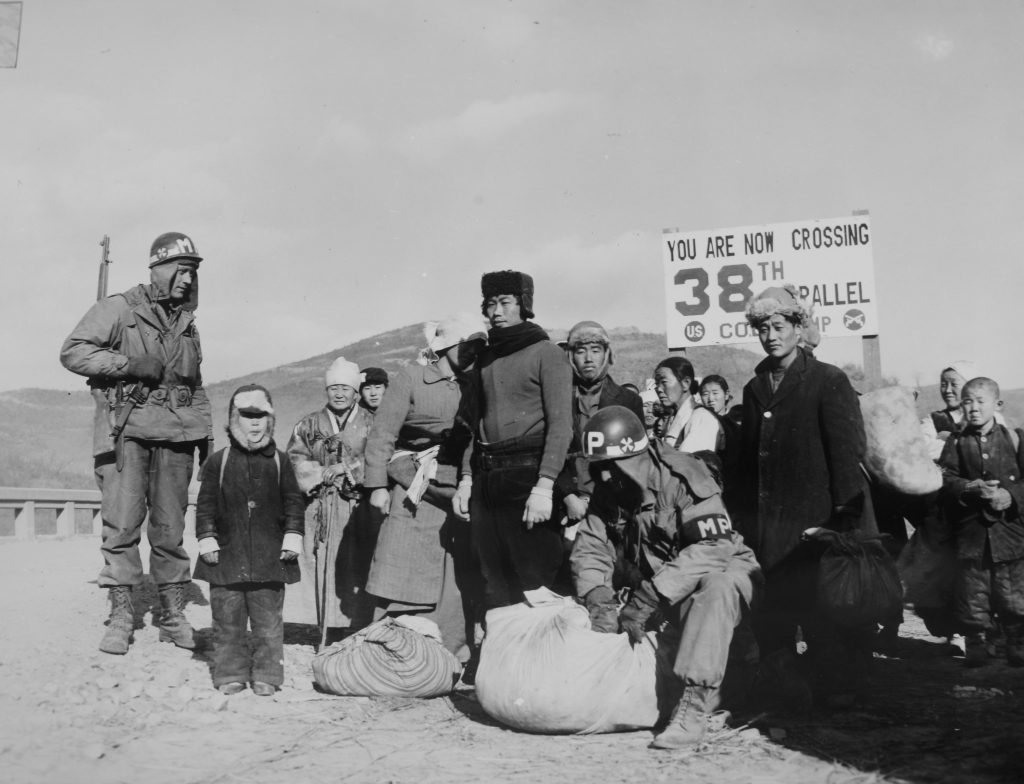
The latitude line passing between the North and the South has separated generations of families.

By Peter Joffre Nye
Journalist
The Korean War, from 1950 to 1953, saw some of the most intense battles in American military history. A total of 33,700 soldiers, sailors, marines, and Air Force personnel were killed in Korea; more than 100,000 were wounded. The fighting ground to a stalemate and ended in a guarded truce, which remains in effect today, like a dormant volcano. Yet the war is not well remembered by Americans.
Koreans, on the other hand, have never had the luxury of forgetting what for them began as a civil war and ended, without any sense of resolution, in a state of indefinite opposition. A new documentary premiering April 29 on PBS titled Korea: The Never-Ending War, nearly two hours long and produced by WETA, helps us understand why a divided Korea is still with us. The film is highly topical, not just for the obvious reason that American foreign policy continues to grapple with the consequences of the war in Korea. Years after the end of the Cold War, the Korean War is especially relevant to the difficult moral and geopolitical choices faced by nations whose influence extends far beyond their own borders.
One of the better remembered aspects of the war is how it started. On June 25, 1950, some 90,000 North Korean soldiers stormed south across most of the breadth of the 38th parallel on foot, by train, and even driving Soviet tanks, on their way to take over American-supported South Korea.

The conflict between the socialist Soviet-sponsored North and the American-backed capitalist South was a byproduct of the end of World War II and reflective of the Cold War balance of power between the Unites Stated and the USSR. How skirmishing along the 38th parallel gave way to invasion, however, is still being researched.
Michael J. Green of Georgetown University’s school of foreign service said in a telephone interview for this article that an indiscreet remark by U.S. Secretary of State Dean Acheson may have helped trigger the war.In a press conference on January 12, 1950, Acheson, a dapper product of Yale University and Harvard Law School who was discussing other geopolitical actors in Asia, stated that America’s defense policy excluded Korea.“Russian Premier Joseph Stalin in Moscow interpreted Acheson’s declaration as an indication that America possibly would avoid getting into any conflict over Korea,” says Green.
As Cold War assumptions have been revised in the last decades, it is worth recalling the global state of play prior to the Korean War. “When NATO was formed in 1949, that created a block of great military power in democratic countries,” Green says. “Stalin and Mao had a great block of power in Communist countries. This was the creation of two big blocks of power for the first time—there was nothing like it in history.”
North Korean dictator Kim Il-sung was massively armed and hungry to reunite Korea, like Mao had done in China. “NATO’s formation was one of the reasons Stalin wanted to strike a blow against the West,” Green says. “He decided to let Kim Il-sung cross the 38th parallel.”
After Kim’s invasion, President Harry Truman wasted no time in committing forces overseas to reinforce South Korea and its president, Syngman Rhee. Truman’s decision to intervene in Korea, however, reflected an ongoing shift in American foreign policy away from isolationism and toward containment.
“Exactly ten years earlier, in June 1940, the country had done nothing when France had fallen and the whole global balance of power had been overturned, for the simple reason that there was no domestic support for full and formal involvement in the war,” Steven Casey, professor of international history at London School of Economics, said in an e-mail. “Now, Truman decided within days to send four divisions to protect a country that the Joint Chiefs of Staff had placed way down the priority list—and, indeed, he would have faced major domestic opposition had he not done so.”
North Korea’s brazen onslaught, Casey adds, also put America’s credibility on the line, as well as the integrity of the recently formed United Nations. “If nothing was done to prevent an ally from succumbing to direct invasion, would allies trust Washington? Would enemies be emboldened?”

Truman soon gained broad political support to send troops to a place unknown to most Americans, many still nursing distressing memories of World War II. K-shaped, Korea lies between the Sea of Japan and the Yellow Sea, on the southeastern edge of Asia, abutting Russia on the far north.
In many ways the stage for this warhad been set in the late 1890s, with the industrial and military ascendance of Japan. In 1910, a month after Japanese forces defeated Russia’s army in Manchuria and destroyed Russia’s fleet, its politicians claimed that Japan had to annex Korea because the Korean peninsula looked like a dagger pointing to its heart. Colonization enabled Japan to exploit Korea’s coal, iron, and limestone deposits and factories in the north, agriculture in the south, and enslave its population. The Japanese pressed as many as 200,000 men into their army, and they forced about the same number of women to become sex partners for Japanese soldiers. The occupiers imposed Japanese as Korea’s official language to eradicate its ancient culture.
When Japan’s brutal occupation ended abruptly after its unconditional surrender in August 1945, Soviet troops stationed in northern Korea began moving south on the peninsula to take over the country. American military leaders overseeing the orderly surrender of Japanese forces in Korea had little time to reach agreements with the Soviets. Two U.S. Army colonels temporarily attached to the State Department were dispatched to Korea to find a dividing line. They suggested occupation zones, modeled on the arrangement in Germany after its surrender in 1945.
The colonels consulted a National Geographic map and focused on the 38th parallel, a degree of latitude north of the equator, passing through the middle of the Korean peninsula. Korea’s ancient capital, Seoul, was conveniently located sixty miles south. The 38th parallel followed no river or mountain range. It went indifferently through farms and villages, roads, and railroad lines. The colonels recommended to Truman that the parallel separate the two zones. Truman offered the idea to the Soviets, and they accepted. Korea was split into the communist north and the democratic south. Thirty million Koreans would be affected, but not a single one of them had a say.
After Japan’s surrender, the Soviet Union’s interest in drawing Korea into its sphere of influence consequently attracted the attention of the Truman administration. Pulitzer Prize-winning journalist and historian David Halberstam wrote that after Truman committed troops, he sought to downplay the conflict by calling it a police action. In the new Cold War, he needed to avoid confronting Soviet dictator Joseph Stalin, the only other world leader beside himself with atomic weapons.

North Korean dictator Kim Il-sung’s attack in June 1950 came as a surprise. His troops drove past the 38th parallel into the Republic of Korea with a swiftness reminiscent of the German invasion of France a decade earlier. In just three days, North Korean troops seized Seoul, with South Korea’s Princeton-educated president, Syngman Rhee, having fled the capital.
South Korea then put its army under the jurisdiction of the United Nations. The United States supported a U.N. coalition that included Canada, England, Australia, France, and 18 other countries. U.S. Army General Douglas MacArthur, a World War II hero, was appointed commander in chief of the U.N. force.
By late summer 1950, North Korea controlled most of the peninsula. On September 15, MacArthur launched a major counter-offensive, directing a fleet of 260 U.S. Navy and British warships in a bold amphibious assault against North Korean troops holding the port city of Inchon on the Yellow Sea. U.S. Marines stormed the beach and captured Inchon. U.N. forces then liberated Seoul, capturing more than ten thousand North Korean soldiers. MacArthur, iconic in photos depicting him in a khaki shirt, open collar, sunglasses on the bridge of his nose, reinstalled Rhee in Seoul, president of the Republic of Korea.

MacArthur’s force, advancing north against little opposition, crossed the 38th parallel and kept going. By October 20, the U.N. coalition entered North Korea’s capital, Pyongyang. MacArthur, age seventy, still held his six-foot frame straight as a sword and planned to take the campaign all the way into China. That same month, Truman flew nearly seven thousand miles to Wake Island in the Pacific Ocean to talk directly with the general, who told the president the Chinese would never attack his U.N. force.
A month after Truman’s meeting with MacArthur, however, 260,000 Chinese troops surrounded the U.N. troops, including the First Marine Division. Worse, the temperature plunged, resulting in one of the coldest winters in a hundred years. Machine guns froze. Jeep engines wouldn’t start. Vastly outnumbered, the Marines and the U.N. troops fought their way in a retreat back to the 38th parallel. Months of hard combat followed, with Seoul having been captured and liberated four times. In April 1951, Truman fired the popular MacArthur, causing the president’s poll numbers to nosedive.
Congress approved legislation allowing Truman to call up World War II veterans serving in the reserves. Thousands of reservists received orders to report back for duty. Many were bitter about having to leave families and jobs—including Red Sox star hitter Ted Williams, a captain in the Marine Corps. He had served three years as a fighter pilot during World War II, mostly as a flight instructor, comfortably out of harm’s way at the Navy Air Station in Pensacola, Florida. But, in early 1952, now thirty-three years old, he was recalled.
Like other vets, Williams complained to friends that Congress hadn’t declared war on Korea, and the United States wasn’t attacked. He secretly sought outside help to keep him playing baseball at $500 an hour. Williams reluctantly accepted his responsibility, however, and learned to fly new straight-wing Grumman Panther jets on missions over North Korea at 500 miles an hour. He survived a fiery crash landing after anti-aircraft fire hit his jet. The next day, he flew another bombing run. Williams wound up flying 33 missions, some with Marine Corps aviator John Glenn, who later became the first American to orbit Earth.
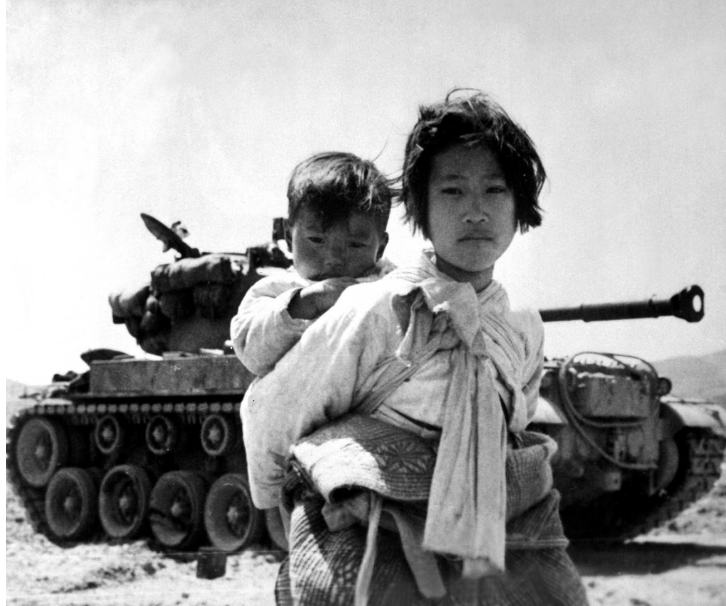
On the ground, deadly firefights, many in the dark, continued near the 38th parallel on hilltops with names like Sniper’s Ridge, Punchbowl, and Porkchop Hill. Yet neither side gained leverage. American troops expressed frustration with the relentless battles, repeating the scornful saying “die for a tie.” Peace talks got under way in July 1951 between representatives of the Republic of Korea, the United States, and the Soviet Union. They met in a modest office building in the North Korean village of Panmunjom, near the 38th parallel.
The negotiations, like the war, dragged on. Stalin’s sudden death of a cerebral hemorrhage on March 5, 1953, however, hastened the conclusion of the peace talks. The sides reached a truce, with no apparent winner, on July 27, 1953.
“The Korean War became the first war of the twentieth century that the United States didn’t win decisively,” says Green. “Afterward it was widely viewed as something embarrassing—a pale comparison with the victory parades in New York and Paris after World War II.”
The campaign also introduced, says Green, the new idea of a limited war fought to contain the enemy. “The idea that wars don’t end in a big parade but in blunting threats from abroad was a new concept,” he said.
Yet the Korean War still has its backers. An eighty-six-year-old Marine Corps veteran of the Korean War, who declined to be identified for this story, told me that he always thought it was worth fighting. “The war did save South Korea from being Communist,” he said. “In 1953 South Korea’s economy was about the same as Egypt. Egypt has stayed at the same level today, but South Korea has risen way up—for a small country its prosperity is remarkable. North Korea’s economy is much smaller.”
Originally published to the public domain by Humanities, the Magazine of the NEH 40:2 (Spring 2019).
About the Author