There is no exception.

By Ilya Somin, J.D.
B. Kenneth Simon Chair in Constitutional Studies, Cato Institute
Professor of Law, George Mason University
The incoming Trump administration may be preparing to deny citizenship rights to children of undocumented immigrants born in the United States. That’s according to recent reporting, a statement on Nov. 11 by a presidential transition member helping develop the new administration’s plans for the Justice Department, and a “Day One” video made by President-elect Trump during the campaign (incoming border czar Tom Homan also supports ending birthright citizenship). According to the New York Times, “the team plans to stop issuing citizenship-affirming documents, like passports and Social Security cards, to infants born on domestic soil to undocumented migrant parents in a bid to end birthright citizenship.”
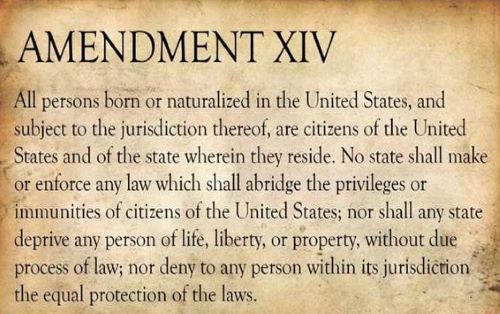
Such policies would be a blatant violation of the Fourteenth Amendment, both the text and the original meaning. Section 1 of the Amendment grants citizenship to anyone “born … in the United States and subject to the jurisdiction thereof.” There is no exception for children of illegal migrants. There is broad agreement on that point among most constitutional law scholars, across the ideological and methodological spectrum.
That broad consensus is backed by longstanding Supreme Court precedent, going back to United States v. Wong Kim Ark (1898). As the Court explained in that case:
The fourteenth amendment affirms the ancient and fundamental rule of citizenship by birth within the territory, in the allegiance and under the protection of the country, including all children here born of resident aliens, with the exceptions or qualifications… of children of foreign sovereigns or their ministers, or born on foreign public ships, or of enemies within and during a hostile occupation of part of our territory, and with the single additional exception of children of members of the Indian tribes owing direct allegiance to their several tribes.
While Wong Kim Ark involved children of legal immigrants, the logic of the Court’s holding is not limited to that scenario. It applies to children of undocumented immigrants, as well, and indeed to all children born on U.S. soil, other than those of foreign diplomats, soldiers of invading armies, and (at the time) certain members of Indian tribes. It is also backed by the original meaning of the Fourteenth Amendment. For example, Senator Jacob Howard, one of the key drafters of the amendment, stated that eligibility for birthright citizenship “will not, of course, include [children of] persons in the United States who are foreigners, aliens, who belong to the families of ambassadors or foreign ministers accredited to the Government of the United States, but will include every other class of persons” (emphasis added). As others have pointed out, even the opponents of the citizenship clause understood its clear meaning. The purpose of the Citizenship Clause of Section 1 was to overturn the notorious holding of Dred Scott v. Sanford, where the Court had ruled that Black Americans could not be citizens. But the text goes beyond that context and prevents the federal government from denying citizenship to any children born in the United States, with a few narrow exceptions, none of which cover children of undocumented immigrants. Conservative originalist legal scholar Michael Ramsey provides an excellent overview of the text and original meaning in a 2020 Georgetown Law Journal article.
Section 1 does have one qualification. It restricts birthright citizenship to those children born in the United States who are “subject to the jurisdiction thereof.” Some have argued that this exception excludes children of undocumented immigrants. But undocumented immigrants are obviously subject to U.S. jurisdiction in that they are subject to the authority of American law and can be sanctioned for violating it. In that obvious respect, they are different from foreign diplomats, who are exempt from such jurisdiction by virtue of having diplomatic immunity.
Undocumented immigrants do not, of course, have all the legal rights of citizens; some have argued that means they are not “subject” to U.S. jurisdiction. But that argument makes little sense. If lacking some of the rights possessed by citizens created an exemption from birthright citizenship, it would essentially gut the Citizenship Clause of Section 1. That theory would enable Congress to deny citizenship even to children of legal immigrants who are not yet citizens themselves. After all, they too lack some of the rights of citizens; for example, they do not get to vote or serve on juries.
If the Citizenship Clause covers only children of people who have the full rights of citizens, that would undermine the central purpose of the Clause, which was to reverse Dred Scott‘s notorious holding that Black people – even those who were not slaves – could not be citizens of the United States. In his infamous opinion in Dred Scott, Chief Justice Roger Taney concluded that Black Americans could not be citizens in part precisely because they were denied various legal rights. As Taney pointed out, in most states free Blacks could not vote, could not serve on juries, and were barred from serving in the militia (including under the 1792 federal Militia Act, which limited militia service to white men). If such logic is applied to the Citizenship Clause, Congress or a state government could have prevented newly freed slaves and their children from becoming citizens simply by declaring that they were not entitled to vote, could not serve on juries, could not be members of the militia, and so on.
Judge James Ho, a Trump appointee to the U.S. Court of Appeals for the Fifth Circuit, has recently suggested a different potential rationale for excluding children of undocumented immigrants from birthright citizenship. In a 2015 article, Ho rightly argued that, under the original meaning of the Fourteenth Amendment, “[b]irthright citizenship [is]… protected no less for children of undocumented persons than for descendants of Mayflower passengers.” In a 2006 law journal article that discussed the original meaning at length, he also correctly observed:
The clause thus covers the vast majority of lawful and unlawful aliens. Of course, the jurisdictional requirement of the Citizenship Clause must do something – and it does. It excludes those persons who, for some reason, are immune from, and thus not required to obey, U.S. law. Most notably, foreign diplomats and enemy soldiers – as agents of a foreign sovereign – are not subject to U.S. law.
In a recent interview, however, he stated that “birthright citizenship obviously doesn’t apply in case of war or invasion. No one to my knowledge has ever argued that the children of invading aliens are entitled to birthright citizenship. And I can’t imagine what the legal argument for that would be.”
The significance of this distinction depends on what qualifies as an “invasion.” If it requires an organized armed attack on the United States, then virtually no children of undocumented immigrants today qualify as children of “invaders.” But in a recent concurring opinion in a Fifth Circuit case, Judge Ho has suggested that illegal migration, as such, may qualify as an “invasion” under Article I, Section 10, Clause 3 of the Constitution, which states that “[n]o state shall, without the Consent of Congress, … engage in war, unless actually invaded, or in such imminent Danger as will not admit of delay.” If he would apply that same definition of “invasion” to the Citizenship Clause, then citizenship could indeed be denied to children of undocumented immigrants.
Elsewhere I have explained why illegal migration, as such, does not qualify as “invasion” under Article I, Section 10, Clause 3, and other provisions of the original Constitution. The idea is contrary to the text and original meaning of the Constitution. As James Madison put it, “invasion is an operation of war.” If courts were to equate illegal migration with invasion, that conclusion would have dire consequences, including allowing states to initiate war with foreign countries without congressional authorization, and giving the federal government nearly unlimited authority to suspend the writ of habeas corpus, and thereby detain people (including U.S. citizens) without charges (the Constitution allows suspension of the writ in times of “Rebellion or Invasion”).
Michael Ramsey offers an additional reason to reject this equation in the case of the Citizenship Clause:
The citizenship clause of the Fourteenth Amendment does not say anything directly about invasion. It gives constitutional citizenship to all persons “born … in the United States and subject to the jurisdiction thereof.” The invasion issue arises from a longstanding rule in English law holding that invading armies were an exception to the general rule that people born in English territory were English subjects, because English sovereign authority could not operate in areas held by a hostile force. Thus the U.S. constitutional rule, derived for the English rule, would also not seem to apply to hostile armies within U.S. territory. That is, a person born under the control of a hostile army in U.S. territory was “born … In the United States” but not, as a practical matter, “subject to the jurisdiction thereof….”
Applied to the situation of illegal immigration, it follows that the question is not whether the current situation at the southern border is an “invasion” within the meaning of Article I, Section 10…. The citizenship question is whether the children of persons present in the United States illegally are “subject to the jurisdiction” of the United States.
In this respect, children of persons present in the United States illegally are different from persons born subject to the control of a hostile army. The United States can and does exercise jurisdiction over the former, while it cannot, as a practical matter, exercise jurisdiction over the latter. And under the text of the Fourteenth Amendment, that is a critical difference.
Ramsey is right. Even if illegal immigration does somehow qualify as an “invasion” under Article I of the original Constitution, that would not justify denying birthright citizenship to children of undocumented immigrants.
Like concluding that illegal migration is “invasion,” denying birthright citizenship to children of undocumented immigrants could have dire real-world consequences. It would make subject to deportation hundreds of thousands of children who have no home other than the United States. Deporting them would cause grave harm to these innocent people (who had no hand in breaking immigration law), and also damage our economy and society, which would lose those children’s valuable contributions.
I have some normative reservations about birthright citizenship. Ideally, I would prefer access to citizenship, residency, and work rights to be less dependent on circumstances of birth. But Trump’s apparent plan to deny citizenship to children of undocumented immigrants would exacerbate the flaws of the system, rather than alleviate them. And, even aside from normative considerations, it is clearly unconstitutional. If the new administration goes through with this proposal whether by executive action or legislation, courts should and most likely would strike it down.
Originally published by the Just Security, 11.25.2024, New York University School of Law, under the terms of a Creative Commons Attribution-No Derivs-NonCommercial license.
About the Author