The medieval Church was wealthy and land-hungry.

By Dr. Ian N. Wood
Professor Emeritus of Early Medieval History
University of Leeds
Although my argument begins chronologically in the fourth century, I take as a point of departure the scale of ecclesiastical landownership in the seventh. Of course, any attempt to estimate that scale can be no more than a guess, but I would suggest that having possessed very little in terms of land in the early fourth century, the Church may have owned as much as a third of the cultivable land of Western Europe by the year 700.1 This is the figure that was suggested by Paul Roth and Émile Lesne for Merovingian Francia.2 David Herlihy, who cited the conclusions of Roth and Lesne, however, went on to argue that this scale of landed possession was only achieved in the ninth century, when, in his view, the Church in Italy held twice as much as it had in the eighth.3 It is, therefore, necessary to set out the reasons for thinking that Church possessions were already massive by 700.
For Francia, this is a figure that can be calculated very roughly from the evidence of bishops’ wills (mainly preserved in diocesan histories written down in the Carolingian period), from the charter record, and from monastic histories (again, Caro-lingian in date). With regard to episcopal wills, it is worth not-ing that there was a widespread view throughout the West that bishops should leave property to the Church, although some of our evidence comes from complaints that they were not doing so. Thus, as early as the mid-fifth century (and, as we shall see, this is remarkably early for such a complaint) Salvian lamented that even bishops who had no family did not always give prop-erty to the Church.4 Gregory of Tours relates the fury of a cleric when in the mid-sixth century Nicetius of Lyon left nothing to his burial church.5 In his account of his archiepiscopal name-sake who died in 570, Agnellus of Ravenna recorded that the archbishop left his property to his granddaughter.6 In a letter to archbishop Deusdedit of Milan, Gregory the Great noted that bishops were allowed to dispose freely of what they owned be-fore taking office,7 but he questioned a grant of land acquired by Constantius of Milan after his election.8 He took the same view of the acquisition of property by abbots.9 Clearly there was a notion that bishops ought to leave their property, and more specifically any property acquired after election to the episcopate, to their Church, and it is also apparent that this was an expectation frequently honored in its breach. In Spain, however, when the ninth Council of Toledo (655) legislated on the division of property of a sacerdos (a term which surely included bishops), it allowed some free disposal of assets, while insisting that the Church should not be defrauded, and that it should receive at least half of what the priest had acquired after his ordination.10
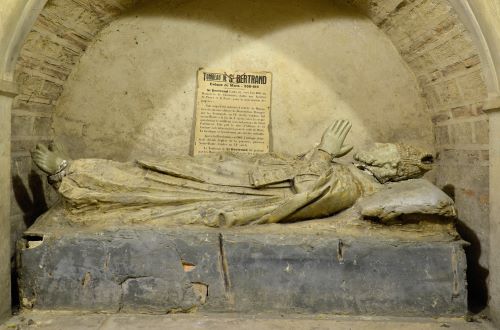
We do have some evidence for bishops who left their property to the Church. The best-known example is Bishop Bertram of Le Mans, whose will lists 120 units of land donated to the Church in 616.11 Fernand Cabrol and Henri Leclercq attempted to identify all the estates in question and concluded that they amounted to 300,000 hectares, which is approximately 0.5% of modern France12 — Margarete Weidemann, who has provided the most recent identification of the properties listed in the will, neither endorses nor questions the figure, so it may stand as a rough estimate. Certainly, this is the most substantial Merovingian will that has survived, and it might be noted that the majority of Bertram’s property was acquired in the course of his episcopate, not least in donations from king Chlothar II, whom he had resolutely supported. This, then, was a will that fulfilled ecclesiastical expectations. But it was not the only one. The Gesta episcoporum Cennomanensium, which preserves the will of Bertram, also transmits numerous other documents, many of which are thought to be suspect, but the will of his successor, Hadoind,13 is thought to be largely authentic.14 It lists over twenty properties, some of which were clearly quite extensive. Among other episcopal wills to survive are those of Caesarius of Arles15 and Remigius of Rheims,16 both from the first half of the sixth century, but both very much less substantial than that of Bertram. Unfortunately, we lack the wills of other bishops who, like Bertram, were closely associated with the royal court, and who might have made comparable wills: men such as Sul-picius of Bourges or Desiderius of Cahors, although, from the Vita Desiderii, which lists the donation of more than ninety estates to various religious institutions, we do learn that the latter gave a considerable amount to his Church,17 probably leaving it as “the largest landowner of the region,” according to Peregrine Horden.18
Bertram’s will was undoubtedly unusual in its scale — if it were not, given that there were over a hundred Merovingian dioceses,19 the Church would have been even wealthier than it was by the end of the seventh century. Perhaps the most sizeable of other donations to episcopal churches was that of the senatorial abbot Aridius of Limoges, who, according to Gregory of Tours, appointed bishops Martin and Hilary as his heirs, that is to say that he gave everything he possessed to the Churches of Tours and Poitiers.20 Flodoard of Rheims, who transmits highly questionable texts of the wills of bishops Bennadius, Remigius, Romulf, and Sompnantius,21 also refers to those of queen Suavegotta and her daughter Theudechildis.22 As royal women, who were among the most notable survivors of the Burgundian royal house, they probably had a good deal to give.
Wills of other non-episcopal Church benefactors have survived.23 We have the testaments of abbess Burgundofara of Fare-moutiers (not, it should be admitted, a major list of donations),24 the deacon Adalgisel Grimo (who endowed various monasteries and churches in the Verdun region),25 and an edited version of that of Widerad, founder and abbot of Flavigny.26 The one will to rival that of Bertram is that of the early eighth-century layman Abbo of Provence, much of whose land went to his foundation of Novalesa, in a part of the Italian peninsula which was politically in territory under Frankish control.27
For the most part, our evidence for monastic landholding does not come from wills but from the property surveys known as polyptychs and from monastic histories. From the Gesta of the abbots of Fontanelle we learn that the monastery of St. Wandrille supposedly held 3,964 mansi (although the text talks of 4,264 estates) in the early eighth century.28 Most of our other figures relate to Charlemagne’s reign or later, by which time the scale of the landholding may have grown, as a result of Carolingian bequests. By the early ninth century, St. Germain-des-Près held 8,000 mansi, which Benjamin Guérard, who edited the monastery’s polyptyque, reckoned amounted to 429,987 hectares,29 almost 1% of modern France. St. Riquier may have been comparable. By Charlemagne’s time Luxeuil held 15,000 hectares.30 Although the majority of our early evidence is Carolingian, it is clear, however, that this type of documentation belongs to a well-established tradition of estate surveys. Jean Pierre Devroey has shown that the surviving polyptych of St. Victor of Marseille from 813–814 was preceded by a survey from c. 740 that no longer survives.31 For St. Martin de Tours, we have 29 sheets of parchment listing dues to the abbey during the days of abbot Agyricus (c. 675),32 which include around 1,000 per-sonal names, largely of tenants or of those required to pay dues, and 137 place names.33 These clearly do not cover the full extent of the abbey’s holdings, since the chance pattern of discovery of the sheets suggests that there were others that have not survived. The best endowed Merovingian monastery, however, was probably St. Denis, whose wealth is known only from its surviving charters — we have good charter records for the donation of 36 villae between 625 and 726, and we know that 46 loca were restored by Pippin III in 751. Despite the fragmentary nature of the evidence, it was, without question, richly endowed by royalty.34
If we combine the figures for the landholdings of the episcopal churches and for the monasteries of Merovingian Gaul, we are surely looking at a massive amount of ecclesiastical property, although, mindful of Peter Brown’s notion of “micro-Christendoms,”35 we should remember that we are dealing with individual churches, and not a single institutional Church, and we should also bear in mind the distinction between episcopal and monastic churches, which had very different economic and pastoral obligations.
In addition to cathedrals and to those churches whose priests were expected to attend diocesan synods — one may regard them as proto-parish churches — there were private churches established on the estates of the aristocracy, which have been termed “proprietary churches” or Eigenkirchen.36 There were unquestionably significant numbers of these, and they are mentioned in the canons of the Church councils. Aristocrats surely regarded them as integral to their local authority. They are, however, tangential to my argument, which is centered on what we know of diocesan and monastic organization and endowment. Although proprietary churches certainly contributed to the provision of Christian cult and indeed to the spiritual economy, their foundation and endowment is largely separate from that of the diocesan Church, and it was not integral to its social and economic activities, to its provision of cult for the diocese at large, or to its charitable work, even though they may have been involved in all these.
Unfortunately, the ecclesiastical evidence that we have for the rest of the early medieval West is nowhere near so rich as it is for Francia. We can be sure that some Visigothic churches were well endowed. Above all we know that Mérida received a vast be-quest from one of the richest senators in Lusitania after bishop Paul had performed surgery to save the man’s wife, following an unsuccessful pregnancy.37 This is said to have dwarfed all the other donations to the diocese. The author of the Vitas Patrum Emeretensium states that as a result “in those days the church of Mérida was so wealthy that no church in the land of Spain was richer.” This, however, would seem to imply that other churches had since caught up, and perhaps even overtaken Mérida in wealth by the mid-seventh century; we can guess that these in-cluded Toledo and Seville. In terms of the wealth of the monasteries of Visigothic Spain we only have the slightest of hints as to their landholdings, although the recent publication of four early documents from San Martín de Asán shows that already before the conversion of Reccared to Catholicism some monasteries were receiving property over quite a wide territory.38 But in Visigothic Spain, there were limitations as to how much might be given to the Church, in that a donor who had children or grandchildren was only allowed to donate a fifth of his property to churches.39 Despite the poverty of the evidence, Pablo Díaz, following Dietrich Claude, has stated that “the Church in its totality was the largest landowner in the kingdom.”40
The evidence for Italy is more complicated, not least because of the division of the peninsula between the Lombards and the Empire. For ecclesiastical landholding in the Lombard region before the eighth century we have little to go on. Bobbio was a major landholder by the ninth century, when we have good documentation, which suggests that by the middle of the century the monastery owned 11,605 hectares, and among monastic landowners in northern Italy it was second only to Santa Giulia in Brescia.41 Santa Giulia was only founded in 753, and so tells us practically nothing about monastic landholding in the Lombard period, but Bobbio certainly had some early endowment, as is clear from the charter record.42 Most of the other monasteries for which we have evidence are first attested in the reign of Liutprand (712–744), or later.43 A law of Aistulf (744–756) refers to monasteries with over fifty monks, suggesting that quite large communities were not uncommon by the mid-eighth century.44
For the Byzantine-held territory of the Exarchate, we have significant evidence relating both to the papacy and to the diocese of Ravenna.45 In fact, it is difficult to quantify the scale of papal landholding. Leaving aside its account of the gifts of Constantine, to which we shall return, the Liber Pontificalisis curiously silent about donations of property rather than of treasure, and especially gold and silver liturgical objects.46 The correspondence of popes Vigilius, Pelagius I, and Gregory the Great, however, has allowed Federico Marazzi to build up a compelling picture of the papal estates in Lazio in the sixth and seventh centuries.47 In addition, the popes held land in northern Italy, the islands of Sicily, Sardinia, and Corsica, as well as the Cottian Alps, southern Gaul, and Illyricum.48 In terms of actual figures, we know that the papacy received 2,100 solidi from its estates in Picenum under Gelasius (492–496), but that this dropped to 500 solidi under Pelagius I (556–561), because of the Gothic Wars.49 These figures are worth bearing in mind when juxtaposing the evidence for the fifth and the sixth centuries. In some regions of Italy, at least, the economy had collapsed. Under Gregory the Great, the Provençal estates of the bishop of Rome were worth 400 solidi per annum.50
Our next major piece of evidence is that of Theophanes, concerning the supposed seizure of papal property in southern Italy by the emperor Leo III in 732–733. This talks of landed estates with a yield of either 410,400 or 25,200 solidi, depending on which textual reading one accepts.51 As Vivien Prigent has noted, both of these figures are problematic.52 The first is almost certainly too high, and the second too low. Agnellus states that the income from just the Sicilian patrimony of Ravenna in the pontificate of Maurus (642–671) was 31,000 solidi, of which 16,000 went into the coffers of the Church and 15,000 went to the emperor.53 Income from the papal estates taken over by agents of the Byzantine emperor was surely greater than this, regardless of the chronological problems in the account given by Theophanes.54 Ravenna’s Sicilian estates also yielded 50,000 modia of wheat, reddened hides, purple robes, silk episcopal vestments, and vases of brass and silver for the mother Church.
In addition to its Sicilian estates, Ravenna held land throughout Italy — according to Agnellus, Justinian had granted to its Church “the property of the Goths, not only in the cities, but also in the suburban villas and hamlets.”55 At roughly the same time, archbishop Maximian acquired a large area of woodland in Istria.56 Clearly these constituted massive acquisitions following Justinian’s conquest of Italy. In the late 520s, the income of the Church of Ravenna appears to have been a mere 12,000 solidi — not much more than a third of what it received from Sicily alone a century later. The post-Conquest endowments must have been substantial. Jan-Olof Tjäder, who edited the texts, thought that one of the Ravenna papyri, which he dated to 565–570, related to revenue deriving from some of the estates that were given by Justinian.57 The document, albeit fragmentary, shows the Church paying the comes patrimonii 932.5 solidi and the prefect 1153.5 solidi, and still having revenue left over. In addition to the 31 papyrus documents to survive from the epis-copal archive, we also have the tenth-century Codex Bavarus, a Breviary of the Church of Ravenna, which covers around 168 land transactions in 8 territoria of central Italy up to the late ninth century.58 Most of the entries refer to leases made by the Church of Ravenna, but 16 donations are also listed,59 giving an impression of the range of the holdings in the area of the Marche. For the most part, there is no indication of the chronology of acquisition, although one donation is listed as being received in the reign of Heraclius,60 and another in the episcopate of Damian (689–705).61 Of the leases, the editor Giuseppi Rabotti dated one to the early seventh century,62 while a further ten were negotiated in the episcopate of Damian,63 and thirteen in that of Sergius (744–69).64 In other words, although the Breviarium is primarily a document of the ninth and tenth centuries, it provides some information on Ravenna’s landholding in the period of the Exarchate. It therefore illustrates Tom Brown’s conclusion, that in the period after Justinian’s conquest “most land […] came to be concentrated in the hands of either the Church or the military commanders.”65
It would, therefore, seem probable that Herlihy underestimated the scale of ecclesiastical landholding in the seventh century, when he claimed that it was very much lower than it would be two centuries later.66 It may be that this is in part a reflection of his lack of consideration of the challenge to ecclesiastical property holding that took place across western Europe in the early eighth century, both from the emperor Leo III and from Charles Martel and Pippin III. Herlihy noted the significance of secularization in the late-Carolingian period, but he provided no comment on that of the early Carolingian period, which surely diminished the Church’s reserves of property.67
As well as the scale of landholding, it is also important to bear in mind the numbers of ecclesiastics, clergy and monks who had to be supported by the yield from Church property. In 600, there were around 1,000 ecclesiastical dioceses in the old Roman West (1,800 is the approximate number for the whole Roman World).68 Although Louis Duchesne reckoned that 27 Italian sees were abandoned as a result of the Lombard invasions,69 Sergio Mochi-Onory estimated that there were 250 dioceses in the peninsula in the sixth century.70 There were approximately 130 bishoprics in Gaul, most of them in the terri-tory later controlled by the Franks, the rest being in Visigothic Septimania.71 Only 87 dioceses are known in Visigothic Spain, although this may be far lower than the actual number, since there were between 300 and 400 civitates in the Roman period.72 Christian Courtois reckoned that there were some 870 dioceses in Vandal Africa, of which 470 were Catholic.73 Many of these, however, will have been small and poor.
The numbers of clergy certainly varied from diocese to dio-cese. Occasionally we have figures. In Rome we hear of at least 70 priests in the city in 418,74 and 67 in 499.75 Given Justinian’s Gothic War, the early sixth century may have marked a high point in clerical numbers in the city. Robert Wiśniewski has argued that there may have been more than 100 priests in Rome in c. 500, but only 40 a century later.76 34 priests, together with 7 abbots and 3 deacons, signed the canons of the provincial Synod of Auxerre held between 561 and 605.77 In a dispute between bishop Ecclesius of Ravenna and his clergy during the pontificate of Felix IV (526–530) 10 priests, 11 deacons, 5 subdeacons, 12 acolytes, 12 lectors, 3 defensors, 4 cantors, 1 orrearius, and 2 decani traveled to Rome.78 This cannot have been the full complement of Ravenna’s clergy. It is unthinkable that the Catholic hierarchy would have left the city at the mercy of the Arians for the three or four weeks that it would have taken to have their case heard. Arnold Pöschl reckoned that the Ravenna clergy at the time must have numbered between 60 and 80.79 The upper figure looks more likely than the lower. Gregory the Great reveals that there were 126 prebendaries in Naples,80 but, unfortunately, he does not supply figures for the other clergy in the city.
A further indication of clerical numbers may be gained from what we know of the number of churches in individual cities and dioceses. In Rome we know of 8 major basilicas, 28 titular churches, 31 non-titular churches, 14 oratories and chapels, and 11 monasteries and xenodochia within the urbs, by the end of the seventh century, and an additional 7 major basilicas, 32 smaller churches, and 12 monasteries in the suburbium.81 Some of these churches will have been served by several clerics (as we shall see), while others (particularly among the non-titular churches) may not have had a permanent staff. Tom Brown has noted the existence of 72 churches in Ravenna, as well as 20 monasteries by the eighth century.82
Outside the cities we are less well informed, but we do have the evidence of a series of disputes between the bishops of Siena and Arezzo, beginning in c. 650 and stretching to 715 and beyond, over jurisdiction in a number of parishes in Tuscany. This is a dossier that is well known to scholars of the government of Lombard and Carolingian Italy,83 but it is also of considerable importance for the history of the Church. The initial intentio of c. 650 deals with 6 parishes,84 the first notitia iudicati of 714 with 16 and 2 monasteries,85 the breve de inquisitione includes a further 6,86 and the final iudicium a total of 22.87 Exactly how many parishes were involved is unclear because of questions of identification, but certainly more than 20. The bishop of Arezzo, who won the case, claimed that these had belonged to his diocese since Roman times. This was clearly an exaggeration, because a small number of the foundations are explicitly stated to have been recent, but it is probable that most did indeed date to the period before the arrival of the Lombards in 568/569. And this is just the number of churches disputed between the dioceses of Arezzo and Siena — it tells us nothing about the core parishes of either diocese. More than 30 priests testified in the course of the breve of 715.
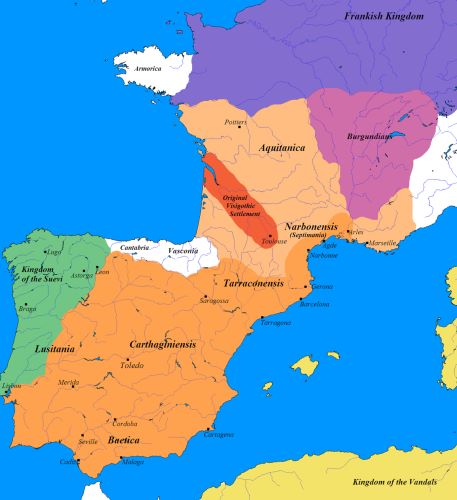
The evidence for Visigothic Spain is less extensive although for the Suevic kingdom of Galicia, from between 572 and 582, we do have a list of 107 churches to be found in 25 pagi of the dioceses of Bracara (Braga), Portugale (Porto), Lameco, Conim-briga (Coimbra), Viseo, Dumio, Egitania, Luco (Lugo), Auria (Ourense), Asturica (Astorga), Iria, Tude (Tuy), and Britonia.88 These are not thought to constitute the total number of churches in the region, but rather to be those to be found in centers of administrative importance.89
Turning to Francia, Clare Stancliffe has counted 16 churches, oratories, and monasteries in the diocesan center of Tours, and 42 in the surrounding countryside by c. 600.90 This is somewhat lower than the 90 noted by Margarete Weidemann for Le Mans.91 By the eighth century, Metz had 43 churches.92 One can compare these figures with the 40 churches known from Oxy-rhynchus in 535.93
Judging from the evidence from Auxerre and Ravenna, most of the churches listed in the western diocesan histories ought to have had at least one senior cleric. From the evidence of cities such as Auxerre, Le Mans, and Metz, we can argue for a figure of around 50 senior clergy (bishop, priests, deacons) on average per diocese, and this may well have been exceeded in such Italian dioceses as Arezzo and Siena. However, the numbers of clerics in the poor rural dioceses of Africa were surely lower than elsewhere. Given the number of dioceses in the post-Roman West, we might be talking of around 40,000 secular clergy at the start of the sixth century. There would, however, have been many more if one adds the lower clerical orders, such as the 126 Neapolitan prebendaries mentioned by Gregory the Great.94
Turning to monastic numbers, Jenal identified 100 monasteries in Italy in the sixth century.95 There were clearly many for which we have no evidence: Cassiodorus talks of monks build-ing monasteries “within the patrimonies of powerful Christians, just as swallows build nests in the cedars of Lebanon.”96 Around 50 monasteries are known from the Lombard regions of Italy, although many of these may have been eighth-century foundations.97 In what had been the Exarchate, there were 54 in Rome, 20 in Ravenna, and 13 in Naples alone by 819, according to Tom Brown, although some of these, as he notes (like those listed in the documents recording the Arezzo–Siena dispute),98 were very small.99 Although Gregory the Great does not provide numbers of monasteries in Rome, he does reveal that there were 3,000 nuns on the census list of the city — and he also tells us that they received 80 lbs. of gold per annum from the coffers of St. Peter’s.100
The evidence for Spain is distinctly patchy, and only 86 Visigothic monasteries are known.101 The largest may have been the Suevic monastery of Dumio, although we do hear of a community founded by Donatus, an African abbot, which had 70 inmates, already in the mid-sixth century.102 Yet more intriguing is the highly important community of Agali, which was in the neighborhood of Toledo, which produced a number of leading churchmen, including the city’s bishops Helladius, Ildefonsus, and perhaps Julian, but whose site remains unidentified and whose scale is hidden from us.103 And there are additional references to unnamed monasteries, notably to foundations of Fructuosus of Braga, which are said to have attracted so many monks as to cause a crisis in military recruitment.104
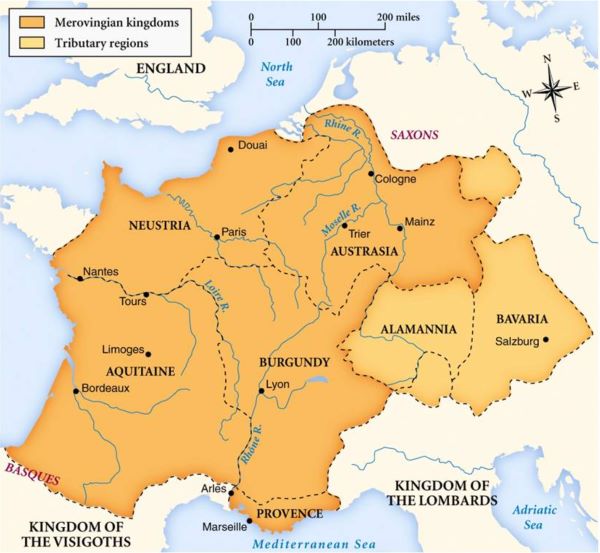
Our best evidence again comes from Merovingian Francia. Hartmut Atsma calculated that there were around 220 monasteries in the Frankish kingdom by 600, and 550 just over a century later.105 Some of these had well over 100 inmates: we can reasonably be skeptical of the 800 monks supposedly to be found in Jumièges,106 but the figure of 220 given for Luxeuil in the Vita Walarici is not impossible — especially since Jonas of Bobbio states that Fontaines, a minor offshoot of Luxeuil, boast-ed 60 monks in the early seventh century.107 A list preserved in a hagiographical text of the tenth or eleventh century claims that there were 1,335 monks and nuns in 12 monasteries in the city of Vienne.108 Although the figures have been queried, the numbers for individual communities are not out of line with those collected by Ursmer Berlière.109 If they are remotely accurate, and I see no reason to doubt them, they may be set alongside the estimated population size of the comparable, and neighboring, city of Lyon, which Tertius Chandler and Gerald Fox calculated as 12,000 inhabitants in the year 800.110 In other words, monks and nuns may have constituted a tenth of the population of Vienne in the late sixth century!
I leave aside the question of the number of monasteries in Britain and Ireland, where again the evidence is uneven. That monasticism was flourishing in pre-Viking Ireland is clear from the hagiography and from the archaeology.111 In Anglosaxon England, monastic history, of course, only begins after the con-version of Kent. Thereafter it is reasonably well attested in the charter record and in Bede’s narrative, which is, of course, most valuable for the history of Northumbrian monasticism.112 The Welsh documentation is more problematic, not least because most of the hagiographical material is late in date. But from the Llandaff charters Wendy Davies noted the existence of 35 monasteries in southeast Wales before 700.113
Despite the gaps in our evidence, we can reckon that there was a much greater number of monks and nuns to be found in Western Europe than there were bishops, priests and deacons. We are surely dealing with a total number of clergy and monks in the low hundreds of thousands. In other words, the total number of religious in the seventh century might have approached A.H.M. Jones’s estimate of 286,000 soldiers in the fourth-century West.114 These churchmen had to be provided for, and, although many lived off their own property, others had to be supported from revenues drawn from ecclesiastical landed property, which were also used to fund church buildings, the requirements of Christian cult, and the pastoral work of the Church. In other words, not only was the Church a very considerable landowner, but it was also staffed by a sizeable clerical order, which, although it was a small proportion of the overall population, was a significant consumer of resources. The Church deserves to be treated as an economic entity in its own right, and not just as a segment of the elite.
Endnotes
- Ian Wood, “Entrusting Western Europe to the Church, 400–750,” Transactions of the Royal Historical Society 23 (2013): 37–73.
- Paul Roth, Geschichte des Beneficialwesens von den ältesten Zeiten bis ins 10. Jahrhundert (Erlangen, 1850), 249; Émile Lesne, Histoire de la propriété ecclésiastique en France, vol. 1: Époques romaine et mérovingienne (Lille: R. Giard, 1910), 224.
- David Herlihy, “Church Property on the Continent, 700–1200,” Speculum 36, no. 1 (1961): 81–105, at 89; also, Thomas S. Brown, Gentlemen and Officers: Imperial Administration and Aristocratic Power in Byzantine Italy, A.D. 554–800 (Rome: British School at Rome, 1984), 176.
- Salvian, ep. 9.11, ed. Georges Lagarrigue, Salvien de Marseille Œuvres, vol. 1, Sources Chrétiennes 176 (Paris: Éditions du Cerf, 1971), 126.
- Gregory of Tours, Liber Vitae Patrum, 8.5, ed. Bruno Krusch, Monumenta Germaniae Historica, Scriptores Rerum Merovingicarum 1.2 (Hanover: Hahn, 1969 [1885]), 245–46.
- Agnellus, Liber Pontificalis ecclesiae Ravennatis, 85, ed. Deborah Mauskopf Deliyannis, Corpus Christianorum, Continuatio Medievalis 199 (Turnhout: Brepols, 2006), 252–53.
- Gregory I, Register, 12.14, in Registrum Epistularum, ed. Dag Norberg, Corpus Christianorum, Series Latina 140–140A (Turnhout: Brepols, 1982), 972.
- See also Gregory I, Register, 4.36, 6.1, ed. Norberg, Registrum Epistularum, 256–57, 369–70.
- Gregory I, Register, 10.1, ed. Norberg, Registrum Epistularum, 825–27.
- Council of Toledo IX (655), c. 4, ed. Gonzalo Martínez Díez and Félix Rodríguez, La Colección Canónica Hispana 5 (Madrid: C.S.I.C., 1992), 496–97.
- Margarete Weidemann, Das Testament des Bischofs Berthramn von Le Mans vom 27. März 616 (Mainz: Habelt, 1986).
- Fernand Cabrol and Henri Leclercq, Dictionnaire d’archéologie chrétienne et de liturgie, vol. 10, col. 1495 (Paris: Letouzey et Ané, 1931); Wood, “Entrusting Western Europe to the Church,” 43.
- Actus Pontificum Cenomannis in urbe degentium, ed. Margarete Weidemann, Geschichte des Bistums Le Mans von der Spätantike bis zur Karo-lingerzeit, 3 vols. (Mainz: Verlag des Römisch-Germanischen Zentralmuseums, 2002), vol. 2, 193–98, 202–6.
- See Walter Goffart, The Le Mans Forgeries: A Chapter from the History of Church Property in the Ninth Century (Cambridge: Harvard University Press, 1966), 154–55.
- Adalbert de Vogüé and Joël Courreau, Césaire d’Arles, Œuves monastiques, vol. 1: Œuvres pour les moniales, Sources Chrétiennes 345 (Paris: Éditions du Cerf, 1988), 360–97.
- Hincmar, Vita Remigii, 32, ed. Bruno Krusch, Monumenta Germaniae Historica, Scriptores Rerum Merovingicarum 3 (Hanover: Hahn, 1896), 336–40; A.H.M. Jones, Philip Grierson, and J. A. Crook, “The Authenticity of the ‘Testamentum sancti Remigii’,” Revue belge de Philologie et d’Histoire 35 (1957): 356–73.
- Vita Desiderii Cadurcae urbis, 34, ed. Bruno Krusch, Monumenta Germaniae Historica, Scriptores Rerum Merovingicarum 4 (Hanover: Hahn, 1902), 591–92. See now Vita vel actus beati Desiderii, 30 (9.17), ed. Keith Bate, Élizabeth Carpentier, and Georges Pon, La Vie de saint Didier évêque de Cahors (630–655), Hagiologia (Turnhout: Brepols. 2021), vol. 16, 210–19, with full identification of the sites.
- Peregrine Horden, “Public Health, Hospitals, and Charity” (forthcoming).
- Louis Duchesne, Fastes épiscopaux de l’ancienne Gaule, 3 vols. (Paris: Fonte-moing, 1894–1915), vol. 1, 1–2, notes around 130 for Gaul, although this includes dioceses in Visigothic Septimania; Robert Godding, Prêtres en Gaule mérovingienne (Brussels: Sociétè des Bollandistes, 2001), 209, argues for c. 110.
- Gregory of Tours, Decem Libri Historiarum, 10.29, ed. Bruno Krusch and Wilhelm Levison, Monumenta Germaniae Historica, Scriptores Rerum Merovingicarum 1.1 (Hanover: Hahn, 1951), 525–29.
- Flodoard, Historia Remensis Ecclesiae, 1.9, 18, 2.4, 5, ed. M. Lejeune, Histoire de l’Église de Reims par Flodoard, 2 vols. (Reims: Imprimeur de l’Académie, 1854), vol. 1, 53–54, 109–39, 243–45, 240–60.
- Flodoard, Historia Remensis Ecclesiae, 2.1, ed. Lejeune, Histoire de l’Église de Reims par Flodoard, vol. 1, 222.
- Ulrich Nonn, “Merowingische Testamenta: Studien zum Fortleben einer rö-mischen Urkundenform im Frankenreich,” Archiv für Diplomatik 18 (1972): 1–129.
- Jean Guérout, “Le testament de sainte Fare: matériaux pour l’étude et l’édition critique de ce document,” Revue d’histoire ecclésiastique 60, no. 3 (1965): 761–821; Alexander O’Hara and Ian Wood, trans., Jonas of Bobbio, Life of Columbanus, Life of John of Réomé, and Life of Vedast (Liverpool: Liverpool University Press, 2017), 311–14.
- Wilhelm Levison, “Das Testament Diakons Adalgisel-Grimo vom Jahre 6 3 4 ,” Trierer Zeitschrift 7 (1932): 69–80.
- Collectio Flaviniacensis, 8, ed. Karl Zeumer, Formulae Merowingici et Karo-lini Aevi, Monumenta Germaniae Historica, Legum 5 (Hanover: Hahn, 1886), 476–77.
- Patrick J. Geary, Aristocracy in Provence: The Rhône Basin at the Dawn of the Carolingian Age (Stuttgart: Hiersemann, 1985).
- Gesta Abbatum Fontanellensium, 11.3, ed. Pascal Pradié, Chronique des abbés de Fontenelle (Paris: Les Belles Lettres, 1999). On the problem of the numbers, Wood, “Entrusting Western Europe to the Church,” 40, n. 13.
- Roth, Geschichte des Beneficialwesens, 249–51.
- Ibid. For Luxeuil’s land, see also Adso of Montierender, Vita Walberti, 7, ed. Monique Goullet, Adso Dervensis Opera Hagiographica, Corpus Christianorum, Continuation Medievalis 198 (Turnhout: Brepols, 2003), 83–84.
- Jean Pierre Devroey, “Elaboration et usage des polyptyques. Quelques éléments de réflexion à partir de l’exemple des descriptions de l’Église de Marseille (VIIIe–IXe siècles),” in Akkulturation: Probleme einer germanischromanischen Kultursynthese in Spätantike und frühem Mittelalter, ed. Die-ter Hägermann, Wolfgang Haubrichs, and Jörg Jarnut (Berlin: De Gruyter, 2004), 436–72, at 443 and 462. The polyptych of 813–14 (Descriptio mancipi-orum ecclesie Massiliensis) was edited by M. Guérard, Cartulaire de l’abbaye de Saint-Victor de Marseille, vol 2. (Paris: Lahure, 1857), 633–54.
- Pierre Gasnault, Documents comptables de Saint-Martin de Tours à l’époque mérovingienne (Paris: Bibliotheque Nationale, 1975); Pierre Gasnault, “Nouveaux fragments de la comptabilité mérovingienne de Saint-Martin de Tours,” Comptes rendues des séances de l’Académie des Inscriptions et Belles Lettres 133, no. 2 (1989): 371–72; Pierre Gasnault, “Deux nouveaux documents comptables de l’époque mérovingienne concernant l’abbaye Saint-Martin de Tours,” Bulletin de la Société Nationale des Antiquaires de France (1989): 164–65; Pierre Gasnault, “Deux nouveaux feuillets de la comptabilité domaniale de l’abbaye Saint-Martin de Tours à l’époque mérovingienne,”Journal des Savants 2 (1995): 307–9.
- Shoichi Sato, “The Merovingian Accounting Documents of Tours: Form and Function,” Early Medieval Europe 9, no. 2 (2000): 143–61.
- J.M. Wallace-Hadrill, The Long-haired Kings, and Other Studies in Frankish History (London: Methuen, 1962), 224–25, 237, 241–42; Wood, “Entrusting Early Medieval Europe to the Church,” 40.
- Brown, The Rise of Western Christendom, 355–79.
- Susan Wood, The Proprietary Church in the Medieval West (Oxford: Oxford University Press, 2006), 9–32; Susan Wood, “Bishops and the Proprietary Church: Diversity of Principle and Practice in Early Medieval Frankish Do-minions and in Italy,” in Chiese locali e chiese regionali nell’alto medioevo, Settimane di Studio del Centro Italiano di studi sull’Alto Medioevo, Spoleto 61 (Spoleto: Fondazione Centro di studi sull’alto medioevo, 2014), 895–912; Odette Pontal, Die Synoden im Merowingerreich (Paderborn: Schöningh, 1986), 178–79, 226, 235–36. For Spain, see Damián Fernández, “Property, Social Status, and Church Building in Visigothic Iberia,” Journal of Late Antiquity 9, no. 2 (2016): 512–41; David Addison, “Property and ‘Publicness’: Bishops and Lay-founded Churches in Post-Roman Hispania,” Early Medieval Europe 28, no. 2 (2020): 175–96.
- Vitas sanctorum Patrum Emeretensium, 4.2, ed. Antonio Maya Sánchez, Corpus Christianorum, Series Latinorum 116 (Turnhout: Brepols, 1992), 26–30; Andrew T. Fear, trans., Lives of the Visigothic Fathers (Liverpool: Liverpool University Press, 1997), 46. Luis García Iglesias, “Las posesiones de la iglesia emeritense en época visigoda,” in Gerión: Estudios sobre la Antigüedad en homenaje al Profesor Santiago Montero Díaz, Anejos de Gerión 2 (1989): 391–401.
- Guillermo Tomás-Faci and José Carlos Martín-Iglesias, “Cuatro documentos inéditos del monasterio visigodo de San Martín de Asán (522–586),” Mittellateinisches Jahrbuch: Internationale Zeitschrift für Mediävistik 52, no. 2 (2017): 261–86; Guillermo Tomás-Faci, “The Transmission of Visigothic Documents in the Pyrenean Monastery of San Victorián de Asán (6th–12th centuries): Monastic Memory and Episcopal Disputes,” Antiquité tardive 25 (2017): 303–14. For an additional charter in favor of San Martín de Asán, see Fidel Fita, “Patrología visigótica. Elpidio, Pompeyano, Vicente y Gabino, obispos de Huesca en el siglo VI,” Boletín de la Real Academia de la Historia 49 (1906): 137–69, at 151–57.
- Leges Visigothorum, 4.3.1, ed. Karl Zeumer, Monumenta Germaniae Historica, Leges Nationum Germanicarum 1 (Hanover: Hahn, 1902), 190. Isabella Velázquez, “Jural Relations as an Indicator of Syncretism from the Law of Inheritance to the Dum Inlicita of Chindaswinth,” in The Visigoths from the Migration Period to the Seventh Century: An Ethnographic Perspective, ed. Peter Heather (Woodbridge: The Boydell Press, 1999), 225–80, at 245.
- Pablo Díaz, “Visigothic Political Institutions,” in The Visigoths, ed. Heather, 321–73, at 347.
- Michael Richter, Bobbio in the Early Middle Ages: The Abiding Legacy of Columbanus (Dublin: Four Courts Press, 2008), 134.
- Codice diplomatico del monastero di S. Colombano di Bobbio, vol. 1, ed. Carlo Cipolla, Fonti per la storia d’Italia 52–54 (Rome: Tipografria del Senato, 1918).
- Gisella Wataghin Cantino, “Monasteri di età longobarda: spunti per una ricerca,” in XXXVI Corso di cultura sull’arte ravennate e bizantina: seminario internazionale di studi sul tema: Ravenna e l’Italia fra Goti e Longobardi: Ravenna, 14–22 aprile 1989 (Ravenna: Girasole, 1989), 73–100; Neil Christie, The Lombards: the Ancient Langobards (Oxford: Blackwell, 1995), 195–98.
- Ahistulfi leges, 19, ed. Claudio Assara and Stefano Gasparri, Le leggi dei Longobardi: Storia, memoria e diritto di un populo germanico (Rome: Viella, 2005), 282 ff.
- Merle Eisenberg and Paolo Tedesco, “Seeing the Churches like the State: Taxes and Wealth Redistribution in Late Antique Italy,” Early Medieval Europe 29, no. 4 (2021): 505–34, at 519–28.
- For the treasure, Dominic Janes, God and Gold in Late Antiquity (Cambridge: Cambridge University Press, 1998), 57–58; Ruth Leader-Newby, Silver and Society in Late Antiquity: Functions and Meanings of Silver Plate in the Fourth to Seventh Centuries (Aldershot: Ashgate, 2004), 61–66.
- Federico Marazzi, I “patrimonia sanctae Romanae ecclesiae” nel Lazio (secoli IV–X): struttura amministrativa e prassi gestionali, Nuovi studi storici 37 (Rome: Nella Sede Dell’Istituto Palazzo Borromini, 1998).
- Jeffrey Richards, The Popes and the Papacy in the Early Middle Ages, 476–752 (London: Routledge, 1979), 307–22. John R.C. Martyn, The Letters of Gregory the Great, 3 vols. (Toronto: Pontifical Institute of Mediaeval Studies, 2004), vol. 1, 162, n. 232, states that seventy-four letters of the pope refer to the patrimony in Sicily: for a list of the Sicilian letters, see the index entry in vol. 3, 950.
- Philipp Jaffe, Regesta Pontificum Romanorum, 2nd edn. (Leipzig: Graz, 1885), 633; Pelagius I, ep. 83, ed. Pius M. Gasso and Columba M. Batlle, Pelagii Papae epistolae quae supersunt (556–61) (Montserrat: In Abbatia Montisserati, 1956), 203–4. Richards, The Popes and the Papacy in the Early Middle Ages, 307–8.
- Gregory I, Register, 3.33, ed. Norberg, Registrum Epistularum, 179.
- Theophanes, Chronographia, AM 6224 (731/732), ed. Carl de Boor (Bonn: Teubner, 1883), 410; Cyril Mango and Roger Scott, trans., The Chronicle of Theophanes the Confessor: Byzantine and Near Eastern History, AD 284–813 (Oxford: Oxford University Press, 1997), 567–69.
- Vivien Prigent, “Les empereurs isauriens et la confiscation des patrimoines pontificaux d’Italie du Sud,” Mélanges de l’École française de Rome, Moyen Âge 116, no. 2 (2004): 557–94, at 573–74. For the problems with this passage, see also Wolfram Brandes, “Byzantinischer Bilderstreit, das Papsttum und die Pippinische Schenkung. Neue Forschungen zum Ost-West Verhältnis im 8. Jahrhundert,” in Menschen, Bilder, Spracher, Dinge: Wege der Kommunikation zwischen Byzanz und dem Westen, 2: Menschen und Worte, ed. Falko Daim, Christian Gastgeber, Dominik Heher, and Claudia Rapp (Mainz: Verlag des Römisch-Germanischen Zentralmuseums, 2018), 63–79, at 64–65; Wolfram Brandes, “Das Schweigen des Liber pontificalis.Die ‘Enteignung’ der päpstlichen Patrimonen Siziliens und Unteritaliens in der 50er Jahren des 8. Jahrhunderts,” in Fontes Minores 12, ed. Wolfram Brandes, Lars Hoffmann, and Kirill Maksimovič (Frankfurt: Löwenklau-Gesellschaft, 2014), 97–203, at 113.
- Agnellus, Liber Pontificalis Ecclesiae Ravennatis, 111, ed. Mauskopf Deliyannis, 281–82.
- Brandes, “Das Schweigen des Liber pontificalis.”
- Agnellus, Liber Pontificalis Ecclesiae Ravennatis, 85, ed. Mauskopf Deliyannis, 252–53.
- Agnellus, Liber Pontificalis Ecclesiae Ravennatis, 70, ed. Mauskopf Deliyannis, 238–40; trans. Mauskopf Deliyannis, Book of the Pontiffs, 184–86.
- Jan-Olof Tjäder, Die nichtliterarischen lateinischen Papyri italiens aus der Zeit 445–700, 2 vols. (Lund: Gleerup, 1955–82), vol. 1, 178–83, n. 2.
- Breviarium ecclesiae Ravennatis (Codice Bavaro) secoli VII–X, ed. Giuseppi Rabotti, Fonti per la Storia d’Italia 110 (Rome: Istituto storico italiano per il Medio Evo, 1985).
- Breviarium ecclesiae Ravennatis (Codice Bavaro) secoli VII–X, 23–92, 48–49, 51–57, 59, 60–61, 93, 152, 155, 156, 174, ed. Rabotti, 23–92.
- Breviarium ecclesiae Ravennatis (Codice Bavaro) secoli VII–X, 174, ed. Rabot ti,92.
- Breviarium ecclesiae Ravennatis (Codice Bavaro) secoli VII–X, 59, ed. Rabot-ti,33.
- Breviarium ecclesiae Ravennatis (Codice Bavaro) secoli VII–X, 170, ed. Rabot ti,90–91, xxiii–xxiv.
- Breviarium ecclesiae Ravennatis (Codice Bavaro) secoli VII–X, 23–25, 30, 32, 36–37, 64, 94, 130, ed. Rabotti, 15–17, 19–20, 22, 31, 52, 74.
- Breviarium ecclesiae Ravennatis (Codice Bavaro) secoli VII–X, 27, 33, 34, 41, 63, 65, 70, 80, 129, 132, 134, 158, 177, ed. Rabotti, 12–94.
- Brown, Gentlemen and Officers, 195.
- Herlihy, “Church Property on the Continent, 700–1200,” 89. Gaëlle Calvet-Marcadé, Assassin des pauvres: l’église et l’inaliénabilité des terres à l’époque carolingienne (Turnhout: Brepols, 2019), 106–7, has rightly noted that “secularization” is not an adequate term for the re-employment of Church property.
- But see Paul Fouracre, The Age of Charles Martel (Harlow: Longman, 2000), 90–93, 123, 183, for the problematic documentation for the secularization. See also Steffen Patzold and Carine van Rhijn, “The Carolingian Local Ec-clesia as a ‘Temple Society’?” Early Medieval Europe 29, no. 4 (2021): 535–54, at 553–54.
- Ian Wood, The Transformation of the Roman West (Leeds: ARC Humanities Press, 2018), 58.
- Louis Duchesne, “Les Évêchés d’Italie et l’invasion lombarde,” Mélanges d’Archéologie et d’Histoire de l’École française de Rome 23 (1903): 83–116; 25 (1905): 365–99; Brown, Gentlemen and Officers, 40.
- Sergio Mochi Onory, Vescovi e Citta (sec. IV–VI) (Bologna: Nicola Zanichelli, 1933), 5–6.
- Duchesne, Fastes épiscopaux, vol. 1, 1–2; Godding, Prêtres en Gaule mérovingienne, 209.
- Laurent Brassous, “Late Roman Spain,” in The Visigothic Kingdom: the Negotiations of Power in Post-Roman Iberia, ed. Sabine Panzram and Paulo Pachá (Amsterdam: Amsterdam University Press, 2020), 39–55, at 48; J.H.W.G. Liebeschuetz, “Transformation and Decline: Are the Two Really Incompatible?” in Die Stadt in der Spätantike: Niedergang oder Wandel? Ak-ten des internationalen Kolloquiums in München am 30. und 31. Mai 2003, ed. Jens-Uwe Krause and Christian Witschel (Stuttgart: Steiner, 2006), 463–83, at 466; Wood, The Transformation of the Roman West, 191.
- Christian Courtois, Les Vandales et l’Afrique (Paris: Arts et Métiers Graphiques, 1954), 110.
- Collectio Avellana, 17.3, ed. Otto Günther, Corpus Scriptorum Ecclesiasticorum Latinorum 35.1 (Vienna: F. Tempsky, 1895), 64; Robert Wiśniewski, “The Last Shall be Last: The Order of Precedence among Clergy in Late Antiquity,” Sacris Erudiri 58 (2019): 321–37, at 321. For numbers earlier in the century, see Robert Wiśniewski, “How Numerous and How Busy Were Late-Antique Presbyters?” Zeitschrift für Antikes Christentum 25, no. 1 (2021): 3–37, who estimates that there were approximately fifty priests in Rome in c. 400.
- Acta synhodi Romani, a. 499, ed. Theodor Mommsen, Cassiodorus Variae, Monumenta Germaniae Historica, Auctores Antiquissimi 12 (Berlin: Weid-mann, 1894), 399–415; Wiśniewski, “The Last Shall Be Last,” 321.
- Wiśniewski, “How Numerous and How Busy Were Late-Antique Presbyters?”
- Synod of Auxerre, ed. Brigitte Basdevant, Les canons des conciles mérovingiens (VIe–VIIe siècles), 2 vols., Sources Chrétiennes 353–354 (Paris: Éditions du Cerf, 1989), vol. 2, 502–5; Godding, Prêtres en Gaule mérovingienne, 209.
- Agnellus, Liber Pontificalis ecclesiae Ravennatis, 60, ed. Mauskopf Deliyan-nis, 226–31.
- Arnold Pöschl, Bischofsgut und mensa episcopalis: Ein Beitrag zur Geschich-te des kirchlichen Vermögensrechtes, 1: Die Grundlagen (Bonn: P. Hanstein, 1908), 23.
- Gregory I, Register, 9.22, ed. Norberg, Registrum Epistularum, 582.
- Federico Guidobaldi, “‘Topografia ecclesiastica’ di Roma (IV–VII) secolo,” in Roma dall’antichita al medioevo: Archeologia e storia, vol. 1, ed. Maria Stella Arena, Paolo Delogu, Lidia Paroli, Marco Ricci, Lucia Sagui, and Laura Vendittelli (Milan: Electa, 2001), 40–51, at 46–47.
- Brown, Gentlemen and Officers, 176.
- Stefano Gasparri, “Il regno longobardo in Italia. Struttura e funzionamento di uno stato altomedievale,” in Il regno dei Longobardi in Italia. Archeologia, società e istituzioni, ed. Stefano Gasparri (Spoleto: Centro italiano di studi sull’Alto Medioevo, 2004), 1–88, at 5–16; Chris Wickham, “Aristocratic Power in Eighth-Century Lombard Italy,” in After Rome’s Fall: Narrators and Sources of Early Medieval History, ed. Alexander C. Murray (Toronto: University of Toronto Press, 1998), 153–70, at 153. Also, Alexandra Chavarria Arnau, “Churches as Assembly Places in Early Medieval Italy,” in Power and Place in Europe in the Early Middle Ages, ed. Jayne Carroll, Andrew Reynolds, and Barbara Yorke (Oxford: Oxford University Press, 2019), 203–15, at 208, 210–12.
- Codice Diplomatico Longobardo, 4 conventio (c. 650), ed. Luigi Schiaparelli, 3 vols., Fonti per la storia d’Italia 52–54 (Rome: Istituto storico italiano, 1929), vol. 1, 8–11.
- Codice Diplomatico Longobardo, 17 notitia iudicati (714), ed. Schiaparelli, vol. 1, 46–51.
- Codice Diplomatico Longobardo, 19 breve de inquisitione (715), ed. Schiaparelli, vol. 1, 61–77.
- Codice Diplomatico Longobardo, 20 iudicatum (715), ed. Schiaparelli, vol. 1, 77–84.
- Parochiale Suevum, ed. Frater Glorie, Itineraria et alia Geographica, Corpus Christianorum, Series Latina 175 (Turnhout: Brepols, 1965), 412–20; José Carlos Sánchez Pardo, “Organización eclesiástica y social en la Galicia tardoantigua. Una perspectiva geográfico-arqueológica del Parroquial suevo,” Hispania Sacra 66 (2014): 439–80, at 441. See also Jorge López Quiroga, “El I y II Concilios de Braga y el ‘Parroquial Suevo’. Élites eclesiásticas y control del territorio en la Gallaecia del siglo VI,” in In tempore Sueborum: el tiempo de los suevos en la Gallaecia (411–585), el primo reino medieval de occidente. Volumen de estudios, ed. Jorge López Quiroga (Ourense: Deputación Provincial de Ourense, 2018), 139–44.
- Sánchez Pardo, “Organización eclesiástica y social en la Galicia tardoantigua,” 460.
- Clare Stancliffe, “From Town to Country: The Christianisation of the Touraine, 370–600,” in Studies in Church History 16: The Church in Town and Countryside, ed. Derek Baker (Oxford: Blackwell, 1979), 43–59, at 46–48.
- Weidemann, Geschichte des Bistums Le Mans, vol. 3, 438.
- Theodor Klauser, “Eine Stationsliste der Metzer Kirche aus dem 8. Jahrhunderts, wahrscheinlich ein Werk Chrodegangs,” Ephemerides Liturgicae 44 (1930): 162–93; Martin A. Claussen, The Reform of the Frankish Church. Chrodegang of Metz and the “Regula Canonicorum” in the Eighth Century (Cambridge: Cambridge University Press, 2004), 276–86.
- Peter M. Head, “Some Recently Published NT Papyri from Oxyrhynchus: An Overview and Preliminary Assessment,” Tyndale Bulletin 51 (2000): 1–16, at 4, n. 9, citing Oxyrhynchus Papyrus 1357.
- Gregory I, Register, 11.22, ed. Norberg, Registrum Epistularum, 892–93.
- Georg Jenal, Italia ascetica atque monastica: das Asketen- und Mönchtum in Italien von den Anfängen bis zur Zeit der Langobarden (ca. 150/250–604), 2 vols. (Stuttgart: Hiersemann, 1995).
- Cassiodorus, Expositio in Psalterium, 103, verse 17, Patrologia Latina 70.
- Wataghin Cantino, “Monasteri di età longobarda: spunti per una ricercar”; Christie, The Lombards, 195.
- Codice Diplomatico Longobardo, n. 17, ed. Schiaparelli, vol. 1, 46–51.
- Brown, Gentlemen and Officers, 176.
- Gregory I, Register, 7.23, ed. Norberg, Registrum Epistularum, 474–78.
- Francisco José Moreno Martín, La arquitectura monástica hispana entre la Tardoantigüedad y la Alta Edad Media, BAR, International Series 2287 (Oxford: Archaeopress, 2011), 691–92; Wood, “Entrusting Western Europe to the Church,” 49; Jorge López Quiroga, “Monasterios altomedievales hispanos: lugares de emplazamiento y ordenación de sus espacios,” in Los monasterios medievales en sus emplazamientos: lugares de memoria de lo sagrado, ed. José Ángel García de Cortázar and Ramón Teja (Aguilar de Campoo: Fundación Santa María la Real, Centro de Estudios del Románico, 2016), 66–99. Also, Artemio Martínez Tejera, “Monasticism in Late Antique Iberia: Its Origins and Influences,” Visigothic Symposium 2 (2017–2018): 176–94.
- Ildefonsus, De viris illustribus, 3, ed. Carmen Codoñer Merino, Ildefonsi Toletani episcopi Opera, Corpus Christianorum, Series Latinorum 114A (Turnhout: Brepols, 2007); Martínez Tejera, “Monasticism in Late Antique Iberia,” 184–85.
- Luis García Moreno, “Los monjes y monasterios en las ciudades de las Espa-ñas tardorromanas y visigodas,” Habis 24 (1993): 179–92.
- Vita Fructuosi, 14, ed. Manuel Díaz y Díaz, La vida de San Fructuoso de Braga (Braga, 1974), 104–6. Wendy Davies adds, in a personal communication, “Later charters, which attribute foundation of many small monasteries to these centuries, would also suggest many more.”
- Hartmut Atsma, “Les monastères urbains du Nord de la Gaule,” Revue d’Histoire de l’Église de France 62, no. 168, La christianisation des pays entre Loire et Rhin (IVe–VIIe siècle) (1976): 163–87, at 168.
- Julien Loth, ed., Histoire de l’abbaye royale de St-Pierre de Jumièges (Rouen: Sociétè de l’Histoire Normandie, 1882), vol. 1, 22.
- Vita Walarici, 5, ed. Bruno Krusch, Monumenta Germaniae Historica, Scriptores Rerum Merovingicarum 4 (Hanover: Hahn, 1902), 162; Jonas, Vita Columbani, I, 17, ed. Bruno Krusch, Monumenta Germaniae Historica, Scriptores Rerum Germanicarum (Hanover: Hahn, 1905), 162.
- Vita Clari II, in Acta Sanctorum der Bollandisten, Ökumenisches Heiligenlexikon, https://www.heiligenlexikon.de/ASJanuar/Clarus_von_Vienne.html; Ian Wood, The Transformation of the Roman West (Leeds: ARC Humanities Press, 2018), 71.
- Ursmer Berlière, “Le nombre des moines dans les anciens monastères,” Revue Bénédictine 41 (1929): 231–61; 42 (1930), 19–42.
- Tertius Chandler and Gerald Fox, Three Thousand Years of Urban Growth (New York: Academic Press, 1974), 114.
- Richard Sharpe, Medieval Irish Saints’ Lives: An Introduction to “Vitae sanctorum Hiberniae” (Oxford: Clarendon Press, 1991); Dáibhí Ó Cróinín, “Hiberno-Latin literature to 1169,” in A New History of Ireland, vol. 1: Prehistoric and Early Ireland, ed. Dáibhí Ó Cróinín (Oxford: Oxford University Press, 2005), 371–404, at 384–87.
- Wood, “Entrusting Western Europe to the Church,” 52–54.
- Wendy Davies, An Early Welsh Microcosm: Studies in the Llandaff Charters (London: Royal Historical Society, 1978), 121–24, 134–38.
- A.H.M. Jones, The Later Roman Empire 284–602 (Oxford: Blackwell, 1964), 679.
Chapter 2 (27-49) from The Christian Economy in the Early Medieval West: Towards a Temple Society, by Ian N. Wood (Punctum Books, 02.14.2022), published by Punctum Books under a Creative Commons Attribution-NonCommercial-ShareAlike 4.0 International license.
About the Author