The Cy-Fair election stands as a reminder that democratic mechanisms still function when citizens recognize what is at stake and choose to act.

By Matthew A. McIntosh
Public Historian
Brewminate
Introduction
Cypress-Fairbanks Independent School District is not a marginal test case or a cultural outlier. It is one of the largest school districts in Texas, serving a vast and diverse student population in the Houston suburbs. That is precisely why what happened there matters. When a school board aligned with far-right Christian ideology began reshaping governance and priorities, the issue was not abstract values or rhetorical excess. It was power. And in November, voters used the most basic democratic tool available to them to take that power back, removing three board members and ending an ideological majority that had begun treating public schools as vehicles for religious and political instruction rather than education.
The election outcome was not subtle. Parents and community members made clear that they wanted schools to teach reading, science, history, and critical thinking, not doctrine. Reporting on the race showed that voters were responding to a board that had prioritized ideological signaling over student needs and classroom realities, a pattern that had drawn national attention and growing local resistance. The message was unmistakable. Faith is a private right. Education is a public responsibility. When those lines are crossed, voters notice, and they act. The Cy-Fair vote was not an attack on religion. It was a defense of the public sphere.
What makes this moment especially significant is that it is not isolated. Similar battles are unfolding across the country as organized Christian nationalist movements target school boards precisely because they are local, low-visibility, and powerful. Scholars and educators have documented how these efforts follow a consistent strategy, reframing religious instruction as neutral values, portraying opposition as hostility to faith, and advancing a version of history that minimizes pluralism and church-state separation. This is not grassroots confusion. It is a coordinated campaign to normalize religious authority within public institutions, including classrooms that are meant to serve students of every belief and background.
These local fights are inseparable from national politics. Since Donald Trump returned to the presidency in January 2025, his administration and allies have openly pushed to weaken or dismantle federal oversight of education, including renewed efforts to hollow out the Department of Education. That project does not empower communities in any neutral sense. It clears the field for the most organized and ideologically driven actors to capture local systems with minimal resistance. In that context, the Cy-Fair election stands as both a warning and a reminder. Public education is not self-defending. But when citizens recognize indoctrination for what it is and refuse to confuse it with education, democracy still has a say.
What Happened in Cy-Fair?
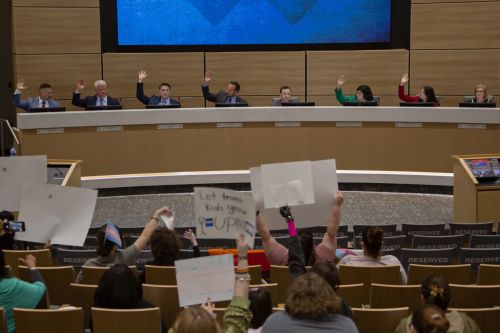
Under the new majority, the Cypress-Fairbanks board’s direction shifted quickly and visibly. Meetings that once focused on district operations and student outcomes increasingly centered on ideological grievances, religious framing, and national culture-war rhetoric. Board actions and public statements reflected a governing philosophy that treated public schools less as civic institutions and more as instruments for moral correction, with little regard for the district’s diversity or professional educational standards.
That shift did not occur in isolation. The board’s agenda aligned closely with a broader Christian conservative strategy that targets school governance precisely because of its low visibility and high impact. Outside advocacy networks and state-level political actors amplified and normalized these efforts, framing ideological control as “parental rights” while sidelining educators and insulating trustees from accountability. The district’s size made it especially attractive as a test case, a place where ideological governance could be modeled and exported elsewhere.
By November, the consequences of that approach were no longer abstract. Voters removed three trustees, ending the ideological majority and rejecting a board that had consistently prioritized far-right agendas over student needs. The election results reflected sustained concern among parents and educators that the board had abandoned its role as a steward of public education. What occurred was not a backlash against faith or values, but a deliberate civic correction by voters who understood the difference between education and indoctrination (Texas AFT).
Parents Were Not Rejecting Faith, They Were Defending Public Education
The backlash in Cy-Fair was repeatedly mischaracterized by board defenders as hostility toward religion itself. That framing was convenient, but it was wrong. What parents objected to was not private belief or personal faith, but the use of public authority to privilege one religious worldview over all others. Public schools serve families of different religions and of none, and voters understood that collapsing that pluralism into a single ideological vision undermines the very premise of public education.
For many parents, the line was crossed when religious language and moral directives began shaping policy and curriculum decisions that should have been grounded in pedagogy and evidence. Concerns centered on governance, not theology. Families were asking why professional educators were being sidelined, why historical complexity was being flattened, and why students were being drawn into battles that had little to do with learning. Analyses of similar conflicts nationwide show that this pattern is common: religious instruction is reframed as neutral values, and resistance is portrayed as persecution, even when the objection is clearly institutional rather than spiritual.
The Cy-Fair vote made something else clear as well. Parents were not demanding that faith disappear from their children’s lives; they were insisting that it remain where it belongs. Religious education has a rightful place in homes, churches, and private schools. Public schools, by contrast, exist to provide shared civic knowledge in a society defined by difference. That distinction is neither radical nor new. It is foundational. When voters acted in Cy-Fair, they were not rejecting belief. They were defending the boundary that allows belief to coexist with democracy in the first place.
This Is Not an Isolated Incident
What happened in Cy-Fair mirrors conflicts playing out across the country, often following the same script. School boards in multiple states have become targets for organized ideological capture, not because they are symbolic, but because they are practical. These bodies control curriculum approvals, library policies, and administrative priorities, yet they typically operate with little public attention. That combination makes them ideal entry points for movements seeking to reshape public education from the ground up.
Across these battles, the language is strikingly consistent. Religious nationalism is framed as neutrality, sectarian priorities are recast as common sense, and opposition is depicted as hostility toward parents or faith itself. In district after district, efforts to inject religious ideology into classrooms are defended as restorations of tradition rather than departures from constitutional norms. The result is a deliberate blurring of boundaries, one that normalizes religious authority in spaces meant to serve a pluralistic public.
This pattern has been documented well beyond Texas. Reporting and analysis have shown how conservative Christian movements coordinate messaging, legal strategies, and candidate recruitment to influence local education systems nationwide. These efforts are not spontaneous expressions of community values but part of a long-term project to redefine public institutions along sectarian lines. Education is central to that project precisely because it shapes how history, citizenship, and belonging are taught to the next generation.
What makes these conflicts feel newly urgent is their increasing alignment with national political power. As federal oversight of education weakens and public institutions are delegitimized from the top, local systems become more vulnerable to capture. The same forces pressing to dismantle or hollow out federal education infrastructure are simultaneously encouraging ideological governance at the local level, creating a pincer effect that leaves public schools exposed on multiple fronts. Cy-Fair is one node in that larger struggle, not an exception, and its experience offers a preview of what unfolds when vigilance gives way to complacency.
The Strategy: Capture, Reframe, Normalize
The strategy behind these takeovers is neither improvised nor chaotic. It begins with capture. School boards are targeted precisely because they sit at the intersection of power and obscurity. Elections are low-turnout, media coverage is thin, and the stakes are often misunderstood until decisions are already being made. By organizing early, recruiting ideologically committed candidates, and mobilizing a motivated minority, movements can gain control of districts that serve tens or hundreds of thousands of students with remarkably little resistance.
Once control is secured, the next step is reframing. Explicit religious objectives are rarely presented as such. Instead, they are translated into the language of neutrality, tradition, or common sense. Religious doctrine becomes “values education.” Sectarian priorities become “parental rights.” Professional standards are dismissed as elitism, while ideological interventions are cast as democratic correction. This rhetorical shift is crucial, because it allows religious governance to present itself not as an imposition, but as a restoration of balance allegedly lost to secular excess.
Normalization follows quickly. Policies that once would have sparked alarm begin to feel routine as they are introduced incrementally and defended relentlessly. Historical narratives are softened or reshaped. Scientific consensus is treated as optional. Educators are pressured to self-censor rather than challenge directives from above. Over time, what would once have been recognized as indoctrination is rebranded as perspective, and resistance is reframed as intolerance.
What makes this strategy especially effective is that it thrives on asymmetry. Those advancing ideological capture are organized, persistent, and willing to frame every objection as an attack on faith or family. Those defending pluralistic education are often reactive, fragmented, and hesitant to be labeled hostile to religion. The result is a tilted playing field in which normalization advances not because it persuades the majority, but because it exhausts it. Cy-Fair illustrates how quickly this process can unfold, and how difficult it can be to reverse once capture has been achieved and reframed as legitimacy (AToday).
Historical Revisionism as the Endgame
Historical revisionism is not a side effect of these campaigns. It is the destination. Control over schools is valuable precisely because it allows those in power to shape how the past is explained, contextualized, and judged. When religious nationalism enters the classroom, history is not taught as inquiry or evidence-based interpretation, but as moral narrative. Complexity becomes threat. Ambiguity becomes subversion. The past is reorganized to validate a particular vision of the nation, one in which dissent is framed as decline and pluralism as betrayal.
One of the first casualties of this approach is the principle of church-state separation itself. Rather than being presented as a hard-won constitutional safeguard, it is minimized, distorted, or dismissed as a modern invention imposed by hostile elites. Founding-era debates are selectively quoted. Contradictory evidence is ignored. Students are encouraged to see the United States not as a contested republic built through compromise and conflict, but as an explicitly Christian nation that has somehow lost its way. This is not historical disagreement. It is ideological reconstruction.
Revisionism also reshapes how power and violence are taught. Slavery, colonialism, and racial hierarchy are softened into unfortunate footnotes rather than foundational systems. Struggles for civil rights are reframed as disruptions rather than demands for inclusion. In some cases, religious authority is positioned as the moral engine of progress, while secular movements for equality are portrayed as corrosive or destabilizing. The goal is not to erase history outright, but to domesticate it, stripping it of its capacity to challenge present power.
This kind of historical control serves a present political function. If students are taught that the nation’s greatness depends on religious conformity and obedience to authority, then contemporary dissent can be dismissed as dangerous rather than democratic. If history is reduced to a story of decline from a mythical moral past, then authoritarian solutions appear not radical, but restorative. In that framework, public education ceases to be a space for critical thinking and becomes a mechanism for identity formation aligned with a single ideological tradition.
What makes this endgame so dangerous is its durability. Policies can be reversed. Boards can be voted out. But a generation taught to distrust pluralism, question evidence selectively, and view democracy through a sectarian lens carries those assumptions forward. That is why battles over curriculum and governance provoke such intensity. They are not about a single lesson plan or textbook. They are about who gets to define the nation’s story, whose voices count as legitimate, and whether public education remains a space for shared civic understanding or becomes an engine of ideological inheritance.
Trump-Era Education Policy and the Push to Hollow Out Public Institutions
The pressures shaping local school board battles cannot be separated from national education policy under Donald Trump’s return to office. Since January 2025, the administration and its allies have renewed efforts to weaken federal oversight of education, portraying public institutions as ideologically corrupt and professionally unaccountable. This rhetoric does more than signal priorities. It delegitimizes the very idea of a shared, nonsectarian public education system and frames federal involvement as an obstacle to moral restoration rather than a guarantor of equal access.
The push to dismantle or hollow out the Department of Education is central to this project. Federal standards, civil rights enforcement, and curricular guidance have long served as imperfect but meaningful constraints on sectarian or exclusionary practices at the local level. Undermining that infrastructure does not produce neutrality. It creates a vacuum. In that vacuum, the most organized and ideologically motivated actors gain disproportionate influence, particularly in states and districts already receptive to religious nationalist framing.
Decentralization is often presented as empowerment, but without safeguards it functions as exposure. When federal oversight retreats, local school boards are left to navigate intense political pressure with fewer institutional protections. Professional norms weaken. Expertise becomes suspect. The language of local control is used to justify policies that would not survive scrutiny under broader constitutional or civil rights standards. In this environment, ideological capture is not an aberration. It is an expected outcome.
Cy-Fair illustrates how national policy signals translate into local consequences. When public education is framed from the top as expendable, corrupt, or in need of moral correction, local actors feel licensed to act accordingly. The result is a layered erosion of public institutions, where federal retreat and local capture reinforce one another. What emerges is not a vibrant marketplace of ideas, but a fragmented system in which access to evidence-based, pluralistic education depends increasingly on geography and political alignment rather than civic principle.
Why Voters Are Pushing Back
Voters are pushing back because the consequences of ideological governance have become tangible. Parents and educators are not responding to abstract fears, but to concrete disruptions in how schools function and whom they serve. When boards prioritize symbolic battles over classroom stability, students bear the cost. In Cy-Fair and elsewhere, voters recognized that governance driven by ideology rather than expertise leads to policy chaos, professional attrition, and a loss of trust in institutions meant to support learning.
There is also a growing awareness that these battles are not about empowering families so much as sidelining them. The rhetoric of “parental rights” collapses under scrutiny when decision-making authority is concentrated in the hands of a few ideologically committed officials rather than shared across a diverse community. Many parents have watched their concerns dismissed unless they aligned with a specific worldview, revealing that participation was welcome only insofar as it reinforced a predetermined agenda. That realization has turned quiet discomfort into organized resistance.
Finally, voters are responding to the recognition that public schools remain one of the last truly shared civic institutions in American life. In communities increasingly fragmented by media ecosystems and political identity, schools still bring together students from different backgrounds under a common educational mission. When that mission is threatened by sectarian control or historical distortion, the stakes become clear. The pushback seen in Cy-Fair reflects a broader determination to preserve public education as a space for pluralism, evidence, and democratic coexistence rather than ideological conformity.
The Stakes Going Forward
The stakes of these conflicts extend far beyond individual districts or election cycles. When ideological governance becomes normalized in public schools, the damage is cumulative. Curriculum coherence erodes, professional standards weaken, and trust between families and institutions fractures. Over time, students receive radically different versions of history, science, and civic life depending on where they live, undermining the premise that public education provides a shared foundation for democratic participation.
There is also a long-term institutional cost. As school boards become sites of perpetual culture war, experienced educators leave, recruitment becomes more difficult, and administrative stability declines. Schools forced to navigate constant political interference lose the capacity to focus on pedagogy, student support, and evidence-based improvement. What is often framed as moral urgency produces practical dysfunction, hollowing out institutions that already operate under financial and logistical strain.
Most consequentially, the normalization of sectarian governance reshapes expectations about democracy itself. When public institutions are treated as spoils to be captured rather than trusts to be stewarded, civic norms erode. The idea that government exists to serve a pluralistic public gives way to the belief that power should be wielded to enforce ideological conformity. If that shift goes unchallenged, public education risks becoming not a space for learning how to live together amid difference, but a training ground for accepting authority that demands allegiance rather than understanding (The Science Survey).
Conclusion: Democracy Still Has a Say
The Cy-Fair election stands as a reminder that democratic mechanisms still function when citizens recognize what is at stake and choose to act. Public education is not a neutral backdrop against which political struggles play out. It is one of the central institutions through which societies transmit knowledge, norms, and civic expectations. When voters intervened to reverse an ideological takeover, they were not engaging in symbolic protest. They were asserting ownership over a public institution that exists to serve everyone, not a narrow faction.
That intervention matters precisely because the pressure will not ease. Efforts to reshape public education along sectarian lines are ongoing, well organized, and increasingly aligned with national political power. Victories like Cy-Fair’s do not end the conflict, but they demonstrate that capture is not inevitable. Democratic accountability still works when people pay attention, refuse false framings, and insist on the distinction between private belief and public authority.
Public schools will remain contested terrain because they shape the future in ways few institutions do. The question is not whether politics will touch education, but whether education will be allowed to remain pluralistic, evidence-based, and oriented toward shared civic life. Cy-Fair shows that when voters draw that line clearly, democracy can still speak with authority. The challenge ahead is ensuring that voice remains engaged long after the headlines fade.
Originally published by Brewminate, 01.14.2024, under the terms of a Creative Commons Attribution-NonCommercial-NoDerivatives 4.0 International license.
About the Author